How to Make A Lesson
Plan
Presented by
Munira Hassan Ali
Academic Manager
Primary
Think…….
What is a lesson plan?
What is a lesson plan
• A lesson plan is a written guide for teachers plans
in order to achieve the intended learning outcomes.
It provides specific definition and direction on
learning objectives, equipment, instructional media
material requirements, and conduct of the lesson.
- Education Dictionaries
Think…….
What to consider when
writing a lesson plan?
What to consider when designing
a lesson plan?
•Know Your Students
•Know the Content
•Know the Instructional Materials
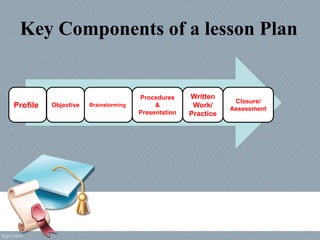
Key Components of a lesson Plan
Profile Objective
Procedures
&
Presentation
Written
Work/
Practice
Closure/
Assessment
Brainstorming
Key Components of a lesson Plan
Profile
Objectives
Brainstorming
Procedures &
Presentation
Written work/
Practice
Closure/
Assessment
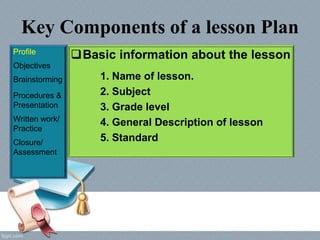
Basic information about the lesson
1. Name of lesson.
2. Subject
3. Grade level
4. General Description of lesson
5. Standard
Key Components of a lesson Plan
Profile
Objectives
Brainstorming
Procedures &
Presentation
Written work/
Practice
Closure/
Assessment
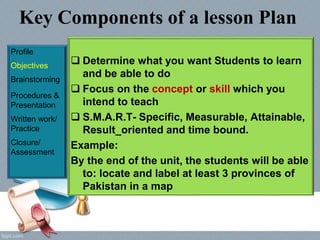
 Determine what you want Students to learn
and be able to do
 Focus on the concept or skill which you
intend to teach
 S.M.A.R.T- Specific, Measurable, Attainable,
Result_oriented and time bound.
Example:
By the end of the unit, the students will be able
to: locate and label at least 3 provinces of
Pakistan in a map
Key Components of a lesson Plan
Profile
Objectives
Brainstorming
Procedures &
Presentation
Written work/
Practice
Closure/
Assessment
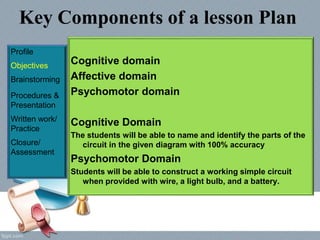
Cognitive domain
Affective domain
Psychomotor domain
Cognitive Domain
The students will be able to name and identify the parts of the
circuit in the given diagram with 100% accuracy
Psychomotor Domain
Students will be able to construct a working simple circuit
when provided with wire, a light bulb, and a battery.
Key Components of a lesson Plan
Profile
Objectives
Brainstorming
Procedures &
Presentation
Written work/
Practice
Closure/
Assessment
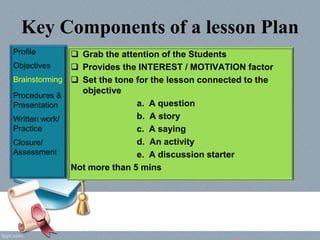
 Grab the attention of the Students
 Provides the INTEREST / MOTIVATION factor
 Set the tone for the lesson connected to the
objective
a. A question
b. A story
c. A saying
d. An activity
e. A discussion starter
Not more than 5 mins
Key Components of a lesson Plan
Profile
Objectives
Brainstorming
Procedures &
Presentation
Written work/
Practice
Closure/
Assessment
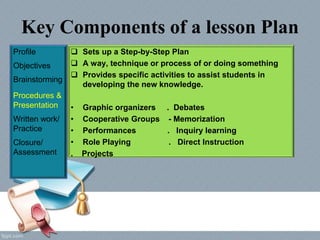
 Sets up a Step-by-Step Plan
 A way, technique or process of or doing something
 Provides specific activities to assist students in
developing the new knowledge.
• Graphic organizers . Debates
• Cooperative Groups - Memorization
• Performances . Inquiry learning
• Role Playing . Direct Instruction
. Projects
Key Components of a lesson Plan
Profile
Objectives
Brainstorming
Procedures &
Presentation
Written work/
Practice
Closure/
Assessment
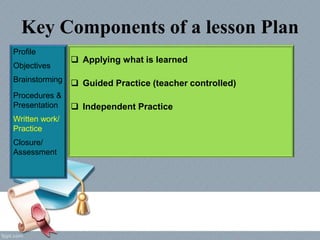
 Applying what is learned
 Guided Practice (teacher controlled)
 Independent Practice
Key Components of a lesson Plan
Profile
Objectives
Brainstorming
Procedures &
Presentation
Written work/
Practice
Closure/
Assessment
 Assess the outcome and to what extent
the objectives were achieved
 Ensure the assessment activity is
directly and explicitly tied to the stated
objectives.
 Take time to reflect upon the result, and
revise the lesson plan accordingly
Key Components of a lesson Plan
Profile
Objectives
Brainstorming
Procedures &
Presentation
Written work/
Practice
Closure/
Assessment
 Some commonly used assessment activities:
. quizzes
. independently performed worksheets(H.W)
. Cooperative learning activities
. Hands-on experiments
. Oral discussion
. Question-and –answer sessions
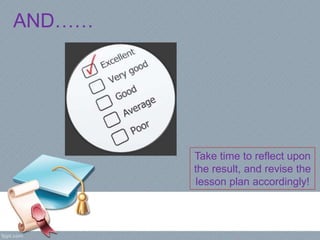
AND……
Take time to reflect upon
the result, and revise the
lesson plan accordingly!
Three Lesson Plan Models
• Gagne’s Nine Events
of Instruction
• Madeline Hunter’s
Seven Step Lesson
Plan Model
• The 5E’s Model
Three
Lesson
Plan
Models
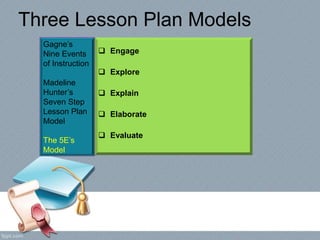
Three Lesson Plan Models
Gagne’s
Nine Events
of Instruction
Madeline
Hunter’s
Seven Step
Lesson Plan
Model
The 5E’s
Model
 Engage
 Explore
 Explain
 Elaborate
 Evaluate
Good Planning
• Keeps the teacher and students on track
• Achieves the objectives
• Helps teachers to avoid “unpleasant” surprises
• Provides the roadmap and visuals in a logical sequence
• Provides direction to a substitute
• Encourages reflection, refinement, and improvement
• Enhances student achievement
Poor Planning
• Frustration for the teacher and the student
• Aimless wandering
• Unmet objectives
• No connections to prior learning's
• Disorganization
• Lack of needed materials
• A waste of time
• Poor management
A Good Lesson Includes:
• Objective - expected student behavior
• Warm – up and introduction
• Procedure
• Materials – worksheets, film, text, etc.
• Presentation
• Practice
• Application
• Closure
• Evaluation-test, assignment, teacher observation ,etc.
How to make a lesson plan  04-06-15 (2)

How to make a lesson plan 04-06-15 (2)

  • 1.
    How to MakeA Lesson Plan Presented by Munira Hassan Ali Academic Manager Primary
  • 2.
  • 3.
    What is alesson plan • A lesson plan is a written guide for teachers plans in order to achieve the intended learning outcomes. It provides specific definition and direction on learning objectives, equipment, instructional media material requirements, and conduct of the lesson. - Education Dictionaries
  • 4.
    Think……. What to considerwhen writing a lesson plan?
  • 5.
    What to considerwhen designing a lesson plan? •Know Your Students •Know the Content •Know the Instructional Materials
  • 6.
    Key Components ofa lesson Plan Profile Objective Procedures & Presentation Written Work/ Practice Closure/ Assessment Brainstorming
  • 7.
    Key Components ofa lesson Plan Profile Objectives Brainstorming Procedures & Presentation Written work/ Practice Closure/ Assessment Basic information about the lesson 1. Name of lesson. 2. Subject 3. Grade level 4. General Description of lesson 5. Standard
  • 8.
    Key Components ofa lesson Plan Profile Objectives Brainstorming Procedures & Presentation Written work/ Practice Closure/ Assessment  Determine what you want Students to learn and be able to do  Focus on the concept or skill which you intend to teach  S.M.A.R.T- Specific, Measurable, Attainable, Result_oriented and time bound. Example: By the end of the unit, the students will be able to: locate and label at least 3 provinces of Pakistan in a map
  • 9.
    Key Components ofa lesson Plan Profile Objectives Brainstorming Procedures & Presentation Written work/ Practice Closure/ Assessment Cognitive domain Affective domain Psychomotor domain Cognitive Domain The students will be able to name and identify the parts of the circuit in the given diagram with 100% accuracy Psychomotor Domain Students will be able to construct a working simple circuit when provided with wire, a light bulb, and a battery.
  • 10.
    Key Components ofa lesson Plan Profile Objectives Brainstorming Procedures & Presentation Written work/ Practice Closure/ Assessment  Grab the attention of the Students  Provides the INTEREST / MOTIVATION factor  Set the tone for the lesson connected to the objective a. A question b. A story c. A saying d. An activity e. A discussion starter Not more than 5 mins
  • 11.
    Key Components ofa lesson Plan Profile Objectives Brainstorming Procedures & Presentation Written work/ Practice Closure/ Assessment  Sets up a Step-by-Step Plan  A way, technique or process of or doing something  Provides specific activities to assist students in developing the new knowledge. • Graphic organizers . Debates • Cooperative Groups - Memorization • Performances . Inquiry learning • Role Playing . Direct Instruction . Projects
  • 12.
    Key Components ofa lesson Plan Profile Objectives Brainstorming Procedures & Presentation Written work/ Practice Closure/ Assessment  Applying what is learned  Guided Practice (teacher controlled)  Independent Practice
  • 13.
    Key Components ofa lesson Plan Profile Objectives Brainstorming Procedures & Presentation Written work/ Practice Closure/ Assessment  Assess the outcome and to what extent the objectives were achieved  Ensure the assessment activity is directly and explicitly tied to the stated objectives.  Take time to reflect upon the result, and revise the lesson plan accordingly
  • 14.
    Key Components ofa lesson Plan Profile Objectives Brainstorming Procedures & Presentation Written work/ Practice Closure/ Assessment  Some commonly used assessment activities: . quizzes . independently performed worksheets(H.W) . Cooperative learning activities . Hands-on experiments . Oral discussion . Question-and –answer sessions
  • 15.
    AND…… Take time toreflect upon the result, and revise the lesson plan accordingly!
  • 16.
    Three Lesson PlanModels • Gagne’s Nine Events of Instruction • Madeline Hunter’s Seven Step Lesson Plan Model • The 5E’s Model Three Lesson Plan Models
  • 17.
    Three Lesson PlanModels Gagne’s Nine Events of Instruction Madeline Hunter’s Seven Step Lesson Plan Model The 5E’s Model  Engage  Explore  Explain  Elaborate  Evaluate
  • 18.
    Good Planning • Keepsthe teacher and students on track • Achieves the objectives • Helps teachers to avoid “unpleasant” surprises • Provides the roadmap and visuals in a logical sequence • Provides direction to a substitute • Encourages reflection, refinement, and improvement • Enhances student achievement
  • 19.
    Poor Planning • Frustrationfor the teacher and the student • Aimless wandering • Unmet objectives • No connections to prior learning's • Disorganization • Lack of needed materials • A waste of time • Poor management
  • 20.
    A Good LessonIncludes: • Objective - expected student behavior • Warm – up and introduction • Procedure • Materials – worksheets, film, text, etc. • Presentation • Practice • Application • Closure • Evaluation-test, assignment, teacher observation ,etc.