

Learning styles & Multiple
       inteligences


           C. Camilo Vélez Q.
          Andrea M. Ortiz Q.
      Second language aqcuisition
   Universidad Tecnológica de Pereira
Learning styles theory


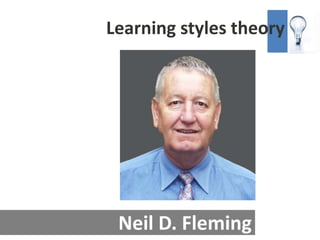
 Neil D. Fleming
Have you ever wondered…


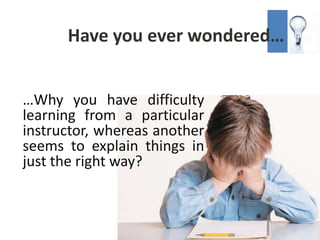
…Why you have difficulty
learning from a particular
instructor, whereas another
seems to explain things in
just the right way?
Have you ever wondered…


…Did you ever question
why the course that your
friend said was so easy
turned into a struggle for
you?
Have you ever wondered…

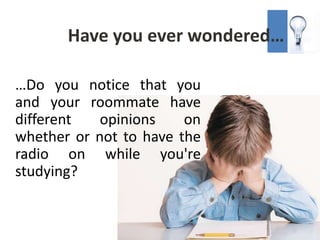
…Do you notice that you
and your roommate have
different   opinions    on
whether or not to have the
radio on while you're
studying?
What is “learning styles”
To put it simply, learning style
is the way you tend to learn
best. It involves your preferred
method       of     taking    in,
organizing, and making sense
of information.
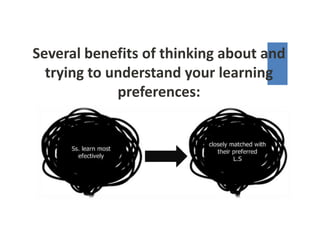
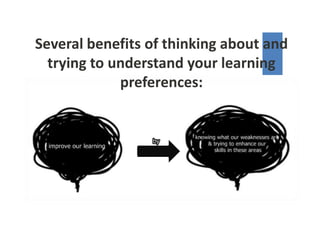
Several benefits of thinking about and
  trying to understand your learning
             preferences:
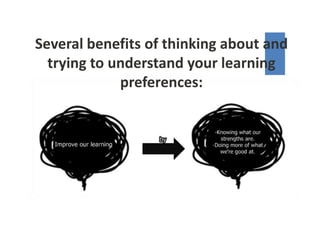
Several benefits of thinking about and
  trying to understand your learning
             preferences:
Several benefits of thinking about and
  trying to understand your learning
             preferences:
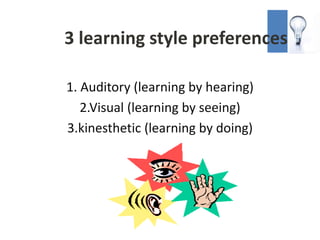
3 learning style preferences

1. Auditory (learning by hearing)
   2.Visual (learning by seeing)
3.kinesthetic (learning by doing)
Auditory (learning by hearing)
• Auditory learners would rather listen to
  things being explained than read about
  them.

• Reciting information out loud and
  having music in the background is a
  common study method.

• Other noises may become a distraction.
Visual (learning by seeing)
• Visual learners learn best by
  looking at graphics, watching a
  demonstration, or reading.

• For them, is easy to look and
  interpret charts and graphs.

• They may have difficulty focusing
  while listening to an explanation.
Kinesthetic (learning by doing)
• Kinesthetic learners process
  information best through a
  “hands-on” experience.

• Actually doing an activity can be
  the easiest way for them to learn.

• Sitting still while studying may be
  difficult, but writing things down
  makes it easier to understand.
Multiple inteligence
      theory
• Who remembers the class clown in your
  elementary or high school?

• Who remembers the boy who always drew on
  desks or any paper found?

• Or the person who was always the leader in
  an activity?

• Intelligence----- Measured in relationship to
  reading, writing, or arithmetic skills.
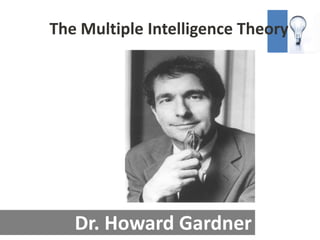
The Multiple Intelligence Theory


   Dr. Howard Gardner
•   Hardvard changed his future
•   * bachelor of arts degree in social relations
•   Thesis- The retirement community in America
•   * degree on developmental psychology
•   thesis- The development of sensitivity to
    figural and stylistic aspects of paintings
•   1. Linguistic Intelligence:
•   Prefer to learn through words and language.
•   2. Logical-Mathematical:
•   Prefers to learn through numbers and logic.
•   3. Musical Intelligence:
•   Prefer the music, sounds and rhytms.
•   4. Bodily Kinesthetic Intelligence:
•   Prefers the physical experience and movement, to touch
    and feel.
•   5. Spatial – Visual Intelligence:
•   Prefers Pictures, shapes, images, 3D space.
•   6. Interpersonal Intelligence:
•   Prefers to use human contact and learn through
    communication in teamwork.
•   7. Intrapersonal Intelligence- Prefers to use Self Reflection
    and self discovery on new topics.
Three suggested possible additions

            • Naturalist
             • Spiritual
              • Moral
“If a child is not learning the way
  you are teaching, then you must
  teach in the way the child learns”
                           Rita Dunna
Bibliography
 http://www.sdc.uwo.ca/learning/index.html?styles#auditory

 http://www.learningrx.com/types-of-learning-styles-faq.htm

http://www.ldpride.net/learningstyles.MI.htm#Learning%20Styl
                        es%20Explained

      https://www.google.com.co/imghp?hl=es&tab=wi

        http://en.wikipedia.org/wiki/Neil_D._Fleming
Learning styles & multiple inteligences

Learning styles & multiple inteligences

  • 1.
    Learning styles &Multiple inteligences C. Camilo Vélez Q. Andrea M. Ortiz Q. Second language aqcuisition Universidad Tecnológica de Pereira
  • 2.
    Learning styles theory Neil D. Fleming
  • 3.
    Have you everwondered… …Why you have difficulty learning from a particular instructor, whereas another seems to explain things in just the right way?
  • 4.
    Have you everwondered… …Did you ever question why the course that your friend said was so easy turned into a struggle for you?
  • 5.
    Have you everwondered… …Do you notice that you and your roommate have different opinions on whether or not to have the radio on while you're studying?
  • 6.
    What is “learningstyles” To put it simply, learning style is the way you tend to learn best. It involves your preferred method of taking in, organizing, and making sense of information.
  • 7.
    Several benefits ofthinking about and trying to understand your learning preferences:
  • 8.
    Several benefits ofthinking about and trying to understand your learning preferences:
  • 9.
    Several benefits ofthinking about and trying to understand your learning preferences:
  • 10.
    3 learning stylepreferences 1. Auditory (learning by hearing) 2.Visual (learning by seeing) 3.kinesthetic (learning by doing)
  • 11.
    Auditory (learning byhearing) • Auditory learners would rather listen to things being explained than read about them. • Reciting information out loud and having music in the background is a common study method. • Other noises may become a distraction.
  • 12.
    Visual (learning byseeing) • Visual learners learn best by looking at graphics, watching a demonstration, or reading. • For them, is easy to look and interpret charts and graphs. • They may have difficulty focusing while listening to an explanation.
  • 13.
    Kinesthetic (learning bydoing) • Kinesthetic learners process information best through a “hands-on” experience. • Actually doing an activity can be the easiest way for them to learn. • Sitting still while studying may be difficult, but writing things down makes it easier to understand.
  • 14.
  • 15.
    • Who remembersthe class clown in your elementary or high school? • Who remembers the boy who always drew on desks or any paper found? • Or the person who was always the leader in an activity? • Intelligence----- Measured in relationship to reading, writing, or arithmetic skills.
  • 16.
    The Multiple IntelligenceTheory Dr. Howard Gardner
  • 17.
    Hardvard changed his future • * bachelor of arts degree in social relations • Thesis- The retirement community in America • * degree on developmental psychology • thesis- The development of sensitivity to figural and stylistic aspects of paintings
  • 18.
    1. Linguistic Intelligence: • Prefer to learn through words and language. • 2. Logical-Mathematical: • Prefers to learn through numbers and logic. • 3. Musical Intelligence: • Prefer the music, sounds and rhytms. • 4. Bodily Kinesthetic Intelligence: • Prefers the physical experience and movement, to touch and feel. • 5. Spatial – Visual Intelligence: • Prefers Pictures, shapes, images, 3D space. • 6. Interpersonal Intelligence: • Prefers to use human contact and learn through communication in teamwork. • 7. Intrapersonal Intelligence- Prefers to use Self Reflection and self discovery on new topics.
  • 19.
    Three suggested possibleadditions • Naturalist • Spiritual • Moral
  • 20.
    “If a childis not learning the way you are teaching, then you must teach in the way the child learns” Rita Dunna
  • 21.