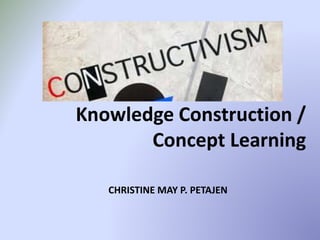
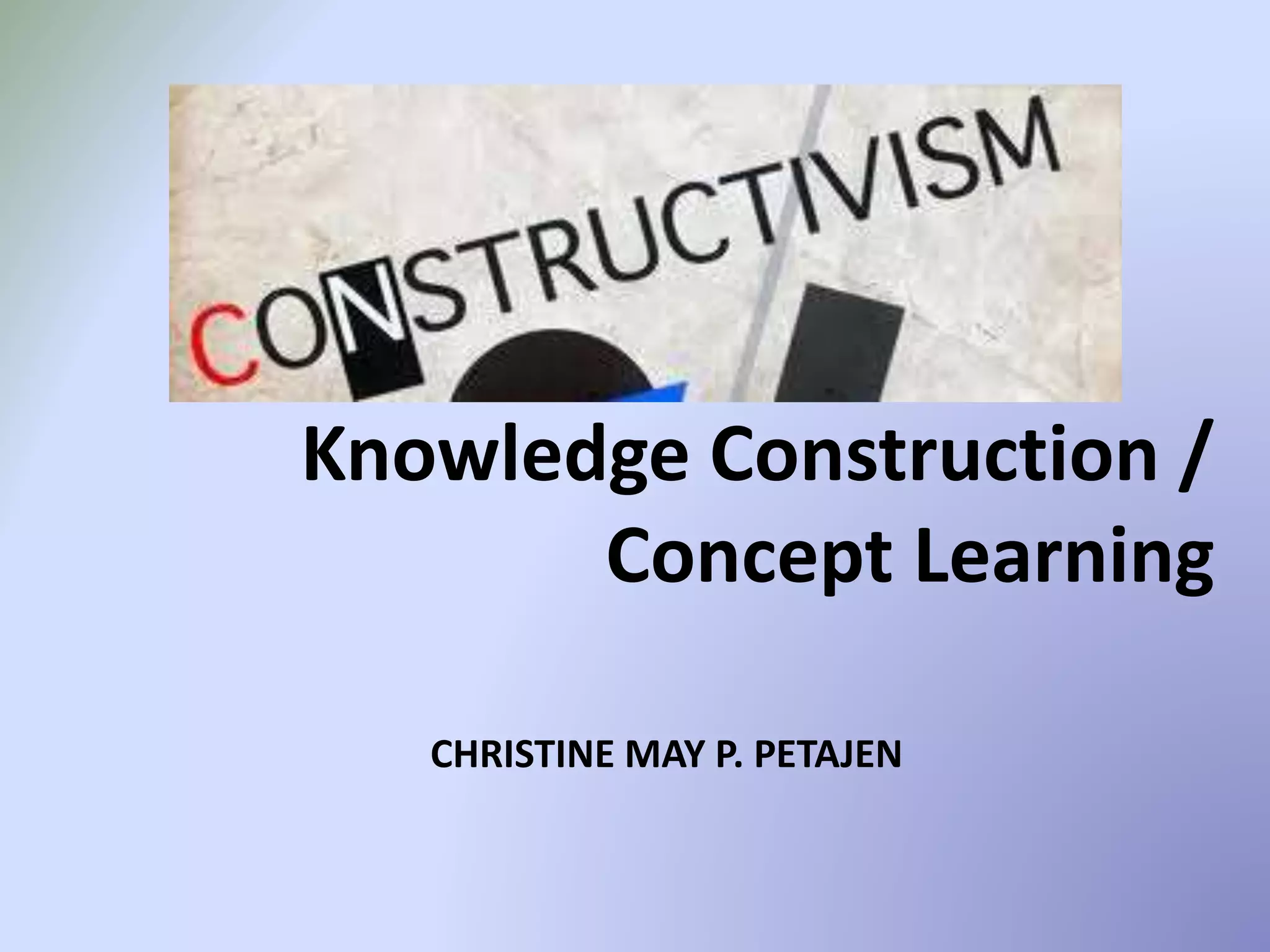



Knowledge Construction /
Concept Learning
CHRISTINE MAY P. PETAJEN
Outline of the Report
• Concept of Constructivism
• Principles of Constructivism
• Key Influential Figures in Constructivism
• Two Views of Constructivism
– Individual Constructivism
– Social Constructivism
• Characteristics of Constructivism
– Learners construct understanding
– New learning depends on current understanding
– Learning is facilitated by social interaction
• Meaningful learning occurs within authentic
learning tasks
• Organizing Knowledge
– Concepts
• Concepts as Feature Lists
• Concepts as Prototypes
• Concepts as Exemplars
• Making Concept-Learning Effective
– Schema and Scripts
• Applying Constructivism in Facilitating
Learning
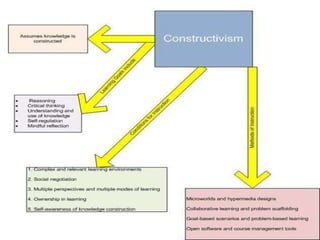
CONCEPT OF CONSTRUCTIVISM
• It is a theory of knowledge that argues that
humans generate knowledge and meaning
from an interaction between their
experiences and their ideas
• Focuses on knowledge construction
• Based on a type of learning in which the
learner forms, or constructs, much of what he
or she learns or comprehends
KEY INFLUENTIAL FIGURES IN
CONSTRUCTIVISM
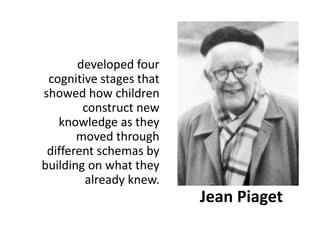
Jean Piaget
developed four
cognitive stages that
showed how children
construct new
knowledge as they
moved through
different schemas by
building on what they
already knew.
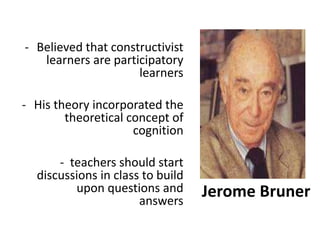
Jerome Bruner
- Believed that constructivist
learners are participatory
learners
- His theory incorporated the
theoretical concept of
cognition
- teachers should start
discussions in class to build
upon questions and
answers
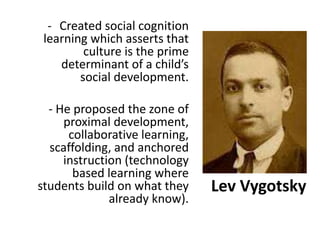
Lev Vygotsky
- Created social cognition
learning which asserts that
culture is the prime
determinant of a child’s
social development.
- He proposed the zone of
proximal development,
collaborative learning,
scaffolding, and anchored
instruction (technology
based learning where
students build on what they
already know).
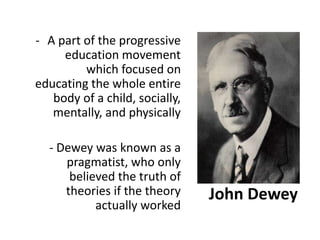
John Dewey
- A part of the progressive
education movement
which focused on
educating the whole entire
body of a child, socially,
mentally, and physically
- Dewey was known as a
pragmatist, who only
believed the truth of
theories if the theory
actually worked
PRINCIPLES OF CONSTRUCTIVISM
–It takes time to learn
–Learning is an active process
in which the student
constructs meaning
–It takes time to learn
–Learning is an active process in which
the student constructs meaning
–People learn to learn
–It takes time to learn
–Learning is an active process in which
the student constructs meaning
–People learn to learn
–Learning involves language
–Learning is a social
activity
–Learning is a social activity
–Learning is contextual
–Learning is a social activity
–Learning is contextual
–The act of constructing
meaning is mental
–Learning is a social activity
–Learning is contextual
–The act of constructing meaning is
mental
–Everyone needs knowledge
to learn
–Learning is not the passive
acceptance of knowledge it
takes work
–Learning is not the passive acceptance
of knowledge it takes work
– Motivation is a major aspect
of learning
• Individual Constructivism
• Social Constructivism
2 Views of Constructivism
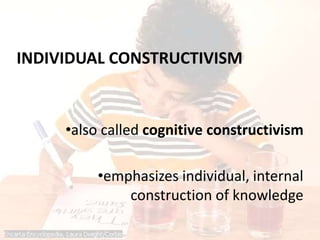
INDIVIDUAL CONSTRUCTIVISM
•also called cognitive constructivism
•emphasizes individual, internal
construction of knowledge
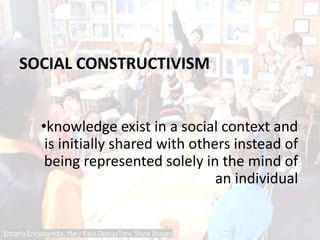
SOCIAL CONSTRUCTIVISM
•knowledge exist in a social context and
is initially shared with others instead of
being represented solely in the mind of
an individual
CHARACTERISTICS OF CONSTRUCTIVISM
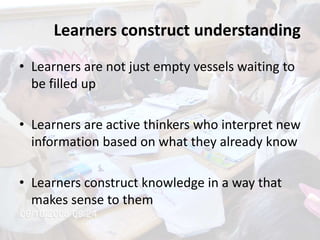
Learners construct understanding
• Learners are not just empty vessels waiting to
be filled up
• Learners are active thinkers who interpret new
information based on what they already know
• Learners construct knowledge in a way that
makes sense to them
New learning depends on current
understanding
• Background information is important
• It is through the present views or scheme that
the learner has, that new information will be
interpreted
Learning is facilitated by social interaction
• Learning communities help learners take
responsibility for their own learning
• Teachers play the role of facilitator rather than
an expert who has all the knowledge
Meaningful learning occurs within
authentic learning tasks
• Involves a learning activity that entails
constructing knowledge that is akin to the to
the knowledge needed when applied in the
real world
ORGANIZING KNOWLEDGE
Concept
a concept is a way of grouping or categorizing
objects or events in our mind.
Concepts as feature lists
learning a concept involves learning specific
features that characterize positive instance of
the concept
Defining Feature
characteristic present in ALL instances
Correlational Feature
present in many positive instances but not
essential for concept membership
Concepts as Prototypes
prototype is an idea or visual image of a typical
example. It is usually formed based on the
positive instances that learners encounter
most often.
Concepts as Exemplars
exemplars represent a variety of examples. It
allows learners to know that an example
under a concept may have variability
MAKING CONCEPT-LEARNING
EFFECTIVE
a)Provide a clear definition of the
concept
a) Provide a clear definition of the concept
b)Make the defining features very
concrete and prominent
a) Provide a clear definition of the concept
b) Make the defining features very concrete and
prominent
c) Give a variety of positive
instances
a) Provide a clear definition of the concept
b) Make the defining features very concrete and
prominent
c) Give a variety of positive instances
d)Give negative instances
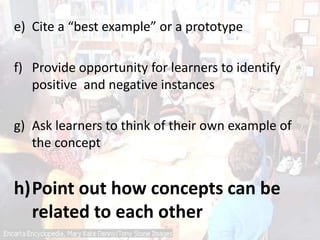
e)Cite a “best example” or a
prototype
e) Cite a “best example” or a prototype
f) Provide opportunity for learners
to identify positive and negative
instances
e) Cite a “best example” or a prototype
f) Provide opportunity for learners to identify
positive and negative instances
g)Ask learners to think of their own
example of the concept
e) Cite a “best example” or a prototype
f) Provide opportunity for learners to identify
positive and negative instances
g) Ask learners to think of their own example of
the concept
h)Point out how concepts can be
related to each other
SCHEMAS AND SCRIPTS
SCHEMA
is an organized body of knowledge about
something
SCRIPT
is a schema that includes a series of predictable
events about a specific activity.
APPLYING CONSTRUCTIVISM IN
FACILITATING LEARNING
• Aim to make learners understand a few key ideas
in an in-depth manner, rather than taking up so
many topics superficially.
• Give varied examples
• Provide opportunities for experimentation
• Provide lots of opportunities for quality
interaction
• Have lots of hands-on activities
• Relate your topic to real life situations
• Do not depend on the explanation method all
the time.
Fin.

Constructivism

  • 1.
    Knowledge Construction / ConceptLearning CHRISTINE MAY P. PETAJEN
  • 2.
    Outline of theReport • Concept of Constructivism • Principles of Constructivism • Key Influential Figures in Constructivism
  • 3.
    • Two Viewsof Constructivism – Individual Constructivism – Social Constructivism • Characteristics of Constructivism – Learners construct understanding – New learning depends on current understanding – Learning is facilitated by social interaction • Meaningful learning occurs within authentic learning tasks
  • 4.
    • Organizing Knowledge –Concepts • Concepts as Feature Lists • Concepts as Prototypes • Concepts as Exemplars • Making Concept-Learning Effective – Schema and Scripts • Applying Constructivism in Facilitating Learning
  • 5.
  • 6.
    • It isa theory of knowledge that argues that humans generate knowledge and meaning from an interaction between their experiences and their ideas • Focuses on knowledge construction
  • 7.
    • Based ona type of learning in which the learner forms, or constructs, much of what he or she learns or comprehends
  • 8.
    KEY INFLUENTIAL FIGURESIN CONSTRUCTIVISM
  • 9.
    Jean Piaget developed four cognitivestages that showed how children construct new knowledge as they moved through different schemas by building on what they already knew.
  • 10.
    Jerome Bruner - Believedthat constructivist learners are participatory learners - His theory incorporated the theoretical concept of cognition - teachers should start discussions in class to build upon questions and answers
  • 11.
    Lev Vygotsky - Createdsocial cognition learning which asserts that culture is the prime determinant of a child’s social development. - He proposed the zone of proximal development, collaborative learning, scaffolding, and anchored instruction (technology based learning where students build on what they already know).
  • 12.
    John Dewey - Apart of the progressive education movement which focused on educating the whole entire body of a child, socially, mentally, and physically - Dewey was known as a pragmatist, who only believed the truth of theories if the theory actually worked
  • 13.
  • 14.
  • 15.
    –It takes timeto learn –Learning is an active process in which the student constructs meaning
  • 16.
    –It takes timeto learn –Learning is an active process in which the student constructs meaning –People learn to learn
  • 17.
    –It takes timeto learn –Learning is an active process in which the student constructs meaning –People learn to learn –Learning involves language
  • 18.
    –Learning is asocial activity
  • 19.
    –Learning is asocial activity –Learning is contextual
  • 20.
    –Learning is asocial activity –Learning is contextual –The act of constructing meaning is mental
  • 21.
    –Learning is asocial activity –Learning is contextual –The act of constructing meaning is mental –Everyone needs knowledge to learn
  • 22.
    –Learning is notthe passive acceptance of knowledge it takes work
  • 23.
    –Learning is notthe passive acceptance of knowledge it takes work – Motivation is a major aspect of learning
  • 24.
    • Individual Constructivism •Social Constructivism 2 Views of Constructivism
  • 25.
    INDIVIDUAL CONSTRUCTIVISM •also calledcognitive constructivism •emphasizes individual, internal construction of knowledge
  • 26.
    SOCIAL CONSTRUCTIVISM •knowledge existin a social context and is initially shared with others instead of being represented solely in the mind of an individual
  • 27.
  • 28.
    Learners construct understanding •Learners are not just empty vessels waiting to be filled up • Learners are active thinkers who interpret new information based on what they already know • Learners construct knowledge in a way that makes sense to them
  • 29.
    New learning dependson current understanding • Background information is important • It is through the present views or scheme that the learner has, that new information will be interpreted
  • 30.
    Learning is facilitatedby social interaction • Learning communities help learners take responsibility for their own learning • Teachers play the role of facilitator rather than an expert who has all the knowledge
  • 31.
    Meaningful learning occurswithin authentic learning tasks • Involves a learning activity that entails constructing knowledge that is akin to the to the knowledge needed when applied in the real world
  • 32.
  • 33.
    Concept a concept isa way of grouping or categorizing objects or events in our mind.
  • 34.
    Concepts as featurelists learning a concept involves learning specific features that characterize positive instance of the concept
  • 35.
    Defining Feature characteristic presentin ALL instances Correlational Feature present in many positive instances but not essential for concept membership
  • 36.
    Concepts as Prototypes prototypeis an idea or visual image of a typical example. It is usually formed based on the positive instances that learners encounter most often.
  • 37.
    Concepts as Exemplars exemplarsrepresent a variety of examples. It allows learners to know that an example under a concept may have variability
  • 38.
  • 39.
    a)Provide a cleardefinition of the concept
  • 40.
    a) Provide aclear definition of the concept b)Make the defining features very concrete and prominent
  • 41.
    a) Provide aclear definition of the concept b) Make the defining features very concrete and prominent c) Give a variety of positive instances
  • 42.
    a) Provide aclear definition of the concept b) Make the defining features very concrete and prominent c) Give a variety of positive instances d)Give negative instances
  • 43.
    e)Cite a “bestexample” or a prototype
  • 44.
    e) Cite a“best example” or a prototype f) Provide opportunity for learners to identify positive and negative instances
  • 45.
    e) Cite a“best example” or a prototype f) Provide opportunity for learners to identify positive and negative instances g)Ask learners to think of their own example of the concept
  • 46.
    e) Cite a“best example” or a prototype f) Provide opportunity for learners to identify positive and negative instances g) Ask learners to think of their own example of the concept h)Point out how concepts can be related to each other
  • 47.
  • 48.
    SCHEMA is an organizedbody of knowledge about something SCRIPT is a schema that includes a series of predictable events about a specific activity.
  • 49.
  • 50.
    • Aim tomake learners understand a few key ideas in an in-depth manner, rather than taking up so many topics superficially. • Give varied examples • Provide opportunities for experimentation • Provide lots of opportunities for quality interaction
  • 51.
    • Have lotsof hands-on activities • Relate your topic to real life situations • Do not depend on the explanation method all the time.
  • 53.