Why plan?
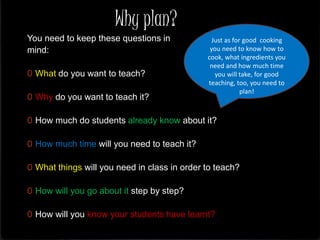
You need to keep these questions in
mind:
0 What do you want to teach?
0 Why do you want to teach it?
0 How much do students already know about it?
0 How much time will you need to teach it?
0 What things will you need in class in order to teach?
0 How will you go about it step by step?
0 How will you know your students have learnt?
Just as for good cooking
you need to know how to
cook, what ingredients you
need and how much time
you will take, for good
teaching, too, you need to
plan!
The objective
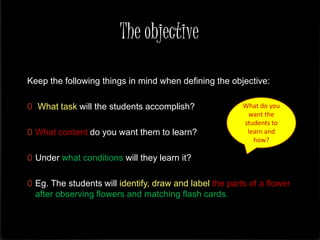
Keep the following things in mind when defining the objective:
0 What task will the students accomplish?
0 What content do you want them to learn?
0 Under what conditions will they learn it?
0 Eg. The students will identify, draw and label the parts of a flower
after observing flowers and matching flash cards.
What do you
want the
students to
learn and
how?
Warming up
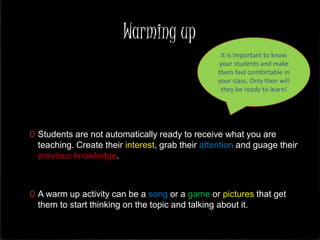
0 Students are not automatically ready to receive what you are
teaching. Create their interest, grab their attention and guage their
previous knowledge.
0 A warm up activity can be a song or a game or pictures that get
them to start thinking on the topic and talking about it.
It is important to know
your students and make
them feel comfortable in
your class. Only then will
they be ready to learn!
Planning your time
0 Identify how much can be covered in a fixed amount of time.
0 Break the plan into sections so that you can speed up or slow
down to accommodate changes
Eg.
11.00 to 11.10 – Warm up activity
11.10 to 11.20 – Dissection and observation
of a flower
11.20 to 11.30 – Matching flash cards etc.
Don’t try to
include too much.
Leave some space
for assimilation
Steps
Plan the lesson step by step.
Eg.
0 Dissection and observation of the parts of a flower
0 Matching of flash cards
0 Drawing and labelling the parts of a flower etc.
Students can work on
their own, in pairs or
groups.
Every student learns differently. Some can
read and understand. Others need to hear it
or see it while some others need to use their
hands to create and learn. Address these
different learning styles.
Give time for
students to learn
at their own
pace,.
Some learn faster
than others. Some
may take time.
Reflection
0 Leave at least ten minutes at the end of the class for students to ask
questions.
0 This could start as a discussion and lead to probing questions.
0 It could also be a time for clarification
While taking a lesson on flowers
you could bring in poems, songs
art , craft, dance related to
flowers to make the lesson lively
and for students to find
connections between different
subjects.
Conclusion
An abrupt stopping of the lesson leaves the learner
uncomfortable. It is good to remind students of what
they have learnt during the lesson. Give enough time
for a neat conclusion!
That doesn’t mean you
don’t leave open ended
questions, encouraging
students to think and find
out more!
Assessment
Continuous and comprehensive assessment can happen throughout the
lesson at different points of time.
Eg. You can assess students on :
0 Observation and discussion
0 Team work
0 Matching of flash cards
0 Drawing and labelling
0 Research work etc.
Instead of only asking
questions that test
memory, ask questions
that make students
imagine, compare,
contrast, evaluate and
apply concepts!
Assessment is related to the objective s of the
lesson. The assessment should test whether or
not your objectives have been met.
Home work
Home work can be used for:
0 Recapitulation and assessment
Eg. Draw and label the parts of a flower
0 Research
Eg. Find out the names of ten common flowers in your
neighbourhood
Give interesting homework so
that the students feel like
attempting it. Meaningless
repetitive exercises are
unnecessary and boring!
You could involve parents or the community in the
research work given to students. Students could find
out facts about their surroundings, for example , by
interviewing their family members and people in the
neighbourhood.
A complete lesson plan should include the following details:
0 The subject being taught
0 The topic/subtopic
0 The grade/class it is meant for
0 The resources required
0 The time taken to conduct the lesson
0 The objectives of the lesson
0 The steps
0 Reflection and recapitulation
0 Assessment/home work
Allow yourself to be
spontaneous in class and
divert from the lesson plan
if needed as long as you
can guide the students
back to the topic/activity
After the class, reflect on the lesson plan.
What worked and what didn’t and why?
Would you do it differently the next time?
Enjoy planning your lesson.
Be creative!

Making a lesson plan

  • 2.
    Why plan? You needto keep these questions in mind: 0 What do you want to teach? 0 Why do you want to teach it? 0 How much do students already know about it? 0 How much time will you need to teach it? 0 What things will you need in class in order to teach? 0 How will you go about it step by step? 0 How will you know your students have learnt? Just as for good cooking you need to know how to cook, what ingredients you need and how much time you will take, for good teaching, too, you need to plan!
  • 3.
    The objective Keep thefollowing things in mind when defining the objective: 0 What task will the students accomplish? 0 What content do you want them to learn? 0 Under what conditions will they learn it? 0 Eg. The students will identify, draw and label the parts of a flower after observing flowers and matching flash cards. What do you want the students to learn and how?
  • 4.
    Warming up 0 Studentsare not automatically ready to receive what you are teaching. Create their interest, grab their attention and guage their previous knowledge. 0 A warm up activity can be a song or a game or pictures that get them to start thinking on the topic and talking about it. It is important to know your students and make them feel comfortable in your class. Only then will they be ready to learn!
  • 5.
    Planning your time 0Identify how much can be covered in a fixed amount of time. 0 Break the plan into sections so that you can speed up or slow down to accommodate changes Eg. 11.00 to 11.10 – Warm up activity 11.10 to 11.20 – Dissection and observation of a flower 11.20 to 11.30 – Matching flash cards etc. Don’t try to include too much. Leave some space for assimilation
  • 6.
    Steps Plan the lessonstep by step. Eg. 0 Dissection and observation of the parts of a flower 0 Matching of flash cards 0 Drawing and labelling the parts of a flower etc. Students can work on their own, in pairs or groups. Every student learns differently. Some can read and understand. Others need to hear it or see it while some others need to use their hands to create and learn. Address these different learning styles. Give time for students to learn at their own pace,. Some learn faster than others. Some may take time.
  • 7.
    Reflection 0 Leave atleast ten minutes at the end of the class for students to ask questions. 0 This could start as a discussion and lead to probing questions. 0 It could also be a time for clarification While taking a lesson on flowers you could bring in poems, songs art , craft, dance related to flowers to make the lesson lively and for students to find connections between different subjects.
  • 8.
    Conclusion An abrupt stoppingof the lesson leaves the learner uncomfortable. It is good to remind students of what they have learnt during the lesson. Give enough time for a neat conclusion! That doesn’t mean you don’t leave open ended questions, encouraging students to think and find out more!
  • 9.
    Assessment Continuous and comprehensiveassessment can happen throughout the lesson at different points of time. Eg. You can assess students on : 0 Observation and discussion 0 Team work 0 Matching of flash cards 0 Drawing and labelling 0 Research work etc. Instead of only asking questions that test memory, ask questions that make students imagine, compare, contrast, evaluate and apply concepts! Assessment is related to the objective s of the lesson. The assessment should test whether or not your objectives have been met.
  • 10.
    Home work Home workcan be used for: 0 Recapitulation and assessment Eg. Draw and label the parts of a flower 0 Research Eg. Find out the names of ten common flowers in your neighbourhood Give interesting homework so that the students feel like attempting it. Meaningless repetitive exercises are unnecessary and boring! You could involve parents or the community in the research work given to students. Students could find out facts about their surroundings, for example , by interviewing their family members and people in the neighbourhood.
  • 11.
    A complete lessonplan should include the following details: 0 The subject being taught 0 The topic/subtopic 0 The grade/class it is meant for 0 The resources required 0 The time taken to conduct the lesson 0 The objectives of the lesson 0 The steps 0 Reflection and recapitulation 0 Assessment/home work Allow yourself to be spontaneous in class and divert from the lesson plan if needed as long as you can guide the students back to the topic/activity After the class, reflect on the lesson plan. What worked and what didn’t and why? Would you do it differently the next time?
  • 12.
    Enjoy planning yourlesson. Be creative!