This presentation was developed for the
exclusive use of students enrolled in:

             Educational Testing & Grading,
               Professor Gregory E. Stone.


© 2004 Gregory E. Stone. All rights reserved. This presentation may not be
reproduced in any form, in part or as a whole, without the express written permission
of the author.
Taxonomies
    in Learning Objectives


Taxonomies help to organize
our thought process.

Ensures higher level skillsets.
Taxonomies
  in Learning Objectives


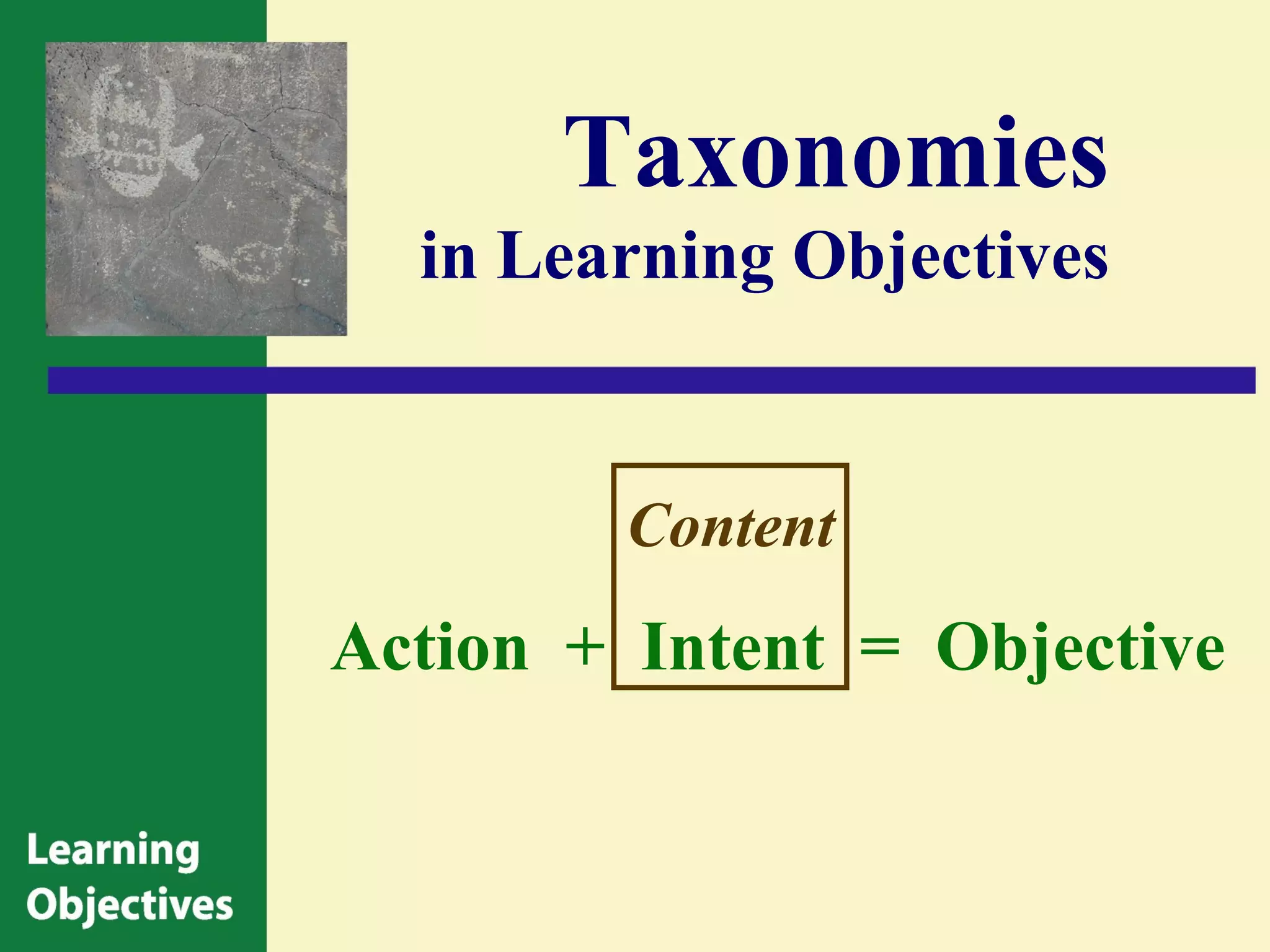
        Content
Action + Intent = Objective
Taxonomies
  in Learning Objectives


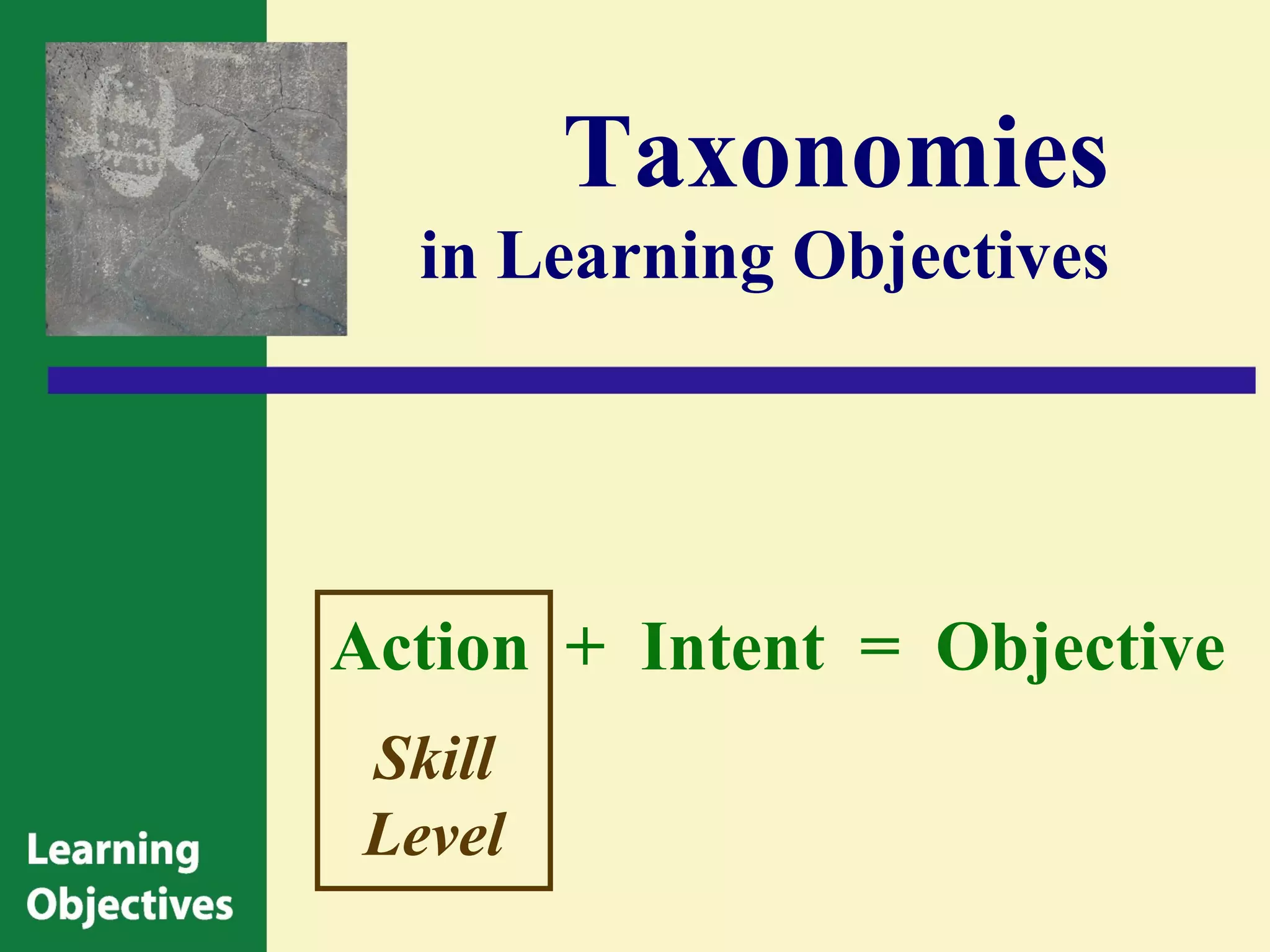
Action + Intent = Objective
 Skill
 Level
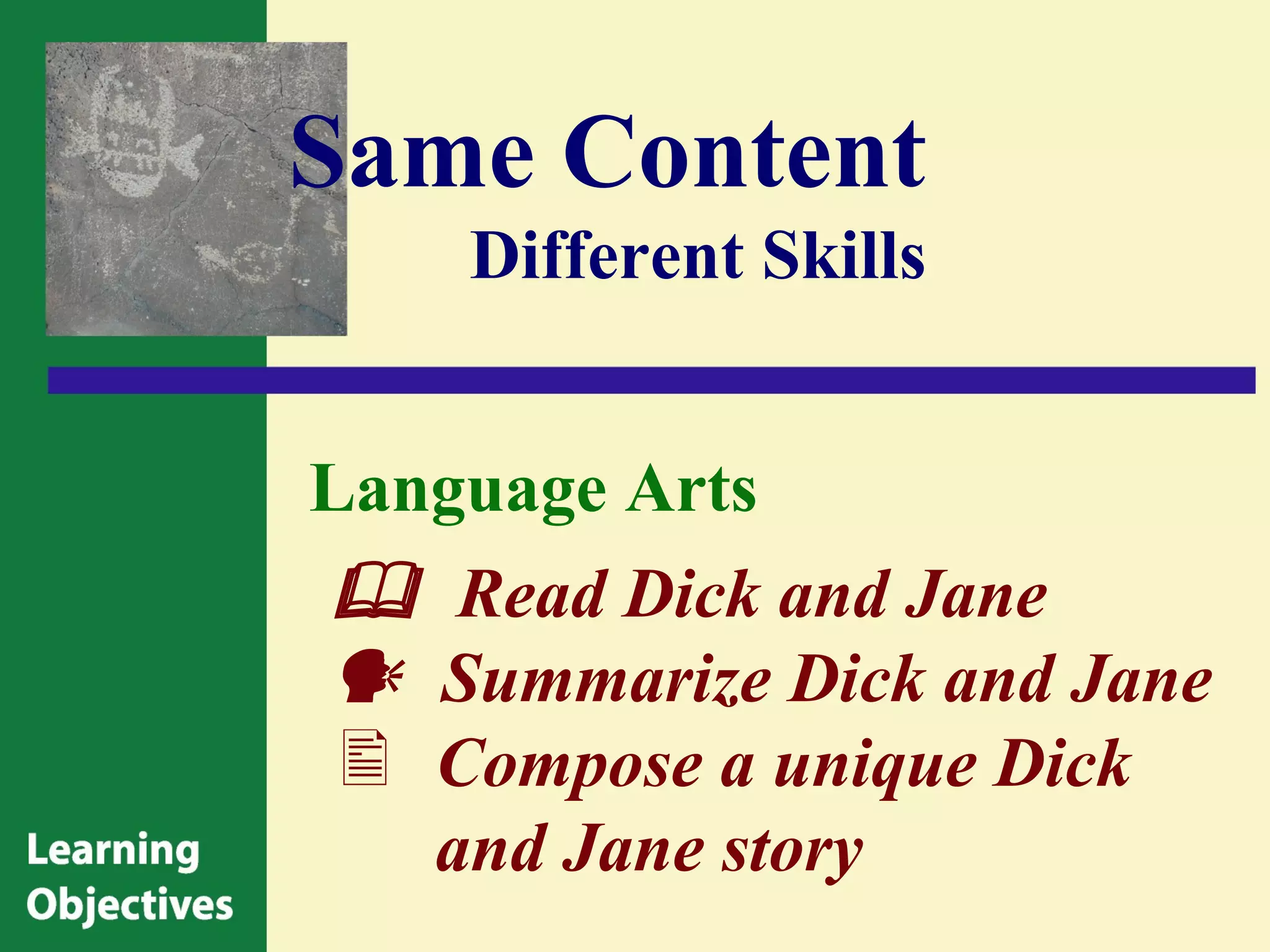
Same Content
    Different Skills


Language Arts
 Read Dick and Jane
 Summarize Dick and Jane
 Compose a unique Dick
   and Jane story
Three Principle
    Skill Facets

Cognitive
What we commonly refer
to as “intelligence” or
scholastic abilities.
Three Principle
    Skill Facets

Affective
Process of developing and
internalizing a set of
societal traits and values.
Three Principle
    Skill Facets

Psychomotor
Basic and advanced motor
expressions of affect and
cognition.
Taxonomic Pioneers

Bloom   Bloom’s Taxonomy


Masia   Affective Taxonomy


Gagné   Alternative Taxonomy
Benjamin Bloom’s
COGNITIVE TAXONOMY


Taxonomies are Hierarchical
Lower Levels  Higher Levels
Most common  Least common
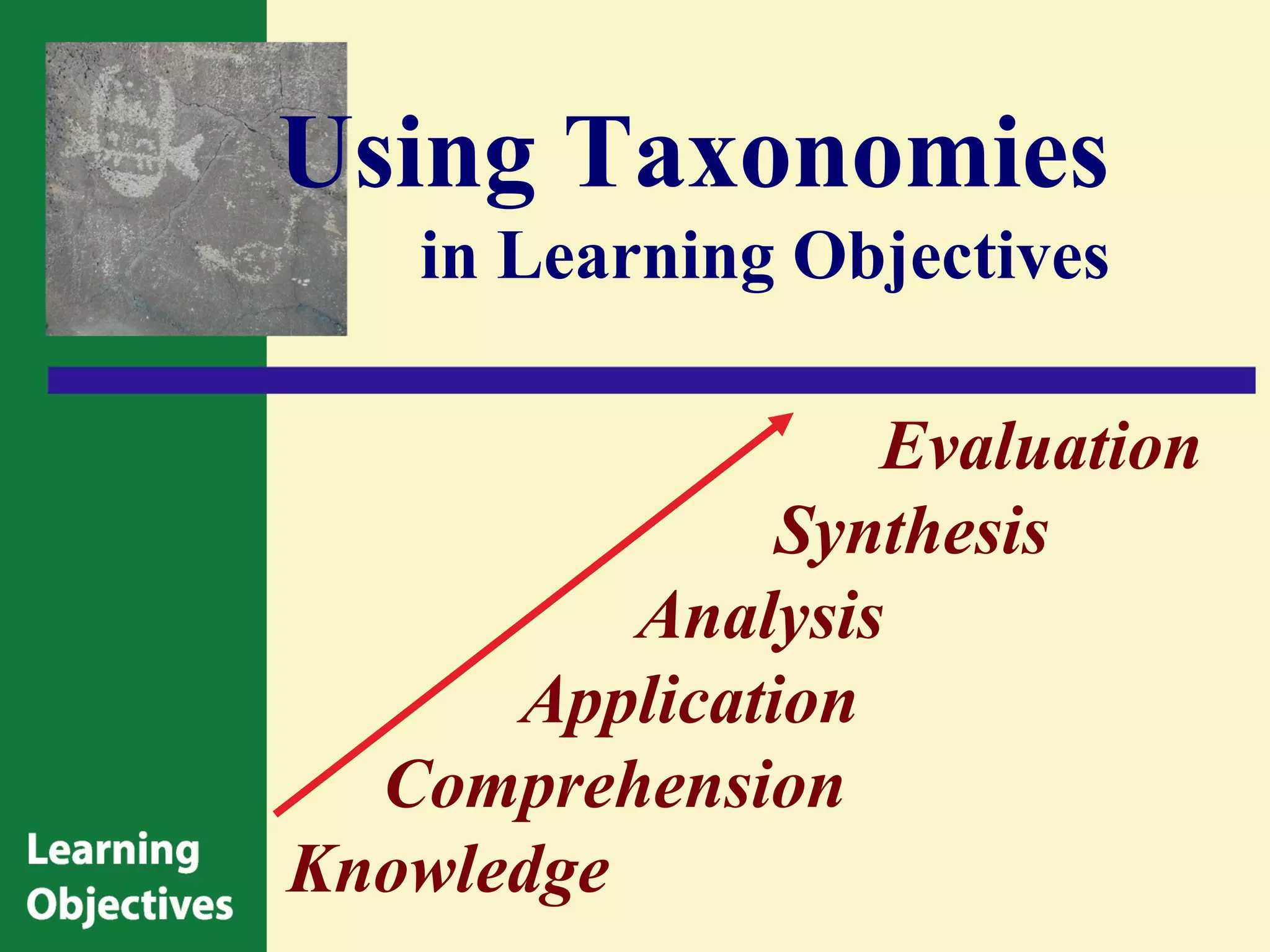
Using Taxonomies
    in Learning Objectives

                  Evaluation
               Synthesis
          Analysis
      Application
  Comprehension
Knowledge
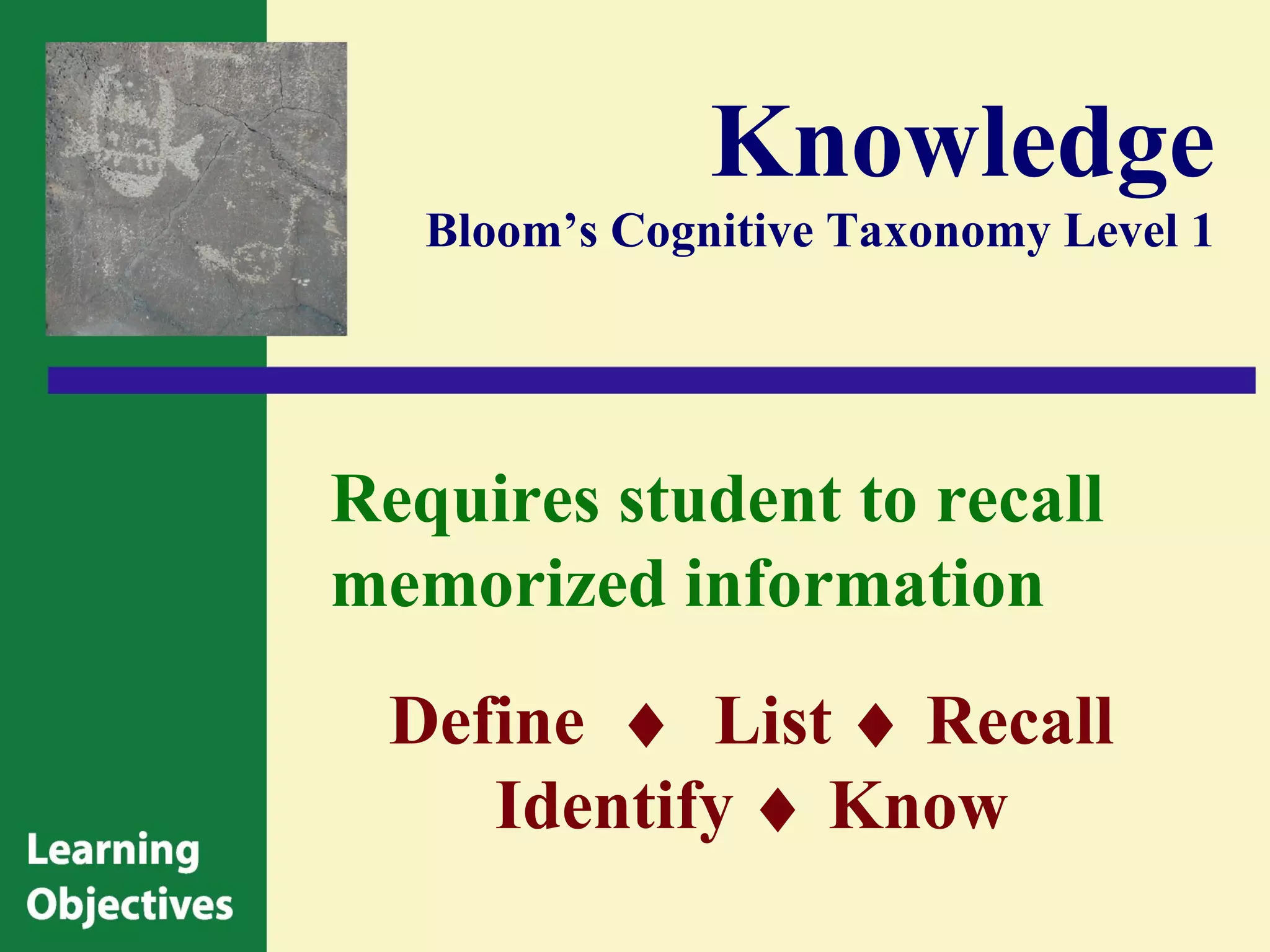
Knowledge
   Bloom’s Cognitive Taxonomy Level 1


Requires student to recall
memorized information
 Define ♦ List ♦ Recall
    Identify ♦ Know
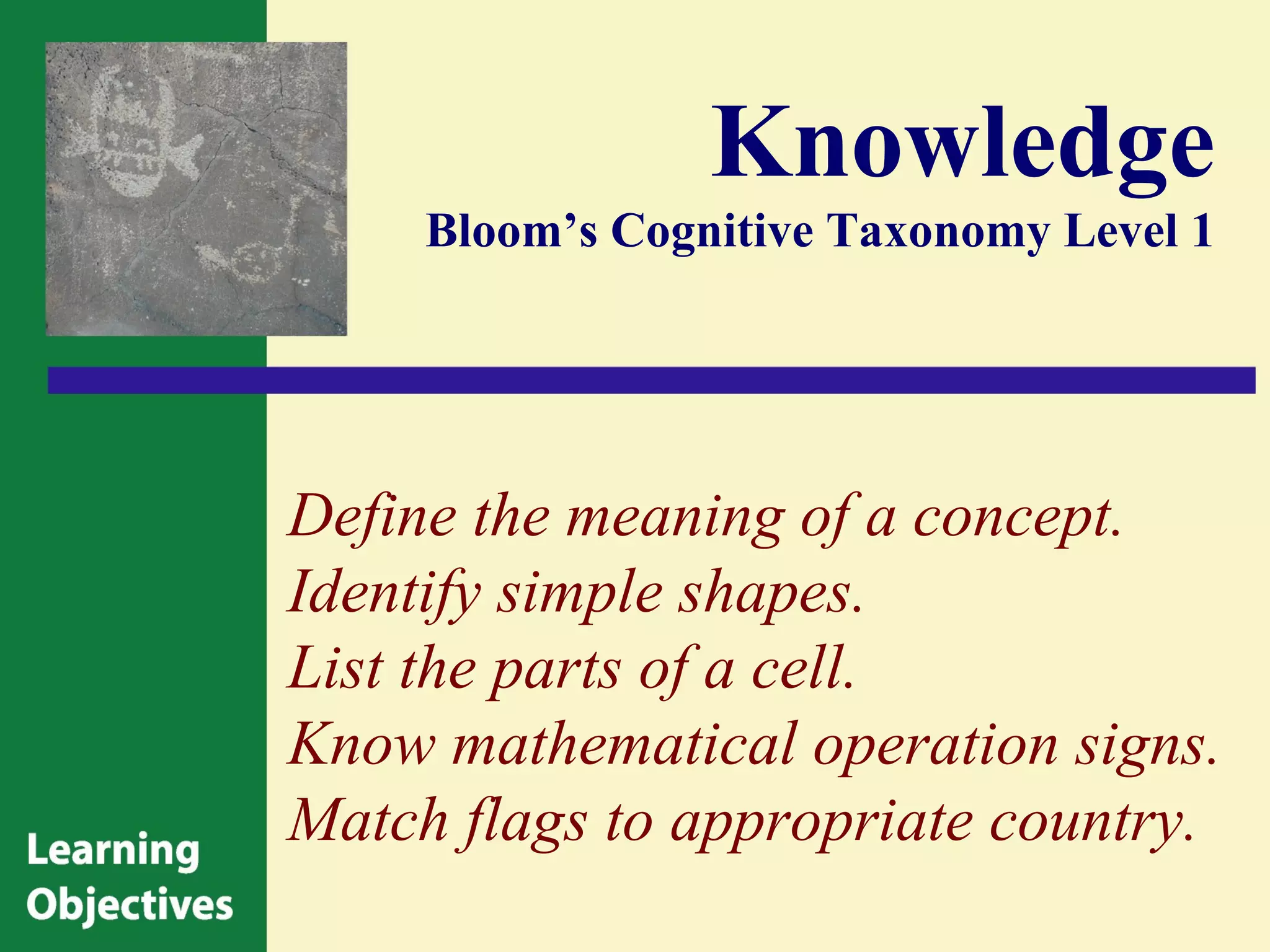
Knowledge
     Bloom’s Cognitive Taxonomy Level 1


Define the meaning of a concept.
Identify simple shapes.
List the parts of a cell.
Know mathematical operation signs.
Match flags to appropriate country.
Comprehension
    Bloom’s Cognitive Taxonomy Level 2


Use the information in familiar
situations without intimate
understanding

Explain ♦ Infer ♦ Summarize
  Paraphrase ♦ Distinguish
Comprehension
      Bloom’s Cognitive Taxonomy Level 2


Summarize the main events of a story.
Discriminate between styles of painting.
Distinguish living from inanimate objects.
Determine greatest from least.
Describe differences in math operations.
Application
   Bloom’s Cognitive Taxonomy Level 3


Use previous knowledge in
a new and different setting
Solve ♦ Produce ♦ Compute
                  (New Situation)
         Organize
Application
        Bloom’s Cognitive Taxonomy Level 3


Compute the sum of fractions (in a
qualitatively different way than in class).
Create a simple short story.
Organize a logical progression.
Analysis
    Bloom’s Cognitive Taxonomy Level 4


Dissect (break down) a concept
into its component parts


Diagram ♦ Outline ♦ Deduce
High level Discriminate ♦ Illustrate
Analysis
     Bloom’s Cognitive Taxonomy Level 4


Distinguishes fact from opinion.
Deduces valid conclusions from data.
Identifies assumptions underlying concept.
Synthesis
    Bloom’s Cognitive Taxonomy Level 5


Produce unique or original
thoughts by piecing together
existing elements in new whole

Compose ♦ Create ♦ Design
  Formulate ♦ Categorize
Synthesis
     Bloom’s Cognitive Taxonomy Level 5


Compose a unique ending to an
unfinished story.

Design a new scientific experiment
Evaluation
    Bloom’s Cognitive Taxonomy Level 6


Formulate judgements about the
value of a concept/thing using a set
of specified criteria

Compare ♦ Contrast ♦ Support
     Interpret ♦ Conclude
Evaluation
     Bloom’s Cognitive Taxonomy Level 6


Judge a sample writing based upon given
criteria.
Compare and contrast political systems.
Compare and contrast simple opposites.
Support the argument than DaVinci was a
“master painter”.
Gagné’s
COGNITIVE TAXONOMY


While Bloom focused on
developmental “Mastery”,
Gagné concentrated on
developmental “Logic”
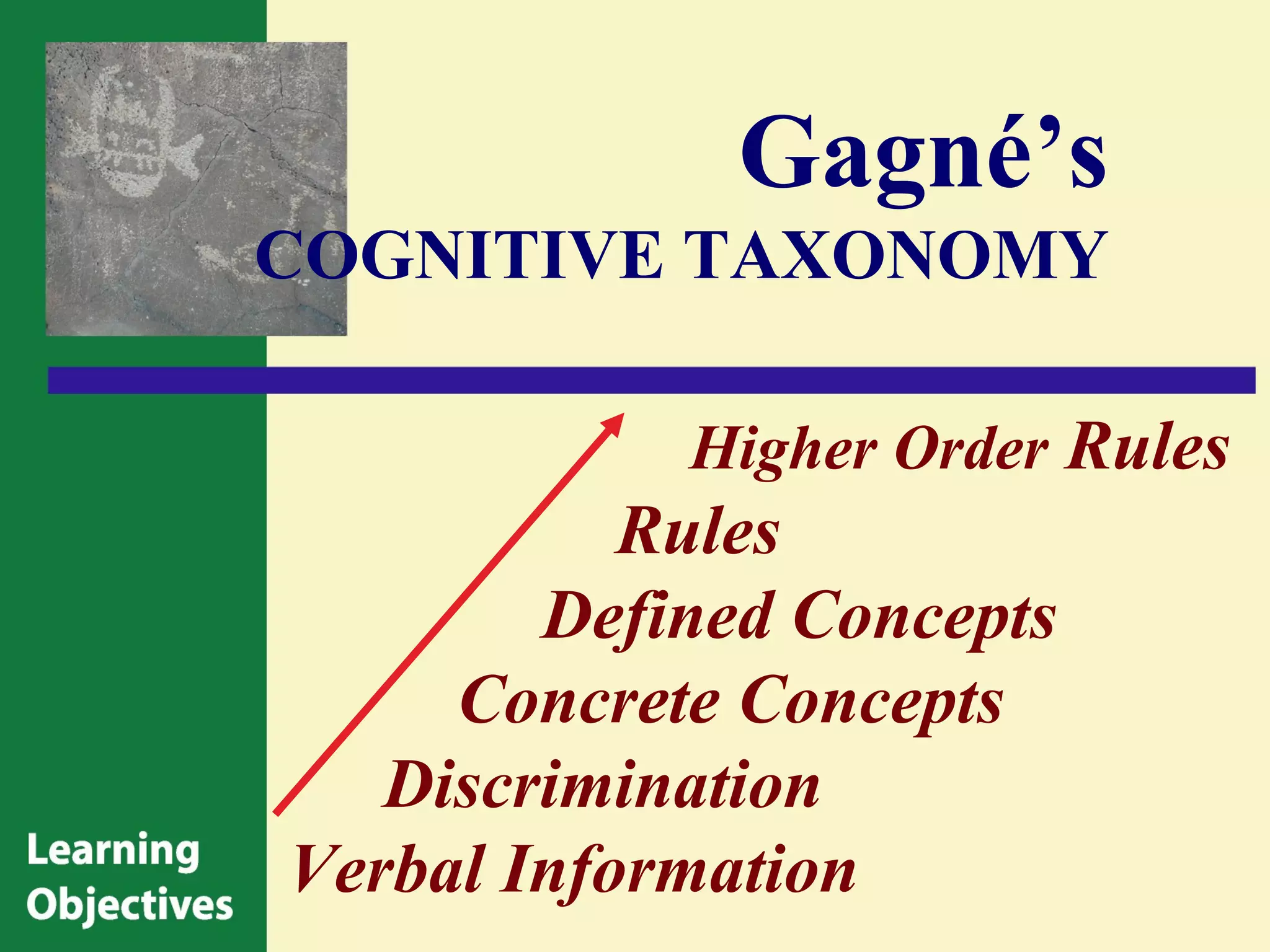
Gagné’s
COGNITIVE TAXONOMY

            Higher Order Rules
           Rules
        Defined Concepts
     Concrete Concepts
   Discrimination
Verbal Information
Verbal Information
    Gagné’s Cognitive Taxonomy Level 1


Akin to Bloom’s Knowledge
(Recall) level.

  Memorize ♦ Remember
Discrimination
    Gagné’s Cognitive Taxonomy Level 2


Relating to stimuli - determining
similarities and differences.

   Have I seen it before? ♦
Concrete Concepts
    Gagné’s Cognitive Taxonomy Level 3


Identifying physical objects that
have a specified characteristics.

  This is an apple because it
    has apple qualities ♦
Defined Concepts
    Gagné’s Cognitive Taxonomy Level 4


Understanding abstract levels of
classification.

    Can distinguish a noun
       from a verb ♦
Rules
    Gagné’s Cognitive Taxonomy Level 5


Applying principles that regulate
the relationship between objects.

Compose simple sentences ♦
Solve standard math problems
Higher Order Rules
    Gagné’s Cognitive Taxonomy Level 6


Combining a series of rules into a
single, more complex rule / to solve
 a new problem.

Write a unique story ♦ Solve a
    novel science problem
Bloom & Masia’s
AFFECTIVE TAXONOMY


Provides theoretical
framework within which the
ideas, beliefs, attitudes, etc. of
others/society are internalized
by a person.
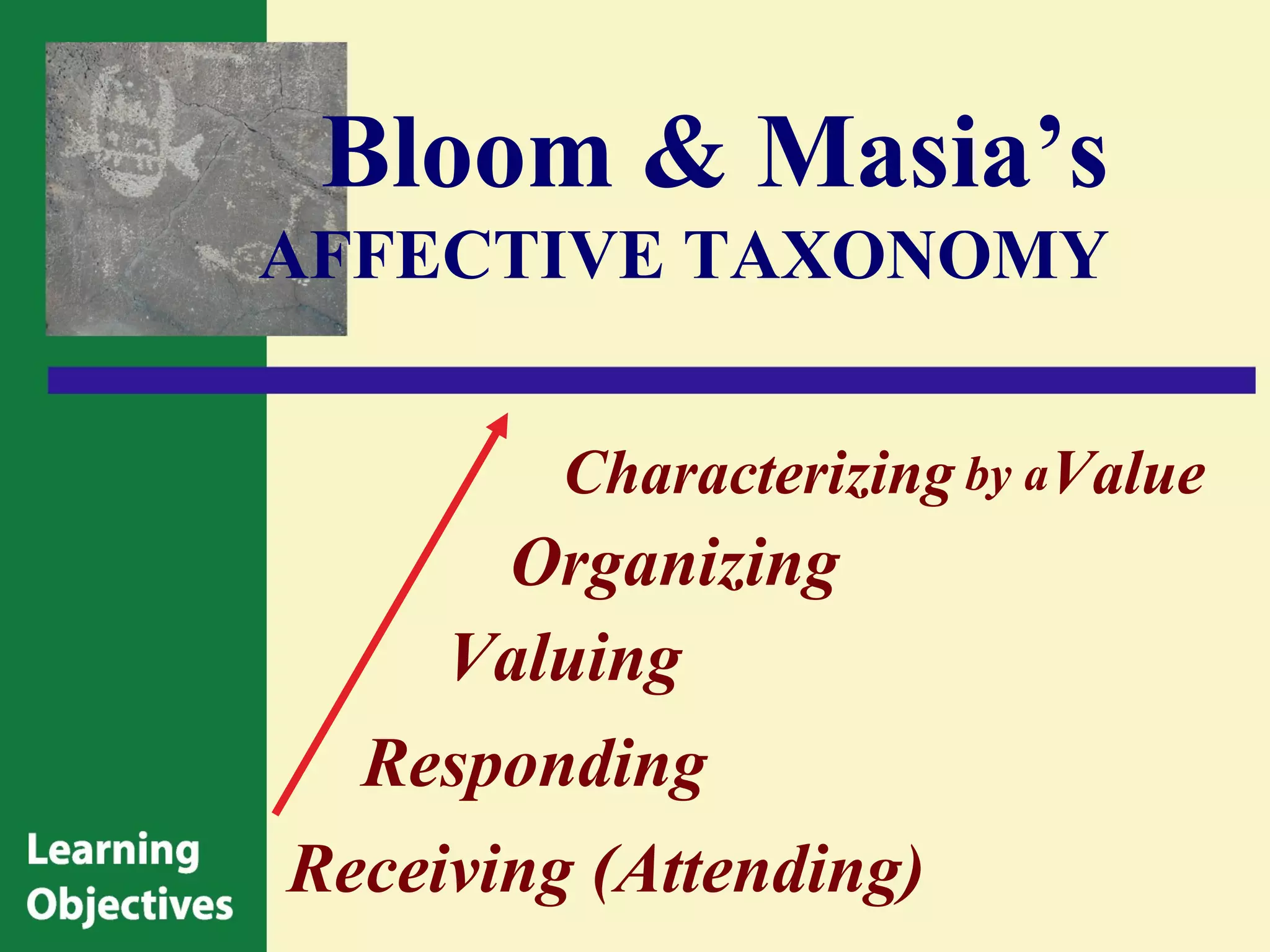
Bloom & Masia’s
AFFECTIVE TAXONOMY


         Characterizing by aValue
       Organizing
     Valuing
  Responding
Receiving (Attending)
Bloom & Masia’s Affective Taxonomy Level 1


 An awareness of the object and a
 willingness to listen, watch.

 At the top of the range, the student
 can distinguish what is and is not
 related to the object..
Responding
Bloom & Masia’s Affective Taxonomy Level 2


 Student actively participates.

 At first, just “acceptance”.

 Later we hope students will approach
 with “willingness” & “satisfaction”.
Valuing
Bloom & Masia’s Affective Taxonomy Level 3


 Judges activity on it’s “worthiness” -
 according to a consistent pattern.

 Minimally “accepts the idea”.
 Then “prefers the idea”.
 Finally, “conviction for the idea”.
Organization
Bloom & Masia’s Affective Taxonomy Level 4


 The many ideas become interrelated.

 An “organization” suggests the start
 of the conceptualization of a value
 system.
Characterizing by a Value
   Bloom & Masia’s Affective Taxonomy Level 5


    Students behave in a way consistent
    with their value system - avoiding
    hypocritical behavior (behaving with
    almost perfect consistency).
Example
    Bloom & Masia’s Affective Taxonomy


Johnny finds biology totally boring.

Ms. Jones assigns a paper about the
importance of biology as a science.

How could Affect help us?
Example
    Bloom & Masia’s Affective Taxonomy


Johnny finds biology totally boring.
                             Receiving
Ms. Jones assigns a paper about the
importance of biology as a science.
                          Responding
                          or Valuing
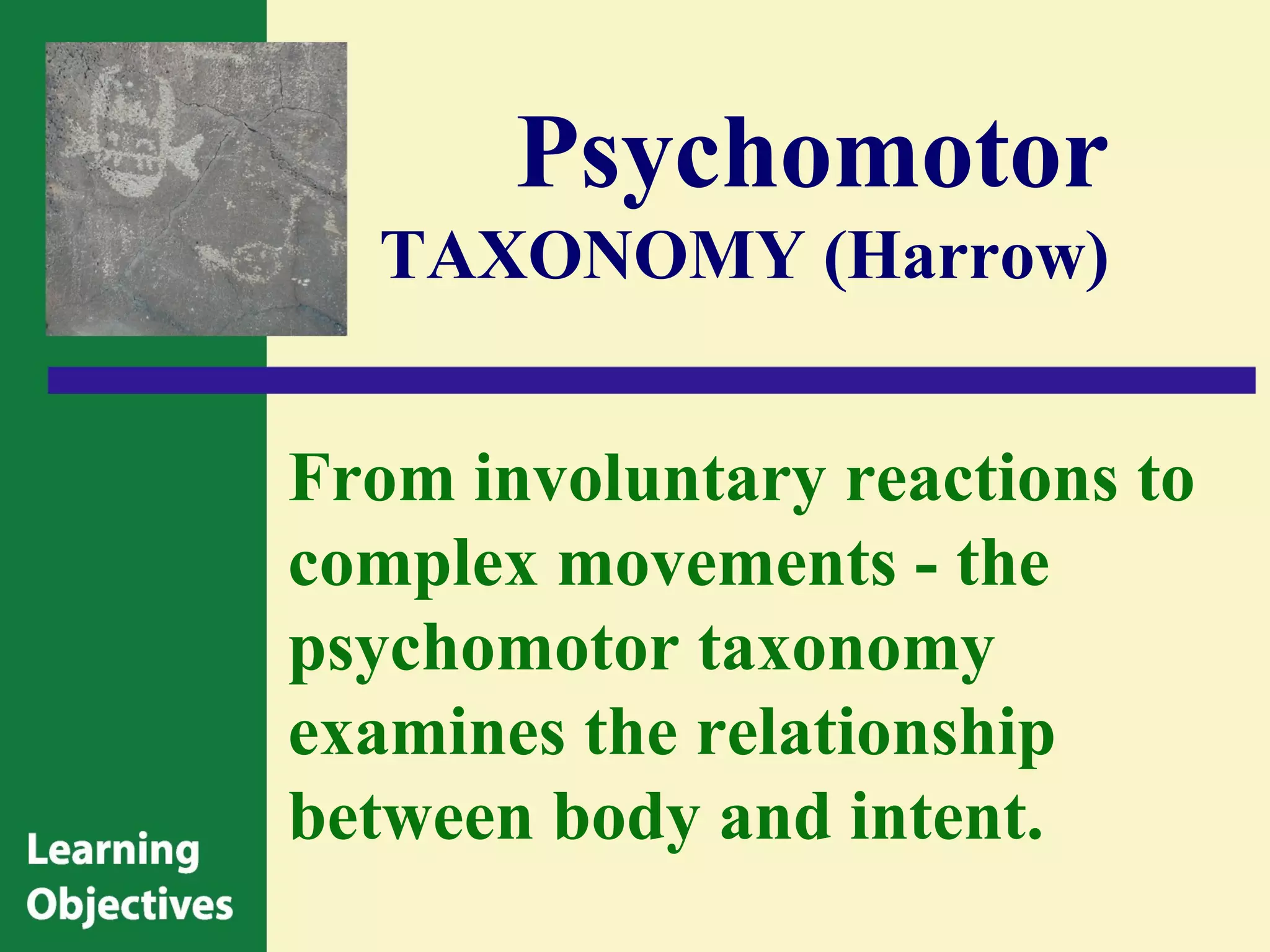
Psychomotor
  TAXONOMY (Harrow)


From involuntary reactions to
complex movements - the
psychomotor taxonomy
examines the relationship
between body and intent.
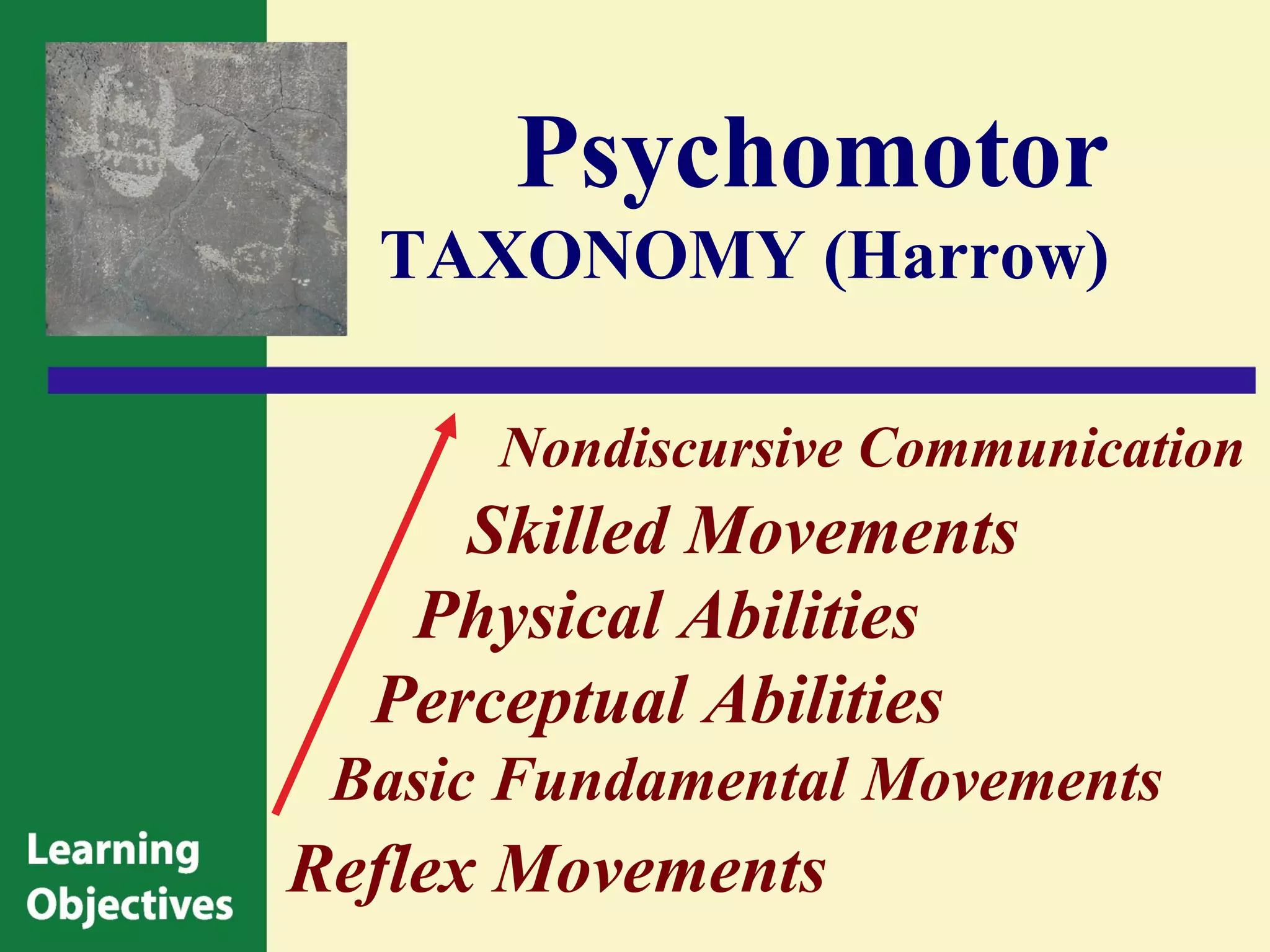
Psychomotor
  TAXONOMY (Harrow)

      Nondiscursive Communication
     Skilled Movements
   Physical Abilities
  Perceptual Abilities
 Basic Fundamental Movements
Reflex Movements
Low Levels
  Psychomotor Taxonomy


Reflex Movements
Involuntary movements
(autonomic)
Basic Fundamental Movements
Simple, but inherent to more
complex movements
Middle Levels
  Psychomotor Taxonomy


Perceptual Abilities
Perceptions sent to the brain that
affects motor movements
Physical Abilities
The physical self that enables
smooth and efficient movements
Highest Levels
  Psychomotor Taxonomy


Skilled Movements
Learned complex tasks
Nondiscursive Communication
Communication through
movement (facial expressions,
dance moves, etc.)
Plan your Actions
    Using the Taxonomies


It is important to consider the
taxonomic structure -
otherwise we run the real risk
of addressing one, usually low,
level of activity.
Group Exercise!


Meet with your group for the
next 20 minutes.

Learning Objectives (Taxonomy)

  • 1.
    This presentation wasdeveloped for the exclusive use of students enrolled in: Educational Testing & Grading, Professor Gregory E. Stone. © 2004 Gregory E. Stone. All rights reserved. This presentation may not be reproduced in any form, in part or as a whole, without the express written permission of the author.
  • 2.
    Taxonomies in Learning Objectives Taxonomies help to organize our thought process. Ensures higher level skillsets.
  • 3.
    Taxonomies inLearning Objectives Content Action + Intent = Objective
  • 4.
    Taxonomies inLearning Objectives Action + Intent = Objective Skill Level
  • 5.
    Same Content Different Skills Language Arts  Read Dick and Jane  Summarize Dick and Jane  Compose a unique Dick and Jane story
  • 6.
    Three Principle Skill Facets Cognitive What we commonly refer to as “intelligence” or scholastic abilities.
  • 7.
    Three Principle Skill Facets Affective Process of developing and internalizing a set of societal traits and values.
  • 8.
    Three Principle Skill Facets Psychomotor Basic and advanced motor expressions of affect and cognition.
  • 9.
    Taxonomic Pioneers Bloom Bloom’s Taxonomy Masia Affective Taxonomy Gagné Alternative Taxonomy
  • 10.
    Benjamin Bloom’s COGNITIVE TAXONOMY Taxonomiesare Hierarchical Lower Levels  Higher Levels Most common  Least common
  • 11.
    Using Taxonomies in Learning Objectives Evaluation Synthesis Analysis Application Comprehension Knowledge
  • 12.
    Knowledge Bloom’s Cognitive Taxonomy Level 1 Requires student to recall memorized information Define ♦ List ♦ Recall Identify ♦ Know
  • 13.
    Knowledge Bloom’s Cognitive Taxonomy Level 1 Define the meaning of a concept. Identify simple shapes. List the parts of a cell. Know mathematical operation signs. Match flags to appropriate country.
  • 14.
    Comprehension Bloom’s Cognitive Taxonomy Level 2 Use the information in familiar situations without intimate understanding Explain ♦ Infer ♦ Summarize Paraphrase ♦ Distinguish
  • 15.
    Comprehension Bloom’s Cognitive Taxonomy Level 2 Summarize the main events of a story. Discriminate between styles of painting. Distinguish living from inanimate objects. Determine greatest from least. Describe differences in math operations.
  • 16.
    Application Bloom’s Cognitive Taxonomy Level 3 Use previous knowledge in a new and different setting Solve ♦ Produce ♦ Compute (New Situation) Organize
  • 17.
    Application Bloom’s Cognitive Taxonomy Level 3 Compute the sum of fractions (in a qualitatively different way than in class). Create a simple short story. Organize a logical progression.
  • 18.
    Analysis Bloom’s Cognitive Taxonomy Level 4 Dissect (break down) a concept into its component parts Diagram ♦ Outline ♦ Deduce High level Discriminate ♦ Illustrate
  • 19.
    Analysis Bloom’s Cognitive Taxonomy Level 4 Distinguishes fact from opinion. Deduces valid conclusions from data. Identifies assumptions underlying concept.
  • 20.
    Synthesis Bloom’s Cognitive Taxonomy Level 5 Produce unique or original thoughts by piecing together existing elements in new whole Compose ♦ Create ♦ Design Formulate ♦ Categorize
  • 21.
    Synthesis Bloom’s Cognitive Taxonomy Level 5 Compose a unique ending to an unfinished story. Design a new scientific experiment
  • 22.
    Evaluation Bloom’s Cognitive Taxonomy Level 6 Formulate judgements about the value of a concept/thing using a set of specified criteria Compare ♦ Contrast ♦ Support Interpret ♦ Conclude
  • 23.
    Evaluation Bloom’s Cognitive Taxonomy Level 6 Judge a sample writing based upon given criteria. Compare and contrast political systems. Compare and contrast simple opposites. Support the argument than DaVinci was a “master painter”.
  • 24.
    Gagné’s COGNITIVE TAXONOMY While Bloomfocused on developmental “Mastery”, Gagné concentrated on developmental “Logic”
  • 25.
    Gagné’s COGNITIVE TAXONOMY Higher Order Rules Rules Defined Concepts Concrete Concepts Discrimination Verbal Information
  • 26.
    Verbal Information Gagné’s Cognitive Taxonomy Level 1 Akin to Bloom’s Knowledge (Recall) level. Memorize ♦ Remember
  • 27.
    Discrimination Gagné’s Cognitive Taxonomy Level 2 Relating to stimuli - determining similarities and differences. Have I seen it before? ♦
  • 28.
    Concrete Concepts Gagné’s Cognitive Taxonomy Level 3 Identifying physical objects that have a specified characteristics. This is an apple because it has apple qualities ♦
  • 29.
    Defined Concepts Gagné’s Cognitive Taxonomy Level 4 Understanding abstract levels of classification. Can distinguish a noun from a verb ♦
  • 30.
    Rules Gagné’s Cognitive Taxonomy Level 5 Applying principles that regulate the relationship between objects. Compose simple sentences ♦ Solve standard math problems
  • 31.
    Higher Order Rules Gagné’s Cognitive Taxonomy Level 6 Combining a series of rules into a single, more complex rule / to solve a new problem. Write a unique story ♦ Solve a novel science problem
  • 32.
    Bloom & Masia’s AFFECTIVETAXONOMY Provides theoretical framework within which the ideas, beliefs, attitudes, etc. of others/society are internalized by a person.
  • 33.
    Bloom & Masia’s AFFECTIVETAXONOMY Characterizing by aValue Organizing Valuing Responding Receiving (Attending)
  • 34.
    Receiving (Attending) Bloom &Masia’s Affective Taxonomy Level 1 An awareness of the object and a willingness to listen, watch. At the top of the range, the student can distinguish what is and is not related to the object..
  • 35.
    Responding Bloom & Masia’sAffective Taxonomy Level 2 Student actively participates. At first, just “acceptance”. Later we hope students will approach with “willingness” & “satisfaction”.
  • 36.
    Valuing Bloom & Masia’sAffective Taxonomy Level 3 Judges activity on it’s “worthiness” - according to a consistent pattern. Minimally “accepts the idea”. Then “prefers the idea”. Finally, “conviction for the idea”.
  • 37.
    Organization Bloom & Masia’sAffective Taxonomy Level 4 The many ideas become interrelated. An “organization” suggests the start of the conceptualization of a value system.
  • 38.
    Characterizing by aValue Bloom & Masia’s Affective Taxonomy Level 5 Students behave in a way consistent with their value system - avoiding hypocritical behavior (behaving with almost perfect consistency).
  • 39.
    Example Bloom & Masia’s Affective Taxonomy Johnny finds biology totally boring. Ms. Jones assigns a paper about the importance of biology as a science. How could Affect help us?
  • 40.
    Example Bloom & Masia’s Affective Taxonomy Johnny finds biology totally boring. Receiving Ms. Jones assigns a paper about the importance of biology as a science. Responding or Valuing
  • 41.
    Psychomotor TAXONOMY(Harrow) From involuntary reactions to complex movements - the psychomotor taxonomy examines the relationship between body and intent.
  • 42.
    Psychomotor TAXONOMY(Harrow) Nondiscursive Communication Skilled Movements Physical Abilities Perceptual Abilities Basic Fundamental Movements Reflex Movements
  • 43.
    Low Levels Psychomotor Taxonomy Reflex Movements Involuntary movements (autonomic) Basic Fundamental Movements Simple, but inherent to more complex movements
  • 44.
    Middle Levels Psychomotor Taxonomy Perceptual Abilities Perceptions sent to the brain that affects motor movements Physical Abilities The physical self that enables smooth and efficient movements
  • 45.
    Highest Levels Psychomotor Taxonomy Skilled Movements Learned complex tasks Nondiscursive Communication Communication through movement (facial expressions, dance moves, etc.)
  • 46.
    Plan your Actions Using the Taxonomies It is important to consider the taxonomic structure - otherwise we run the real risk of addressing one, usually low, level of activity.
  • 47.
    Group Exercise! Meet withyour group for the next 20 minutes.