Administering,
Scoring and
Analyzing a Test
Test Administration
• Administering the written test is perhaps the
most important aspect of the examining
process. The test administrator creates the
atmosphere in the test room and the attitude
the administrator displays in performing his
or her duties is extremely important.
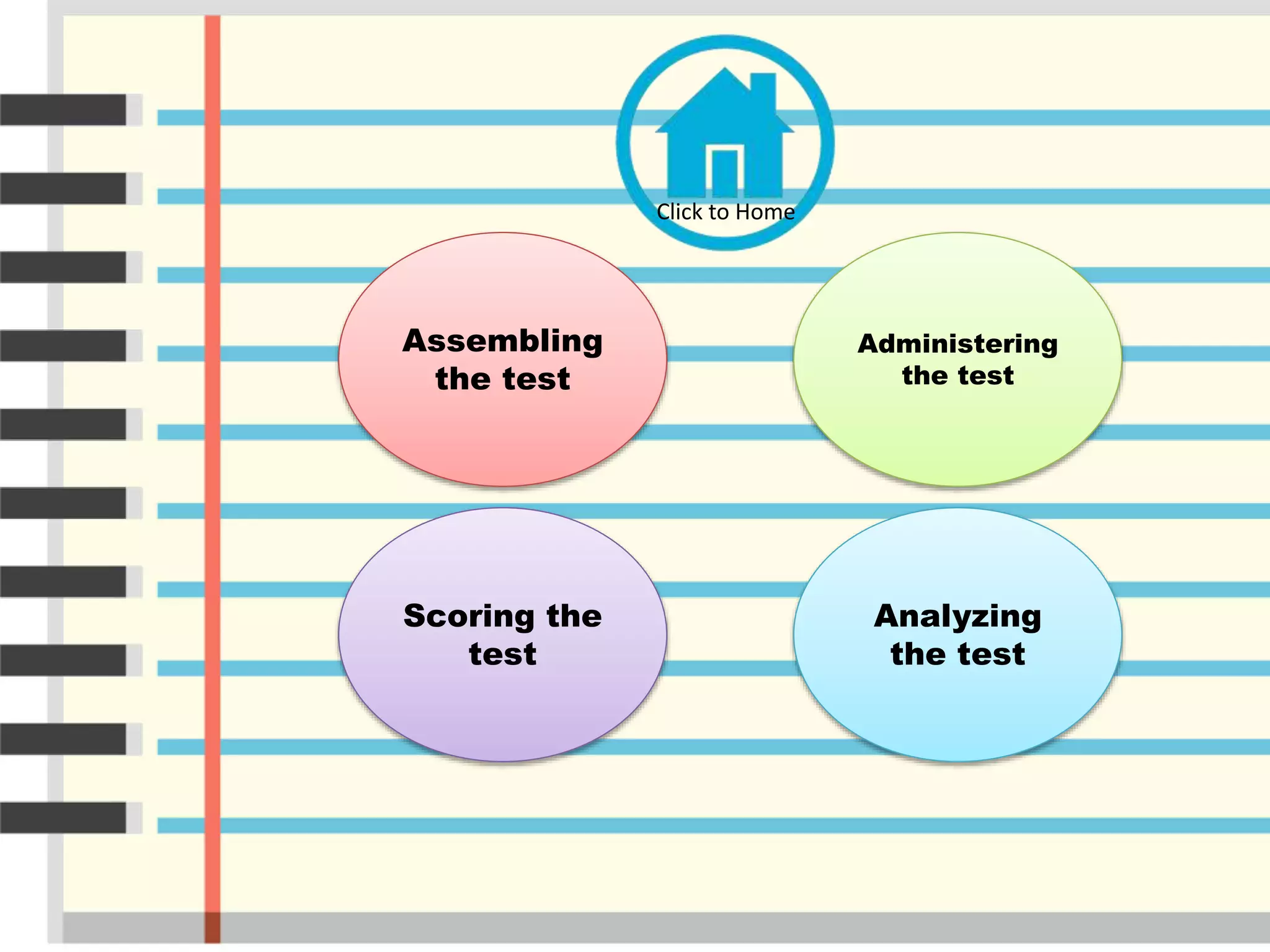
Assembling
the test
Scoring the
test
Analyzing
the test
Administering
the test
Click to Home
Assembling the test
Packaging the Test Reproducing the Test
Click to Home
Group together all
items of similar
format
Arrange test items
from easy to hard
Space the items for
easy reading
Keep the items and
options on the same
page
Position illustration
near descriptions and
above the item
Position illustration
near descriptions and
above the item
Check your answer
Provide space for
Name and Date
Determine how the
students record their
answer
Check test directions
Proofread the test
Click to home2
Know the
photocopyin
g machine
Specify
copying
instructions
File original
test
Click to Home Click to home2
Administering
the Test
• Maintain a positive attitude
• Maximize Achievement
Motivation
• Equalize Advantages
• Avoid Surprises
• Clarify the rules
• Rotate Distribution
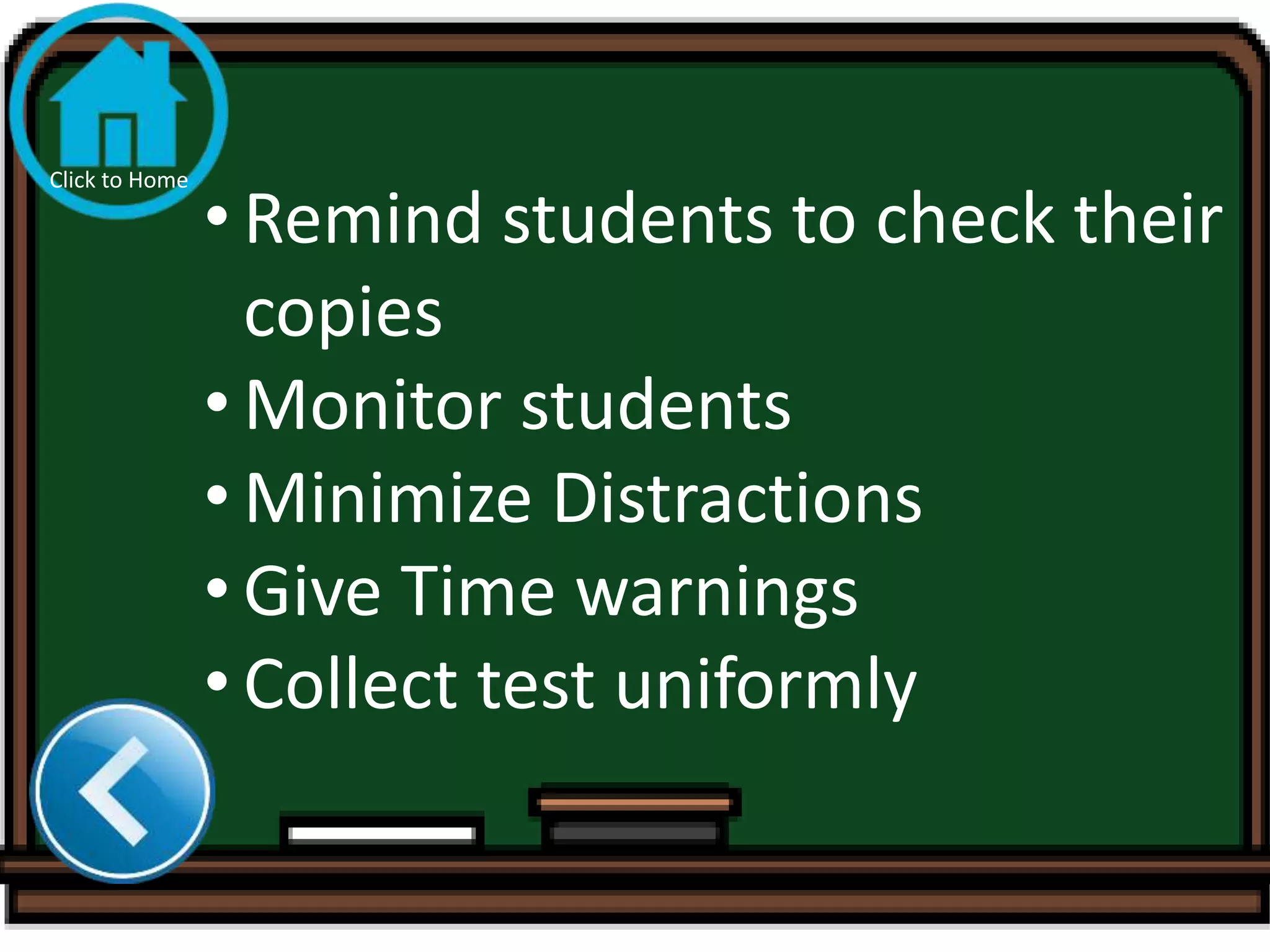
• Remind students to check their
copies
• Monitor students
• Minimize Distractions
• Give Time warnings
• Collect test uniformly
Click to Home
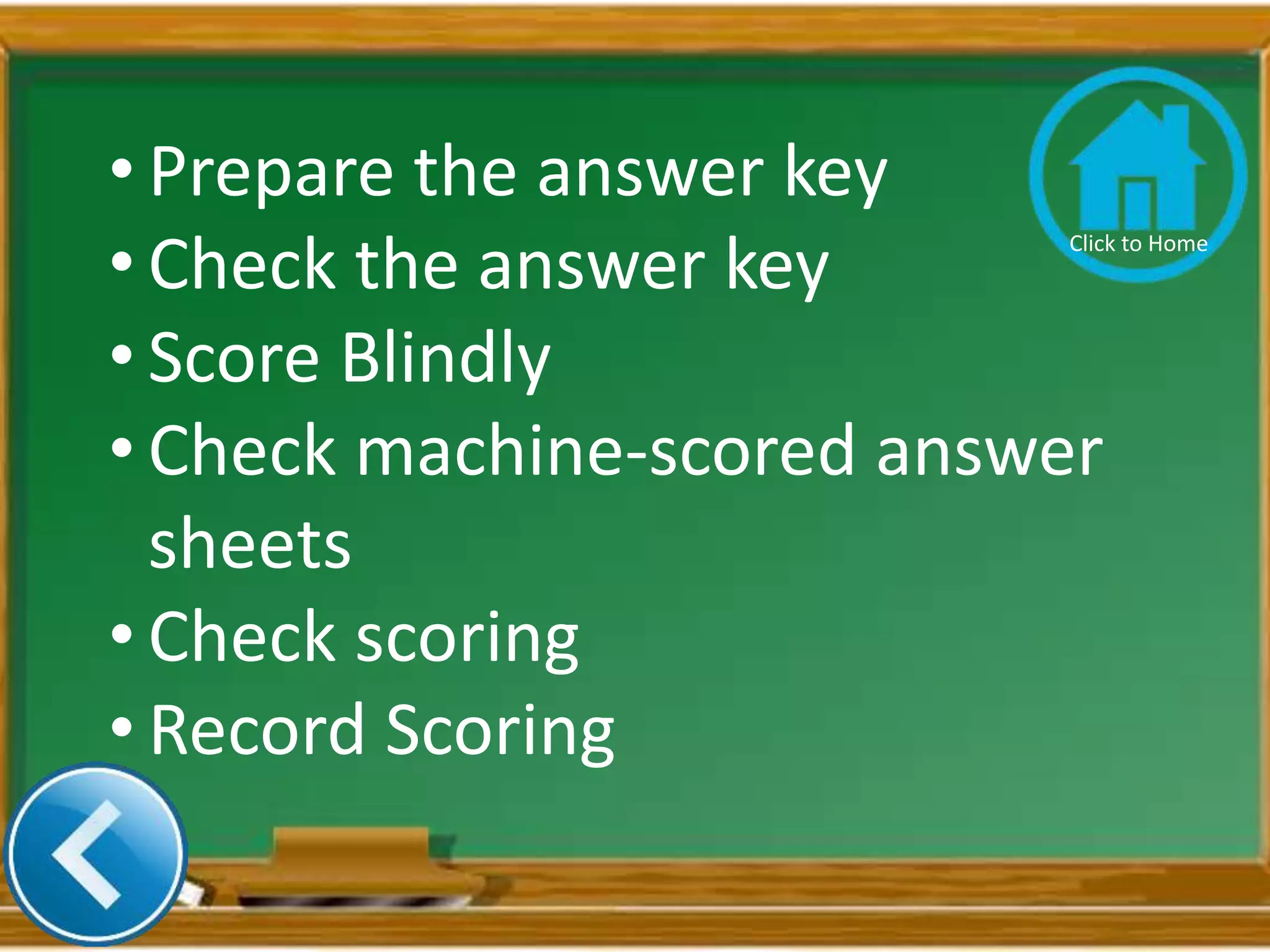
• Prepare the answer key
• Check the answer key
• Score Blindly
• Check machine-scored answer
sheets
• Check scoring
• Record Scoring
Click to Home
Analyzing the Test
Qualitative Item Analysis
Quantitative Item Analysis
A numerical method for
analyzing test items
employing students
response alternatives or
options
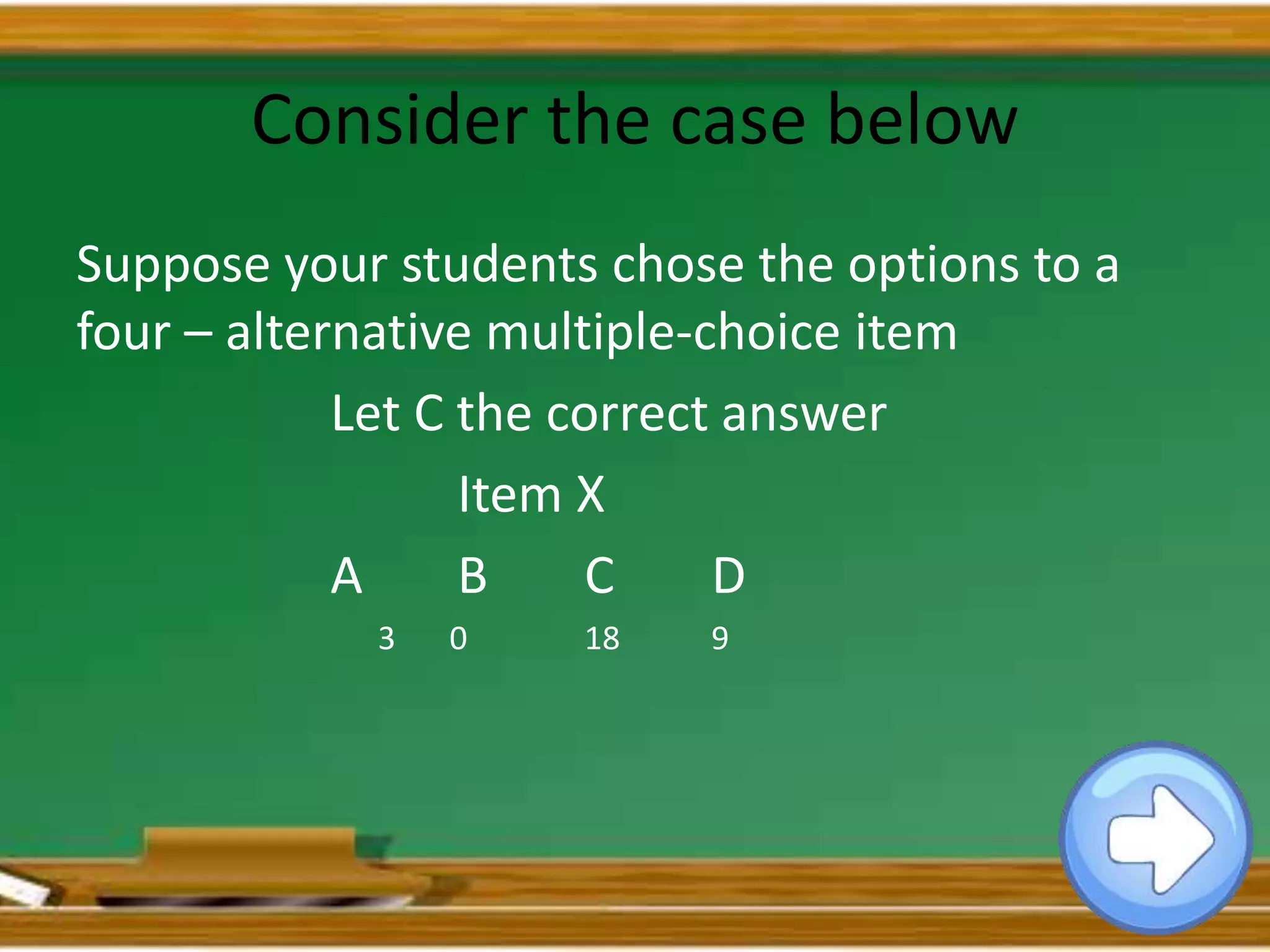
Consider the case below
Suppose your students chose the options to a
four – alternative multiple-choice item
Let C the correct answer
Item X
A B C D
3 0 18 9
Guide Questions
1. What is the difficulty level?
2. What is the discrimination index?
3. Should this item be eliminated?
DIFFICULTY LEVEL
number selecting correct answer
p = _________________________________
total number taking the test
What is the difficulty level of the item?
Do you consider the item difficult or easy? Why?
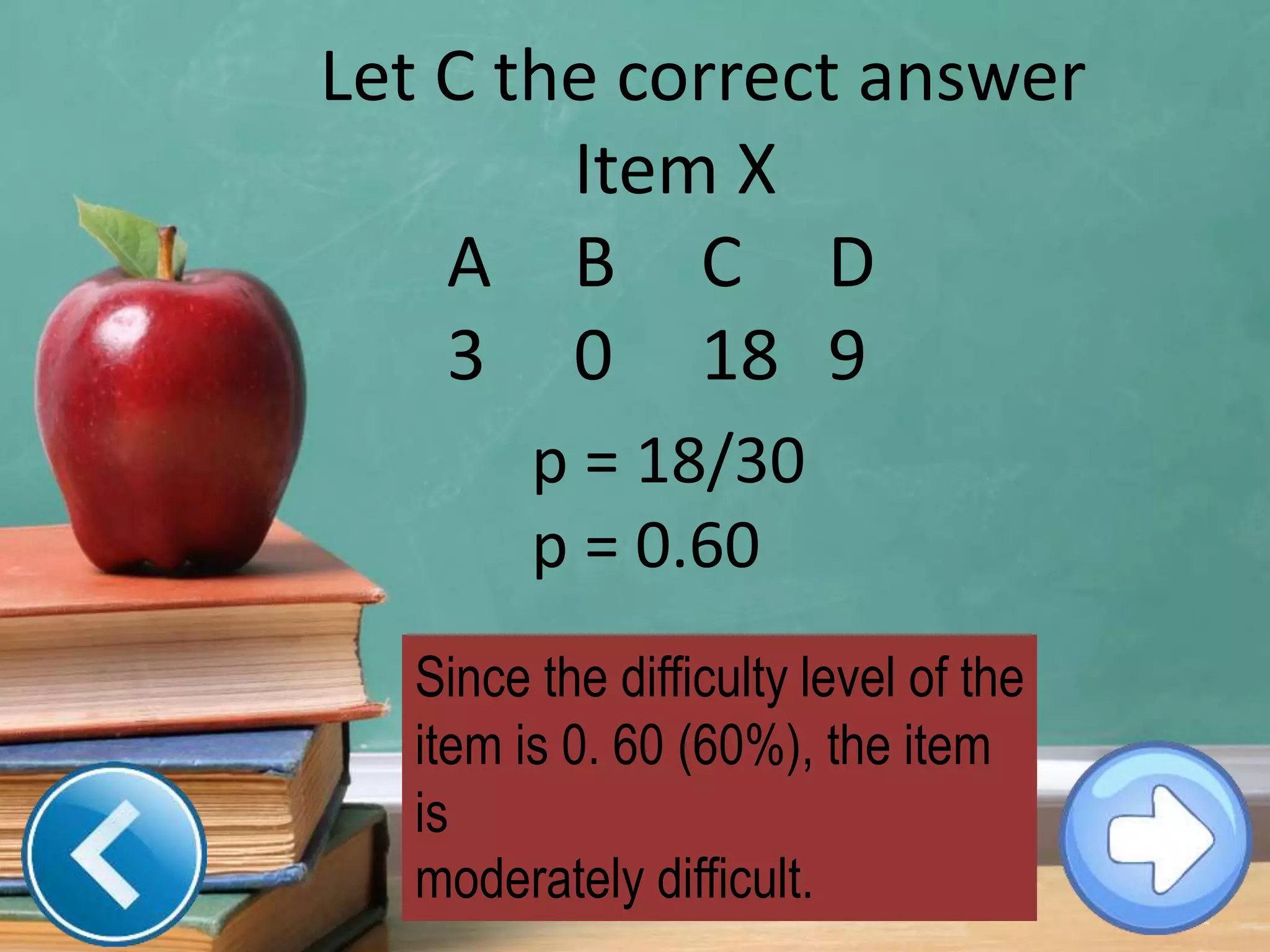
Let C the correct answer
Item X
A B C D
3 0 18 9
p = 18/30
p = 0.60
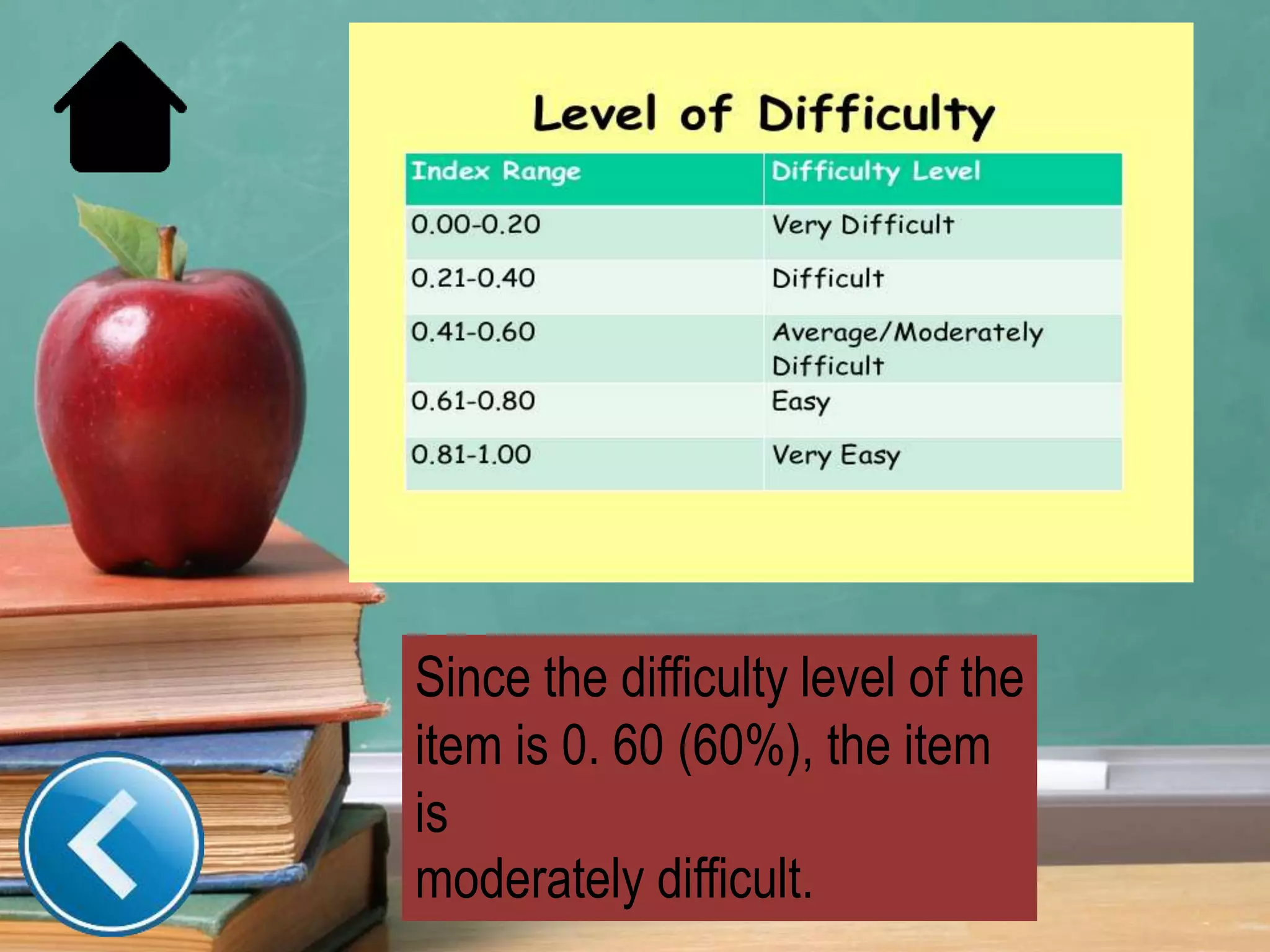
Since the difficulty level of the
item is 0. 60 (60%), the item
is
moderately difficult.
Since the difficulty level of the
item is 0. 60 (60%), the item

is
moderately difficult.
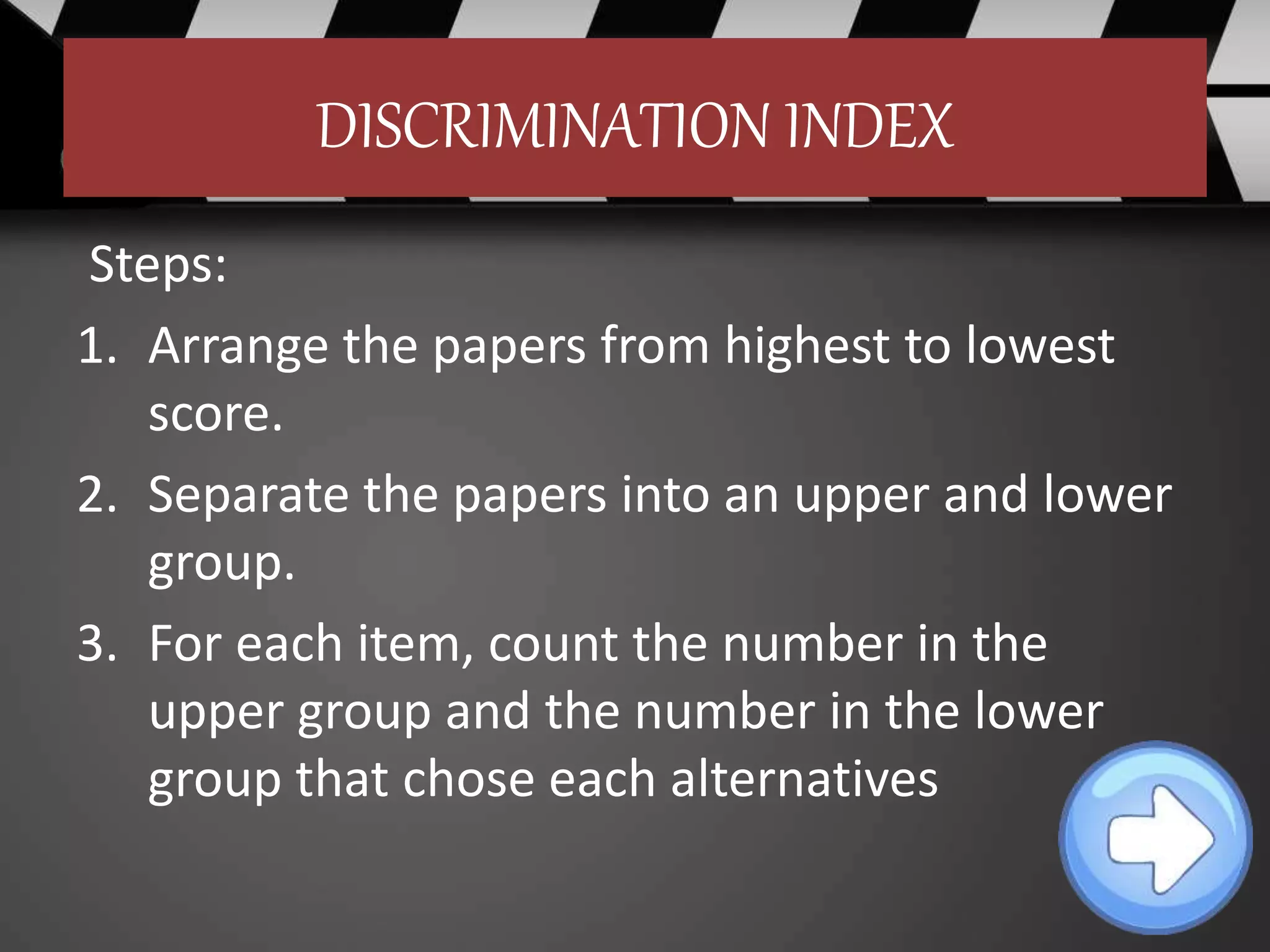
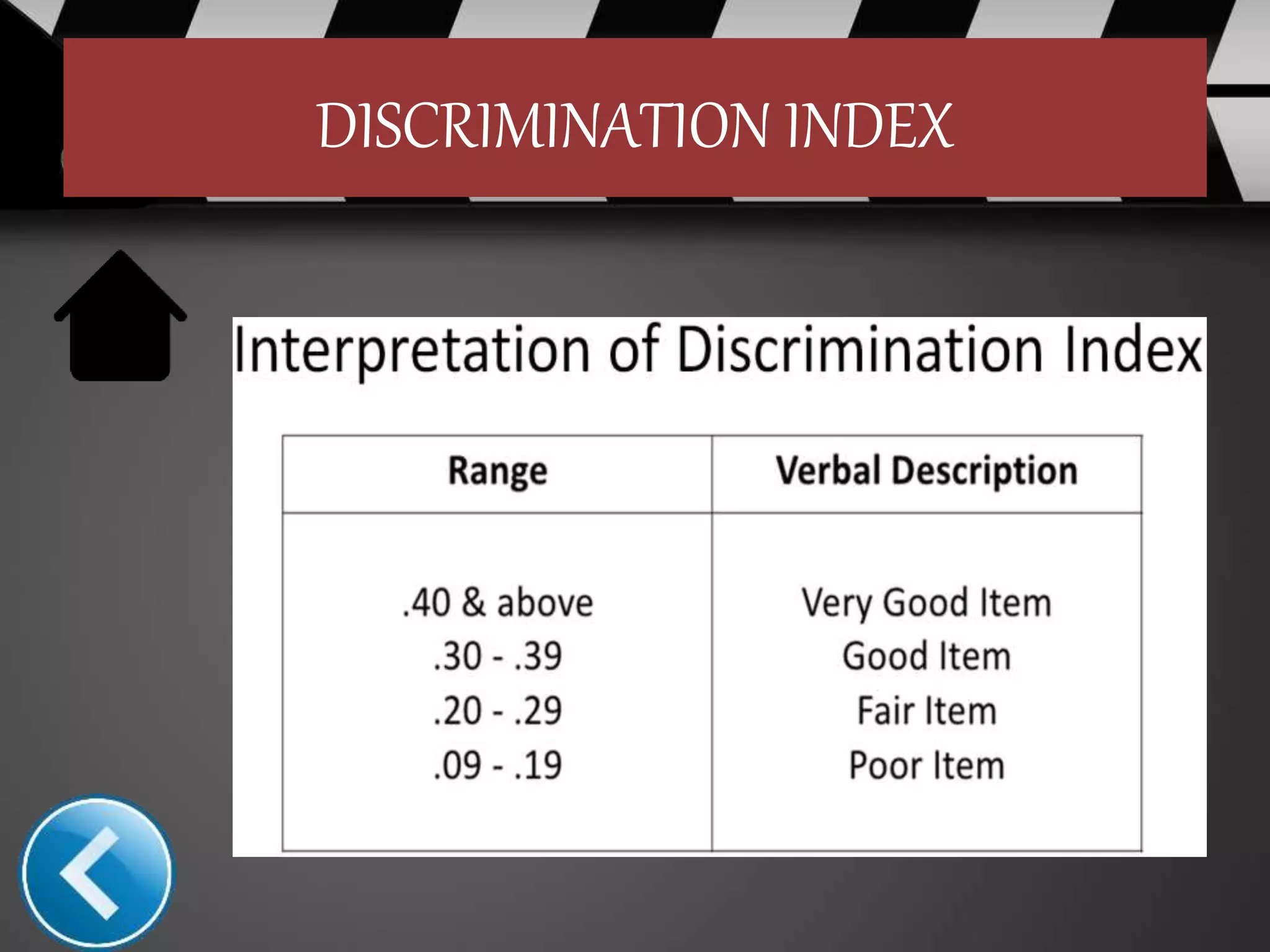
DISCRIMINATION INDEX
Steps:
1. Arrange the papers from highest to lowest
score.
2. Separate the papers into an upper and lower
group.
3. For each item, count the number in the
upper group and the number in the lower
group that chose each alternatives
DISCRIMINATION INDEX
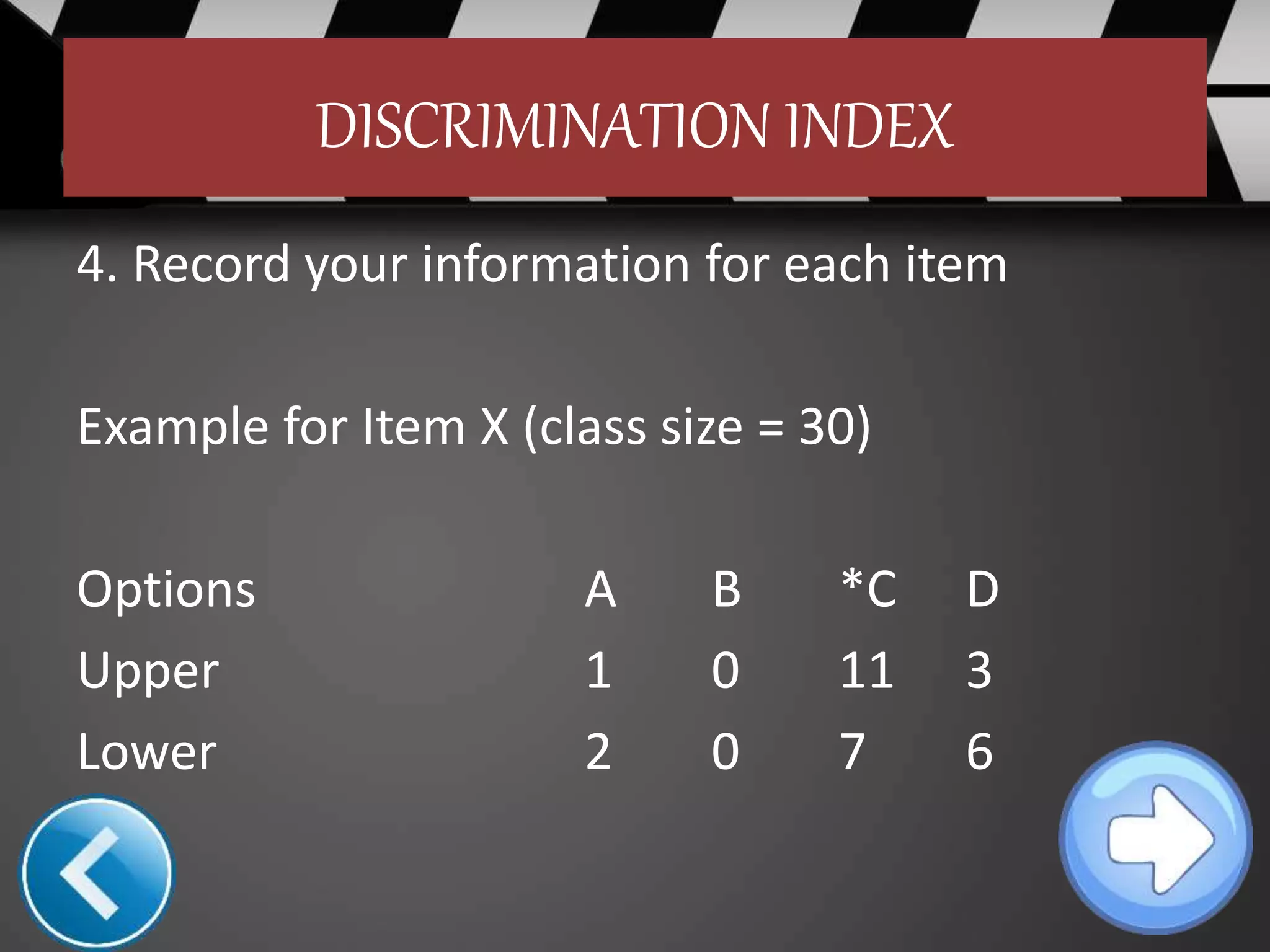
4. Record your information for each item
Example for Item X (class size = 30)
Options A B *C D
Upper 1 0 11 3
Lower 2 0 7 6
DISCRIMINATION INDEX
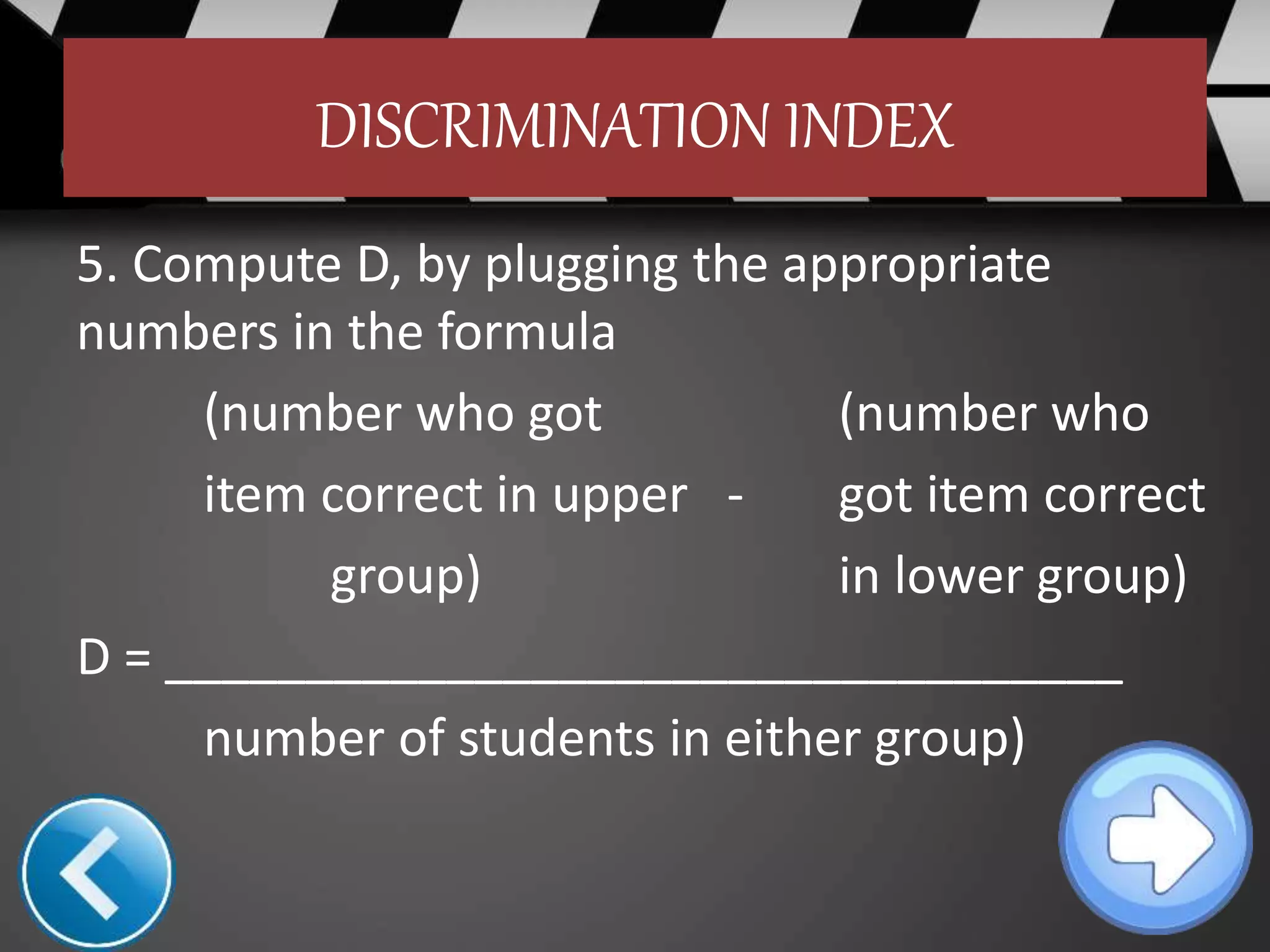
5. Compute D, by plugging the appropriate
numbers in the formula
(number who got (number who
item correct in upper - got item correct
group) in lower group)
D = __________________________________
number of students in either group)
DISCRIMINATION INDEX
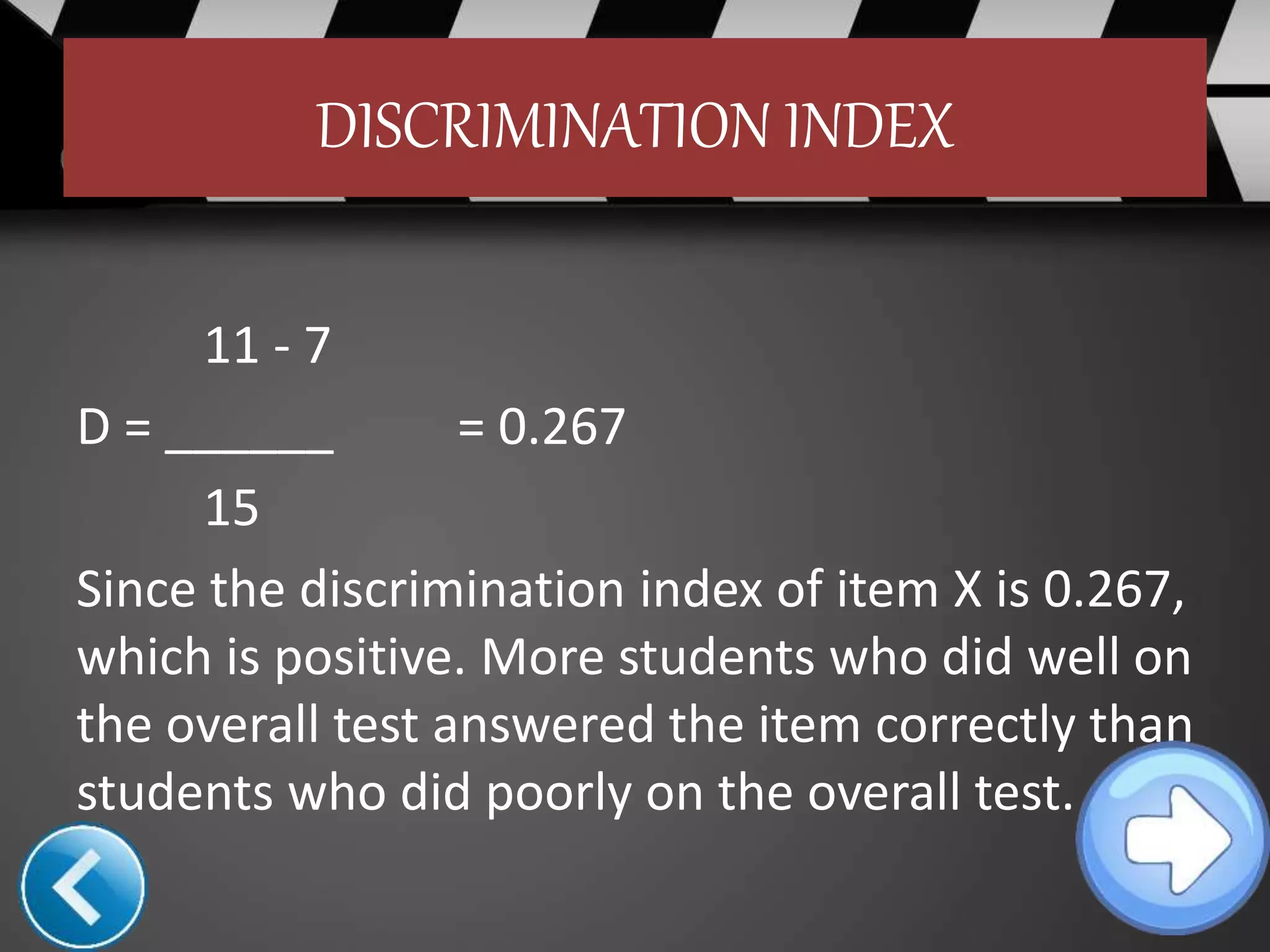
11 - 7
D = ______ = 0.267
15
Since the discrimination index of item X is 0.267,
which is positive. More students who did well on
the overall test answered the item correctly than
students who did poorly on the overall test.
DISCRIMINATION INDEX
ANALYSIS
Implication:
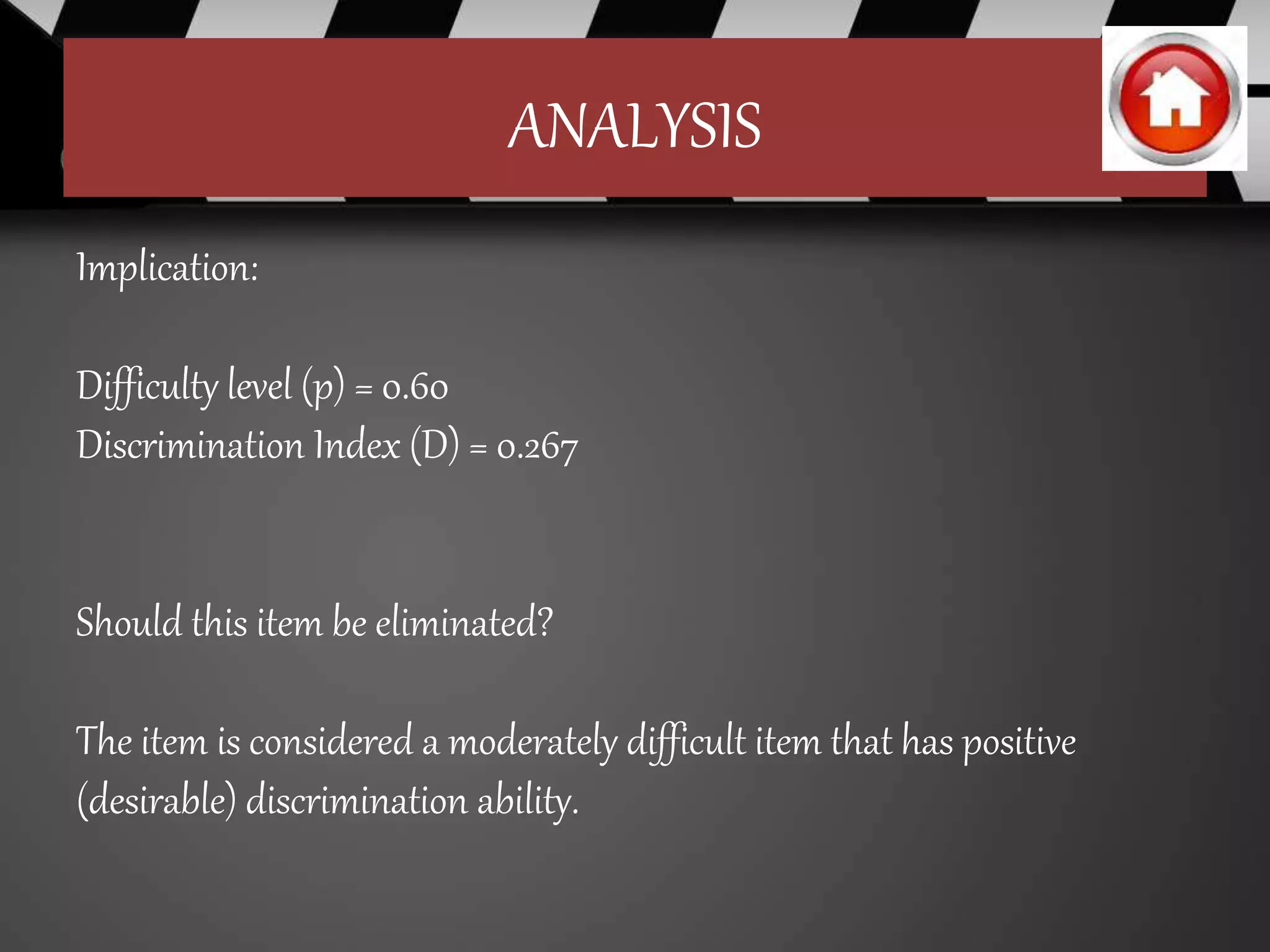
Difficulty level (p) = 0.60
Discrimination Index (D) = 0.267
Should this item be eliminated?
The item is considered a moderately difficult item that has positive
(desirable) discrimination ability.
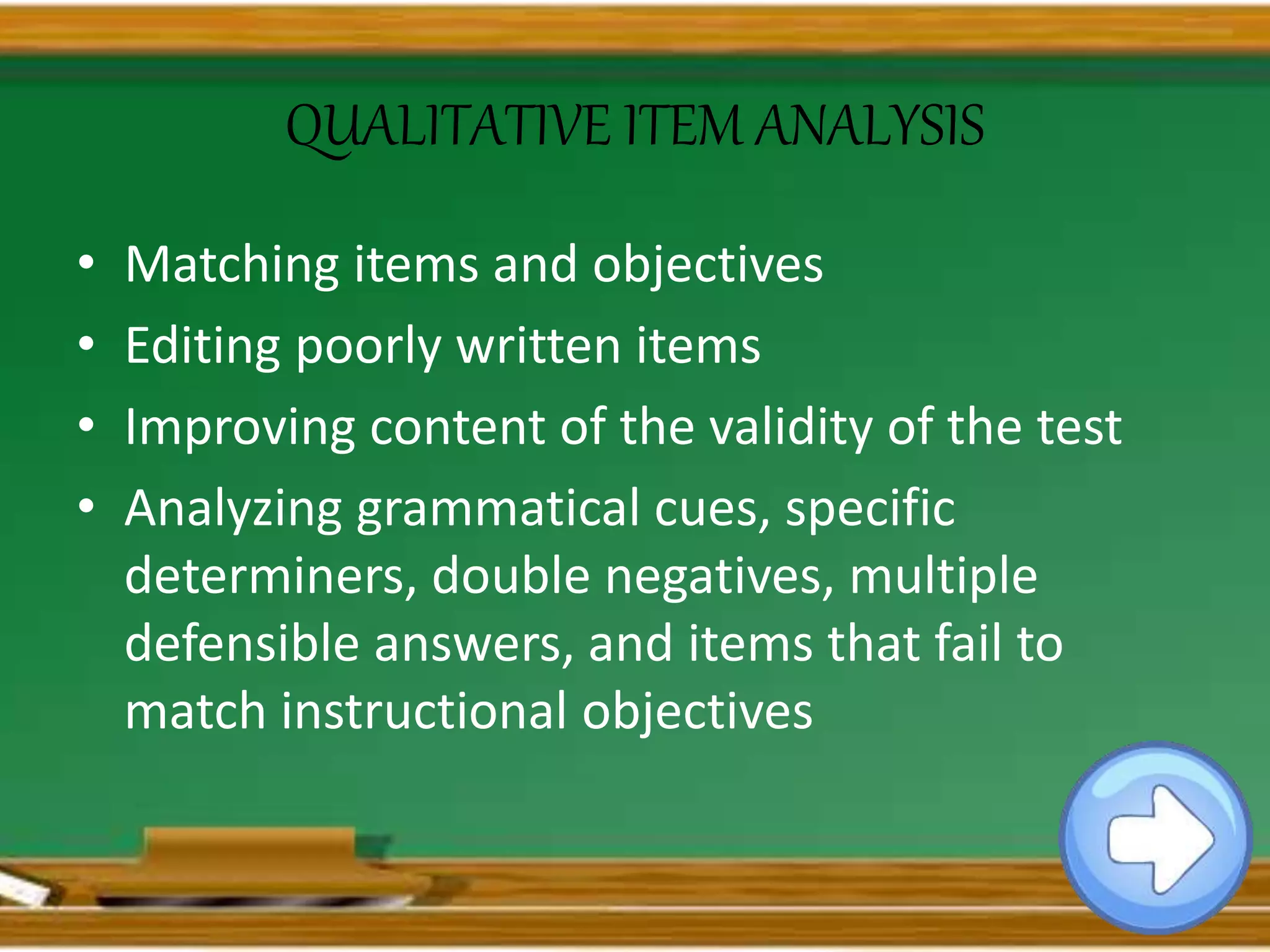
QUALITATIVE ITEM ANALYSIS
• Matching items and objectives
• Editing poorly written items
• Improving content of the validity of the test
• Analyzing grammatical cues, specific
determiners, double negatives, multiple
defensible answers, and items that fail to
match instructional objectives
Administering, Scoring, and Analyzing Test

Administering, Scoring, and Analyzing Test