Surgical management of
Neurogenic Bladder
Dept of Urology
Govt Royapettah Hospital and Kilpauk Medical College
Chennai
1
Moderators:
Professors:
 Prof. Dr. G. Sivasankar, M.S., M.Ch.,
 Prof. Dr.A. Senthilvel, M.S., M.Ch.,
Asst Professors:
 Dr. J. Sivabalan, M.S., M.Ch.,
 Dr. R. Bhargavi, M.S., M.Ch.,
 Dr. S. Raju, M.S., M.Ch.,
 Dr. K. Muthurathinam, M.S., M.Ch.,
 Dr. D.Tamilselvan, M.S., M.Ch.,
 Dr. K. Senthilkumar, M.S., M.Ch.
Dept of Urology, GRH and KMC, Chennai.
2
Treatment Detrusor overactivity
Neuromodulation
Augmentation enterocystoplasty[*]
Autoaugmentation[*]
Denervation procedures
Urinary diversion
Low bladder compliance
Augmentation enterocystoplasty[*]
Autoaugmentation[*]
Denervation Procedures
Sphincteric dysfunction
Surgery
Midurethral sling
Pubovaginal sling
Urethral/colposuspension
Artificial urinary sphincter
3 Dept of Urology, GRH and KMC, Chennai.
Therapy to Facilitate Bladder
Emptying/Voiding
 Bladder Related (Increasing Intravesical Pressure or
Facilitating Bladder Contractility)
 Electrical stimulation
Directly to the bladder or spinal cord
Directly to the nerve roots
Intravesical (transurethral)
Neuromodulation
 Reduction cystoplasty
 Bladder myoplasty (muscle wrap)
4 Dept of Urology, GRH and KMC, Chennai.
 Outlet Related (Decreasing Outlet Resistance)
 At a site of anatomic obstruction
 Prostatectomy,
 prostatotomy (diathermy, heat, laser)
 Bladder neck incision or resection
 Urethral stricture repair or dilation
 Intraurethral stent
 Balloon dilatation of stricture/contracture
5 Dept of Urology, GRH and KMC, Chennai.
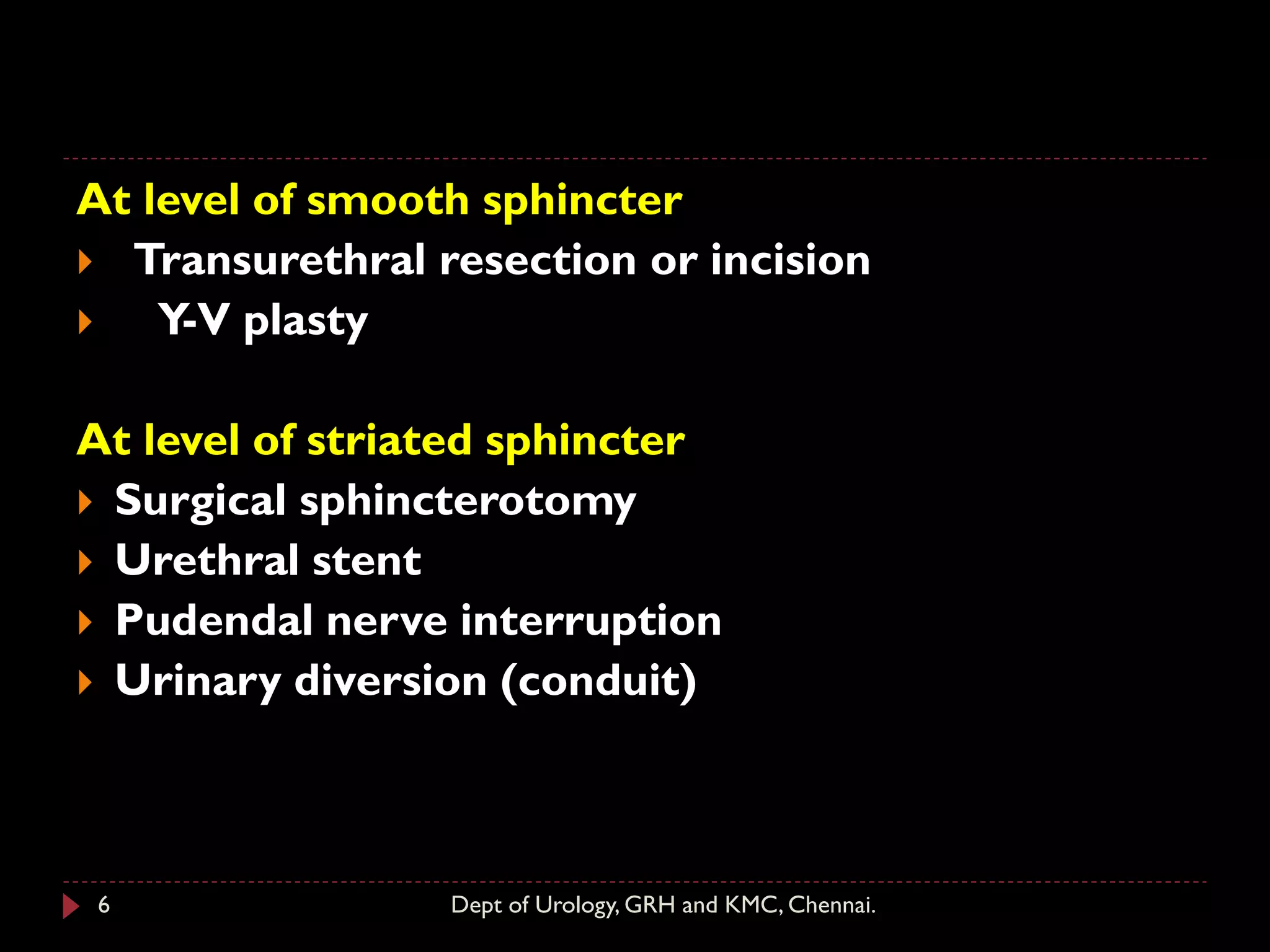
At level of smooth sphincter
 Transurethral resection or incision
 Y-V plasty
At level of striated sphincter
 Surgical sphincterotomy
 Urethral stent
 Pudendal nerve interruption
 Urinary diversion (conduit)
6 Dept of Urology, GRH and KMC, Chennai.
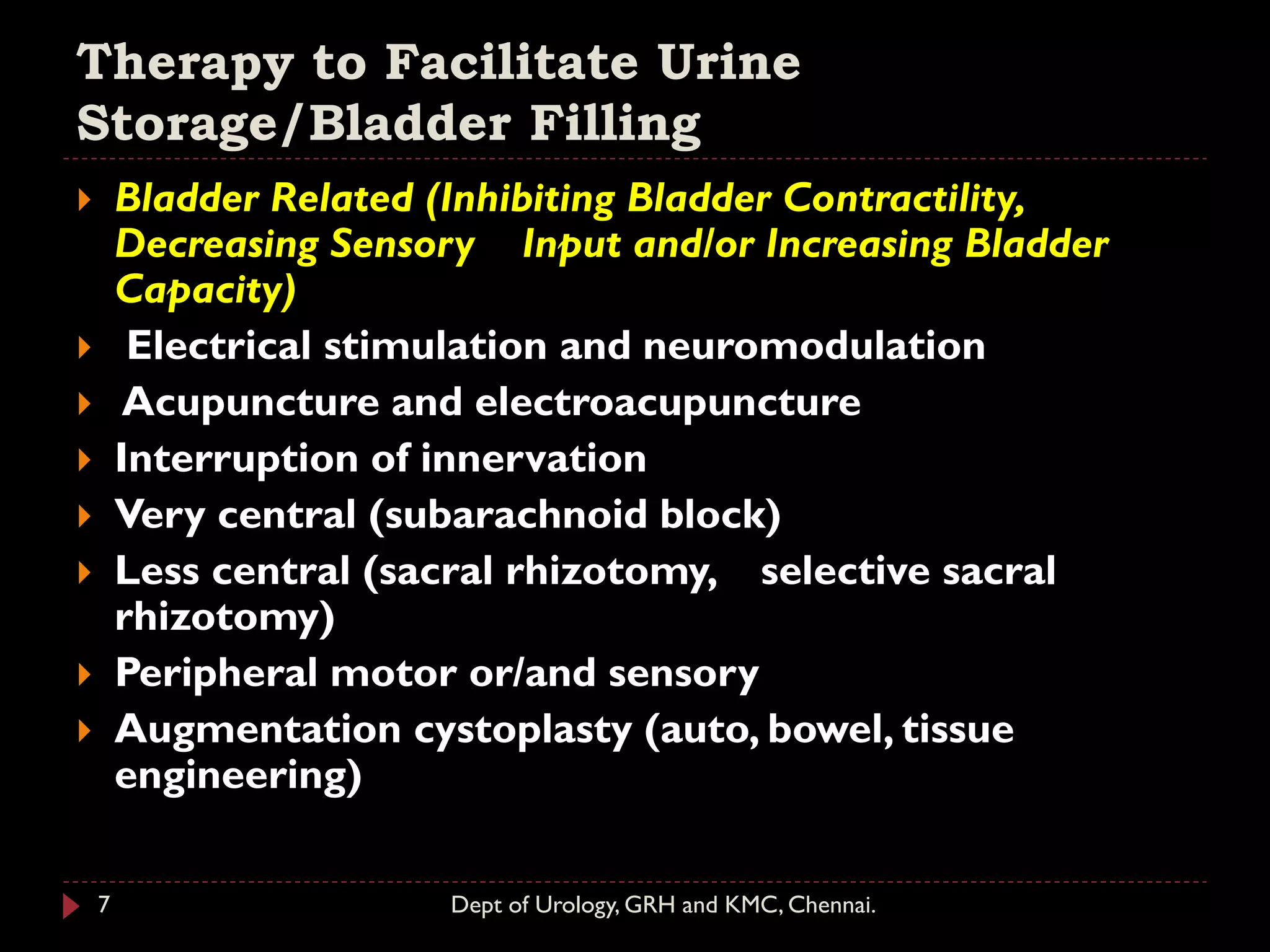
Therapy to Facilitate Urine
Storage/Bladder Filling
 Bladder Related (Inhibiting Bladder Contractility,
Decreasing Sensory Input and/or Increasing Bladder
Capacity)
 Electrical stimulation and neuromodulation
 Acupuncture and electroacupuncture
 Interruption of innervation
 Very central (subarachnoid block)
 Less central (sacral rhizotomy, selective sacral
rhizotomy)
 Peripheral motor or/and sensory
 Augmentation cystoplasty (auto, bowel, tissue
engineering)
7 Dept of Urology, GRH and KMC, Chennai.
 Outlet Related (Increasing Outlet Resistance)
 Vesicourethral suspension ± prolapse repair
(female)
 Sling procedures ± prolapse repair (female)
 Closure of the bladder outlet
 Artificial urinary sphincter
 Bladder outlet reconstruction
 Myoplasty (muscle transposition)
 Urinary diversion
8 Dept of Urology, GRH and KMC, Chennai.
HISTORY OF ELECTRICAL STIMULATION
 Magendie (1822) -the first to conduct physiologic
investigations of the spinal nerve roots,
 documenting in young dogs that
 transection of the posterior (dorsal) segments
resulted in a lack of sensation but persistence of
motor function,
 anterior (ventral) root transection yielded
preservation of sensation yet abolishment of motor
function.
 These important findings created the foundation for
our understanding of basic neurophysiology of
micturition and led to further discoveries on bladder
function in the setting of selective rhizotomy of both
the pelvic and hypogastric nerves
9 Dept of Urology, GRH and KMC, Chennai.
Putative Mechanism of Action of Sacral
Neuromodulation
 How neuromodulation works is evolving,
 Two main theories exist:
 (1) direct activation of efferent fibers to the
striated urethral sphincter reflexively causes
detrusor relaxation and
 (2) selective activation of afferent fibers causes
inhibition at spinal and supraspinal levels.
 Sacral neuromodulation therapy works by sacral
afferent activity and concomitant activation of the
somatosensory cortex.
10 Dept of Urology, GRH and KMC, Chennai.
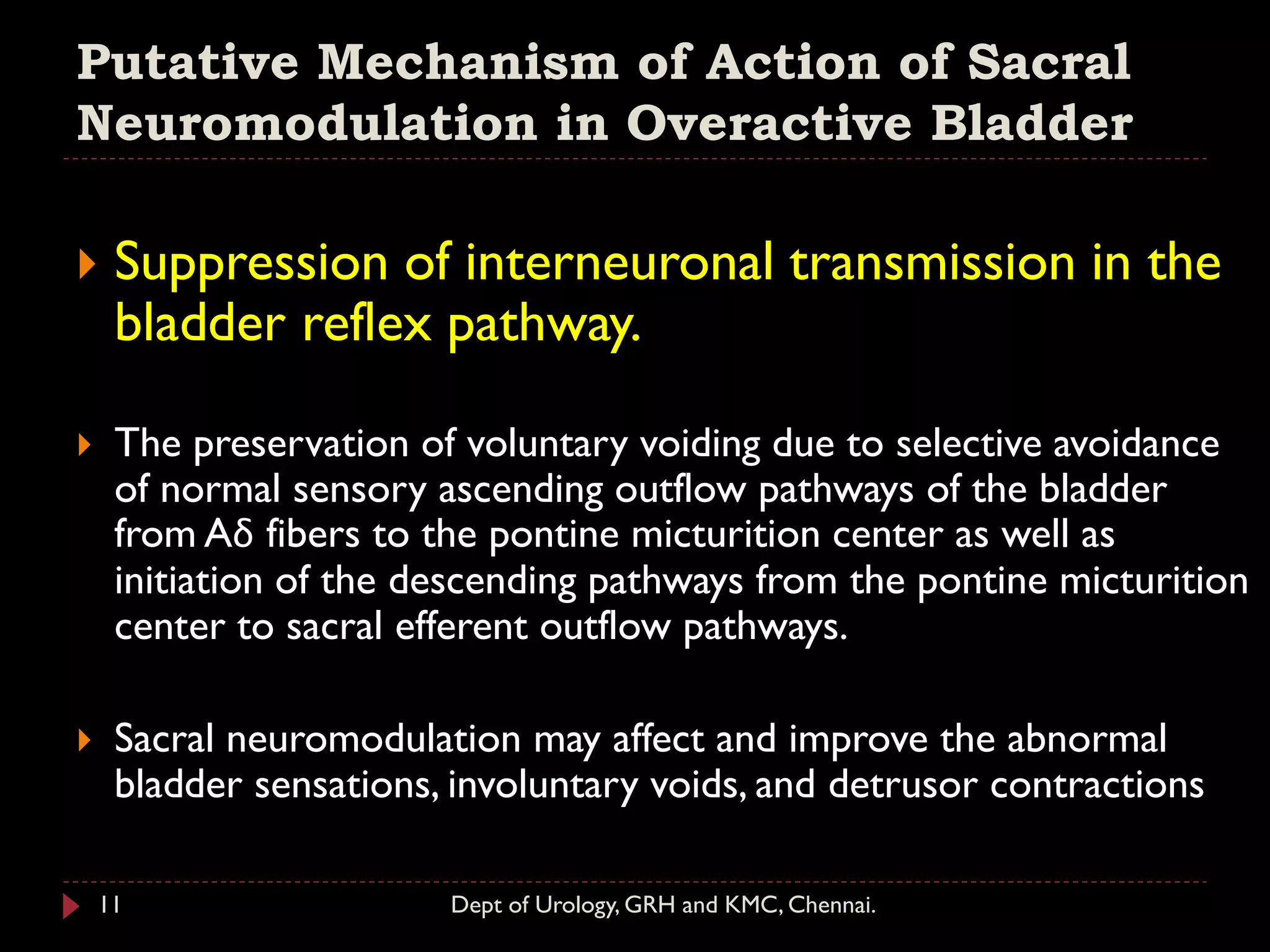
Putative Mechanism of Action of Sacral
Neuromodulation in Overactive Bladder
 Suppression of interneuronal transmission in the
bladder reflex pathway.
 The preservation of voluntary voiding due to selective avoidance
of normal sensory ascending outflow pathways of the bladder
from Aδ fibers to the pontine micturition center as well as
initiation of the descending pathways from the pontine micturition
center to sacral efferent outflow pathways.
 Sacral neuromodulation may affect and improve the abnormal
bladder sensations, involuntary voids, and detrusor contractions
11 Dept of Urology, GRH and KMC, Chennai.
Pudendal nerve afferent firing can modulate and accordingly
inhibit the bladder micturition reflex. SNS, sacral nerve
stimulation.
12 Dept of Urology, GRH and KMC, Chennai.
Putative Mechanism of Action of Sacral
Neuromodulation in Urinary Retention
 Sphincteric activity can be turned off by brain pathways to
allow efficient and complete bladder emptying.
 If the suprasacral pathways are altered, the guarding and
urethral reflexes still exist and cannot be turned off.
 This may cause retention, as in the spinal cord–injured
patient who in turn has detrusor-sphincter dyssynergia
resulting in urinary retention.
 Sacral neuromodulation may somehow turn off excitatory
flow to the urethral outlet and facilitate bladder emptying.
13 Dept of Urology, GRH and KMC, Chennai.
Sacral neuromodulation (SNS) can restore the normal
voluntary pattern of micturition by inhibition of the
spinal guarding reflex.
14 Dept of Urology, GRH and KMC, Chennai.
ELECTRICAL STIMULATION FOR STORAGE
DISORDERS
 Criteria for Selection of Patients
 Lower urinary tract symptoms and dysfunctions are secondary to a
neuromuscular etiology,
 a thorough history and physical examination will often reveal
 the nature (acute versus chronic) and
 help classify the cause (neurogenic, anatomic, postsurgical, functional,
inflammatory, or idiopathic).
 A urinalysis
 urine cytology should be considered in patients who present with
refractory symptoms of dysuria, urgency, or frequency of urination since
carcinoma in situ and bladder tumors may present with irritative bladder
symptoms without hematuria.
 urodynamic studies
 voiding diary
 physical examination of the pelvis.
 Electromyography is recommended in suspected cases of neurogenic
bladder dysfunction, detrusor-sphincter dyssynergia, or Fowler's syndrome
and may be considered for evaluation of inappropriate pelvic floor muscle
behavior
15 Dept of Urology, GRH and KMC, Chennai.
 Cystourethroscopy -yield information -diagnosis.
 Anatomic lesions such as urethral stricture, bladder neck fibrosis,
trabeculation, and bladder lesions have been found even in women
with bladder outlet obstruction.
 Baseline upper tract imaging is performed in patients with
neurologic disease or, if indicated, by physical or baseline studies or a
patient's history.
 Sacral neuromodulation is indicated when conservative measures
(such as bladder retraining, pelvic floor biofeedback, and
medications) have failed
Excluding patients from this therapy.
 Significant anatomic abnormalities in the spine or sacrum
 Mental incapacitation of patients, who cannot manage their device
or judge the clinical outcome;
 Functional urinary incontinence; and
 Noncompliance of the patient.
16 Dept of Urology, GRH and KMC, Chennai.
Relative contraindications
 Teratogenicity or abortion from the effect of
electrical stimulation-pregnant women
 Women with electrical stimulation devices for
pelvic health conditions who become pregnant
may simply turn off their devices during
pregnancy.
17 Dept of Urology, GRH and KMC, Chennai.
Electrical Stimulation of the Bladder
 Transurethral electrical bladder stimulation (TEBS) not
only for initiating sensory awareness of bladder filling and
stimulating detrusor contractility but also for increasing
bladder capacity at low pressure in pediatric patients with
myelomeningocele
 The goal was to provide children with neurogenic bladder
dysfunction, mostly secondary to spina bifida, enough
sensation to detect a filling or full bladder and to have them
synergistically void or catheterize in a timely manner.
 The potential to increase bladder capacity while
maintaining or decreasing end-filling bladder pressure (in
essence, improving compliance).
 Bladder capacity increased by 20%
 Pressure at bladder capacity decreased by 25%
18 Dept of Urology, GRH and KMC, Chennai.
Sacral Rhizotomy
 In most cases, bilateral anterior and posterior sacral rhizotomy
or conusectomy converts a hyperreflexic bladder to an
areflexic one.
 It adversely affects the rectum, anal and urethral sphincters,
sexual function, and the lower extremities.
 In an attempt to leave sphincter and sexual function intact,
selective motor nerve section by abolishing only the motor
supply responsible for involuntary contractions.
 The third anterior (ventral) sacral root provided the dominant
motor innervation of the human bladder.
 Differential sacral rhizotomy should always be preceded by
stimulation and blockade of the individual sacral roots with
cystometric and sphincterometric control.
19 Dept of Urology, GRH and KMC, Chennai.
 BothTanagho and Schmidt and Brindley
popularized the concept of sensory
deafferentation by dorsal or posterior rhizotomy
to increase bladder capacity as part of their
overall plan to simultaneously rehabilitate storage
and emptying problems in patients with significant
spinal cord injury or disease.
20 Dept of Urology, GRH and KMC, Chennai.
Sacral Neuromodulation
 Neuromodulation is an innovative treatment of
lower urinary tract symptoms and dysfunctions of
bladder storage secondary to neuromuscular
causes
Expanding clinical indications
 Neurogenic detrusor overactivity,
 Interstitial cystitis,
 Pelvic pain,
 Pediatric voiding dysfunction
 Bowel disorders
21 Dept of Urology, GRH and KMC, Chennai.
Technique
 Sacral nerve stimulation (SNS) by the InterStim[*]
procedure is performed in two stages:
 Stage I, a clinical trial of a temporary or
permanent lead for external stimulation; and
 Stage II, implantation of a subcutaneous
implantable pulse generator (IPG).
 Each stage can be performed with monitored
anesthesia care supplemented by local anesthesia.
 During the initial introduction of sacral
neuromodulation therapy, patients underwent a
percutaneous nerve evaluation by the placement
of a unilateral percutaneous lead in the S3
foramen with use of local injectable anesthesia.
22 Dept of Urology, GRH and KMC, Chennai.
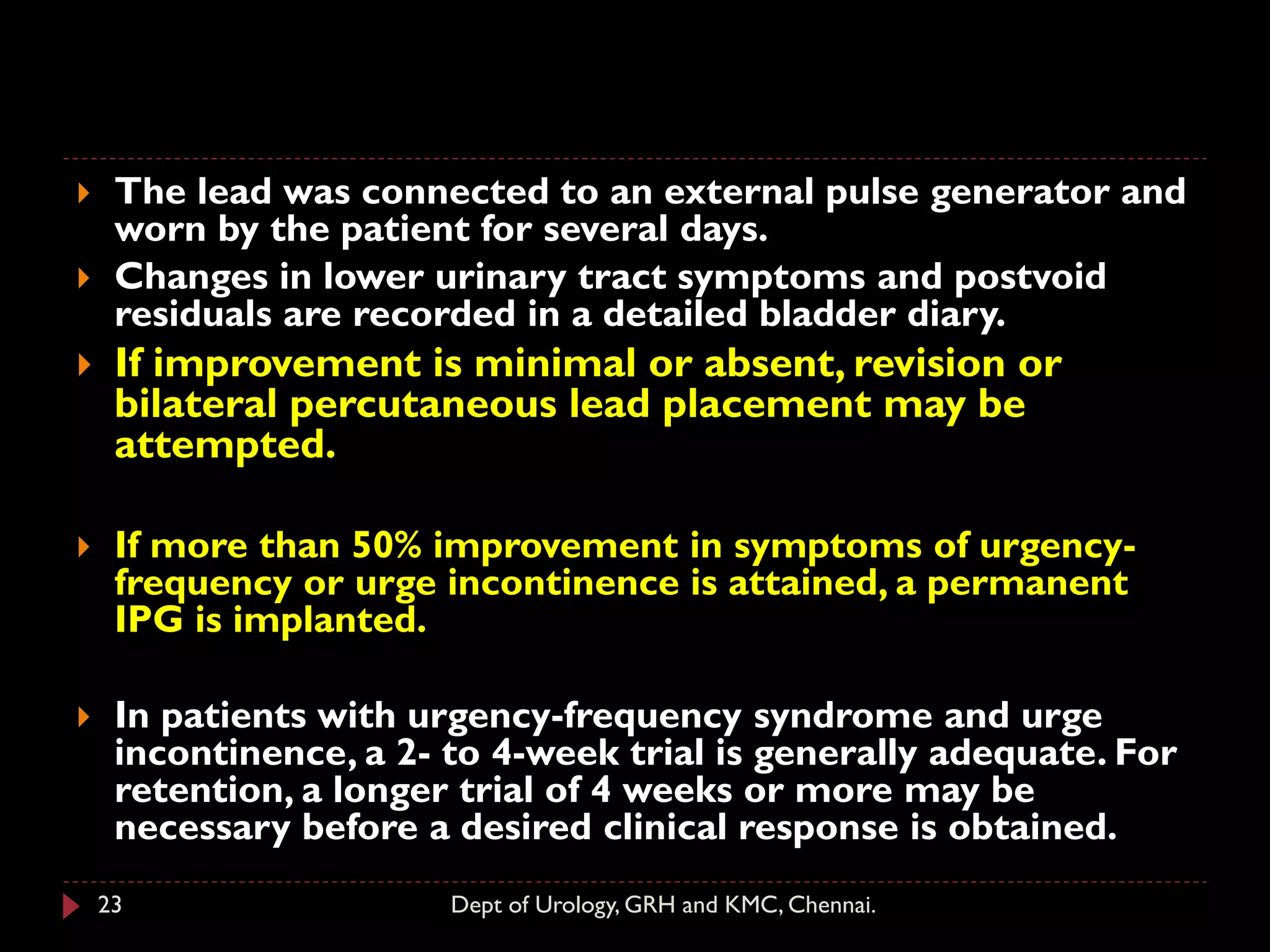
 The lead was connected to an external pulse generator and
worn by the patient for several days.
 Changes in lower urinary tract symptoms and postvoid
residuals are recorded in a detailed bladder diary.
 If improvement is minimal or absent, revision or
bilateral percutaneous lead placement may be
attempted.
 If more than 50% improvement in symptoms of urgency-
frequency or urge incontinence is attained, a permanent
IPG is implanted.
 In patients with urgency-frequency syndrome and urge
incontinence, a 2- to 4-week trial is generally adequate. For
retention, a longer trial of 4 weeks or more may be
necessary before a desired clinical response is obtained.
23 Dept of Urology, GRH and KMC, Chennai.
 Implantation of the percutaneous lead easier and
less prone to migration.
 The false-positive rate of the screening trial is
reduced when placement of a permanent lead
with reliable fixation during the screening trial
ensures that the same location of stimulation is
achieved when the IPG is implanted.
24 Dept of Urology, GRH and KMC, Chennai.
The tined lead is introduced typically into the S3
nerve foramen.
The “tines” allow the lead to be fixed into the fascial
layers above the sacrum.
This lead has a quadripolar configuration (four
contact points).
25 Dept of Urology, GRH and KMC, Chennai.
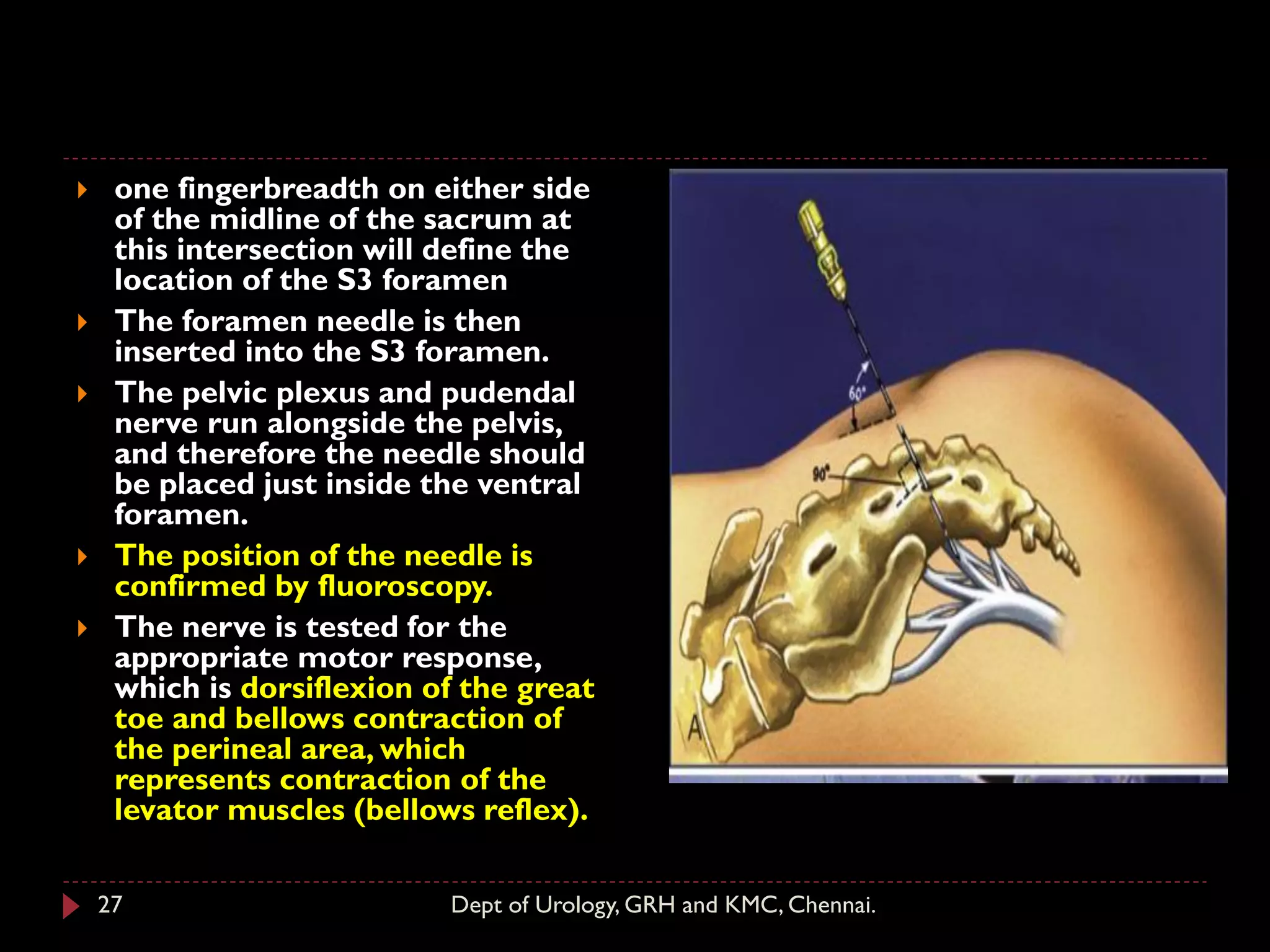
 Prone position, buttocks are
held apart by wide tape
retraction so that the anus is
visible during test stimulation.
 The location of the S3
foramen is approximated by
measuring approximately 9
cm cephalad to Coccyx or 11
cm from anus and 1 to 2 cm
lateral to the midline on
either side.
 Also be localized by palpating
the cephalad portions of the
sciatic notches bilaterally and
drawing a connecting line that
intersects the midline of the
sacrum;
26 Dept of Urology, GRH and KMC, Chennai.
 one fingerbreadth on either side
of the midline of the sacrum at
this intersection will define the
location of the S3 foramen
 The foramen needle is then
inserted into the S3 foramen.
 The pelvic plexus and pudendal
nerve run alongside the pelvis,
and therefore the needle should
be placed just inside the ventral
foramen.
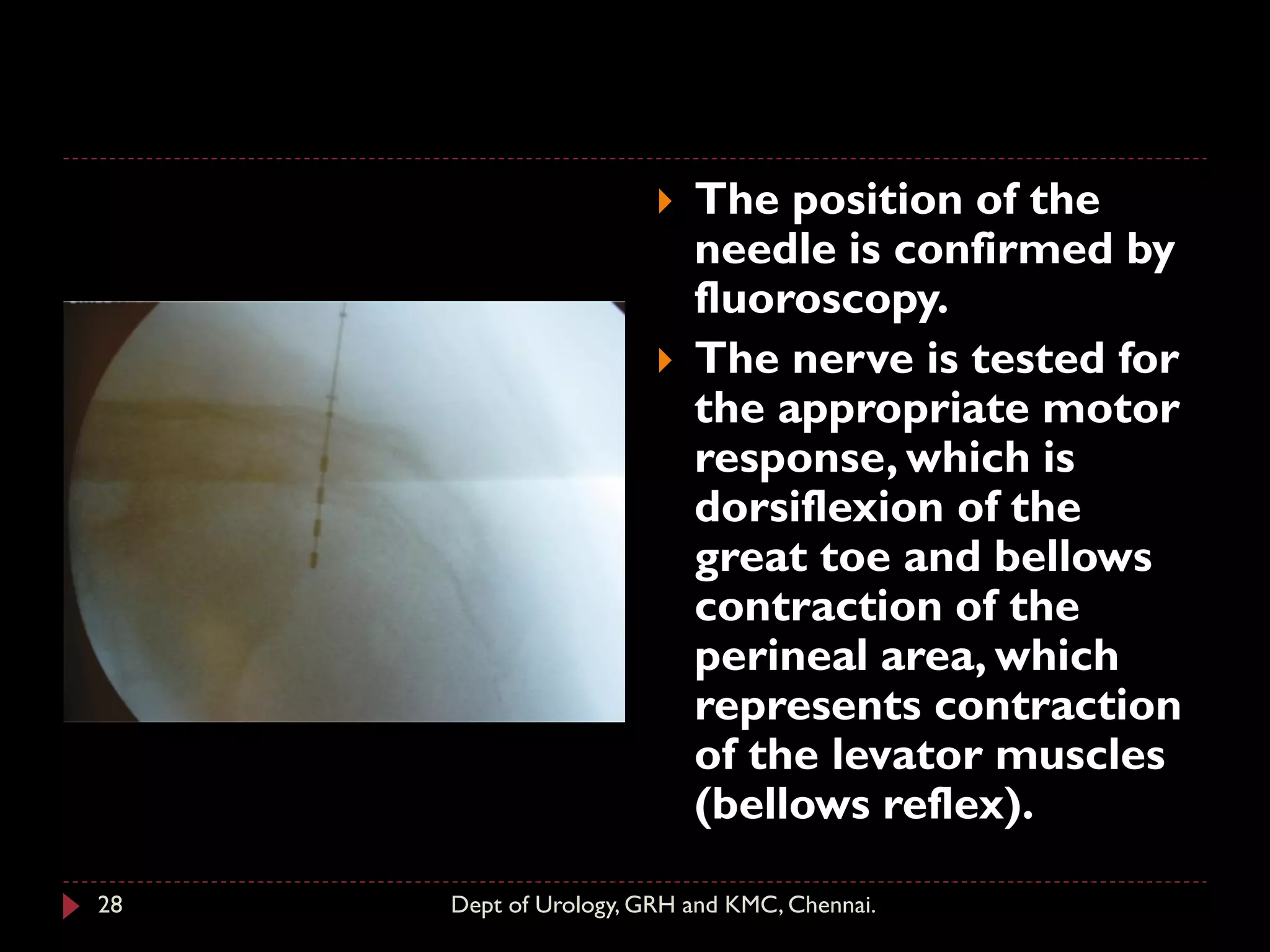
 The position of the needle is
confirmed by fluoroscopy.
 The nerve is tested for the
appropriate motor response,
which is dorsiflexion of the great
toe and bellows contraction of
the perineal area, which
represents contraction of the
levator muscles (bellows reflex).
27 Dept of Urology, GRH and KMC, Chennai.
 The position of the
needle is confirmed by
fluoroscopy.
 The nerve is tested for
the appropriate motor
response, which is
dorsiflexion of the
great toe and bellows
contraction of the
perineal area, which
represents contraction
of the levator muscles
(bellows reflex).
28 Dept of Urology, GRH and KMC, Chennai.
 The foramen needle stylet is removed and replaced with
the introducer sheath.
 The distal aspect of the lead consists of four electrodes
numbered 0 through 3.
 The lead is placed into the introducer sheath as directed to
expose the electrodes.
 Typically, electrodes are positioned such that electrodes 2
and 3 straddle the ventral surface of the sacrum
 Test stimulation is repeated on each electrode, and the
responses are observed.An S3 response should be noted on
at least two of the electrodes
 Once the surgeon is satisfied with the position, the sheath
is removed, releasing the tines that anchor the lead.A
sensory response, sensation of stimulation in the perineum,
is not needed to confirm proper placement if the correct
S3 motor response is observed.
29 Dept of Urology, GRH and KMC, Chennai.
 A 3- to 4-cm incision into the subcutaneous tissues in the upper
lateral buttock is made below the beltline or below the level of
the ischial wings for connecting the permanent lead to the
percutaneous extension lead wire.
 If the screening trial is successful, this connection site will be the
site of implantation for the IPG.
 With use of the tunneling device provided in the commercial kit,
the permanent lead is transferred to the medial aspect of the
lateral buttock incision.
 The lead is then connected to the extension wire, and the
tunneling device is used again to transpose the extension wire
from the medial aspect of the incision to an exit point on the
contralateral side of the back.
 This transfer and long tunnel reduce the occurrence of infection
from the percutaneous exit site of the wire.
 The extension wire is connected to the external pulse generator.
 Patients are able to resume their normal activities immediately
30 Dept of Urology, GRH and KMC, Chennai.
 A stage II procedure entails placement of the IPG.
 No fluoroscopy is required during stage II when a
permanent neuroelectrode has been placed for the stage I
procedure;
 The patient may be placed in the prone position or a
lateral position with the site of the previous lateral incision
for the lead connections placed upward
 The previous buttock incision overlying the lead
connections is opened, the percutaneous extension wire is
removed, and the extension lead is secured to the
permanent lead and subsequently to the IPG.
 A pocket is made in the subcutaneous tissue that is large
enough to avoid tension on closure and at a depth to
provide a covering layer of subcutaneous tissue anterior to
the pulse generator to prevent erosion.
31 Dept of Urology, GRH and KMC, Chennai.
A 3- to 4-cm counterincision in the
upper gluteal crease is made for a deep
subcutaneous pocket to allow
implantation of the IPG.
32 Dept of Urology, GRH and KMC, Chennai.
 Outcomes
 47%completely dry, and
 29% more than 50% reduction in incontinence
episodes.
 Complications were IPG site
 pain in 16%,
 implant infections in 19%, and
 lead migration in 7%.
33 Dept of Urology, GRH and KMC, Chennai.
 The current expansion of indications for
neuromodulation has developed into areas of
 neurogenic bladder (Parkinson's disease, multiple
sclerosis, spinal cord injury),
 interstitial cystitis (painful bladder syndrome),
 pelvic pain,
 fecal incontinence and bowel disorders, and
 pediatric voiding dysfunction.
34 Dept of Urology, GRH and KMC, Chennai.
Bilateral Stimulation and
Neuromodulation
 In failed unilateral lead placements, for potential
salvage or added benefit as the bladder receives
bilateral innervation
 There has been only one clinical study to
demonstrate the differences in unilateral versus
bilateral stimulation ( Scheepens et al, 2002 ).
 there will be subgroups that may benefit more
than others (e.g., retention patients), but larger
scale studies with good methodology as shown in
the Scheepens study will be required.
35 Dept of Urology, GRH and KMC, Chennai.
Selective Nerve Stimulation
Pudendal Nerve
 The Bion device[*] is a minimally invasive
implantable ministimulator with an integrated
electrode for nerve neuromodulation.
 Early feasibility trial results of the Bion device
placed at the level of the pudendal nerve exiting
Alcock's canal indicate that a considerable
reduction in the degree of detrusor overactivity
incontinence can be obtained in refractory cases,
including those cases of failed SNS
neuromodulation ( Bosch, 2005 ).
 Clinical trials of the rechargeable Bion device are
under way in the United States and Europe.
36 Dept of Urology, GRH and KMC, Chennai.
Dorsal Genital Nerve
 The dorsal genital nerves (dorsal nerve of the penis in males,
clitoral nerve in females) are the terminal and most superficial
branches of the pudendal nerve found at the level of the
symphysis pubis.
 The nerves are afferent nerves that carry sensory information
from the glans of the penis or clitoris.
 Proximally, the dorsal genital nerves form a component of the
pudendal nerve and then the sacral spinal roots.
 As a pure sensory afferent nerve branch of the pudendal nerve,
the dorsal genital nerve contributes to the pudendal-pelvic nerve
reflex that has been proposed as a mechanism of bladder
inhibition.
 Whereas squeezing the glans penis or manipulation of the clitoris
is clinically known to help suppress bladder contractions as
observed in behaviors of voiding avoidance
 direct dorsal genital nerve electrical stimulation in experimental
and clinical studies appears promising in producing an inhibition
of the micturition reflex.
37 Dept of Urology, GRH and KMC, Chennai.
 Stimulation of the dorsal penile nerve has been tested
in humans to control incontinence in individuals with
spinal cord injury and increase bladder volume and
reduce bladder overactivity
 Electrical stimulation of the dorsal genital nerves can
abolish detrusor overactivity and increase bladder
capacity in individuals with neurogenic detrusor
overactivity due to spinal injury.
 Feasibility trials with MEDStim,[*] an implantable
neuroelectrode and pulse generator, are under way to
determine the optimal stimulation parameters that
have limited its application in the past for increasing
bladder capacity and treating the symptoms of
idiopathic detrusor overactivity in otherwise healthy
persons.
38 Dept of Urology, GRH and KMC, Chennai.
Posterior Tibial Nerve
 The posterior tibial nerve is a mixed sensory and motor nerve
containing fibers originating from spinal roots L4 through S3 that
modulate the somatic and autonomic nerves to the pelvic floor muscles,
bladder, and urinary sphincter.
 On the basis of translational findings of the traditional Chinese practice
of using acupuncture points over the common peroneal or posterior
tibial nerve to inhibit bladder activity,
 McGuire and associates (1983) used transcutaneous stimulation of the
common peroneal or posterior tibial nerve for inhibition of detrusor
overactivity.
 PTNS[†] as approved by the FDA currently consists of weekly 30-minute
stimulation treatments provided by insertion of a small-gauge
stimulating needle approximately 5 cm cephalad from the medial
malleolus and just posterior to the margin of the tibia with the
grounding electrode pad placed on the medial surface of the calcaneus
 PTNS is minimally invasive, demonstrates efficacy, and is easily applicable
and well tolerated in all the lower urinary tract conditions studied.
39 Dept of Urology, GRH and KMC, Chennai.
ELECTRICAL STIMULATION FOR
EMPTYING DISORDERS
 Electrical Stimulation Directly to the Bladder or
Spinal Cord
 Direct electrical stimulation was most effective in
patients with hypotonic and areflexic bladders.
 Initial success, defined as low postvoid residual
urine volume with sterile urine, was achieved in
only 50% to 60% of patients, and secondary failure
often supervened, usually related to fibrosis,
electrode malfunction, bladder erosion, or other
equipment malfunction.
40 Dept of Urology, GRH and KMC, Chennai.
 Electrical Stimulation to the Nerve Roots
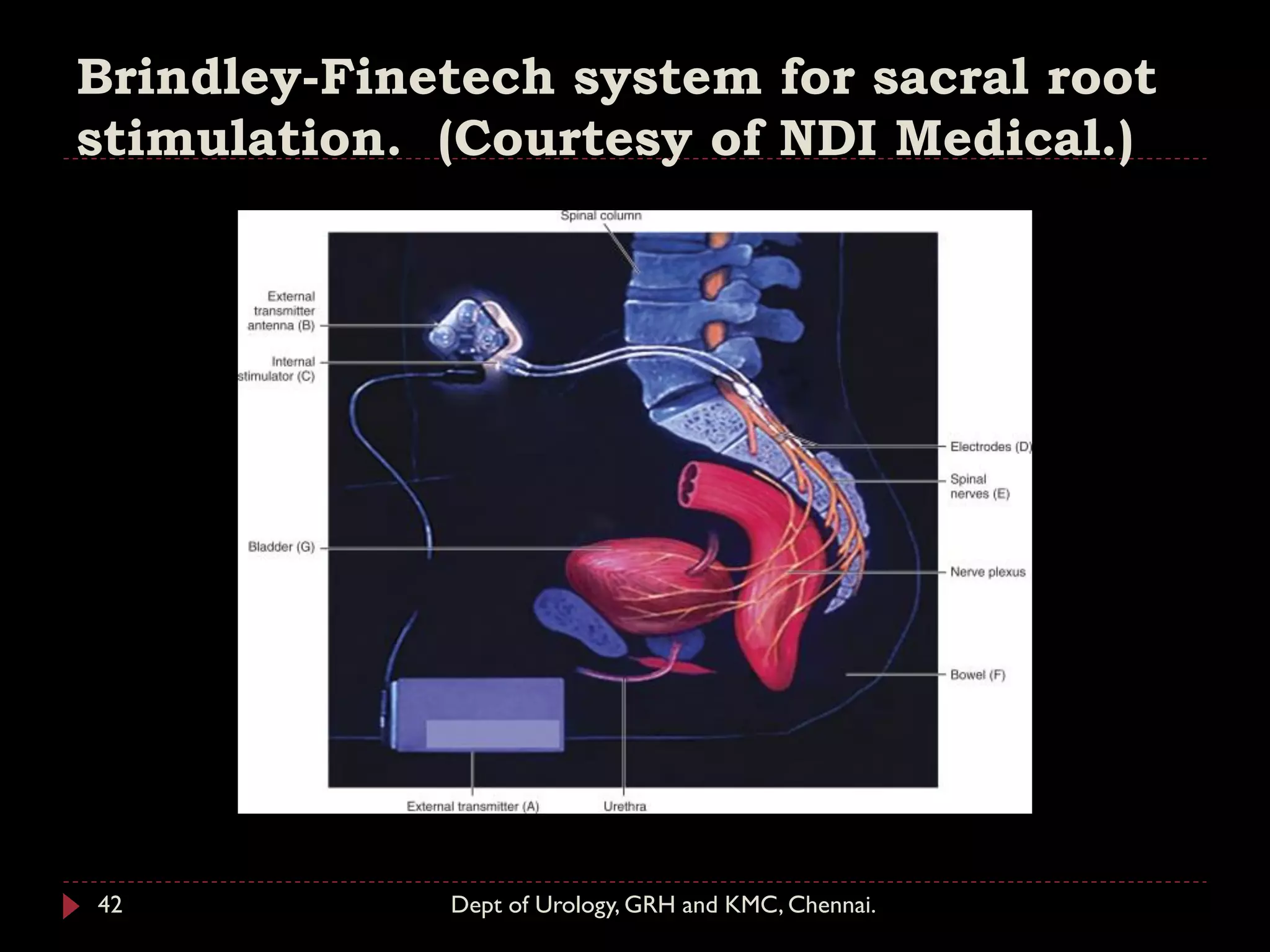
 The Brindley device is the one most commonly
used.
 Prerequisites for such use as
 (1) intact neural pathways between the sacral
cord nuclei of the pelvic nerve and the bladder
and
 (2) a bladder that is capable of contracting.
 The chief applications are in patients with
inefficient or nonreflex micturition after spinal
cord injury.
41 Dept of Urology, GRH and KMC, Chennai.
Brindley-Finetech system for sacral root
stimulation. (Courtesy of NDI Medical.)
42 Dept of Urology, GRH and KMC, Chennai.
TO FACILITATE BLADDER FILLING/URINE STORAGE
Bladder Overdistention
 Therapeutic overdistention involves prolonged
stretching of the bladder wall using a hydrostatic
pressure equal to systolic blood pressure.
 Improvement, when it occurs, is generally
attributable to ischemic changes in the nerve
endings or terminals in the bladder wall.
 Potential complications include bladder rupture
(5% to 10%), hematuria, and retention.
 Although there was an increase in mean bladder
capacity after treatment, of the 28 women treated
only 4 (15%) had any improvement in symptoms
at 9 months.
43 Dept of Urology, GRH and KMC, Chennai.
Acupuncture
 Acupuncture compositely describes a number of
procedures involving stimulation of anatomic locations on
the skin by a variety of techniques.
 It is thus a form of somatic sensory stimulation, the most
common techniques of which involve stimulation of certain
“acupuncture points” by means of penetration of the skin
by thin solid metallic needles that are manipulated
manually or electrically stimulated.
 The techniques of classic acupuncture seem to merge with
other forms of peripheral electrical stimulation to inhibit
bladder contractility, such as the posterior tibial nerve
stimulation described by McGuire and coworkers (1983) .
 Philp and colleagues (1988) reported on patients who
underwent weekly acupuncture treatments for 10 to 12
weeks.
44 Dept of Urology, GRH and KMC, Chennai.
 Mechanisms of action for acupuncture, the authors
hypothesize any one or a combination of
 (1) endorphinergic effects at the sacral spinal cord level or
above,
 (2) inhibitory somatovesical reflexes, and
 (3) increase in peripheral circulation.
 More recently, Emmons and Otto (2005) compared
acupuncture versus placebo acupuncture in the treatment
of women with overactive bladder and urinary urgency
incontinence.
 The number of incontinent episodes decreased by 59% in
the treatment group compared with 40% in the placebo
group.
 The treatment group had a significant improvement in
bladder capacity, urgency, frequency, and quality of life
scores compared with the placebo group.
45 Dept of Urology, GRH and KMC, Chennai.
Interruption of Innervation
 Conservative therapy for detrusor overactivity has become much
more effective, and, when this fails, denervation procedures
compete with neuromodulation and augmentation cystoplasty.
 In general, peripheral denervation is more selective but less
effective than central denervation.
 Very Central (Subarachnoid Block)
 Historically, this type of interruption convert a state of severe
somatic spasticity to flaccidity and to abolish autonomic
 Neurogenic detrusor overactivity was converted acutely to
areflexia.
 The flaccid bladder that resulted generally required additional
therapy to empty or required clean intermittent catheterization
(CIC).
 Disadvantage of this type of procedure is
 1. lack of selectivity, with unintended motor or sensory loss other
than related to the bladder.
 2.Decreased compliance often developed in such patients,
resulting in significant storage problems.
46 Dept of Urology, GRH and KMC, Chennai.
Less Central (Sacral Rhizotomy, Selective
Sacral Rhizotomy)
 In most cases, bilateral anterior and posterior sacral
rhizotomy or conusectomy converts an overactive
bladder to an areflexic one.
 This adversely affects the rectum, anal and urethral
sphincters, sexual function, and the lower extremities.
 Selective motor nerve sectioning was originally
introduced as a treatment to increase bladder
capacity by abolishing only the motor supply
responsible for involuntary contractions in an attempt
to leave sphincter and sexual function intact.
 To enhance the clinical response and to minimize side
effects, differential sacral rhizotomy should always be
preceded by stimulation and blockade of the individual
sacral roots with cystometric and sphincterometric
control.
47 Dept of Urology, GRH and KMC, Chennai.
 Brindley (1994) summarizes
 the advantages of bilateral posterior sacral
rhizotomy in treating voiding dysfunction after
SCI as
 (1) abolishing reflex incontinence,
 (2) improving compliance, and
 (3) abolishing striated sphincter dyssynergia
without altering resting tone.
 Partial or selective procedures are considered
only in such patients who retain some sensation
or have excellent reflex erections.
48 Dept of Urology, GRH and KMC, Chennai.
 Madersbacher (2000) comments that
 posterior sacral rhizotomy for sacral
deafferentation of the bladder is best achieved by
the intradural approach
 advantage -motor and sensory fibers can easily be
separated
 If an intradural procedure is not possible, he
believes that a deafferentation at the level of the
conus medullaris is preferable to an extradural
sacral approach.
 Incontinence was abolished in 90% of these
patients.
49 Dept of Urology, GRH and KMC, Chennai.
Peripheral and Perivesical Bladder
Denervation
 Transvaginal partial denervation of the bladder
was originally described by Ingelman-Sundberg in
1959 .This procedure has been used mostly for the
treatment of refractory urge urinary incontinence;
50 Dept of Urology, GRH and KMC, Chennai.
Cystolysis
 Extensive perivesical dissection and
 mobilization with division of the superior vesical
pedicle and the ascending branches of the inferior
vesicle pedicle. Some initial reports were very
promising for relief of both pain
51 Dept of Urology, GRH and KMC, Chennai.
Bladder transection
 A complete circumferential division of the full
thickness of the bladder wall at a level just above
the ureteric orifices
 Success rates in excess of 50% for at least
detrusor overactivity,
 a long-term subjective success rate of 65%. Only
35% of those who claimed to be symptomatically
cured had reverted to urodynamically stable
detrusor behavior
52 Dept of Urology, GRH and KMC, Chennai.
Augmentation Cystoplasty
 Suffice it to say here that positive results have been
obtained in up to 90% of patients with neurogenic
lower urinary tract dysfunction and also in patients
with bladders of limited capacity secondary to other
problems, such as tuberculous cystitis, for which the
procedure was used initially.
 Emptying failure -perform CIC,
 augmentation cystoplasty
 (enterocystoplasty, autoaugmentation,
ureterocystoplasty
 New considerations include the possibility of creating
new functional bladder segments by tissue
engineering, using selective cell transplantation,
expansion in culture, attachment to a support matrix,
and reimplantation after expansion
53 Dept of Urology, GRH and KMC, Chennai.
Bladder Outlet Reconstruction
 Reconstruction of the bladder outlet is one method of restoring sphincteric
continence in patients with a fixed, open bladder outlet.
 This technique was introduced for the treatment of urinary incontinence by Hugh
HamptonYoung in 1907 and was subsequently modified by Dees, Leadbetter, and
Tanagho.
 Procedures using theYoung-Dees principle involve construction of a
neourethra from the posterior surface of the bladder wall and trigone.
 In the male, the prostatic urethra affords additional substance for closure and
increase in outlet resistance.
 The Leadbetter modification involves proximal reimplantation of the
ureters to allow more extensive tubularization of the trigone.

 Tanagho (1981) has described a procedure based on a similar concept
but using the anterior bladder neck to create a functioning neourethral
sphincter.
 Long-term success rates of between 60% and 70% have been reported (
Leadbetter, 1985 ), but it is difficult to know what success means and what the
true rates of success are, using a contemporary definition.
54 Dept of Urology, GRH and KMC, Chennai.
55 Dept of Urology, GRH and KMC, Chennai.
Myoplasty for Functional Sphincter
Reconstruction
 Deming (1926) first reported the use of the gracilis muscle, transposed
around the urethra, for the treatment of sphincteric incontinence.
 In this “unstimulated” myoplasty, reliance is placed on the patient's own
voluntary contraction (adduction of the leg) to provide sphincteric
continence.
 Stenzl (1998) describes unstimulated graciloplasty as an innovative idea
but one that was associated with a number of problems:
 (1) the need for uncomfortable prolonged adduction of the leg to
maintain sphincteric contraction;
 (2) unsatisfactory sustained muscle contraction caused by the high
content of fast-twitch, non–fatigue-resistant fibers;
 (3) loss of resting tension after dissection of the muscle, resulting in
reduced contractility;
 (4) passive obstruction; and
 (5) the risk of fibrosis because the minor pedicles supplying the caudal
segment of the gracilis are severed.
56 Dept of Urology, GRH and KMC, Chennai.
 To overcome these problems, electrical stimulation
through electrodes implanted into the muscle was
developed and reported on by Janknegt and associates
(1995) .
 The electrical stimulation program used parameters
to transform fatigable type 2 skeletal muscle fibers to
slow type 1 fibers, able to sustain a long-lasting
contraction. Only three patients are described as
having “good results,”
 Palacio and coworkers (1998) , using female dogs,
described by using a free but innervated flap of well-
vascularized (only) proximal gracilis muscle that
apparently is easily transposable to the urethra
because of its smaller size. Stimulation of the
sphincter is carried out through the graft's own motor
innervation.
57 Dept of Urology, GRH and KMC, Chennai.
Urinary Diversion
 Indications may include
 (1) Progressive hydronephrosis and intractable upper
tract dilatation
 (2) Recurrent episodes of urosepsis; and
 (3) Intractable filling/storage or emptying failure when
CIC is impossible.
 cutaneous vesicostomy in children,
 cutaneous incontinent diversion at the level of the
bladder can be accomplished without the need for
ureteral reimplantation by an ileovesicostomy or
“chimney” procedure.
 Continent diversion requires that the patient be able
to perform CIC
58 Dept of Urology, GRH and KMC, Chennai.
The Artificial Bladder
 The goals as a structure that will provide adequate urine storage with
complete volitional evacuation of urine while preserving renal function.
 The structure of the artificial bladder must be biocompatible and
resistant to urinary encrustation and tolerant to bacterial infection.
 Desirable guidelines for future designs as follows:
 1. Direct anastomoses between living tissue and the prosthesis should
be as limited as possible.
 2. A composite structure reservoir is preferable, one that will prove
resistant to long-term encrustation, allow tissue penetration to ensure
watertight anastomoses, and reduce the risks of urinary leaks.
 3. Active reservoir filling and emptying are necessary; ureteral
peristalsis alone is unable to ensure reliable filling of an artificial flexible
bladder; gravity alone is insufficient to ensure complete emptying.
 4. New technologies will be necessary to resolve infection and
encrustation problems
59 Dept of Urology, GRH and KMC, Chennai.
TO FACILITATE BLADDER
EMPTYING
60 Dept of Urology, GRH and KMC, Chennai.
Reduction Cystoplasty
 Myogenic decompensation of the bladder with persistently
large amounts of residual urine exist with megacystis .
 Because the chronic overstretching affects mainly the
upper “free” part of the bladder and because the nerve and
vessel supply enters primarily from below, resection of the
dome does not influence the function of the spared bladder
base and lower bladder body
 Hanna (1982) procedure involved creating a laterally based
mucosa-free detrusor pedicle flap and wrapping this flap
around the body of the bladder, thus doubling the muscle
bulk while reducing the bladder size.
 the operation “has helped to improve voiding and minimize
infection during early childhood but it does not seem to
decrease bladder capacity or improve voiding dynamics in
the long term.”
61 Dept of Urology, GRH and KMC, Chennai.
Bladder Myoplasty
 Transfer of an innervated free striated muscle flap has proved to be a
valuable adjunct in the reconstructive repair of various types of
functional deficits.
 Restoration of voluntary emptying of the bladder with a wrap of
skeletal muscle, in this case rectus abdominis
 a microneurovascular free transfer of autologous latissimus dorsi
muscle to the bladder to restore contractility.
 In this surgery, the main neural and vascular supply to the latissimus
dorsi was anastomosed to the lowermost motor nerve supplying the
rectus abdominis and to the inferior epigastric vessels.
 The transferred muscle was wrapped around the bladder with
longitudinal tension and a slightly spiral configuration, ultimately
covering about 75% of the mobilized bladder and leaving only the area
of the trigone and the lateral pedicles uncovered. Patients were
instructed to empty their bladders by actively contracting the lower
abdominal musculature.
62 Dept of Urology, GRH and KMC, Chennai.
 2.anastomosing the thoracodorsal nerve to the obturator
nerve and the vascular supply to the external iliac vessels.The
graft was then stimulated by electrodes connected to the
anastomosed neural supply and with direct muscle stimulation.
 stimulation being achieved with electrodes inserted into the
muscle near the nerve entrance.
 3.The use of myoblasts as a vehicle for gene delivery to
muscles.
 myoblast-mediated ex vivo gene transfer, with observations of
long-term survival of the injected myoblasts in the bladder and
with preliminary histochemical evidence that, after injection,
these skeletal myoblasts can differentiate into smooth muscle.
63 Dept of Urology, GRH and KMC, Chennai.
Decreasing Outlet Resistance at a
Site of Anatomic Obstruction
64 Dept of Urology, GRH and KMC, Chennai.
Transurethral Resection or Incision of the
Bladder Neck
 Emmett performed the first transurethral bladder
neck resection for neurogenic lower urinary tract
dysfunction in 1937,
 The operation was originally performed primarily
in two types of neurogenic patients:
 (1) those with weak or absent detrusor
contractions and
 (2) those with anatomic or functional obstruction
at the level of the bladder neck and/or proximal
urethra, which prevented emptying either with
abdominal straining or with a sustained detrusor
contraction.
65 Dept of Urology, GRH and KMC, Chennai.
 The prime indication for transurethral resection
or incision of the bladder neck
 1.Demonstration of true obstruction at the
bladder neck or proximal urethra by urodynamic
studies demonstrate obstruction
 A.either with fluoroscopic demonstration of
failure of opening of the smooth sphincter area
 B. or with a micturitional (urethral pressure)
profile showing that the pressure falls off sharply
at some point between the bladder neck and the
area of the striated sphincter.
66 Dept of Urology, GRH and KMC, Chennai.
 The preferred technique at this
time is incision of the bladder
neck at the 5 and/or 7 o'clock
position:
 a single full-thickness incision
extending from the bladder base
down to the level of the
verumontanum.
 deepening the incision until
pinpoints of reflected light reveal
minute interstitial fat globules
between the latticework of the
residual prostatic capsule fibers.
 Most people would place the
incidence of retrograde or
diminished ejaculation
somewhere between the
reported incidences of 15% to
50%.
67 Dept of Urology, GRH and KMC, Chennai.
YV-Plasty of the Bladder Neck
 only when a bladder neck resection or incision was
desired and an open surgical procedure was
simultaneously required to correct a concomitant
disorder.
 This procedure, a revision of only the anterior
bladder neck, because the posterior bladder neck
is untouched.
 Because it is rarely carried out at this time, there
is little information on results
68 Dept of Urology, GRH and KMC, Chennai.
Decreasing Outlet Resistance at
the Level of the Striated
Sphincter
Pharmacologic Sphincterotomy
Surgical sphincterotomy
69 Dept of Urology, GRH and KMC, Chennai.
Pharmacologic Sphincterotomy
 Botulinum A toxin (Botox) is an inhibitor of acetylcholine release
at the neuromuscular junction of somatic nerves on striated
muscle.
 the use of small injected doses has been successful in the
management of focal dystonia, skeletal muscle spasms and
spasticity, and, more recently, of wrinkles maintained by the
contraction of small muscle fibers in the face.
 It produces enough weakness of the muscle to prevent or
considerably ameliorate spasm or involuntary contraction but
not to completely block voluntary control,
 Its urologic use for the treatment of detrusor striated sphincter
dyssynergia was first reported by Dykstra and colleagues (
Dykstra and Sidi, 1990 ; Dykstra et al, 1998 ).
 Injections were carried out weekly for 3 weeks, achieving a
duration of effect averaging 2 months.
 The only side effects transitory limb paresis and transitory
exacerbation of autonomic hyperreflexia.
70 Dept of Urology, GRH and KMC, Chennai.
Surgical Sphincterotomy
 The primary indication
 Detrusor striated sphincter dyssynergia in a male
patient when other types of management have been
unsuccessful or are not possible.
 A substantial improvement in bladder emptying was
classically reported in 70% to 90% of cases
 Upper tract deterioration was rarely reported after
successful sphincterotomy.
 Vesicoureteral reflux, disappears because of decreased
bladder pressures and a reduced incidence of infection
in a catheter-free patient with a low residual urine
volume.
 An external collecting device is generally worn
postoperatively,
71 Dept of Urology, GRH and KMC, Chennai.
 Sphincterotomy can be performed by use of a knife
electrode, resection with a loop electrode, or laser
ablation.
 The incision must extend from the level of the
verumontanum at least to the bulbomembranous
junction.
 Gradual deepening of the incision allows good visual
control and minimizes the chance of significant
hemorrhage and extravasation.
 When early failure occurs, it is generally attributable
to an inadequate surgical procedure (either not deep
enough or not extensive enough), inadequate detrusor
function, and bladder neck or prostatic obstruction.
72 Dept of Urology, GRH and KMC, Chennai.
 The 12-o'clock sphincterotomy, originally
proposed by Madersbacher and Scott (1975) ,
remains the procedure of choice
 The anatomy of the striated sphincter is such that
its main bulk is anteromedial.
 The blood supply is primarily lateral, and thus
there is little chance of significant hemorrhage
with a 12-o'clock incision.
 Complications
 5% ED
 hemorrhage (5% to 20%) and
 urinary extravasation.
73 Dept of Urology, GRH and KMC, Chennai.
 Long-term follow-up SCI patients who had undergone
sphincterotomy.
 The procedure was judged a failure because of any or all of
 (1) the presence of large postvoid residual urine volumes
associated with urinary tract infections;
 (2) autonomic hyperreflexia symptomatology associated with
bladder overdistention or high voiding pressures; and
 (3) progressive upper tract deterioration from persistent reflux
or poor bladder emptying.

 Causes for failure included
 recurrent striated sphincter dyssynergia,
 the development of a poorly contractile bladder,
 bladder neck contracture,
 stricture in the area of the sphincterotomy,
 incomplete sphincterotomy and
 unknown causes.
74 Dept of Urology, GRH and KMC, Chennai.
Urethral Overdilatation
 Urethral overdilatation to 40 to 50 Fr in females can
achieve the same objective as external
sphincterotomy in males.
 In young boys, when sphincterotomy is contemplated,
a similar stretching of the posterior urethra can be
accomplished through a perineal urethrostomy,
obviating or postponing the need for normal
sphincterotomy.
 After dilatation, the intravesical pressures decreased
and upper tract function and bladder compliance
improved.There was no discernible effect on
continence.
75 Dept of Urology, GRH and KMC, Chennai.
 Balloon dilatation of the external urethral sphincter
 Using balloon dilatation to 90 Fr at 3 atm,
 A significant decrease in detrusor leak point pressure
and residual urine occurred.
 Bladder capacity remained constant,
 renal function stabilized or improved, and
 autonomic hyperreflexia improved.
 Balloon dilatation –
shorter surgery and hospitalization and less of a
decrease in hemoglobin
 Sphincter activity was initially abolished in all patients,
and reflux, which was present in 1 patient, resolved.
 Long term- 85% overall failure rate and a 62% failure
rate within 1 year.
76 Dept of Urology, GRH and KMC, Chennai.
Urethral Stent Prosthesis
 with the use of the UroLume stent
 A significant decrease in detrusor leak pressure and
residual urine volume occurred.
 18 % required more than one procedure to adequately
cover the sphincter with the prosthesis.
 Three months after,
 hyperplasia within the lumen
 bladder neck obstruction
 A stent prosthesis is as effective, easier, less morbid,
and less expensive.
77 Dept of Urology, GRH and KMC, Chennai.
 Mean voiding pressure decreased from 75.1 cm
H2O to 37.4 cm H2O at year 1, and this decrease
seemed to be maintained at up to 5 years (mean
of 44.2 cm H2O in 41 patients followed for that
period).
 Residual urine volume decreased, and this
decrease was maintained for 5 years.
 Advantage to a sphincter stent is that it is
potentially reversible.
 Disadvantage
 Stent migration
 bladder neck obstruction
78 Dept of Urology, GRH and KMC, Chennai.
 Long-term treatment for striated sphincter
dyssynergia in the majority of patients- either
surgical sphincterotomy or stenting as the surgical
treatments of choice for this condition.
79 Dept of Urology, GRH and KMC, Chennai.
Pudendal Nerve Interruption
 First described in 1899 by Rocket
 This method is seldom used today because of the
potential of undesirable effects consequent to
even a unilateral nerve section.
 Bilateral nerve section results in an extremely
high rate of male impotence and may result in
fecal and severe stress urinary incontinence.
80 Dept of Urology, GRH and KMC, Chennai.
81 Dept of Urology, GRH and KMC, Chennai.

Bladder neurogenic- management- surgical

  • 1.
    Surgical management of NeurogenicBladder Dept of Urology Govt Royapettah Hospital and Kilpauk Medical College Chennai 1
  • 2.
    Moderators: Professors:  Prof. Dr.G. Sivasankar, M.S., M.Ch.,  Prof. Dr.A. Senthilvel, M.S., M.Ch., Asst Professors:  Dr. J. Sivabalan, M.S., M.Ch.,  Dr. R. Bhargavi, M.S., M.Ch.,  Dr. S. Raju, M.S., M.Ch.,  Dr. K. Muthurathinam, M.S., M.Ch.,  Dr. D.Tamilselvan, M.S., M.Ch.,  Dr. K. Senthilkumar, M.S., M.Ch. Dept of Urology, GRH and KMC, Chennai. 2
  • 3.
    Treatment Detrusor overactivity Neuromodulation Augmentationenterocystoplasty[*] Autoaugmentation[*] Denervation procedures Urinary diversion Low bladder compliance Augmentation enterocystoplasty[*] Autoaugmentation[*] Denervation Procedures Sphincteric dysfunction Surgery Midurethral sling Pubovaginal sling Urethral/colposuspension Artificial urinary sphincter 3 Dept of Urology, GRH and KMC, Chennai.
  • 4.
    Therapy to FacilitateBladder Emptying/Voiding  Bladder Related (Increasing Intravesical Pressure or Facilitating Bladder Contractility)  Electrical stimulation Directly to the bladder or spinal cord Directly to the nerve roots Intravesical (transurethral) Neuromodulation  Reduction cystoplasty  Bladder myoplasty (muscle wrap) 4 Dept of Urology, GRH and KMC, Chennai.
  • 5.
     Outlet Related(Decreasing Outlet Resistance)  At a site of anatomic obstruction  Prostatectomy,  prostatotomy (diathermy, heat, laser)  Bladder neck incision or resection  Urethral stricture repair or dilation  Intraurethral stent  Balloon dilatation of stricture/contracture 5 Dept of Urology, GRH and KMC, Chennai.
  • 6.
    At level ofsmooth sphincter  Transurethral resection or incision  Y-V plasty At level of striated sphincter  Surgical sphincterotomy  Urethral stent  Pudendal nerve interruption  Urinary diversion (conduit) 6 Dept of Urology, GRH and KMC, Chennai.
  • 7.
    Therapy to FacilitateUrine Storage/Bladder Filling  Bladder Related (Inhibiting Bladder Contractility, Decreasing Sensory Input and/or Increasing Bladder Capacity)  Electrical stimulation and neuromodulation  Acupuncture and electroacupuncture  Interruption of innervation  Very central (subarachnoid block)  Less central (sacral rhizotomy, selective sacral rhizotomy)  Peripheral motor or/and sensory  Augmentation cystoplasty (auto, bowel, tissue engineering) 7 Dept of Urology, GRH and KMC, Chennai.
  • 8.
     Outlet Related(Increasing Outlet Resistance)  Vesicourethral suspension ± prolapse repair (female)  Sling procedures ± prolapse repair (female)  Closure of the bladder outlet  Artificial urinary sphincter  Bladder outlet reconstruction  Myoplasty (muscle transposition)  Urinary diversion 8 Dept of Urology, GRH and KMC, Chennai.
  • 9.
    HISTORY OF ELECTRICALSTIMULATION  Magendie (1822) -the first to conduct physiologic investigations of the spinal nerve roots,  documenting in young dogs that  transection of the posterior (dorsal) segments resulted in a lack of sensation but persistence of motor function,  anterior (ventral) root transection yielded preservation of sensation yet abolishment of motor function.  These important findings created the foundation for our understanding of basic neurophysiology of micturition and led to further discoveries on bladder function in the setting of selective rhizotomy of both the pelvic and hypogastric nerves 9 Dept of Urology, GRH and KMC, Chennai.
  • 10.
    Putative Mechanism ofAction of Sacral Neuromodulation  How neuromodulation works is evolving,  Two main theories exist:  (1) direct activation of efferent fibers to the striated urethral sphincter reflexively causes detrusor relaxation and  (2) selective activation of afferent fibers causes inhibition at spinal and supraspinal levels.  Sacral neuromodulation therapy works by sacral afferent activity and concomitant activation of the somatosensory cortex. 10 Dept of Urology, GRH and KMC, Chennai.
  • 11.
    Putative Mechanism ofAction of Sacral Neuromodulation in Overactive Bladder  Suppression of interneuronal transmission in the bladder reflex pathway.  The preservation of voluntary voiding due to selective avoidance of normal sensory ascending outflow pathways of the bladder from Aδ fibers to the pontine micturition center as well as initiation of the descending pathways from the pontine micturition center to sacral efferent outflow pathways.  Sacral neuromodulation may affect and improve the abnormal bladder sensations, involuntary voids, and detrusor contractions 11 Dept of Urology, GRH and KMC, Chennai.
  • 12.
    Pudendal nerve afferentfiring can modulate and accordingly inhibit the bladder micturition reflex. SNS, sacral nerve stimulation. 12 Dept of Urology, GRH and KMC, Chennai.
  • 13.
    Putative Mechanism ofAction of Sacral Neuromodulation in Urinary Retention  Sphincteric activity can be turned off by brain pathways to allow efficient and complete bladder emptying.  If the suprasacral pathways are altered, the guarding and urethral reflexes still exist and cannot be turned off.  This may cause retention, as in the spinal cord–injured patient who in turn has detrusor-sphincter dyssynergia resulting in urinary retention.  Sacral neuromodulation may somehow turn off excitatory flow to the urethral outlet and facilitate bladder emptying. 13 Dept of Urology, GRH and KMC, Chennai.
  • 14.
    Sacral neuromodulation (SNS)can restore the normal voluntary pattern of micturition by inhibition of the spinal guarding reflex. 14 Dept of Urology, GRH and KMC, Chennai.
  • 15.
    ELECTRICAL STIMULATION FORSTORAGE DISORDERS  Criteria for Selection of Patients  Lower urinary tract symptoms and dysfunctions are secondary to a neuromuscular etiology,  a thorough history and physical examination will often reveal  the nature (acute versus chronic) and  help classify the cause (neurogenic, anatomic, postsurgical, functional, inflammatory, or idiopathic).  A urinalysis  urine cytology should be considered in patients who present with refractory symptoms of dysuria, urgency, or frequency of urination since carcinoma in situ and bladder tumors may present with irritative bladder symptoms without hematuria.  urodynamic studies  voiding diary  physical examination of the pelvis.  Electromyography is recommended in suspected cases of neurogenic bladder dysfunction, detrusor-sphincter dyssynergia, or Fowler's syndrome and may be considered for evaluation of inappropriate pelvic floor muscle behavior 15 Dept of Urology, GRH and KMC, Chennai.
  • 16.
     Cystourethroscopy -yieldinformation -diagnosis.  Anatomic lesions such as urethral stricture, bladder neck fibrosis, trabeculation, and bladder lesions have been found even in women with bladder outlet obstruction.  Baseline upper tract imaging is performed in patients with neurologic disease or, if indicated, by physical or baseline studies or a patient's history.  Sacral neuromodulation is indicated when conservative measures (such as bladder retraining, pelvic floor biofeedback, and medications) have failed Excluding patients from this therapy.  Significant anatomic abnormalities in the spine or sacrum  Mental incapacitation of patients, who cannot manage their device or judge the clinical outcome;  Functional urinary incontinence; and  Noncompliance of the patient. 16 Dept of Urology, GRH and KMC, Chennai.
  • 17.
    Relative contraindications  Teratogenicityor abortion from the effect of electrical stimulation-pregnant women  Women with electrical stimulation devices for pelvic health conditions who become pregnant may simply turn off their devices during pregnancy. 17 Dept of Urology, GRH and KMC, Chennai.
  • 18.
    Electrical Stimulation ofthe Bladder  Transurethral electrical bladder stimulation (TEBS) not only for initiating sensory awareness of bladder filling and stimulating detrusor contractility but also for increasing bladder capacity at low pressure in pediatric patients with myelomeningocele  The goal was to provide children with neurogenic bladder dysfunction, mostly secondary to spina bifida, enough sensation to detect a filling or full bladder and to have them synergistically void or catheterize in a timely manner.  The potential to increase bladder capacity while maintaining or decreasing end-filling bladder pressure (in essence, improving compliance).  Bladder capacity increased by 20%  Pressure at bladder capacity decreased by 25% 18 Dept of Urology, GRH and KMC, Chennai.
  • 19.
    Sacral Rhizotomy  Inmost cases, bilateral anterior and posterior sacral rhizotomy or conusectomy converts a hyperreflexic bladder to an areflexic one.  It adversely affects the rectum, anal and urethral sphincters, sexual function, and the lower extremities.  In an attempt to leave sphincter and sexual function intact, selective motor nerve section by abolishing only the motor supply responsible for involuntary contractions.  The third anterior (ventral) sacral root provided the dominant motor innervation of the human bladder.  Differential sacral rhizotomy should always be preceded by stimulation and blockade of the individual sacral roots with cystometric and sphincterometric control. 19 Dept of Urology, GRH and KMC, Chennai.
  • 20.
     BothTanagho andSchmidt and Brindley popularized the concept of sensory deafferentation by dorsal or posterior rhizotomy to increase bladder capacity as part of their overall plan to simultaneously rehabilitate storage and emptying problems in patients with significant spinal cord injury or disease. 20 Dept of Urology, GRH and KMC, Chennai.
  • 21.
    Sacral Neuromodulation  Neuromodulationis an innovative treatment of lower urinary tract symptoms and dysfunctions of bladder storage secondary to neuromuscular causes Expanding clinical indications  Neurogenic detrusor overactivity,  Interstitial cystitis,  Pelvic pain,  Pediatric voiding dysfunction  Bowel disorders 21 Dept of Urology, GRH and KMC, Chennai.
  • 22.
    Technique  Sacral nervestimulation (SNS) by the InterStim[*] procedure is performed in two stages:  Stage I, a clinical trial of a temporary or permanent lead for external stimulation; and  Stage II, implantation of a subcutaneous implantable pulse generator (IPG).  Each stage can be performed with monitored anesthesia care supplemented by local anesthesia.  During the initial introduction of sacral neuromodulation therapy, patients underwent a percutaneous nerve evaluation by the placement of a unilateral percutaneous lead in the S3 foramen with use of local injectable anesthesia. 22 Dept of Urology, GRH and KMC, Chennai.
  • 23.
     The leadwas connected to an external pulse generator and worn by the patient for several days.  Changes in lower urinary tract symptoms and postvoid residuals are recorded in a detailed bladder diary.  If improvement is minimal or absent, revision or bilateral percutaneous lead placement may be attempted.  If more than 50% improvement in symptoms of urgency- frequency or urge incontinence is attained, a permanent IPG is implanted.  In patients with urgency-frequency syndrome and urge incontinence, a 2- to 4-week trial is generally adequate. For retention, a longer trial of 4 weeks or more may be necessary before a desired clinical response is obtained. 23 Dept of Urology, GRH and KMC, Chennai.
  • 24.
     Implantation ofthe percutaneous lead easier and less prone to migration.  The false-positive rate of the screening trial is reduced when placement of a permanent lead with reliable fixation during the screening trial ensures that the same location of stimulation is achieved when the IPG is implanted. 24 Dept of Urology, GRH and KMC, Chennai.
  • 25.
    The tined leadis introduced typically into the S3 nerve foramen. The “tines” allow the lead to be fixed into the fascial layers above the sacrum. This lead has a quadripolar configuration (four contact points). 25 Dept of Urology, GRH and KMC, Chennai.
  • 26.
     Prone position,buttocks are held apart by wide tape retraction so that the anus is visible during test stimulation.  The location of the S3 foramen is approximated by measuring approximately 9 cm cephalad to Coccyx or 11 cm from anus and 1 to 2 cm lateral to the midline on either side.  Also be localized by palpating the cephalad portions of the sciatic notches bilaterally and drawing a connecting line that intersects the midline of the sacrum; 26 Dept of Urology, GRH and KMC, Chennai.
  • 27.
     one fingerbreadthon either side of the midline of the sacrum at this intersection will define the location of the S3 foramen  The foramen needle is then inserted into the S3 foramen.  The pelvic plexus and pudendal nerve run alongside the pelvis, and therefore the needle should be placed just inside the ventral foramen.  The position of the needle is confirmed by fluoroscopy.  The nerve is tested for the appropriate motor response, which is dorsiflexion of the great toe and bellows contraction of the perineal area, which represents contraction of the levator muscles (bellows reflex). 27 Dept of Urology, GRH and KMC, Chennai.
  • 28.
     The positionof the needle is confirmed by fluoroscopy.  The nerve is tested for the appropriate motor response, which is dorsiflexion of the great toe and bellows contraction of the perineal area, which represents contraction of the levator muscles (bellows reflex). 28 Dept of Urology, GRH and KMC, Chennai.
  • 29.
     The foramenneedle stylet is removed and replaced with the introducer sheath.  The distal aspect of the lead consists of four electrodes numbered 0 through 3.  The lead is placed into the introducer sheath as directed to expose the electrodes.  Typically, electrodes are positioned such that electrodes 2 and 3 straddle the ventral surface of the sacrum  Test stimulation is repeated on each electrode, and the responses are observed.An S3 response should be noted on at least two of the electrodes  Once the surgeon is satisfied with the position, the sheath is removed, releasing the tines that anchor the lead.A sensory response, sensation of stimulation in the perineum, is not needed to confirm proper placement if the correct S3 motor response is observed. 29 Dept of Urology, GRH and KMC, Chennai.
  • 30.
     A 3-to 4-cm incision into the subcutaneous tissues in the upper lateral buttock is made below the beltline or below the level of the ischial wings for connecting the permanent lead to the percutaneous extension lead wire.  If the screening trial is successful, this connection site will be the site of implantation for the IPG.  With use of the tunneling device provided in the commercial kit, the permanent lead is transferred to the medial aspect of the lateral buttock incision.  The lead is then connected to the extension wire, and the tunneling device is used again to transpose the extension wire from the medial aspect of the incision to an exit point on the contralateral side of the back.  This transfer and long tunnel reduce the occurrence of infection from the percutaneous exit site of the wire.  The extension wire is connected to the external pulse generator.  Patients are able to resume their normal activities immediately 30 Dept of Urology, GRH and KMC, Chennai.
  • 31.
     A stageII procedure entails placement of the IPG.  No fluoroscopy is required during stage II when a permanent neuroelectrode has been placed for the stage I procedure;  The patient may be placed in the prone position or a lateral position with the site of the previous lateral incision for the lead connections placed upward  The previous buttock incision overlying the lead connections is opened, the percutaneous extension wire is removed, and the extension lead is secured to the permanent lead and subsequently to the IPG.  A pocket is made in the subcutaneous tissue that is large enough to avoid tension on closure and at a depth to provide a covering layer of subcutaneous tissue anterior to the pulse generator to prevent erosion. 31 Dept of Urology, GRH and KMC, Chennai.
  • 32.
    A 3- to4-cm counterincision in the upper gluteal crease is made for a deep subcutaneous pocket to allow implantation of the IPG. 32 Dept of Urology, GRH and KMC, Chennai.
  • 33.
     Outcomes  47%completelydry, and  29% more than 50% reduction in incontinence episodes.  Complications were IPG site  pain in 16%,  implant infections in 19%, and  lead migration in 7%. 33 Dept of Urology, GRH and KMC, Chennai.
  • 34.
     The currentexpansion of indications for neuromodulation has developed into areas of  neurogenic bladder (Parkinson's disease, multiple sclerosis, spinal cord injury),  interstitial cystitis (painful bladder syndrome),  pelvic pain,  fecal incontinence and bowel disorders, and  pediatric voiding dysfunction. 34 Dept of Urology, GRH and KMC, Chennai.
  • 35.
    Bilateral Stimulation and Neuromodulation In failed unilateral lead placements, for potential salvage or added benefit as the bladder receives bilateral innervation  There has been only one clinical study to demonstrate the differences in unilateral versus bilateral stimulation ( Scheepens et al, 2002 ).  there will be subgroups that may benefit more than others (e.g., retention patients), but larger scale studies with good methodology as shown in the Scheepens study will be required. 35 Dept of Urology, GRH and KMC, Chennai.
  • 36.
    Selective Nerve Stimulation PudendalNerve  The Bion device[*] is a minimally invasive implantable ministimulator with an integrated electrode for nerve neuromodulation.  Early feasibility trial results of the Bion device placed at the level of the pudendal nerve exiting Alcock's canal indicate that a considerable reduction in the degree of detrusor overactivity incontinence can be obtained in refractory cases, including those cases of failed SNS neuromodulation ( Bosch, 2005 ).  Clinical trials of the rechargeable Bion device are under way in the United States and Europe. 36 Dept of Urology, GRH and KMC, Chennai.
  • 37.
    Dorsal Genital Nerve The dorsal genital nerves (dorsal nerve of the penis in males, clitoral nerve in females) are the terminal and most superficial branches of the pudendal nerve found at the level of the symphysis pubis.  The nerves are afferent nerves that carry sensory information from the glans of the penis or clitoris.  Proximally, the dorsal genital nerves form a component of the pudendal nerve and then the sacral spinal roots.  As a pure sensory afferent nerve branch of the pudendal nerve, the dorsal genital nerve contributes to the pudendal-pelvic nerve reflex that has been proposed as a mechanism of bladder inhibition.  Whereas squeezing the glans penis or manipulation of the clitoris is clinically known to help suppress bladder contractions as observed in behaviors of voiding avoidance  direct dorsal genital nerve electrical stimulation in experimental and clinical studies appears promising in producing an inhibition of the micturition reflex. 37 Dept of Urology, GRH and KMC, Chennai.
  • 38.
     Stimulation ofthe dorsal penile nerve has been tested in humans to control incontinence in individuals with spinal cord injury and increase bladder volume and reduce bladder overactivity  Electrical stimulation of the dorsal genital nerves can abolish detrusor overactivity and increase bladder capacity in individuals with neurogenic detrusor overactivity due to spinal injury.  Feasibility trials with MEDStim,[*] an implantable neuroelectrode and pulse generator, are under way to determine the optimal stimulation parameters that have limited its application in the past for increasing bladder capacity and treating the symptoms of idiopathic detrusor overactivity in otherwise healthy persons. 38 Dept of Urology, GRH and KMC, Chennai.
  • 39.
    Posterior Tibial Nerve The posterior tibial nerve is a mixed sensory and motor nerve containing fibers originating from spinal roots L4 through S3 that modulate the somatic and autonomic nerves to the pelvic floor muscles, bladder, and urinary sphincter.  On the basis of translational findings of the traditional Chinese practice of using acupuncture points over the common peroneal or posterior tibial nerve to inhibit bladder activity,  McGuire and associates (1983) used transcutaneous stimulation of the common peroneal or posterior tibial nerve for inhibition of detrusor overactivity.  PTNS[†] as approved by the FDA currently consists of weekly 30-minute stimulation treatments provided by insertion of a small-gauge stimulating needle approximately 5 cm cephalad from the medial malleolus and just posterior to the margin of the tibia with the grounding electrode pad placed on the medial surface of the calcaneus  PTNS is minimally invasive, demonstrates efficacy, and is easily applicable and well tolerated in all the lower urinary tract conditions studied. 39 Dept of Urology, GRH and KMC, Chennai.
  • 40.
    ELECTRICAL STIMULATION FOR EMPTYINGDISORDERS  Electrical Stimulation Directly to the Bladder or Spinal Cord  Direct electrical stimulation was most effective in patients with hypotonic and areflexic bladders.  Initial success, defined as low postvoid residual urine volume with sterile urine, was achieved in only 50% to 60% of patients, and secondary failure often supervened, usually related to fibrosis, electrode malfunction, bladder erosion, or other equipment malfunction. 40 Dept of Urology, GRH and KMC, Chennai.
  • 41.
     Electrical Stimulationto the Nerve Roots  The Brindley device is the one most commonly used.  Prerequisites for such use as  (1) intact neural pathways between the sacral cord nuclei of the pelvic nerve and the bladder and  (2) a bladder that is capable of contracting.  The chief applications are in patients with inefficient or nonreflex micturition after spinal cord injury. 41 Dept of Urology, GRH and KMC, Chennai.
  • 42.
    Brindley-Finetech system forsacral root stimulation. (Courtesy of NDI Medical.) 42 Dept of Urology, GRH and KMC, Chennai.
  • 43.
    TO FACILITATE BLADDERFILLING/URINE STORAGE Bladder Overdistention  Therapeutic overdistention involves prolonged stretching of the bladder wall using a hydrostatic pressure equal to systolic blood pressure.  Improvement, when it occurs, is generally attributable to ischemic changes in the nerve endings or terminals in the bladder wall.  Potential complications include bladder rupture (5% to 10%), hematuria, and retention.  Although there was an increase in mean bladder capacity after treatment, of the 28 women treated only 4 (15%) had any improvement in symptoms at 9 months. 43 Dept of Urology, GRH and KMC, Chennai.
  • 44.
    Acupuncture  Acupuncture compositelydescribes a number of procedures involving stimulation of anatomic locations on the skin by a variety of techniques.  It is thus a form of somatic sensory stimulation, the most common techniques of which involve stimulation of certain “acupuncture points” by means of penetration of the skin by thin solid metallic needles that are manipulated manually or electrically stimulated.  The techniques of classic acupuncture seem to merge with other forms of peripheral electrical stimulation to inhibit bladder contractility, such as the posterior tibial nerve stimulation described by McGuire and coworkers (1983) .  Philp and colleagues (1988) reported on patients who underwent weekly acupuncture treatments for 10 to 12 weeks. 44 Dept of Urology, GRH and KMC, Chennai.
  • 45.
     Mechanisms ofaction for acupuncture, the authors hypothesize any one or a combination of  (1) endorphinergic effects at the sacral spinal cord level or above,  (2) inhibitory somatovesical reflexes, and  (3) increase in peripheral circulation.  More recently, Emmons and Otto (2005) compared acupuncture versus placebo acupuncture in the treatment of women with overactive bladder and urinary urgency incontinence.  The number of incontinent episodes decreased by 59% in the treatment group compared with 40% in the placebo group.  The treatment group had a significant improvement in bladder capacity, urgency, frequency, and quality of life scores compared with the placebo group. 45 Dept of Urology, GRH and KMC, Chennai.
  • 46.
    Interruption of Innervation Conservative therapy for detrusor overactivity has become much more effective, and, when this fails, denervation procedures compete with neuromodulation and augmentation cystoplasty.  In general, peripheral denervation is more selective but less effective than central denervation.  Very Central (Subarachnoid Block)  Historically, this type of interruption convert a state of severe somatic spasticity to flaccidity and to abolish autonomic  Neurogenic detrusor overactivity was converted acutely to areflexia.  The flaccid bladder that resulted generally required additional therapy to empty or required clean intermittent catheterization (CIC).  Disadvantage of this type of procedure is  1. lack of selectivity, with unintended motor or sensory loss other than related to the bladder.  2.Decreased compliance often developed in such patients, resulting in significant storage problems. 46 Dept of Urology, GRH and KMC, Chennai.
  • 47.
    Less Central (SacralRhizotomy, Selective Sacral Rhizotomy)  In most cases, bilateral anterior and posterior sacral rhizotomy or conusectomy converts an overactive bladder to an areflexic one.  This adversely affects the rectum, anal and urethral sphincters, sexual function, and the lower extremities.  Selective motor nerve sectioning was originally introduced as a treatment to increase bladder capacity by abolishing only the motor supply responsible for involuntary contractions in an attempt to leave sphincter and sexual function intact.  To enhance the clinical response and to minimize side effects, differential sacral rhizotomy should always be preceded by stimulation and blockade of the individual sacral roots with cystometric and sphincterometric control. 47 Dept of Urology, GRH and KMC, Chennai.
  • 48.
     Brindley (1994)summarizes  the advantages of bilateral posterior sacral rhizotomy in treating voiding dysfunction after SCI as  (1) abolishing reflex incontinence,  (2) improving compliance, and  (3) abolishing striated sphincter dyssynergia without altering resting tone.  Partial or selective procedures are considered only in such patients who retain some sensation or have excellent reflex erections. 48 Dept of Urology, GRH and KMC, Chennai.
  • 49.
     Madersbacher (2000)comments that  posterior sacral rhizotomy for sacral deafferentation of the bladder is best achieved by the intradural approach  advantage -motor and sensory fibers can easily be separated  If an intradural procedure is not possible, he believes that a deafferentation at the level of the conus medullaris is preferable to an extradural sacral approach.  Incontinence was abolished in 90% of these patients. 49 Dept of Urology, GRH and KMC, Chennai.
  • 50.
    Peripheral and PerivesicalBladder Denervation  Transvaginal partial denervation of the bladder was originally described by Ingelman-Sundberg in 1959 .This procedure has been used mostly for the treatment of refractory urge urinary incontinence; 50 Dept of Urology, GRH and KMC, Chennai.
  • 51.
    Cystolysis  Extensive perivesicaldissection and  mobilization with division of the superior vesical pedicle and the ascending branches of the inferior vesicle pedicle. Some initial reports were very promising for relief of both pain 51 Dept of Urology, GRH and KMC, Chennai.
  • 52.
    Bladder transection  Acomplete circumferential division of the full thickness of the bladder wall at a level just above the ureteric orifices  Success rates in excess of 50% for at least detrusor overactivity,  a long-term subjective success rate of 65%. Only 35% of those who claimed to be symptomatically cured had reverted to urodynamically stable detrusor behavior 52 Dept of Urology, GRH and KMC, Chennai.
  • 53.
    Augmentation Cystoplasty  Sufficeit to say here that positive results have been obtained in up to 90% of patients with neurogenic lower urinary tract dysfunction and also in patients with bladders of limited capacity secondary to other problems, such as tuberculous cystitis, for which the procedure was used initially.  Emptying failure -perform CIC,  augmentation cystoplasty  (enterocystoplasty, autoaugmentation, ureterocystoplasty  New considerations include the possibility of creating new functional bladder segments by tissue engineering, using selective cell transplantation, expansion in culture, attachment to a support matrix, and reimplantation after expansion 53 Dept of Urology, GRH and KMC, Chennai.
  • 54.
    Bladder Outlet Reconstruction Reconstruction of the bladder outlet is one method of restoring sphincteric continence in patients with a fixed, open bladder outlet.  This technique was introduced for the treatment of urinary incontinence by Hugh HamptonYoung in 1907 and was subsequently modified by Dees, Leadbetter, and Tanagho.  Procedures using theYoung-Dees principle involve construction of a neourethra from the posterior surface of the bladder wall and trigone.  In the male, the prostatic urethra affords additional substance for closure and increase in outlet resistance.  The Leadbetter modification involves proximal reimplantation of the ureters to allow more extensive tubularization of the trigone.   Tanagho (1981) has described a procedure based on a similar concept but using the anterior bladder neck to create a functioning neourethral sphincter.  Long-term success rates of between 60% and 70% have been reported ( Leadbetter, 1985 ), but it is difficult to know what success means and what the true rates of success are, using a contemporary definition. 54 Dept of Urology, GRH and KMC, Chennai.
  • 55.
    55 Dept ofUrology, GRH and KMC, Chennai.
  • 56.
    Myoplasty for FunctionalSphincter Reconstruction  Deming (1926) first reported the use of the gracilis muscle, transposed around the urethra, for the treatment of sphincteric incontinence.  In this “unstimulated” myoplasty, reliance is placed on the patient's own voluntary contraction (adduction of the leg) to provide sphincteric continence.  Stenzl (1998) describes unstimulated graciloplasty as an innovative idea but one that was associated with a number of problems:  (1) the need for uncomfortable prolonged adduction of the leg to maintain sphincteric contraction;  (2) unsatisfactory sustained muscle contraction caused by the high content of fast-twitch, non–fatigue-resistant fibers;  (3) loss of resting tension after dissection of the muscle, resulting in reduced contractility;  (4) passive obstruction; and  (5) the risk of fibrosis because the minor pedicles supplying the caudal segment of the gracilis are severed. 56 Dept of Urology, GRH and KMC, Chennai.
  • 57.
     To overcomethese problems, electrical stimulation through electrodes implanted into the muscle was developed and reported on by Janknegt and associates (1995) .  The electrical stimulation program used parameters to transform fatigable type 2 skeletal muscle fibers to slow type 1 fibers, able to sustain a long-lasting contraction. Only three patients are described as having “good results,”  Palacio and coworkers (1998) , using female dogs, described by using a free but innervated flap of well- vascularized (only) proximal gracilis muscle that apparently is easily transposable to the urethra because of its smaller size. Stimulation of the sphincter is carried out through the graft's own motor innervation. 57 Dept of Urology, GRH and KMC, Chennai.
  • 58.
    Urinary Diversion  Indicationsmay include  (1) Progressive hydronephrosis and intractable upper tract dilatation  (2) Recurrent episodes of urosepsis; and  (3) Intractable filling/storage or emptying failure when CIC is impossible.  cutaneous vesicostomy in children,  cutaneous incontinent diversion at the level of the bladder can be accomplished without the need for ureteral reimplantation by an ileovesicostomy or “chimney” procedure.  Continent diversion requires that the patient be able to perform CIC 58 Dept of Urology, GRH and KMC, Chennai.
  • 59.
    The Artificial Bladder The goals as a structure that will provide adequate urine storage with complete volitional evacuation of urine while preserving renal function.  The structure of the artificial bladder must be biocompatible and resistant to urinary encrustation and tolerant to bacterial infection.  Desirable guidelines for future designs as follows:  1. Direct anastomoses between living tissue and the prosthesis should be as limited as possible.  2. A composite structure reservoir is preferable, one that will prove resistant to long-term encrustation, allow tissue penetration to ensure watertight anastomoses, and reduce the risks of urinary leaks.  3. Active reservoir filling and emptying are necessary; ureteral peristalsis alone is unable to ensure reliable filling of an artificial flexible bladder; gravity alone is insufficient to ensure complete emptying.  4. New technologies will be necessary to resolve infection and encrustation problems 59 Dept of Urology, GRH and KMC, Chennai.
  • 60.
    TO FACILITATE BLADDER EMPTYING 60Dept of Urology, GRH and KMC, Chennai.
  • 61.
    Reduction Cystoplasty  Myogenicdecompensation of the bladder with persistently large amounts of residual urine exist with megacystis .  Because the chronic overstretching affects mainly the upper “free” part of the bladder and because the nerve and vessel supply enters primarily from below, resection of the dome does not influence the function of the spared bladder base and lower bladder body  Hanna (1982) procedure involved creating a laterally based mucosa-free detrusor pedicle flap and wrapping this flap around the body of the bladder, thus doubling the muscle bulk while reducing the bladder size.  the operation “has helped to improve voiding and minimize infection during early childhood but it does not seem to decrease bladder capacity or improve voiding dynamics in the long term.” 61 Dept of Urology, GRH and KMC, Chennai.
  • 62.
    Bladder Myoplasty  Transferof an innervated free striated muscle flap has proved to be a valuable adjunct in the reconstructive repair of various types of functional deficits.  Restoration of voluntary emptying of the bladder with a wrap of skeletal muscle, in this case rectus abdominis  a microneurovascular free transfer of autologous latissimus dorsi muscle to the bladder to restore contractility.  In this surgery, the main neural and vascular supply to the latissimus dorsi was anastomosed to the lowermost motor nerve supplying the rectus abdominis and to the inferior epigastric vessels.  The transferred muscle was wrapped around the bladder with longitudinal tension and a slightly spiral configuration, ultimately covering about 75% of the mobilized bladder and leaving only the area of the trigone and the lateral pedicles uncovered. Patients were instructed to empty their bladders by actively contracting the lower abdominal musculature. 62 Dept of Urology, GRH and KMC, Chennai.
  • 63.
     2.anastomosing thethoracodorsal nerve to the obturator nerve and the vascular supply to the external iliac vessels.The graft was then stimulated by electrodes connected to the anastomosed neural supply and with direct muscle stimulation.  stimulation being achieved with electrodes inserted into the muscle near the nerve entrance.  3.The use of myoblasts as a vehicle for gene delivery to muscles.  myoblast-mediated ex vivo gene transfer, with observations of long-term survival of the injected myoblasts in the bladder and with preliminary histochemical evidence that, after injection, these skeletal myoblasts can differentiate into smooth muscle. 63 Dept of Urology, GRH and KMC, Chennai.
  • 64.
    Decreasing Outlet Resistanceat a Site of Anatomic Obstruction 64 Dept of Urology, GRH and KMC, Chennai.
  • 65.
    Transurethral Resection orIncision of the Bladder Neck  Emmett performed the first transurethral bladder neck resection for neurogenic lower urinary tract dysfunction in 1937,  The operation was originally performed primarily in two types of neurogenic patients:  (1) those with weak or absent detrusor contractions and  (2) those with anatomic or functional obstruction at the level of the bladder neck and/or proximal urethra, which prevented emptying either with abdominal straining or with a sustained detrusor contraction. 65 Dept of Urology, GRH and KMC, Chennai.
  • 66.
     The primeindication for transurethral resection or incision of the bladder neck  1.Demonstration of true obstruction at the bladder neck or proximal urethra by urodynamic studies demonstrate obstruction  A.either with fluoroscopic demonstration of failure of opening of the smooth sphincter area  B. or with a micturitional (urethral pressure) profile showing that the pressure falls off sharply at some point between the bladder neck and the area of the striated sphincter. 66 Dept of Urology, GRH and KMC, Chennai.
  • 67.
     The preferredtechnique at this time is incision of the bladder neck at the 5 and/or 7 o'clock position:  a single full-thickness incision extending from the bladder base down to the level of the verumontanum.  deepening the incision until pinpoints of reflected light reveal minute interstitial fat globules between the latticework of the residual prostatic capsule fibers.  Most people would place the incidence of retrograde or diminished ejaculation somewhere between the reported incidences of 15% to 50%. 67 Dept of Urology, GRH and KMC, Chennai.
  • 68.
    YV-Plasty of theBladder Neck  only when a bladder neck resection or incision was desired and an open surgical procedure was simultaneously required to correct a concomitant disorder.  This procedure, a revision of only the anterior bladder neck, because the posterior bladder neck is untouched.  Because it is rarely carried out at this time, there is little information on results 68 Dept of Urology, GRH and KMC, Chennai.
  • 69.
    Decreasing Outlet Resistanceat the Level of the Striated Sphincter Pharmacologic Sphincterotomy Surgical sphincterotomy 69 Dept of Urology, GRH and KMC, Chennai.
  • 70.
    Pharmacologic Sphincterotomy  BotulinumA toxin (Botox) is an inhibitor of acetylcholine release at the neuromuscular junction of somatic nerves on striated muscle.  the use of small injected doses has been successful in the management of focal dystonia, skeletal muscle spasms and spasticity, and, more recently, of wrinkles maintained by the contraction of small muscle fibers in the face.  It produces enough weakness of the muscle to prevent or considerably ameliorate spasm or involuntary contraction but not to completely block voluntary control,  Its urologic use for the treatment of detrusor striated sphincter dyssynergia was first reported by Dykstra and colleagues ( Dykstra and Sidi, 1990 ; Dykstra et al, 1998 ).  Injections were carried out weekly for 3 weeks, achieving a duration of effect averaging 2 months.  The only side effects transitory limb paresis and transitory exacerbation of autonomic hyperreflexia. 70 Dept of Urology, GRH and KMC, Chennai.
  • 71.
    Surgical Sphincterotomy  Theprimary indication  Detrusor striated sphincter dyssynergia in a male patient when other types of management have been unsuccessful or are not possible.  A substantial improvement in bladder emptying was classically reported in 70% to 90% of cases  Upper tract deterioration was rarely reported after successful sphincterotomy.  Vesicoureteral reflux, disappears because of decreased bladder pressures and a reduced incidence of infection in a catheter-free patient with a low residual urine volume.  An external collecting device is generally worn postoperatively, 71 Dept of Urology, GRH and KMC, Chennai.
  • 72.
     Sphincterotomy canbe performed by use of a knife electrode, resection with a loop electrode, or laser ablation.  The incision must extend from the level of the verumontanum at least to the bulbomembranous junction.  Gradual deepening of the incision allows good visual control and minimizes the chance of significant hemorrhage and extravasation.  When early failure occurs, it is generally attributable to an inadequate surgical procedure (either not deep enough or not extensive enough), inadequate detrusor function, and bladder neck or prostatic obstruction. 72 Dept of Urology, GRH and KMC, Chennai.
  • 73.
     The 12-o'clocksphincterotomy, originally proposed by Madersbacher and Scott (1975) , remains the procedure of choice  The anatomy of the striated sphincter is such that its main bulk is anteromedial.  The blood supply is primarily lateral, and thus there is little chance of significant hemorrhage with a 12-o'clock incision.  Complications  5% ED  hemorrhage (5% to 20%) and  urinary extravasation. 73 Dept of Urology, GRH and KMC, Chennai.
  • 74.
     Long-term follow-upSCI patients who had undergone sphincterotomy.  The procedure was judged a failure because of any or all of  (1) the presence of large postvoid residual urine volumes associated with urinary tract infections;  (2) autonomic hyperreflexia symptomatology associated with bladder overdistention or high voiding pressures; and  (3) progressive upper tract deterioration from persistent reflux or poor bladder emptying.   Causes for failure included  recurrent striated sphincter dyssynergia,  the development of a poorly contractile bladder,  bladder neck contracture,  stricture in the area of the sphincterotomy,  incomplete sphincterotomy and  unknown causes. 74 Dept of Urology, GRH and KMC, Chennai.
  • 75.
    Urethral Overdilatation  Urethraloverdilatation to 40 to 50 Fr in females can achieve the same objective as external sphincterotomy in males.  In young boys, when sphincterotomy is contemplated, a similar stretching of the posterior urethra can be accomplished through a perineal urethrostomy, obviating or postponing the need for normal sphincterotomy.  After dilatation, the intravesical pressures decreased and upper tract function and bladder compliance improved.There was no discernible effect on continence. 75 Dept of Urology, GRH and KMC, Chennai.
  • 76.
     Balloon dilatationof the external urethral sphincter  Using balloon dilatation to 90 Fr at 3 atm,  A significant decrease in detrusor leak point pressure and residual urine occurred.  Bladder capacity remained constant,  renal function stabilized or improved, and  autonomic hyperreflexia improved.  Balloon dilatation – shorter surgery and hospitalization and less of a decrease in hemoglobin  Sphincter activity was initially abolished in all patients, and reflux, which was present in 1 patient, resolved.  Long term- 85% overall failure rate and a 62% failure rate within 1 year. 76 Dept of Urology, GRH and KMC, Chennai.
  • 77.
    Urethral Stent Prosthesis with the use of the UroLume stent  A significant decrease in detrusor leak pressure and residual urine volume occurred.  18 % required more than one procedure to adequately cover the sphincter with the prosthesis.  Three months after,  hyperplasia within the lumen  bladder neck obstruction  A stent prosthesis is as effective, easier, less morbid, and less expensive. 77 Dept of Urology, GRH and KMC, Chennai.
  • 78.
     Mean voidingpressure decreased from 75.1 cm H2O to 37.4 cm H2O at year 1, and this decrease seemed to be maintained at up to 5 years (mean of 44.2 cm H2O in 41 patients followed for that period).  Residual urine volume decreased, and this decrease was maintained for 5 years.  Advantage to a sphincter stent is that it is potentially reversible.  Disadvantage  Stent migration  bladder neck obstruction 78 Dept of Urology, GRH and KMC, Chennai.
  • 79.
     Long-term treatmentfor striated sphincter dyssynergia in the majority of patients- either surgical sphincterotomy or stenting as the surgical treatments of choice for this condition. 79 Dept of Urology, GRH and KMC, Chennai.
  • 80.
    Pudendal Nerve Interruption First described in 1899 by Rocket  This method is seldom used today because of the potential of undesirable effects consequent to even a unilateral nerve section.  Bilateral nerve section results in an extremely high rate of male impotence and may result in fecal and severe stress urinary incontinence. 80 Dept of Urology, GRH and KMC, Chennai.
  • 81.
    81 Dept ofUrology, GRH and KMC, Chennai.