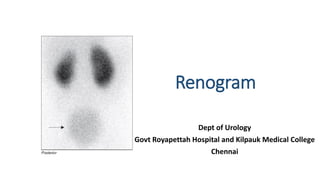
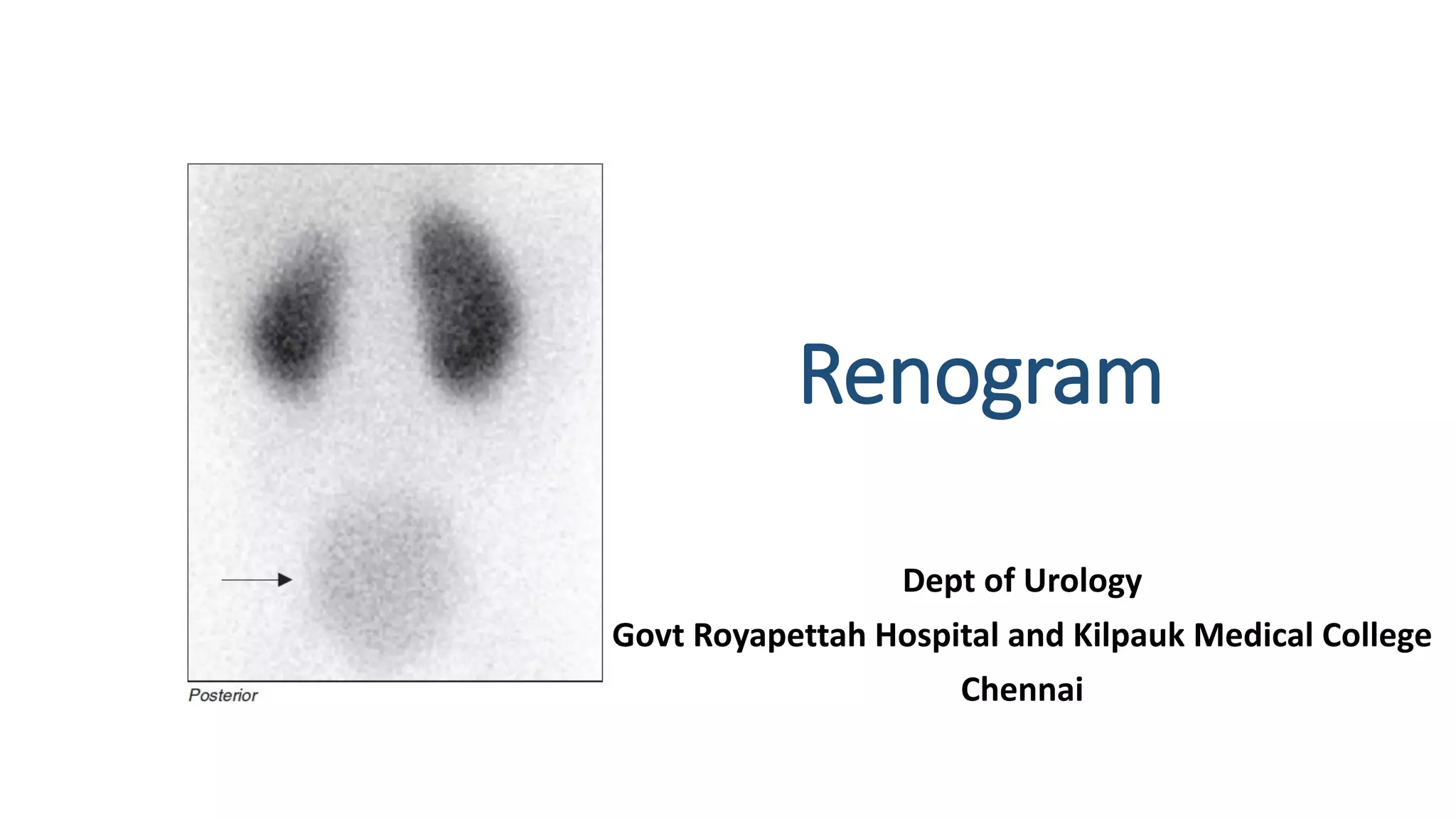
Renogram
Dept of Urology
Govt Royapettah Hospital and Kilpauk Medical College
Chennai
Moderators:
Professors:
• Prof. Dr. G. Sivasankar, M.S., M.Ch.,
• Prof. Dr. A. Senthilvel, M.S., M.Ch.,
Asst Professors:
• Dr. J. Sivabalan, M.S., M.Ch.,
• Dr. R. Bhargavi, M.S., M.Ch.,
• Dr. S. Raju, M.S., M.Ch.,
• Dr. K. Muthurathinam, M.S., M.Ch.,
• Dr. D. Tamilselvan, M.S., M.Ch.,
• Dr. K. Senthilkumar, M.S., M.Ch.
Dept of Urology, GRH and KMC, Chennai. 2
Renogram and Its purpose
• The renogram is a dynamic nuclear medicine study used to investigate
kidney perfusion, function, and elimination of tracer.
• Renography can evaluate—
• Renal blood flow
• Renal cortical imaging
• Renal glomerular filtration
• Renal handling
• Renal excretion
3
Dept of Urology, GRH and KMC, Chennai.
Development
4
Dept of Urology, GRH and KMC, Chennai.
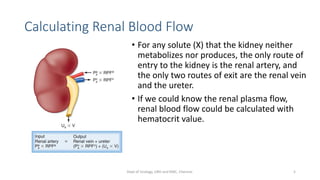
Calculating Renal Blood Flow
• For any solute (X) that the kidney neither
metabolizes nor produces, the only route of
entry to the kidney is the renal artery, and
the only two routes of exit are the renal vein
and the ureter.
• If we could know the renal plasma flow,
renal blood flow could be calculated with
hematocrit value.
5
Dept of Urology, GRH and KMC, Chennai.
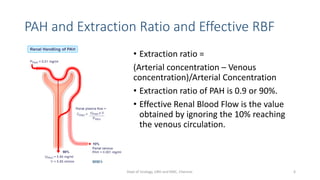
PAH and Extraction Ratio and Effective RBF
• Extraction ratio =
(Arterial concentration – Venous
concentration)/Arterial Concentration
• Extraction ratio of PAH is 0.9 or 90%.
• Effective Renal Blood Flow is the value
obtained by ignoring the 10% reaching
the venous circulation.
6
Dept of Urology, GRH and KMC, Chennai.
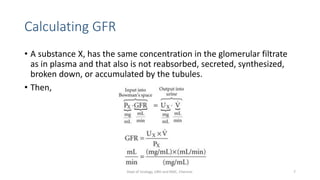
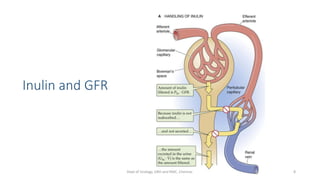
Calculating GFR
• A substance X, has the same concentration in the glomerular filtrate
as in plasma and that also is not reabsorbed, secreted, synthesized,
broken down, or accumulated by the tubules.
• Then,
7
Dept of Urology, GRH and KMC, Chennai.
Inulin and GFR
8
Dept of Urology, GRH and KMC, Chennai.
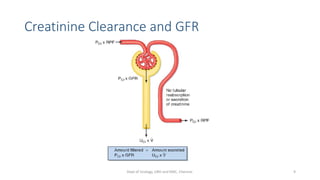
Creatinine Clearance and GFR
9
Dept of Urology, GRH and KMC, Chennai.
Problems with Previous Methods
• Individual Kidney assessment could not be done.
• Invasive process.
• Chemical separation of compounds itself difficult.
10
Dept of Urology, GRH and KMC, Chennai.
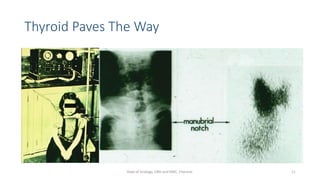
Thyroid Paves The Way
11
Dept of Urology, GRH and KMC, Chennai.
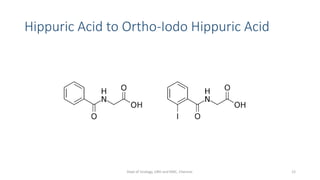
Hippuric Acid to Ortho-Iodo Hippuric Acid
12
Dept of Urology, GRH and KMC, Chennai.
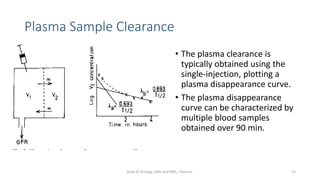
Plasma Sample Clearance
• The plasma clearance is
typically obtained using the
single-injection, plotting a
plasma disappearance curve.
• The plasma disappearance
curve can be characterized by
multiple blood samples
obtained over 90 min.
13
Dept of Urology, GRH and KMC, Chennai.
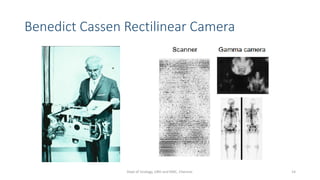
Benedict Cassen Rectilinear Camera
14
Dept of Urology, GRH and KMC, Chennai.
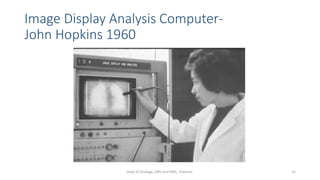
Image Display Analysis Computer-
John Hopkins 1960
15
Dept of Urology, GRH and KMC, Chennai.
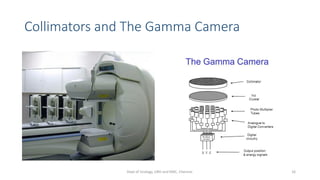
Collimators and The Gamma Camera
16
Dept of Urology, GRH and KMC, Chennai.
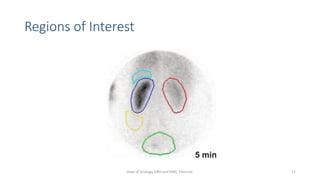
Regions of Interest
17
Dept of Urology, GRH and KMC, Chennai.
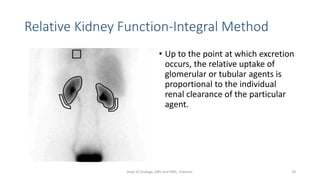
Relative Kidney Function-Integral Method
• Up to the point at which excretion
occurs, the relative uptake of
glomerular or tubular agents is
proportional to the individual
renal clearance of the particular
agent.
18
Dept of Urology, GRH and KMC, Chennai.
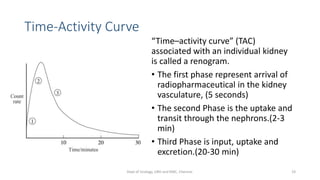
Time-Activity Curve
“Time–activity curve” (TAC)
associated with an individual kidney
is called a renogram.
• The first phase represent arrival of
radiopharmaceutical in the kidney
vasculature, (5 seconds)
• The second Phase is the uptake and
transit through the nephrons.(2-3
min)
• Third Phase is input, uptake and
excretion.(20-30 min)
19
Dept of Urology, GRH and KMC, Chennai.
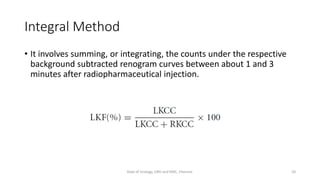
Integral Method
• It involves summing, or integrating, the counts under the respective
background subtracted renogram curves between about 1 and 3
minutes after radiopharmaceutical injection.
20
Dept of Urology, GRH and KMC, Chennai.
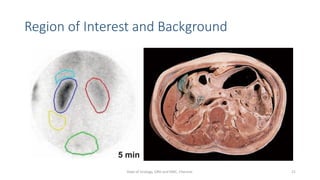
Region of Interest and Background
21
Dept of Urology, GRH and KMC, Chennai.
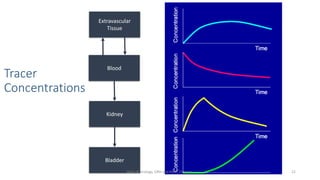
Blood
Kidney
Bladder
Extravascular
Tissue
Tracer
Concentrations
22
Dept of Urology, GRH and KMC, Chennai.
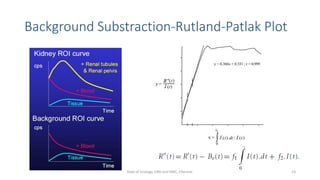
Background Substraction-Rutland-Patlak Plot
23
Dept of Urology, GRH and KMC, Chennai.
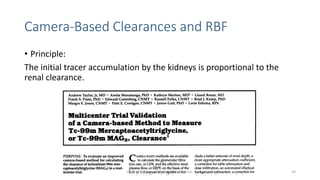
Camera-Based Clearances and RBF
• Principle:
The initial tracer accumulation by the kidneys is proportional to the
renal clearance.
24
Dept of Urology, GRH and KMC, Chennai.
Radio Pharmaceuticals
25
Dept of Urology, GRH and KMC, Chennai.
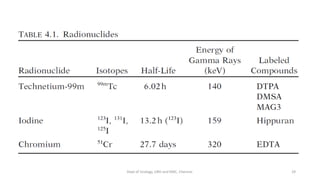
Radionucleotide-Categories
1. Those excreted by glomerular filtration
2. Those excreted primarily by tubular secretion and
3. Those retained in the renal tubules for long periods of time.
26
Dept of Urology, GRH and KMC, Chennai.
Ideal Radio-Pharmaceutical
1. Easily and cheaply generated
2. Radiochemically pure
3. Non-toxic
4. Should emit only gamma rays (100–200 keV energy)
5. Half-life long enough to complete investigation
6. Half-life short enough to minimize patient radiation risk
27
Dept of Urology, GRH and KMC, Chennai.
Available Pharmaceuticals
• Are safe in the short term
• Rarely cause allergic reactions
• Have long-term risks common to all forms of radiation. All exposure
must be kept as low as reasonably achievable (ALARA principle)
• Ought to be avoided in pregnant and lactating women unless in
exceptional circumstances.
• Most are excreted in breast milk, lactating mothers are advised to
stop nursing for 2–3 days.
• Excreted primarily in urine and patients must be advised to urinate
frequently post-examination to minimize radiation .risk
28
Dept of Urology, GRH and KMC, Chennai.
29
Dept of Urology, GRH and KMC, Chennai.
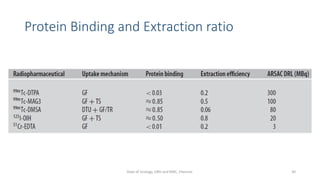
Protein Binding and Extraction ratio
30
Dept of Urology, GRH and KMC, Chennai.
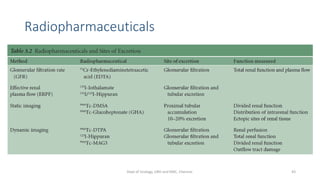
99mTc DTPA (Glomerular Filtration)
• Only renal radiopharmaceutical available for routine imaging that is
purely filtered by the glomerulus.
• Only imaging radiopharmaceutical that can be used to measure
glomerular filtration rate (GFR)
• Extraction fraction of 99mTc-DTPA is approximately 20%;
• It is relatively low compared with the extraction fraction of tubular
tracers (41%–86%)
31
Dept of Urology, GRH and KMC, Chennai.
125I-Iothalamate (Glomerular Filtration)
• 125I-iothalamate is used to measure GFR via plasma sampling
techniques.
• 125I does not emit a photon of sufficient energy to be useful for renal
imaging.
32
Dept of Urology, GRH and KMC, Chennai.
123I- and 131I-Orthoiodohippurate (OIH)
(Tubular Secretion)
• 123I- and 131I-OIH are cleared primarily by the proximal tubules
although a small component is filtered by the glomeruli.
• The clearance of OIH is approximately 500–600 mL/min in subjects
with normal kidneys.
• 131I- and 123I-OIH are no longer commercially available, because of
the introduction of 99mTc-mercaptoacetyltriglycine (MAG3), the poor
imaging characteristics
33
Dept of Urology, GRH and KMC, Chennai.
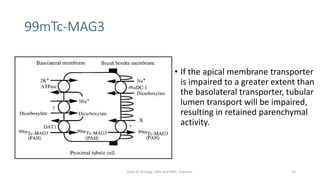
99mTc-MAG3
• 99mTc-MAG3 is highly protein-bound
• It is removed from the plasma primarily by the organic anion
transporter 1 located on the basolateral membrane of the proximal
renal tubules.
• It is then transported to tubular lumen via organic anion transporters
on the apical membrane;
34
Dept of Urology, GRH and KMC, Chennai.
99mTc-MAG3
• If the apical membrane transporter
is impaired to a greater extent than
the basolateral transporter, tubular
lumen transport will be impaired,
resulting in retained parenchymal
activity.
35
Dept of Urology, GRH and KMC, Chennai.
99mTc-MAG3
• The extraction fraction of 99mTc-MAG3 is 40%–50%, more than twice
that of 99mTc-DTPA.
• 99mTc-MAG3 is preferred over 99mTc-DTPA in patients with
suspected obstruction and impaired renal function.
36
Dept of Urology, GRH and KMC, Chennai.
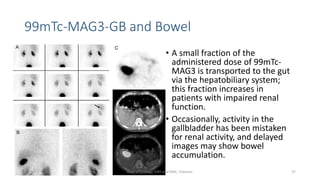
99mTc-MAG3-GB and Bowel
• A small fraction of the
administered dose of 99mTc-
MAG3 is transported to the gut
via the hepatobiliary system;
this fraction increases in
patients with impaired renal
function.
• Occasionally, activity in the
gallbladder has been mistaken
for renal activity, and delayed
images may show bowel
accumulation.
37
Dept of Urology, GRH and KMC, Chennai.
99mTc-L,L- and D,D-Ethylenedicysteine (EC)
(Tubular Secretion)
• 99mTc-L,L- and D,D-EC are enantiomers; both are excellent renal
radiopharmaceuticals with clearances slightly higher than 99mTc-
MAG3.
• Although 99mTc-D,D-EC is cleared more rapidly than 99mTc-L,L-EC,
99mTc-L,L-EC was first described and is available in several countries
as a kit formulation.
38
Dept of Urology, GRH and KMC, Chennai.
99mTc-(CO3)Tricarbonylnitriloacetic Acid
(NTA) (Tubular Secretion)
• Tc-(CO3)NTA is a new 99mTc renal radiopharmaceutical with
renogram curves and clearance equivalent to those of 131I-OIH.
• On the basis of its structure and charge distribution, 99mTc-(CO3)NTA
is likely to be transported by the organic anion transporter 1.
• Unlike 99mTc-MAG3, however, preliminary studies in patients with
chronic kidney disease show no evidence of gallbladder or gut
activity.
39
Dept of Urology, GRH and KMC, Chennai.
99mTc-Dimercaptosuccinic Acid (DMSA)
(Cortical Retention)
• 99mTc-DMSA is an excellent cortical imaging agent to evaluate
relative function, pyelonephritis, and renal scarring.
• Approximately 40% of the injected dose is retained by the renal
tubules within 1 h after injection
• The remainder is slowly excreted in the urine over the subsequent 24
h.
• Consequently, the renal uptake of 99mTc-DMSA is dependent on
renal blood flow, glomerular filtration, and proximal tubule receptor-
mediated endocytosis.
40
Dept of Urology, GRH and KMC, Chennai.
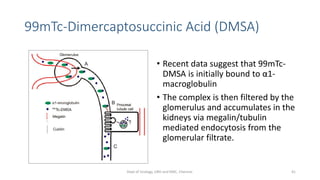
99mTc-Dimercaptosuccinic Acid (DMSA)
• Recent data suggest that 99mTc-
DMSA is initially bound to α1-
macroglobulin
• The complex is then filtered by the
glomerulus and accumulates in the
kidneys via megalin/tubulin
mediated endocytosis from the
glomerular filtrate.
41
Dept of Urology, GRH and KMC, Chennai.
99mTc-Glucoheptonate (GH) (Cortical
Retention and GFR)
• 99mTc-GH is cleared primarily by glomerular filtration, but
approximately10%– 15% of the injected dose is retained in the renal
tubules, allowing delayed, high-resolution static images to be
obtained.
• 99mTc-GH tends to be used for static imaging if 99mTc-DMSA is
unavailable; because of the parenchymal retention, it should not be
used for diuretic renography.
42
Dept of Urology, GRH and KMC, Chennai.
Radiopharmaceuticals
43
Dept of Urology, GRH and KMC, Chennai.
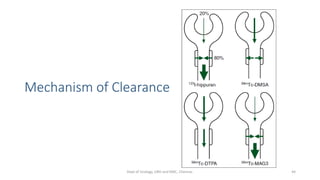
Mechanism of Clearance
44
Dept of Urology, GRH and KMC, Chennai.
Procedure Protocols
45
Dept of Urology, GRH and KMC, Chennai.
Procedure and Time required for study
• The patient will receive an intravenous injection of the
radiopharmaceutical
• The patient will lie quietly on an imaging table for 20–30 min.
• Depending on the protocol, there may be 2 imaging sessions.
46
Dept of Urology, GRH and KMC, Chennai.
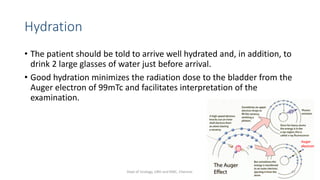
Hydration
• The patient should be told to arrive well hydrated and, in addition, to
drink 2 large glasses of water just before arrival.
• Good hydration minimizes the radiation dose to the bladder from the
Auger electron of 99mTc and facilitates interpretation of the
examination.
47
Dept of Urology, GRH and KMC, Chennai.
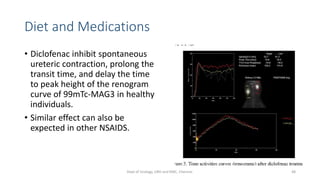
Diet and Medications
• Diclofenac inhibit spontaneous
ureteric contraction, prolong the
transit time, and delay the time
to peak height of the renogram
curve of 99mTc-MAG3 in healthy
individuals.
• Similar effect can also be
expected in other NSAIDS.
48
Dept of Urology, GRH and KMC, Chennai.
Voiding Before Study
• The patient should void immediately before the study.
• This practice will lessen the possibility that the patient needs to void
during the acquisition and
• It is essential for diuretic studies since a full bladder may delay upper
tract emptying.
49
Dept of Urology, GRH and KMC, Chennai.
Administered Dose
• Approximately 370 MBq (10 mCi) of 99mTc-MAG3 or 99mTc-DTPA.
• Administration of activities in the range of 370 MBq may be required
to obtain sufficient counts to visualize the initial bolus as it transits
the aorta and kidneys or to calculate quantitative flow indices;
• An administered dose of 370 MBq is unnecessarily high for almost all
applications, and a range from 37 to 185 MBq is much more
appropriate.
50
Dept of Urology, GRH and KMC, Chennai.
Image Acquisition
• Images are acquired dynamically for 20–30 min in 10- to 20-s frames
and are usually displayed at 1- or 2-min intervals as the radioactive
tracer is removed from the blood, transits the kidney, and enters the
bladder.
• Postvoid views of the kidneys and bladder are recommended at the
conclusion of the study.
51
Dept of Urology, GRH and KMC, Chennai.
Imaging Acquisition
• Imaging is usually performed with the patient supine.
• The supine position allows a more accurate estimate of relative renal
function since the kidneys are more likely to lie at the same depth.
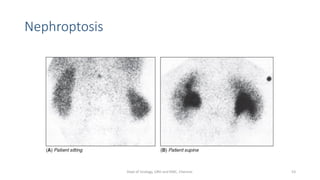
• Nephroptosis has been observed in 22% of kidneys when patients are
imaged in a seated position. A change in kidney position due to
nephroptosis can lead to a difference in the measurement of relative
uptake due to differences in attenuation rather than differences in
relative function.
52
Dept of Urology, GRH and KMC, Chennai.
Nephroptosis
53
Dept of Urology, GRH and KMC, Chennai.
Time-Activity Curves
• Time–activity curves are generated after placement of an ROI over each
kidney, the renal cortex (parenchyma), or retained activity in the collecting
system.
• The whole-kidney ROI consists of an ROI placed around the entire kidney,
including the renal pelvis.
• Quantitative values generated using this ROI will be affected by retention
of tracer in both the kidney parenchyma and the renal pelvis.
• Tracer retention may occur in pathologic states such as diabetic
nephropathy or obstruction.
• It may also occur in nonpathologic states such as a nonobstructed dilated
collecting system or mild dehydration.
54
Dept of Urology, GRH and KMC, Chennai.
• To obtain a better assessment of parenchymal function, ROIs can be
restricted to the renal cortex (parenchyma), excluding any retained
activity in the renal pelvis or calyces.
55
Dept of Urology, GRH and KMC, Chennai.
Quantitative indices
56
Dept of Urology, GRH and KMC, Chennai.
Relative perfusion
• Renal perfusion is evaluated by the visual or quantitative analysis of
the initial bolus as it transits the abdominal aorta and enters the renal
arteries.
• With the exception of renal transplant evaluation, quantitative
measurements of renal perfusion have not been demonstrated to
contribute to renal scan interpretation.
57
Dept of Urology, GRH and KMC, Chennai.
Relative Function
• The relative uptake of the radiopharmaceutical provides a measure of
differential renal function (the specific function depends on the
radiopharmaceutical).
• For 99mTc-MAG3 and DTPA, the measurement is usually made by
placing an ROI over each kidney and measuring the integral of the
counts in renal ROI during the 1- to 2-, 1- to 2.5-, or 2- to 3-min period
after injection or using the Rutland–Patlak plot.
58
Dept of Urology, GRH and KMC, Chennai.
Bilaterally Impaired Kidneys
• In patients with bilaterally impaired function and delayed excretion,
the kidney-to-background ratio will be reduced compared with
normally functioning kidneys;
• In this setting, the differential function measurement will be more
accurate if the measurement is obtained not during the 1- to 3-min
postinjection period but rather.
• It is done in the 1-min period just before any tracer leaves the kidney
ROI.
59
Dept of Urology, GRH and KMC, Chennai.
Time to Peak/T-max
• The time to peak, or Tmax, simply refers to the time from
radiopharmaceutical injection to the peak height of the renogram
curve.
• 99mTc-MAG3 and 99mTc-DTPA renograms normally peak by 5 min
and decline to half-peak height by 15 min after injection.
• Physiologic retention of the tracer in the renal calyces or pelvis can
alter the shape of the whole-kidney renogram curve in normal
kidneys and lead to prolonged values for the time to peak, 20-
min/maximum count ratio, and T½.
60
Dept of Urology, GRH and KMC, Chennai.
T1/2
• The T½ refers to the time it takes for the activity in the kidney to fall
to 50% of its maximum value.
61
Dept of Urology, GRH and KMC, Chennai.
20-Min/Maximum Count Ratio
• It is the ratio of the kidney counts at 20 min to the maximum (peak)
counts;
• It provides an index of the transit time and parenchymal function and
is often obtained for both whole kidney and cortical (parenchymal)
ROIs.
• For 99mTc-MAG3, it averages 0.19, with SDs of 0.07 and 0.04 for the
right and left kidneys, respectively.
• In addition to detecting abnormal function, the 20-min/maximum
and 20-min/1- to 2-min count ratios can be useful in monitoring
patients with suspected urinarytract obstruction and renovascular
hypertension.
62
Dept of Urology, GRH and KMC, Chennai.
Interventions in Renogram
• Diuretic renography
• Captopril/ACE inhibition renography
63
Dept of Urology, GRH and KMC, Chennai.
Diuretic Renography
• O'Reilly et al first described this procedure using I131- OIH.
• 99mTc DTPA was described by Koff et al 8 as an alternative, but the
glomerular extraction of this tracer is now considered too slow to fill
the renal pelvis as rapidly as is needed.
• 99mTc MAG3 has replaced both DTPA and I123 OIH.
64
Dept of Urology, GRH and KMC, Chennai.
Principle
F=V/T
• F is the rate of fluid flow through the renal pelvis,
• V is the pelvic volume and
• T is the mean transit time of flow through the pelvis.
In unobstructed system, if F is increased, T will decrease.
But in Obstructed system, if F is increased, T cannot decrease.
It will manifest as accumulation of tracer on schintigraphy.
65
Dept of Urology, GRH and KMC, Chennai.
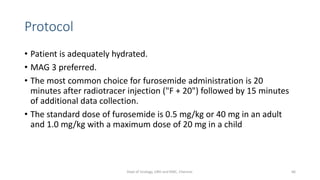
Protocol
• Patient is adequately hydrated.
• MAG 3 preferred.
• The most common choice for furosemide administration is 20
minutes after radiotracer injection ("F + 20") followed by 15 minutes
of additional data collection.
• The standard dose of furosemide is 0.5 mg/kg or 40 mg in an adult
and 1.0 mg/kg with a maximum dose of 20 mg in a child
66
Dept of Urology, GRH and KMC, Chennai.
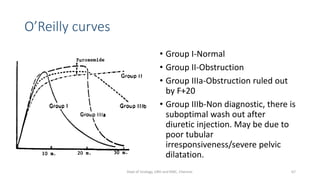
O’Reilly curves
• Group I-Normal
• Group II-Obstruction
• Group IIIa-Obstruction ruled out
by F+20
• Group IIIb-Non diagnostic, there is
suboptimal wash out after
diuretic injection. May be due to
poor tubular
irresponsiveness/severe pelvic
dilatation.
67
Dept of Urology, GRH and KMC, Chennai.
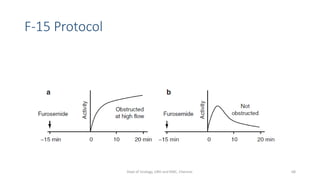
F-15 Protocol
68
Dept of Urology, GRH and KMC, Chennai.
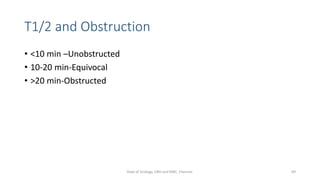
T1/2 and Obstruction
• <10 min –Unobstructed
• 10-20 min-Equivocal
• >20 min-Obstructed
69
Dept of Urology, GRH and KMC, Chennai.
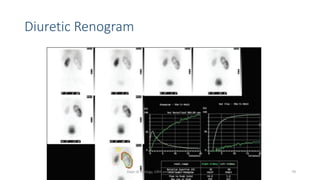
Diuretic Renogram
70
Dept of Urology, GRH and KMC, Chennai.
Captopril/ACE inhibitor renogram
Indications:
• Patient under 40 years with severe hypertension
• IVU suggests features of RAS
• Renal bruit
• Hypertension associated with known arterial disease, Takayasu’s
disease
• Hypertension poorly controlled with antihypertensives
• Deteriorating renal function
71
Dept of Urology, GRH and KMC, Chennai.
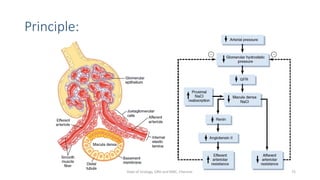
Principle:
72
Dept of Urology, GRH and KMC, Chennai.
Renogram effect based on Tracer Used
99Tcm-MAG3
• Since, dependent solely on renal tubular secretion, tracer is delivered,
as usual, to the tubular lumen.
• However, reduced urine flow causes delayed tubular transit and
washout into the pelvocalyceal system.
• Scintigraphically, we see delayed pelvic activity and delayed
parenchymal excretion.
73
Dept of Urology, GRH and KMC, Chennai.
Renogram effect based on Tracer Used
DTPA
• Since dependent solely on glomerular filtration, principally
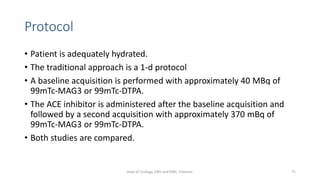
demonstrates reduced uptake on the affected side.
• If the GFR reduction is severe, DTPA uptake is reduced virtually to
zero.
• Renogram curves demonstrate a blood pool image throughout the
study, proportional to blood background activity.
• The collecting system is never seen.
74
Dept of Urology, GRH and KMC, Chennai.
Protocol
• Patient is adequately hydrated.
• The traditional approach is a 1-d protocol
• A baseline acquisition is performed with approximately 40 MBq of
99mTc-MAG3 or 99mTc-DTPA.
• The ACE inhibitor is administered after the baseline acquisition and
followed by a second acquisition with approximately 370 mBq of
99mTc-MAG3 or 99mTc-DTPA.
• Both studies are compared.
75
Dept of Urology, GRH and KMC, Chennai.
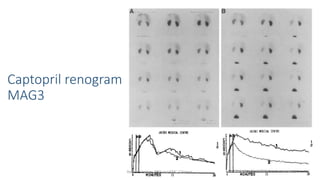
Captopril renogram
MAG3
76
Dept of Urology, GRH and KMC, Chennai.
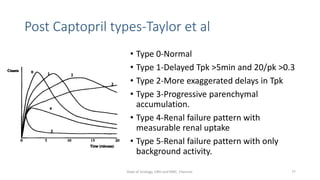
Post Captopril types-Taylor et al
• Type 0-Normal
• Type 1-Delayed Tpk >5min and 20/pk >0.3
• Type 2-More exaggerated delays in Tpk
• Type 3-Progressive parenchymal
accumulation.
• Type 4-Renal failure pattern with
measurable renal uptake
• Type 5-Renal failure pattern with only
background activity.
77
Dept of Urology, GRH and KMC, Chennai.
Absolute renal function-Static Imaging
• Radionuclide renal imaging with quantitation measures the
contribution of an individual kidney to overall renal function.
• In addition, the technique can be used to assess the regional
distribution of function within an individual kidney.
• For most purposes, a static imaging agent (DMSA) is the
pharmaceutical of choice.
78
Dept of Urology, GRH and KMC, Chennai.
DMSA-Static Imaging
• It closely reflects the total parenchymal function.
• The distribution and uptake change only very slowly with time —
unlike the dynamic agents (DTPA, MAG3).
• The background is low, with a very high target/background ratio.
• Multiple views can be obtained.
• Exact timing of the imaging is not critical.
79
Dept of Urology, GRH and KMC, Chennai.
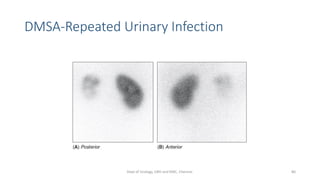
DMSA-Repeated Urinary Infection
80
Dept of Urology, GRH and KMC, Chennai.
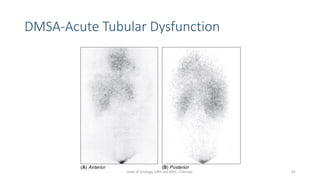
DMSA-Acute Tubular Dysfunction
81
Dept of Urology, GRH and KMC, Chennai.
Renal Transplant Renogram
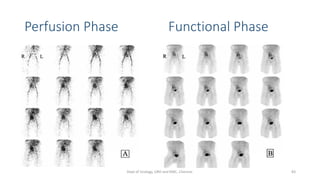
Perfusion Renography:
• A technique whereby a short (40 second) period of relatively rapid
fast framing (frame rate = 1/s) precedes the basic renogram
acquisition.
• The resultant “splitframe” study thus comprises a “perfusion phase”
followed by a “function phase”.
It was mainly used to diagnose transplant rejection.
But newer modalities have made the procedure less useful.
82
Dept of Urology, GRH and KMC, Chennai.
Perfusion Phase Functional Phase
83
Dept of Urology, GRH and KMC, Chennai.
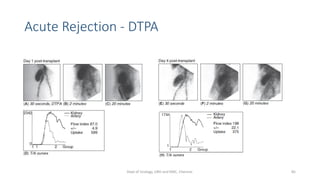
• It is used to differentiate Acute tubular necrosis which may resolve
spontaneously from acute rejection, in a patient with anuria after
renal transplantation.
84
Dept of Urology, GRH and KMC, Chennai.
Acute Rejection - DTPA
85
Dept of Urology, GRH and KMC, Chennai.
Thank You
86
Dept of Urology, GRH and KMC, Chennai.

RENOGRAM

  • 1.
    Renogram Dept of Urology GovtRoyapettah Hospital and Kilpauk Medical College Chennai
  • 2.
    Moderators: Professors: • Prof. Dr.G. Sivasankar, M.S., M.Ch., • Prof. Dr. A. Senthilvel, M.S., M.Ch., Asst Professors: • Dr. J. Sivabalan, M.S., M.Ch., • Dr. R. Bhargavi, M.S., M.Ch., • Dr. S. Raju, M.S., M.Ch., • Dr. K. Muthurathinam, M.S., M.Ch., • Dr. D. Tamilselvan, M.S., M.Ch., • Dr. K. Senthilkumar, M.S., M.Ch. Dept of Urology, GRH and KMC, Chennai. 2
  • 3.
    Renogram and Itspurpose • The renogram is a dynamic nuclear medicine study used to investigate kidney perfusion, function, and elimination of tracer. • Renography can evaluate— • Renal blood flow • Renal cortical imaging • Renal glomerular filtration • Renal handling • Renal excretion 3 Dept of Urology, GRH and KMC, Chennai.
  • 4.
    Development 4 Dept of Urology,GRH and KMC, Chennai.
  • 5.
    Calculating Renal BloodFlow • For any solute (X) that the kidney neither metabolizes nor produces, the only route of entry to the kidney is the renal artery, and the only two routes of exit are the renal vein and the ureter. • If we could know the renal plasma flow, renal blood flow could be calculated with hematocrit value. 5 Dept of Urology, GRH and KMC, Chennai.
  • 6.
    PAH and ExtractionRatio and Effective RBF • Extraction ratio = (Arterial concentration – Venous concentration)/Arterial Concentration • Extraction ratio of PAH is 0.9 or 90%. • Effective Renal Blood Flow is the value obtained by ignoring the 10% reaching the venous circulation. 6 Dept of Urology, GRH and KMC, Chennai.
  • 7.
    Calculating GFR • Asubstance X, has the same concentration in the glomerular filtrate as in plasma and that also is not reabsorbed, secreted, synthesized, broken down, or accumulated by the tubules. • Then, 7 Dept of Urology, GRH and KMC, Chennai.
  • 8.
    Inulin and GFR 8 Deptof Urology, GRH and KMC, Chennai.
  • 9.
    Creatinine Clearance andGFR 9 Dept of Urology, GRH and KMC, Chennai.
  • 10.
    Problems with PreviousMethods • Individual Kidney assessment could not be done. • Invasive process. • Chemical separation of compounds itself difficult. 10 Dept of Urology, GRH and KMC, Chennai.
  • 11.
    Thyroid Paves TheWay 11 Dept of Urology, GRH and KMC, Chennai.
  • 12.
    Hippuric Acid toOrtho-Iodo Hippuric Acid 12 Dept of Urology, GRH and KMC, Chennai.
  • 13.
    Plasma Sample Clearance •The plasma clearance is typically obtained using the single-injection, plotting a plasma disappearance curve. • The plasma disappearance curve can be characterized by multiple blood samples obtained over 90 min. 13 Dept of Urology, GRH and KMC, Chennai.
  • 14.
    Benedict Cassen RectilinearCamera 14 Dept of Urology, GRH and KMC, Chennai.
  • 15.
    Image Display AnalysisComputer- John Hopkins 1960 15 Dept of Urology, GRH and KMC, Chennai.
  • 16.
    Collimators and TheGamma Camera 16 Dept of Urology, GRH and KMC, Chennai.
  • 17.
    Regions of Interest 17 Deptof Urology, GRH and KMC, Chennai.
  • 18.
    Relative Kidney Function-IntegralMethod • Up to the point at which excretion occurs, the relative uptake of glomerular or tubular agents is proportional to the individual renal clearance of the particular agent. 18 Dept of Urology, GRH and KMC, Chennai.
  • 19.
    Time-Activity Curve “Time–activity curve”(TAC) associated with an individual kidney is called a renogram. • The first phase represent arrival of radiopharmaceutical in the kidney vasculature, (5 seconds) • The second Phase is the uptake and transit through the nephrons.(2-3 min) • Third Phase is input, uptake and excretion.(20-30 min) 19 Dept of Urology, GRH and KMC, Chennai.
  • 20.
    Integral Method • Itinvolves summing, or integrating, the counts under the respective background subtracted renogram curves between about 1 and 3 minutes after radiopharmaceutical injection. 20 Dept of Urology, GRH and KMC, Chennai.
  • 21.
    Region of Interestand Background 21 Dept of Urology, GRH and KMC, Chennai.
  • 22.
  • 23.
    Background Substraction-Rutland-Patlak Plot 23 Deptof Urology, GRH and KMC, Chennai.
  • 24.
    Camera-Based Clearances andRBF • Principle: The initial tracer accumulation by the kidneys is proportional to the renal clearance. 24 Dept of Urology, GRH and KMC, Chennai.
  • 25.
    Radio Pharmaceuticals 25 Dept ofUrology, GRH and KMC, Chennai.
  • 26.
    Radionucleotide-Categories 1. Those excretedby glomerular filtration 2. Those excreted primarily by tubular secretion and 3. Those retained in the renal tubules for long periods of time. 26 Dept of Urology, GRH and KMC, Chennai.
  • 27.
    Ideal Radio-Pharmaceutical 1. Easilyand cheaply generated 2. Radiochemically pure 3. Non-toxic 4. Should emit only gamma rays (100–200 keV energy) 5. Half-life long enough to complete investigation 6. Half-life short enough to minimize patient radiation risk 27 Dept of Urology, GRH and KMC, Chennai.
  • 28.
    Available Pharmaceuticals • Aresafe in the short term • Rarely cause allergic reactions • Have long-term risks common to all forms of radiation. All exposure must be kept as low as reasonably achievable (ALARA principle) • Ought to be avoided in pregnant and lactating women unless in exceptional circumstances. • Most are excreted in breast milk, lactating mothers are advised to stop nursing for 2–3 days. • Excreted primarily in urine and patients must be advised to urinate frequently post-examination to minimize radiation .risk 28 Dept of Urology, GRH and KMC, Chennai.
  • 29.
    29 Dept of Urology,GRH and KMC, Chennai.
  • 30.
    Protein Binding andExtraction ratio 30 Dept of Urology, GRH and KMC, Chennai.
  • 31.
    99mTc DTPA (GlomerularFiltration) • Only renal radiopharmaceutical available for routine imaging that is purely filtered by the glomerulus. • Only imaging radiopharmaceutical that can be used to measure glomerular filtration rate (GFR) • Extraction fraction of 99mTc-DTPA is approximately 20%; • It is relatively low compared with the extraction fraction of tubular tracers (41%–86%) 31 Dept of Urology, GRH and KMC, Chennai.
  • 32.
    125I-Iothalamate (Glomerular Filtration) •125I-iothalamate is used to measure GFR via plasma sampling techniques. • 125I does not emit a photon of sufficient energy to be useful for renal imaging. 32 Dept of Urology, GRH and KMC, Chennai.
  • 33.
    123I- and 131I-Orthoiodohippurate(OIH) (Tubular Secretion) • 123I- and 131I-OIH are cleared primarily by the proximal tubules although a small component is filtered by the glomeruli. • The clearance of OIH is approximately 500–600 mL/min in subjects with normal kidneys. • 131I- and 123I-OIH are no longer commercially available, because of the introduction of 99mTc-mercaptoacetyltriglycine (MAG3), the poor imaging characteristics 33 Dept of Urology, GRH and KMC, Chennai.
  • 34.
    99mTc-MAG3 • 99mTc-MAG3 ishighly protein-bound • It is removed from the plasma primarily by the organic anion transporter 1 located on the basolateral membrane of the proximal renal tubules. • It is then transported to tubular lumen via organic anion transporters on the apical membrane; 34 Dept of Urology, GRH and KMC, Chennai.
  • 35.
    99mTc-MAG3 • If theapical membrane transporter is impaired to a greater extent than the basolateral transporter, tubular lumen transport will be impaired, resulting in retained parenchymal activity. 35 Dept of Urology, GRH and KMC, Chennai.
  • 36.
    99mTc-MAG3 • The extractionfraction of 99mTc-MAG3 is 40%–50%, more than twice that of 99mTc-DTPA. • 99mTc-MAG3 is preferred over 99mTc-DTPA in patients with suspected obstruction and impaired renal function. 36 Dept of Urology, GRH and KMC, Chennai.
  • 37.
    99mTc-MAG3-GB and Bowel •A small fraction of the administered dose of 99mTc- MAG3 is transported to the gut via the hepatobiliary system; this fraction increases in patients with impaired renal function. • Occasionally, activity in the gallbladder has been mistaken for renal activity, and delayed images may show bowel accumulation. 37 Dept of Urology, GRH and KMC, Chennai.
  • 38.
    99mTc-L,L- and D,D-Ethylenedicysteine(EC) (Tubular Secretion) • 99mTc-L,L- and D,D-EC are enantiomers; both are excellent renal radiopharmaceuticals with clearances slightly higher than 99mTc- MAG3. • Although 99mTc-D,D-EC is cleared more rapidly than 99mTc-L,L-EC, 99mTc-L,L-EC was first described and is available in several countries as a kit formulation. 38 Dept of Urology, GRH and KMC, Chennai.
  • 39.
    99mTc-(CO3)Tricarbonylnitriloacetic Acid (NTA) (TubularSecretion) • Tc-(CO3)NTA is a new 99mTc renal radiopharmaceutical with renogram curves and clearance equivalent to those of 131I-OIH. • On the basis of its structure and charge distribution, 99mTc-(CO3)NTA is likely to be transported by the organic anion transporter 1. • Unlike 99mTc-MAG3, however, preliminary studies in patients with chronic kidney disease show no evidence of gallbladder or gut activity. 39 Dept of Urology, GRH and KMC, Chennai.
  • 40.
    99mTc-Dimercaptosuccinic Acid (DMSA) (CorticalRetention) • 99mTc-DMSA is an excellent cortical imaging agent to evaluate relative function, pyelonephritis, and renal scarring. • Approximately 40% of the injected dose is retained by the renal tubules within 1 h after injection • The remainder is slowly excreted in the urine over the subsequent 24 h. • Consequently, the renal uptake of 99mTc-DMSA is dependent on renal blood flow, glomerular filtration, and proximal tubule receptor- mediated endocytosis. 40 Dept of Urology, GRH and KMC, Chennai.
  • 41.
    99mTc-Dimercaptosuccinic Acid (DMSA) •Recent data suggest that 99mTc- DMSA is initially bound to α1- macroglobulin • The complex is then filtered by the glomerulus and accumulates in the kidneys via megalin/tubulin mediated endocytosis from the glomerular filtrate. 41 Dept of Urology, GRH and KMC, Chennai.
  • 42.
    99mTc-Glucoheptonate (GH) (Cortical Retentionand GFR) • 99mTc-GH is cleared primarily by glomerular filtration, but approximately10%– 15% of the injected dose is retained in the renal tubules, allowing delayed, high-resolution static images to be obtained. • 99mTc-GH tends to be used for static imaging if 99mTc-DMSA is unavailable; because of the parenchymal retention, it should not be used for diuretic renography. 42 Dept of Urology, GRH and KMC, Chennai.
  • 43.
  • 44.
    Mechanism of Clearance 44 Deptof Urology, GRH and KMC, Chennai.
  • 45.
    Procedure Protocols 45 Dept ofUrology, GRH and KMC, Chennai.
  • 46.
    Procedure and Timerequired for study • The patient will receive an intravenous injection of the radiopharmaceutical • The patient will lie quietly on an imaging table for 20–30 min. • Depending on the protocol, there may be 2 imaging sessions. 46 Dept of Urology, GRH and KMC, Chennai.
  • 47.
    Hydration • The patientshould be told to arrive well hydrated and, in addition, to drink 2 large glasses of water just before arrival. • Good hydration minimizes the radiation dose to the bladder from the Auger electron of 99mTc and facilitates interpretation of the examination. 47 Dept of Urology, GRH and KMC, Chennai.
  • 48.
    Diet and Medications •Diclofenac inhibit spontaneous ureteric contraction, prolong the transit time, and delay the time to peak height of the renogram curve of 99mTc-MAG3 in healthy individuals. • Similar effect can also be expected in other NSAIDS. 48 Dept of Urology, GRH and KMC, Chennai.
  • 49.
    Voiding Before Study •The patient should void immediately before the study. • This practice will lessen the possibility that the patient needs to void during the acquisition and • It is essential for diuretic studies since a full bladder may delay upper tract emptying. 49 Dept of Urology, GRH and KMC, Chennai.
  • 50.
    Administered Dose • Approximately370 MBq (10 mCi) of 99mTc-MAG3 or 99mTc-DTPA. • Administration of activities in the range of 370 MBq may be required to obtain sufficient counts to visualize the initial bolus as it transits the aorta and kidneys or to calculate quantitative flow indices; • An administered dose of 370 MBq is unnecessarily high for almost all applications, and a range from 37 to 185 MBq is much more appropriate. 50 Dept of Urology, GRH and KMC, Chennai.
  • 51.
    Image Acquisition • Imagesare acquired dynamically for 20–30 min in 10- to 20-s frames and are usually displayed at 1- or 2-min intervals as the radioactive tracer is removed from the blood, transits the kidney, and enters the bladder. • Postvoid views of the kidneys and bladder are recommended at the conclusion of the study. 51 Dept of Urology, GRH and KMC, Chennai.
  • 52.
    Imaging Acquisition • Imagingis usually performed with the patient supine. • The supine position allows a more accurate estimate of relative renal function since the kidneys are more likely to lie at the same depth. • Nephroptosis has been observed in 22% of kidneys when patients are imaged in a seated position. A change in kidney position due to nephroptosis can lead to a difference in the measurement of relative uptake due to differences in attenuation rather than differences in relative function. 52 Dept of Urology, GRH and KMC, Chennai.
  • 53.
    Nephroptosis 53 Dept of Urology,GRH and KMC, Chennai.
  • 54.
    Time-Activity Curves • Time–activitycurves are generated after placement of an ROI over each kidney, the renal cortex (parenchyma), or retained activity in the collecting system. • The whole-kidney ROI consists of an ROI placed around the entire kidney, including the renal pelvis. • Quantitative values generated using this ROI will be affected by retention of tracer in both the kidney parenchyma and the renal pelvis. • Tracer retention may occur in pathologic states such as diabetic nephropathy or obstruction. • It may also occur in nonpathologic states such as a nonobstructed dilated collecting system or mild dehydration. 54 Dept of Urology, GRH and KMC, Chennai.
  • 55.
    • To obtaina better assessment of parenchymal function, ROIs can be restricted to the renal cortex (parenchyma), excluding any retained activity in the renal pelvis or calyces. 55 Dept of Urology, GRH and KMC, Chennai.
  • 56.
    Quantitative indices 56 Dept ofUrology, GRH and KMC, Chennai.
  • 57.
    Relative perfusion • Renalperfusion is evaluated by the visual or quantitative analysis of the initial bolus as it transits the abdominal aorta and enters the renal arteries. • With the exception of renal transplant evaluation, quantitative measurements of renal perfusion have not been demonstrated to contribute to renal scan interpretation. 57 Dept of Urology, GRH and KMC, Chennai.
  • 58.
    Relative Function • Therelative uptake of the radiopharmaceutical provides a measure of differential renal function (the specific function depends on the radiopharmaceutical). • For 99mTc-MAG3 and DTPA, the measurement is usually made by placing an ROI over each kidney and measuring the integral of the counts in renal ROI during the 1- to 2-, 1- to 2.5-, or 2- to 3-min period after injection or using the Rutland–Patlak plot. 58 Dept of Urology, GRH and KMC, Chennai.
  • 59.
    Bilaterally Impaired Kidneys •In patients with bilaterally impaired function and delayed excretion, the kidney-to-background ratio will be reduced compared with normally functioning kidneys; • In this setting, the differential function measurement will be more accurate if the measurement is obtained not during the 1- to 3-min postinjection period but rather. • It is done in the 1-min period just before any tracer leaves the kidney ROI. 59 Dept of Urology, GRH and KMC, Chennai.
  • 60.
    Time to Peak/T-max •The time to peak, or Tmax, simply refers to the time from radiopharmaceutical injection to the peak height of the renogram curve. • 99mTc-MAG3 and 99mTc-DTPA renograms normally peak by 5 min and decline to half-peak height by 15 min after injection. • Physiologic retention of the tracer in the renal calyces or pelvis can alter the shape of the whole-kidney renogram curve in normal kidneys and lead to prolonged values for the time to peak, 20- min/maximum count ratio, and T½. 60 Dept of Urology, GRH and KMC, Chennai.
  • 61.
    T1/2 • The T½refers to the time it takes for the activity in the kidney to fall to 50% of its maximum value. 61 Dept of Urology, GRH and KMC, Chennai.
  • 62.
    20-Min/Maximum Count Ratio •It is the ratio of the kidney counts at 20 min to the maximum (peak) counts; • It provides an index of the transit time and parenchymal function and is often obtained for both whole kidney and cortical (parenchymal) ROIs. • For 99mTc-MAG3, it averages 0.19, with SDs of 0.07 and 0.04 for the right and left kidneys, respectively. • In addition to detecting abnormal function, the 20-min/maximum and 20-min/1- to 2-min count ratios can be useful in monitoring patients with suspected urinarytract obstruction and renovascular hypertension. 62 Dept of Urology, GRH and KMC, Chennai.
  • 63.
    Interventions in Renogram •Diuretic renography • Captopril/ACE inhibition renography 63 Dept of Urology, GRH and KMC, Chennai.
  • 64.
    Diuretic Renography • O'Reillyet al first described this procedure using I131- OIH. • 99mTc DTPA was described by Koff et al 8 as an alternative, but the glomerular extraction of this tracer is now considered too slow to fill the renal pelvis as rapidly as is needed. • 99mTc MAG3 has replaced both DTPA and I123 OIH. 64 Dept of Urology, GRH and KMC, Chennai.
  • 65.
    Principle F=V/T • F isthe rate of fluid flow through the renal pelvis, • V is the pelvic volume and • T is the mean transit time of flow through the pelvis. In unobstructed system, if F is increased, T will decrease. But in Obstructed system, if F is increased, T cannot decrease. It will manifest as accumulation of tracer on schintigraphy. 65 Dept of Urology, GRH and KMC, Chennai.
  • 66.
    Protocol • Patient isadequately hydrated. • MAG 3 preferred. • The most common choice for furosemide administration is 20 minutes after radiotracer injection ("F + 20") followed by 15 minutes of additional data collection. • The standard dose of furosemide is 0.5 mg/kg or 40 mg in an adult and 1.0 mg/kg with a maximum dose of 20 mg in a child 66 Dept of Urology, GRH and KMC, Chennai.
  • 67.
    O’Reilly curves • GroupI-Normal • Group II-Obstruction • Group IIIa-Obstruction ruled out by F+20 • Group IIIb-Non diagnostic, there is suboptimal wash out after diuretic injection. May be due to poor tubular irresponsiveness/severe pelvic dilatation. 67 Dept of Urology, GRH and KMC, Chennai.
  • 68.
    F-15 Protocol 68 Dept ofUrology, GRH and KMC, Chennai.
  • 69.
    T1/2 and Obstruction •<10 min –Unobstructed • 10-20 min-Equivocal • >20 min-Obstructed 69 Dept of Urology, GRH and KMC, Chennai.
  • 70.
    Diuretic Renogram 70 Dept ofUrology, GRH and KMC, Chennai.
  • 71.
    Captopril/ACE inhibitor renogram Indications: •Patient under 40 years with severe hypertension • IVU suggests features of RAS • Renal bruit • Hypertension associated with known arterial disease, Takayasu’s disease • Hypertension poorly controlled with antihypertensives • Deteriorating renal function 71 Dept of Urology, GRH and KMC, Chennai.
  • 72.
    Principle: 72 Dept of Urology,GRH and KMC, Chennai.
  • 73.
    Renogram effect basedon Tracer Used 99Tcm-MAG3 • Since, dependent solely on renal tubular secretion, tracer is delivered, as usual, to the tubular lumen. • However, reduced urine flow causes delayed tubular transit and washout into the pelvocalyceal system. • Scintigraphically, we see delayed pelvic activity and delayed parenchymal excretion. 73 Dept of Urology, GRH and KMC, Chennai.
  • 74.
    Renogram effect basedon Tracer Used DTPA • Since dependent solely on glomerular filtration, principally demonstrates reduced uptake on the affected side. • If the GFR reduction is severe, DTPA uptake is reduced virtually to zero. • Renogram curves demonstrate a blood pool image throughout the study, proportional to blood background activity. • The collecting system is never seen. 74 Dept of Urology, GRH and KMC, Chennai.
  • 75.
    Protocol • Patient isadequately hydrated. • The traditional approach is a 1-d protocol • A baseline acquisition is performed with approximately 40 MBq of 99mTc-MAG3 or 99mTc-DTPA. • The ACE inhibitor is administered after the baseline acquisition and followed by a second acquisition with approximately 370 mBq of 99mTc-MAG3 or 99mTc-DTPA. • Both studies are compared. 75 Dept of Urology, GRH and KMC, Chennai.
  • 76.
    Captopril renogram MAG3 76 Dept ofUrology, GRH and KMC, Chennai.
  • 77.
    Post Captopril types-Tayloret al • Type 0-Normal • Type 1-Delayed Tpk >5min and 20/pk >0.3 • Type 2-More exaggerated delays in Tpk • Type 3-Progressive parenchymal accumulation. • Type 4-Renal failure pattern with measurable renal uptake • Type 5-Renal failure pattern with only background activity. 77 Dept of Urology, GRH and KMC, Chennai.
  • 78.
    Absolute renal function-StaticImaging • Radionuclide renal imaging with quantitation measures the contribution of an individual kidney to overall renal function. • In addition, the technique can be used to assess the regional distribution of function within an individual kidney. • For most purposes, a static imaging agent (DMSA) is the pharmaceutical of choice. 78 Dept of Urology, GRH and KMC, Chennai.
  • 79.
    DMSA-Static Imaging • Itclosely reflects the total parenchymal function. • The distribution and uptake change only very slowly with time — unlike the dynamic agents (DTPA, MAG3). • The background is low, with a very high target/background ratio. • Multiple views can be obtained. • Exact timing of the imaging is not critical. 79 Dept of Urology, GRH and KMC, Chennai.
  • 80.
    DMSA-Repeated Urinary Infection 80 Deptof Urology, GRH and KMC, Chennai.
  • 81.
    DMSA-Acute Tubular Dysfunction 81 Deptof Urology, GRH and KMC, Chennai.
  • 82.
    Renal Transplant Renogram PerfusionRenography: • A technique whereby a short (40 second) period of relatively rapid fast framing (frame rate = 1/s) precedes the basic renogram acquisition. • The resultant “splitframe” study thus comprises a “perfusion phase” followed by a “function phase”. It was mainly used to diagnose transplant rejection. But newer modalities have made the procedure less useful. 82 Dept of Urology, GRH and KMC, Chennai.
  • 83.
    Perfusion Phase FunctionalPhase 83 Dept of Urology, GRH and KMC, Chennai.
  • 84.
    • It isused to differentiate Acute tubular necrosis which may resolve spontaneously from acute rejection, in a patient with anuria after renal transplantation. 84 Dept of Urology, GRH and KMC, Chennai.
  • 85.
    Acute Rejection -DTPA 85 Dept of Urology, GRH and KMC, Chennai.
  • 86.
    Thank You 86 Dept ofUrology, GRH and KMC, Chennai.