NOCTURIA
Dept of Urology
Govt Royapettah Hospital and Kilpauk Medical College
Chennai
MODERATORS:
Professors:
 Prof. Dr. G. Sivasankar, M.S., M.Ch.,
 Prof. Dr. A. Senthilvel, M.S., M.Ch.,
Asst Professors:
 Dr. J. Sivabalan, M.S., M.Ch.,
 Dr. R. Bhargavi, M.S., M.Ch.,
 Dr. S. Raju, M.S., M.Ch.,
 Dr. K. Muthurathinam, M.S., M.Ch.,
 Dr. D. Tamilselvan, M.S., M.Ch.,
 Dr. K. Senthilkumar, M.S., M.Ch.
Dept of Urology, GRH and KMC, Chennai. 2
NOCTURIA- DEFINITION
 Nocturia is defined as waking because of the
desire to void during intended sleep.
 It can be the result of an abnormality in the
genitourinary tract or a symptom of an
underlying medical condition.
3
Dept
of
Urology,
GRH
and
KMC,
Chennai.
INTERNATIONAL CONTINENCE SOCIETY
DEFINITION
 Nocturia is voiding that occurs during the hours
of sleep (voiding that is preceded and followed by
sleep).
 This definition does not include the degree of
bother for the patient.
4
Dept
of
Urology,
GRH
and
KMC,
Chennai.
PREVALENCE
 Nocturia (>1 void per night) 28.4%, 25.2% among
men and 31.3% among women.
 Prevalence of nocturia in both men and women
increases with age.
5
Dept
of
Urology,
GRH
and
KMC,
Chennai.
NOCTURIA AND SLEEP QUALITY
 Nocturia affects sleep efficiency and sleep
latency.
6
Dept
of
Urology,
GRH
and
KMC,
Chennai.
SLEEP EFFICIENCY
 Sleep efficiency is defined as actual time asleep
(minutes) divided by total time of intended sleep
(minutes).
 Normal is considered greater than 85%.
 <80% is associated with twice the risk of
mortality.
7
Dept
of
Urology,
GRH
and
KMC,
Chennai.
SLEEP LATENCY
 Sleep latency is defined as the time it takes to go
from being completely awake to being completely
asleep.
 Individuals with sleep latency more than 30 min
were found to have greater than twice the risk of
death .
8
Dept
of
Urology,
GRH
and
KMC,
Chennai.
METABOLIC SYNDROME
 Decreased immune function
 Increased risk of CAD
 Increased risk of obesity and type 2 diabetes.
 Nocturia impairs slow wave sleep. Suppression of
slow wave sleep impairs glucose tolerance and
insulin sensitivity.
9
Dept
of
Urology,
GRH
and
KMC,
Chennai.
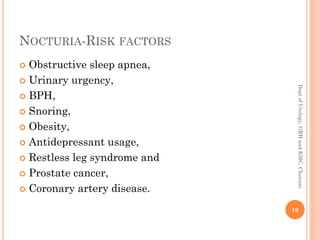
NOCTURIA-RISK FACTORS
 Obstructive sleep apnea,
 Urinary urgency,
 BPH,
 Snoring,
 Obesity,
 Antidepressant usage,
 Restless leg syndrome and
 Prostate cancer,
 Coronary artery disease.
10
Dept
of
Urology,
GRH
and
KMC,
Chennai.
11
Dept
of
Urology,
GRH
and
KMC,
Chennai.
12
Dept
of
Urology,
GRH
and
KMC,
Chennai.
13
Dept
of
Urology,
GRH
and
KMC,
Chennai.
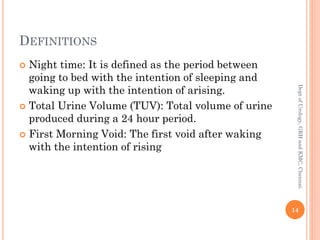
DEFINITIONS
 Night time: It is defined as the period between
going to bed with the intention of sleeping and
waking up with the intention of arising.
 Total Urine Volume (TUV): Total volume of urine
produced during a 24 hour period.
 First Morning Void: The first void after waking
with the intention of rising
14
Dept
of
Urology,
GRH
and
KMC,
Chennai.
DEFINITIONS
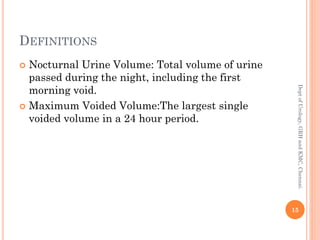
 Nocturnal Urine Volume: Total volume of urine
passed during the night, including the first
morning void.
 Maximum Voided Volume:The largest single
voided volume in a 24 hour period.
15
Dept
of
Urology,
GRH
and
KMC,
Chennai.
DEFINITIONS
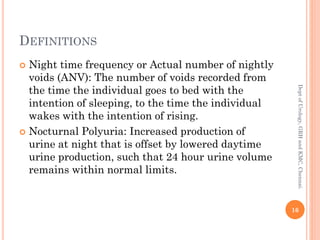
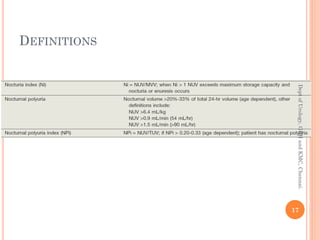
 Night time frequency or Actual number of nightly
voids (ANV): The number of voids recorded from
the time the individual goes to bed with the
intention of sleeping, to the time the individual
wakes with the intention of rising.
 Nocturnal Polyuria: Increased production of
urine at night that is offset by lowered daytime
urine production, such that 24 hour urine volume
remains within normal limits.
16
Dept
of
Urology,
GRH
and
KMC,
Chennai.
DEFINITIONS
17
Dept
of
Urology,
GRH
and
KMC,
Chennai.
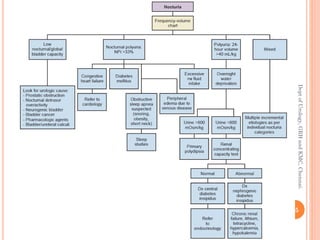
NOCTURIA CLASSIFICATION
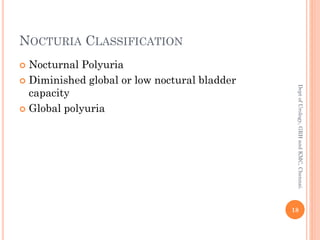
 Nocturnal Polyuria
 Diminished global or low noctural bladder
capacity
 Global polyuria
18
Dept
of
Urology,
GRH
and
KMC,
Chennai.
NOCTURNAL POLYURIA
 Increased production of urine at night that is
offset by lowered daytime urine production, such
that 24 hour urine volume remains within
normal limits.
19
Dept
of
Urology,
GRH
and
KMC,
Chennai.
NOCTURNAL POLYURIA
 Excessive nighttime fluid intake
 Peripheral edema
 Obstructive sleep apnea
 Diabetes mellitus
 Congenital heart failure
20
Dept
of
Urology,
GRH
and
KMC,
Chennai.
NOCTURNAL POLYURIA
 Obstructive sleep apnea is a common cause of
nocturnal polyuria.
 OSA is defined as the sudden cessation of
respiration during sleep because of airway
obstruction.
21
Dept
of
Urology,
GRH
and
KMC,
Chennai.
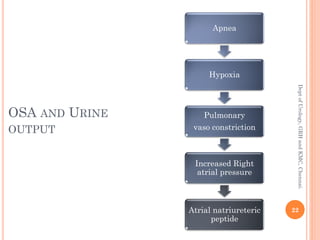
OSA AND URINE
OUTPUT
Apnea
Hypoxia
Pulmonary
vaso constriction
Increased Right
atrial pressure
Atrial natriureteric
peptide
22
Dept
of
Urology,
GRH
and
KMC,
Chennai.
MANAGEMENT
 Conservative approach.
 Cessation of fluid intake 4 hours before bedtime
 Use compressive lower extremity stockings
 Diuretics in mid-afternoon for edema states
 ADH supplementation at bedtime.
 CPAP for OSA
23
Dept
of
Urology,
GRH
and
KMC,
Chennai.
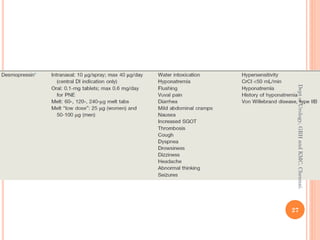
DESMOPRESSIN-RECOMMENDATION
 ICI: Grade A (Level 1 Evidence)
 EAU: Grade A (level 1b evidence)
Women are more sensitive to desmopressin than
man in terms of effects on nocturnal urine
production and duration of action.
Gene for V2 receptor present on X chromosome.
24
Dept
of
Urology,
GRH
and
KMC,
Chennai.
DESMOPRESSIN-PRECAUTIONS
 Desmopressin is most appropriate therapy for
patients with nocturia related to noctural
polyuria.
 Gender sensitivity differentials present.
 Baseline sodium before starting therapy.
 Should not be given to elderly patients with
baseline hyponatremia
 Monitor sodium within 7 days and then 28 days
after initial or incremental dosing, then check
every 6 months or more often as indicated.
25
Dept
of
Urology,
GRH
and
KMC,
Chennai.
26
Dept
of
Urology,
GRH
and
KMC,
Chennai.
27
Dept
of
Urology,
GRH
and
KMC,
Chennai.
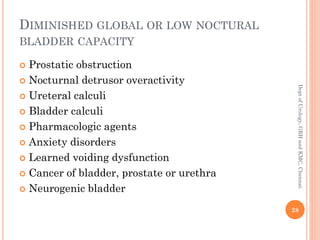
DIMINISHED GLOBAL OR LOW NOCTURAL
BLADDER CAPACITY
 Prostatic obstruction
 Nocturnal detrusor overactivity
 Ureteral calculi
 Bladder calculi
 Pharmacologic agents
 Anxiety disorders
 Learned voiding dysfunction
 Cancer of bladder, prostate or urethra
 Neurogenic bladder
28
Dept
of
Urology,
GRH
and
KMC,
Chennai.
MANAGEMENT
 Treat bladder outlet obstruction (Tamsulosin
therapy and TURP).
 TURP appears to be superior to Tamsulosin for
treatment of BPH related nocturia.
29
Dept
of
Urology,
GRH
and
KMC,
Chennai.
SOLIFENACIN?
 In overactive bladder?
 Dose of 5 mg and 10 mg.
 Decreased nocturia but not clinically significant.
30
Dept
of
Urology,
GRH
and
KMC,
Chennai.
TOLT ER
 Tolterodine Extended Release
 Dose 4 mg, daily 4 hours before sleep
 Severe OAB related noctural micturitions
decreased. Non OAB related nocturnal
micturitions not affected.
31
Dept
of
Urology,
GRH
and
KMC,
Chennai.
TROSPIUM CHLORIDE
 20 mg twice daily
 Significant decrease in noctural episodes
compared to placebo.
32
Dept
of
Urology,
GRH
and
KMC,
Chennai.
FESOTERODINE
Prodrug of tolterodine
Decreased noctural episodes compared to placebo.
33
Dept
of
Urology,
GRH
and
KMC,
Chennai.
MIRABEGRON
 Beta 3 adrenergic agonist.
 Causes decrease in noctural micturition episodes
related to overactive bladder.
34
Dept
of
Urology,
GRH
and
KMC,
Chennai.
CONCLUSION
 Alpha blockers, 5 ARIs, antimuscarinics and
antimuscarinics plus alpha blockers have
occasionally been found to have statistically
significant reduction in nocturia episodes, but
clinical significance appears to be minimal.
35
Dept
of
Urology,
GRH
and
KMC,
Chennai.
MIXED NOCTURAL POLYURIA AND DIMINISHED
GLOBAL AND NOCTURNAL BLADDER CAPACITY
 36% of patients have a mixed cause.
36
Dept
of
Urology,
GRH
and
KMC,
Chennai.
BEHAVIOURAL MODIFICATIONS
 Reduced caffeine and alcohol intake
 Limited night time fluid intake
 Improved sleep hygiene through moderate
exercise
 Attention to room temperature, noise and
lighting.
 Early evening leg elevation
 Compression stockings in lower extremity edema
37
Dept
of
Urology,
GRH
and
KMC,
Chennai.
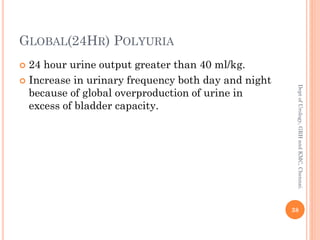
GLOBAL(24HR) POLYURIA
 24 hour urine output greater than 40 ml/kg.
 Increase in urinary frequency both day and night
because of global overproduction of urine in
excess of bladder capacity.
38
Dept
of
Urology,
GRH
and
KMC,
Chennai.
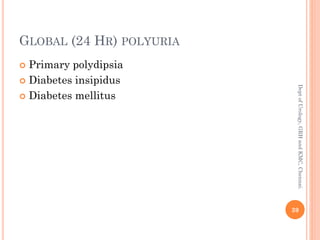
GLOBAL (24 HR) POLYURIA
 Primary polydipsia
 Diabetes insipidus
 Diabetes mellitus
39
Dept
of
Urology,
GRH
and
KMC,
Chennai.
CENTRAL DI-DAMAGE TO HYPOTHALAMUS
OR POSTERIOR PITUITARY
 Trauma,
 Primary pituitary tumors
(e.g.,craniopharyngioma),
 Metastatic disease (e.g.,breast, lung),
 Infiltrative diseases (e.g., sarcoid),
 Infarction (e.g., Sheehan syndrome postpartum),
 Infection (e.g., tuberculosis, meningitis)
 Idiopathic
40
Dept
of
Urology,
GRH
and
KMC,
Chennai.
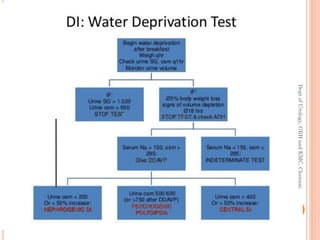
NEPHROGENIC DI- NORMAL ADH LEVELS
BUT KIDNEYS DO NOT RESPOND
 Diagnosis is done by overnight water
depreviation test and Renal concentrating
capacity test.
41
Dept
of
Urology,
GRH
and
KMC,
Chennai.
42
Dept
of
Urology,
GRH
and
KMC,
Chennai.
POLYDIPSIA
Primary polydipsia will have normal urine
osmolality on water deprivation tests.
Dipsogenic polydipsia is associated with a history
of a central neurologic abnormality such as a
history of brain trauma or radiation.
Psychogenic polydipsia is a long term behavioural
or psychiatric disorder.
43
Dept
of
Urology,
GRH
and
KMC,
Chennai.
MANAGEMENT
 Central diabetes insipidus- ADH
supplementation
 Nephrogenic DI-No specific treatment
 Primary and psychogenic polydipsia-Behavioural
therapy
 Diabetes mellitus with glycosuria- Glycemic
control.
44
Dept
of
Urology,
GRH
and
KMC,
Chennai.
45
Dept
of
Urology,
GRH
and
KMC,
Chennai.
THANK YOU
46
Dept
of
Urology,
GRH
and
KMC,
Chennai.

Nocturia

  • 1.
    NOCTURIA Dept of Urology GovtRoyapettah Hospital and Kilpauk Medical College Chennai
  • 2.
    MODERATORS: Professors:  Prof. Dr.G. Sivasankar, M.S., M.Ch.,  Prof. Dr. A. Senthilvel, M.S., M.Ch., Asst Professors:  Dr. J. Sivabalan, M.S., M.Ch.,  Dr. R. Bhargavi, M.S., M.Ch.,  Dr. S. Raju, M.S., M.Ch.,  Dr. K. Muthurathinam, M.S., M.Ch.,  Dr. D. Tamilselvan, M.S., M.Ch.,  Dr. K. Senthilkumar, M.S., M.Ch. Dept of Urology, GRH and KMC, Chennai. 2
  • 3.
    NOCTURIA- DEFINITION  Nocturiais defined as waking because of the desire to void during intended sleep.  It can be the result of an abnormality in the genitourinary tract or a symptom of an underlying medical condition. 3 Dept of Urology, GRH and KMC, Chennai.
  • 4.
    INTERNATIONAL CONTINENCE SOCIETY DEFINITION Nocturia is voiding that occurs during the hours of sleep (voiding that is preceded and followed by sleep).  This definition does not include the degree of bother for the patient. 4 Dept of Urology, GRH and KMC, Chennai.
  • 5.
    PREVALENCE  Nocturia (>1void per night) 28.4%, 25.2% among men and 31.3% among women.  Prevalence of nocturia in both men and women increases with age. 5 Dept of Urology, GRH and KMC, Chennai.
  • 6.
    NOCTURIA AND SLEEPQUALITY  Nocturia affects sleep efficiency and sleep latency. 6 Dept of Urology, GRH and KMC, Chennai.
  • 7.
    SLEEP EFFICIENCY  Sleepefficiency is defined as actual time asleep (minutes) divided by total time of intended sleep (minutes).  Normal is considered greater than 85%.  <80% is associated with twice the risk of mortality. 7 Dept of Urology, GRH and KMC, Chennai.
  • 8.
    SLEEP LATENCY  Sleeplatency is defined as the time it takes to go from being completely awake to being completely asleep.  Individuals with sleep latency more than 30 min were found to have greater than twice the risk of death . 8 Dept of Urology, GRH and KMC, Chennai.
  • 9.
    METABOLIC SYNDROME  Decreasedimmune function  Increased risk of CAD  Increased risk of obesity and type 2 diabetes.  Nocturia impairs slow wave sleep. Suppression of slow wave sleep impairs glucose tolerance and insulin sensitivity. 9 Dept of Urology, GRH and KMC, Chennai.
  • 10.
    NOCTURIA-RISK FACTORS  Obstructivesleep apnea,  Urinary urgency,  BPH,  Snoring,  Obesity,  Antidepressant usage,  Restless leg syndrome and  Prostate cancer,  Coronary artery disease. 10 Dept of Urology, GRH and KMC, Chennai.
  • 11.
  • 12.
  • 13.
  • 14.
    DEFINITIONS  Night time:It is defined as the period between going to bed with the intention of sleeping and waking up with the intention of arising.  Total Urine Volume (TUV): Total volume of urine produced during a 24 hour period.  First Morning Void: The first void after waking with the intention of rising 14 Dept of Urology, GRH and KMC, Chennai.
  • 15.
    DEFINITIONS  Nocturnal UrineVolume: Total volume of urine passed during the night, including the first morning void.  Maximum Voided Volume:The largest single voided volume in a 24 hour period. 15 Dept of Urology, GRH and KMC, Chennai.
  • 16.
    DEFINITIONS  Night timefrequency or Actual number of nightly voids (ANV): The number of voids recorded from the time the individual goes to bed with the intention of sleeping, to the time the individual wakes with the intention of rising.  Nocturnal Polyuria: Increased production of urine at night that is offset by lowered daytime urine production, such that 24 hour urine volume remains within normal limits. 16 Dept of Urology, GRH and KMC, Chennai.
  • 17.
  • 18.
    NOCTURIA CLASSIFICATION  NocturnalPolyuria  Diminished global or low noctural bladder capacity  Global polyuria 18 Dept of Urology, GRH and KMC, Chennai.
  • 19.
    NOCTURNAL POLYURIA  Increasedproduction of urine at night that is offset by lowered daytime urine production, such that 24 hour urine volume remains within normal limits. 19 Dept of Urology, GRH and KMC, Chennai.
  • 20.
    NOCTURNAL POLYURIA  Excessivenighttime fluid intake  Peripheral edema  Obstructive sleep apnea  Diabetes mellitus  Congenital heart failure 20 Dept of Urology, GRH and KMC, Chennai.
  • 21.
    NOCTURNAL POLYURIA  Obstructivesleep apnea is a common cause of nocturnal polyuria.  OSA is defined as the sudden cessation of respiration during sleep because of airway obstruction. 21 Dept of Urology, GRH and KMC, Chennai.
  • 22.
    OSA AND URINE OUTPUT Apnea Hypoxia Pulmonary vasoconstriction Increased Right atrial pressure Atrial natriureteric peptide 22 Dept of Urology, GRH and KMC, Chennai.
  • 23.
    MANAGEMENT  Conservative approach. Cessation of fluid intake 4 hours before bedtime  Use compressive lower extremity stockings  Diuretics in mid-afternoon for edema states  ADH supplementation at bedtime.  CPAP for OSA 23 Dept of Urology, GRH and KMC, Chennai.
  • 24.
    DESMOPRESSIN-RECOMMENDATION  ICI: GradeA (Level 1 Evidence)  EAU: Grade A (level 1b evidence) Women are more sensitive to desmopressin than man in terms of effects on nocturnal urine production and duration of action. Gene for V2 receptor present on X chromosome. 24 Dept of Urology, GRH and KMC, Chennai.
  • 25.
    DESMOPRESSIN-PRECAUTIONS  Desmopressin ismost appropriate therapy for patients with nocturia related to noctural polyuria.  Gender sensitivity differentials present.  Baseline sodium before starting therapy.  Should not be given to elderly patients with baseline hyponatremia  Monitor sodium within 7 days and then 28 days after initial or incremental dosing, then check every 6 months or more often as indicated. 25 Dept of Urology, GRH and KMC, Chennai.
  • 26.
  • 27.
  • 28.
    DIMINISHED GLOBAL ORLOW NOCTURAL BLADDER CAPACITY  Prostatic obstruction  Nocturnal detrusor overactivity  Ureteral calculi  Bladder calculi  Pharmacologic agents  Anxiety disorders  Learned voiding dysfunction  Cancer of bladder, prostate or urethra  Neurogenic bladder 28 Dept of Urology, GRH and KMC, Chennai.
  • 29.
    MANAGEMENT  Treat bladderoutlet obstruction (Tamsulosin therapy and TURP).  TURP appears to be superior to Tamsulosin for treatment of BPH related nocturia. 29 Dept of Urology, GRH and KMC, Chennai.
  • 30.
    SOLIFENACIN?  In overactivebladder?  Dose of 5 mg and 10 mg.  Decreased nocturia but not clinically significant. 30 Dept of Urology, GRH and KMC, Chennai.
  • 31.
    TOLT ER  TolterodineExtended Release  Dose 4 mg, daily 4 hours before sleep  Severe OAB related noctural micturitions decreased. Non OAB related nocturnal micturitions not affected. 31 Dept of Urology, GRH and KMC, Chennai.
  • 32.
    TROSPIUM CHLORIDE  20mg twice daily  Significant decrease in noctural episodes compared to placebo. 32 Dept of Urology, GRH and KMC, Chennai.
  • 33.
    FESOTERODINE Prodrug of tolterodine Decreasednoctural episodes compared to placebo. 33 Dept of Urology, GRH and KMC, Chennai.
  • 34.
    MIRABEGRON  Beta 3adrenergic agonist.  Causes decrease in noctural micturition episodes related to overactive bladder. 34 Dept of Urology, GRH and KMC, Chennai.
  • 35.
    CONCLUSION  Alpha blockers,5 ARIs, antimuscarinics and antimuscarinics plus alpha blockers have occasionally been found to have statistically significant reduction in nocturia episodes, but clinical significance appears to be minimal. 35 Dept of Urology, GRH and KMC, Chennai.
  • 36.
    MIXED NOCTURAL POLYURIAAND DIMINISHED GLOBAL AND NOCTURNAL BLADDER CAPACITY  36% of patients have a mixed cause. 36 Dept of Urology, GRH and KMC, Chennai.
  • 37.
    BEHAVIOURAL MODIFICATIONS  Reducedcaffeine and alcohol intake  Limited night time fluid intake  Improved sleep hygiene through moderate exercise  Attention to room temperature, noise and lighting.  Early evening leg elevation  Compression stockings in lower extremity edema 37 Dept of Urology, GRH and KMC, Chennai.
  • 38.
    GLOBAL(24HR) POLYURIA  24hour urine output greater than 40 ml/kg.  Increase in urinary frequency both day and night because of global overproduction of urine in excess of bladder capacity. 38 Dept of Urology, GRH and KMC, Chennai.
  • 39.
    GLOBAL (24 HR)POLYURIA  Primary polydipsia  Diabetes insipidus  Diabetes mellitus 39 Dept of Urology, GRH and KMC, Chennai.
  • 40.
    CENTRAL DI-DAMAGE TOHYPOTHALAMUS OR POSTERIOR PITUITARY  Trauma,  Primary pituitary tumors (e.g.,craniopharyngioma),  Metastatic disease (e.g.,breast, lung),  Infiltrative diseases (e.g., sarcoid),  Infarction (e.g., Sheehan syndrome postpartum),  Infection (e.g., tuberculosis, meningitis)  Idiopathic 40 Dept of Urology, GRH and KMC, Chennai.
  • 41.
    NEPHROGENIC DI- NORMALADH LEVELS BUT KIDNEYS DO NOT RESPOND  Diagnosis is done by overnight water depreviation test and Renal concentrating capacity test. 41 Dept of Urology, GRH and KMC, Chennai.
  • 42.
  • 43.
    POLYDIPSIA Primary polydipsia willhave normal urine osmolality on water deprivation tests. Dipsogenic polydipsia is associated with a history of a central neurologic abnormality such as a history of brain trauma or radiation. Psychogenic polydipsia is a long term behavioural or psychiatric disorder. 43 Dept of Urology, GRH and KMC, Chennai.
  • 44.
    MANAGEMENT  Central diabetesinsipidus- ADH supplementation  Nephrogenic DI-No specific treatment  Primary and psychogenic polydipsia-Behavioural therapy  Diabetes mellitus with glycosuria- Glycemic control. 44 Dept of Urology, GRH and KMC, Chennai.
  • 45.
  • 46.