ARTIFICIAL URINARY SPHINCTER
Dept of Urology
Govt Royapettah Hospital and Kilpauk Medical College
Chennai
Moderators:
Professors:
• Prof. Dr. G. Sivasankar, M.S., M.Ch.,
• Prof. Dr. A. Senthilvel, M.S., M.Ch.,
Asst Professors:
• Dr. J. Sivabalan, M.S., M.Ch.,
• Dr. R. Bhargavi, M.S., M.Ch.,
• Dr. S. Raju, M.S., M.Ch.,
• Dr. K. Muthurathinam, M.S., M.Ch.,
• Dr. D. Tamilselvan, M.S., M.Ch.,
• Dr. K. Senthilkumar, M.S., M.Ch.
Dept of Urology, GRH and KMC, Chennai. 2
Urinary incontinence (UI)
• The complaint of any involuntary leakage of
urine
• Causes
– Congenital anomalies
– Injury
– Genitourinary surgery
– Miscellaneous causes
3
Dept of Urology, GRH and KMC, Chennai.
• Urinary continence in the male depends on
– A compliant and contractile bladder body
– Functional posterior urethra
• The bladder neck
• Intact prostatic (internal sphincter) sphincter
• Intact rhabdosphincter (external sphincter)
4
Dept of Urology, GRH and KMC, Chennai.
• Internal sphincter incompetence causes
– Pelvic surgery
– Bladder neck injury
– Specific sympathetic neuropathic dysfunction
– Embryologic disruption
• Incompetence of the external sphincter, known as intrinsic
sphincter deficiency (ISD), causes
– Radical prostatectomy (most frequent)
– Prostatomembranous urethral distraction injuries,
– Traumatic and acquired myelopathy
– Spinal dysraphism
– Sacral agenesis
– Exstrophy/Epispadias complex.
5
Dept of Urology, GRH and KMC, Chennai.
• Incontinence after TURP
– Reflect persistent bladder overactivity
– Rarely results from damage to the external sphincter
during transurethral resection
• Incidence of incontinence after Radical
Prostatectomy is 2.5% to 87%
• Progressive improvement in urinary control
occurs
• Nerve-sparing techniques pioneered by Walsh
decreases rate of urinary incontinence 6
Dept of Urology, GRH and KMC, Chennai.
To be ruled out
• Associated bladder dysfunction
– Decreased compliance
– Detrusor overactivity
7
Dept of Urology, GRH and KMC, Chennai.
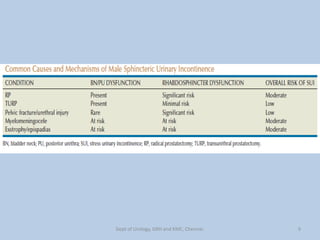
• Radical prostatectomy (RP) the most common
etiology of Sphincteric UI in men
8
Dept of Urology, GRH and KMC, Chennai.
9
Dept of Urology, GRH and KMC, Chennai.
OPTIONS FOR URINARY
INCONTINENECE
• Surgical treatment
– Including transurethral bulking agents
– Bulbar urethral slings
– The artificial urinary sphincter (AUS)
10
Dept of Urology, GRH and KMC, Chennai.
Bulking Agents Vs AUS
• Bulking agents were first-line treatment for male
sphincteric UI
• Poor results in
– Severe incontinence
– Patients with Postprostatectomy scarring in the
vesicourethral region
• The AUS - The gold standard for the treatment of
UI
– Has long-term durability
– Is highly Efficient
– Is a solution to moderate and severe degrees of
urinary loss.
11
Dept of Urology, GRH and KMC, Chennai.
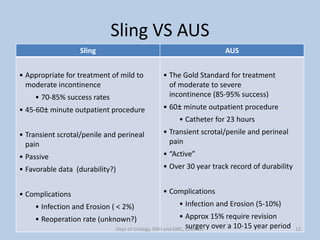
Sling VS AUS
Sling AUS
• Appropriate for treatment of mild to
moderate incontinence
• 70-85% success rates
• 45-60± minute outpatient procedure
• Transient scrotal/penile and perineal
pain
• Passive
• Favorable data (durability?)
• Complications
• Infection and Erosion ( < 2%)
• Reoperation rate (unknown?)
• The Gold Standard for treatment
of moderate to severe
incontinence (85-95% success)
• 60± minute outpatient procedure
• Catheter for 23 hours
• Transient scrotal/penile and perineal
pain
• “Active”
• Over 30 year track record of durability
• Complications
• Infection and Erosion (5-10%)
• Approx 15% require revision
surgery over a 10-15 year period 12
Dept of Urology, GRH and KMC, Chennai.
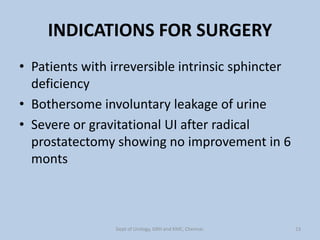
INDICATIONS FOR SURGERY
• Patients with irreversible intrinsic sphincter
deficiency
• Bothersome involuntary leakage of urine
• Severe or gravitational UI after radical
prostatectomy showing no improvement in 6
monts
13
Dept of Urology, GRH and KMC, Chennai.
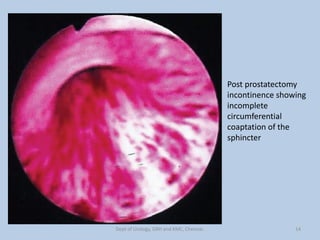
Post prostatectomy
incontinence showing
incomplete
circumferential
coaptation of the
sphincter
14
Dept of Urology, GRH and KMC, Chennai.
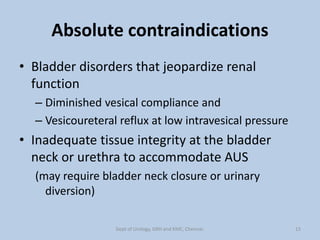
Absolute contraindications
• Bladder disorders that jeopardize renal
function
– Diminished vesical compliance and
– Vesicoureteral reflux at low intravesical pressure
• Inadequate tissue integrity at the bladder
neck or urethra to accommodate AUS
(may require bladder neck closure or urinary
diversion)
15
Dept of Urology, GRH and KMC, Chennai.
Relative contra indications
• Urinary tract abnormalities that require future
transurethral management
– Bladder cancer
– Refractory vesicourethral anastomotic strictures
16
Dept of Urology, GRH and KMC, Chennai.
History
• In 1976, Rosen designed the first model of an
AUS
• In 1978, Scott presented his initial report with
the AMS 721 with 79% success rate
• In 1988, The AMS 742 allowed automatic cuff
closure after cuff decompression
• In 1989, The AMS 791 and 792 used a silicone
rubber cuff and a deactivation button
• The AMS 800 included the deactivation button
within the control pump
17
Dept of Urology, GRH and KMC, Chennai.
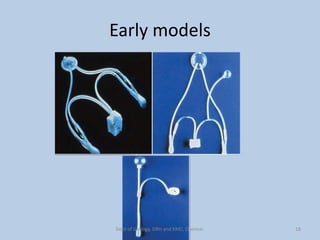
Early models
18
Dept of Urology, GRH and KMC, Chennai.
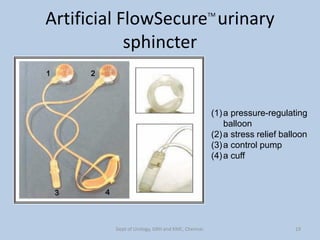
Artificial FlowSecureTM
urinary
sphincter
(1)a pressure-regulating
balloon
(2)a stress relief balloon
(3)a control pump
(4)a cuff
19
Dept of Urology, GRH and KMC, Chennai.
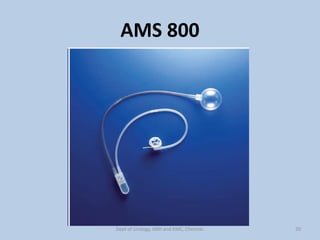
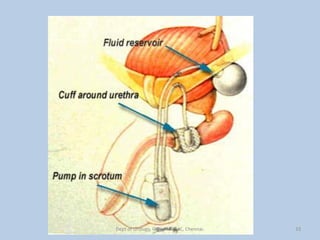
AMS 800
20
Dept of Urology, GRH and KMC, Chennai.
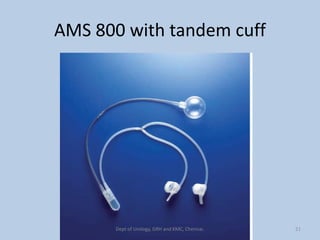
AMS 800 with tandem cuff
21
Dept of Urology, GRH and KMC, Chennai.
Preoperative evaluation
• Detailed history
• Physical examination
• Urinalysis
• Cystoscopy
• Pressure flow urodynamics
22
Dept of Urology, GRH and KMC, Chennai.
Medical history
• Focus on the type, degree, and severity of UI
• H/o Previous surgical procedures
• Symptoms of neurologic disease
• Specific evaluation of the failed AUS
23
Dept of Urology, GRH and KMC, Chennai.
• Differentiation between stress and urge UI
– Voiding diary
– Pad test
24
Dept of Urology, GRH and KMC, Chennai.
Physical examination
• Thorough examination
– Abdomen
– Back
– Genitalia
– Perineum
– Rectum
– Neurologic system
25
Dept of Urology, GRH and KMC, Chennai.
Physical examination
• Status of the skin examined for
– Integrity
– Infection (eg: fungal)
– Incision (of previous procedure)
• Inguinal hernias, hydroceles and scrotal
masses should be looked for
26
Dept of Urology, GRH and KMC, Chennai.
Laboratory investigations
• Complete Urine analysis
• Urine culture and sensitivity
• Renal function test
• Serum PSA (especially in post radical
prostatectomy)
27
Dept of Urology, GRH and KMC, Chennai.
Cystoscopy
• To rule out
– Vesicourethral anastomotic stricture
– Bladder neck contracture
– Bulbar urethral stricture
• In cases of previous failed AUS, urethral
atrophy should be ruled out before
reimplantation
28
Dept of Urology, GRH and KMC, Chennai.
Urodynamics
• To assess
– Bladder capacity
– Compliance
– Contractility
• To rule out bladder pathology that might
cause persistence of symptoms after the
procedure
29
Dept of Urology, GRH and KMC, Chennai.
SPECIAL SITUATION: Evaluation of Persistent
Incontinence after AUS
• Aim : To differentiate between
– Inadvertent deactivation
– Insufficient urethral compression (oversizing of
cuff)
– Mechanical failure with fluid loss
– Cuff erosion
– Bladder storage failure
– Urethral or bladder neck atrophy under the cuff
– Plugged delay-fill resistor or kinked tubing (rare)
30
Dept of Urology, GRH and KMC, Chennai.
AMS 800
31
Dept of Urology, GRH and KMC, Chennai.
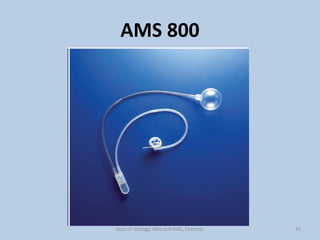
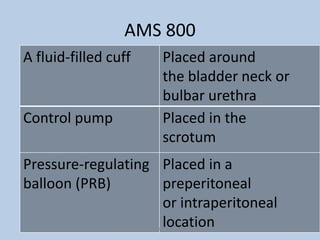
AMS 800
A fluid-filled cuff Placed around
the bladder neck or
bulbar urethra
Control pump Placed in the
scrotum
Pressure-regulating
balloon (PRB)
Placed in a
preperitoneal
or intraperitoneal
location 32
Dept of Urology, GRH and KMC, Chennai.
33
Dept of Urology, GRH and KMC, Chennai.
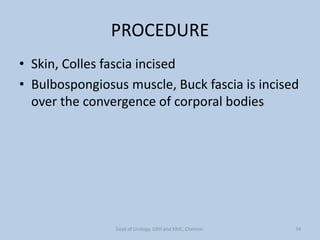
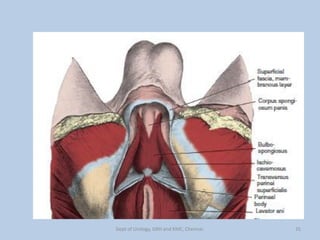
PROCEDURE
• Skin, Colles fascia incised
• Bulbospongiosus muscle, Buck fascia is incised
over the convergence of corporal bodies
34
Dept of Urology, GRH and KMC, Chennai.
35
Dept of Urology, GRH and KMC, Chennai.
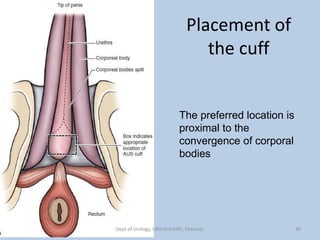
Placement of
the cuff
The preferred location is
proximal to the
convergence of corporal
bodies
36
Dept of Urology, GRH and KMC, Chennai.
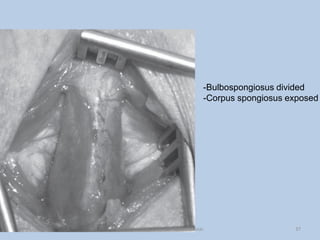
-Bulbospongiosus divided
-Corpus spongiosus exposed
37
Dept of Urology, GRH and KMC, Chennai.
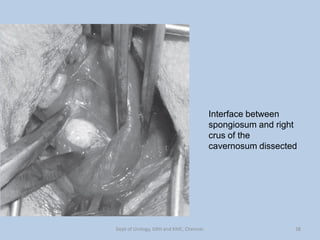
Interface between
spongiosum and right
crus of the
cavernosum dissected
38
Dept of Urology, GRH and KMC, Chennai.
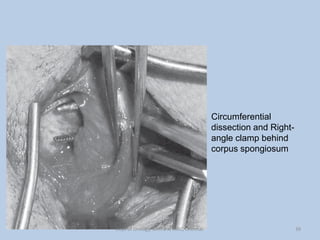
Circumferential
dissection and Right-
angle clamp behind
corpus spongiosum
39
Dept of Urology, GRH and KMC, Chennai.
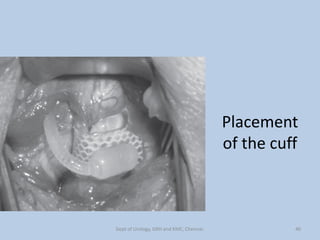
Placement
of the cuff
40
Dept of Urology, GRH and KMC, Chennai.
Technical aspects
• Circumference of urethra should be measured
and appropriate size of cuff selected
• The Foley should be removed before the
measurement
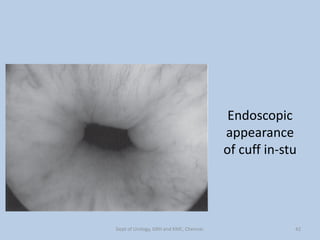
• The best test of cuff fit is the visual and
endoscopic appearance
41
Dept of Urology, GRH and KMC, Chennai.
Endoscopic
appearance
of cuff in-stu
42
Dept of Urology, GRH and KMC, Chennai.
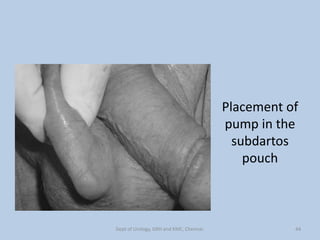
Control pump placement
• Another small scrotal incision made
• Tunnelled to the perineal incision
• A subdartos pouch created
• Pump kept in the pouch
43
Dept of Urology, GRH and KMC, Chennai.
Placement of
pump in the
subdartos
pouch
44
Dept of Urology, GRH and KMC, Chennai.
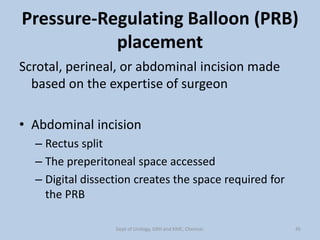
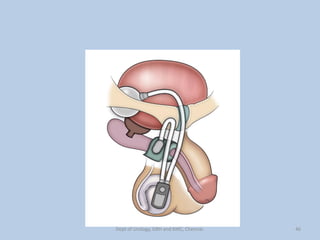
Pressure-Regulating Balloon (PRB)
placement
Scrotal, perineal, or abdominal incision made
based on the expertise of surgeon
• Abdominal incision
– Rectus split
– The preperitoneal space accessed
– Digital dissection creates the space required for
the PRB
45
Dept of Urology, GRH and KMC, Chennai.
46
Dept of Urology, GRH and KMC, Chennai.
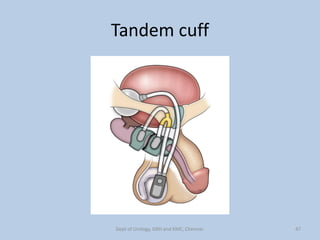
Tandem cuff
47
Dept of Urology, GRH and KMC, Chennai.
COMPLICATIONS
48
Dept of Urology, GRH and KMC, Chennai.
Urinary Retention
• Acute retention
– Ensure Cuff deactivation
– Transurethral bladder drainage with a small (10-Fr or
12-Fr) catheter for 24 to 48 hours
• Retention >48 hrs has erosion risk
– Suprapubic diversion to be done
– Use ultrasound or fluoro to guide the puncture
without injuring the implant
• Retention beyond several weeks means ‘over cuff
size’
– Undersizing the cuff
– Rule out proximal urethral obstruction
49
Dept of Urology, GRH and KMC, Chennai.
Urinary Retention
• Late-onset urinary retention
– Endoscopic evaluation
– Urodynamic evaluation
• Causes
– Erosion
– Undiagnosed Proximal urethral obstruction
– Undiagnosed Detrusor failure
50
Dept of Urology, GRH and KMC, Chennai.
AUS Infection
• A serious and devastating complication
• Rate is 1% to 3%
– 10% in cases of pelvic irradiation & reoperations
• Skin pathogens are the most common organisms
– Staphylococcus epidermidis &
– S. aureus
• Late infections (>4 months) are due to indolent
organinsms introduced by haematogenous route
• All men undergoing AUS implant should be given
prophylactic antibiotics as per AUA guidelines
51
Dept of Urology, GRH and KMC, Chennai.
AUS Infection
• Clinical presentation:
– Persistent fever in the postoperative period
– Scrotal pain
– Erythema
– Edema
– Frank purulence
• Management:
– Explantation
– Removal of device →antiseptic
irrigation→reimplantation→continuing irrigation
regime
52
Dept of Urology, GRH and KMC, Chennai.
AUS Infection
• Contraindications to prosthesis salvage
– Sepsis
– Ketoacidosis
– Necrotizing infection
– Immunosuppression
– Presence of gross purulent material
53
Dept of Urology, GRH and KMC, Chennai.
Urethral Erosion
• Incidence is 5%
• Risk factors:
– Hypertension
– Coronary artery disease
– Prior radiation therapy
– Prior AUS revisions
• Prevention:
– Postoperatively deactivation of the pump till the
healing process is complete (decreases the chance
from 18% to 1.3%)
54
Dept of Urology, GRH and KMC, Chennai.
Urethral Erosion - management
• Immediate removal of all the components of
the AUS
• SPC or urethral catheter drainage (if possible)
• Reimplantation may be possible after 6
months if urethrography confirms healing
55
Dept of Urology, GRH and KMC, Chennai.
Urethral Atrophy
• Most common reason for revision of the AUS
• Results from the chronic compression of the
spongy tissue under the occlusive cuff
• Treatment options
– Cuff downsizing
– Movement of the cuff proximally or distally where
the urethra may be thicker
– Placement of a second cuff in tandem.
56
Dept of Urology, GRH and KMC, Chennai.
THANKYOU
57
Dept of Urology, GRH and KMC, Chennai.

ARTIFICIAL URINARY SPHINCTER

  • 1.
    ARTIFICIAL URINARY SPHINCTER Deptof Urology Govt Royapettah Hospital and Kilpauk Medical College Chennai
  • 2.
    Moderators: Professors: • Prof. Dr.G. Sivasankar, M.S., M.Ch., • Prof. Dr. A. Senthilvel, M.S., M.Ch., Asst Professors: • Dr. J. Sivabalan, M.S., M.Ch., • Dr. R. Bhargavi, M.S., M.Ch., • Dr. S. Raju, M.S., M.Ch., • Dr. K. Muthurathinam, M.S., M.Ch., • Dr. D. Tamilselvan, M.S., M.Ch., • Dr. K. Senthilkumar, M.S., M.Ch. Dept of Urology, GRH and KMC, Chennai. 2
  • 3.
    Urinary incontinence (UI) •The complaint of any involuntary leakage of urine • Causes – Congenital anomalies – Injury – Genitourinary surgery – Miscellaneous causes 3 Dept of Urology, GRH and KMC, Chennai.
  • 4.
    • Urinary continencein the male depends on – A compliant and contractile bladder body – Functional posterior urethra • The bladder neck • Intact prostatic (internal sphincter) sphincter • Intact rhabdosphincter (external sphincter) 4 Dept of Urology, GRH and KMC, Chennai.
  • 5.
    • Internal sphincterincompetence causes – Pelvic surgery – Bladder neck injury – Specific sympathetic neuropathic dysfunction – Embryologic disruption • Incompetence of the external sphincter, known as intrinsic sphincter deficiency (ISD), causes – Radical prostatectomy (most frequent) – Prostatomembranous urethral distraction injuries, – Traumatic and acquired myelopathy – Spinal dysraphism – Sacral agenesis – Exstrophy/Epispadias complex. 5 Dept of Urology, GRH and KMC, Chennai.
  • 6.
    • Incontinence afterTURP – Reflect persistent bladder overactivity – Rarely results from damage to the external sphincter during transurethral resection • Incidence of incontinence after Radical Prostatectomy is 2.5% to 87% • Progressive improvement in urinary control occurs • Nerve-sparing techniques pioneered by Walsh decreases rate of urinary incontinence 6 Dept of Urology, GRH and KMC, Chennai.
  • 7.
    To be ruledout • Associated bladder dysfunction – Decreased compliance – Detrusor overactivity 7 Dept of Urology, GRH and KMC, Chennai.
  • 8.
    • Radical prostatectomy(RP) the most common etiology of Sphincteric UI in men 8 Dept of Urology, GRH and KMC, Chennai.
  • 9.
    9 Dept of Urology,GRH and KMC, Chennai.
  • 10.
    OPTIONS FOR URINARY INCONTINENECE •Surgical treatment – Including transurethral bulking agents – Bulbar urethral slings – The artificial urinary sphincter (AUS) 10 Dept of Urology, GRH and KMC, Chennai.
  • 11.
    Bulking Agents VsAUS • Bulking agents were first-line treatment for male sphincteric UI • Poor results in – Severe incontinence – Patients with Postprostatectomy scarring in the vesicourethral region • The AUS - The gold standard for the treatment of UI – Has long-term durability – Is highly Efficient – Is a solution to moderate and severe degrees of urinary loss. 11 Dept of Urology, GRH and KMC, Chennai.
  • 12.
    Sling VS AUS SlingAUS • Appropriate for treatment of mild to moderate incontinence • 70-85% success rates • 45-60± minute outpatient procedure • Transient scrotal/penile and perineal pain • Passive • Favorable data (durability?) • Complications • Infection and Erosion ( < 2%) • Reoperation rate (unknown?) • The Gold Standard for treatment of moderate to severe incontinence (85-95% success) • 60± minute outpatient procedure • Catheter for 23 hours • Transient scrotal/penile and perineal pain • “Active” • Over 30 year track record of durability • Complications • Infection and Erosion (5-10%) • Approx 15% require revision surgery over a 10-15 year period 12 Dept of Urology, GRH and KMC, Chennai.
  • 13.
    INDICATIONS FOR SURGERY •Patients with irreversible intrinsic sphincter deficiency • Bothersome involuntary leakage of urine • Severe or gravitational UI after radical prostatectomy showing no improvement in 6 monts 13 Dept of Urology, GRH and KMC, Chennai.
  • 14.
    Post prostatectomy incontinence showing incomplete circumferential coaptationof the sphincter 14 Dept of Urology, GRH and KMC, Chennai.
  • 15.
    Absolute contraindications • Bladderdisorders that jeopardize renal function – Diminished vesical compliance and – Vesicoureteral reflux at low intravesical pressure • Inadequate tissue integrity at the bladder neck or urethra to accommodate AUS (may require bladder neck closure or urinary diversion) 15 Dept of Urology, GRH and KMC, Chennai.
  • 16.
    Relative contra indications •Urinary tract abnormalities that require future transurethral management – Bladder cancer – Refractory vesicourethral anastomotic strictures 16 Dept of Urology, GRH and KMC, Chennai.
  • 17.
    History • In 1976,Rosen designed the first model of an AUS • In 1978, Scott presented his initial report with the AMS 721 with 79% success rate • In 1988, The AMS 742 allowed automatic cuff closure after cuff decompression • In 1989, The AMS 791 and 792 used a silicone rubber cuff and a deactivation button • The AMS 800 included the deactivation button within the control pump 17 Dept of Urology, GRH and KMC, Chennai.
  • 18.
    Early models 18 Dept ofUrology, GRH and KMC, Chennai.
  • 19.
    Artificial FlowSecureTM urinary sphincter (1)a pressure-regulating balloon (2)astress relief balloon (3)a control pump (4)a cuff 19 Dept of Urology, GRH and KMC, Chennai.
  • 20.
    AMS 800 20 Dept ofUrology, GRH and KMC, Chennai.
  • 21.
    AMS 800 withtandem cuff 21 Dept of Urology, GRH and KMC, Chennai.
  • 22.
    Preoperative evaluation • Detailedhistory • Physical examination • Urinalysis • Cystoscopy • Pressure flow urodynamics 22 Dept of Urology, GRH and KMC, Chennai.
  • 23.
    Medical history • Focuson the type, degree, and severity of UI • H/o Previous surgical procedures • Symptoms of neurologic disease • Specific evaluation of the failed AUS 23 Dept of Urology, GRH and KMC, Chennai.
  • 24.
    • Differentiation betweenstress and urge UI – Voiding diary – Pad test 24 Dept of Urology, GRH and KMC, Chennai.
  • 25.
    Physical examination • Thoroughexamination – Abdomen – Back – Genitalia – Perineum – Rectum – Neurologic system 25 Dept of Urology, GRH and KMC, Chennai.
  • 26.
    Physical examination • Statusof the skin examined for – Integrity – Infection (eg: fungal) – Incision (of previous procedure) • Inguinal hernias, hydroceles and scrotal masses should be looked for 26 Dept of Urology, GRH and KMC, Chennai.
  • 27.
    Laboratory investigations • CompleteUrine analysis • Urine culture and sensitivity • Renal function test • Serum PSA (especially in post radical prostatectomy) 27 Dept of Urology, GRH and KMC, Chennai.
  • 28.
    Cystoscopy • To ruleout – Vesicourethral anastomotic stricture – Bladder neck contracture – Bulbar urethral stricture • In cases of previous failed AUS, urethral atrophy should be ruled out before reimplantation 28 Dept of Urology, GRH and KMC, Chennai.
  • 29.
    Urodynamics • To assess –Bladder capacity – Compliance – Contractility • To rule out bladder pathology that might cause persistence of symptoms after the procedure 29 Dept of Urology, GRH and KMC, Chennai.
  • 30.
    SPECIAL SITUATION: Evaluationof Persistent Incontinence after AUS • Aim : To differentiate between – Inadvertent deactivation – Insufficient urethral compression (oversizing of cuff) – Mechanical failure with fluid loss – Cuff erosion – Bladder storage failure – Urethral or bladder neck atrophy under the cuff – Plugged delay-fill resistor or kinked tubing (rare) 30 Dept of Urology, GRH and KMC, Chennai.
  • 31.
    AMS 800 31 Dept ofUrology, GRH and KMC, Chennai.
  • 32.
    AMS 800 A fluid-filledcuff Placed around the bladder neck or bulbar urethra Control pump Placed in the scrotum Pressure-regulating balloon (PRB) Placed in a preperitoneal or intraperitoneal location 32 Dept of Urology, GRH and KMC, Chennai.
  • 33.
    33 Dept of Urology,GRH and KMC, Chennai.
  • 34.
    PROCEDURE • Skin, Collesfascia incised • Bulbospongiosus muscle, Buck fascia is incised over the convergence of corporal bodies 34 Dept of Urology, GRH and KMC, Chennai.
  • 35.
    35 Dept of Urology,GRH and KMC, Chennai.
  • 36.
    Placement of the cuff Thepreferred location is proximal to the convergence of corporal bodies 36 Dept of Urology, GRH and KMC, Chennai.
  • 37.
    -Bulbospongiosus divided -Corpus spongiosusexposed 37 Dept of Urology, GRH and KMC, Chennai.
  • 38.
    Interface between spongiosum andright crus of the cavernosum dissected 38 Dept of Urology, GRH and KMC, Chennai.
  • 39.
    Circumferential dissection and Right- angleclamp behind corpus spongiosum 39 Dept of Urology, GRH and KMC, Chennai.
  • 40.
    Placement of the cuff 40 Deptof Urology, GRH and KMC, Chennai.
  • 41.
    Technical aspects • Circumferenceof urethra should be measured and appropriate size of cuff selected • The Foley should be removed before the measurement • The best test of cuff fit is the visual and endoscopic appearance 41 Dept of Urology, GRH and KMC, Chennai.
  • 42.
    Endoscopic appearance of cuff in-stu 42 Deptof Urology, GRH and KMC, Chennai.
  • 43.
    Control pump placement •Another small scrotal incision made • Tunnelled to the perineal incision • A subdartos pouch created • Pump kept in the pouch 43 Dept of Urology, GRH and KMC, Chennai.
  • 44.
    Placement of pump inthe subdartos pouch 44 Dept of Urology, GRH and KMC, Chennai.
  • 45.
    Pressure-Regulating Balloon (PRB) placement Scrotal,perineal, or abdominal incision made based on the expertise of surgeon • Abdominal incision – Rectus split – The preperitoneal space accessed – Digital dissection creates the space required for the PRB 45 Dept of Urology, GRH and KMC, Chennai.
  • 46.
    46 Dept of Urology,GRH and KMC, Chennai.
  • 47.
    Tandem cuff 47 Dept ofUrology, GRH and KMC, Chennai.
  • 48.
    COMPLICATIONS 48 Dept of Urology,GRH and KMC, Chennai.
  • 49.
    Urinary Retention • Acuteretention – Ensure Cuff deactivation – Transurethral bladder drainage with a small (10-Fr or 12-Fr) catheter for 24 to 48 hours • Retention >48 hrs has erosion risk – Suprapubic diversion to be done – Use ultrasound or fluoro to guide the puncture without injuring the implant • Retention beyond several weeks means ‘over cuff size’ – Undersizing the cuff – Rule out proximal urethral obstruction 49 Dept of Urology, GRH and KMC, Chennai.
  • 50.
    Urinary Retention • Late-onseturinary retention – Endoscopic evaluation – Urodynamic evaluation • Causes – Erosion – Undiagnosed Proximal urethral obstruction – Undiagnosed Detrusor failure 50 Dept of Urology, GRH and KMC, Chennai.
  • 51.
    AUS Infection • Aserious and devastating complication • Rate is 1% to 3% – 10% in cases of pelvic irradiation & reoperations • Skin pathogens are the most common organisms – Staphylococcus epidermidis & – S. aureus • Late infections (>4 months) are due to indolent organinsms introduced by haematogenous route • All men undergoing AUS implant should be given prophylactic antibiotics as per AUA guidelines 51 Dept of Urology, GRH and KMC, Chennai.
  • 52.
    AUS Infection • Clinicalpresentation: – Persistent fever in the postoperative period – Scrotal pain – Erythema – Edema – Frank purulence • Management: – Explantation – Removal of device →antiseptic irrigation→reimplantation→continuing irrigation regime 52 Dept of Urology, GRH and KMC, Chennai.
  • 53.
    AUS Infection • Contraindicationsto prosthesis salvage – Sepsis – Ketoacidosis – Necrotizing infection – Immunosuppression – Presence of gross purulent material 53 Dept of Urology, GRH and KMC, Chennai.
  • 54.
    Urethral Erosion • Incidenceis 5% • Risk factors: – Hypertension – Coronary artery disease – Prior radiation therapy – Prior AUS revisions • Prevention: – Postoperatively deactivation of the pump till the healing process is complete (decreases the chance from 18% to 1.3%) 54 Dept of Urology, GRH and KMC, Chennai.
  • 55.
    Urethral Erosion -management • Immediate removal of all the components of the AUS • SPC or urethral catheter drainage (if possible) • Reimplantation may be possible after 6 months if urethrography confirms healing 55 Dept of Urology, GRH and KMC, Chennai.
  • 56.
    Urethral Atrophy • Mostcommon reason for revision of the AUS • Results from the chronic compression of the spongy tissue under the occlusive cuff • Treatment options – Cuff downsizing – Movement of the cuff proximally or distally where the urethra may be thicker – Placement of a second cuff in tandem. 56 Dept of Urology, GRH and KMC, Chennai.
  • 57.
    THANKYOU 57 Dept of Urology,GRH and KMC, Chennai.