BCG for superficial TCC
Dept of Urology
Govt Royapettah Hospital and Kilpauk Medical College
Chennai
1
Moderators:
Professors:
• Prof. Dr. G. Sivasankar, M.S., M.Ch.,
• Prof. Dr. A. Senthilvel, M.S., M.Ch.,
Asst Professors:
• Dr. J. Sivabalan, M.S., M.Ch.,
• Dr. R. Bhargavi, M.S., M.Ch.,
• Dr. S. Raju, M.S., M.Ch.,
• Dr. K. Muthurathinam, M.S., M.Ch.,
• Dr. D. Tamilselvan, M.S., M.Ch.,
• Dr. K. Senthilkumar, M.S., M.Ch.
Dept of Urology, GRH and KMC,
Chennai. 2
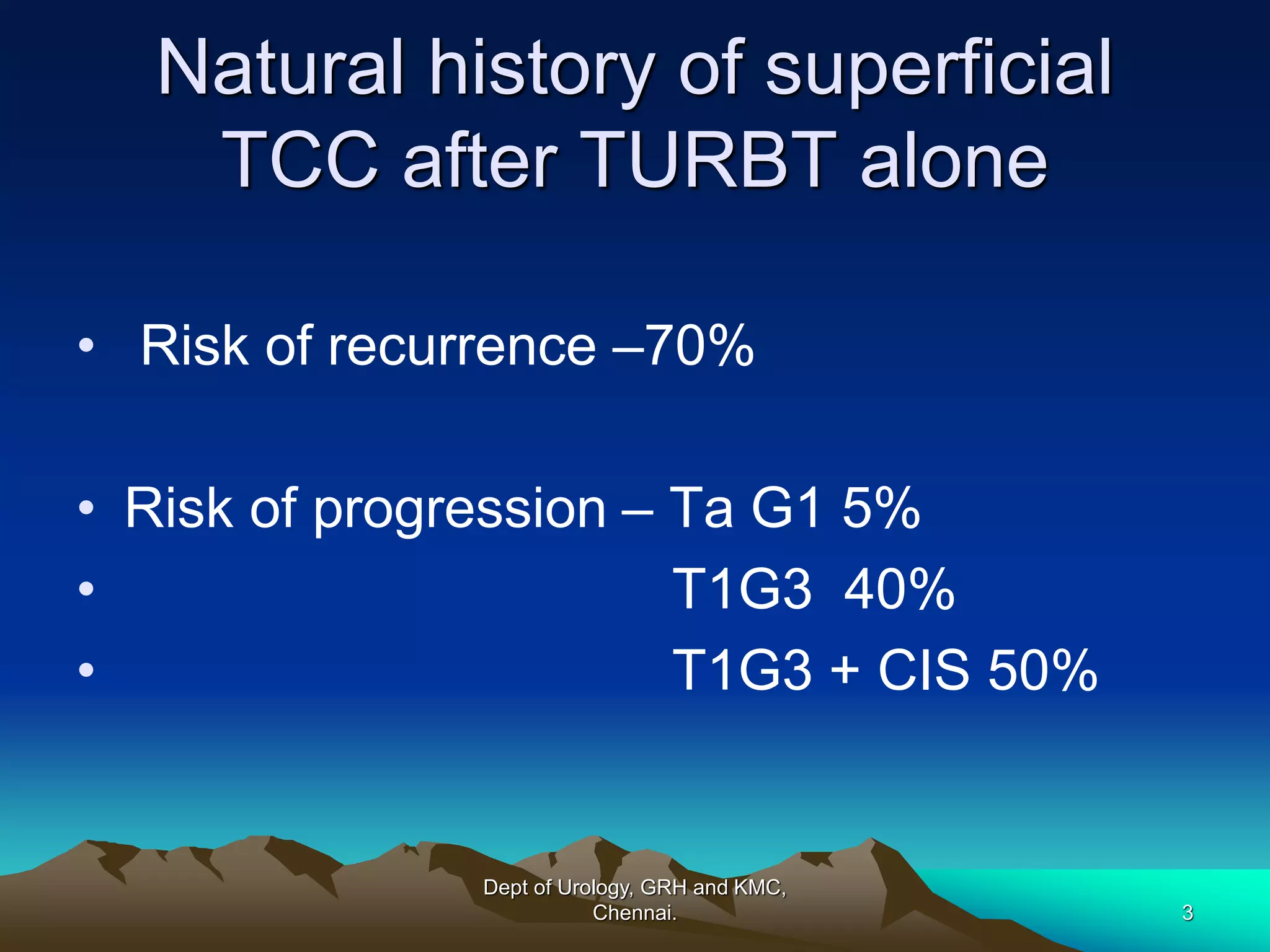
Natural history of superficial
TCC after TURBT alone
• Risk of recurrence –70%
• Risk of progression – Ta G1 5%
• T1G3 40%
• T1G3 + CIS 50%
3
Dept of Urology, GRH and KMC,
Chennai.
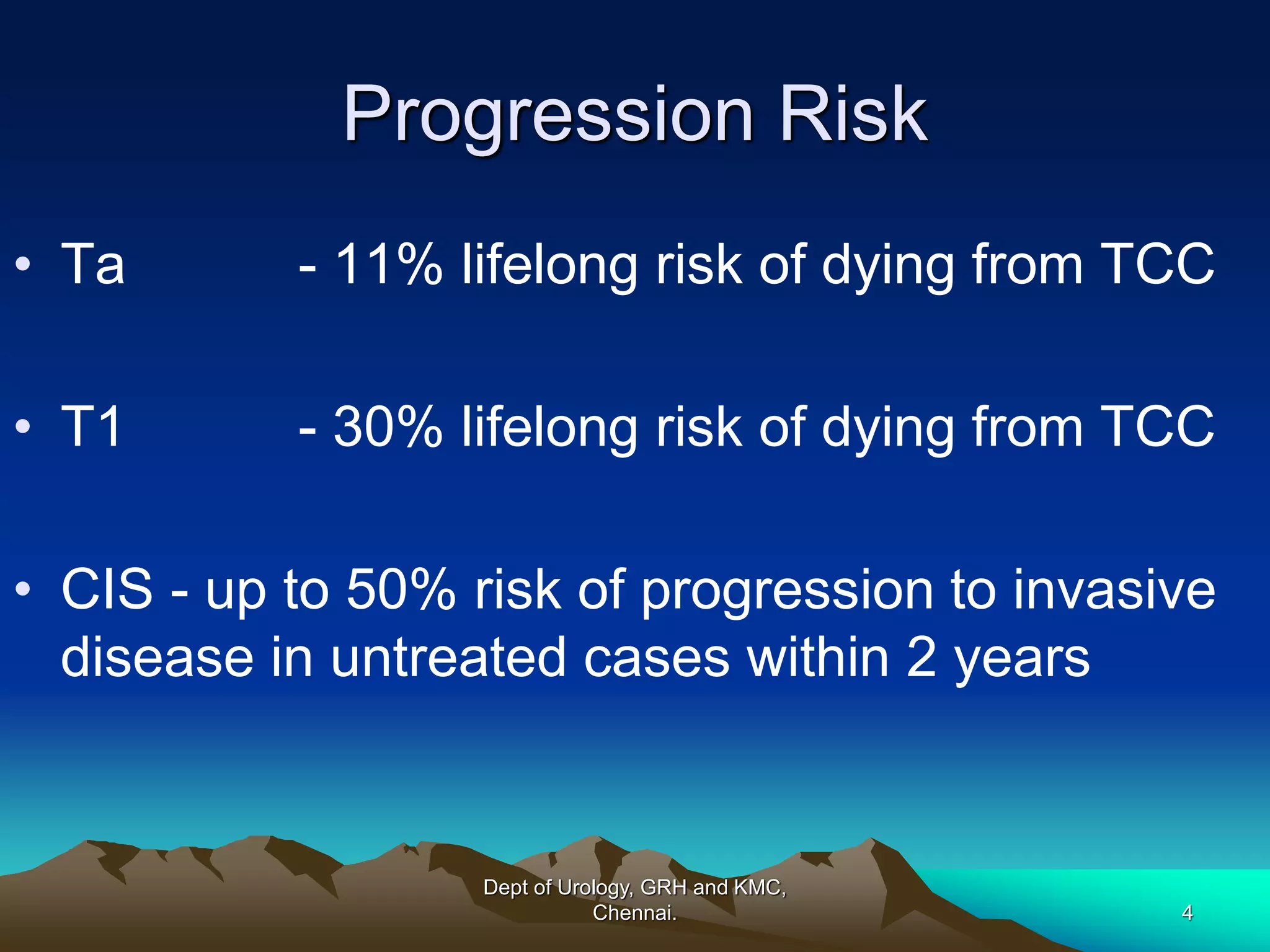
Progression Risk
• Ta - 11% lifelong risk of dying from TCC
• T1 - 30% lifelong risk of dying from TCC
• CIS - up to 50% risk of progression to invasive
disease in untreated cases within 2 years
4
Dept of Urology, GRH and KMC,
Chennai.
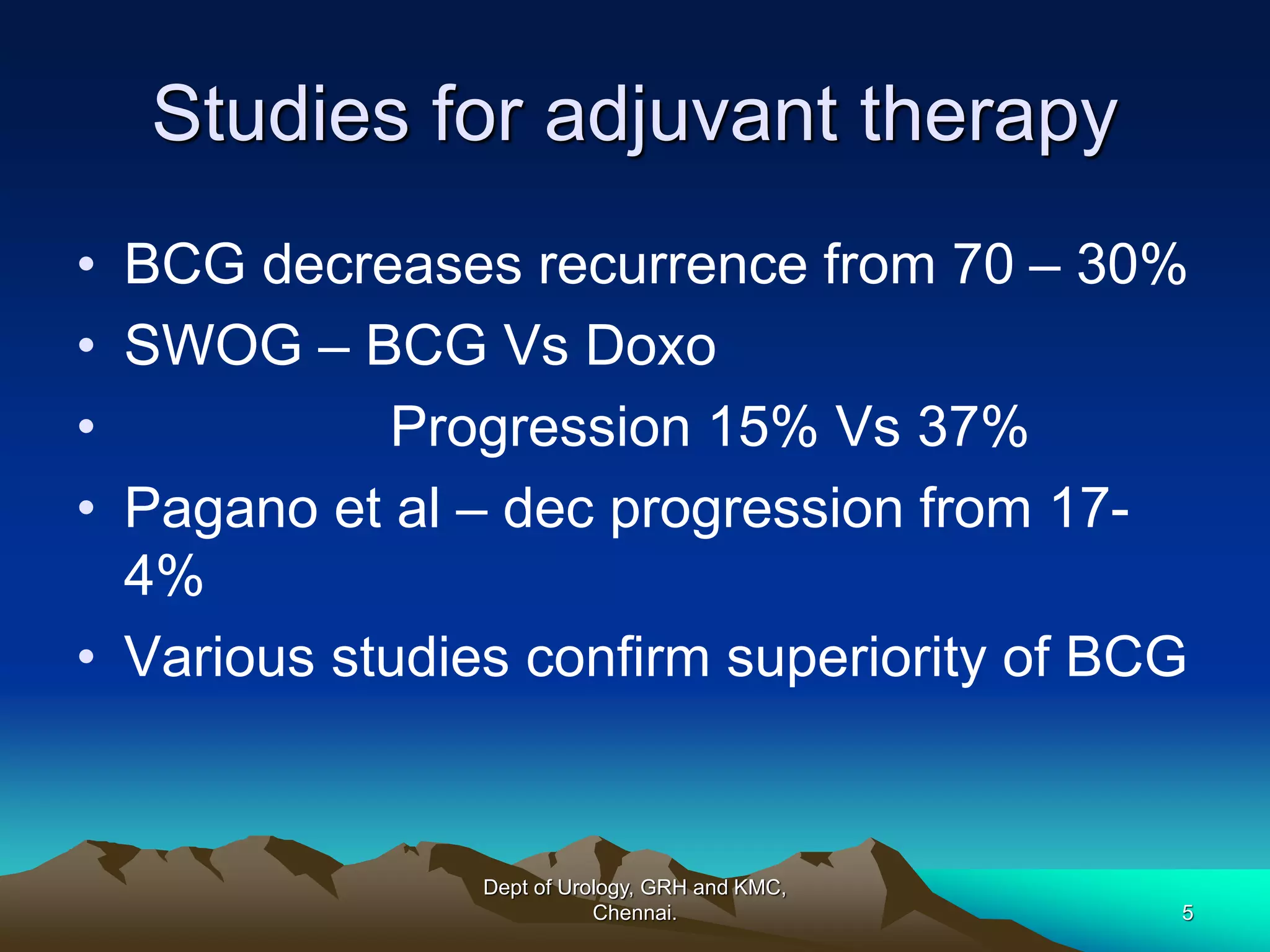
Studies for adjuvant therapy
• BCG decreases recurrence from 70 – 30%
• SWOG – BCG Vs Doxo
• Progression 15% Vs 37%
• Pagano et al – dec progression from 17-
4%
• Various studies confirm superiority of BCG
5
Dept of Urology, GRH and KMC,
Chennai.
BCG
• It is an attenuated live mycobacterium
• Used as a vaccine for tuberculosis
• Anti tumor activity against several different
cancers.
6
Dept of Urology, GRH and KMC,
Chennai.
Role of BCG
• Effective form of intravesical therapy for
prophylaxis & treatment of superficial
bladder cancer.
• Also effective against treating CIS,
residual papillary disease
• Prophylaxis against recurrent superficial
disease.
7
Dept of Urology, GRH and KMC,
Chennai.
Mechanism of action
• BCG contacts tumor cells principally
through a novel fibronectin attachment
protein that is required to initiate any
interaction.
• Expression of IL-2 , IFN –GAMMA as well
as T cell populations noted at the site of
BCG inflammation
8
Dept of Urology, GRH and KMC,
Chennai.
• IL-12 ,a strong polarizer of the T- HELPER
CELL (Th1 ) response and inducer of
interferon detected after BCG ,in urine
• Th1 response probably mediates the
therapeutic effect of BCG
9
Dept of Urology, GRH and KMC,
Chennai.
Anti tumour effect is associated with
delayed hypersensitivity reaction
• Anti tumor effect also due to induction of
NITRIC ACID SYNTHETASE by BCG
•
• HIGH nitric acid concentration inhibits
bladder tumour growth.
10
Dept of Urology, GRH and KMC,
Chennai.
INDICATIONS
• Multiple tumors
• Large tumors
• High grade tumors
• CIS / Concomitant CIS
• Prostatic urethral involvement
• Positive urine cytology
11
Dept of Urology, GRH and KMC,
Chennai.
CONTRAINDICATIONS
• Gross haematuria
• Active bacterial infection
• Immune suppressed & Immuno-
compromised patients.
• Poor overall performance status &
advanced age ,
• prior history of TB- relative
contraindications.
12
Dept of Urology, GRH and KMC,
Chennai.
Schedule
• Morales – 6 weekly administration
• Studies – better response with
maintenance for 1 yr
• Ideal regimen ???
• SWOG regimen
13
Dept of Urology, GRH and KMC,
Chennai.
• Effective treatment for low volume G3 and CIS
• Initial course weekly for 6 weeks. Rescope after
4 to 6 weeks
– Complete response - put on maintenance treatment
– Partial response - repeat 6 week course and rescope
– Progression – change to MMC or early cystectomy
14
Dept of Urology, GRH and KMC,
Chennai.
PREPARATION &
ADMINISTRATION
• Lyophilized powder
• Stored in 4 degrees C until instillation
• TICE, CONNAUGHT, PASTEUR,
TOKYO,RIVM, DANISH 1331
• Therapeutic efficacy associated with the
ability to deliver approx 10 MILLION
organisms per instillation
15
Dept of Urology, GRH and KMC,
Chennai.
• Reconstituted with 50 ml of saline,
administer immediately
• Treatment - min 2-4 weeks after TUR
16
Dept of Urology, GRH and KMC,
Chennai.
- Traumatic catheterization;- treatment
should be delayed for several days.
Gravity method of administration
Dwell / Contact time- 1-2 hours
• Change in position ??
17
Dept of Urology, GRH and KMC,
Chennai.
CIS
• Initial tumour free response- 76%
• BCG replaced cystectomy in initial form of
therapy.
• In CIS - failure to respond to 6 week
course, early recurrence of high-risk
disease requires more aggressive therapy
18
Dept of Urology, GRH and KMC,
Chennai.
RESIDUAL TUMOUR
• Effectively treat residual papillary disease
• Response rate around 60%
19
Dept of Urology, GRH and KMC,
Chennai.
TUMOUR PROPHYLAXIS
• T1 & HIGH GRADE Ta treated
prophylactically after TUR
• DECREASED TUMOUR RECURRENCE
OF AROUND 40%
• DOSE - 6 WEEK induction course is
insufficient
20
Dept of Urology, GRH and KMC,
Chennai.
SWOG- 6+3 REGIMEN
• 6 WEEK INDUCTION COURSE followed by 3
weekly instillations at 3 & 6 monthes,then every
6 monthes for 3 years.
• 5 year survival of non maintainance group is
78%, maintainance group is 83%
• 16% only tolerated full dose regimen
• Post therapy p53 over expression is an
independent marker of disease progression.
21
Dept of Urology, GRH and KMC,
Chennai.
SIDE EFFECTS OF BCG
THERAPY
• Fever 3%
• Haematuria 1%
• Granulomatous Prostatitis 1%
• Pneumonitis / Hepatitis <1%
• Epididymitis
• Sepsis
• Rash
• Ureteral Obstruction
• Contracted bladder
22
Dept of Urology, GRH and KMC,
Chennai.
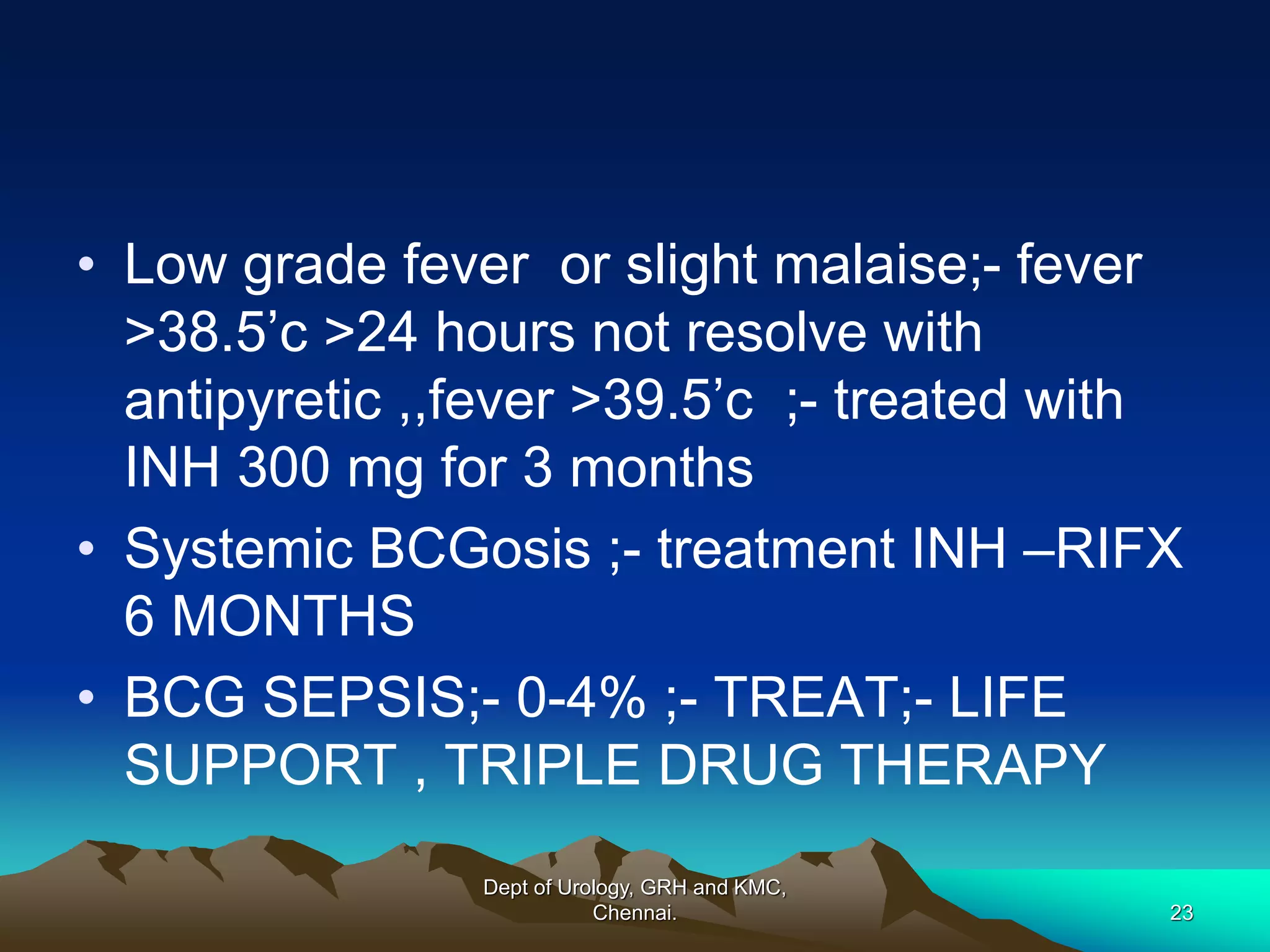
• Low grade fever or slight malaise;- fever
>38.5’c >24 hours not resolve with
antipyretic ,,fever >39.5’c ;- treated with
INH 300 mg for 3 months
• Systemic BCGosis ;- treatment INH –RIFX
6 MONTHS
• BCG SEPSIS;- 0-4% ;- TREAT;- LIFE
SUPPORT , TRIPLE DRUG THERAPY
23
Dept of Urology, GRH and KMC,
Chennai.
• Carcinoma of mucosa & superficial ducts
of prostate can be treated with BCG.
• TUMOUR free rate around 50% is
ATTAINED.
24
Dept of Urology, GRH and KMC,
Chennai.
• Response rates to treatment up to 70%
disease free at 36 months
– 40 % response to first course
– 30% more respond to a second course
– Problems relate to patients managing to
remain on maintenance therapy
25
Dept of Urology, GRH and KMC,
Chennai.
Advantages
• Persistent activity
• Deeper activity
• Panurothelial effect
26
Dept of Urology, GRH and KMC,
Chennai.
Combination therapy
• High dose Vit A,B6,E & Zn
• IFN Alpha
• Increased panurothelial effect and
decreased dose
27
Dept of Urology, GRH and KMC,
Chennai.
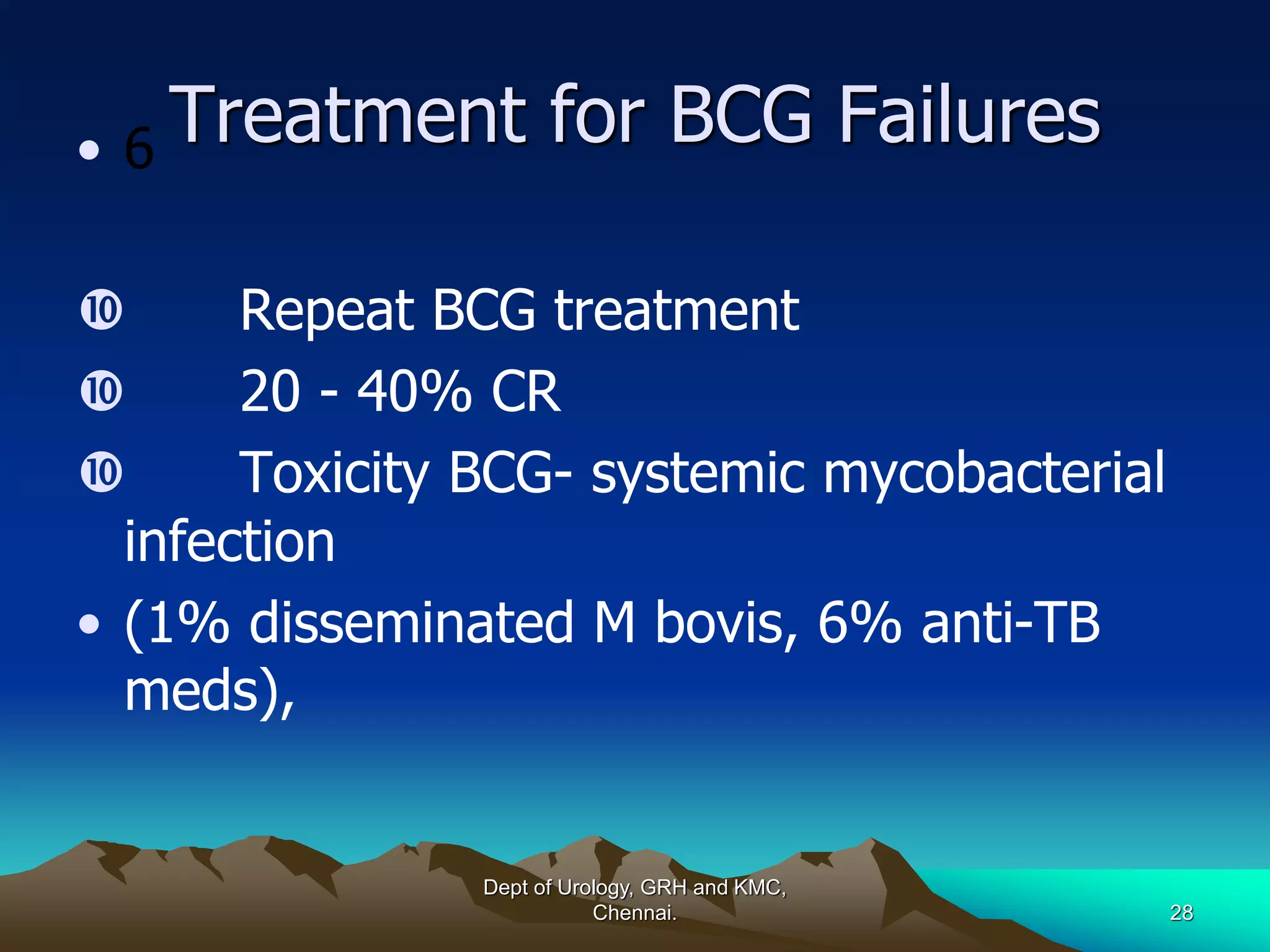
Treatment for BCG Failures
• 6
 Repeat BCG treatment
 20 - 40% CR
 Toxicity BCG- systemic mycobacterial
infection
• (1% disseminated M bovis, 6% anti-TB
meds),
28
Dept of Urology, GRH and KMC,
Chennai.
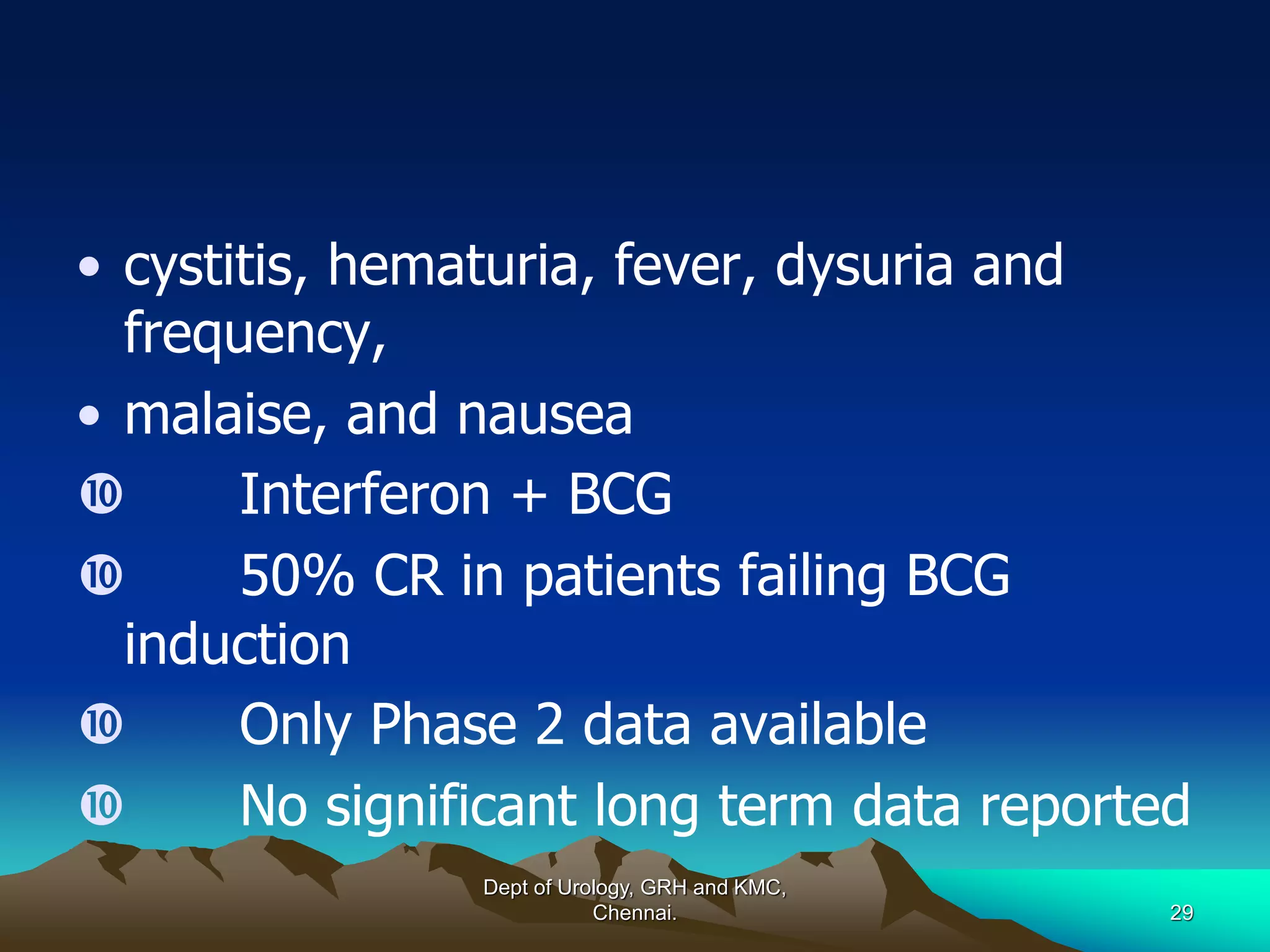
• cystitis, hematuria, fever, dysuria and
frequency,
• malaise, and nausea
 Interferon + BCG
 50% CR in patients failing BCG
induction
 Only Phase 2 data available
 No significant long term data reported
29
Dept of Urology, GRH and KMC,
Chennai.
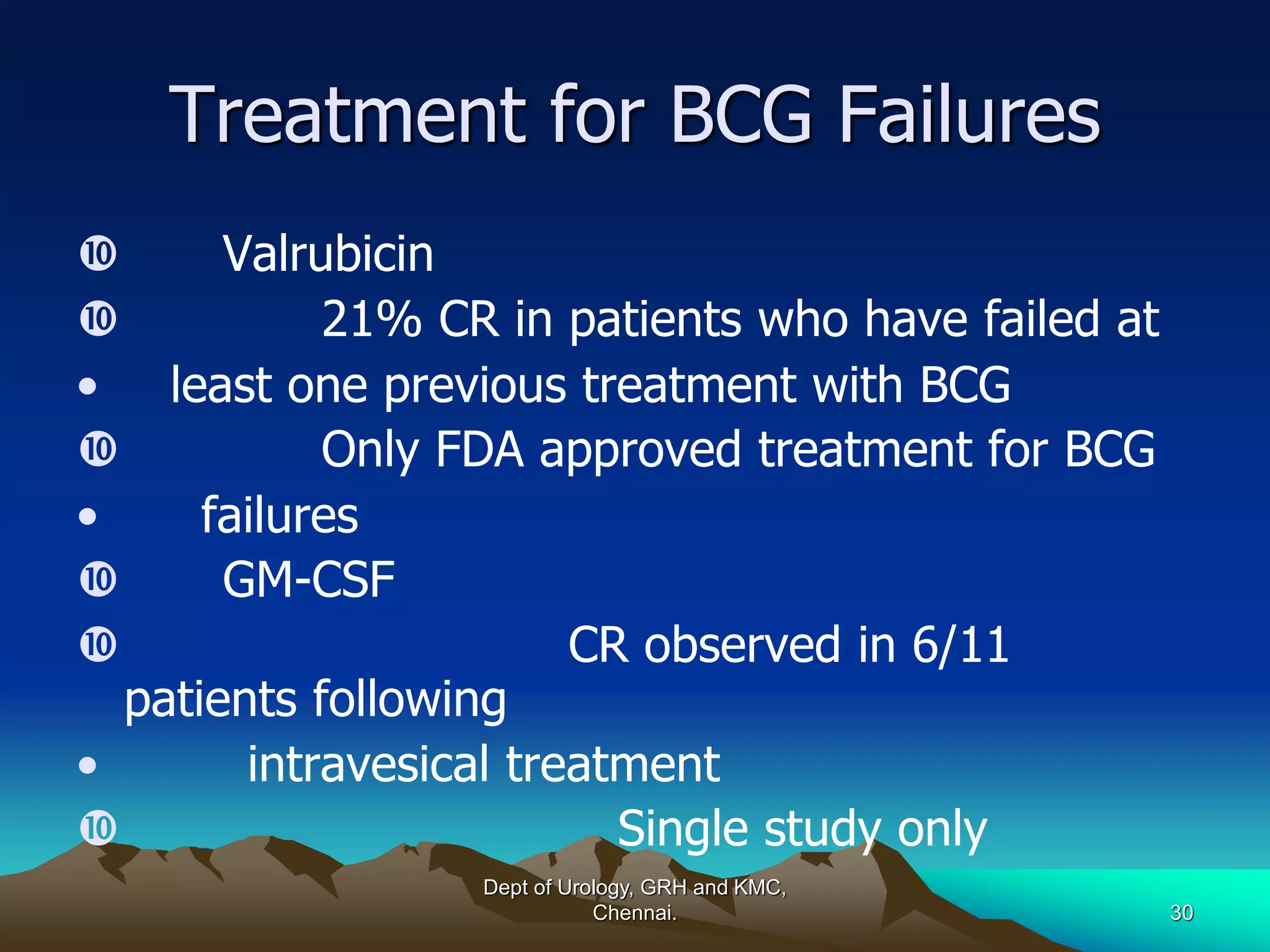
Treatment for BCG Failures
 Valrubicin
 21% CR in patients who have failed at
• least one previous treatment with BCG
 Only FDA approved treatment for BCG
• failures
 GM-CSF
 CR observed in 6/11
patients following
• intravesical treatment
 Single study only
30
Dept of Urology, GRH and KMC,
Chennai.
Treatment for BCG Failures
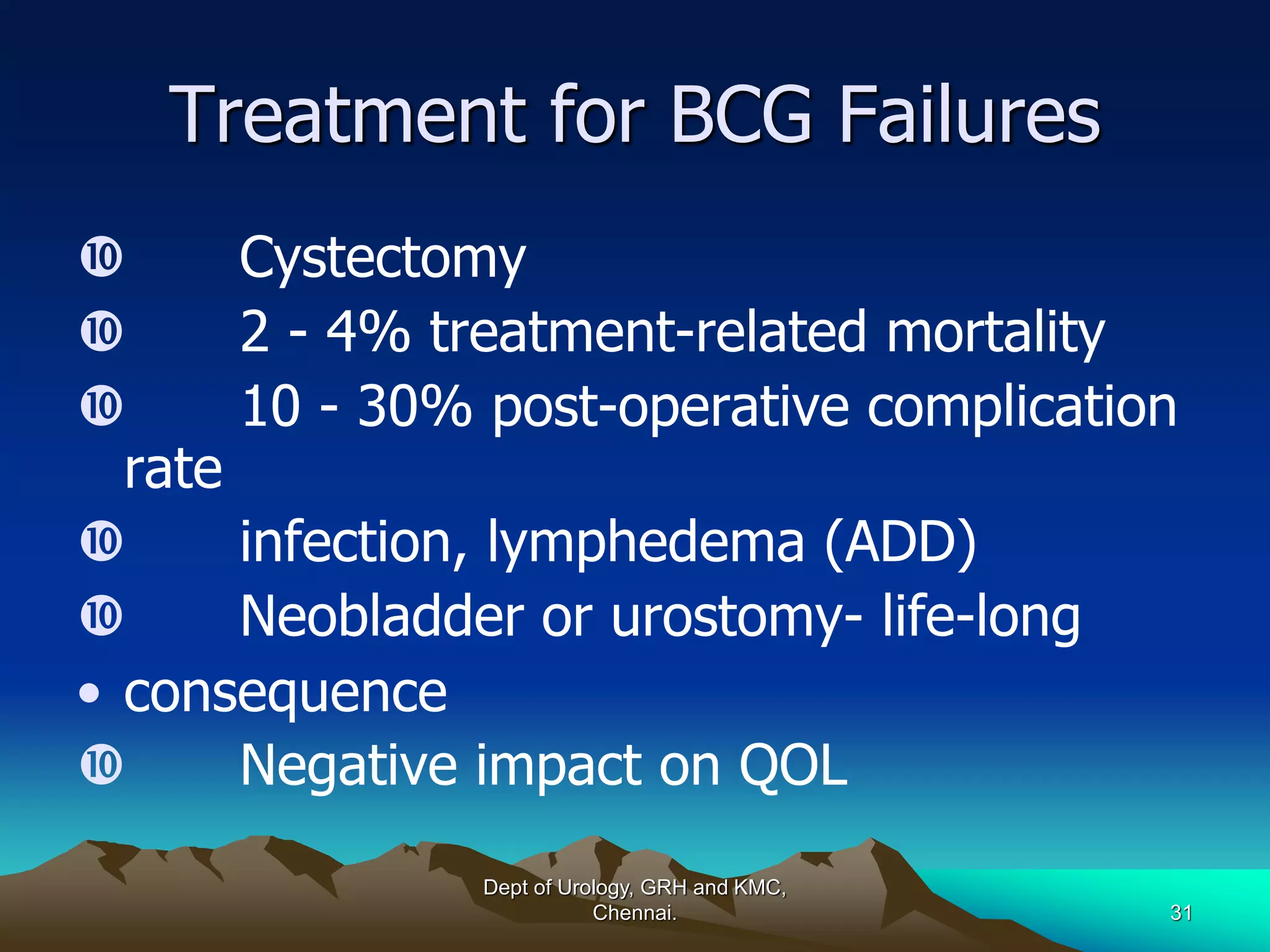
 Cystectomy
 2 - 4% treatment-related mortality
 10 - 30% post-operative complication
rate
 infection, lymphedema (ADD)
 Neobladder or urostomy- life-long
• consequence
 Negative impact on QOL
31
Dept of Urology, GRH and KMC,
Chennai.
CONCLUSIONS
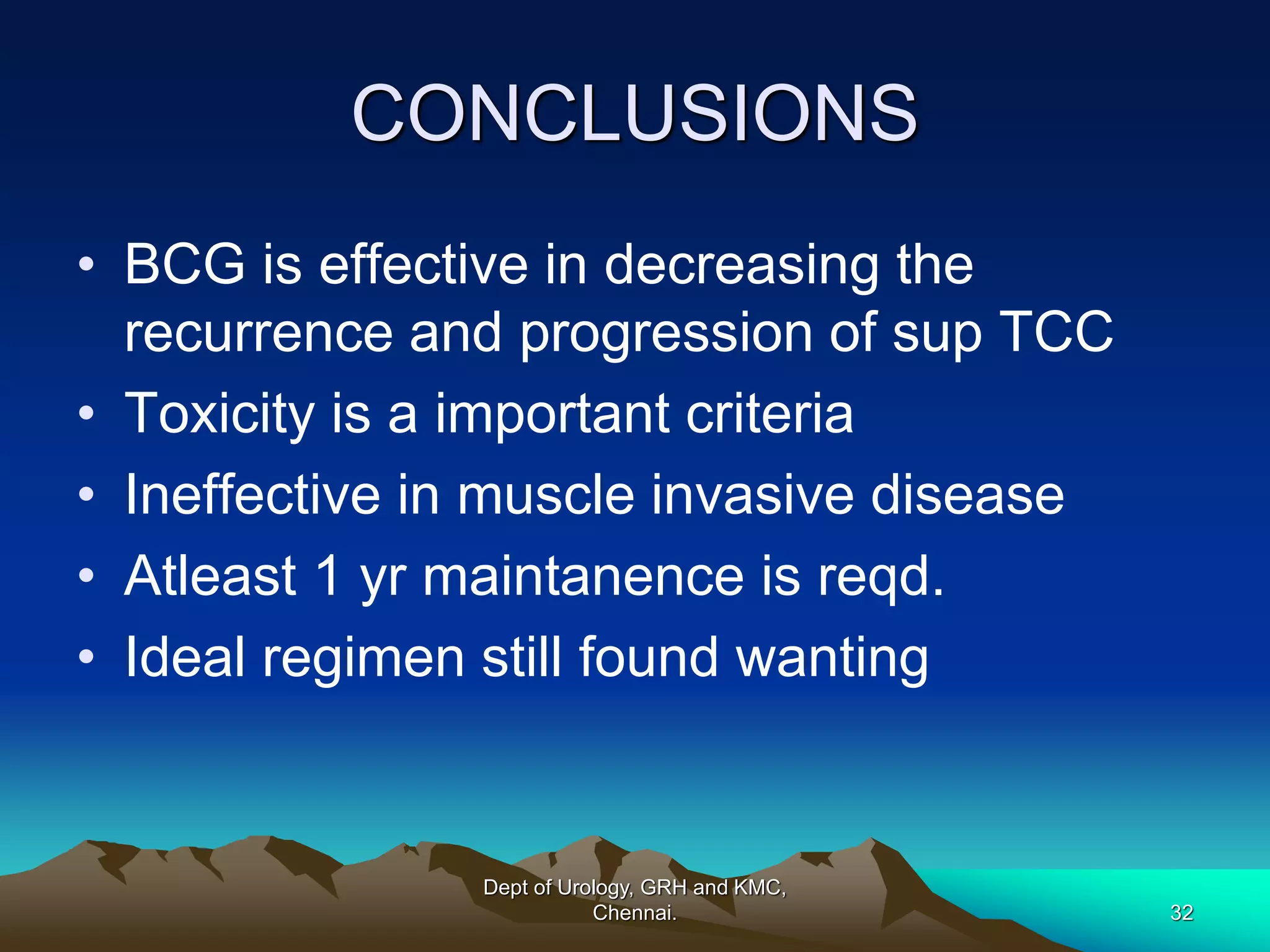
• BCG is effective in decreasing the
recurrence and progression of sup TCC
• Toxicity is a important criteria
• Ineffective in muscle invasive disease
• Atleast 1 yr maintanence is reqd.
• Ideal regimen still found wanting
32
Dept of Urology, GRH and KMC,
Chennai.

BCG for Bladder carcinoma

  • 1.
    BCG for superficialTCC Dept of Urology Govt Royapettah Hospital and Kilpauk Medical College Chennai 1
  • 2.
    Moderators: Professors: • Prof. Dr.G. Sivasankar, M.S., M.Ch., • Prof. Dr. A. Senthilvel, M.S., M.Ch., Asst Professors: • Dr. J. Sivabalan, M.S., M.Ch., • Dr. R. Bhargavi, M.S., M.Ch., • Dr. S. Raju, M.S., M.Ch., • Dr. K. Muthurathinam, M.S., M.Ch., • Dr. D. Tamilselvan, M.S., M.Ch., • Dr. K. Senthilkumar, M.S., M.Ch. Dept of Urology, GRH and KMC, Chennai. 2
  • 3.
    Natural history ofsuperficial TCC after TURBT alone • Risk of recurrence –70% • Risk of progression – Ta G1 5% • T1G3 40% • T1G3 + CIS 50% 3 Dept of Urology, GRH and KMC, Chennai.
  • 4.
    Progression Risk • Ta- 11% lifelong risk of dying from TCC • T1 - 30% lifelong risk of dying from TCC • CIS - up to 50% risk of progression to invasive disease in untreated cases within 2 years 4 Dept of Urology, GRH and KMC, Chennai.
  • 5.
    Studies for adjuvanttherapy • BCG decreases recurrence from 70 – 30% • SWOG – BCG Vs Doxo • Progression 15% Vs 37% • Pagano et al – dec progression from 17- 4% • Various studies confirm superiority of BCG 5 Dept of Urology, GRH and KMC, Chennai.
  • 6.
    BCG • It isan attenuated live mycobacterium • Used as a vaccine for tuberculosis • Anti tumor activity against several different cancers. 6 Dept of Urology, GRH and KMC, Chennai.
  • 7.
    Role of BCG •Effective form of intravesical therapy for prophylaxis & treatment of superficial bladder cancer. • Also effective against treating CIS, residual papillary disease • Prophylaxis against recurrent superficial disease. 7 Dept of Urology, GRH and KMC, Chennai.
  • 8.
    Mechanism of action •BCG contacts tumor cells principally through a novel fibronectin attachment protein that is required to initiate any interaction. • Expression of IL-2 , IFN –GAMMA as well as T cell populations noted at the site of BCG inflammation 8 Dept of Urology, GRH and KMC, Chennai.
  • 9.
    • IL-12 ,astrong polarizer of the T- HELPER CELL (Th1 ) response and inducer of interferon detected after BCG ,in urine • Th1 response probably mediates the therapeutic effect of BCG 9 Dept of Urology, GRH and KMC, Chennai.
  • 10.
    Anti tumour effectis associated with delayed hypersensitivity reaction • Anti tumor effect also due to induction of NITRIC ACID SYNTHETASE by BCG • • HIGH nitric acid concentration inhibits bladder tumour growth. 10 Dept of Urology, GRH and KMC, Chennai.
  • 11.
    INDICATIONS • Multiple tumors •Large tumors • High grade tumors • CIS / Concomitant CIS • Prostatic urethral involvement • Positive urine cytology 11 Dept of Urology, GRH and KMC, Chennai.
  • 12.
    CONTRAINDICATIONS • Gross haematuria •Active bacterial infection • Immune suppressed & Immuno- compromised patients. • Poor overall performance status & advanced age , • prior history of TB- relative contraindications. 12 Dept of Urology, GRH and KMC, Chennai.
  • 13.
    Schedule • Morales –6 weekly administration • Studies – better response with maintenance for 1 yr • Ideal regimen ??? • SWOG regimen 13 Dept of Urology, GRH and KMC, Chennai.
  • 14.
    • Effective treatmentfor low volume G3 and CIS • Initial course weekly for 6 weeks. Rescope after 4 to 6 weeks – Complete response - put on maintenance treatment – Partial response - repeat 6 week course and rescope – Progression – change to MMC or early cystectomy 14 Dept of Urology, GRH and KMC, Chennai.
  • 15.
    PREPARATION & ADMINISTRATION • Lyophilizedpowder • Stored in 4 degrees C until instillation • TICE, CONNAUGHT, PASTEUR, TOKYO,RIVM, DANISH 1331 • Therapeutic efficacy associated with the ability to deliver approx 10 MILLION organisms per instillation 15 Dept of Urology, GRH and KMC, Chennai.
  • 16.
    • Reconstituted with50 ml of saline, administer immediately • Treatment - min 2-4 weeks after TUR 16 Dept of Urology, GRH and KMC, Chennai.
  • 17.
    - Traumatic catheterization;-treatment should be delayed for several days. Gravity method of administration Dwell / Contact time- 1-2 hours • Change in position ?? 17 Dept of Urology, GRH and KMC, Chennai.
  • 18.
    CIS • Initial tumourfree response- 76% • BCG replaced cystectomy in initial form of therapy. • In CIS - failure to respond to 6 week course, early recurrence of high-risk disease requires more aggressive therapy 18 Dept of Urology, GRH and KMC, Chennai.
  • 19.
    RESIDUAL TUMOUR • Effectivelytreat residual papillary disease • Response rate around 60% 19 Dept of Urology, GRH and KMC, Chennai.
  • 20.
    TUMOUR PROPHYLAXIS • T1& HIGH GRADE Ta treated prophylactically after TUR • DECREASED TUMOUR RECURRENCE OF AROUND 40% • DOSE - 6 WEEK induction course is insufficient 20 Dept of Urology, GRH and KMC, Chennai.
  • 21.
    SWOG- 6+3 REGIMEN •6 WEEK INDUCTION COURSE followed by 3 weekly instillations at 3 & 6 monthes,then every 6 monthes for 3 years. • 5 year survival of non maintainance group is 78%, maintainance group is 83% • 16% only tolerated full dose regimen • Post therapy p53 over expression is an independent marker of disease progression. 21 Dept of Urology, GRH and KMC, Chennai.
  • 22.
    SIDE EFFECTS OFBCG THERAPY • Fever 3% • Haematuria 1% • Granulomatous Prostatitis 1% • Pneumonitis / Hepatitis <1% • Epididymitis • Sepsis • Rash • Ureteral Obstruction • Contracted bladder 22 Dept of Urology, GRH and KMC, Chennai.
  • 23.
    • Low gradefever or slight malaise;- fever >38.5’c >24 hours not resolve with antipyretic ,,fever >39.5’c ;- treated with INH 300 mg for 3 months • Systemic BCGosis ;- treatment INH –RIFX 6 MONTHS • BCG SEPSIS;- 0-4% ;- TREAT;- LIFE SUPPORT , TRIPLE DRUG THERAPY 23 Dept of Urology, GRH and KMC, Chennai.
  • 24.
    • Carcinoma ofmucosa & superficial ducts of prostate can be treated with BCG. • TUMOUR free rate around 50% is ATTAINED. 24 Dept of Urology, GRH and KMC, Chennai.
  • 25.
    • Response ratesto treatment up to 70% disease free at 36 months – 40 % response to first course – 30% more respond to a second course – Problems relate to patients managing to remain on maintenance therapy 25 Dept of Urology, GRH and KMC, Chennai.
  • 26.
    Advantages • Persistent activity •Deeper activity • Panurothelial effect 26 Dept of Urology, GRH and KMC, Chennai.
  • 27.
    Combination therapy • Highdose Vit A,B6,E & Zn • IFN Alpha • Increased panurothelial effect and decreased dose 27 Dept of Urology, GRH and KMC, Chennai.
  • 28.
    Treatment for BCGFailures • 6  Repeat BCG treatment  20 - 40% CR  Toxicity BCG- systemic mycobacterial infection • (1% disseminated M bovis, 6% anti-TB meds), 28 Dept of Urology, GRH and KMC, Chennai.
  • 29.
    • cystitis, hematuria,fever, dysuria and frequency, • malaise, and nausea  Interferon + BCG  50% CR in patients failing BCG induction  Only Phase 2 data available  No significant long term data reported 29 Dept of Urology, GRH and KMC, Chennai.
  • 30.
    Treatment for BCGFailures  Valrubicin  21% CR in patients who have failed at • least one previous treatment with BCG  Only FDA approved treatment for BCG • failures  GM-CSF  CR observed in 6/11 patients following • intravesical treatment  Single study only 30 Dept of Urology, GRH and KMC, Chennai.
  • 31.
    Treatment for BCGFailures  Cystectomy  2 - 4% treatment-related mortality  10 - 30% post-operative complication rate  infection, lymphedema (ADD)  Neobladder or urostomy- life-long • consequence  Negative impact on QOL 31 Dept of Urology, GRH and KMC, Chennai.
  • 32.
    CONCLUSIONS • BCG iseffective in decreasing the recurrence and progression of sup TCC • Toxicity is a important criteria • Ineffective in muscle invasive disease • Atleast 1 yr maintanence is reqd. • Ideal regimen still found wanting 32 Dept of Urology, GRH and KMC, Chennai.