Dept of Urology
Govt Royapettah Hospital and Kilpauk Medical College
Chennai
Moderators:
Professors:
 Prof. Dr. G. Sivasankar, M.S., M.Ch.,
 Prof. Dr. A. Senthilvel, M.S., M.Ch.,
Asst Professors:
 Dr. J. Sivabalan, M.S., M.Ch.,
 Dr. R. Bhargavi, M.S., M.Ch.,
 Dr. S. Raju, M.S., M.Ch.,
 Dr. K. Muthurathinam, M.S., M.Ch.,
 Dr. D. Tamilselvan, M.S., M.Ch.,
 Dr. K. Senthilkumar, M.S., M.Ch.
Dept of Urology, GRH and KMC, Chennai. 2
PROSTATE TUMOUR MARKERS
Prostatic acid phosphatase: high
concentrations in semen, prostate
 Neither protate tissue nor tumour specific
 Increased in prostate,breast,stomach,colon ca
 Less stable than PSA
 Overall poor specificity
3
Dept of Urology, GRH and KMC, Chennai.
PROSTATE-SPECIFIC ANTIGEN
 34-kD glycoprotein /237 aminoacids
 Produced by epithelial cells forming acini/ducts of
prostate gland
 Chromosome 19
 Proteolytic enzyme of kallikrein family-liquify human
semen
 First identified in 1969-Hara-seminal fluid
4
Dept of Urology, GRH and KMC, Chennai.
PROSTATE-SPECIFIC ANTIGEN
 Free /complexed form –α₁-anti chymotrypsin,
α₂ macroglobulin
• Free:complexed PSA=1:4
 Tissue specific but not cancer specific
 Periurethral glands,some breast cancers also produce
PSA
5
Dept of Urology, GRH and KMC, Chennai.
PROSTATE-SPECIFIC ANTIGEN
 BPH/protatitis/significant elevations in older men
after ejaculations
 No studies have shown significant elevation in serum
PSA after routine DRE
 Four fold rise in serum PSA after cystoscopy with
prostatic massage (stamey )
6
Dept of Urology, GRH and KMC, Chennai.
PSA-SCREENING GUIDELINES
 Men >50 yrs with >10 yrs life expectancy
 Men >45 yrs considered at high risk (african descent
,family h/o cancer in first degree relative )
7
Dept of Urology, GRH and KMC, Chennai.
PROSTATE-SPECIFIC ANTIGEN
 In early detection of prostate cancer
 PSA>4 ng/ml-detected 82% of tumour
 DRE detected 55%
 75% of tumour detected by PSA –organ
confined ,56% by DRE ,78% if both are
used
 (Catalona,J Urol 1994;151:1283-90 )
8
Dept of Urology, GRH and KMC, Chennai.
PROSTATE-SPECIFIC ANTIGEN
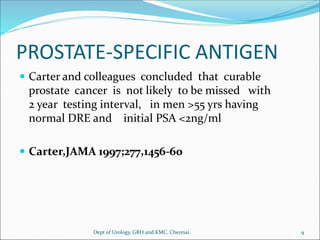
 Carter and colleagues concluded that curable
prostate cancer is not likely to be missed with
2 year testing interval, in men >55 yrs having
normal DRE and initial PSA <2ng/ml
 Carter,JAMA 1997;277,1456-60
9
Dept of Urology, GRH and KMC, Chennai.
AGE-SPECIFIC PSA REFERENCE
RANGES
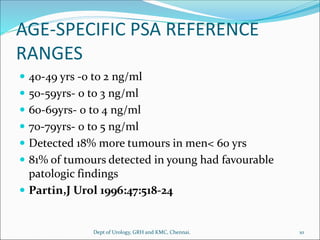
 40-49 yrs -0 to 2 ng/ml
 50-59yrs- 0 to 3 ng/ml
 60-69yrs- 0 to 4 ng/ml
 70-79yrs- 0 to 5 ng/ml
 Detected 18% more tumours in men< 60 yrs
 81% of tumours detected in young had favourable
patologic findings
 Partin,J Urol 1996:47:518-24
10
Dept of Urology, GRH and KMC, Chennai.
FREE/TOTAL PSA
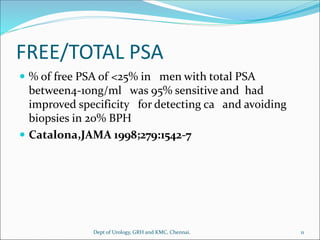
 % of free PSA of <25% in men with total PSA
between4-10ng/ml was 95% sensitive and had
improved specificity for detecting ca and avoiding
biopsies in 20% BPH
 Catalona,JAMA 1998;279:1542-7
11
Dept of Urology, GRH and KMC, Chennai.
FREE/TOTAL PSA
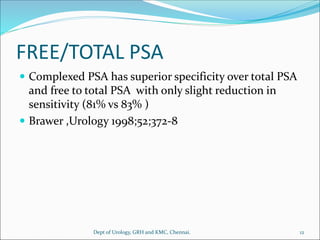
 Complexed PSA has superior specificity over total PSA
and free to total PSA with only slight reduction in
sensitivity (81% vs 83% )
 Brawer ,Urology 1998;52;372-8
12
Dept of Urology, GRH and KMC, Chennai.
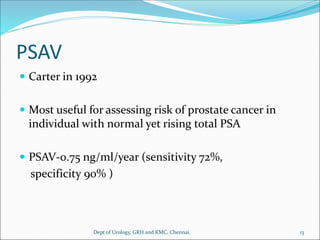
PSAV
 Carter in 1992
 Most useful for assessing risk of prostate cancer in
individual with normal yet rising total PSA
 PSAV-0.75 ng/ml/year (sensitivity 72%,
specificity 90% )
13
Dept of Urology, GRH and KMC, Chennai.
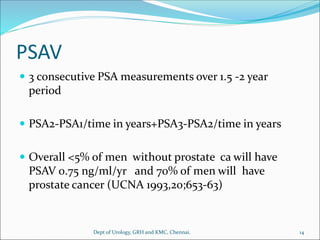
PSAV
 3 consecutive PSA measurements over 1.5 -2 year
period
 PSA2-PSA1/time in years+PSA3-PSA2/time in years
 Overall <5% of men without prostate ca will have
PSAV 0.75 ng/ml/yr and 70% of men will have
prostate cancer (UCNA 1993,20;653-63)
14
Dept of Urology, GRH and KMC, Chennai.
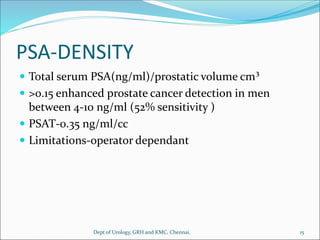
PSA-DENSITY
 Total serum PSA(ng/ml)/prostatic volume cm³
 >0.15 enhanced prostate cancer detection in men
between 4-10 ng/ml (52% sensitivity )
 PSAT-0.35 ng/ml/cc
 Limitations-operator dependant
15
Dept of Urology, GRH and KMC, Chennai.
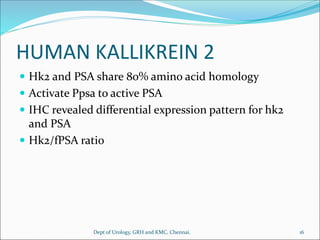
HUMAN KALLIKREIN 2
 Hk2 and PSA share 80% amino acid homology
 Activate Ppsa to active PSA
 IHC revealed differential expression pattern for hk2
and PSA
 Hk2/fPSA ratio
16
Dept of Urology, GRH and KMC, Chennai.
Kallikrein markers
 KLK4
 KLK11
 KLK14
 KLK15
17
Dept of Urology, GRH and KMC, Chennai.
PSMA
 Folate hydratase found in cell membrane of prostate
epithelium,brain small bowel
 PSMA m RNA expression within protate cancer
,highest in hormone deprived state
 PSMA/PSM’ ratio upregulated 3-6 fold in prostate
cancer
 Immuno-SELDI assay
18
Dept of Urology, GRH and KMC, Chennai.
NEW MARKERS
 Ki-67 labelling index (LI )
 P53 and BCL2 staining
 MVD-CD31 staining
 AMACR staining
19
Dept of Urology, GRH and KMC, Chennai.
AFP
 70 kD glycoprotein first found normal human fetal
serum in 1954
 Dominant serum protein of early embryo
 Concentrations peak at 12-14 wks ofgestation, decline
after 16 wks,fall by 1 year of age <10ng/dl which is
usually seen in adults
21
Dept of Urology, GRH and KMC, Chennai.
AFP
 Cells of yolk sac origin is responsible for its production
 Elevated in benign liver disease, pregnancy,ataxia
telangiectasia , tyrosenemia and in HCC ,ca
pancreas,stomach and lung
 Elevated in embryonal carcinoma, teratocarcinoma
and yolk sac tumours
 Never present in pure seminoma or choriocarcinoma
22
Dept of Urology, GRH and KMC, Chennai.
HCG
 38kD hormone - by syncitiotrophoblasts
 α and β subunits
 β subunit is antigenically and structurally
distinct /biologically active
 Only minute amounts are detectable in healthy adults
( <5 IU/ml )
23
Dept of Urology, GRH and KMC, Chennai.
HCG ELEVATIONS
 Pregnancy ,gestational disorders
 Hepatic, pancreatic, gastric, pulmonary, breast, renal,
bladder tumours and in multiple myeloma
 In GCT, 40-60% of patients will have elevated levels
• All pts with choriocarcinoma
• 80% of pts with embryonal carcinoma
• 10-25% of those pts with seminoma
24
Dept of Urology, GRH and KMC, Chennai.
LACTATE DEHYDROGENASE
 134 KD cellular protein
 Expressed in skeletal, cardiac, smooth muscle, liver,
kidney and brain
 Specificity for testicular tumours is extremely poor
,not particularly useful in diagnosis
 Extremely useful prognostic marker
25
Dept of Urology, GRH and KMC, Chennai.
LACTATE DEHYDROGENASE
 Important role in monitoring response to treatment &
recurrence in pts with advanced disease
 Five isoenzymes
 LDH-1 MC elevated isoenzyme
26
Dept of Urology, GRH and KMC, Chennai.
PLACENTAL ALKALINE
PHOSPHATASE
 Fetal isoenzyme of adult alkaline phosphatase
 Normally expressed in utero,children < 1 yr
 Protein phosphotyrosine phosphatase
 Widely accepted as a reliable histologic marker for
seminoma
 Merit as a serum tumour marker is uncertain
 Elevated in 50-72% of pts with higher stages of
seminoma
27
Dept of Urology, GRH and KMC, Chennai.
PLACENTAL ALKALINE
PHOSPHATASE
 PLAP have higher sensitivity for detecting metastases
/specificity is poor
 Elevated in smokers, ca lung ,ovary, breast, GI
malignancies
 Overall,not a proven beneficial serum marker for
testicular neoplasms
28
Dept of Urology, GRH and KMC, Chennai.
OTHER SERUM MARKERS
 Neuron specific enolase
 Carcinoembryonic antigen
 Pregnancy specific B1 glycoprotein (SP-1 )
29
Dept of Urology, GRH and KMC, Chennai.
OTHER SERUM MARKERS
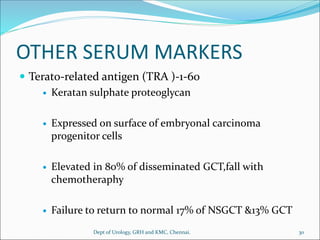
 Terato-related antigen (TRA )-1-60
 Keratan sulphate proteoglycan
 Expressed on surface of embryonal carcinoma
progenitor cells
 Elevated in 80% of disseminated GCT,fall with
chemotheraphy
 Failure to return to normal 17% of NSGCT &13% GCT
30
Dept of Urology, GRH and KMC, Chennai.
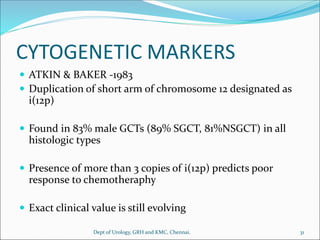
CYTOGENETIC MARKERS
 ATKIN & BAKER -1983
 Duplication of short arm of chromosome 12 designated as
i(12p)
 Found in 83% male GCTs (89% SGCT, 81%NSGCT) in all
histologic types
 Presence of more than 3 copies of i(12p) predicts poor
response to chemotheraphy
 Exact clinical value is still evolving
31
Dept of Urology, GRH and KMC, Chennai.
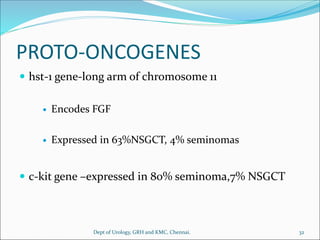
PROTO-ONCOGENES
 hst-1 gene-long arm of chromosome 11
 Encodes FGF
 Expressed in 63%NSGCT, 4% seminomas
 c-kit gene –expressed in 80% seminoma,7% NSGCT
32
Dept of Urology, GRH and KMC, Chennai.
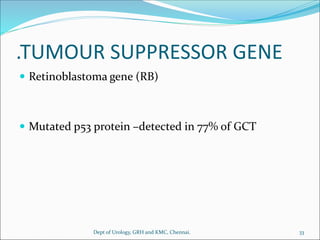
.TUMOUR SUPPRESSOR GENE
 Retinoblastoma gene (RB)
 Mutated p53 protein –detected in 77% of GCT
33
Dept of Urology, GRH and KMC, Chennai.
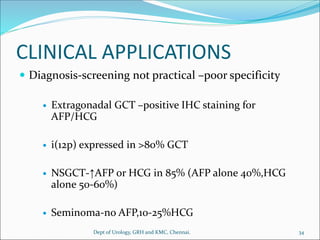
CLINICAL APPLICATIONS
 Diagnosis-screening not practical –poor specificity
 Extragonadal GCT –positive IHC staining for
AFP/HCG
 i(12p) expressed in >80% GCT
 NSGCT-↑AFP or HCG in 85% (AFP alone 40%,HCG
alone 50-60%)
 Seminoma-no AFP,10-25%HCG
34
Dept of Urology, GRH and KMC, Chennai.
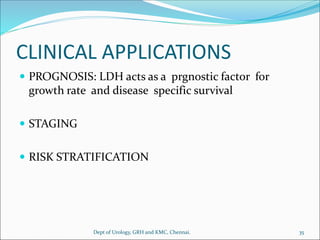
CLINICAL APPLICATIONS
 PROGNOSIS: LDH acts as a prgnostic factor for
growth rate and disease specific survival
 STAGING
 RISK STRATIFICATION
35
Dept of Urology, GRH and KMC, Chennai.
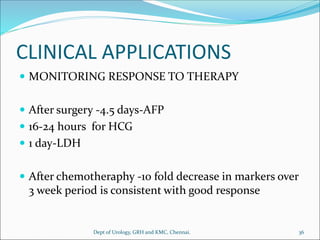
CLINICAL APPLICATIONS
 MONITORING RESPONSE TO THERAPY
 After surgery -4.5 days-AFP
 16-24 hours for HCG
 1 day-LDH
 After chemotheraphy -10 fold decrease in markers over
3 week period is consistent with good response
36
Dept of Urology, GRH and KMC, Chennai.
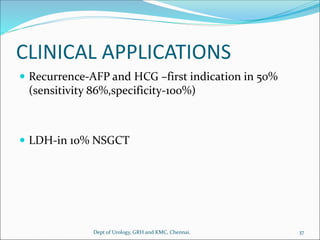
CLINICAL APPLICATIONS
 Recurrence-AFP and HCG –first indication in 50%
(sensitivity 86%,specificity-100%)
 LDH-in 10% NSGCT
37
Dept of Urology, GRH and KMC, Chennai.
URINE BASED BLADDER TUMOUR
MARKERS
 Non invasive
 Rapid
 Objective
 Easy to perform & interpret
 High sensitivity & specificity
38
Dept of Urology, GRH and KMC, Chennai.
NMP22
 Evaluates urinary levels of nuclear mitotic apparatus
protein, found in nuclear matrix of all cells
 Quantitative analysis-ELISA or point -of –care test,
bladderchek test
 10 IU/ml is the threshold for a positive test
39
Dept of Urology, GRH and KMC, Chennai.
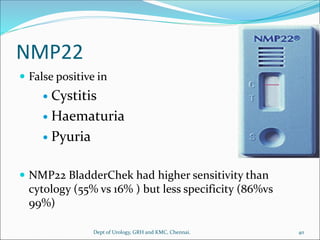
NMP22
 False positive in
 Cystitis
 Haematuria
 Pyuria
 NMP22 BladderChek had higher sensitivity than
cytology (55% vs 16% ) but less specificity (86%vs
99%)
40
Dept of Urology, GRH and KMC, Chennai.
NMP22
 In combination with cystoscopy it detects 99% of
recurrence,during surveillance .
 NMP22 always best used as an adjunct and might not
have the ability to fuction as stand alone test in place
of cystoscopy
41
Dept of Urology, GRH and KMC, Chennai.
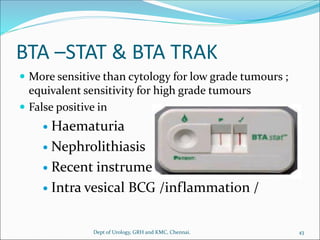
BTA –STAT & BTA TRAK
 Enzyme immuno assays to measure human
complement factor H-related protein in urine by
using MAB X13.2 & X52.1
 BTAstat is a qualitative point of care diagnostic test
(sensitivity-68% ; specificity 74% )
 BTA TRAK –quantitative test-sensitivity62% ;
specificity 74%
42
Dept of Urology, GRH and KMC, Chennai.
BTA –STAT & BTA TRAK
 More sensitive than cytology for low grade tumours ;
equivalent sensitivity for high grade tumours
 False positive in
 Haematuria
 Nephrolithiasis
 Recent instrumentation
 Intra vesical BCG /inflammation /
43
Dept of Urology, GRH and KMC, Chennai.
IMMUNOCYT
 Fluorescent labelled antibodies to three cell surface
glycoprotein antigens commonly found on malignant
urothelial cells
 M344 (71% Ta-T1 tumours )
 LDQ10
 19A211 (90% Ta-T1 tumours )
44
Dept of Urology, GRH and KMC, Chennai.
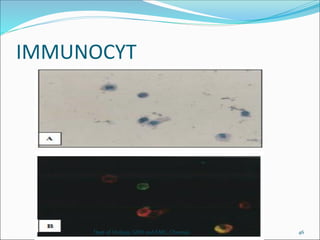
IMMUNOCYT
 Sample is positive –if atleast one cell has red or green
fluorescense
 Negative declared only after countig 500 cells
 Usually used with cytology to improve sensitivity
 Limitations: 500 cells/slide ,difficulty in detecting
green fluorescence,need for trained person
45
Dept of Urology, GRH and KMC, Chennai.
IMMUNOCYT
46
Dept of Urology, GRH and KMC, Chennai.
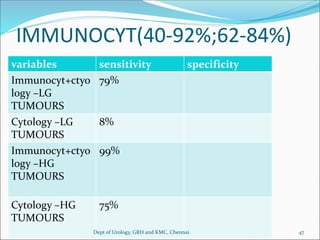
IMMUNOCYT(40-92%;62-84%)
variables sensitivity specificity
Immunocyt+ctyo
logy –LG
TUMOURS
79%
Cytology –LG
TUMOURS
8%
Immunocyt+ctyo
logy –HG
TUMOURS
99%
Cytology –HG
TUMOURS
75%
47
Dept of Urology, GRH and KMC, Chennai.
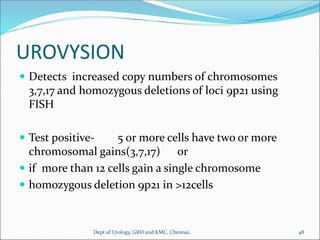
UROVYSION
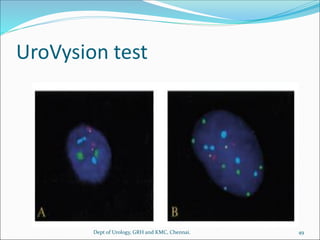
 Detects increased copy numbers of chromosomes
3,7,17 and homozygous deletions of loci 9p21 using
FISH
 Test positive- 5 or more cells have two or more
chromosomal gains(3,7,17) or
 if more than 12 cells gain a single chromosome
 homozygous deletion 9p21 in >12cells
48
Dept of Urology, GRH and KMC, Chennai.
UroVysion test
49
Dept of Urology, GRH and KMC, Chennai.
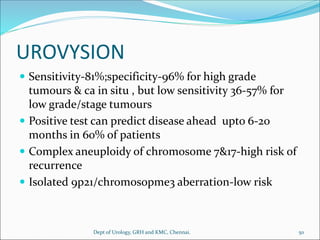
UROVYSION
 Sensitivity-81%;specificity-96% for high grade
tumours & ca in situ , but low sensitivity 36-57% for
low grade/stage tumours
 Positive test can predict disease ahead upto 6-20
months in 60% of patients
 Complex aneuploidy of chromosome 7&17-high risk of
recurrence
 Isolated 9p21/chromosopme3 aberration-low risk
50
Dept of Urology, GRH and KMC, Chennai.
UROVYSION
 Better adjunct to cystoscopy than cytology but more
expensive
 Urovysion FISH useful in predicting recurrence after
intravesical theraphy
 Also very effective in arbitrating equivocal urine
cytology results
 Cytology scores over urovysion for detecting 2nd
primary who had cystectomy &urine diversion
51
Dept of Urology, GRH and KMC, Chennai.
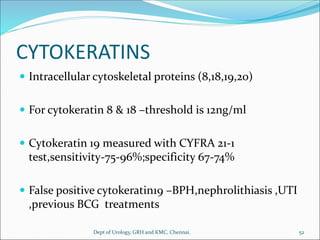
CYTOKERATINS
 Intracellular cytoskeletal proteins (8,18,19,20)
 For cytokeratin 8 & 18 –threshold is 12ng/ml
 Cytokeratin 19 measured with CYFRA 21-1
test,sensitivity-75-96%;specificity 67-74%
 False positive cytokeratin19 –BPH,nephrolithiasis ,UTI
,previous BCG treatments
52
Dept of Urology, GRH and KMC, Chennai.
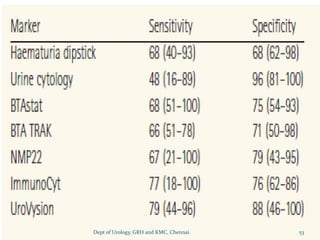
53
Dept of Urology, GRH and KMC, Chennai.
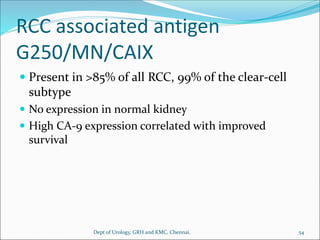
RCC associated antigen
G250/MN/CAIX
 Present in >85% of all RCC, 99% of the clear-cell
subtype
 No expression in normal kidney
 High CA-9 expression correlated with improved
survival
54
Dept of Urology, GRH and KMC, Chennai.
55
Dept of Urology, GRH and KMC, Chennai.

Tumour markers in urology

  • 1.
    Dept of Urology GovtRoyapettah Hospital and Kilpauk Medical College Chennai
  • 2.
    Moderators: Professors:  Prof. Dr.G. Sivasankar, M.S., M.Ch.,  Prof. Dr. A. Senthilvel, M.S., M.Ch., Asst Professors:  Dr. J. Sivabalan, M.S., M.Ch.,  Dr. R. Bhargavi, M.S., M.Ch.,  Dr. S. Raju, M.S., M.Ch.,  Dr. K. Muthurathinam, M.S., M.Ch.,  Dr. D. Tamilselvan, M.S., M.Ch.,  Dr. K. Senthilkumar, M.S., M.Ch. Dept of Urology, GRH and KMC, Chennai. 2
  • 3.
    PROSTATE TUMOUR MARKERS Prostaticacid phosphatase: high concentrations in semen, prostate  Neither protate tissue nor tumour specific  Increased in prostate,breast,stomach,colon ca  Less stable than PSA  Overall poor specificity 3 Dept of Urology, GRH and KMC, Chennai.
  • 4.
    PROSTATE-SPECIFIC ANTIGEN  34-kDglycoprotein /237 aminoacids  Produced by epithelial cells forming acini/ducts of prostate gland  Chromosome 19  Proteolytic enzyme of kallikrein family-liquify human semen  First identified in 1969-Hara-seminal fluid 4 Dept of Urology, GRH and KMC, Chennai.
  • 5.
    PROSTATE-SPECIFIC ANTIGEN  Free/complexed form –α₁-anti chymotrypsin, α₂ macroglobulin • Free:complexed PSA=1:4  Tissue specific but not cancer specific  Periurethral glands,some breast cancers also produce PSA 5 Dept of Urology, GRH and KMC, Chennai.
  • 6.
    PROSTATE-SPECIFIC ANTIGEN  BPH/protatitis/significantelevations in older men after ejaculations  No studies have shown significant elevation in serum PSA after routine DRE  Four fold rise in serum PSA after cystoscopy with prostatic massage (stamey ) 6 Dept of Urology, GRH and KMC, Chennai.
  • 7.
    PSA-SCREENING GUIDELINES  Men>50 yrs with >10 yrs life expectancy  Men >45 yrs considered at high risk (african descent ,family h/o cancer in first degree relative ) 7 Dept of Urology, GRH and KMC, Chennai.
  • 8.
    PROSTATE-SPECIFIC ANTIGEN  Inearly detection of prostate cancer  PSA>4 ng/ml-detected 82% of tumour  DRE detected 55%  75% of tumour detected by PSA –organ confined ,56% by DRE ,78% if both are used  (Catalona,J Urol 1994;151:1283-90 ) 8 Dept of Urology, GRH and KMC, Chennai.
  • 9.
    PROSTATE-SPECIFIC ANTIGEN  Carterand colleagues concluded that curable prostate cancer is not likely to be missed with 2 year testing interval, in men >55 yrs having normal DRE and initial PSA <2ng/ml  Carter,JAMA 1997;277,1456-60 9 Dept of Urology, GRH and KMC, Chennai.
  • 10.
    AGE-SPECIFIC PSA REFERENCE RANGES 40-49 yrs -0 to 2 ng/ml  50-59yrs- 0 to 3 ng/ml  60-69yrs- 0 to 4 ng/ml  70-79yrs- 0 to 5 ng/ml  Detected 18% more tumours in men< 60 yrs  81% of tumours detected in young had favourable patologic findings  Partin,J Urol 1996:47:518-24 10 Dept of Urology, GRH and KMC, Chennai.
  • 11.
    FREE/TOTAL PSA  %of free PSA of <25% in men with total PSA between4-10ng/ml was 95% sensitive and had improved specificity for detecting ca and avoiding biopsies in 20% BPH  Catalona,JAMA 1998;279:1542-7 11 Dept of Urology, GRH and KMC, Chennai.
  • 12.
    FREE/TOTAL PSA  ComplexedPSA has superior specificity over total PSA and free to total PSA with only slight reduction in sensitivity (81% vs 83% )  Brawer ,Urology 1998;52;372-8 12 Dept of Urology, GRH and KMC, Chennai.
  • 13.
    PSAV  Carter in1992  Most useful for assessing risk of prostate cancer in individual with normal yet rising total PSA  PSAV-0.75 ng/ml/year (sensitivity 72%, specificity 90% ) 13 Dept of Urology, GRH and KMC, Chennai.
  • 14.
    PSAV  3 consecutivePSA measurements over 1.5 -2 year period  PSA2-PSA1/time in years+PSA3-PSA2/time in years  Overall <5% of men without prostate ca will have PSAV 0.75 ng/ml/yr and 70% of men will have prostate cancer (UCNA 1993,20;653-63) 14 Dept of Urology, GRH and KMC, Chennai.
  • 15.
    PSA-DENSITY  Total serumPSA(ng/ml)/prostatic volume cm³  >0.15 enhanced prostate cancer detection in men between 4-10 ng/ml (52% sensitivity )  PSAT-0.35 ng/ml/cc  Limitations-operator dependant 15 Dept of Urology, GRH and KMC, Chennai.
  • 16.
    HUMAN KALLIKREIN 2 Hk2 and PSA share 80% amino acid homology  Activate Ppsa to active PSA  IHC revealed differential expression pattern for hk2 and PSA  Hk2/fPSA ratio 16 Dept of Urology, GRH and KMC, Chennai.
  • 17.
    Kallikrein markers  KLK4 KLK11  KLK14  KLK15 17 Dept of Urology, GRH and KMC, Chennai.
  • 18.
    PSMA  Folate hydratasefound in cell membrane of prostate epithelium,brain small bowel  PSMA m RNA expression within protate cancer ,highest in hormone deprived state  PSMA/PSM’ ratio upregulated 3-6 fold in prostate cancer  Immuno-SELDI assay 18 Dept of Urology, GRH and KMC, Chennai.
  • 19.
    NEW MARKERS  Ki-67labelling index (LI )  P53 and BCL2 staining  MVD-CD31 staining  AMACR staining 19 Dept of Urology, GRH and KMC, Chennai.
  • 21.
    AFP  70 kDglycoprotein first found normal human fetal serum in 1954  Dominant serum protein of early embryo  Concentrations peak at 12-14 wks ofgestation, decline after 16 wks,fall by 1 year of age <10ng/dl which is usually seen in adults 21 Dept of Urology, GRH and KMC, Chennai.
  • 22.
    AFP  Cells ofyolk sac origin is responsible for its production  Elevated in benign liver disease, pregnancy,ataxia telangiectasia , tyrosenemia and in HCC ,ca pancreas,stomach and lung  Elevated in embryonal carcinoma, teratocarcinoma and yolk sac tumours  Never present in pure seminoma or choriocarcinoma 22 Dept of Urology, GRH and KMC, Chennai.
  • 23.
    HCG  38kD hormone- by syncitiotrophoblasts  α and β subunits  β subunit is antigenically and structurally distinct /biologically active  Only minute amounts are detectable in healthy adults ( <5 IU/ml ) 23 Dept of Urology, GRH and KMC, Chennai.
  • 24.
    HCG ELEVATIONS  Pregnancy,gestational disorders  Hepatic, pancreatic, gastric, pulmonary, breast, renal, bladder tumours and in multiple myeloma  In GCT, 40-60% of patients will have elevated levels • All pts with choriocarcinoma • 80% of pts with embryonal carcinoma • 10-25% of those pts with seminoma 24 Dept of Urology, GRH and KMC, Chennai.
  • 25.
    LACTATE DEHYDROGENASE  134KD cellular protein  Expressed in skeletal, cardiac, smooth muscle, liver, kidney and brain  Specificity for testicular tumours is extremely poor ,not particularly useful in diagnosis  Extremely useful prognostic marker 25 Dept of Urology, GRH and KMC, Chennai.
  • 26.
    LACTATE DEHYDROGENASE  Importantrole in monitoring response to treatment & recurrence in pts with advanced disease  Five isoenzymes  LDH-1 MC elevated isoenzyme 26 Dept of Urology, GRH and KMC, Chennai.
  • 27.
    PLACENTAL ALKALINE PHOSPHATASE  Fetalisoenzyme of adult alkaline phosphatase  Normally expressed in utero,children < 1 yr  Protein phosphotyrosine phosphatase  Widely accepted as a reliable histologic marker for seminoma  Merit as a serum tumour marker is uncertain  Elevated in 50-72% of pts with higher stages of seminoma 27 Dept of Urology, GRH and KMC, Chennai.
  • 28.
    PLACENTAL ALKALINE PHOSPHATASE  PLAPhave higher sensitivity for detecting metastases /specificity is poor  Elevated in smokers, ca lung ,ovary, breast, GI malignancies  Overall,not a proven beneficial serum marker for testicular neoplasms 28 Dept of Urology, GRH and KMC, Chennai.
  • 29.
    OTHER SERUM MARKERS Neuron specific enolase  Carcinoembryonic antigen  Pregnancy specific B1 glycoprotein (SP-1 ) 29 Dept of Urology, GRH and KMC, Chennai.
  • 30.
    OTHER SERUM MARKERS Terato-related antigen (TRA )-1-60  Keratan sulphate proteoglycan  Expressed on surface of embryonal carcinoma progenitor cells  Elevated in 80% of disseminated GCT,fall with chemotheraphy  Failure to return to normal 17% of NSGCT &13% GCT 30 Dept of Urology, GRH and KMC, Chennai.
  • 31.
    CYTOGENETIC MARKERS  ATKIN& BAKER -1983  Duplication of short arm of chromosome 12 designated as i(12p)  Found in 83% male GCTs (89% SGCT, 81%NSGCT) in all histologic types  Presence of more than 3 copies of i(12p) predicts poor response to chemotheraphy  Exact clinical value is still evolving 31 Dept of Urology, GRH and KMC, Chennai.
  • 32.
    PROTO-ONCOGENES  hst-1 gene-longarm of chromosome 11  Encodes FGF  Expressed in 63%NSGCT, 4% seminomas  c-kit gene –expressed in 80% seminoma,7% NSGCT 32 Dept of Urology, GRH and KMC, Chennai.
  • 33.
    .TUMOUR SUPPRESSOR GENE Retinoblastoma gene (RB)  Mutated p53 protein –detected in 77% of GCT 33 Dept of Urology, GRH and KMC, Chennai.
  • 34.
    CLINICAL APPLICATIONS  Diagnosis-screeningnot practical –poor specificity  Extragonadal GCT –positive IHC staining for AFP/HCG  i(12p) expressed in >80% GCT  NSGCT-↑AFP or HCG in 85% (AFP alone 40%,HCG alone 50-60%)  Seminoma-no AFP,10-25%HCG 34 Dept of Urology, GRH and KMC, Chennai.
  • 35.
    CLINICAL APPLICATIONS  PROGNOSIS:LDH acts as a prgnostic factor for growth rate and disease specific survival  STAGING  RISK STRATIFICATION 35 Dept of Urology, GRH and KMC, Chennai.
  • 36.
    CLINICAL APPLICATIONS  MONITORINGRESPONSE TO THERAPY  After surgery -4.5 days-AFP  16-24 hours for HCG  1 day-LDH  After chemotheraphy -10 fold decrease in markers over 3 week period is consistent with good response 36 Dept of Urology, GRH and KMC, Chennai.
  • 37.
    CLINICAL APPLICATIONS  Recurrence-AFPand HCG –first indication in 50% (sensitivity 86%,specificity-100%)  LDH-in 10% NSGCT 37 Dept of Urology, GRH and KMC, Chennai.
  • 38.
    URINE BASED BLADDERTUMOUR MARKERS  Non invasive  Rapid  Objective  Easy to perform & interpret  High sensitivity & specificity 38 Dept of Urology, GRH and KMC, Chennai.
  • 39.
    NMP22  Evaluates urinarylevels of nuclear mitotic apparatus protein, found in nuclear matrix of all cells  Quantitative analysis-ELISA or point -of –care test, bladderchek test  10 IU/ml is the threshold for a positive test 39 Dept of Urology, GRH and KMC, Chennai.
  • 40.
    NMP22  False positivein  Cystitis  Haematuria  Pyuria  NMP22 BladderChek had higher sensitivity than cytology (55% vs 16% ) but less specificity (86%vs 99%) 40 Dept of Urology, GRH and KMC, Chennai.
  • 41.
    NMP22  In combinationwith cystoscopy it detects 99% of recurrence,during surveillance .  NMP22 always best used as an adjunct and might not have the ability to fuction as stand alone test in place of cystoscopy 41 Dept of Urology, GRH and KMC, Chennai.
  • 42.
    BTA –STAT &BTA TRAK  Enzyme immuno assays to measure human complement factor H-related protein in urine by using MAB X13.2 & X52.1  BTAstat is a qualitative point of care diagnostic test (sensitivity-68% ; specificity 74% )  BTA TRAK –quantitative test-sensitivity62% ; specificity 74% 42 Dept of Urology, GRH and KMC, Chennai.
  • 43.
    BTA –STAT &BTA TRAK  More sensitive than cytology for low grade tumours ; equivalent sensitivity for high grade tumours  False positive in  Haematuria  Nephrolithiasis  Recent instrumentation  Intra vesical BCG /inflammation / 43 Dept of Urology, GRH and KMC, Chennai.
  • 44.
    IMMUNOCYT  Fluorescent labelledantibodies to three cell surface glycoprotein antigens commonly found on malignant urothelial cells  M344 (71% Ta-T1 tumours )  LDQ10  19A211 (90% Ta-T1 tumours ) 44 Dept of Urology, GRH and KMC, Chennai.
  • 45.
    IMMUNOCYT  Sample ispositive –if atleast one cell has red or green fluorescense  Negative declared only after countig 500 cells  Usually used with cytology to improve sensitivity  Limitations: 500 cells/slide ,difficulty in detecting green fluorescence,need for trained person 45 Dept of Urology, GRH and KMC, Chennai.
  • 46.
    IMMUNOCYT 46 Dept of Urology,GRH and KMC, Chennai.
  • 47.
    IMMUNOCYT(40-92%;62-84%) variables sensitivity specificity Immunocyt+ctyo logy–LG TUMOURS 79% Cytology –LG TUMOURS 8% Immunocyt+ctyo logy –HG TUMOURS 99% Cytology –HG TUMOURS 75% 47 Dept of Urology, GRH and KMC, Chennai.
  • 48.
    UROVYSION  Detects increasedcopy numbers of chromosomes 3,7,17 and homozygous deletions of loci 9p21 using FISH  Test positive- 5 or more cells have two or more chromosomal gains(3,7,17) or  if more than 12 cells gain a single chromosome  homozygous deletion 9p21 in >12cells 48 Dept of Urology, GRH and KMC, Chennai.
  • 49.
    UroVysion test 49 Dept ofUrology, GRH and KMC, Chennai.
  • 50.
    UROVYSION  Sensitivity-81%;specificity-96% forhigh grade tumours & ca in situ , but low sensitivity 36-57% for low grade/stage tumours  Positive test can predict disease ahead upto 6-20 months in 60% of patients  Complex aneuploidy of chromosome 7&17-high risk of recurrence  Isolated 9p21/chromosopme3 aberration-low risk 50 Dept of Urology, GRH and KMC, Chennai.
  • 51.
    UROVYSION  Better adjunctto cystoscopy than cytology but more expensive  Urovysion FISH useful in predicting recurrence after intravesical theraphy  Also very effective in arbitrating equivocal urine cytology results  Cytology scores over urovysion for detecting 2nd primary who had cystectomy &urine diversion 51 Dept of Urology, GRH and KMC, Chennai.
  • 52.
    CYTOKERATINS  Intracellular cytoskeletalproteins (8,18,19,20)  For cytokeratin 8 & 18 –threshold is 12ng/ml  Cytokeratin 19 measured with CYFRA 21-1 test,sensitivity-75-96%;specificity 67-74%  False positive cytokeratin19 –BPH,nephrolithiasis ,UTI ,previous BCG treatments 52 Dept of Urology, GRH and KMC, Chennai.
  • 53.
    53 Dept of Urology,GRH and KMC, Chennai.
  • 54.
    RCC associated antigen G250/MN/CAIX Present in >85% of all RCC, 99% of the clear-cell subtype  No expression in normal kidney  High CA-9 expression correlated with improved survival 54 Dept of Urology, GRH and KMC, Chennai.
  • 55.
    55 Dept of Urology,GRH and KMC, Chennai.