
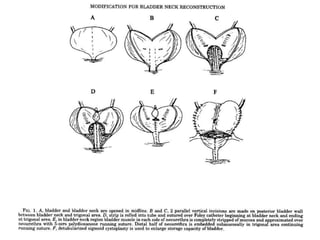
BLADDER NECK RECONSTRUCTION
Sunil Kumar
JIPMER, Puducherry
Indication
• Neurogenic dysfunction secondary to spinal
dysraphism.
• Exstrophy, bilateral ectopic ureters, and
ureteroceles,
Mechanism
 Tightening of the bladder neck
 Construction of a flap valve mechanism
 Placement of artificial or autologous bulking agents,
 The artificial urinary sphincter.
The selected option should
be individualized to the patient’s pathologic process,
needs, and personal goal
• The major disadvantage of flap valves is that the
valve will not allow leakage with high intravesical
pressures, potentiating renal damage. (Level 1)
• Therefore, these procedures can be dangerous
to the patient who is not totally committed to
follow catheterization recommendations.(Grade
A)
 Young-Dees-Leadbetter Repair (Urethral
lengthening+Detrusor back up)
 Tanagho procedure (Urethral lenghtening)
 Kroppe procedure (Urethral Lengthening+Flap valve
mechanism)
 Pippi-Salle Procedure (anterior bladder onlay flp)
 Bladder Neck Division
• Fascial Sling
• Bladder Neck Bulking Agents
• Artifiial Urinary Sphincter
No single option is best for all patients
(Kryger et al, 2000; Cole et al,
2003; Lemelle et al, 2006; Dave et al, 2008a).
Compairability?
• learning curve
• lack of a true, consistent definition of
“success” and “continence,”
• Consideration of patients with and without
concomitant bladder augmentation,
• evaluation of small populations of patients
with mixed pathologic condition
• Bladder neck and urethral reconstruction for
continence in patients who had previous
attempts at repair has resulted in less success.
• Presumably this relates to tissue scarring with
the loss of elasticity and contractility
Tanagho procedure
Young-Dees-Leadbetter Repair
Kropp procedure
– Main problem is
catheterisation
• Initial complications of Kroppe procedure
included
persistent incontinence,
urethrovesical fitula, and
 partial necrosis of the intravesical neourethra
• Snodgrass (1997) examined the results in 23
children,
22 of whom had neurogenic sphincter
incompetence and noted
continence in more than 90% of the children
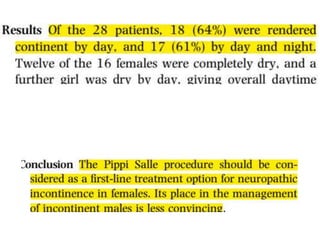
Pippi Salle Procedure
Jawaheer and Rangecroft (1999) reported a
diurnal continence rate of 61% for 3 hours or
longer with the Salle procedure.
However, only 44% of their patients were dry
through the night.
Less trouble with catheterization has occurred
relative to the Kropp technique, and it rarely
remains a problem.
Continence rates have not been quite as high in
most series
Rink et al, 1994;Mouriquand et al, 1995; Cole et al, 2003).
• Mitchell and Rink described the addition of
external support and compression achieved
through the placement of a silicone sheath
around the reconstructed bladder neck.
• This was somewhat done to establish a plane for
future placement of an artificial sphincter cuff, if
necessary.
-erosion b/c thick sheet
– Thin sheet by Quimby and colleagues
Thank You

Bladder neck reconstruction

  • 1.
    BLADDER NECK RECONSTRUCTION SunilKumar JIPMER, Puducherry
  • 2.
    Indication • Neurogenic dysfunctionsecondary to spinal dysraphism. • Exstrophy, bilateral ectopic ureters, and ureteroceles,
  • 3.
    Mechanism  Tightening ofthe bladder neck  Construction of a flap valve mechanism  Placement of artificial or autologous bulking agents,  The artificial urinary sphincter. The selected option should be individualized to the patient’s pathologic process, needs, and personal goal
  • 4.
    • The majordisadvantage of flap valves is that the valve will not allow leakage with high intravesical pressures, potentiating renal damage. (Level 1) • Therefore, these procedures can be dangerous to the patient who is not totally committed to follow catheterization recommendations.(Grade A)
  • 5.
     Young-Dees-Leadbetter Repair(Urethral lengthening+Detrusor back up)  Tanagho procedure (Urethral lenghtening)  Kroppe procedure (Urethral Lengthening+Flap valve mechanism)  Pippi-Salle Procedure (anterior bladder onlay flp)  Bladder Neck Division • Fascial Sling • Bladder Neck Bulking Agents • Artifiial Urinary Sphincter
  • 6.
    No single optionis best for all patients (Kryger et al, 2000; Cole et al, 2003; Lemelle et al, 2006; Dave et al, 2008a).
  • 7.
    Compairability? • learning curve •lack of a true, consistent definition of “success” and “continence,” • Consideration of patients with and without concomitant bladder augmentation, • evaluation of small populations of patients with mixed pathologic condition
  • 8.
    • Bladder neckand urethral reconstruction for continence in patients who had previous attempts at repair has resulted in less success. • Presumably this relates to tissue scarring with the loss of elasticity and contractility
  • 9.
  • 12.
  • 25.
    Kropp procedure – Mainproblem is catheterisation
  • 26.
    • Initial complicationsof Kroppe procedure included persistent incontinence, urethrovesical fitula, and  partial necrosis of the intravesical neourethra
  • 27.
    • Snodgrass (1997)examined the results in 23 children, 22 of whom had neurogenic sphincter incompetence and noted continence in more than 90% of the children
  • 32.
  • 36.
    Jawaheer and Rangecroft(1999) reported a diurnal continence rate of 61% for 3 hours or longer with the Salle procedure. However, only 44% of their patients were dry through the night. Less trouble with catheterization has occurred relative to the Kropp technique, and it rarely remains a problem. Continence rates have not been quite as high in most series Rink et al, 1994;Mouriquand et al, 1995; Cole et al, 2003).
  • 43.
    • Mitchell andRink described the addition of external support and compression achieved through the placement of a silicone sheath around the reconstructed bladder neck. • This was somewhat done to establish a plane for future placement of an artificial sphincter cuff, if necessary. -erosion b/c thick sheet – Thin sheet by Quimby and colleagues
  • 58.