O’REILLY’S CURVES
• Functional upper tract assessment.
• Attaching a gamma-emitting nuclide to a molecule that is excreted
and concentrated in urine.
• 99mTc-EC (Ethylene dicystine)
RENOGRAPHY
• Differentiating patients with equivocal obstruction of upper urinary
tract.
• If a system is genuinely obstructed  flow is impaired at high and low
urinary flow rates.
• Slow elimination is due to urinary stasis  responds to increase in
the urinary flow rate.
• Increased flow is achieved by a loop diuretic.
DIURESIS RENOGRAPHY
O’Reilly PH, Testa HJ, Lawson RS et al. Diuresis renography in equivocal urinary tract obstruction. Br J Urol 1978;50:76-80.
• Patient should be well hydrated.
• Bladder should be empty.
• Radiopharmaceutical in injected IV.
• Dynamic images are obtained at 15sec/frame.
• Static images at 30min and 4 hrs.
• Furosemide injected as per protocol (F+20, F-15, F0-children)
• Patient should void post procedure.
PROTOCOL
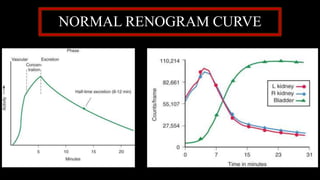
• Region of Interest (ROI) are drawn over both the kidneys and bladder.
• The number of counts occurring in each ROI is computed for each
time frame and the counts plotted against time.
• Background count is subtracted.
• Resultant “Time-activity curve”
NORMAL RENOGRAM CURVE
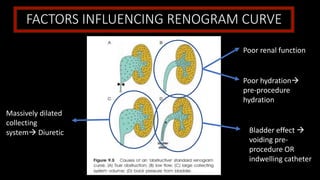
FACTORS INFLUENCING RENOGRAM CURVE
Poor renal function
Poor hydration
pre-procedure
hydration
Massively dilated
collecting
system Diuretic Bladder effect 
voiding pre-
procedure OR
indwelling catheter
• Original description- inject diuretic 20mins after radiopharmaceutical- F+20.
• Enables upper tract to be studied without manipulation.
• If rapid washout is observed, diuretic injection may be considered
unnecessary, reducing small inconvenience to patient.
• Classic response curves are described on the F+20 protocol.
TIMING OF DIURETIC
• If maximum diuresis is required from the outset- diuretic should be
injected 15 mins prior to radiopharmaceutical- F-15
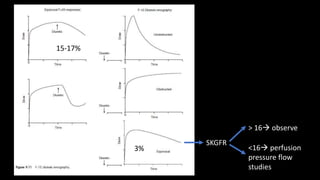
• Reduces the equivocal rate from 15-17% (F+20) to 3%(F-15)*
• Simultaneous injection of tracer and diuretic-F0
• Alternative to F-15 which is more convenient.
* O’Reilly PH. Diuresis renography. Recent advances an recommended protocols. Br J Urol 1992; 69:113-20.
TYPES OF CURVES
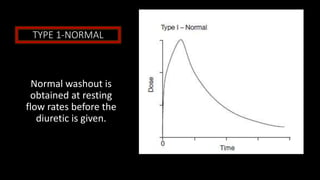
TYPE 1-NORMAL
Normal washout is
obtained at resting
flow rates before the
diuretic is given.
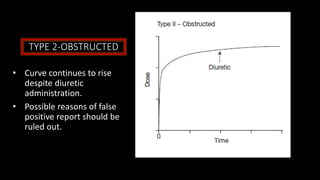
TYPE 2-OBSTRUCTED
• Curve continues to rise
despite diuretic
administration.
• Possible reasons of false
positive report should be
ruled out.
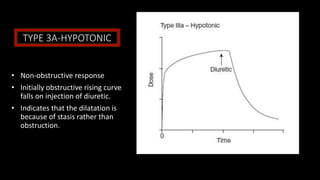
TYPE 3A-HYPOTONIC
• Non-obstructive response
• Initially obstructive rising curve
falls on injection of diuretic.
• Indicates that the dilatation is
because of stasis rather than
obstruction.
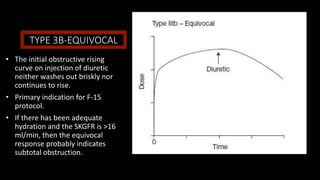
TYPE 3B-EQUIVOCAL
• The initial obstructive rising
curve on injection of diuretic
neither washes out briskly nor
continues to rise.
• Primary indication for F-15
protocol.
• If there has been adequate
hydration and the SKGFR is >16
ml/min, then the equivocal
response probably indicates
subtotal obstruction.
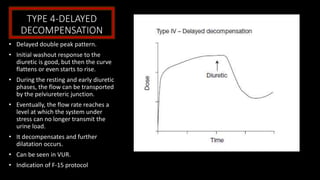
TYPE 4-DELAYED
DECOMPENSATION
• Delayed double peak pattern.
• Initial washout response to the
diuretic is good, but then the curve
flattens or even starts to rise.
• During the resting and early diuretic
phases, the flow can be transported
by the pelviureteric junction.
• Eventually, the flow rate reaches a
level at which the system under
stress can no longer transmit the
urine load.
• It decompensates and further
dilatation occurs.
• Can be seen in VUR.
• Indication of F-15 protocol
3%
SKGFR
<16 perfusion
pressure flow
studies
> 16 observe
15-17%
THANK YOU

O'Reilly curves.pptx

  • 1.
  • 2.
    • Functional uppertract assessment. • Attaching a gamma-emitting nuclide to a molecule that is excreted and concentrated in urine. • 99mTc-EC (Ethylene dicystine) RENOGRAPHY
  • 3.
    • Differentiating patientswith equivocal obstruction of upper urinary tract. • If a system is genuinely obstructed  flow is impaired at high and low urinary flow rates. • Slow elimination is due to urinary stasis  responds to increase in the urinary flow rate. • Increased flow is achieved by a loop diuretic. DIURESIS RENOGRAPHY
  • 5.
    O’Reilly PH, TestaHJ, Lawson RS et al. Diuresis renography in equivocal urinary tract obstruction. Br J Urol 1978;50:76-80.
  • 6.
    • Patient shouldbe well hydrated. • Bladder should be empty. • Radiopharmaceutical in injected IV. • Dynamic images are obtained at 15sec/frame. • Static images at 30min and 4 hrs. • Furosemide injected as per protocol (F+20, F-15, F0-children) • Patient should void post procedure. PROTOCOL
  • 7.
    • Region ofInterest (ROI) are drawn over both the kidneys and bladder. • The number of counts occurring in each ROI is computed for each time frame and the counts plotted against time. • Background count is subtracted. • Resultant “Time-activity curve”
  • 8.
  • 9.
    FACTORS INFLUENCING RENOGRAMCURVE Poor renal function Poor hydration pre-procedure hydration Massively dilated collecting system Diuretic Bladder effect  voiding pre- procedure OR indwelling catheter
  • 10.
    • Original description-inject diuretic 20mins after radiopharmaceutical- F+20. • Enables upper tract to be studied without manipulation. • If rapid washout is observed, diuretic injection may be considered unnecessary, reducing small inconvenience to patient. • Classic response curves are described on the F+20 protocol. TIMING OF DIURETIC
  • 11.
    • If maximumdiuresis is required from the outset- diuretic should be injected 15 mins prior to radiopharmaceutical- F-15 • Reduces the equivocal rate from 15-17% (F+20) to 3%(F-15)* • Simultaneous injection of tracer and diuretic-F0 • Alternative to F-15 which is more convenient. * O’Reilly PH. Diuresis renography. Recent advances an recommended protocols. Br J Urol 1992; 69:113-20.
  • 12.
  • 13.
    TYPE 1-NORMAL Normal washoutis obtained at resting flow rates before the diuretic is given.
  • 14.
    TYPE 2-OBSTRUCTED • Curvecontinues to rise despite diuretic administration. • Possible reasons of false positive report should be ruled out.
  • 15.
    TYPE 3A-HYPOTONIC • Non-obstructiveresponse • Initially obstructive rising curve falls on injection of diuretic. • Indicates that the dilatation is because of stasis rather than obstruction.
  • 16.
    TYPE 3B-EQUIVOCAL • Theinitial obstructive rising curve on injection of diuretic neither washes out briskly nor continues to rise. • Primary indication for F-15 protocol. • If there has been adequate hydration and the SKGFR is >16 ml/min, then the equivocal response probably indicates subtotal obstruction.
  • 17.
    TYPE 4-DELAYED DECOMPENSATION • Delayeddouble peak pattern. • Initial washout response to the diuretic is good, but then the curve flattens or even starts to rise. • During the resting and early diuretic phases, the flow can be transported by the pelviureteric junction. • Eventually, the flow rate reaches a level at which the system under stress can no longer transmit the urine load. • It decompensates and further dilatation occurs. • Can be seen in VUR. • Indication of F-15 protocol
  • 18.
  • 22.