RADICAL
CYSTECTOMY
Dept of Urology
Govt Royapettah Hospital and Kilpauk Medical College
Chennai 1
Moderators:
Professors:
◦ Prof. Dr. G. Sivasankar, M.S., M.Ch.,
◦ Prof. Dr. A. Senthilvel, M.S., M.Ch.,
Asst Professors:
◦ Dr. J. Sivabalan, M.S., M.Ch.,
◦ Dr. R. Bhargavi, M.S., M.Ch.,
◦ Dr. S. Raju, M.S., M.Ch.,
◦ Dr. K. Muthurathinam, M.S., M.Ch.,
◦ Dr. D. Tamilselvan, M.S., M.Ch.,
◦ Dr. K. Senthilkumar, M.S., M.Ch.
Dept of Urology, GRH and KMC, Chennai. 2
Definition:
◦ Men:
◦ En bloc removal of bladder
◦ Urachus
◦ Prostate,seminal vesicles
◦ Perivesical fat
◦ Women: anterior pelvic exentration
◦ Ovaries
◦ Fallopian tubes
◦ Uterus,cervix,portion of vaginal wall
3
Dept of Urology, GRH and KMC, Chennai.
Indications for radical cystectomy
◦ Infiltrating muscle-invasive bladder cancer
- without evidence of metastasis
- low-volume, resectable locoregional metastases (stage T2-T3b)
◦ Superficial bladder tumors characterized by any of the following:
◦ Refractory to cystoscopic resection and intravesical chemotherapy or immunotherapy
◦ Extensive disease not amenable to cystoscopic resection
◦ Invasive prostatic urethral involvement
◦ Stage-pT1, grade-3 tumors unresponsive to intravesical BCG therapy
◦ CIS refractory to intravesical immunotherapy or chemotherapy
◦ Palliation for pain, bleeding, or urinary frequency
◦ Primary adenocarcinoma, SCC, or sarcoma
4
Dept of Urology, GRH and KMC, Chennai.
Pre-op preparation
◦ Pre-op evaluation & counselling by enterostomal nurse:
◦ Site marked for a cutaneous stoma – supine, sitting and standing
◦ Antibiotic bowel preparation challenged
◦ Clear liquid diet 1-2 days prior to surgery
◦ Simple mechanical bowel preparation with peglec
◦ Pre op fluid management
◦ Iv broad spectrum antibiotics
◦ Lower extremity intermittent compression devices
5
Dept of Urology, GRH and KMC, Chennai.
6
Dept of Urology, GRH and KMC, Chennai.
7
Dept of Urology, GRH and KMC, Chennai.
8
Dept of Urology, GRH and KMC, Chennai.
CYSTECTOMY IN THE
MALE
9
Dept of Urology, GRH and KMC, Chennai.
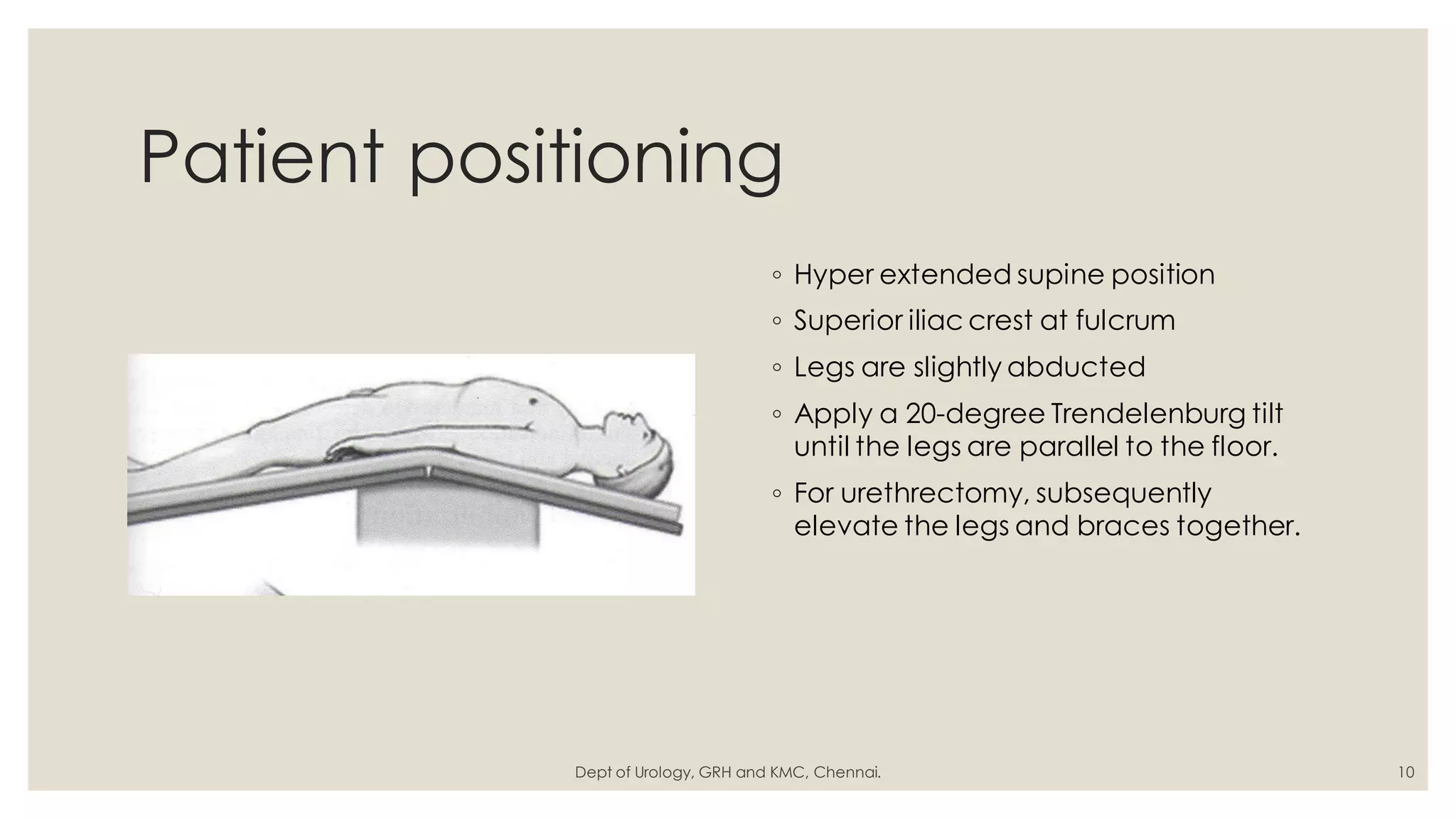
Patient positioning
◦ Hyper extended supine position
◦ Superior iliac crest at fulcrum
◦ Legs are slightly abducted
◦ Apply a 20-degree Trendelenburg tilt
until the legs are parallel to the floor.
◦ For urethrectomy, subsequently
elevate the legs and braces together.
10
Dept of Urology, GRH and KMC, Chennai.
◦ lower midline abdominal incision from
the symphysis pubis to the periumbilical
area.
11
Dept of Urology, GRH and KMC, Chennai.
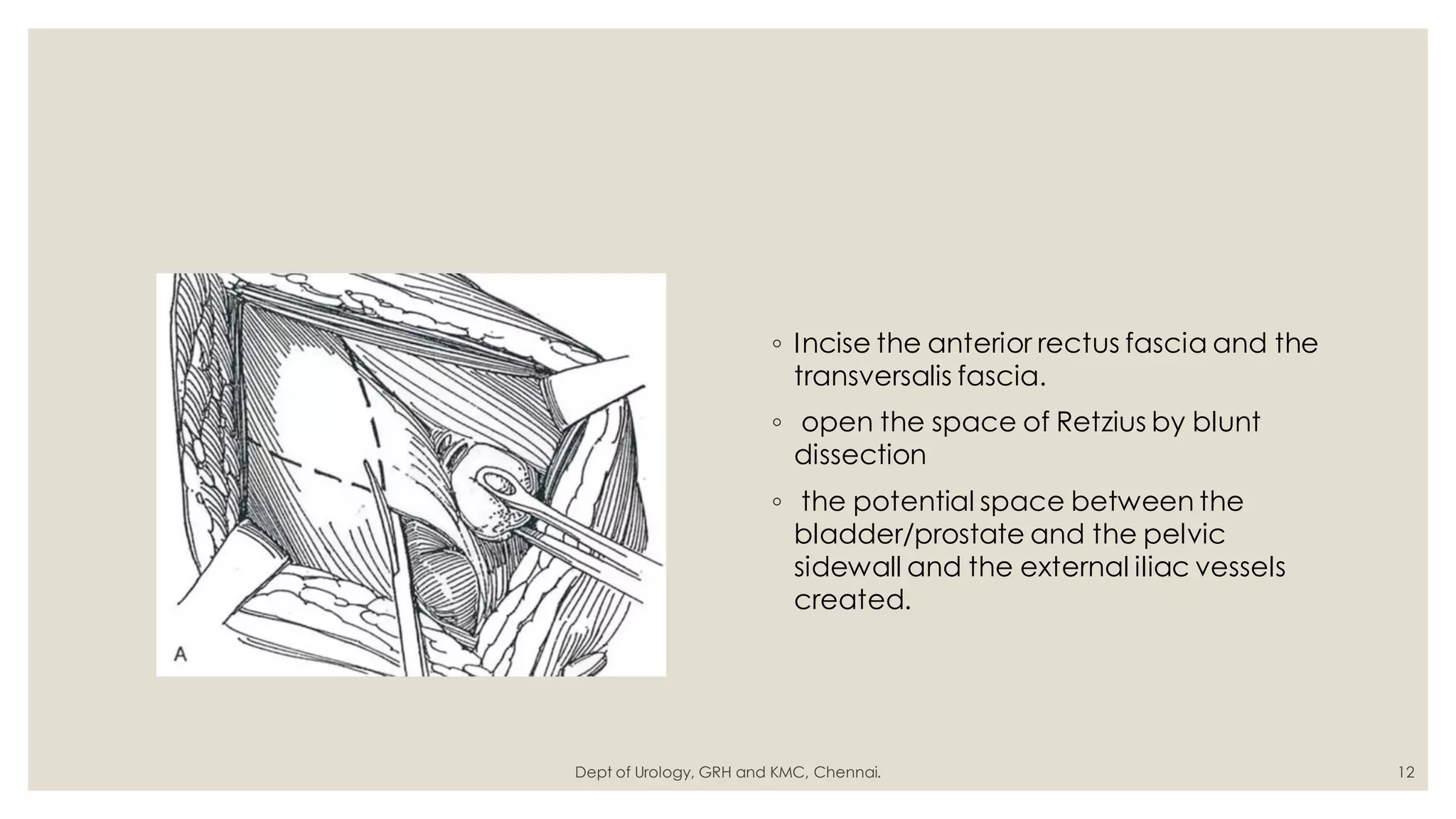
◦ Incise the anterior rectus fascia and the
transversalis fascia.
◦ open the space of Retzius by blunt
dissection
◦ the potential space between the
bladder/prostate and the pelvic
sidewall and the external iliac vessels
created.
12
Dept of Urology, GRH and KMC, Chennai.
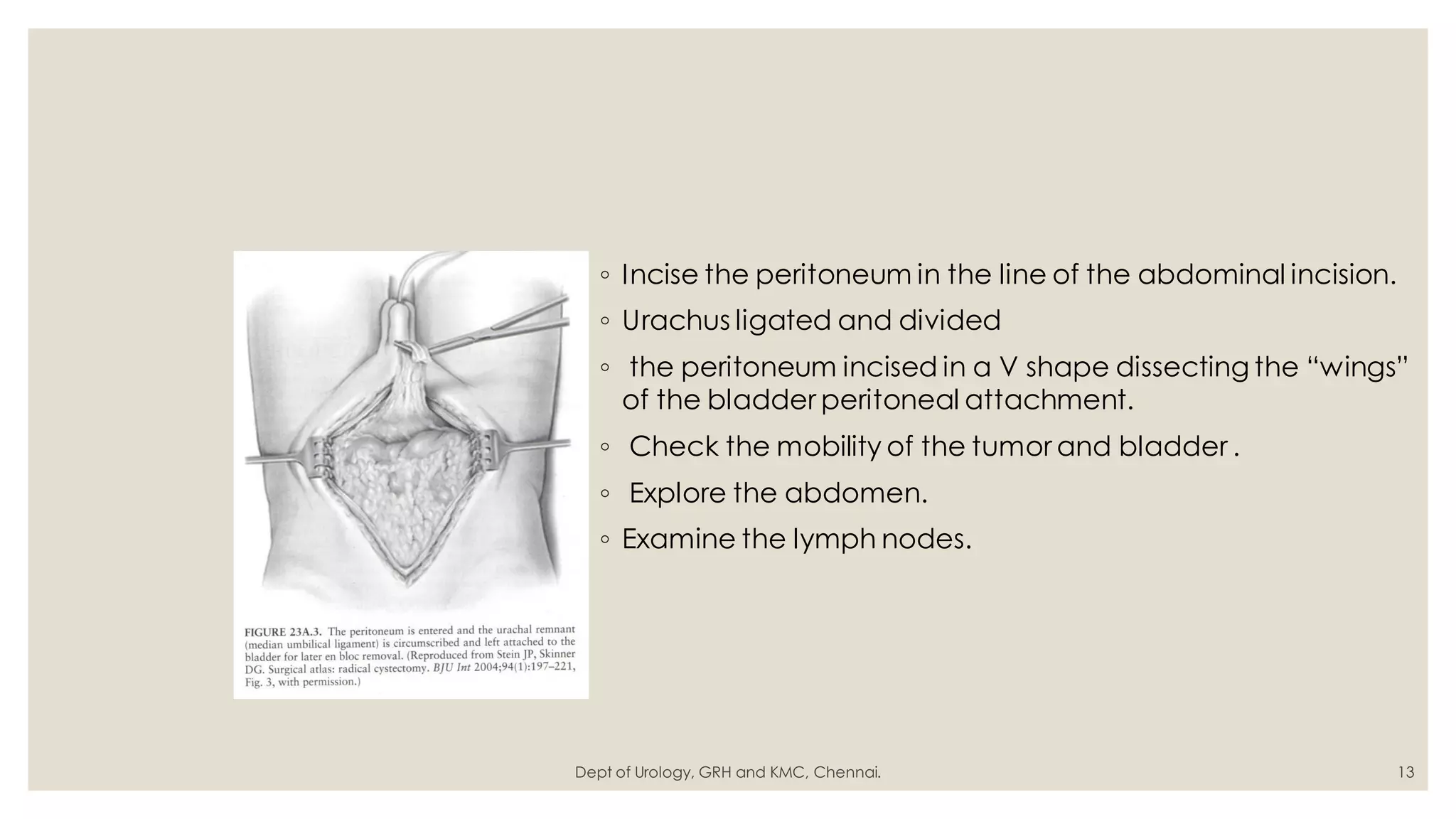
◦ Incise the peritoneum in the line of the abdominal incision.
◦ Urachus ligated and divided
◦ the peritoneum incised in a V shape dissecting the “wings”
of the bladder peritoneal attachment.
◦ Check the mobility of the tumor and bladder .
◦ Explore the abdomen.
◦ Examine the lymph nodes.
13
Dept of Urology, GRH and KMC, Chennai.
14
Dept of Urology, GRH and KMC, Chennai.
Bowel mobilization
◦ Caecum and ascending colon mobilized medially by incising white line of toldt upto the
root of mesentry
◦ Small bowel mobilized and retroperitoneal duodenum exposed-lymph node dissection
◦ Inverted triangle-
base-3 rd and 4 th part of duodenum
right edge by ascending colon
left edge by sigmoid and descending colon
◦ Descending colon and sigmoid mesentry elevated of sacral promontry
◦ Window created in sigmoid mesentry below inf.mesenteric vessels for left ureter to pass to
right side of abdomen
◦ All bowel except descending colon and sigmoid packed into epigastrium
◦
15
Dept of Urology, GRH and KMC, Chennai.
16
Dept of Urology, GRH and KMC, Chennai.
17
Dept of Urology, GRH and KMC, Chennai.
Identification of ureters
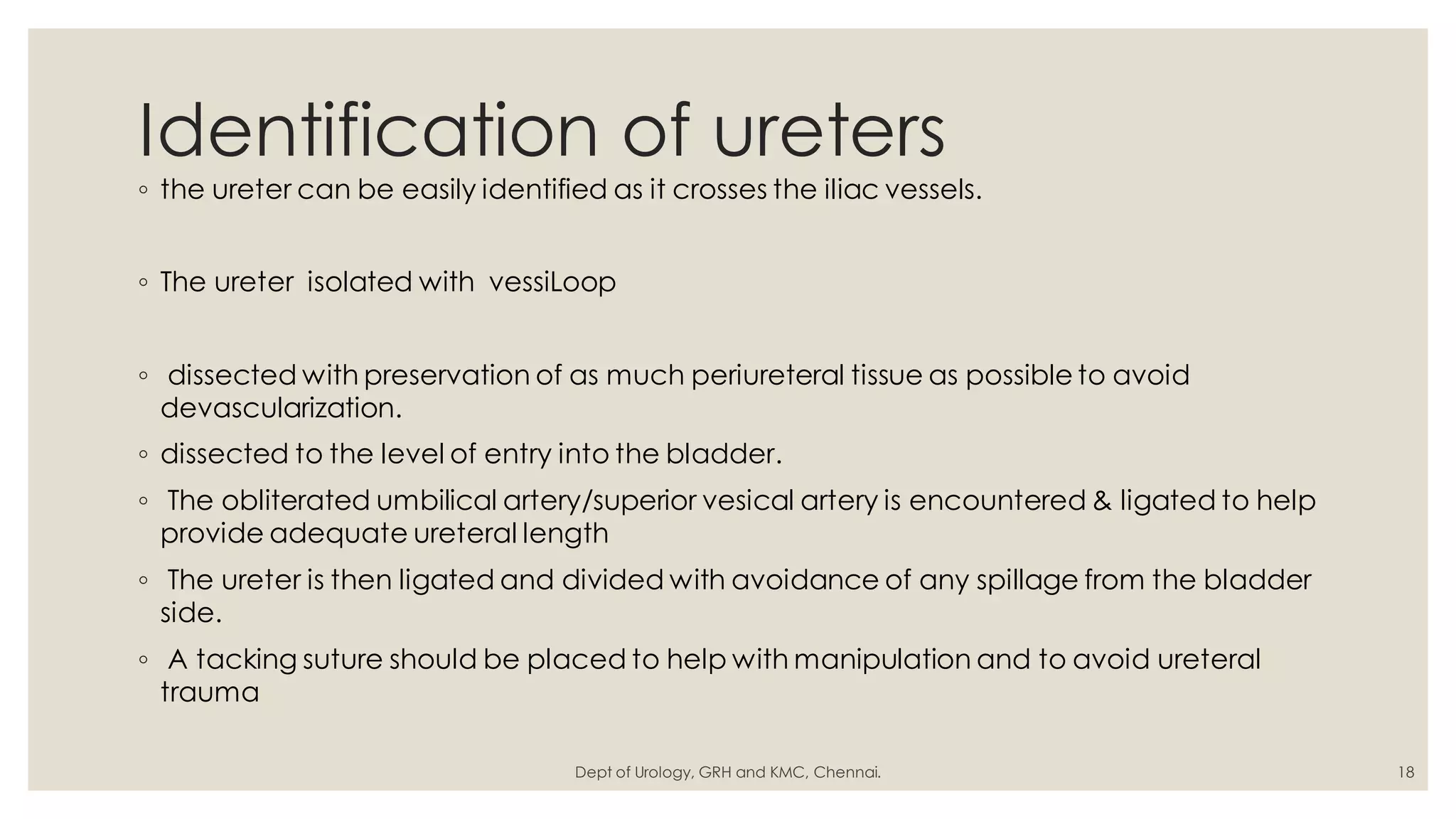
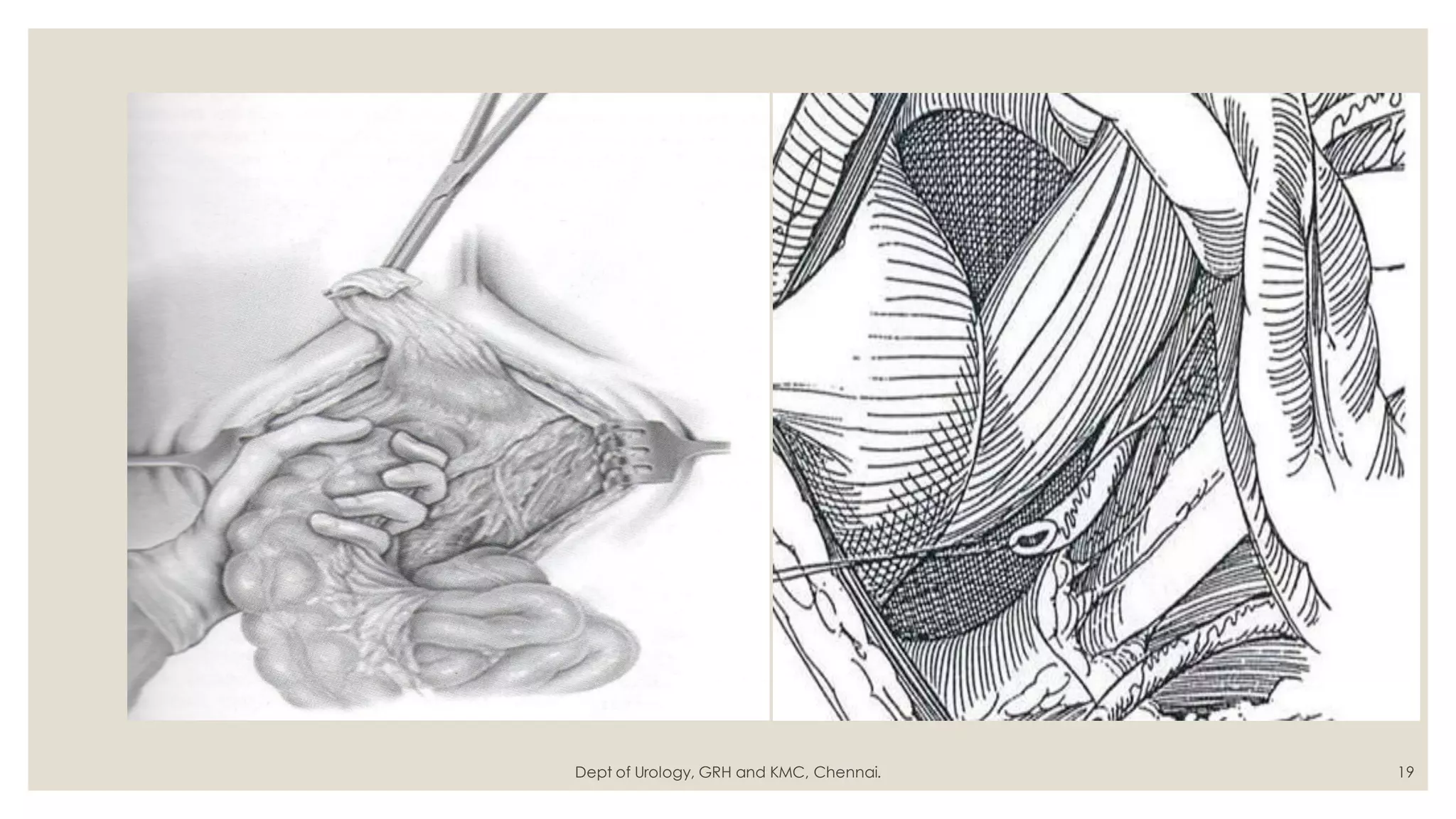
◦ the ureter can be easily identified as it crosses the iliac vessels.
◦ The ureter isolated with vessiLoop
◦ dissected with preservation of as much periureteral tissue as possible to avoid
devascularization.
◦ dissected to the level of entry into the bladder.
◦ The obliterated umbilical artery/superior vesical artery is encountered & ligated to help
provide adequate ureteral length
◦ The ureter is then ligated and divided with avoidance of any spillage from the bladder
side.
◦ A tacking suture should be placed to help with manipulation and to avoid ureteral
trauma
18
Dept of Urology, GRH and KMC, Chennai.
19
Dept of Urology, GRH and KMC, Chennai.
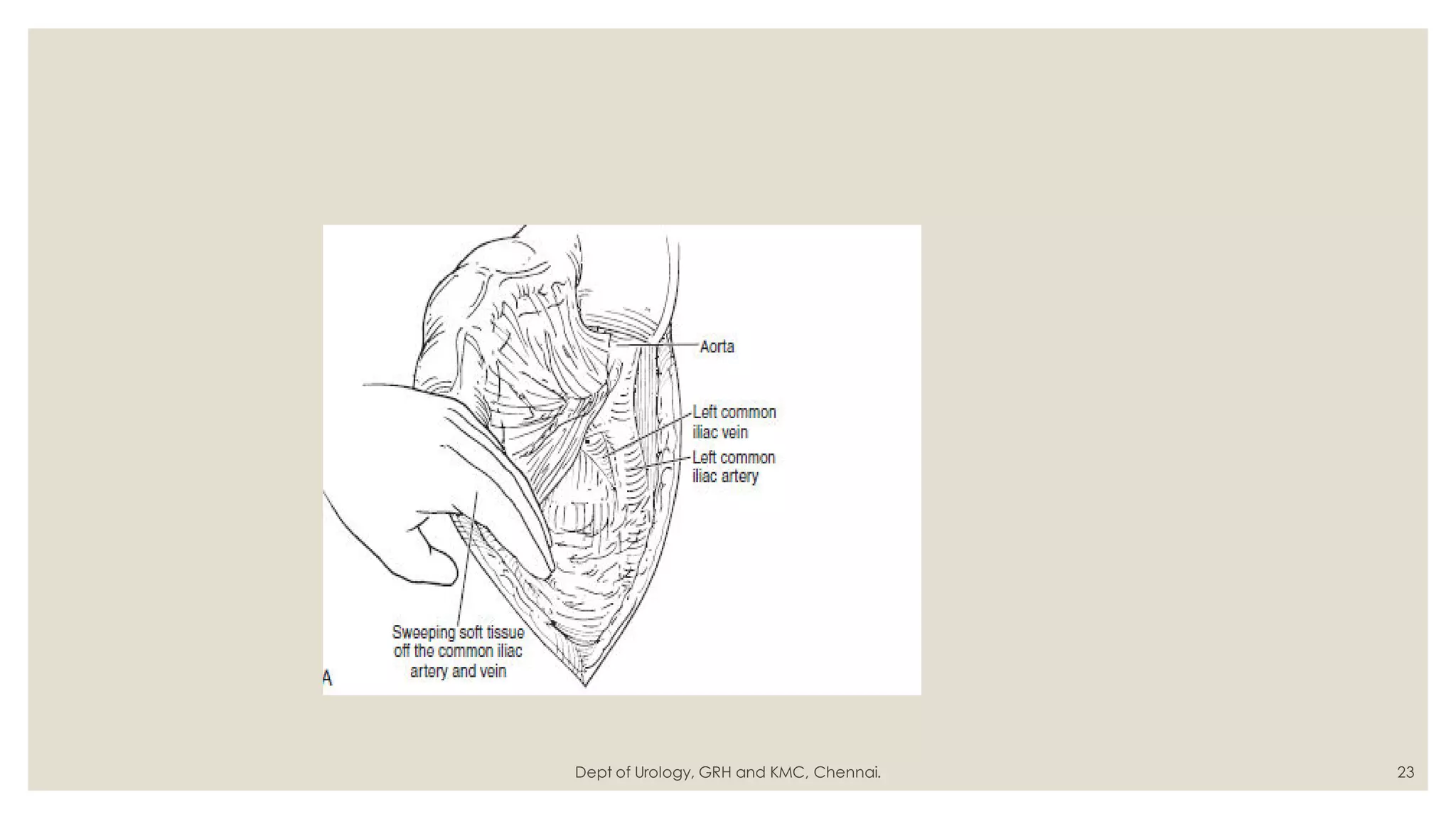
Pelvic Lymphadenectomy
◦ The limits for node dissection are:
◦ Laterally-genitofemoral nerve
◦ medially- the bladder
◦ cephalad- the bifurcation of the
common iliac artery
◦ caudad-cooper ligament
20
Dept of Urology, GRH and KMC, Chennai.
Extended lymphadenectomy
◦ proximal common iliac artery cranially,
◦ the genitofemoral nerves laterally,
◦ Cooper ligament inferiorly
◦ Obturator canal and hypogastric
vessels, laterally and medially, caudally
21
Dept of Urology, GRH and KMC, Chennai.
22
Dept of Urology, GRH and KMC, Chennai.
23
Dept of Urology, GRH and KMC, Chennai.
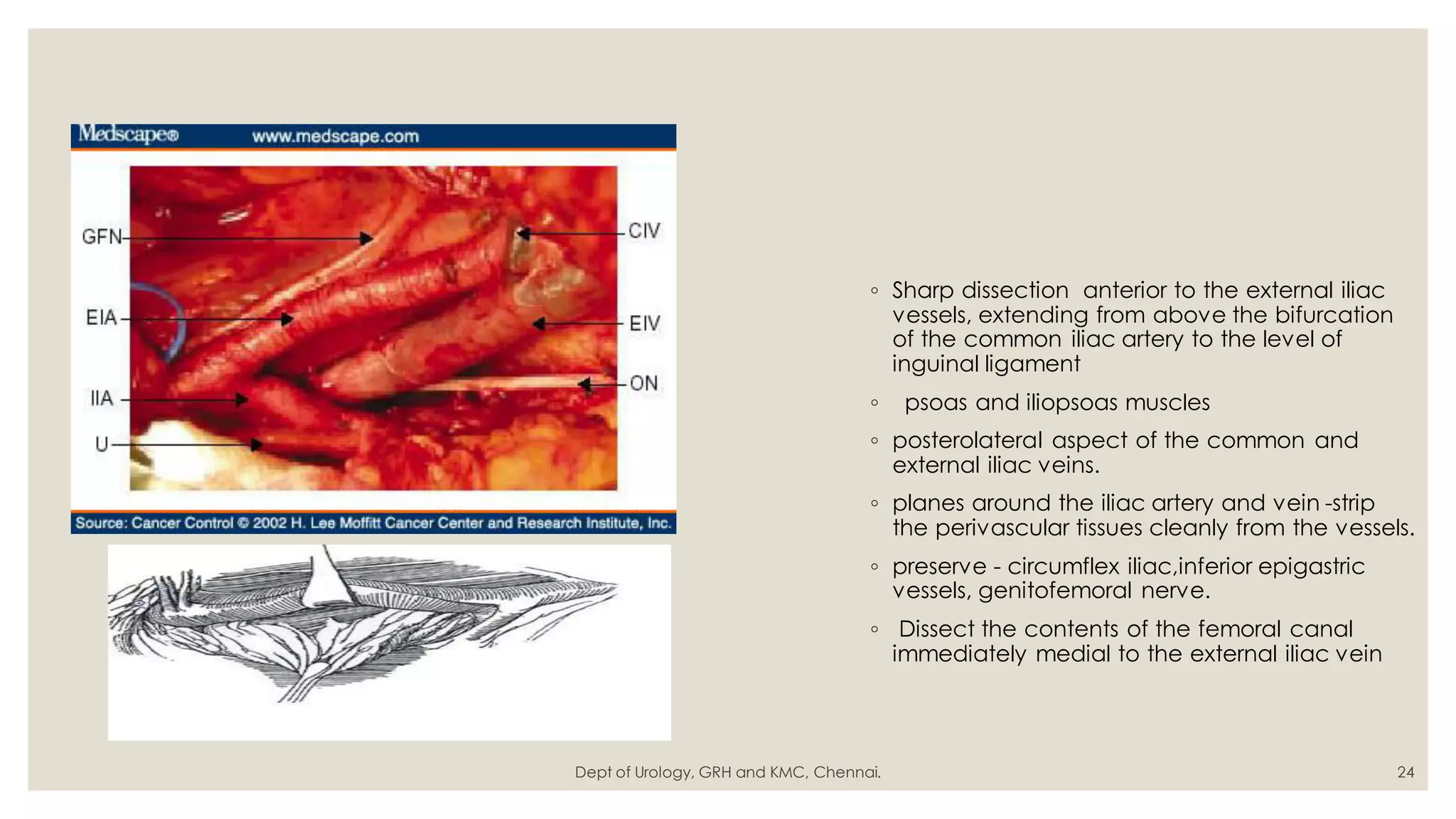
◦ Sharp dissection anterior to the external iliac
vessels, extending from above the bifurcation
of the common iliac artery to the level of
inguinal ligament
◦ psoas and iliopsoas muscles
◦ posterolateral aspect of the common and
external iliac veins.
◦ planes around the iliac artery and vein -strip
the perivascular tissues cleanly from the vessels.
◦ preserve - circumflex iliac,inferior epigastric
vessels, genitofemoral nerve.
◦ Dissect the contents of the femoral canal
immediately medial to the external iliac vein
24
Dept of Urology, GRH and KMC, Chennai.
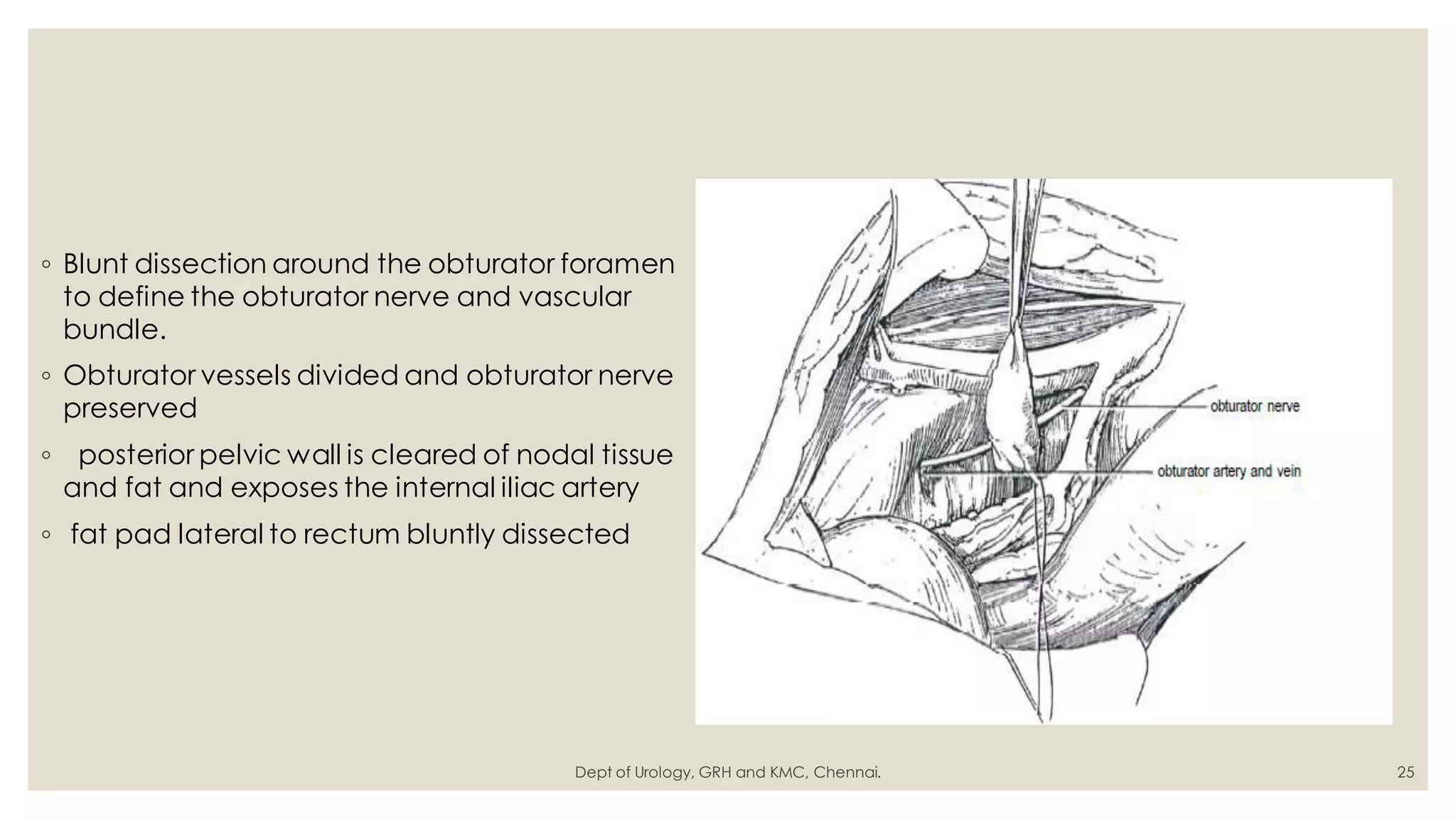
◦ Blunt dissection around the obturator foramen
to define the obturator nerve and vascular
bundle.
◦ Obturator vessels divided and obturator nerve
preserved
◦ posterior pelvic wall is cleared of nodal tissue
and fat and exposes the internal iliac artery
◦ fat pad lateral to rectum bluntly dissected
25
Dept of Urology, GRH and KMC, Chennai.
DIVISION OF LATERAL PEDICLE
◦ Clear the internal iliac artery and identify its first branch,
the superior gluteal.
◦ Dissect distal to the gluteal branch.
◦ Vesical pedicle dissected and ligated
◦ the index finger used to develop the plane and protect
the rectum.
◦ Do not ligate the internal iliac artery
◦ Avoid the autonomic nerves from the superior internal
iliac, pelvic, and vesical plexuses when dividing the
superior and inferior vesical pedicles.
26
Dept of Urology, GRH and KMC, Chennai.
DIVISION OF LATERAL PEDICLE
27
Dept of Urology, GRH and KMC, Chennai.
28
Dept of Urology, GRH and KMC, Chennai.
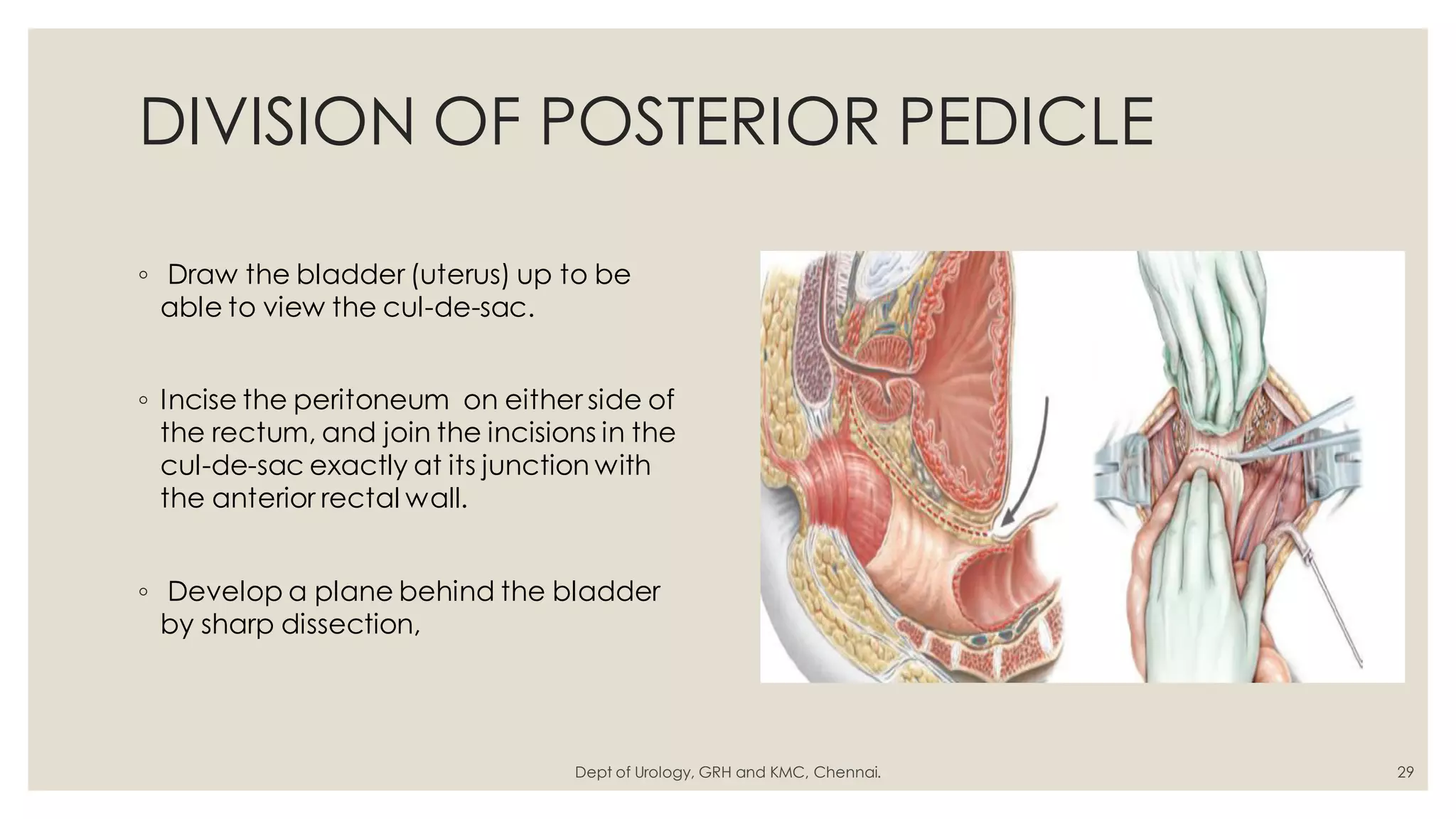
DIVISION OF POSTERIOR PEDICLE
◦ Draw the bladder (uterus) up to be
able to view the cul-de-sac.
◦ Incise the peritoneum on either side of
the rectum, and join the incisions in the
cul-de-sac exactly at its junction with
the anterior rectal wall.
◦ Develop a plane behind the bladder
by sharp dissection,
29
Dept of Urology, GRH and KMC, Chennai.
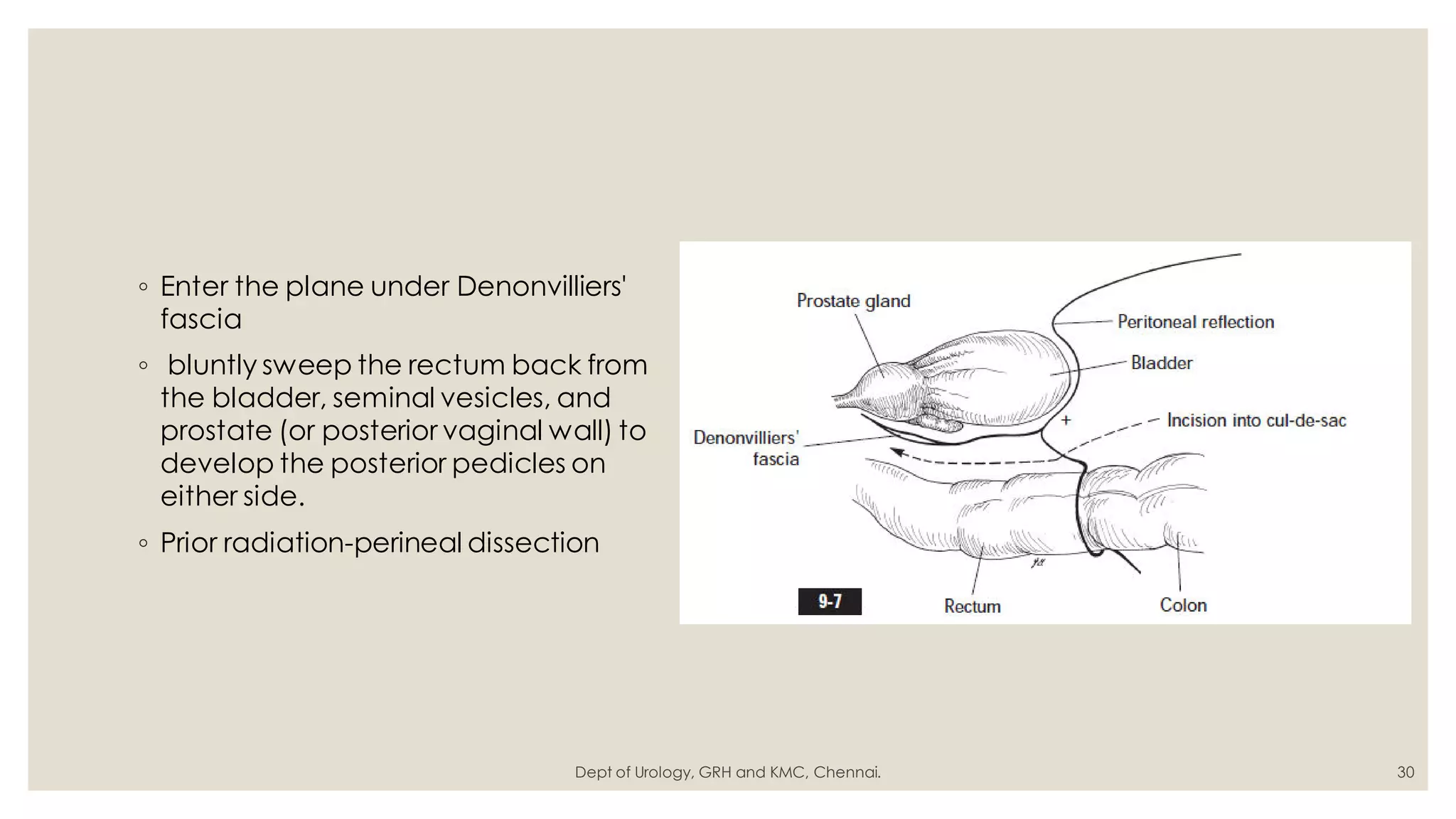
◦ Enter the plane under Denonvilliers'
fascia
◦ bluntly sweep the rectum back from
the bladder, seminal vesicles, and
prostate (or posterior vaginal wall) to
develop the posterior pedicles on
either side.
◦ Prior radiation-perineal dissection
30
Dept of Urology, GRH and KMC, Chennai.
31
Dept of Urology, GRH and KMC, Chennai.
◦ Dissect the pedicles lateral to the seminal vesicles
◦ neurovascular bundles are seen on the ventrolateral surface
of the rectum.
◦ Clip and divide the pedicles along the anterolateral border
of the seminal vesicle until the endopelvic fascia is reached.
◦ extravesical extension - widely excise the neurovascular
bundle on that side, including the pelvic plexus, and divide
the pedicle close to the pelvic wall
32
Dept of Urology, GRH and KMC, Chennai.
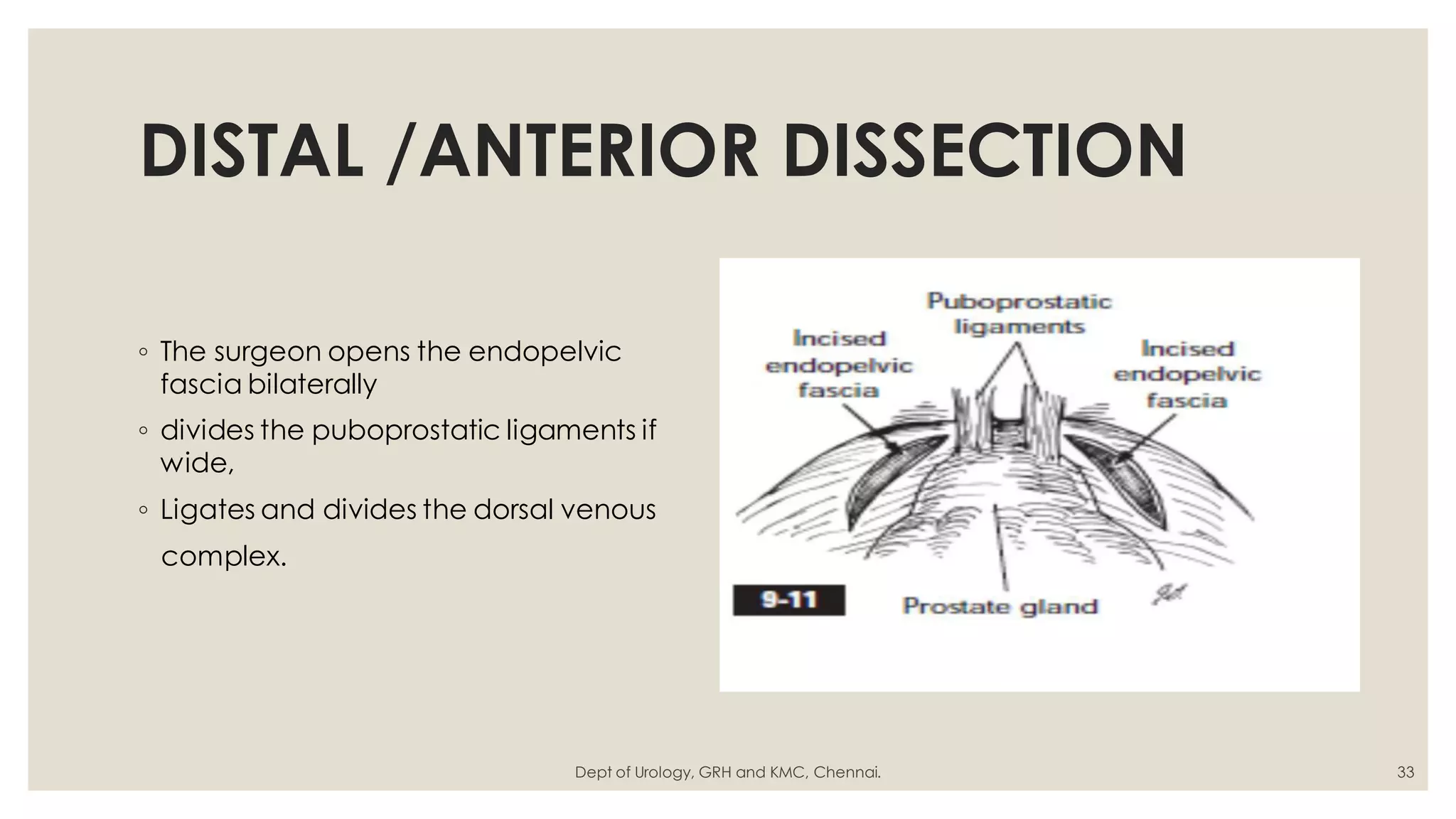
DISTAL /ANTERIOR DISSECTION
◦ The surgeon opens the endopelvic
fascia bilaterally
◦ divides the puboprostatic ligaments if
wide,
◦ Ligates and divides the dorsal venous
complex.
33
Dept of Urology, GRH and KMC, Chennai.
34
Dept of Urology, GRH and KMC, Chennai.
35
Dept of Urology, GRH and KMC, Chennai.
Nerve-sparing technique
◦ neurovascular bundle of the prostate
released sharply on both sides of the
prostate with incision of its thin fascia
while remaining outside the capsule of
theprostate
◦ from the apex of the prostate to the
tip of the seminal vesicles
◦ limited traction and cautery
◦ neurovascular bundles laterally and
the striated sphincter at the apex.
36
Dept of Urology, GRH and KMC, Chennai.
◦ Urethra dissected and stretched with umblical tape
◦ avoid the neurovascular bundles that lie posterolaterally
◦ Place a silk ligature around the urethra to prevent
contamination at the time of division.
◦ the urethra can be mobilized from the urogenital
diaphragm preparatory to perineal urethrectomy ‘
◦ Clamp the urethra near the prostate
◦ Pass the left index finger behind the urethra, and divide
the space along the indwelling catheter.
◦ Elevate the rectourethralis muscle with a clamp, and
sharply divide it under vision, again avoiding the
neurovascular bundles that lie immediately adjacent in
the posterolateral quadrants
37
Dept of Urology, GRH and KMC, Chennai.
◦ The free end of the cut Foley catheter is
retracted up
◦ Using both hands, the surgeon can now feel
a thin web of tissues separating the proximal
and distal dissections
◦ This thin web is punctured with the surgeon’s
fingers.
◦ Remove the specimen
38
Dept of Urology, GRH and KMC, Chennai.
◦ place a figure-eight 1-0 synthetic absorbable suture through both levators anteriorly just behind the
pubis.
◦ Check for bleeding elsewhere
◦ Replace the bowel carefully, and pull the omentum down to cover the anastomoses.
◦ Suction drainage is usually needed for protection of the diversion.
◦ If a bladder substitute is not constructed, a balloon catheter placed through the urethra helps drain
the pelvic cavity for the first few days postoperatively.
◦ Close the wound appropriately.
39
Dept of Urology, GRH and KMC, Chennai.
CYSTECTOMY IN THE
FEMALE
40
Dept of Urology, GRH and KMC, Chennai.
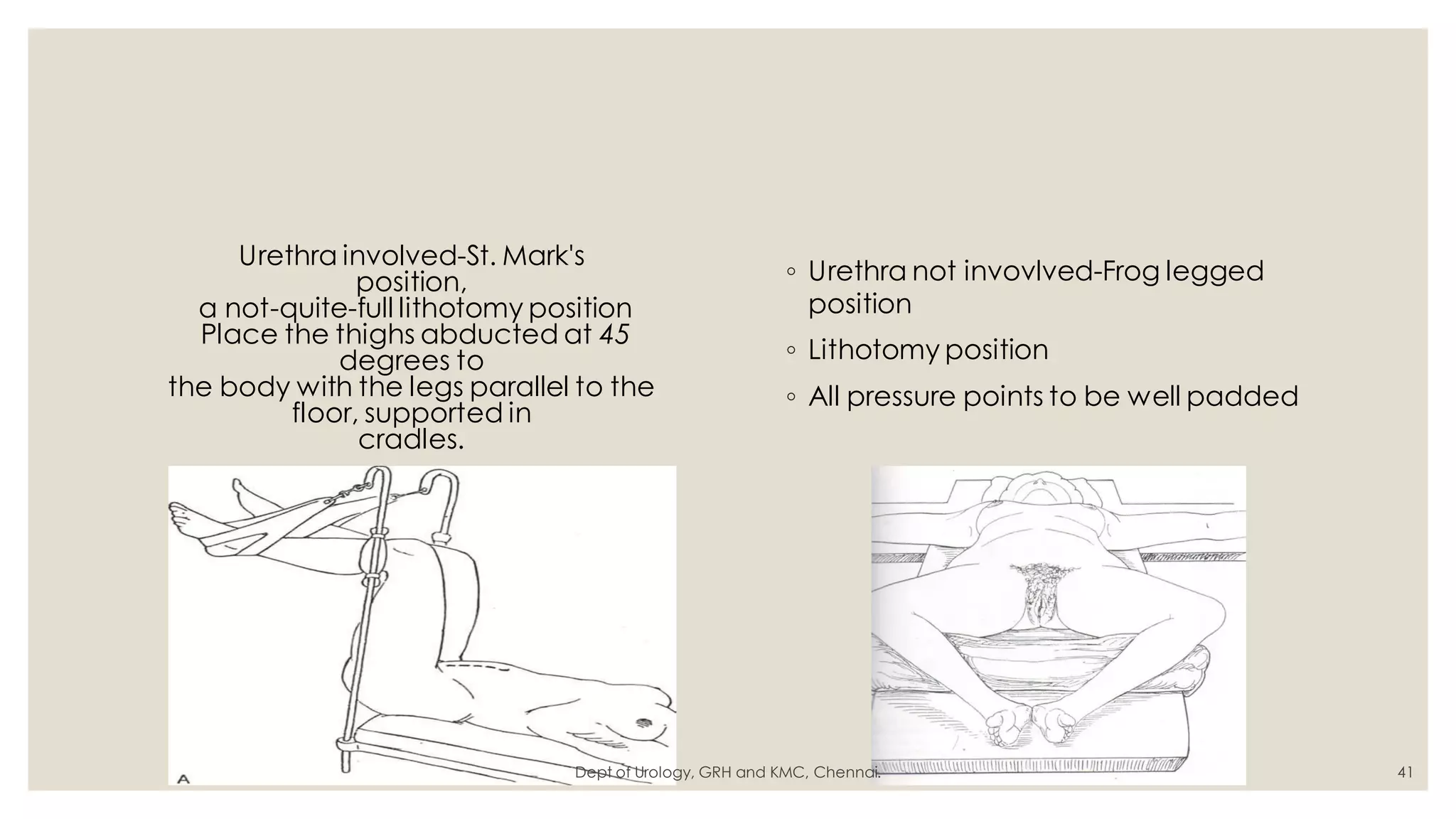
Urethra involved-St. Mark's
position,
a not-quite-full lithotomy position
Place the thighs abducted at 45
degrees to
the body with the legs parallel to the
floor, supported in
cradles.
◦ Urethra not invovlved-Frog legged
position
◦ Lithotomy position
◦ All pressure points to be well padded
41
Dept of Urology, GRH and KMC, Chennai.
Intraabdominal Exposure
42
Dept of Urology, GRH and KMC, Chennai.
◦ The peritoneum lateral to the bladder is
incised
◦ round ligament is ligated and divided.
◦ The ovarian vesselsin the
infundibulopelvic ligament are
identified, ligated,and divided
◦ These maneuvers allow the peritoneal
contents to be packed away from the
pelvis
43
Dept of Urology, GRH and KMC, Chennai.
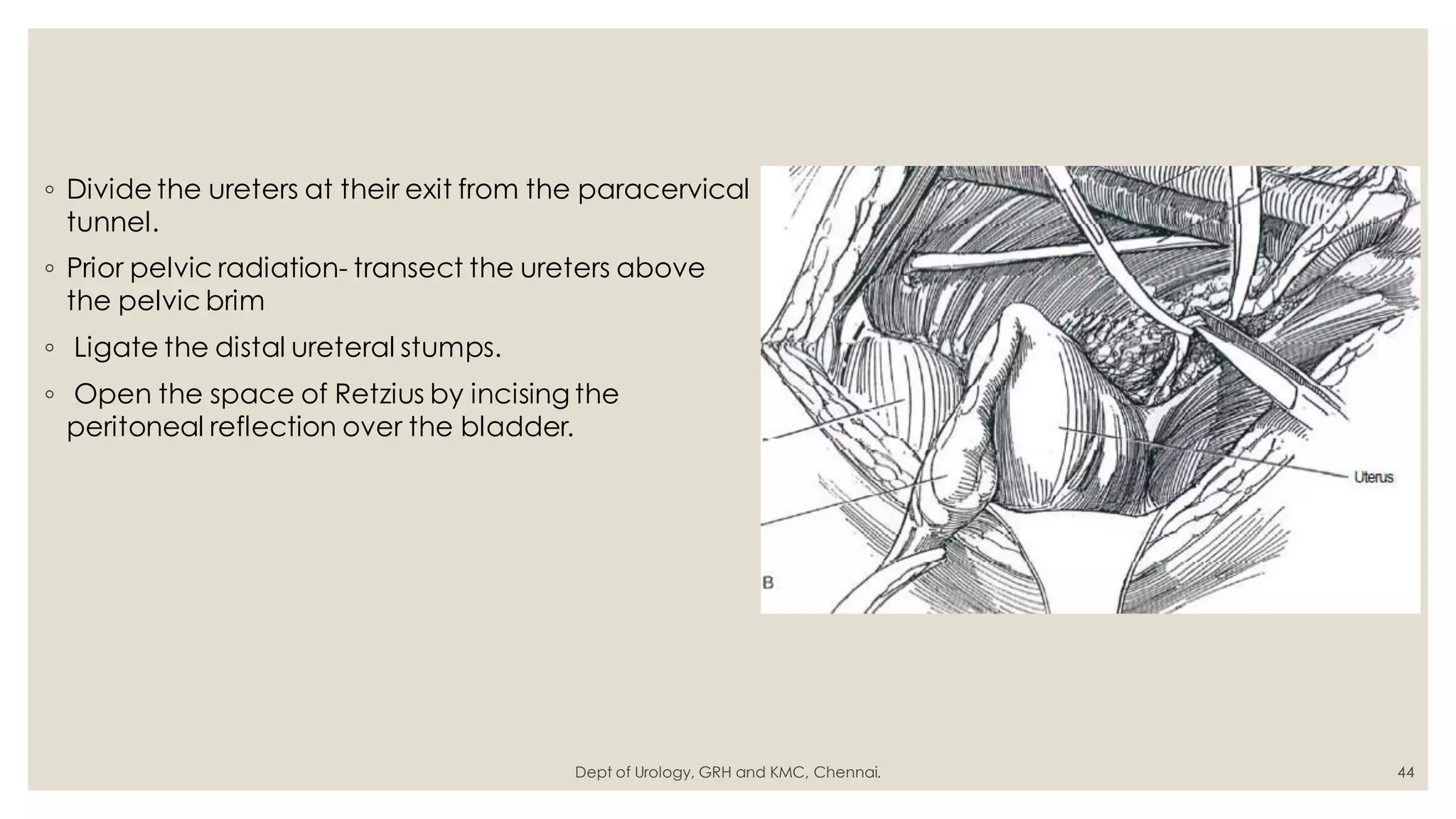
◦ Divide the ureters at their exit from the paracervical
tunnel.
◦ Prior pelvic radiation- transect the ureters above
the pelvic brim
◦ Ligate the distal ureteral stumps.
◦ Open the space of Retzius by incising the
peritoneal reflection over the bladder.
44
Dept of Urology, GRH and KMC, Chennai.
ANTERIOR DISSECTION
◦ Dissection of the anterior bladder wall
to the level of endopelvic fascia
bilaterally
◦ incised on each side to allow for better
exposure of the urethra all the way to
the perineum.
45
Dept of Urology, GRH and KMC, Chennai.
LATERAL DISSECTION
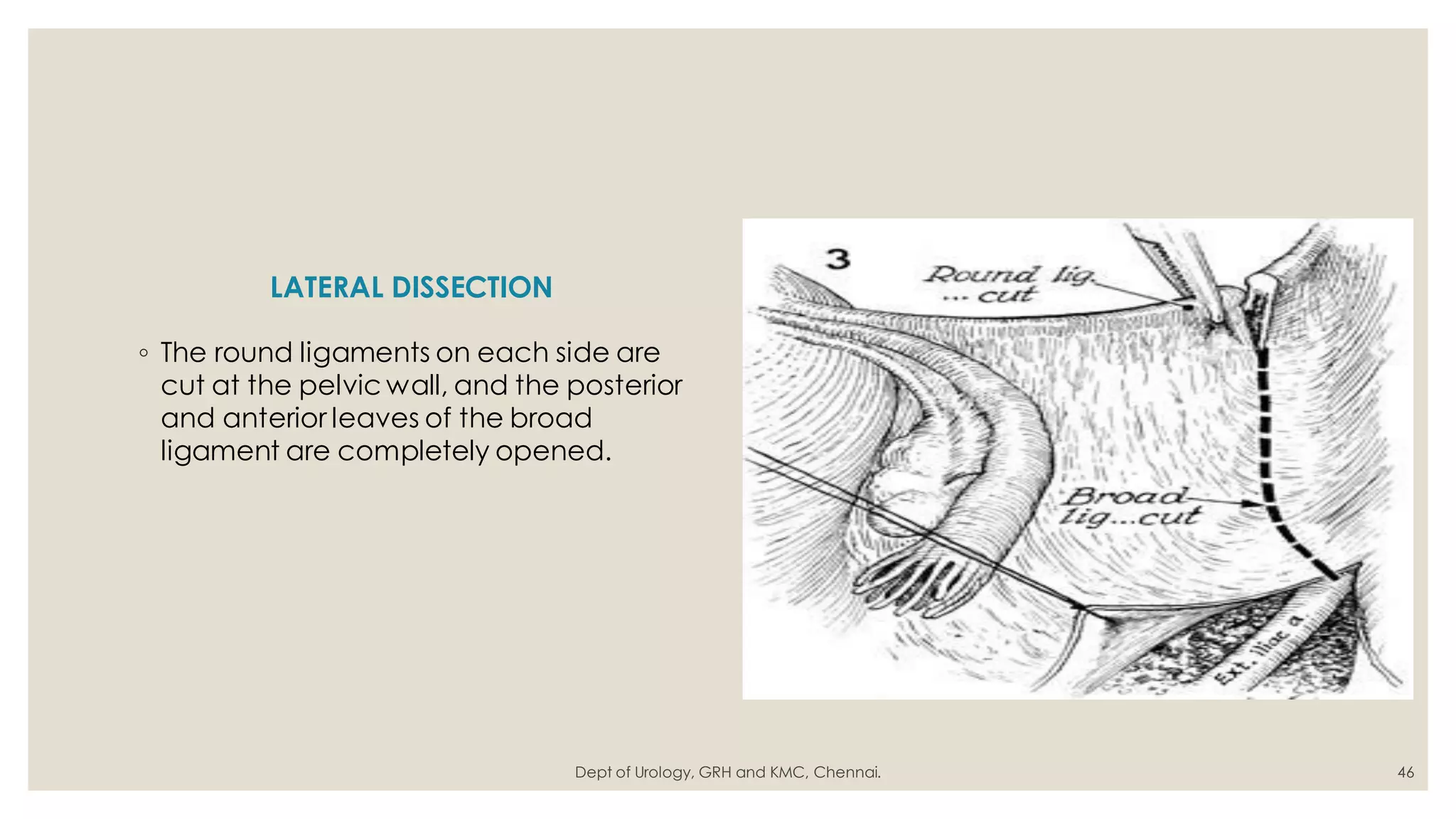
◦ The round ligaments on each side are
cut at the pelvic wall, and the posterior
and anterior leaves of the broad
ligament are completely opened.
46
Dept of Urology, GRH and KMC, Chennai.
PARARECTAL DISSECTION
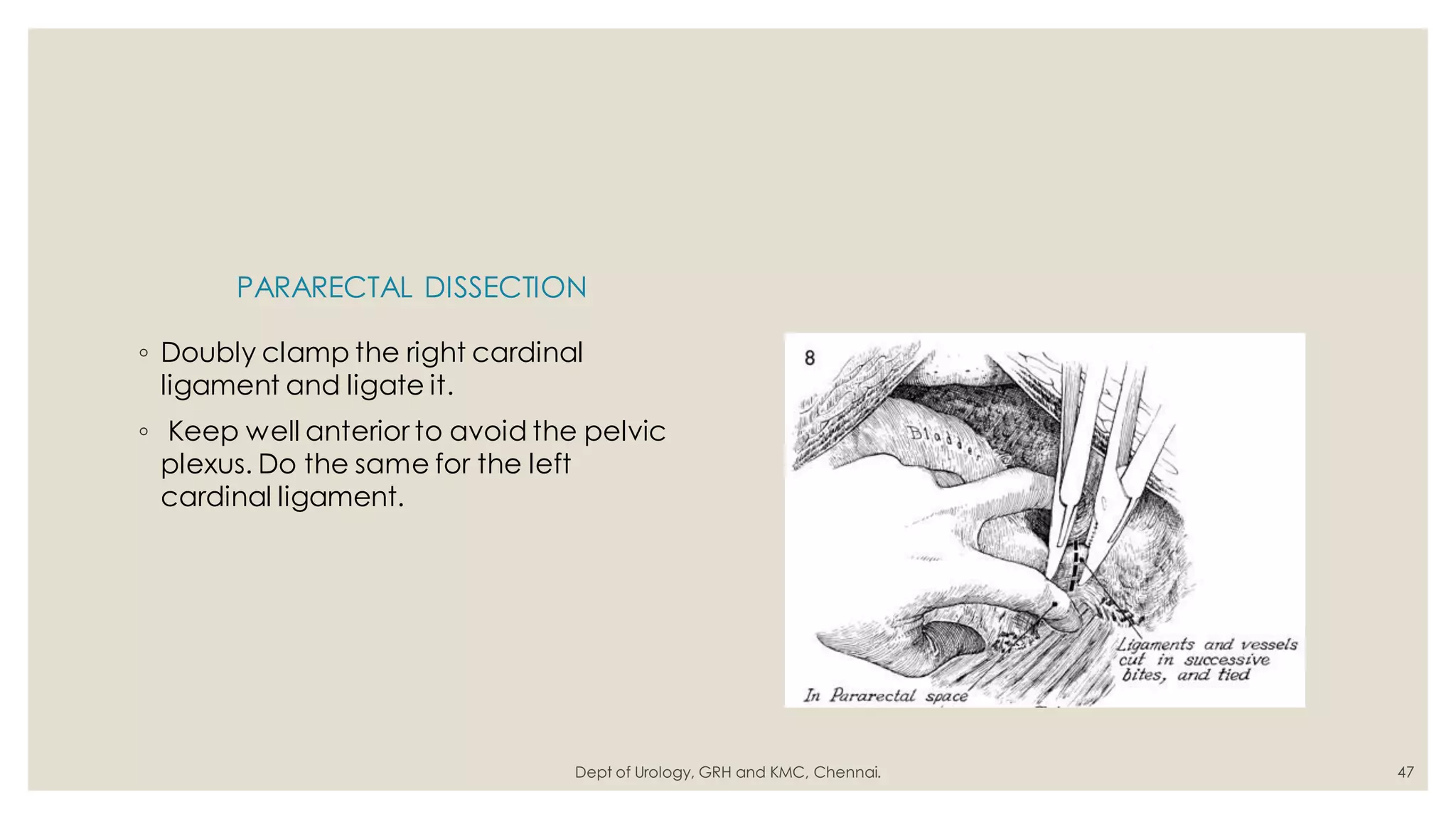
◦ Doubly clamp the right cardinal
ligament and ligate it.
◦ Keep well anterior to avoid the pelvic
plexus. Do the same for the left
cardinal ligament.
47
Dept of Urology, GRH and KMC, Chennai.
Posterior dissection
◦ Incise the peritoneum in the cul-de-sac, and
dissect the rectum from the posterior wall of the
vagina
◦ Clamp, divide, and suture-ligate the uterosacral
ligament on both sides.
48
Dept of Urology, GRH and KMC, Chennai.
◦ ligate the lateral vesical pedicles at
the level of endopelvic fascia with 2-0
nonabsorbable suture
◦ Place a stick sponge in the posterior
fornix of the vagina, open the vagina
over it with the cutting current, and
incise the lateral wall for a short
distance.
49
Dept of Urology, GRH and KMC, Chennai.
Anterior Dissection and Urethral
Dissection with Urethrectomy
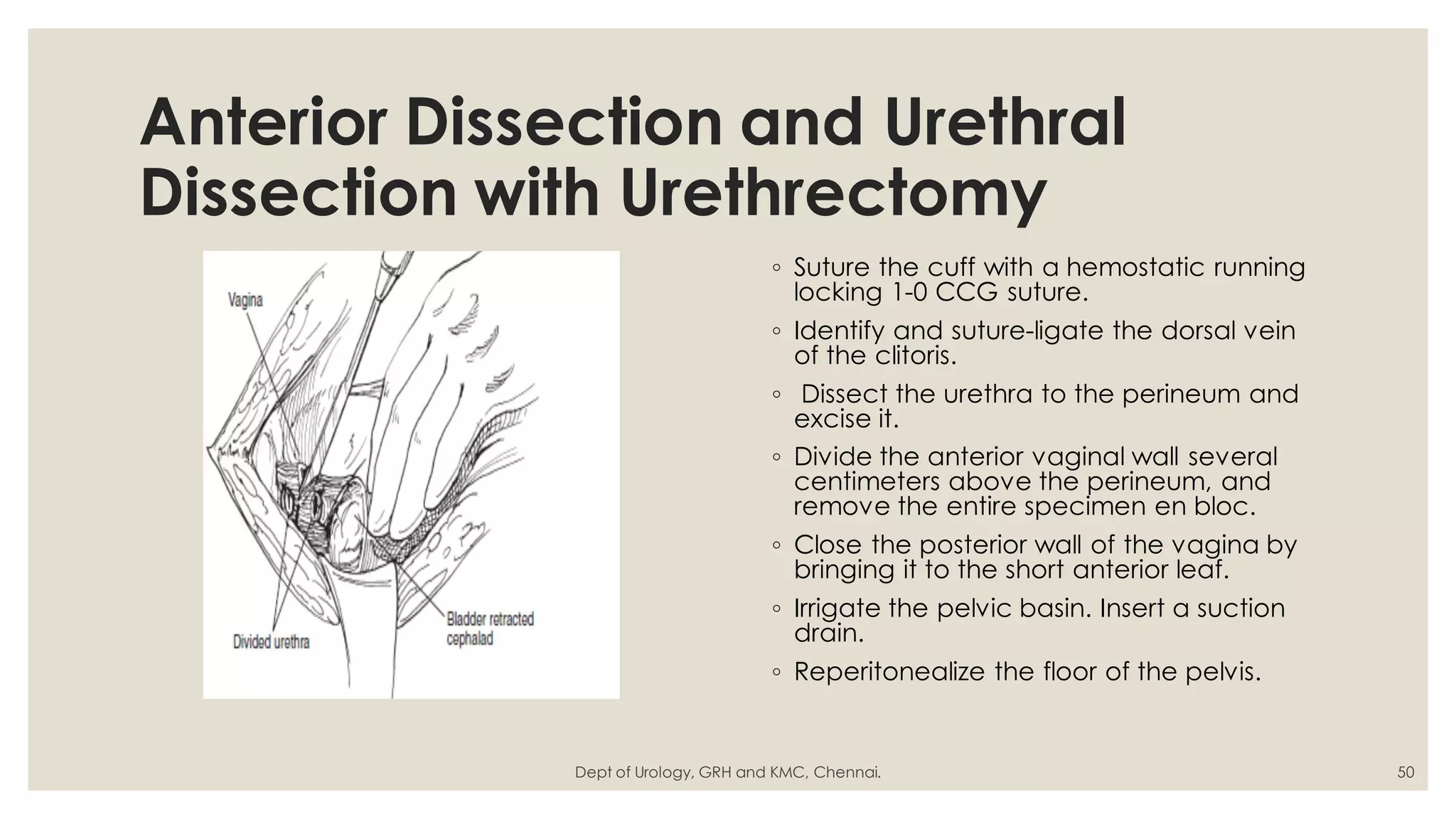
◦ Suture the cuff with a hemostatic running
locking 1-0 CCG suture.
◦ Identify and suture-ligate the dorsal vein
of the clitoris.
◦ Dissect the urethra to the perineum and
excise it.
◦ Divide the anterior vaginal wall several
centimeters above the perineum, and
remove the entire specimen en bloc.
◦ Close the posterior wall of the vagina by
bringing it to the short anterior leaf.
◦ Irrigate the pelvic basin. Insert a suction
drain.
◦ Reperitonealize the floor of the pelvis.
50
Dept of Urology, GRH and KMC, Chennai.
51
Dept of Urology, GRH and KMC, Chennai.
52
Dept of Urology, GRH and KMC, Chennai.
ILEAL CONDUIT
53
Dept of Urology, GRH and KMC, Chennai.
Ureter mobilization
54
Dept of Urology, GRH and KMC, Chennai.
55
Dept of Urology, GRH and KMC, Chennai.
◦ select a suitable segment of ileum near the ileocecal
junction by visualizing the mesenteric vessels.
◦ Place a temporary stay suture of 4-0 silk on a detachable
needle in the bowel 10 to 15 cm from the ileocecal valve
and beyond the ileocecal arcade
◦ Select a loop of ileum that contains one or two distinct
vascular arcades
◦ the segment should be long enough to reach the skin
level plus another 2 cm
◦ place Kocher clamps at45-degree angles on the ends of
the bowel
◦ Divide the bowel with the cutting current
◦ the ileal contents are essentially sterile.
PREPARING THE LOOP
56
Dept of Urology, GRH and KMC, Chennai.
Divide the mesentry
57
Dept of Urology, GRH and KMC, Chennai.
Harvest the bowel
58
Dept of Urology, GRH and KMC, Chennai.
ILEOILEAL ANASTAMOSIS
Stapled technique-side to side Sutured technique-end to end
59
Dept of Urology, GRH and KMC, Chennai.
Close the Mesenteric Trap
60
Dept of Urology, GRH and KMC, Chennai.
URETERAL ANASTOMOSIS
Direct Anastomosis, Right
(Cordonnier)
◦ Cut the right ureter obliquely to freshen
the end and spatulate
◦ The site of implantation of the ureter will
be more distal on the conduit than the
left and will also be on the lateral
aspect.
Implant the left ureter first
61
Dept of Urology, GRH and KMC, Chennai.
62
Dept of Urology, GRH and KMC, Chennai.
63
Dept of Urology, GRH and KMC, Chennai.
◦ Place a 4-0 SAS through the adventitia
and muscularis of the ureter 2 cm from
the end, and stitch it on the
antimesenteric border of the ileum
64
Dept of Urology, GRH and KMC, Chennai.
Open Bowel Mucosa
◦ Pinch the bowel between the thumb
and forefinger of the left hand, and
incise through the muscularis with a
#15 blade, exposing the submucosa
65
Dept of Urology, GRH and KMC, Chennai.
◦ About 10 to 12 interrupted 4-0 braided synthetic
absorbable stitches
used.
◦ interrupted sutures
◦
66
Dept of Urology, GRH and KMC, Chennai.
◦ When the anastomosis is more than
half complete, a 7-French single-J stent
is placed up the ureter (blue on the
left,red on the right
◦ The distal aspect of the stent can be
drawn through the window and out
through the distal opening in the
conduit
67
Dept of Urology, GRH and KMC, Chennai.
CREATION OF THE STOMA
Excise the Skin and Subcutaneous
Tissue Cruciate Incision in the Fascia
68
Dept of Urology, GRH and KMC, Chennai.
Tack and Mature the Stoma Completed Conduit
69
Dept of Urology, GRH and KMC, Chennai.
TRIMMING AND CLOSURE OF THE
PROXIMAL END OF THE LOOP
70
Dept of Urology, GRH and KMC, Chennai.
Conjoined (End-to-End)
71
Dept of Urology, GRH and KMC, Chennai.
STOMA ALTERNATIVES
Z-Incision Stoma Loop Stoma
72
Dept of Urology, GRH and KMC, Chennai.
COMPLICATIONS
73
Dept of Urology, GRH and KMC, Chennai.
RC
◦ Mortality
◦ Hemorrhage
◦ Rectal injury
◦ Venous
thromboembolism
◦ Postoperative ileus
◦ Bowel leak &
enterocutaneous fistula
◦ Lymphocoele
◦ Wound dehiscence(3-
6)%
CONDUIT
◦ Acute necrosis
◦ Calculi
◦ Malignancy
◦ Parastomal hernias/prolapse
◦ Stomal stenosis
◦ Ureteroileal anastomotic leak
◦ Anastomotic strictures
◦ Pyelonephritis & renal
damage
PLND
• Nerve injury-obturator,femoral
,genitofemoral nerve injury
• Lymphocoele:!-4%
74
Dept of Urology, GRH and KMC, Chennai.
◦ Mortality-
◦ 1-5%
◦ Hemorrhage:
◦ Lateral pedicle,posterior pedicle and
dorsal venous complex
◦ Rectal injury:
◦ 0.3-9.2%
◦ Prior surgery,IBD,radiation
◦ Two layered closure
◦ Loop simoidostomy
◦ DVT:1-4%
◦ Obesity,smoking,age,immobility
◦ Compression stockings/pneumatic
compression devices
◦ Warfarin/enoxaparin prophylaxis
◦ Ileus:7-23%
◦ Bowel leak /fistula:
◦ Laparotomy/conservative
management
75
Dept of Urology, GRH and KMC, Chennai.
◦ NECROSIS :
◦ Dusky ,oozing stoma
◦ Metabolic acidosis,hperphosphatemia,shock
◦ Early exploration ,resection and replacement of diseased segment
◦ CALCULI:
◦ 5-20%
◦ Stasis, contact with bowel and infection
◦ Prevention with urinary alkanization and catherization
◦ Upper tract calculi- eswl/pcnl
◦ Conduit-laser lithotripsy
◦ MALIGNANCY:
◦ rare
◦ Adenocarcinoma,carcinoids,TCC
76
Dept of Urology, GRH and KMC, Chennai.
◦ BOWEL RELATED:
◦ Malabsorption syndromes
◦ Vitamin B12 deficiency
◦ PARASTOMAL HERNIA/PROLAPSE:
◦ 4-6.5%
◦ Incorrect placement of stomal opening lateral to rectus fascia
◦ STOMAL STENOSIS:
◦ 2.8-19%
◦ Poorly fitting appliances
◦ Uretero-ileal leak:
◦ 1.9-5.5%
◦ Poor surgical technique,prior radiation,recurrence,stomal edema,extraluminal
hematoma/seroma/pelvic abscess.
◦ Upto 10 days- conservative approach
◦ >14 days-complete resection of devitalized ureter and ileal transposition or
transureteroureterostomy
77
Dept of Urology, GRH and KMC, Chennai.
◦ Anastomotic stricture:
◦ 1.5-8.4%
◦ Tension anastomosis,ischemia,prior radiation,leak
◦ <1 c mstricture- endoscopic stricture incision
◦ >1 cm –open reimplantation
78
Dept of Urology, GRH and KMC, Chennai.
THANK YOU
79
Dept of Urology, GRH and KMC, Chennai.

Radical cystectomy

  • 1.
    RADICAL CYSTECTOMY Dept of Urology GovtRoyapettah Hospital and Kilpauk Medical College Chennai 1
  • 2.
    Moderators: Professors: ◦ Prof. Dr.G. Sivasankar, M.S., M.Ch., ◦ Prof. Dr. A. Senthilvel, M.S., M.Ch., Asst Professors: ◦ Dr. J. Sivabalan, M.S., M.Ch., ◦ Dr. R. Bhargavi, M.S., M.Ch., ◦ Dr. S. Raju, M.S., M.Ch., ◦ Dr. K. Muthurathinam, M.S., M.Ch., ◦ Dr. D. Tamilselvan, M.S., M.Ch., ◦ Dr. K. Senthilkumar, M.S., M.Ch. Dept of Urology, GRH and KMC, Chennai. 2
  • 3.
    Definition: ◦ Men: ◦ Enbloc removal of bladder ◦ Urachus ◦ Prostate,seminal vesicles ◦ Perivesical fat ◦ Women: anterior pelvic exentration ◦ Ovaries ◦ Fallopian tubes ◦ Uterus,cervix,portion of vaginal wall 3 Dept of Urology, GRH and KMC, Chennai.
  • 4.
    Indications for radicalcystectomy ◦ Infiltrating muscle-invasive bladder cancer - without evidence of metastasis - low-volume, resectable locoregional metastases (stage T2-T3b) ◦ Superficial bladder tumors characterized by any of the following: ◦ Refractory to cystoscopic resection and intravesical chemotherapy or immunotherapy ◦ Extensive disease not amenable to cystoscopic resection ◦ Invasive prostatic urethral involvement ◦ Stage-pT1, grade-3 tumors unresponsive to intravesical BCG therapy ◦ CIS refractory to intravesical immunotherapy or chemotherapy ◦ Palliation for pain, bleeding, or urinary frequency ◦ Primary adenocarcinoma, SCC, or sarcoma 4 Dept of Urology, GRH and KMC, Chennai.
  • 5.
    Pre-op preparation ◦ Pre-opevaluation & counselling by enterostomal nurse: ◦ Site marked for a cutaneous stoma – supine, sitting and standing ◦ Antibiotic bowel preparation challenged ◦ Clear liquid diet 1-2 days prior to surgery ◦ Simple mechanical bowel preparation with peglec ◦ Pre op fluid management ◦ Iv broad spectrum antibiotics ◦ Lower extremity intermittent compression devices 5 Dept of Urology, GRH and KMC, Chennai.
  • 6.
    6 Dept of Urology,GRH and KMC, Chennai.
  • 7.
    7 Dept of Urology,GRH and KMC, Chennai.
  • 8.
    8 Dept of Urology,GRH and KMC, Chennai.
  • 9.
    CYSTECTOMY IN THE MALE 9 Deptof Urology, GRH and KMC, Chennai.
  • 10.
    Patient positioning ◦ Hyperextended supine position ◦ Superior iliac crest at fulcrum ◦ Legs are slightly abducted ◦ Apply a 20-degree Trendelenburg tilt until the legs are parallel to the floor. ◦ For urethrectomy, subsequently elevate the legs and braces together. 10 Dept of Urology, GRH and KMC, Chennai.
  • 11.
    ◦ lower midlineabdominal incision from the symphysis pubis to the periumbilical area. 11 Dept of Urology, GRH and KMC, Chennai.
  • 12.
    ◦ Incise theanterior rectus fascia and the transversalis fascia. ◦ open the space of Retzius by blunt dissection ◦ the potential space between the bladder/prostate and the pelvic sidewall and the external iliac vessels created. 12 Dept of Urology, GRH and KMC, Chennai.
  • 13.
    ◦ Incise theperitoneum in the line of the abdominal incision. ◦ Urachus ligated and divided ◦ the peritoneum incised in a V shape dissecting the “wings” of the bladder peritoneal attachment. ◦ Check the mobility of the tumor and bladder . ◦ Explore the abdomen. ◦ Examine the lymph nodes. 13 Dept of Urology, GRH and KMC, Chennai.
  • 14.
    14 Dept of Urology,GRH and KMC, Chennai.
  • 15.
    Bowel mobilization ◦ Caecumand ascending colon mobilized medially by incising white line of toldt upto the root of mesentry ◦ Small bowel mobilized and retroperitoneal duodenum exposed-lymph node dissection ◦ Inverted triangle- base-3 rd and 4 th part of duodenum right edge by ascending colon left edge by sigmoid and descending colon ◦ Descending colon and sigmoid mesentry elevated of sacral promontry ◦ Window created in sigmoid mesentry below inf.mesenteric vessels for left ureter to pass to right side of abdomen ◦ All bowel except descending colon and sigmoid packed into epigastrium ◦ 15 Dept of Urology, GRH and KMC, Chennai.
  • 16.
    16 Dept of Urology,GRH and KMC, Chennai.
  • 17.
    17 Dept of Urology,GRH and KMC, Chennai.
  • 18.
    Identification of ureters ◦the ureter can be easily identified as it crosses the iliac vessels. ◦ The ureter isolated with vessiLoop ◦ dissected with preservation of as much periureteral tissue as possible to avoid devascularization. ◦ dissected to the level of entry into the bladder. ◦ The obliterated umbilical artery/superior vesical artery is encountered & ligated to help provide adequate ureteral length ◦ The ureter is then ligated and divided with avoidance of any spillage from the bladder side. ◦ A tacking suture should be placed to help with manipulation and to avoid ureteral trauma 18 Dept of Urology, GRH and KMC, Chennai.
  • 19.
    19 Dept of Urology,GRH and KMC, Chennai.
  • 20.
    Pelvic Lymphadenectomy ◦ Thelimits for node dissection are: ◦ Laterally-genitofemoral nerve ◦ medially- the bladder ◦ cephalad- the bifurcation of the common iliac artery ◦ caudad-cooper ligament 20 Dept of Urology, GRH and KMC, Chennai.
  • 21.
    Extended lymphadenectomy ◦ proximalcommon iliac artery cranially, ◦ the genitofemoral nerves laterally, ◦ Cooper ligament inferiorly ◦ Obturator canal and hypogastric vessels, laterally and medially, caudally 21 Dept of Urology, GRH and KMC, Chennai.
  • 22.
    22 Dept of Urology,GRH and KMC, Chennai.
  • 23.
    23 Dept of Urology,GRH and KMC, Chennai.
  • 24.
    ◦ Sharp dissectionanterior to the external iliac vessels, extending from above the bifurcation of the common iliac artery to the level of inguinal ligament ◦ psoas and iliopsoas muscles ◦ posterolateral aspect of the common and external iliac veins. ◦ planes around the iliac artery and vein -strip the perivascular tissues cleanly from the vessels. ◦ preserve - circumflex iliac,inferior epigastric vessels, genitofemoral nerve. ◦ Dissect the contents of the femoral canal immediately medial to the external iliac vein 24 Dept of Urology, GRH and KMC, Chennai.
  • 25.
    ◦ Blunt dissectionaround the obturator foramen to define the obturator nerve and vascular bundle. ◦ Obturator vessels divided and obturator nerve preserved ◦ posterior pelvic wall is cleared of nodal tissue and fat and exposes the internal iliac artery ◦ fat pad lateral to rectum bluntly dissected 25 Dept of Urology, GRH and KMC, Chennai.
  • 26.
    DIVISION OF LATERALPEDICLE ◦ Clear the internal iliac artery and identify its first branch, the superior gluteal. ◦ Dissect distal to the gluteal branch. ◦ Vesical pedicle dissected and ligated ◦ the index finger used to develop the plane and protect the rectum. ◦ Do not ligate the internal iliac artery ◦ Avoid the autonomic nerves from the superior internal iliac, pelvic, and vesical plexuses when dividing the superior and inferior vesical pedicles. 26 Dept of Urology, GRH and KMC, Chennai.
  • 27.
    DIVISION OF LATERALPEDICLE 27 Dept of Urology, GRH and KMC, Chennai.
  • 28.
    28 Dept of Urology,GRH and KMC, Chennai.
  • 29.
    DIVISION OF POSTERIORPEDICLE ◦ Draw the bladder (uterus) up to be able to view the cul-de-sac. ◦ Incise the peritoneum on either side of the rectum, and join the incisions in the cul-de-sac exactly at its junction with the anterior rectal wall. ◦ Develop a plane behind the bladder by sharp dissection, 29 Dept of Urology, GRH and KMC, Chennai.
  • 30.
    ◦ Enter theplane under Denonvilliers' fascia ◦ bluntly sweep the rectum back from the bladder, seminal vesicles, and prostate (or posterior vaginal wall) to develop the posterior pedicles on either side. ◦ Prior radiation-perineal dissection 30 Dept of Urology, GRH and KMC, Chennai.
  • 31.
    31 Dept of Urology,GRH and KMC, Chennai.
  • 32.
    ◦ Dissect thepedicles lateral to the seminal vesicles ◦ neurovascular bundles are seen on the ventrolateral surface of the rectum. ◦ Clip and divide the pedicles along the anterolateral border of the seminal vesicle until the endopelvic fascia is reached. ◦ extravesical extension - widely excise the neurovascular bundle on that side, including the pelvic plexus, and divide the pedicle close to the pelvic wall 32 Dept of Urology, GRH and KMC, Chennai.
  • 33.
    DISTAL /ANTERIOR DISSECTION ◦The surgeon opens the endopelvic fascia bilaterally ◦ divides the puboprostatic ligaments if wide, ◦ Ligates and divides the dorsal venous complex. 33 Dept of Urology, GRH and KMC, Chennai.
  • 34.
    34 Dept of Urology,GRH and KMC, Chennai.
  • 35.
    35 Dept of Urology,GRH and KMC, Chennai.
  • 36.
    Nerve-sparing technique ◦ neurovascularbundle of the prostate released sharply on both sides of the prostate with incision of its thin fascia while remaining outside the capsule of theprostate ◦ from the apex of the prostate to the tip of the seminal vesicles ◦ limited traction and cautery ◦ neurovascular bundles laterally and the striated sphincter at the apex. 36 Dept of Urology, GRH and KMC, Chennai.
  • 37.
    ◦ Urethra dissectedand stretched with umblical tape ◦ avoid the neurovascular bundles that lie posterolaterally ◦ Place a silk ligature around the urethra to prevent contamination at the time of division. ◦ the urethra can be mobilized from the urogenital diaphragm preparatory to perineal urethrectomy ‘ ◦ Clamp the urethra near the prostate ◦ Pass the left index finger behind the urethra, and divide the space along the indwelling catheter. ◦ Elevate the rectourethralis muscle with a clamp, and sharply divide it under vision, again avoiding the neurovascular bundles that lie immediately adjacent in the posterolateral quadrants 37 Dept of Urology, GRH and KMC, Chennai.
  • 38.
    ◦ The freeend of the cut Foley catheter is retracted up ◦ Using both hands, the surgeon can now feel a thin web of tissues separating the proximal and distal dissections ◦ This thin web is punctured with the surgeon’s fingers. ◦ Remove the specimen 38 Dept of Urology, GRH and KMC, Chennai.
  • 39.
    ◦ place afigure-eight 1-0 synthetic absorbable suture through both levators anteriorly just behind the pubis. ◦ Check for bleeding elsewhere ◦ Replace the bowel carefully, and pull the omentum down to cover the anastomoses. ◦ Suction drainage is usually needed for protection of the diversion. ◦ If a bladder substitute is not constructed, a balloon catheter placed through the urethra helps drain the pelvic cavity for the first few days postoperatively. ◦ Close the wound appropriately. 39 Dept of Urology, GRH and KMC, Chennai.
  • 40.
    CYSTECTOMY IN THE FEMALE 40 Deptof Urology, GRH and KMC, Chennai.
  • 41.
    Urethra involved-St. Mark's position, anot-quite-full lithotomy position Place the thighs abducted at 45 degrees to the body with the legs parallel to the floor, supported in cradles. ◦ Urethra not invovlved-Frog legged position ◦ Lithotomy position ◦ All pressure points to be well padded 41 Dept of Urology, GRH and KMC, Chennai.
  • 42.
    Intraabdominal Exposure 42 Dept ofUrology, GRH and KMC, Chennai.
  • 43.
    ◦ The peritoneumlateral to the bladder is incised ◦ round ligament is ligated and divided. ◦ The ovarian vesselsin the infundibulopelvic ligament are identified, ligated,and divided ◦ These maneuvers allow the peritoneal contents to be packed away from the pelvis 43 Dept of Urology, GRH and KMC, Chennai.
  • 44.
    ◦ Divide theureters at their exit from the paracervical tunnel. ◦ Prior pelvic radiation- transect the ureters above the pelvic brim ◦ Ligate the distal ureteral stumps. ◦ Open the space of Retzius by incising the peritoneal reflection over the bladder. 44 Dept of Urology, GRH and KMC, Chennai.
  • 45.
    ANTERIOR DISSECTION ◦ Dissectionof the anterior bladder wall to the level of endopelvic fascia bilaterally ◦ incised on each side to allow for better exposure of the urethra all the way to the perineum. 45 Dept of Urology, GRH and KMC, Chennai.
  • 46.
    LATERAL DISSECTION ◦ Theround ligaments on each side are cut at the pelvic wall, and the posterior and anterior leaves of the broad ligament are completely opened. 46 Dept of Urology, GRH and KMC, Chennai.
  • 47.
    PARARECTAL DISSECTION ◦ Doublyclamp the right cardinal ligament and ligate it. ◦ Keep well anterior to avoid the pelvic plexus. Do the same for the left cardinal ligament. 47 Dept of Urology, GRH and KMC, Chennai.
  • 48.
    Posterior dissection ◦ Incisethe peritoneum in the cul-de-sac, and dissect the rectum from the posterior wall of the vagina ◦ Clamp, divide, and suture-ligate the uterosacral ligament on both sides. 48 Dept of Urology, GRH and KMC, Chennai.
  • 49.
    ◦ ligate thelateral vesical pedicles at the level of endopelvic fascia with 2-0 nonabsorbable suture ◦ Place a stick sponge in the posterior fornix of the vagina, open the vagina over it with the cutting current, and incise the lateral wall for a short distance. 49 Dept of Urology, GRH and KMC, Chennai.
  • 50.
    Anterior Dissection andUrethral Dissection with Urethrectomy ◦ Suture the cuff with a hemostatic running locking 1-0 CCG suture. ◦ Identify and suture-ligate the dorsal vein of the clitoris. ◦ Dissect the urethra to the perineum and excise it. ◦ Divide the anterior vaginal wall several centimeters above the perineum, and remove the entire specimen en bloc. ◦ Close the posterior wall of the vagina by bringing it to the short anterior leaf. ◦ Irrigate the pelvic basin. Insert a suction drain. ◦ Reperitonealize the floor of the pelvis. 50 Dept of Urology, GRH and KMC, Chennai.
  • 51.
    51 Dept of Urology,GRH and KMC, Chennai.
  • 52.
    52 Dept of Urology,GRH and KMC, Chennai.
  • 53.
    ILEAL CONDUIT 53 Dept ofUrology, GRH and KMC, Chennai.
  • 54.
    Ureter mobilization 54 Dept ofUrology, GRH and KMC, Chennai.
  • 55.
    55 Dept of Urology,GRH and KMC, Chennai.
  • 56.
    ◦ select asuitable segment of ileum near the ileocecal junction by visualizing the mesenteric vessels. ◦ Place a temporary stay suture of 4-0 silk on a detachable needle in the bowel 10 to 15 cm from the ileocecal valve and beyond the ileocecal arcade ◦ Select a loop of ileum that contains one or two distinct vascular arcades ◦ the segment should be long enough to reach the skin level plus another 2 cm ◦ place Kocher clamps at45-degree angles on the ends of the bowel ◦ Divide the bowel with the cutting current ◦ the ileal contents are essentially sterile. PREPARING THE LOOP 56 Dept of Urology, GRH and KMC, Chennai.
  • 57.
    Divide the mesentry 57 Deptof Urology, GRH and KMC, Chennai.
  • 58.
    Harvest the bowel 58 Deptof Urology, GRH and KMC, Chennai.
  • 59.
    ILEOILEAL ANASTAMOSIS Stapled technique-sideto side Sutured technique-end to end 59 Dept of Urology, GRH and KMC, Chennai.
  • 60.
    Close the MesentericTrap 60 Dept of Urology, GRH and KMC, Chennai.
  • 61.
    URETERAL ANASTOMOSIS Direct Anastomosis,Right (Cordonnier) ◦ Cut the right ureter obliquely to freshen the end and spatulate ◦ The site of implantation of the ureter will be more distal on the conduit than the left and will also be on the lateral aspect. Implant the left ureter first 61 Dept of Urology, GRH and KMC, Chennai.
  • 62.
    62 Dept of Urology,GRH and KMC, Chennai.
  • 63.
    63 Dept of Urology,GRH and KMC, Chennai.
  • 64.
    ◦ Place a4-0 SAS through the adventitia and muscularis of the ureter 2 cm from the end, and stitch it on the antimesenteric border of the ileum 64 Dept of Urology, GRH and KMC, Chennai.
  • 65.
    Open Bowel Mucosa ◦Pinch the bowel between the thumb and forefinger of the left hand, and incise through the muscularis with a #15 blade, exposing the submucosa 65 Dept of Urology, GRH and KMC, Chennai.
  • 66.
    ◦ About 10to 12 interrupted 4-0 braided synthetic absorbable stitches used. ◦ interrupted sutures ◦ 66 Dept of Urology, GRH and KMC, Chennai.
  • 67.
    ◦ When theanastomosis is more than half complete, a 7-French single-J stent is placed up the ureter (blue on the left,red on the right ◦ The distal aspect of the stent can be drawn through the window and out through the distal opening in the conduit 67 Dept of Urology, GRH and KMC, Chennai.
  • 68.
    CREATION OF THESTOMA Excise the Skin and Subcutaneous Tissue Cruciate Incision in the Fascia 68 Dept of Urology, GRH and KMC, Chennai.
  • 69.
    Tack and Maturethe Stoma Completed Conduit 69 Dept of Urology, GRH and KMC, Chennai.
  • 70.
    TRIMMING AND CLOSUREOF THE PROXIMAL END OF THE LOOP 70 Dept of Urology, GRH and KMC, Chennai.
  • 71.
    Conjoined (End-to-End) 71 Dept ofUrology, GRH and KMC, Chennai.
  • 72.
    STOMA ALTERNATIVES Z-Incision StomaLoop Stoma 72 Dept of Urology, GRH and KMC, Chennai.
  • 73.
    COMPLICATIONS 73 Dept of Urology,GRH and KMC, Chennai.
  • 74.
    RC ◦ Mortality ◦ Hemorrhage ◦Rectal injury ◦ Venous thromboembolism ◦ Postoperative ileus ◦ Bowel leak & enterocutaneous fistula ◦ Lymphocoele ◦ Wound dehiscence(3- 6)% CONDUIT ◦ Acute necrosis ◦ Calculi ◦ Malignancy ◦ Parastomal hernias/prolapse ◦ Stomal stenosis ◦ Ureteroileal anastomotic leak ◦ Anastomotic strictures ◦ Pyelonephritis & renal damage PLND • Nerve injury-obturator,femoral ,genitofemoral nerve injury • Lymphocoele:!-4% 74 Dept of Urology, GRH and KMC, Chennai.
  • 75.
    ◦ Mortality- ◦ 1-5% ◦Hemorrhage: ◦ Lateral pedicle,posterior pedicle and dorsal venous complex ◦ Rectal injury: ◦ 0.3-9.2% ◦ Prior surgery,IBD,radiation ◦ Two layered closure ◦ Loop simoidostomy ◦ DVT:1-4% ◦ Obesity,smoking,age,immobility ◦ Compression stockings/pneumatic compression devices ◦ Warfarin/enoxaparin prophylaxis ◦ Ileus:7-23% ◦ Bowel leak /fistula: ◦ Laparotomy/conservative management 75 Dept of Urology, GRH and KMC, Chennai.
  • 76.
    ◦ NECROSIS : ◦Dusky ,oozing stoma ◦ Metabolic acidosis,hperphosphatemia,shock ◦ Early exploration ,resection and replacement of diseased segment ◦ CALCULI: ◦ 5-20% ◦ Stasis, contact with bowel and infection ◦ Prevention with urinary alkanization and catherization ◦ Upper tract calculi- eswl/pcnl ◦ Conduit-laser lithotripsy ◦ MALIGNANCY: ◦ rare ◦ Adenocarcinoma,carcinoids,TCC 76 Dept of Urology, GRH and KMC, Chennai.
  • 77.
    ◦ BOWEL RELATED: ◦Malabsorption syndromes ◦ Vitamin B12 deficiency ◦ PARASTOMAL HERNIA/PROLAPSE: ◦ 4-6.5% ◦ Incorrect placement of stomal opening lateral to rectus fascia ◦ STOMAL STENOSIS: ◦ 2.8-19% ◦ Poorly fitting appliances ◦ Uretero-ileal leak: ◦ 1.9-5.5% ◦ Poor surgical technique,prior radiation,recurrence,stomal edema,extraluminal hematoma/seroma/pelvic abscess. ◦ Upto 10 days- conservative approach ◦ >14 days-complete resection of devitalized ureter and ileal transposition or transureteroureterostomy 77 Dept of Urology, GRH and KMC, Chennai.
  • 78.
    ◦ Anastomotic stricture: ◦1.5-8.4% ◦ Tension anastomosis,ischemia,prior radiation,leak ◦ <1 c mstricture- endoscopic stricture incision ◦ >1 cm –open reimplantation 78 Dept of Urology, GRH and KMC, Chennai.
  • 79.
    THANK YOU 79 Dept ofUrology, GRH and KMC, Chennai.