INTRAVENOUS UROGRAPHY
Dept of Urology
Govt Royapettah Hospital and Kilpauk Medical College
Chennai
Moderators:
Professors:
▪ Prof. Dr. G. Sivasankar, M.S., M.Ch.,
▪ Prof. Dr. A. Senthilvel, M.S., M.Ch.,
Asst Professors:
▪ Dr. J. Sivabalan, M.S., M.Ch.,
▪ Dr. R. Bhargavi, M.S., M.Ch.,
▪ Dr. S. Raju, M.S., M.Ch.,
▪ Dr. K. Muthurathinam, M.S., M.Ch.,
▪ Dr. D.Tamilselvan, M.S., M.Ch.,
▪ Dr. K. Senthilkumar, M.S., M.Ch.
Dept of Urology, GRH and KMC, Chennai. 2
DEFINITION
RADIOGRAPHIC STUDY OFTHE RENAL
PARENCHYMA,PELVIS,URETERSAND
URINARY BLADDERAFTER INTRAVENOUS
INJECTION OF CONTRAST MEDIA
3
Dept of Urology, GRH and KMC, Chennai.
TERMINOLOGY
▪ Urogram
Visualization of kidney parenchyma,
calyces and pelvis resulting from IV
injection of contrast.
▪ Pyelogram
Describes retrograde studies visualizing
only the collecting system.
▪ IVP is misnomer
4
Dept of Urology, GRH and KMC, Chennai.
Moses Swick
HISTORY
▪ Introduction of excretory
urograpy was done in
1929, by American
urologist Moses Swick.
▪ He injected an
organically-bound iodide
compound—later named
Uroselectan—into a vein,
taking X-rays as the
material cleared the body
through the urinary tract.
5
Dept of Urology, GRH and KMC, Chennai.
INDICATIONS
American College of Radiology (ACR) guidelines
▪ To evaluate the presence or continuing presence of
suspected or known ureteral obstruction.
▪ To assess the integrity of the urinary tract status
post trauma.
▪ To assess the urinary tract for suspected congenital
anomalies.
▪ To assess the urinary tract for lesions that may
explain hematuria or infection
▪ Investigation of HTN in young adults not controlled
6
Dept of Urology, GRH and KMC, Chennai.
Contraindications
Absolute contraindication – Contrast Allergy
Relative contraindications
▪ Renal failure (raised serum creatinine level >1.5
mg/dL)
▪ Hepatorenal syndrome
▪ Generalized allergic conditions
▪ Multiple myeloma
▪ Pregnancy
▪ Infancy
▪ Thyrotoxicosis
▪ Diabetes
7
Dept of Urology, GRH and KMC, Chennai.
Advantages
▪ Clearly outlines of the entire urinary system
so can see even mild hydronephrosis.
▪ Easier to pick out obstructing stone when
there are multiple pelvic calcifications.
▪ Can show non-opaque stones as filling
defects.
▪ Demonstrate renal function and allow for
verification that the opposite kidney is
functioning normally.
8
Dept of Urology, GRH and KMC, Chennai.
Disadvantages
▪ Need for IV contrast material
▪ Contrast agent may provoke anaphylactoid reactions,
nephropathy.
▪ Multiple delayed films (Can take hours as contrast
passes quite slowly into the blocked renal unit and
ureter.)
▪ May not have sufficient opacification to define the
anatomy and point of obstruction.
▪ Requires a significant amount of radiation exposure
and may not be ideal for young children or pregnant
women
9
Dept of Urology, GRH and KMC, Chennai.
Anatomy
▪ The parenchyma of the
kidney is divided into two
major structures: superficial is
the renal cortex and deep is
the renal medulla.
▪ Grossly, these structures take
the shape of 8 to 18 cone-
shaped renal lobes, each
containing renal cortex
surrounding a portion of
medulla called a renal
pyramid (of Malpighi).
▪ Between the renal pyramids
are projections of cortex
called renal columns (of
Bertin).
10
Dept of Urology, GRH and KMC, Chennai.
▪ Nephrons, the urine-
producing functional
structures of the kidney, span
the cortex and medulla.
▪ The tip, or papilla, of each
pyramid empties urine into a
minor calyx(8-12)
▪ Minor calyces empty into
major calyces (2-4), and
major calyces empty into the
renal pelvis, which becomes
the ureter.
11
Dept of Urology, GRH and KMC, Chennai.
Shape & Size
▪ Shape
 Bean shaped
 Convex laterally & linear
medially
 Contour – smooth &
regular
▪ Size
 12-15cm in length
 Right kidney appears
smalller than left
 Length – 31/2 verterbral
bodies
 Children – 4 vertebral
bodies
12
Dept of Urology, GRH and KMC, Chennai.
Position
▪ Lumbar fossa
▪ Left kidney slightly
higher than right
▪ Upper pole of left kidney
–T11-12
▪ Upper pole of Right
kidney –T12-L1
▪ Lower limit – well above
iliac crest at the level of
L3 or L3-4 IV disc
▪ Medial border – parallel
to psoas margin
13
Dept of Urology, GRH and KMC, Chennai.
Renal Axes
▪ Long axis of the kidney is
parallel to the lateral border
of the psoas muscle and lies
on the quadratus lumborum
muscle.
▪ In addition, the kidneys lie at
an oblique angle, that is the
superior renal pole is more
medial and anterior than the
inferior pole.
▪ Their transverse axes form an
approximately 45° angle with
the sagittal plane
14
Dept of Urology, GRH and KMC, Chennai.
Intravascular Radiological
Contrast Media (IRCM)
▪ Iodine is the main element which imparts Radio opacity
▪ All currently used IRCM are chemical modifications of
a 2,4,6-tri-iodinated benzene ring.
▪ They are classified on the basis of their physical and
chemical characteristics, including their chemical
structure, osmolality, iodine content, and ionization in
solution.
▪ In clinical practice, categorization based on osmolality
is widely used.
15
Dept of Urology, GRH and KMC, Chennai.
HIGH
• IONIC
MONOMERS
• Contain sodium
or meglumine
salts
• 2 ORGANIC
SIDECHAINS &
CARBOXYL
GROUP
• 1500-1900
MOSM/KG H2O
• EG:
DIATRIAZOATE –
Urograffin ,
angiograffin, &
Urovision.
• IOTHALAMATE
ISO
OSMOLAR
• NON IONIC
DIMERS
• EG: IOTROL
• IODIXANOL
LOW
• NON IONIC
MONOMERS:
• ORGANIC SIDE
CHAIN+HYDROXYL
GROUP
• EG:IOHEXOL
IOPAMIDOL IOVERSOL
IOPROMIDE
• AGENTSOF CHOICE
• LOWTOXICITY since do
not dissociate in the
body
• IONIC DIMERS:
• 2 IONIC MONOMERS-
CARBOXYL GROUP
• EG: IOXAGLATE
• ADR:3%
• Expensive than HOCM
16
Dept of Urology, GRH and KMC, Chennai.
17
Dept of Urology, GRH and KMC, Chennai.
18
Dept of Urology, GRH and KMC, Chennai.
Patient Preparation
▪ Complete urine and blood examination to assess the renal function.
▪ The patient is given mild laxatives about twelve to twenty four hours
prior. The patient is kept nil by mouth over night
▪ In active healthy patients, food or liquid restriction or administration of
laxative has little value.
▪ With modern contrast media overhydration should be avoided but
dehydration is unnecessary.
▪ Pretesting does not provide reliable information regarding sensitivity to
contrast media and is therefore not performed before the injection
▪ Take informed consent
19
Dept of Urology, GRH and KMC, Chennai.
▪ Dose of contrast :patient size ,radiologist preference
▪ 200mg of I per pound body weight: 20-30 g ,50-100ml
▪ Pediatric – 1ml/kg
▪ Bolus injection given through IV access
▪ Rapid : < 60 sec-better nephrogram
▪ Slow: 2-3 min ,less side effects
▪ Density of nephrogram = plasma level of contrast
▪ Drip infusion: 40-45g of I in 250-400 ml of fluid; not practised nowadays
20
Dept of Urology, GRH and KMC, Chennai.
▪ Bolus injection gives immediate peak plasma
level followed by rapid decline due to
 Vascular mixing
 Extravascular diffusion
 Renal excretion
▪ Diagnostic quality depends on
 Amount of iodine excreted
 Volume of urine formed to distend PCS
21
Dept of Urology, GRH and KMC, Chennai.
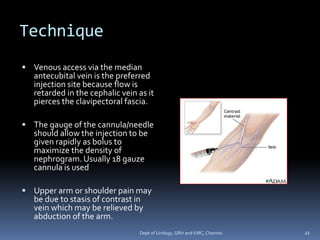
Technique
▪ Venous access via the median
antecubital vein is the preferred
injection site because flow is
retarded in the cephalic vein as it
pierces the clavipectoral fascia.
▪ The gauge of the cannula/needle
should allow the injection to be
given rapidly as bolus to
maximize the density of
nephrogram. Usually 18 gauze
cannula is used
▪ Upper arm or shoulder pain may
be due to stasis of contrast in
vein which may be relieved by
abduction of the arm.
22
Dept of Urology, GRH and KMC, Chennai.
Scout Film ( plain film of
abdomen)
• State of bowel preparation
• Calcified density in the renal tract
• To check exposure factors & positioning
• Skeletal abnomality – spinal deformities in
congenital disorders, skeletal metastases,
metabolic bone changes as in rickets
• Abdominal masses
• Foreign bodies
23
Dept of Urology, GRH and KMC, Chennai.
Preliminary Film
➢ Supine, full length AP of
abdomen in inspiration.
➢ The lower border of cassette
is at the level of symphysis
pubis and the x-ray beam is
centred in the midline at the
level of iliac crests.
➢ To demonstrate bowel
preparation, check exposure
factor, and location of
radiopaque stones or any
radiopaque artifacts.
24
Dept of Urology, GRH and KMC, Chennai.
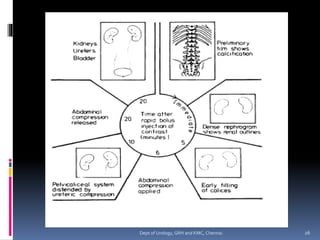
Film Sequence
➢ 1-3 minutes Antero-posterior- film coned to the renal area
➢ 5 minutes Antero-posterior-film coned to the renal area (to see if
excretion is symmetrical; if poor opacification, further injection of
contrast)
➢ Apply ureteral compression
➢ 10 minutes Antero-posterior (5mins after compression; 10mins from
contrast administration – Pyelographic phase
➢ “Flush”, “X” or “Release view”- - full length view at 20 minutes
(ureter & bladder images after release of compression)
➢ Upright post void Antero-posterior
25
Dept of Urology, GRH and KMC, Chennai.
26
Dept of Urology, GRH and KMC, Chennai.
27
Dept of Urology, GRH and KMC, Chennai.
28
Dept of Urology, GRH and KMC, Chennai.
29
Dept of Urology, GRH and KMC, Chennai.
Contraindications to Ureteral
Compression
▪ Evidence of obstruction on the 5-minute
image
▪ Abdominal aortic aneurysm or other
abdominal mass
▪ Severe abdominal pain
▪ Recent abdominal surgery
▪ Suspected urinary tract trauma
▪ Presence of a urinary diversion
▪ Presence of a renal transplant
30
Dept of Urology, GRH and KMC, Chennai.
Additional Views &
Modifications
▪ Plain films – Additional oblique views to assist
the location of potentially intra renal opacities
▪ 5min film – Second injection of contrast to
improve opacification of PCS if inadequate
▪ 15 mins release film
 When the bladder is poorly filled additional delayed
films
 Small suspected calculus in distal ureter confirmed
with oblique films
31
Dept of Urology, GRH and KMC, Chennai.
▪ Delayed films – 3, 6, 12, 24 hrs for delayed
opacification
 Early nephrogram but collecting system not visualised
 Long standing HUN – Rim sign
 In certain congenital lesions such as nonvisualised
upper calyceal system with ectopic or obstructed
ureter
 Unrewarding in total absence of an early nephrogram
▪ Immediate after micturition film –VU reflux
▪ Rapid sequence urography
 Renal artery stenosis
 2, 4, 6 min
 To compare rate of excretion of each kidney
32
Dept of Urology, GRH and KMC, Chennai.
▪ Prone film
 For viewing filling of ureteral areas that are not
seen in supine position
 Useful in renal ptosis, lesions on the anterior
bladder wall, bladder herniation
▪ Erect film
 For demonstrating renal ptosis, bladder hernias,
cystocoeles
 Demonstrates layering of calculi in cysts or
abscesses
33
Dept of Urology, GRH and KMC, Chennai.
▪ Hypertensive urogram
 Discontinued
 Work up for renal hypertension in pts younger than 50
years
 Findings – small kidney (smaller than the opposite
kidney by more than 1.5cm), delayed nephrogram,
hyperconcentration in late film
▪ Hydration urogram / Frusemide IVU
 20 mg of Frusemide IV after 15 min film
 Suspected PUJO not evident of standard IVU
 Provoke HUN & pain
34
Dept of Urology, GRH and KMC, Chennai.
WHAT TO LOOK FOR IN IVU
➢Size, shape, position and axis of kidneys
➢External cortex and inner medulla
➢Calyceal system
➢Renal pelvis and ureteropelvic junction
➢Ureter
➢Uretero-vesical junction
➢Urinary bladder
➢Relation of ureter to spine and psoas muscle
RADIATION DOSE FROM IVU
➢1,465 mR/projection for males
➢1,047 mR for females
35
Dept of Urology, GRH and KMC, Chennai.
Phases of Nephrogram
▪ Spontaneous nephrogram
 Non opacified kidney outlined by retroperitoneal fat visible on plain film
▪ Vascular nephrogram
 Contrast reaches renal artery in 15 secs (arm to kidney time)
 Coexists with diffusion of contrast
 Lasts for few secs to 1 min
▪ Total body opacification phase
 Contrast freely filtered by glomeruli
 Due to opacification of pre & retro renal softtissue
 Lasts for 1 min
▪ Tubular Phase
 Contrast in proximal and distal tubules
 Density fades
▪ Pyelographic phase
 Contrast in the collecting system
36
Dept of Urology, GRH and KMC, Chennai.
Vasular (Angiographic
Nephrogram)
▪ Occurs during passage of contrast material through the cortical
microvasculature.
▪ Short lasting seen within 30 sec of rapid IV bolus
▪ Approx. 80% of renal blood flows to the cortex → renal cortex
looks much more radiodense as compared to medulla (CM
differentiation)
▪ If CM differentiation is not seen, the vascular nephrogram is
inadequate & must be interpreted with great caution
▪ Requires intact vascular system – indicator of disturbance in
blood flow to the kidney
37
Dept of Urology, GRH and KMC, Chennai.
Tubular (Urographic
Nephrogram)
▪ Appear after the contrast medium has been concentrated in PCT
▪ Density is greater approx 1 min of injection of IV bolus at which time
peak plasma level is reached
▪ Radiodensity of medulla equals to that of cortex → homogenous with
no CM differentiation
▪ Permits accurate evaluation of fundamentals of renal radiology – size,
position, axis & contour
▪ Normal tubular nephrogram requires
 Normal blood flow
 Structural & functional integrity of nephrons
 Unobstructed flow of filtrate through the tubules
38
Dept of Urology, GRH and KMC, Chennai.
Failure to Visualise
Nephrogram
▪ Insufficient dose of contrast
▪ Acute or chronic renal failure
▪ End stage renal disease
▪ Absent kidney
▪ Renal artery occlusion / avulsion
39
Dept of Urology, GRH and KMC, Chennai.
Abnormal Density Patterns
▪ Immediate, faint & persistent nephrogram
▪ Increasingly dense nephrogram
▪ Immediate, dense & persistent nephrogram
40
Dept of Urology, GRH and KMC, Chennai.
Immediate, faint, persistent
nephrogram
▪ Peak density is seen on the first film exposed at the completion
of injection of contrast
▪ Density is disproportionate with amount of contrast material
injected.Though faint, persists for several hours
▪ Cause
 Reduction in number of functioning nephrons → immediate faint
nephrogram
 Severely impaired glomerular filtration & low plasm clearance rate of
contrast → persistent nephrogram
▪ Conditions
 Chronic glomerular disease
 Sudden loss of glomerular function – atheroembolic renal disease
41
Dept of Urology, GRH and KMC, Chennai.
Increasingly dense nephrogram
▪ Faint to begin with and
increasingly dense over a
period of hours to days
▪ Seen in
 Acute extrarenal obstruction
 Diminished perfusion
pressure of kidney – SHT,
RAS
 Intratubular obstruction –
calculus, casts, acute
papillary necrosis
 Acute renal vein thrombosis
 Acute glomerular disease
 Acute tubular necrosis
42
Dept of Urology, GRH and KMC, Chennai.
Immediate, dense, persistent
nephrogram
▪ As dense as normally expected to be at 1 min
▪ Level of density persists
▪ Pathogenesis
 Unimpaired glomerular filtration → immediate dense
nephrogram
 Diffusion of filtrate into interstitium due to damaged tubules
return of filtered material to the circulation → persistent
nephrogram
▪ Seen in
 Acute tubular necrosis
 Acute bacterial nephritis
43
Dept of Urology, GRH and KMC, Chennai.
44
Dept of Urology, GRH and KMC, Chennai.
45
Dept of Urology, GRH and KMC, Chennai.
Inhomogenous nephrograms
▪ Striated nephrogram / Sunburst nephrogram
 Fine linear strands of alternating lucency & density uniformly
oriented in direction similar to that of tubules & collecting ducts
 Seen in – Acute extrarenal obstruction, Acute bacterial nephritis,
acute pyelonephritis,AR-Infantile polycystic kidney disease,
Medullary cystic disease, Medullary sponge kidney
▪ Patchy nephrogram
 Patchy densities in nephrogram
 Seen in – Polyartertitis nodosa, scleroderma, Necrotising angitis
▪ Cortical rim nephrogram
 Only thin rim of peripheral cortex is opacified that is perfused by
capsular collateral arteries
 Reliable indicator of underperfusion of kidney
 Seen in – Infarction of kidney, segmental RA occlusion, Renal vein
thrombosis (some cases)
46
Dept of Urology, GRH and KMC, Chennai.
SUNBURST NEPHROGRAM
CORTICAL RIM NEPHROGRAM
PATCHY NEPHROGRAM
47
Dept of Urology, GRH and KMC, Chennai.
▪ The size of the kidneys should be assesed during
neprographic phase
▪ The normal kidney may range from 9 to13 cm in
cephalocaudal length, with the left kidney
inherently larger than the right by 0.5 cm and the
kidneys slightly larger in men than in women
▪ Significant discrepancies (right kidney 1.5 cm
larger than the left kidney,left kidney 2 cm larger
than the right kidney) require explanation.
48
Dept of Urology, GRH and KMC, Chennai.
5 & 10 MINUTE FILM
▪ At this stage the calyces, renal pelvis and part
of the ureters will be visible.
▪ Nephrogram will be reduced but both kidneys
should have the same density
49
Dept of Urology, GRH and KMC, Chennai.
•In normally functioning kidneys, contrast is first seen in the calyces at 2 mins
following bolus injection.
50
Dept of Urology, GRH and KMC, Chennai.
▪ On the 5-minute image, the nephrogram
should be receding as the collecting system
becomes opacified.
▪ On the 10-minute image, the pyelogram is
the dominant urographic element.
▪ Alterations in this temporal sequence require
explanation.
51
Dept of Urology, GRH and KMC, Chennai.
▪ Visualization of the collecting system and
renal pelvis can be augmented with the use of
abdominal compression,Trendelenburg
position, and other gravity maneuvers such
as placing the patient with the side of interest
in the ipsilateral posterior oblique position
▪ The appearance of the calices and renal pelvis
should be examined closely
52
Dept of Urology, GRH and KMC, Chennai.
▪ Early and mild obstruction is indicated by
subtle rounding of the forniceal margins
▪ More severe and prolonged obstruction
evidenced by progressive loss of the papillary
impression and eventual clubbing of calices.
53
Dept of Urology, GRH and KMC, Chennai.
➢Ureters
➢Ureters begin to transport opacified urine about 3 mins post injection
➢Maximum ureteral filling occurs between 5-10 minutes.
54
Dept of Urology, GRH and KMC, Chennai.
▪ At the release of compression, the bolus of contrast material–laden
urine entering the ureters provides optimal visualization throughout
their length
▪ Persistence of a standing column of contrast material on several
images may indicate obstruction or ureteral ileus (nonobstructive
dilatation).
▪ Medial deviation of the ureter should be considered when the ureter
overlies the ipsilateral lumbar pedicle.
▪ Lateral deviation should be considered when the ureter lies more
than 1.5 cm beyond the tip of the transverseprocess, but comparison
with the position of the contralateral ureter should always be made
55
Dept of Urology, GRH and KMC, Chennai.
▪ An absolute ureteral diameter exceeding 8 mm is
considered a criterion for dilatation.
▪ Asymmetry of ureteral caliber is a more significant
finding.
▪ Early in its course, high-grade ureteral obstruction
may be associated with only minimal ureteral
dilatation.
▪ More chronic forms of obstruction and other chronic
ureteral conditions are typically associated with
greater degrees of ureteral dilatation
56
Dept of Urology, GRH and KMC, Chennai.
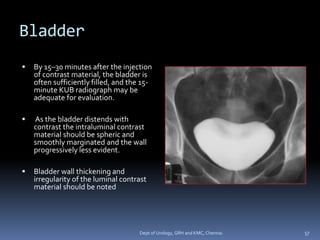
Bladder
▪ By 15–30 minutes after the injection
of contrast material, the bladder is
often sufficiently filled, and the 15-
minute KUB radiograph may be
adequate for evaluation.
▪ As the bladder distends with
contrast the intraluminal contrast
material should be spheric and
smoothly marginated and the wall
progressively less evident.
▪ Bladder wall thickening and
irregularity of the luminal contrast
material should be noted
57
Dept of Urology, GRH and KMC, Chennai.
▪ The postvoid image may also be helpful in
evaluating patients with upper urinary tract
dilatation.
▪ Persistence of the dilatation on the postvoid
image suggests fixed obstruction,
▪ The postvoid image is most helpful in
assessing residual volume.
58
Dept of Urology, GRH and KMC, Chennai.
CONGENITAL ANOMALIES &
VARIATIONS
Unilateral Agenesis
60
Dept of Urology, GRH and KMC, Chennai.
Renal Ectopia
▪ Failure of complete
ascent of the kidney
to its normal position
▪ IVU- abnormally
placed kidneys
61
Dept of Urology, GRH and KMC, Chennai.
Crossed fused Renal ectopia
▪ Two complete
pelvicalyceal systems
on one side usually
one above the other
▪ Ureter from the lower
renal pelvis crosses
the midline and enters
bladder normally
62
Dept of Urology, GRH and KMC, Chennai.
Crossed Fused Ectopic Kidney
63
Dept of Urology, GRH and KMC, Chennai.
Horshoe Kidney
▪ Kidneys placed lower than normal
▪ Malrotation of pelvis
▪ Lower pole calyces of both sides
deviated towards midline
▪ Ureters have characteristic
vaselike curve
▪ Pelvicalyectasis
▪ Renal calculi
▪ Intravenous urogram (IVU) shows an
altered renal axis with medially
directed lower renal poles, which
suggests horseshoe kidney. Also
note the dilated collecting system of
the left kidney, resulting from a
uretero pelvic junction obstruction;
this is a frequently associated
finding
64
Dept of Urology, GRH and KMC, Chennai.
Horshoe Kidney
65
Dept of Urology, GRH and KMC, Chennai.
• Minor form – bifid renal
pelvis
• Ureteral duplication
• Incomplete – ureters fuse in
their course
• Complete – 2 ureters open
seperately in bladder, lower
moiety inserted
orthoptically & upper
moiety ectopically
• “Drooping lily” sign-
obstructed upper moiety
ureter, in a completely
duplicated system, may
produce downward and
lateral displacement of the
functional lower moiety
collecting system,
DUPLEX COLLECTING SYSTEM
66
Dept of Urology, GRH and KMC, Chennai.
DROPPING LILY SIGN
67
Dept of Urology, GRH and KMC, Chennai.
URETEROCOELE
Contrast filled structure with a thin
smooth radiolucent wall surrounded
by contrast containing urine in the
bladder- “Cobra’s head’ appearence
68
Dept of Urology, GRH and KMC, Chennai.
Retrocaval Ureter
▪ The ureter may have a
sickle, S or reverse J
appearance before
crossing behind and
medial to the IVC.
▪ The ureter descends
medial to right lumbar
pedicle.
▪ Proximal ureter is
dilated.
69
Dept of Urology, GRH and KMC, Chennai.
Congenital Hydronephrosis
• Due to functional obstruction at the pelvi-ureteral junction
• Aetiology- cong. Bands, adhesions, neuro muscular inco-
ordination, abberent vessels
• Advanced cases - large soft tissue mass replacing the renal
parenchyma; No opacification of collecting system
• Lesser degrees of obstruction
• Thin rim of renal substance outlining kidney.
• Later films – crescent shaped opacities produced by
dilated stretched tubules surrounding the enlarged non
opacified calyx
• Delayed films – slow filling of calyces & renal pelvis
• Mildest form- minimal deviation from the normal
appearance
70
Dept of Urology, GRH and KMC, Chennai.
Grading of Hydronephrosis
▪ Grade 1 (mild)
 dilatation of the renal pelvis without dilatation of the calyces (can
also occur in the extrarenal pelvis)
 no parenchymal atrophy
▪ Grade 2 (mild)
 dilatation of the renal pelvis (mild) and calyces (pelvicalyceal
pattern is retained)
 no parenchymal atrophy
▪ Grade 3 (moderate)
 moderate dilatation of the renal pelvis and calyces
 blunting of fornices and flattening of papillae
 mild cortical thinning may be seen
▪ Grade 4 (severe)
 gross dilatation of the renal pelvis and calyces, which appear
ballooned
 loss of borders between the renal pelvis and calyces
 renal atrophy seen as cortical thinning
71
Dept of Urology, GRH and KMC, Chennai.
72
Dept of Urology, GRH and KMC, Chennai.
Grade 3
73
Dept of Urology, GRH and KMC, Chennai.
PUJO
▪ The balloon on a string
sign This sign refers to
the appearance of a high
and somewhat eccentric
exit point of the ureter
from a dilated renal
pelvis and is a typical
finding of ureteropelvic
junction obstruction
74
Dept of Urology, GRH and KMC, Chennai.
Polycystic kidney
▪ Autosomal dominant
➢ Plain films- cyst calcification
➢ IVU- enlarged kidneys with
compression and displacement
of calyces by intrarenal cyst
▪ Autosomal recessive
▪ B/L symmetrical enlargement
of kidneys
▪ Streaky nephrogram
▪ Calyces maybe distorted
75
Dept of Urology, GRH and KMC, Chennai.
Polycystic Kidney
▪ B/l enlarged kidneys
▪ Asymmetric (left>
right)
▪ Multiple parenchymal
defects “Swiss cheese”
nephrogram
76
Dept of Urology, GRH and KMC, Chennai.
Polycystic Kidney
77
Dept of Urology, GRH and KMC, Chennai.
Malrotated Kidneys
78
Dept of Urology, GRH and KMC, Chennai.
Persistence of Fetal
Lobulations
79
Dept of Urology, GRH and KMC, Chennai.
Dromedary hump
▪ Prominent cortical hump in the interpolar region of the left kidney.
▪ On a compression image obtained in a later phase of the
sequence, the hump is subtended by a normal collecting system.
▪ Normal variants of the renal contour, caused by the splenic
impression onto the superolateral left kidney.
▪ Dromedary humps are important because they may mimic a renal
mass, and as such is considered a renal pseudotumour.
80
Dept of Urology, GRH and KMC, Chennai.
Atrophic Small Smooth Kidney
▪ Chronic
glomerulonephritis
▪ Arteriosclerosis
▪ Papillary necrosis
▪ Embolic disease
▪ Hypotension
▪ Alport syndrome
▪ Nephrosclerosis
▪ Amyloidosis (late)
81
Dept of Urology, GRH and KMC, Chennai.
Papillary Necrosis
82
Dept of Urology, GRH and KMC, Chennai.
Papillary Necrosis
Central Excavation with “Ball onTee”
apperance
83
Dept of Urology, GRH and KMC, Chennai.
Papillary Necrosis
▪ Excavation extending
from the caliceal
fornices
▪ “LOBSTER CLAW”
deformity
84
Dept of Urology, GRH and KMC, Chennai.
Renal masses
▪ Small lesions → Localised bulge with increased
thickness of the renal substance; Deforms or displaces
or distends a calyx
▪ Medium sized lesions → Localized or generalized
enlargement of the kidneys; Displacement or
distortion of renal pelvis, ureter or adjacent structures
▪ Very large lesions → Non functioning kidneys;
Calycine spreading;Visceral displacement
85
Dept of Urology, GRH and KMC, Chennai.
Renal Mass
▪ Loss of renal contour
▪ Displacement and splaying of calyces
86
Dept of Urology, GRH and KMC, Chennai.
Features of Malignant Masses
▪ Pathognomonic – Invasion
of collecting system
producing amputation of
calyx or intraluminal filling
defect.
▪ Suggestive
 Vascular mass
 Calcification
 Tumor shell – wall is thick &
irregular
 Absent mobility with
respiration & change in
position
87
Dept of Urology, GRH and KMC, Chennai.
URETER
88
Dept of Urology, GRH and KMC, Chennai.
89
Dept of Urology, GRH and KMC, Chennai.
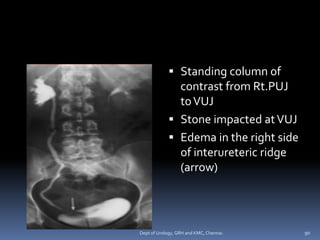
▪ Standing column of
contrast from Rt.PUJ
toVUJ
▪ Stone impacted atVUJ
▪ Edema in the right side
of interureteric ridge
(arrow)
90
Dept of Urology, GRH and KMC, Chennai.
Transitional Cell Carcinoma
▪ Multiple filling defects
in Left renal pelvis and
ureter
▪ “Goblet” appearance
below the filling defect
– typically seen in
lesions that grow
slowly into the lumen
of the ureter
91
Dept of Urology, GRH and KMC, Chennai.
▪ Ureteral filling defects may
be single or multiple and can
usually be attributed to
luminal, mural, or extrinsic
causes.
▪ Urographic image shows
multiple filling defects in the
left renal pelvis and ureter.
▪ Multifocal transitional cell
carcinoma was confirmed in
this case.
92
Dept of Urology, GRH and KMC, Chennai.
93
Dept of Urology, GRH and KMC, Chennai.
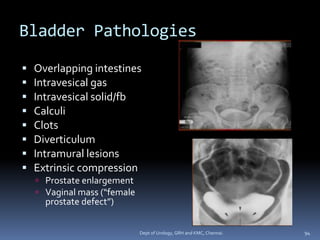
Bladder Pathologies
▪ Overlapping intestines
▪ Intravesical gas
▪ Intravesical solid/fb
▪ Calculi
▪ Clots
▪ Diverticulum
▪ Intramural lesions
▪ Extrinsic compression
 Prostate enlargement
 Vaginal mass (“female
prostate defect”)
94
Dept of Urology, GRH and KMC, Chennai.
Clot within Bladder
BladderTumor
95
Dept of Urology, GRH and KMC, Chennai.
Bladder Diverticulum
96
Dept of Urology, GRH and KMC, Chennai.
97
Dept of Urology, GRH and KMC, Chennai.
98
Dept of Urology, GRH and KMC, Chennai.
Bladder transitional cell
carcinoma .
▪ Bladder image shows a filling
defect with a papillary
configuration along the right
bladder wall
▪ Note the irregular distribution
of contrast material
associated with the filling
defect (“stipple sign”)
99
Dept of Urology, GRH and KMC, Chennai.
100
Dept of Urology, GRH and KMC, Chennai.
101
Dept of Urology, GRH and KMC, Chennai.
Hemorrhagic Cystitis
Bladder shows contrast material with a
lobulated and irregular contour withing the
lumen of the bladder
102
Dept of Urology, GRH and KMC, Chennai.
GU Tb-plain KUB
▪ Disparity in renal size on plain films may indicate early increase in
size of the affected kidney due to caseous lesions or a shrunken
fibrotic kidney of autonephrectomy.
▪ Calcifications are seen in 30% to 50%
▪ A characteristic diffuse, uniform,extensive parenchymal, putty-
like calcification, forming a lobar cast of the kidney is seen with
autonephrectomy
▪ Calculi may also be seen in the collecting system or ureter
secondary to stricture formation.
▪ Ureteral calcifications are rare and are characteristically
intraluminal as opposed to the mural calcifications of
schistosomiasis
103
Dept of Urology, GRH and KMC, Chennai.
▪ . Bladder wall calcifications seen in late cases
of bladder contraction.
▪ Calcifications of the prostate and seminal
vesicles are seen in 10% of cases .
▪ Plain film findings suggestive of tuberculosis
may be seen in surrounding tissues such as
erosions of the vertebral bodies or
calcifications in a cold abscess of the psoas
muscle.
104
Dept of Urology, GRH and KMC, Chennai.
105
Dept of Urology, GRH and KMC, Chennai.
▪ Extensive calcification
which was non-
functional
▪ “Putty Kidney”
▪ Consistent with
autonephrectomy
106
Dept of Urology, GRH and KMC, Chennai.
GU Tb-IVU
▪ The most common findings being
hydrocalycosis,hydronephrosis, or
hydroureter due to stricture formation .
▪ Early signs include the moth-eaten
appearance of calyceal erosion and papillary
irregularity- best seen on early excretory
films.
107
Dept of Urology, GRH and KMC, Chennai.
108
Dept of Urology, GRH and KMC, Chennai.
▪ Cavitary lesions communicating with the
collecting system are characteristic ofTB.
▪ These lesions eventually enlarge as parenchymal
destruction ensues.
▪ Fibrotic distortion of the collecting system and
ureter is also seen.
▪ Calyceal obliteration and amputation,
hydrocalycosis, segmental or total
hydronephrosis, and a shriveled reduced
capacity renal pelvis may all be signs of renal
tuberculosis
109
Dept of Urology, GRH and KMC, Chennai.
110
Dept of Urology, GRH and KMC, Chennai.
111
Dept of Urology, GRH and KMC, Chennai.
GUTB – Ureter & Bladder
▪ Scarring and angulation of the ureteropelvic junction (UPJ) may
also occur, the so-called “Kerr’s kink” .
▪ Tuberculosis of the ureter is commonly seen as a rigid,
straightened “pipe-stem”
▪ Ureter also beaded, corkscrew appearance due to multiple
strictures
▪ Ureterovesical junction obstruction is caused by tuberculous
cystitis or strictures of the distal third of the ureter.
▪ The cystogram films may show a small contracted bladder due to
excessive fibrosis
112
Dept of Urology, GRH and KMC, Chennai.
Kerr’s Kink
▪ Scarring & angulation
of ureteropelvic
junction
▪ Hiked up pelvis
113
Dept of Urology, GRH and KMC, Chennai.
114
Dept of Urology, GRH and KMC, Chennai.
115
Dept of Urology, GRH and KMC, Chennai.
116
Dept of Urology, GRH and KMC, Chennai.
117
Dept of Urology, GRH and KMC, Chennai.
118
Dept of Urology, GRH and KMC, Chennai.

INTRAVENOUS UROGRAPHY 1

  • 1.
    INTRAVENOUS UROGRAPHY Dept ofUrology Govt Royapettah Hospital and Kilpauk Medical College Chennai
  • 2.
    Moderators: Professors: ▪ Prof. Dr.G. Sivasankar, M.S., M.Ch., ▪ Prof. Dr. A. Senthilvel, M.S., M.Ch., Asst Professors: ▪ Dr. J. Sivabalan, M.S., M.Ch., ▪ Dr. R. Bhargavi, M.S., M.Ch., ▪ Dr. S. Raju, M.S., M.Ch., ▪ Dr. K. Muthurathinam, M.S., M.Ch., ▪ Dr. D.Tamilselvan, M.S., M.Ch., ▪ Dr. K. Senthilkumar, M.S., M.Ch. Dept of Urology, GRH and KMC, Chennai. 2
  • 3.
    DEFINITION RADIOGRAPHIC STUDY OFTHERENAL PARENCHYMA,PELVIS,URETERSAND URINARY BLADDERAFTER INTRAVENOUS INJECTION OF CONTRAST MEDIA 3 Dept of Urology, GRH and KMC, Chennai.
  • 4.
    TERMINOLOGY ▪ Urogram Visualization ofkidney parenchyma, calyces and pelvis resulting from IV injection of contrast. ▪ Pyelogram Describes retrograde studies visualizing only the collecting system. ▪ IVP is misnomer 4 Dept of Urology, GRH and KMC, Chennai.
  • 5.
    Moses Swick HISTORY ▪ Introductionof excretory urograpy was done in 1929, by American urologist Moses Swick. ▪ He injected an organically-bound iodide compound—later named Uroselectan—into a vein, taking X-rays as the material cleared the body through the urinary tract. 5 Dept of Urology, GRH and KMC, Chennai.
  • 6.
    INDICATIONS American College ofRadiology (ACR) guidelines ▪ To evaluate the presence or continuing presence of suspected or known ureteral obstruction. ▪ To assess the integrity of the urinary tract status post trauma. ▪ To assess the urinary tract for suspected congenital anomalies. ▪ To assess the urinary tract for lesions that may explain hematuria or infection ▪ Investigation of HTN in young adults not controlled 6 Dept of Urology, GRH and KMC, Chennai.
  • 7.
    Contraindications Absolute contraindication –Contrast Allergy Relative contraindications ▪ Renal failure (raised serum creatinine level >1.5 mg/dL) ▪ Hepatorenal syndrome ▪ Generalized allergic conditions ▪ Multiple myeloma ▪ Pregnancy ▪ Infancy ▪ Thyrotoxicosis ▪ Diabetes 7 Dept of Urology, GRH and KMC, Chennai.
  • 8.
    Advantages ▪ Clearly outlinesof the entire urinary system so can see even mild hydronephrosis. ▪ Easier to pick out obstructing stone when there are multiple pelvic calcifications. ▪ Can show non-opaque stones as filling defects. ▪ Demonstrate renal function and allow for verification that the opposite kidney is functioning normally. 8 Dept of Urology, GRH and KMC, Chennai.
  • 9.
    Disadvantages ▪ Need forIV contrast material ▪ Contrast agent may provoke anaphylactoid reactions, nephropathy. ▪ Multiple delayed films (Can take hours as contrast passes quite slowly into the blocked renal unit and ureter.) ▪ May not have sufficient opacification to define the anatomy and point of obstruction. ▪ Requires a significant amount of radiation exposure and may not be ideal for young children or pregnant women 9 Dept of Urology, GRH and KMC, Chennai.
  • 10.
    Anatomy ▪ The parenchymaof the kidney is divided into two major structures: superficial is the renal cortex and deep is the renal medulla. ▪ Grossly, these structures take the shape of 8 to 18 cone- shaped renal lobes, each containing renal cortex surrounding a portion of medulla called a renal pyramid (of Malpighi). ▪ Between the renal pyramids are projections of cortex called renal columns (of Bertin). 10 Dept of Urology, GRH and KMC, Chennai.
  • 11.
    ▪ Nephrons, theurine- producing functional structures of the kidney, span the cortex and medulla. ▪ The tip, or papilla, of each pyramid empties urine into a minor calyx(8-12) ▪ Minor calyces empty into major calyces (2-4), and major calyces empty into the renal pelvis, which becomes the ureter. 11 Dept of Urology, GRH and KMC, Chennai.
  • 12.
    Shape & Size ▪Shape  Bean shaped  Convex laterally & linear medially  Contour – smooth & regular ▪ Size  12-15cm in length  Right kidney appears smalller than left  Length – 31/2 verterbral bodies  Children – 4 vertebral bodies 12 Dept of Urology, GRH and KMC, Chennai.
  • 13.
    Position ▪ Lumbar fossa ▪Left kidney slightly higher than right ▪ Upper pole of left kidney –T11-12 ▪ Upper pole of Right kidney –T12-L1 ▪ Lower limit – well above iliac crest at the level of L3 or L3-4 IV disc ▪ Medial border – parallel to psoas margin 13 Dept of Urology, GRH and KMC, Chennai.
  • 14.
    Renal Axes ▪ Longaxis of the kidney is parallel to the lateral border of the psoas muscle and lies on the quadratus lumborum muscle. ▪ In addition, the kidneys lie at an oblique angle, that is the superior renal pole is more medial and anterior than the inferior pole. ▪ Their transverse axes form an approximately 45° angle with the sagittal plane 14 Dept of Urology, GRH and KMC, Chennai.
  • 15.
    Intravascular Radiological Contrast Media(IRCM) ▪ Iodine is the main element which imparts Radio opacity ▪ All currently used IRCM are chemical modifications of a 2,4,6-tri-iodinated benzene ring. ▪ They are classified on the basis of their physical and chemical characteristics, including their chemical structure, osmolality, iodine content, and ionization in solution. ▪ In clinical practice, categorization based on osmolality is widely used. 15 Dept of Urology, GRH and KMC, Chennai.
  • 16.
    HIGH • IONIC MONOMERS • Containsodium or meglumine salts • 2 ORGANIC SIDECHAINS & CARBOXYL GROUP • 1500-1900 MOSM/KG H2O • EG: DIATRIAZOATE – Urograffin , angiograffin, & Urovision. • IOTHALAMATE ISO OSMOLAR • NON IONIC DIMERS • EG: IOTROL • IODIXANOL LOW • NON IONIC MONOMERS: • ORGANIC SIDE CHAIN+HYDROXYL GROUP • EG:IOHEXOL IOPAMIDOL IOVERSOL IOPROMIDE • AGENTSOF CHOICE • LOWTOXICITY since do not dissociate in the body • IONIC DIMERS: • 2 IONIC MONOMERS- CARBOXYL GROUP • EG: IOXAGLATE • ADR:3% • Expensive than HOCM 16 Dept of Urology, GRH and KMC, Chennai.
  • 17.
    17 Dept of Urology,GRH and KMC, Chennai.
  • 18.
    18 Dept of Urology,GRH and KMC, Chennai.
  • 19.
    Patient Preparation ▪ Completeurine and blood examination to assess the renal function. ▪ The patient is given mild laxatives about twelve to twenty four hours prior. The patient is kept nil by mouth over night ▪ In active healthy patients, food or liquid restriction or administration of laxative has little value. ▪ With modern contrast media overhydration should be avoided but dehydration is unnecessary. ▪ Pretesting does not provide reliable information regarding sensitivity to contrast media and is therefore not performed before the injection ▪ Take informed consent 19 Dept of Urology, GRH and KMC, Chennai.
  • 20.
    ▪ Dose ofcontrast :patient size ,radiologist preference ▪ 200mg of I per pound body weight: 20-30 g ,50-100ml ▪ Pediatric – 1ml/kg ▪ Bolus injection given through IV access ▪ Rapid : < 60 sec-better nephrogram ▪ Slow: 2-3 min ,less side effects ▪ Density of nephrogram = plasma level of contrast ▪ Drip infusion: 40-45g of I in 250-400 ml of fluid; not practised nowadays 20 Dept of Urology, GRH and KMC, Chennai.
  • 21.
    ▪ Bolus injectiongives immediate peak plasma level followed by rapid decline due to  Vascular mixing  Extravascular diffusion  Renal excretion ▪ Diagnostic quality depends on  Amount of iodine excreted  Volume of urine formed to distend PCS 21 Dept of Urology, GRH and KMC, Chennai.
  • 22.
    Technique ▪ Venous accessvia the median antecubital vein is the preferred injection site because flow is retarded in the cephalic vein as it pierces the clavipectoral fascia. ▪ The gauge of the cannula/needle should allow the injection to be given rapidly as bolus to maximize the density of nephrogram. Usually 18 gauze cannula is used ▪ Upper arm or shoulder pain may be due to stasis of contrast in vein which may be relieved by abduction of the arm. 22 Dept of Urology, GRH and KMC, Chennai.
  • 23.
    Scout Film (plain film of abdomen) • State of bowel preparation • Calcified density in the renal tract • To check exposure factors & positioning • Skeletal abnomality – spinal deformities in congenital disorders, skeletal metastases, metabolic bone changes as in rickets • Abdominal masses • Foreign bodies 23 Dept of Urology, GRH and KMC, Chennai.
  • 24.
    Preliminary Film ➢ Supine,full length AP of abdomen in inspiration. ➢ The lower border of cassette is at the level of symphysis pubis and the x-ray beam is centred in the midline at the level of iliac crests. ➢ To demonstrate bowel preparation, check exposure factor, and location of radiopaque stones or any radiopaque artifacts. 24 Dept of Urology, GRH and KMC, Chennai.
  • 25.
    Film Sequence ➢ 1-3minutes Antero-posterior- film coned to the renal area ➢ 5 minutes Antero-posterior-film coned to the renal area (to see if excretion is symmetrical; if poor opacification, further injection of contrast) ➢ Apply ureteral compression ➢ 10 minutes Antero-posterior (5mins after compression; 10mins from contrast administration – Pyelographic phase ➢ “Flush”, “X” or “Release view”- - full length view at 20 minutes (ureter & bladder images after release of compression) ➢ Upright post void Antero-posterior 25 Dept of Urology, GRH and KMC, Chennai.
  • 26.
    26 Dept of Urology,GRH and KMC, Chennai.
  • 27.
    27 Dept of Urology,GRH and KMC, Chennai.
  • 28.
    28 Dept of Urology,GRH and KMC, Chennai.
  • 29.
    29 Dept of Urology,GRH and KMC, Chennai.
  • 30.
    Contraindications to Ureteral Compression ▪Evidence of obstruction on the 5-minute image ▪ Abdominal aortic aneurysm or other abdominal mass ▪ Severe abdominal pain ▪ Recent abdominal surgery ▪ Suspected urinary tract trauma ▪ Presence of a urinary diversion ▪ Presence of a renal transplant 30 Dept of Urology, GRH and KMC, Chennai.
  • 31.
    Additional Views & Modifications ▪Plain films – Additional oblique views to assist the location of potentially intra renal opacities ▪ 5min film – Second injection of contrast to improve opacification of PCS if inadequate ▪ 15 mins release film  When the bladder is poorly filled additional delayed films  Small suspected calculus in distal ureter confirmed with oblique films 31 Dept of Urology, GRH and KMC, Chennai.
  • 32.
    ▪ Delayed films– 3, 6, 12, 24 hrs for delayed opacification  Early nephrogram but collecting system not visualised  Long standing HUN – Rim sign  In certain congenital lesions such as nonvisualised upper calyceal system with ectopic or obstructed ureter  Unrewarding in total absence of an early nephrogram ▪ Immediate after micturition film –VU reflux ▪ Rapid sequence urography  Renal artery stenosis  2, 4, 6 min  To compare rate of excretion of each kidney 32 Dept of Urology, GRH and KMC, Chennai.
  • 33.
    ▪ Prone film For viewing filling of ureteral areas that are not seen in supine position  Useful in renal ptosis, lesions on the anterior bladder wall, bladder herniation ▪ Erect film  For demonstrating renal ptosis, bladder hernias, cystocoeles  Demonstrates layering of calculi in cysts or abscesses 33 Dept of Urology, GRH and KMC, Chennai.
  • 34.
    ▪ Hypertensive urogram Discontinued  Work up for renal hypertension in pts younger than 50 years  Findings – small kidney (smaller than the opposite kidney by more than 1.5cm), delayed nephrogram, hyperconcentration in late film ▪ Hydration urogram / Frusemide IVU  20 mg of Frusemide IV after 15 min film  Suspected PUJO not evident of standard IVU  Provoke HUN & pain 34 Dept of Urology, GRH and KMC, Chennai.
  • 35.
    WHAT TO LOOKFOR IN IVU ➢Size, shape, position and axis of kidneys ➢External cortex and inner medulla ➢Calyceal system ➢Renal pelvis and ureteropelvic junction ➢Ureter ➢Uretero-vesical junction ➢Urinary bladder ➢Relation of ureter to spine and psoas muscle RADIATION DOSE FROM IVU ➢1,465 mR/projection for males ➢1,047 mR for females 35 Dept of Urology, GRH and KMC, Chennai.
  • 36.
    Phases of Nephrogram ▪Spontaneous nephrogram  Non opacified kidney outlined by retroperitoneal fat visible on plain film ▪ Vascular nephrogram  Contrast reaches renal artery in 15 secs (arm to kidney time)  Coexists with diffusion of contrast  Lasts for few secs to 1 min ▪ Total body opacification phase  Contrast freely filtered by glomeruli  Due to opacification of pre & retro renal softtissue  Lasts for 1 min ▪ Tubular Phase  Contrast in proximal and distal tubules  Density fades ▪ Pyelographic phase  Contrast in the collecting system 36 Dept of Urology, GRH and KMC, Chennai.
  • 37.
    Vasular (Angiographic Nephrogram) ▪ Occursduring passage of contrast material through the cortical microvasculature. ▪ Short lasting seen within 30 sec of rapid IV bolus ▪ Approx. 80% of renal blood flows to the cortex → renal cortex looks much more radiodense as compared to medulla (CM differentiation) ▪ If CM differentiation is not seen, the vascular nephrogram is inadequate & must be interpreted with great caution ▪ Requires intact vascular system – indicator of disturbance in blood flow to the kidney 37 Dept of Urology, GRH and KMC, Chennai.
  • 38.
    Tubular (Urographic Nephrogram) ▪ Appearafter the contrast medium has been concentrated in PCT ▪ Density is greater approx 1 min of injection of IV bolus at which time peak plasma level is reached ▪ Radiodensity of medulla equals to that of cortex → homogenous with no CM differentiation ▪ Permits accurate evaluation of fundamentals of renal radiology – size, position, axis & contour ▪ Normal tubular nephrogram requires  Normal blood flow  Structural & functional integrity of nephrons  Unobstructed flow of filtrate through the tubules 38 Dept of Urology, GRH and KMC, Chennai.
  • 39.
    Failure to Visualise Nephrogram ▪Insufficient dose of contrast ▪ Acute or chronic renal failure ▪ End stage renal disease ▪ Absent kidney ▪ Renal artery occlusion / avulsion 39 Dept of Urology, GRH and KMC, Chennai.
  • 40.
    Abnormal Density Patterns ▪Immediate, faint & persistent nephrogram ▪ Increasingly dense nephrogram ▪ Immediate, dense & persistent nephrogram 40 Dept of Urology, GRH and KMC, Chennai.
  • 41.
    Immediate, faint, persistent nephrogram ▪Peak density is seen on the first film exposed at the completion of injection of contrast ▪ Density is disproportionate with amount of contrast material injected.Though faint, persists for several hours ▪ Cause  Reduction in number of functioning nephrons → immediate faint nephrogram  Severely impaired glomerular filtration & low plasm clearance rate of contrast → persistent nephrogram ▪ Conditions  Chronic glomerular disease  Sudden loss of glomerular function – atheroembolic renal disease 41 Dept of Urology, GRH and KMC, Chennai.
  • 42.
    Increasingly dense nephrogram ▪Faint to begin with and increasingly dense over a period of hours to days ▪ Seen in  Acute extrarenal obstruction  Diminished perfusion pressure of kidney – SHT, RAS  Intratubular obstruction – calculus, casts, acute papillary necrosis  Acute renal vein thrombosis  Acute glomerular disease  Acute tubular necrosis 42 Dept of Urology, GRH and KMC, Chennai.
  • 43.
    Immediate, dense, persistent nephrogram ▪As dense as normally expected to be at 1 min ▪ Level of density persists ▪ Pathogenesis  Unimpaired glomerular filtration → immediate dense nephrogram  Diffusion of filtrate into interstitium due to damaged tubules return of filtered material to the circulation → persistent nephrogram ▪ Seen in  Acute tubular necrosis  Acute bacterial nephritis 43 Dept of Urology, GRH and KMC, Chennai.
  • 44.
    44 Dept of Urology,GRH and KMC, Chennai.
  • 45.
    45 Dept of Urology,GRH and KMC, Chennai.
  • 46.
    Inhomogenous nephrograms ▪ Striatednephrogram / Sunburst nephrogram  Fine linear strands of alternating lucency & density uniformly oriented in direction similar to that of tubules & collecting ducts  Seen in – Acute extrarenal obstruction, Acute bacterial nephritis, acute pyelonephritis,AR-Infantile polycystic kidney disease, Medullary cystic disease, Medullary sponge kidney ▪ Patchy nephrogram  Patchy densities in nephrogram  Seen in – Polyartertitis nodosa, scleroderma, Necrotising angitis ▪ Cortical rim nephrogram  Only thin rim of peripheral cortex is opacified that is perfused by capsular collateral arteries  Reliable indicator of underperfusion of kidney  Seen in – Infarction of kidney, segmental RA occlusion, Renal vein thrombosis (some cases) 46 Dept of Urology, GRH and KMC, Chennai.
  • 47.
    SUNBURST NEPHROGRAM CORTICAL RIMNEPHROGRAM PATCHY NEPHROGRAM 47 Dept of Urology, GRH and KMC, Chennai.
  • 48.
    ▪ The sizeof the kidneys should be assesed during neprographic phase ▪ The normal kidney may range from 9 to13 cm in cephalocaudal length, with the left kidney inherently larger than the right by 0.5 cm and the kidneys slightly larger in men than in women ▪ Significant discrepancies (right kidney 1.5 cm larger than the left kidney,left kidney 2 cm larger than the right kidney) require explanation. 48 Dept of Urology, GRH and KMC, Chennai.
  • 49.
    5 & 10MINUTE FILM ▪ At this stage the calyces, renal pelvis and part of the ureters will be visible. ▪ Nephrogram will be reduced but both kidneys should have the same density 49 Dept of Urology, GRH and KMC, Chennai.
  • 50.
    •In normally functioningkidneys, contrast is first seen in the calyces at 2 mins following bolus injection. 50 Dept of Urology, GRH and KMC, Chennai.
  • 51.
    ▪ On the5-minute image, the nephrogram should be receding as the collecting system becomes opacified. ▪ On the 10-minute image, the pyelogram is the dominant urographic element. ▪ Alterations in this temporal sequence require explanation. 51 Dept of Urology, GRH and KMC, Chennai.
  • 52.
    ▪ Visualization ofthe collecting system and renal pelvis can be augmented with the use of abdominal compression,Trendelenburg position, and other gravity maneuvers such as placing the patient with the side of interest in the ipsilateral posterior oblique position ▪ The appearance of the calices and renal pelvis should be examined closely 52 Dept of Urology, GRH and KMC, Chennai.
  • 53.
    ▪ Early andmild obstruction is indicated by subtle rounding of the forniceal margins ▪ More severe and prolonged obstruction evidenced by progressive loss of the papillary impression and eventual clubbing of calices. 53 Dept of Urology, GRH and KMC, Chennai.
  • 54.
    ➢Ureters ➢Ureters begin totransport opacified urine about 3 mins post injection ➢Maximum ureteral filling occurs between 5-10 minutes. 54 Dept of Urology, GRH and KMC, Chennai.
  • 55.
    ▪ At therelease of compression, the bolus of contrast material–laden urine entering the ureters provides optimal visualization throughout their length ▪ Persistence of a standing column of contrast material on several images may indicate obstruction or ureteral ileus (nonobstructive dilatation). ▪ Medial deviation of the ureter should be considered when the ureter overlies the ipsilateral lumbar pedicle. ▪ Lateral deviation should be considered when the ureter lies more than 1.5 cm beyond the tip of the transverseprocess, but comparison with the position of the contralateral ureter should always be made 55 Dept of Urology, GRH and KMC, Chennai.
  • 56.
    ▪ An absoluteureteral diameter exceeding 8 mm is considered a criterion for dilatation. ▪ Asymmetry of ureteral caliber is a more significant finding. ▪ Early in its course, high-grade ureteral obstruction may be associated with only minimal ureteral dilatation. ▪ More chronic forms of obstruction and other chronic ureteral conditions are typically associated with greater degrees of ureteral dilatation 56 Dept of Urology, GRH and KMC, Chennai.
  • 57.
    Bladder ▪ By 15–30minutes after the injection of contrast material, the bladder is often sufficiently filled, and the 15- minute KUB radiograph may be adequate for evaluation. ▪ As the bladder distends with contrast the intraluminal contrast material should be spheric and smoothly marginated and the wall progressively less evident. ▪ Bladder wall thickening and irregularity of the luminal contrast material should be noted 57 Dept of Urology, GRH and KMC, Chennai.
  • 58.
    ▪ The postvoidimage may also be helpful in evaluating patients with upper urinary tract dilatation. ▪ Persistence of the dilatation on the postvoid image suggests fixed obstruction, ▪ The postvoid image is most helpful in assessing residual volume. 58 Dept of Urology, GRH and KMC, Chennai.
  • 59.
  • 60.
    Unilateral Agenesis 60 Dept ofUrology, GRH and KMC, Chennai.
  • 61.
    Renal Ectopia ▪ Failureof complete ascent of the kidney to its normal position ▪ IVU- abnormally placed kidneys 61 Dept of Urology, GRH and KMC, Chennai.
  • 62.
    Crossed fused Renalectopia ▪ Two complete pelvicalyceal systems on one side usually one above the other ▪ Ureter from the lower renal pelvis crosses the midline and enters bladder normally 62 Dept of Urology, GRH and KMC, Chennai.
  • 63.
    Crossed Fused EctopicKidney 63 Dept of Urology, GRH and KMC, Chennai.
  • 64.
    Horshoe Kidney ▪ Kidneysplaced lower than normal ▪ Malrotation of pelvis ▪ Lower pole calyces of both sides deviated towards midline ▪ Ureters have characteristic vaselike curve ▪ Pelvicalyectasis ▪ Renal calculi ▪ Intravenous urogram (IVU) shows an altered renal axis with medially directed lower renal poles, which suggests horseshoe kidney. Also note the dilated collecting system of the left kidney, resulting from a uretero pelvic junction obstruction; this is a frequently associated finding 64 Dept of Urology, GRH and KMC, Chennai.
  • 65.
    Horshoe Kidney 65 Dept ofUrology, GRH and KMC, Chennai.
  • 66.
    • Minor form– bifid renal pelvis • Ureteral duplication • Incomplete – ureters fuse in their course • Complete – 2 ureters open seperately in bladder, lower moiety inserted orthoptically & upper moiety ectopically • “Drooping lily” sign- obstructed upper moiety ureter, in a completely duplicated system, may produce downward and lateral displacement of the functional lower moiety collecting system, DUPLEX COLLECTING SYSTEM 66 Dept of Urology, GRH and KMC, Chennai.
  • 67.
    DROPPING LILY SIGN 67 Deptof Urology, GRH and KMC, Chennai.
  • 68.
    URETEROCOELE Contrast filled structurewith a thin smooth radiolucent wall surrounded by contrast containing urine in the bladder- “Cobra’s head’ appearence 68 Dept of Urology, GRH and KMC, Chennai.
  • 69.
    Retrocaval Ureter ▪ Theureter may have a sickle, S or reverse J appearance before crossing behind and medial to the IVC. ▪ The ureter descends medial to right lumbar pedicle. ▪ Proximal ureter is dilated. 69 Dept of Urology, GRH and KMC, Chennai.
  • 70.
    Congenital Hydronephrosis • Dueto functional obstruction at the pelvi-ureteral junction • Aetiology- cong. Bands, adhesions, neuro muscular inco- ordination, abberent vessels • Advanced cases - large soft tissue mass replacing the renal parenchyma; No opacification of collecting system • Lesser degrees of obstruction • Thin rim of renal substance outlining kidney. • Later films – crescent shaped opacities produced by dilated stretched tubules surrounding the enlarged non opacified calyx • Delayed films – slow filling of calyces & renal pelvis • Mildest form- minimal deviation from the normal appearance 70 Dept of Urology, GRH and KMC, Chennai.
  • 71.
    Grading of Hydronephrosis ▪Grade 1 (mild)  dilatation of the renal pelvis without dilatation of the calyces (can also occur in the extrarenal pelvis)  no parenchymal atrophy ▪ Grade 2 (mild)  dilatation of the renal pelvis (mild) and calyces (pelvicalyceal pattern is retained)  no parenchymal atrophy ▪ Grade 3 (moderate)  moderate dilatation of the renal pelvis and calyces  blunting of fornices and flattening of papillae  mild cortical thinning may be seen ▪ Grade 4 (severe)  gross dilatation of the renal pelvis and calyces, which appear ballooned  loss of borders between the renal pelvis and calyces  renal atrophy seen as cortical thinning 71 Dept of Urology, GRH and KMC, Chennai.
  • 72.
    72 Dept of Urology,GRH and KMC, Chennai.
  • 73.
    Grade 3 73 Dept ofUrology, GRH and KMC, Chennai.
  • 74.
    PUJO ▪ The balloonon a string sign This sign refers to the appearance of a high and somewhat eccentric exit point of the ureter from a dilated renal pelvis and is a typical finding of ureteropelvic junction obstruction 74 Dept of Urology, GRH and KMC, Chennai.
  • 75.
    Polycystic kidney ▪ Autosomaldominant ➢ Plain films- cyst calcification ➢ IVU- enlarged kidneys with compression and displacement of calyces by intrarenal cyst ▪ Autosomal recessive ▪ B/L symmetrical enlargement of kidneys ▪ Streaky nephrogram ▪ Calyces maybe distorted 75 Dept of Urology, GRH and KMC, Chennai.
  • 76.
    Polycystic Kidney ▪ B/lenlarged kidneys ▪ Asymmetric (left> right) ▪ Multiple parenchymal defects “Swiss cheese” nephrogram 76 Dept of Urology, GRH and KMC, Chennai.
  • 77.
    Polycystic Kidney 77 Dept ofUrology, GRH and KMC, Chennai.
  • 78.
    Malrotated Kidneys 78 Dept ofUrology, GRH and KMC, Chennai.
  • 79.
    Persistence of Fetal Lobulations 79 Deptof Urology, GRH and KMC, Chennai.
  • 80.
    Dromedary hump ▪ Prominentcortical hump in the interpolar region of the left kidney. ▪ On a compression image obtained in a later phase of the sequence, the hump is subtended by a normal collecting system. ▪ Normal variants of the renal contour, caused by the splenic impression onto the superolateral left kidney. ▪ Dromedary humps are important because they may mimic a renal mass, and as such is considered a renal pseudotumour. 80 Dept of Urology, GRH and KMC, Chennai.
  • 81.
    Atrophic Small SmoothKidney ▪ Chronic glomerulonephritis ▪ Arteriosclerosis ▪ Papillary necrosis ▪ Embolic disease ▪ Hypotension ▪ Alport syndrome ▪ Nephrosclerosis ▪ Amyloidosis (late) 81 Dept of Urology, GRH and KMC, Chennai.
  • 82.
    Papillary Necrosis 82 Dept ofUrology, GRH and KMC, Chennai.
  • 83.
    Papillary Necrosis Central Excavationwith “Ball onTee” apperance 83 Dept of Urology, GRH and KMC, Chennai.
  • 84.
    Papillary Necrosis ▪ Excavationextending from the caliceal fornices ▪ “LOBSTER CLAW” deformity 84 Dept of Urology, GRH and KMC, Chennai.
  • 85.
    Renal masses ▪ Smalllesions → Localised bulge with increased thickness of the renal substance; Deforms or displaces or distends a calyx ▪ Medium sized lesions → Localized or generalized enlargement of the kidneys; Displacement or distortion of renal pelvis, ureter or adjacent structures ▪ Very large lesions → Non functioning kidneys; Calycine spreading;Visceral displacement 85 Dept of Urology, GRH and KMC, Chennai.
  • 86.
    Renal Mass ▪ Lossof renal contour ▪ Displacement and splaying of calyces 86 Dept of Urology, GRH and KMC, Chennai.
  • 87.
    Features of MalignantMasses ▪ Pathognomonic – Invasion of collecting system producing amputation of calyx or intraluminal filling defect. ▪ Suggestive  Vascular mass  Calcification  Tumor shell – wall is thick & irregular  Absent mobility with respiration & change in position 87 Dept of Urology, GRH and KMC, Chennai.
  • 88.
    URETER 88 Dept of Urology,GRH and KMC, Chennai.
  • 89.
    89 Dept of Urology,GRH and KMC, Chennai.
  • 90.
    ▪ Standing columnof contrast from Rt.PUJ toVUJ ▪ Stone impacted atVUJ ▪ Edema in the right side of interureteric ridge (arrow) 90 Dept of Urology, GRH and KMC, Chennai.
  • 91.
    Transitional Cell Carcinoma ▪Multiple filling defects in Left renal pelvis and ureter ▪ “Goblet” appearance below the filling defect – typically seen in lesions that grow slowly into the lumen of the ureter 91 Dept of Urology, GRH and KMC, Chennai.
  • 92.
    ▪ Ureteral fillingdefects may be single or multiple and can usually be attributed to luminal, mural, or extrinsic causes. ▪ Urographic image shows multiple filling defects in the left renal pelvis and ureter. ▪ Multifocal transitional cell carcinoma was confirmed in this case. 92 Dept of Urology, GRH and KMC, Chennai.
  • 93.
    93 Dept of Urology,GRH and KMC, Chennai.
  • 94.
    Bladder Pathologies ▪ Overlappingintestines ▪ Intravesical gas ▪ Intravesical solid/fb ▪ Calculi ▪ Clots ▪ Diverticulum ▪ Intramural lesions ▪ Extrinsic compression  Prostate enlargement  Vaginal mass (“female prostate defect”) 94 Dept of Urology, GRH and KMC, Chennai.
  • 95.
    Clot within Bladder BladderTumor 95 Deptof Urology, GRH and KMC, Chennai.
  • 96.
    Bladder Diverticulum 96 Dept ofUrology, GRH and KMC, Chennai.
  • 97.
    97 Dept of Urology,GRH and KMC, Chennai.
  • 98.
    98 Dept of Urology,GRH and KMC, Chennai.
  • 99.
    Bladder transitional cell carcinoma. ▪ Bladder image shows a filling defect with a papillary configuration along the right bladder wall ▪ Note the irregular distribution of contrast material associated with the filling defect (“stipple sign”) 99 Dept of Urology, GRH and KMC, Chennai.
  • 100.
    100 Dept of Urology,GRH and KMC, Chennai.
  • 101.
    101 Dept of Urology,GRH and KMC, Chennai.
  • 102.
    Hemorrhagic Cystitis Bladder showscontrast material with a lobulated and irregular contour withing the lumen of the bladder 102 Dept of Urology, GRH and KMC, Chennai.
  • 103.
    GU Tb-plain KUB ▪Disparity in renal size on plain films may indicate early increase in size of the affected kidney due to caseous lesions or a shrunken fibrotic kidney of autonephrectomy. ▪ Calcifications are seen in 30% to 50% ▪ A characteristic diffuse, uniform,extensive parenchymal, putty- like calcification, forming a lobar cast of the kidney is seen with autonephrectomy ▪ Calculi may also be seen in the collecting system or ureter secondary to stricture formation. ▪ Ureteral calcifications are rare and are characteristically intraluminal as opposed to the mural calcifications of schistosomiasis 103 Dept of Urology, GRH and KMC, Chennai.
  • 104.
    ▪ . Bladderwall calcifications seen in late cases of bladder contraction. ▪ Calcifications of the prostate and seminal vesicles are seen in 10% of cases . ▪ Plain film findings suggestive of tuberculosis may be seen in surrounding tissues such as erosions of the vertebral bodies or calcifications in a cold abscess of the psoas muscle. 104 Dept of Urology, GRH and KMC, Chennai.
  • 105.
    105 Dept of Urology,GRH and KMC, Chennai.
  • 106.
    ▪ Extensive calcification whichwas non- functional ▪ “Putty Kidney” ▪ Consistent with autonephrectomy 106 Dept of Urology, GRH and KMC, Chennai.
  • 107.
    GU Tb-IVU ▪ Themost common findings being hydrocalycosis,hydronephrosis, or hydroureter due to stricture formation . ▪ Early signs include the moth-eaten appearance of calyceal erosion and papillary irregularity- best seen on early excretory films. 107 Dept of Urology, GRH and KMC, Chennai.
  • 108.
    108 Dept of Urology,GRH and KMC, Chennai.
  • 109.
    ▪ Cavitary lesionscommunicating with the collecting system are characteristic ofTB. ▪ These lesions eventually enlarge as parenchymal destruction ensues. ▪ Fibrotic distortion of the collecting system and ureter is also seen. ▪ Calyceal obliteration and amputation, hydrocalycosis, segmental or total hydronephrosis, and a shriveled reduced capacity renal pelvis may all be signs of renal tuberculosis 109 Dept of Urology, GRH and KMC, Chennai.
  • 110.
    110 Dept of Urology,GRH and KMC, Chennai.
  • 111.
    111 Dept of Urology,GRH and KMC, Chennai.
  • 112.
    GUTB – Ureter& Bladder ▪ Scarring and angulation of the ureteropelvic junction (UPJ) may also occur, the so-called “Kerr’s kink” . ▪ Tuberculosis of the ureter is commonly seen as a rigid, straightened “pipe-stem” ▪ Ureter also beaded, corkscrew appearance due to multiple strictures ▪ Ureterovesical junction obstruction is caused by tuberculous cystitis or strictures of the distal third of the ureter. ▪ The cystogram films may show a small contracted bladder due to excessive fibrosis 112 Dept of Urology, GRH and KMC, Chennai.
  • 113.
    Kerr’s Kink ▪ Scarring& angulation of ureteropelvic junction ▪ Hiked up pelvis 113 Dept of Urology, GRH and KMC, Chennai.
  • 114.
    114 Dept of Urology,GRH and KMC, Chennai.
  • 115.
    115 Dept of Urology,GRH and KMC, Chennai.
  • 116.
    116 Dept of Urology,GRH and KMC, Chennai.
  • 117.
    117 Dept of Urology,GRH and KMC, Chennai.
  • 118.
    118 Dept of Urology,GRH and KMC, Chennai.