Urinary incontinence-
Evaluation and Management
Dept of Urology
Govt Royapettah Hospital and Kilpauk Medical College
Chennai
1
Moderators:
Professors:
• Prof. Dr. G. Sivasankar, M.S., M.Ch.,
• Prof. Dr. A. Senthilvel, M.S., M.Ch.,
Asst Professors:
• Dr. J. Sivabalan, M.S., M.Ch.,
• Dr. R. Bhargavi, M.S., M.Ch.,
• Dr. S. Raju, M.S., M.Ch.,
• Dr. K. Muthurathinam, M.S., M.Ch.,
• Dr. D. Tamilselvan, M.S., M.Ch.,
• Dr. K. Senthilkumar, M.S., M.Ch.
Dept Of Urology, KMC and GRH, Chennai 2
Definition
“ Symptomatic complaint regarding the
involuntary loss of urine”
Dept Of Urology, KMC and GRH, Chennai 3
Classification
• Stress Urinary incontinence
• Mixed urinary incontinence
• Urge urinary incontinence
Other types:
• Postural UI
• Nocturnal enuresis
• Continuous UI (fistulas)
• Insensible UI
• Coital incontinence
Dept Of Urology, KMC and GRH, Chennai 4
Transient Incontinence
DIAPPERS
• Delerium
• Infection (urinary tract infection)
• Atrophic vaginitis/urethritis
• Psychologic (e.g., severe depression, neurosis)
• Pharmacologic
• Excess urine production
• Restricted mobility
• Stool impaction
Dept Of Urology, KMC and GRH, Chennai 5
SUI
• Involuntary loss of urine with physical exertion (i.e.,
walking, straining,exercise) or with
sneezing/coughing or other activities that causes rise
in intra-abdominal pressure
• Urodynamic stress incontinence - involuntary urine
leakage during filling cystometry associated with an
increase in intra-abdominal pressure, and in the
absence of a detrusor contraction.
Dept Of Urology, KMC and GRH, Chennai 6
UUI
• Involuntary urine loss associated with
urgency.
• Urodynamic finding such as detrusor
overactivity, bladder oversensitivity, or
diminished maximum bladder capacity- need
not be present for diagnosis
Dept Of Urology, KMC and GRH, Chennai 7
MUI
• Involuntary urine loss associated with
urgency and is also associated with effort,
physical exertion, sneezing, or coughing.
• May be urge predominant, stress
predominant, or equal
Dept Of Urology, KMC and GRH, Chennai 8
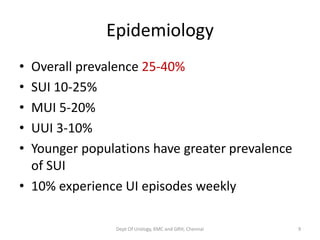
Epidemiology
• Overall prevalence 25-40%
• SUI 10-25%
• MUI 5-20%
• UUI 3-10%
• Younger populations have greater prevalence
of SUI
• 10% experience UI episodes weekly
Dept Of Urology, KMC and GRH, Chennai 9
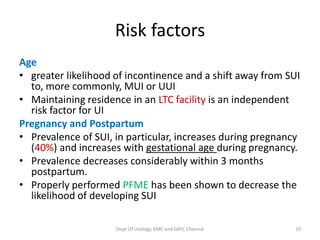
Risk factors
Age
• greater likelihood of incontinence and a shift away from SUI
to, more commonly, MUI or UUI
• Maintaining residence in an LTC facility is an independent
risk factor for UI
Pregnancy and Postpartum
• Prevalence of SUI, in particular, increases during pregnancy
(40%) and increases with gestational age during pregnancy.
• Prevalence decreases considerably within 3 months
postpartum.
• Properly performed PFME has been shown to decrease the
likelihood of developing SUI
Dept Of Urology, KMC and GRH, Chennai 10
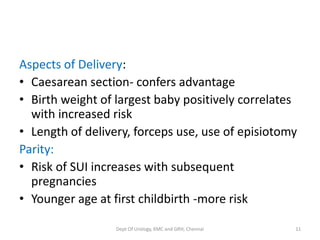
Aspects of Delivery:
• Caesarean section- confers advantage
• Birth weight of largest baby positively correlates
with increased risk
• Length of delivery, forceps use, use of episiotomy
Parity:
• Risk of SUI increases with subsequent
pregnancies
• Younger age at first childbirth -more risk
Dept Of Urology, KMC and GRH, Chennai 11
Race:
• Increased risk in caucasian women
Hormonal therapy:
• Oral estrogen with our without progesterone
increase risk of SUI
• No association with topical estrogen
Obesity:
• BMI > 30 more than doubles risk of UI
• UI reversible after weight loss
Dept Of Urology, KMC and GRH, Chennai 12
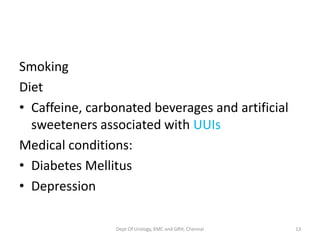
Smoking
Diet
• Caffeine, carbonated beverages and artificial
sweeteners associated with UUIs
Medical conditions:
• Diabetes Mellitus
• Depression
Dept Of Urology, KMC and GRH, Chennai 13
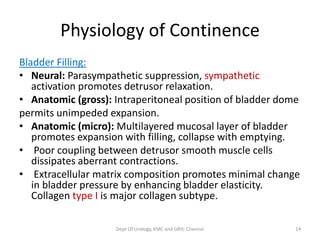
Physiology of Continence
Bladder Filling:
• Neural: Parasympathetic suppression, sympathetic
activation promotes detrusor relaxation.
• Anatomic (gross): Intraperitoneal position of bladder dome
permits unimpeded expansion.
• Anatomic (micro): Multilayered mucosal layer of bladder
promotes expansion with filling, collapse with emptying.
• Poor coupling between detrusor smooth muscle cells
dissipates aberrant contractions.
• Extracellular matrix composition promotes minimal change
in bladder pressure by enhancing bladder elasticity.
Collagen type I is major collagen subtype.
Dept Of Urology, KMC and GRH, Chennai 14
Dept Of Urology, KMC and GRH, Chennai 15
Dept Of Urology, KMC and GRH, Chennai 16
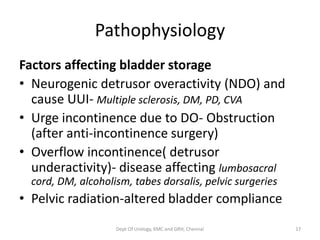
Pathophysiology
Factors affecting bladder storage
• Neurogenic detrusor overactivity (NDO) and
cause UUI- Multiple sclerosis, DM, PD, CVA
• Urge incontinence due to DO- Obstruction
(after anti-incontinence surgery)
• Overflow incontinence( detrusor
underactivity)- disease affecting lumbosacral
cord, DM, alcoholism, tabes dorsalis, pelvic surgeries
• Pelvic radiation-altered bladder compliance
Dept Of Urology, KMC and GRH, Chennai 17
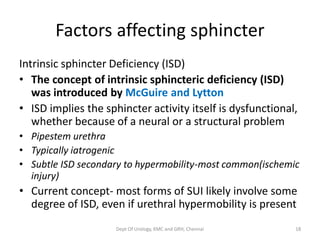
Factors affecting sphincter
Intrinsic sphincter Deficiency (ISD)
• The concept of intrinsic sphincteric deficiency (ISD)
was introduced by McGuire and Lytton
• ISD implies the sphincter activity itself is dysfunctional,
whether because of a neural or a structural problem
• Pipestem urethra
• Typically iatrogenic
• Subtle ISD secondary to hypermobility-most common(ischemic
injury)
• Current concept- most forms of SUI likely involve some
degree of ISD, even if urethral hypermobility is present
Dept Of Urology, KMC and GRH, Chennai 18
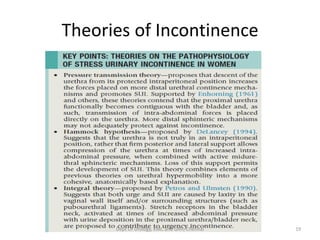
Theories of Incontinence
Dept Of Urology, KMC and GRH, Chennai 19
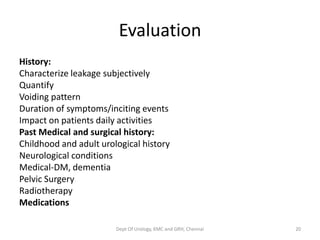
Evaluation
History:
Characterize leakage subjectively
Quantify
Voiding pattern
Duration of symptoms/inciting events
Impact on patients daily activities
Past Medical and surgical history:
Childhood and adult urological history
Neurological conditions
Medical-DM, dementia
Pelvic Surgery
Radiotherapy
Medications
Dept Of Urology, KMC and GRH, Chennai 20
Dept Of Urology, KMC and GRH, Chennai 21
Examination
• General assessment
• Pelvic examination
- Stress test
- Q tip test
• Neurological examination
Dept Of Urology, KMC and GRH, Chennai 22
Supplemental evaluation
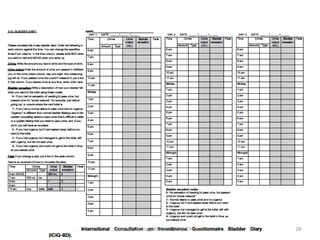
Voiding diary
• Diagnostic and therapeutic
Quality of life Questionnaires
Pad tests
• More than 1.3gm- positive
Urine analysis
PVR
• To document baseline bladder emptying before
therapy
• To diagnose overflow incontinence
Dept Of Urology, KMC and GRH, Chennai 23
Q-tip test:
To objectify the evaluation of urethral mobility
The Q-tip is inserted into the bladder through urethra, and the angle that the Q-
tip moves from horizontal to its final position with straining is measured.
Hypermobility is defined as a Q-tip angle > 30 degrees from horizontal.
Dept Of Urology, KMC and GRH, Chennai 24
Stress Test
.
The bladder must be moderately
moderately full.
The patient in the lithotomy position,
the lithotomy position, the two labia
the two labia
are separated, and the patient is asked to cough.
If
If urine escapes
urine escapes,
, the patient is
the patient is incontinent.
incontinent.
If no urine escapes, the test is repeated while the
index and middle fingers in the vagina press
fingers in the vagina press on the
on the
perineum to abolish reflex contraction of the levator
index and middle
perineum to abolish reflex contraction of the levator
ani muscles during straining.
muscles during straining.
ani
If
If still
still no urine
no urine escapes,
escapes, the
the test
test is
is repeated while
repeated while
the patient is standing with the legs separated.
Dept Of Urology, KMC and GRH, Chennai 25
Bonney test
.
It
It is indicated
is indicated in
in case
case of
of a
a positive
associated with a cystocele.
positive stress
stress test
test
associated with a cystocele.
To
To know if
know if incontinence
incontinence is due
is due to descent
to descent of
of
bladder neck or weakness of the sphincter.
The index and middle fingers are placed on
both sides of
of the
neck upwards.
the urethra
urethra to elevate the
to elevate the bladder
bladder
both sides
neck upwards.
If
If no
no urine
urine escapes
escapes on
on stress
stress it
it means
means that
that the
incontinence is due to descent of the bladder
the
incontinence is due to descent of the bladder
neck,
neck, but
but if
if urine
urine still escapes
still escapes it
weakness of the sphincter.
it means
means
weakness of the sphincter.
Dept Of Urology, KMC and GRH, Chennai 26
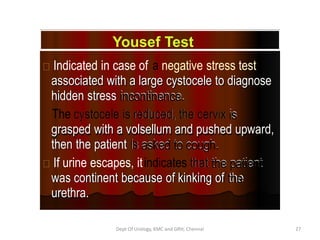
Indicated in case of a negative stress test
associated with a large cystocele to diagnose
hidden stress incontinence.
incontinence.
hidden stress
The cystocele is
cystocele is reduced,
reduced, the cervix
the cervix is
is
grasped with a volsellum and pushed upward,
then the patient is
is asked to cough.
asked to cough.
then the patient
If urine escapes, itindicates that
that the patient
the patient
was continent because of kinking of the
the
was continent because of kinking of
urethra.
urethra.
Yousef Test
Dept Of Urology, KMC and GRH, Chennai 27
Dept Of Urology, KMC and GRH, Chennai 28
Cystoscopy
• Urgency
• Hematuria
• Previous surgery for incontinence, pelvic prolapse
UDE
• when conservative treatment methods fail
• when the diagnosis is unclear or
• when previous diagnostic procedures are inconclusive,
• in patients with clinical pictures complicated by radiation therapy,
neurologic disease
• prior failed pelvic floor reconstruction or anti-incontinence surgery, or
Imaging
• Upper tract status
• Pelvic pathology
Dept Of Urology, KMC and GRH, Chennai 29
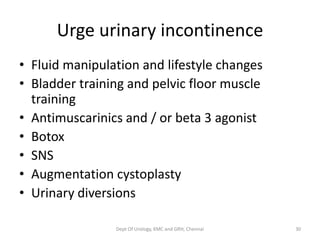
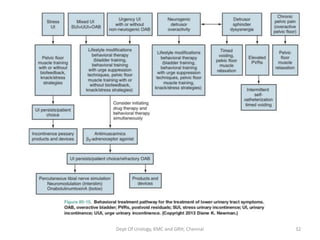
• Fluid manipulation and lifestyle changes
• Bladder training and pelvic floor muscle
training
• Antimuscarinics and / or beta 3 agonist
• Botox
• SNS
• Augmentation cystoplasty
• Urinary diversions
Urge urinary incontinence
Dept Of Urology, KMC and GRH, Chennai 30
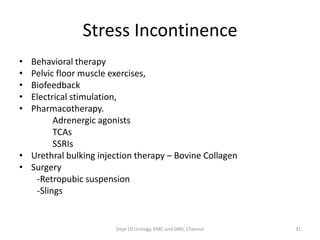
Stress Incontinence
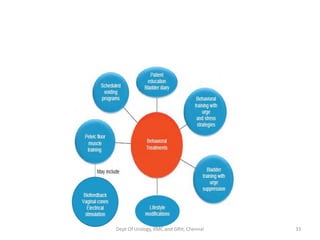
• Behavioral therapy
• Pelvic floor muscle exercises,
• Biofeedback
• Electrical stimulation,
• Pharmacotherapy.
Adrenergic agonists
TCAs
SSRIs
• Urethral bulking injection therapy – Bovine Collagen
• Surgery
-Retropubic suspension
-Slings
Dept Of Urology, KMC and GRH, Chennai 31
Dept Of Urology, KMC and GRH, Chennai 32
Dept Of Urology, KMC and GRH, Chennai 33
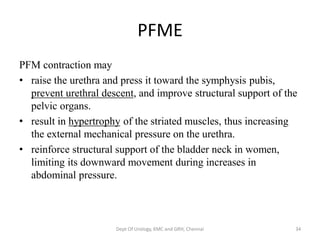
PFME
PFM contraction may
• raise the urethra and press it toward the symphysis pubis,
prevent urethral descent, and improve structural support of the
pelvic organs.
• result in hypertrophy of the striated muscles, thus increasing
the external mechanical pressure on the urethra.
• reinforce structural support of the bladder neck in women,
limiting its downward movement during increases in
abdominal pressure.
Dept Of Urology, KMC and GRH, Chennai 34
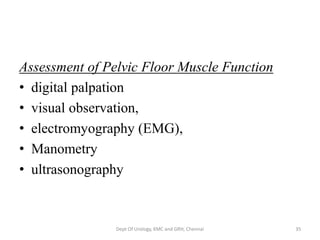
Assessment of Pelvic Floor Muscle Function
• digital palpation
• visual observation,
• electromyography (EMG),
• Manometry
• ultrasonography
Dept Of Urology, KMC and GRH, Chennai 35
Dept Of Urology, KMC and GRH, Chennai 36
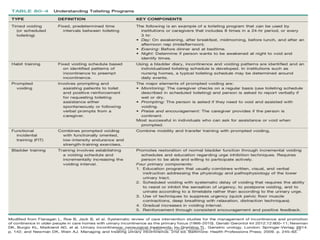
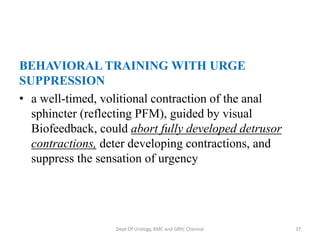
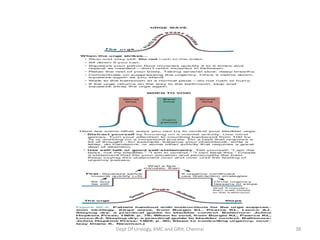
BEHAVIORAL TRAINING WITH URGE
SUPPRESSION
• a well-timed, volitional contraction of the anal
sphincter (reflecting PFM), guided by visual
Biofeedback, could abort fully developed detrusor
contractions, deter developing contractions, and
suppress the sensation of urgency
Dept Of Urology, KMC and GRH, Chennai 37
Dept Of Urology, KMC and GRH, Chennai 38
Dept Of Urology, KMC and GRH, Chennai 39
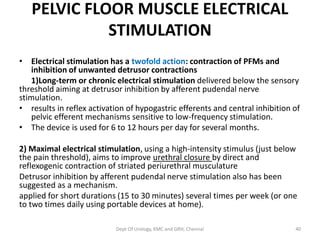
PELVIC FLOOR MUSCLE ELECTRICAL
STIMULATION
• Electrical stimulation has a twofold action: contraction of PFMs and
inhibition of unwanted detrusor contractions
1)Long-term or chronic electrical stimulation delivered below the sensory
threshold aiming at detrusor inhibition by afferent pudendal nerve
stimulation.
• results in reflex activation of hypogastric efferents and central inhibition of
pelvic efferent mechanisms sensitive to low-frequency stimulation.
• The device is used for 6 to 12 hours per day for several months.
2) Maximal electrical stimulation, using a high-intensity stimulus (just below
the pain threshold), aims to improve urethral closure by direct and
reflexogenic contraction of striated periurethral musculature
Detrusor inhibition by afferent pudendal nerve stimulation also has been
suggested as a mechanism.
applied for short durations (15 to 30 minutes) several times per week (or one
to two times daily using portable devices at home).
Dept Of Urology, KMC and GRH, Chennai 40
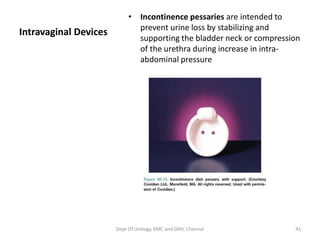
Intravaginal Devices
• Incontinence pessaries are intended to
prevent urine loss by stabilizing and
supporting the bladder neck or compression
of the urethra during increase in intra-
abdominal pressure
Dept Of Urology, KMC and GRH, Chennai 41
Dept Of Urology, KMC and GRH, Chennai 42
Thank you….
Dept Of Urology, KMC and GRH, Chennai 43

Uro gynacology- ui- evaluation & management

  • 1.
    Urinary incontinence- Evaluation andManagement Dept of Urology Govt Royapettah Hospital and Kilpauk Medical College Chennai 1
  • 2.
    Moderators: Professors: • Prof. Dr.G. Sivasankar, M.S., M.Ch., • Prof. Dr. A. Senthilvel, M.S., M.Ch., Asst Professors: • Dr. J. Sivabalan, M.S., M.Ch., • Dr. R. Bhargavi, M.S., M.Ch., • Dr. S. Raju, M.S., M.Ch., • Dr. K. Muthurathinam, M.S., M.Ch., • Dr. D. Tamilselvan, M.S., M.Ch., • Dr. K. Senthilkumar, M.S., M.Ch. Dept Of Urology, KMC and GRH, Chennai 2
  • 3.
    Definition “ Symptomatic complaintregarding the involuntary loss of urine” Dept Of Urology, KMC and GRH, Chennai 3
  • 4.
    Classification • Stress Urinaryincontinence • Mixed urinary incontinence • Urge urinary incontinence Other types: • Postural UI • Nocturnal enuresis • Continuous UI (fistulas) • Insensible UI • Coital incontinence Dept Of Urology, KMC and GRH, Chennai 4
  • 5.
    Transient Incontinence DIAPPERS • Delerium •Infection (urinary tract infection) • Atrophic vaginitis/urethritis • Psychologic (e.g., severe depression, neurosis) • Pharmacologic • Excess urine production • Restricted mobility • Stool impaction Dept Of Urology, KMC and GRH, Chennai 5
  • 6.
    SUI • Involuntary lossof urine with physical exertion (i.e., walking, straining,exercise) or with sneezing/coughing or other activities that causes rise in intra-abdominal pressure • Urodynamic stress incontinence - involuntary urine leakage during filling cystometry associated with an increase in intra-abdominal pressure, and in the absence of a detrusor contraction. Dept Of Urology, KMC and GRH, Chennai 6
  • 7.
    UUI • Involuntary urineloss associated with urgency. • Urodynamic finding such as detrusor overactivity, bladder oversensitivity, or diminished maximum bladder capacity- need not be present for diagnosis Dept Of Urology, KMC and GRH, Chennai 7
  • 8.
    MUI • Involuntary urineloss associated with urgency and is also associated with effort, physical exertion, sneezing, or coughing. • May be urge predominant, stress predominant, or equal Dept Of Urology, KMC and GRH, Chennai 8
  • 9.
    Epidemiology • Overall prevalence25-40% • SUI 10-25% • MUI 5-20% • UUI 3-10% • Younger populations have greater prevalence of SUI • 10% experience UI episodes weekly Dept Of Urology, KMC and GRH, Chennai 9
  • 10.
    Risk factors Age • greaterlikelihood of incontinence and a shift away from SUI to, more commonly, MUI or UUI • Maintaining residence in an LTC facility is an independent risk factor for UI Pregnancy and Postpartum • Prevalence of SUI, in particular, increases during pregnancy (40%) and increases with gestational age during pregnancy. • Prevalence decreases considerably within 3 months postpartum. • Properly performed PFME has been shown to decrease the likelihood of developing SUI Dept Of Urology, KMC and GRH, Chennai 10
  • 11.
    Aspects of Delivery: •Caesarean section- confers advantage • Birth weight of largest baby positively correlates with increased risk • Length of delivery, forceps use, use of episiotomy Parity: • Risk of SUI increases with subsequent pregnancies • Younger age at first childbirth -more risk Dept Of Urology, KMC and GRH, Chennai 11
  • 12.
    Race: • Increased riskin caucasian women Hormonal therapy: • Oral estrogen with our without progesterone increase risk of SUI • No association with topical estrogen Obesity: • BMI > 30 more than doubles risk of UI • UI reversible after weight loss Dept Of Urology, KMC and GRH, Chennai 12
  • 13.
    Smoking Diet • Caffeine, carbonatedbeverages and artificial sweeteners associated with UUIs Medical conditions: • Diabetes Mellitus • Depression Dept Of Urology, KMC and GRH, Chennai 13
  • 14.
    Physiology of Continence BladderFilling: • Neural: Parasympathetic suppression, sympathetic activation promotes detrusor relaxation. • Anatomic (gross): Intraperitoneal position of bladder dome permits unimpeded expansion. • Anatomic (micro): Multilayered mucosal layer of bladder promotes expansion with filling, collapse with emptying. • Poor coupling between detrusor smooth muscle cells dissipates aberrant contractions. • Extracellular matrix composition promotes minimal change in bladder pressure by enhancing bladder elasticity. Collagen type I is major collagen subtype. Dept Of Urology, KMC and GRH, Chennai 14
  • 15.
    Dept Of Urology,KMC and GRH, Chennai 15
  • 16.
    Dept Of Urology,KMC and GRH, Chennai 16
  • 17.
    Pathophysiology Factors affecting bladderstorage • Neurogenic detrusor overactivity (NDO) and cause UUI- Multiple sclerosis, DM, PD, CVA • Urge incontinence due to DO- Obstruction (after anti-incontinence surgery) • Overflow incontinence( detrusor underactivity)- disease affecting lumbosacral cord, DM, alcoholism, tabes dorsalis, pelvic surgeries • Pelvic radiation-altered bladder compliance Dept Of Urology, KMC and GRH, Chennai 17
  • 18.
    Factors affecting sphincter Intrinsicsphincter Deficiency (ISD) • The concept of intrinsic sphincteric deficiency (ISD) was introduced by McGuire and Lytton • ISD implies the sphincter activity itself is dysfunctional, whether because of a neural or a structural problem • Pipestem urethra • Typically iatrogenic • Subtle ISD secondary to hypermobility-most common(ischemic injury) • Current concept- most forms of SUI likely involve some degree of ISD, even if urethral hypermobility is present Dept Of Urology, KMC and GRH, Chennai 18
  • 19.
    Theories of Incontinence DeptOf Urology, KMC and GRH, Chennai 19
  • 20.
    Evaluation History: Characterize leakage subjectively Quantify Voidingpattern Duration of symptoms/inciting events Impact on patients daily activities Past Medical and surgical history: Childhood and adult urological history Neurological conditions Medical-DM, dementia Pelvic Surgery Radiotherapy Medications Dept Of Urology, KMC and GRH, Chennai 20
  • 21.
    Dept Of Urology,KMC and GRH, Chennai 21
  • 22.
    Examination • General assessment •Pelvic examination - Stress test - Q tip test • Neurological examination Dept Of Urology, KMC and GRH, Chennai 22
  • 23.
    Supplemental evaluation Voiding diary •Diagnostic and therapeutic Quality of life Questionnaires Pad tests • More than 1.3gm- positive Urine analysis PVR • To document baseline bladder emptying before therapy • To diagnose overflow incontinence Dept Of Urology, KMC and GRH, Chennai 23
  • 24.
    Q-tip test: To objectifythe evaluation of urethral mobility The Q-tip is inserted into the bladder through urethra, and the angle that the Q- tip moves from horizontal to its final position with straining is measured. Hypermobility is defined as a Q-tip angle > 30 degrees from horizontal. Dept Of Urology, KMC and GRH, Chennai 24
  • 25.
    Stress Test . The bladdermust be moderately moderately full. The patient in the lithotomy position, the lithotomy position, the two labia the two labia are separated, and the patient is asked to cough. are separated, and the patient is asked to cough. If If urine escapes urine escapes, , the patient is the patient is incontinent. incontinent. If no urine escapes, the test is repeated while the index and middle fingers in the vagina press fingers in the vagina press on the on the perineum to abolish reflex contraction of the levator index and middle perineum to abolish reflex contraction of the levator ani muscles during straining. muscles during straining. ani If If still still no urine no urine escapes, escapes, the the test test is is repeated while repeated while the patient is standing with the legs separated. the patient is standing with the legs separated. Dept Of Urology, KMC and GRH, Chennai 25
  • 26.
    Bonney test . It It isindicated is indicated in in case case of of a a positive associated with a cystocele. positive stress stress test test associated with a cystocele. To To know if know if incontinence incontinence is due is due to descent to descent of of bladder neck or weakness of the sphincter. bladder neck or weakness of the sphincter. The index and middle fingers are placed on both sides of of the neck upwards. the urethra urethra to elevate the to elevate the bladder bladder both sides neck upwards. If If no no urine urine escapes escapes on on stress stress it it means means that that the incontinence is due to descent of the bladder the incontinence is due to descent of the bladder neck, neck, but but if if urine urine still escapes still escapes it weakness of the sphincter. it means means weakness of the sphincter. Dept Of Urology, KMC and GRH, Chennai 26
  • 27.
    Indicated in caseof a negative stress test associated with a large cystocele to diagnose associated with a large cystocele to diagnose hidden stress incontinence. incontinence. hidden stress The cystocele is cystocele is reduced, reduced, the cervix the cervix is is grasped with a volsellum and pushed upward, grasped with a volsellum and pushed upward, then the patient is is asked to cough. asked to cough. then the patient If urine escapes, itindicates that that the patient the patient was continent because of kinking of the the was continent because of kinking of urethra. urethra. Yousef Test Dept Of Urology, KMC and GRH, Chennai 27
  • 28.
    Dept Of Urology,KMC and GRH, Chennai 28
  • 29.
    Cystoscopy • Urgency • Hematuria •Previous surgery for incontinence, pelvic prolapse UDE • when conservative treatment methods fail • when the diagnosis is unclear or • when previous diagnostic procedures are inconclusive, • in patients with clinical pictures complicated by radiation therapy, neurologic disease • prior failed pelvic floor reconstruction or anti-incontinence surgery, or Imaging • Upper tract status • Pelvic pathology Dept Of Urology, KMC and GRH, Chennai 29
  • 30.
    • Fluid manipulationand lifestyle changes • Bladder training and pelvic floor muscle training • Antimuscarinics and / or beta 3 agonist • Botox • SNS • Augmentation cystoplasty • Urinary diversions Urge urinary incontinence Dept Of Urology, KMC and GRH, Chennai 30
  • 31.
    Stress Incontinence • Behavioraltherapy • Pelvic floor muscle exercises, • Biofeedback • Electrical stimulation, • Pharmacotherapy. Adrenergic agonists TCAs SSRIs • Urethral bulking injection therapy – Bovine Collagen • Surgery -Retropubic suspension -Slings Dept Of Urology, KMC and GRH, Chennai 31
  • 32.
    Dept Of Urology,KMC and GRH, Chennai 32
  • 33.
    Dept Of Urology,KMC and GRH, Chennai 33
  • 34.
    PFME PFM contraction may •raise the urethra and press it toward the symphysis pubis, prevent urethral descent, and improve structural support of the pelvic organs. • result in hypertrophy of the striated muscles, thus increasing the external mechanical pressure on the urethra. • reinforce structural support of the bladder neck in women, limiting its downward movement during increases in abdominal pressure. Dept Of Urology, KMC and GRH, Chennai 34
  • 35.
    Assessment of PelvicFloor Muscle Function • digital palpation • visual observation, • electromyography (EMG), • Manometry • ultrasonography Dept Of Urology, KMC and GRH, Chennai 35
  • 36.
    Dept Of Urology,KMC and GRH, Chennai 36
  • 37.
    BEHAVIORAL TRAINING WITHURGE SUPPRESSION • a well-timed, volitional contraction of the anal sphincter (reflecting PFM), guided by visual Biofeedback, could abort fully developed detrusor contractions, deter developing contractions, and suppress the sensation of urgency Dept Of Urology, KMC and GRH, Chennai 37
  • 38.
    Dept Of Urology,KMC and GRH, Chennai 38
  • 39.
    Dept Of Urology,KMC and GRH, Chennai 39
  • 40.
    PELVIC FLOOR MUSCLEELECTRICAL STIMULATION • Electrical stimulation has a twofold action: contraction of PFMs and inhibition of unwanted detrusor contractions 1)Long-term or chronic electrical stimulation delivered below the sensory threshold aiming at detrusor inhibition by afferent pudendal nerve stimulation. • results in reflex activation of hypogastric efferents and central inhibition of pelvic efferent mechanisms sensitive to low-frequency stimulation. • The device is used for 6 to 12 hours per day for several months. 2) Maximal electrical stimulation, using a high-intensity stimulus (just below the pain threshold), aims to improve urethral closure by direct and reflexogenic contraction of striated periurethral musculature Detrusor inhibition by afferent pudendal nerve stimulation also has been suggested as a mechanism. applied for short durations (15 to 30 minutes) several times per week (or one to two times daily using portable devices at home). Dept Of Urology, KMC and GRH, Chennai 40
  • 41.
    Intravaginal Devices • Incontinencepessaries are intended to prevent urine loss by stabilizing and supporting the bladder neck or compression of the urethra during increase in intra- abdominal pressure Dept Of Urology, KMC and GRH, Chennai 41
  • 42.
    Dept Of Urology,KMC and GRH, Chennai 42
  • 43.
    Thank you…. Dept OfUrology, KMC and GRH, Chennai 43