

Dr Santosh Agrawal
Chief Urologist and Transplant Surgeon
Bansal hospital, Bhopal, MP
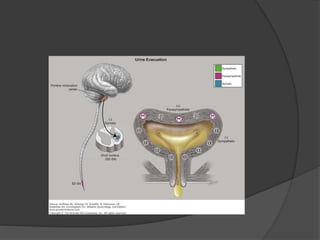
Uro + Dynamics
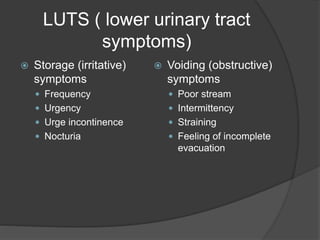
LUTS ( lower urinary tract
symptoms)
 Storage (irritative)
symptoms
 Frequency
 Urgency
 Urge incontinence
 Nocturia
 Voiding (obstructive)
symptoms
 Poor stream
 Intermittency
 Straining
 Feeling of incomplete
evacuation
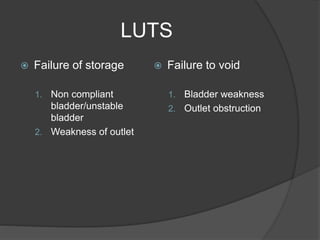
LUTS
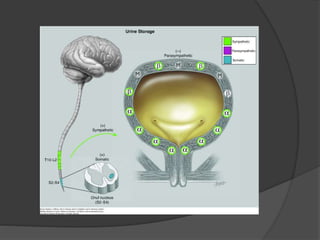
 Failure of storage
1. Non compliant
bladder/unstable
bladder
2. Weakness of outlet
 Failure to void
1. Bladder weakness
2. Outlet obstruction
COMMON INDICATION OF
URO-DYNAMICS
1. Young male patient with LUTS not responding to
medical treatment.
2. BPH patients with history of prolonged diabetes
mellitus and suspected diabetic cystopathy.
3. BPH patients with history of neurologic illness eg.
parkinsonism, cerebro vascular accident etc
4. Female patients with confusing mix of stress and
urge incontinence to guide appropriate therapy.
5. Children with spinal dysraphism.
6. Neurogenic bladder dysfunction to guide
appropriate therapy
COMPONENT OF
URODYNAMIC STUDY
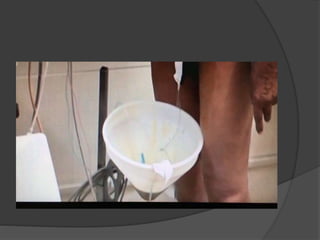
1. Uro flowmetry
2. PVR (post void residual urine) assessment
3. Cystometrography ( CMG)
4. Pressure flow study
5. Electrometrography (EMG)
 Urethral pressure profile
 Video urodynamic study
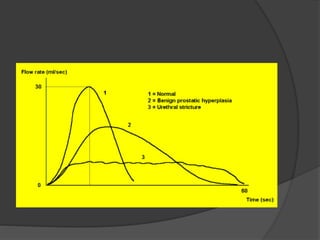
Uro flowmetry
 Measurement of
urine flow rate
overtime.
1. Voided volume
2. Maximum flow rate
3. Average flow rate
4. Flow time
5. Time to maximum
flow
Cystometrography
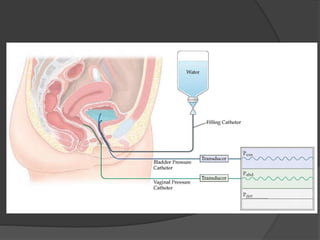
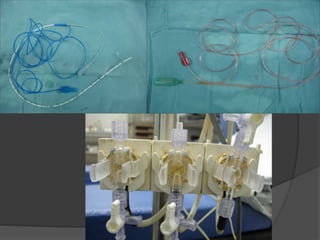
 Double lumen catheter in put per-urethrally
for bladder filling and vesicle pressure
measurement
 Rectal balloon catheter is put in the rectum
for intrabdominal pressure measurement.
 Bladder is filled slowely by filling cathetar
and change in intravesical pressure with
bladder filling is plotted on computer
screen.
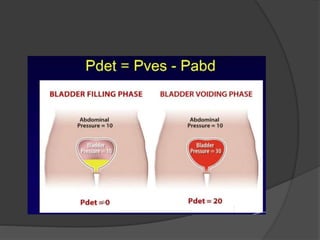
 Detrussor pressure Pdet = Pves- Pabd
Electromyography ( EMG)
 Measurement of electronic potential of
striated sphincter muscle during bladder
filling and bladder emptying.
 It is measured by electrode placed on
muscle (surface electrode) or insrted in
the sphicter muscle (needle electrode).
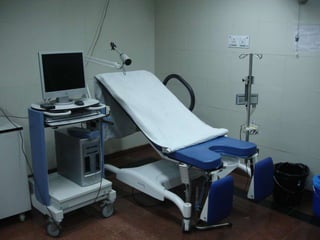
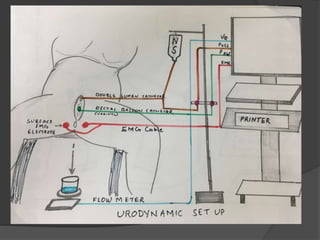
URODYNAMIC EQUIPMENT
AND SET UP
1. Urodynamic table /couch
2. Cathetars (double lumen cathetar for bladder
filling/ intravesical presuure measurement and
rectal balloon cathetar for intra abdominal
pressure measurement)
3. Pressure transducers and EMG electrodes
4. Uro flowmeter
5. Display monitor and printer
6. Computer software programme installed on
PC– for secure storage of pressure and fow
measurement data
PREREQUISITE FOR
URODYNAMIC STUDY
 Uro-dynamic question – one should
have specific question in mind which
urologist want to know in that particular
patient.
 Urine culture should be sterile.
 Severe constipation should be treated.
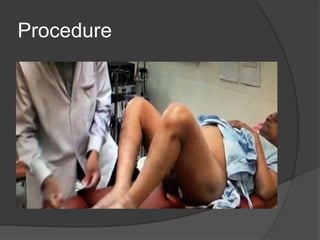
Procedure
Filling phase results - CMG
 First desire
 Normal desire
 Strong desire
 Urgency
 Maximum cystometric capacity
 Urine leakage
 Compliance = P/V
 End filling detrussor pressure
Voiding phase results - PFS
 Peak flow rate
 Pdet at Q max
 Maximum detrussor pressor
 Post void residual urine
 Nomograms - obstrcted/non obstructed
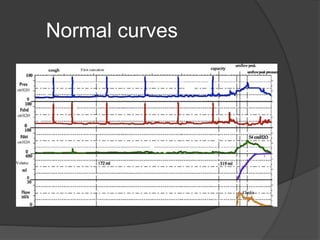
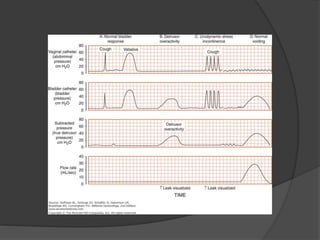
Normal curves
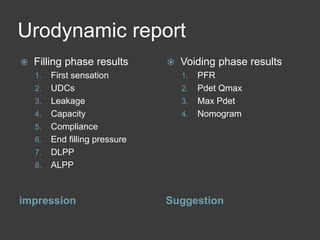
Urodynamic report
impression Suggestion
 Filling phase results
1. First sensation
2. UDCs
3. Leakage
4. Capacity
5. Compliance
6. End filling pressure
7. DLPP
8. ALPP
 Voiding phase results
1. PFR
2. Pdet Qmax
3. Max Pdet
4. Nomogram
Thank you

Urodynamics

  • 1.
    Dr Santosh Agrawal ChiefUrologist and Transplant Surgeon Bansal hospital, Bhopal, MP
  • 2.
  • 7.
    LUTS ( lowerurinary tract symptoms)  Storage (irritative) symptoms  Frequency  Urgency  Urge incontinence  Nocturia  Voiding (obstructive) symptoms  Poor stream  Intermittency  Straining  Feeling of incomplete evacuation
  • 8.
    LUTS  Failure ofstorage 1. Non compliant bladder/unstable bladder 2. Weakness of outlet  Failure to void 1. Bladder weakness 2. Outlet obstruction
  • 9.
    COMMON INDICATION OF URO-DYNAMICS 1.Young male patient with LUTS not responding to medical treatment. 2. BPH patients with history of prolonged diabetes mellitus and suspected diabetic cystopathy. 3. BPH patients with history of neurologic illness eg. parkinsonism, cerebro vascular accident etc 4. Female patients with confusing mix of stress and urge incontinence to guide appropriate therapy. 5. Children with spinal dysraphism. 6. Neurogenic bladder dysfunction to guide appropriate therapy
  • 10.
    COMPONENT OF URODYNAMIC STUDY 1.Uro flowmetry 2. PVR (post void residual urine) assessment 3. Cystometrography ( CMG) 4. Pressure flow study 5. Electrometrography (EMG)  Urethral pressure profile  Video urodynamic study
  • 11.
    Uro flowmetry  Measurementof urine flow rate overtime. 1. Voided volume 2. Maximum flow rate 3. Average flow rate 4. Flow time 5. Time to maximum flow
  • 13.
    Cystometrography  Double lumencatheter in put per-urethrally for bladder filling and vesicle pressure measurement  Rectal balloon catheter is put in the rectum for intrabdominal pressure measurement.  Bladder is filled slowely by filling cathetar and change in intravesical pressure with bladder filling is plotted on computer screen.  Detrussor pressure Pdet = Pves- Pabd
  • 16.
    Electromyography ( EMG) Measurement of electronic potential of striated sphincter muscle during bladder filling and bladder emptying.  It is measured by electrode placed on muscle (surface electrode) or insrted in the sphicter muscle (needle electrode).
  • 17.
    URODYNAMIC EQUIPMENT AND SETUP 1. Urodynamic table /couch 2. Cathetars (double lumen cathetar for bladder filling/ intravesical presuure measurement and rectal balloon cathetar for intra abdominal pressure measurement) 3. Pressure transducers and EMG electrodes 4. Uro flowmeter 5. Display monitor and printer 6. Computer software programme installed on PC– for secure storage of pressure and fow measurement data
  • 21.
    PREREQUISITE FOR URODYNAMIC STUDY Uro-dynamic question – one should have specific question in mind which urologist want to know in that particular patient.  Urine culture should be sterile.  Severe constipation should be treated.
  • 23.
  • 24.
    Filling phase results- CMG  First desire  Normal desire  Strong desire  Urgency  Maximum cystometric capacity  Urine leakage  Compliance = P/V  End filling detrussor pressure
  • 26.
    Voiding phase results- PFS  Peak flow rate  Pdet at Q max  Maximum detrussor pressor  Post void residual urine  Nomograms - obstrcted/non obstructed
  • 27.
  • 30.
    Urodynamic report impression Suggestion Filling phase results 1. First sensation 2. UDCs 3. Leakage 4. Capacity 5. Compliance 6. End filling pressure 7. DLPP 8. ALPP  Voiding phase results 1. PFR 2. Pdet Qmax 3. Max Pdet 4. Nomogram
  • 31.

Editor's Notes

  • #12 It is an imporatnt component of urodynamic study. It gives an idea of bladder emptying pattern. Multiple parameters can be reporterd in uroflowmetry. Eg;
  • #14 Main component of urodynamic study Pressure/volume relationship of the bladder is measured during bladder filling.
  • #18 Urodynamic set up consist of following components: Urodynamic table and machine is set up in a small room of appropriate size. There should be adequate privacy in the room so that unneccesary dissturbances during study can be avoided. Set up consist of of following component
  • #22 Urodynamic question should be pertinent to patients LUTS and should help in managing voiding dysfunction in patient. History and examination should be done in details before starting the study.