Bessel’s equation and Orthogonality
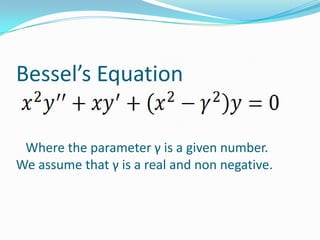
Bessel’s Equation   Where the parameter γis a given number.  We assume that γ is a real and non negative.
Bessel’s Function of the First kindConsider the Bessel’s EquationComparing withWe getWhich can not be expressed as a non negative powers of x, so they are not analytic but a(x)and b(x) are analytic  as they can be expressed as a non negative powers of x.So, Extended Power series method is applicable.
Consider Substituting into We get
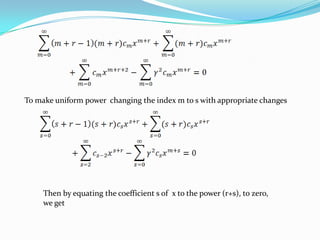
To make uniform power  changing the index m to s with appropriate changesThen by equating the coefficient s of  x to the power (r+s), to zero, we get
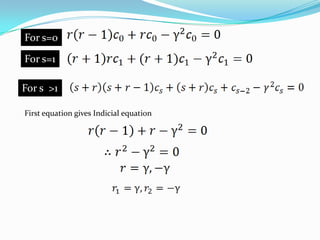
For s=0For s=1For s  >1First equation gives Indicial equation
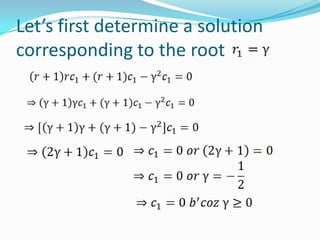
Let’s first determine a solution corresponding to the root
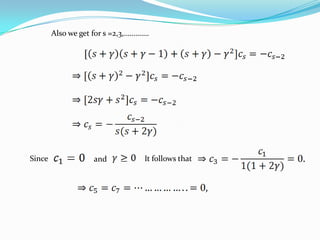
Also we get for s =2,3,…………. Since It follows that and
But for the even terms taking s=2m

Bessel’s equation

  • 1.
  • 2.
    Bessel’s Equation Where the parameter γis a given number. We assume that γ is a real and non negative.
  • 3.
    Bessel’s Function ofthe First kindConsider the Bessel’s EquationComparing withWe getWhich can not be expressed as a non negative powers of x, so they are not analytic but a(x)and b(x) are analytic as they can be expressed as a non negative powers of x.So, Extended Power series method is applicable.
  • 4.
  • 5.
    To make uniformpower changing the index m to s with appropriate changesThen by equating the coefficient s of x to the power (r+s), to zero, we get
  • 6.
    For s=0For s=1Fors >1First equation gives Indicial equation
  • 7.
    Let’s first determinea solution corresponding to the root
  • 8.
    Also we getfor s =2,3,…………. Since It follows that and
  • 9.
    But for theeven terms taking s=2m