By: Arijit Dhali
 Abstract
 Keywords
 Termology
 Introduction
 Power Series
 Legendre Polynomial
 Bessel’s Equation
 Conclusion
In this presentation , our aim
is to solve an infinite
convergent series using Power
series, Legendre Polynomial
and Bessel’s Equation.
Throughout this presentation
we will gather the basic
knowledge about the topic .
This presentation is a team
work and every member is
associated with this
presentation has collected the
data from various trusted
sources.
 Power Series
 Legendre Polynomial
 Bessel’s Equation
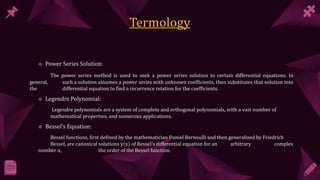
 Power Series Solution:
The power series method is used to seek a power series solution to certain differential equations. In
general, such a solution assumes a power series with unknown coefficients, then substitutes that solution into
the differential equation to find a recurrence relation for the coefficients.
 Legendre Polynomial:
Legendre polynomials are a system of complete and orthogonal polynomials, with a vast number of
mathematical properties, and numerous applications.
 Bessel’s Equation:
Bessel functions, first defined by the mathematician Daniel Bernoulli and then generalized by Friedrich
Bessel, are canonical solutions y(x) of Bessel's differential equation for an arbitrary complex
number α, the order of the Bessel function.
Sometimes we face some differential equations which cannot be solved by the ordinary methods.
For such equations an infinite convergent series arranged in ascending power of independent
variables satisfying the equation approximately.
Those equations could be easier to solve if we use one the followings:
 Power Series
 Legendre Polynomial
 Bessel’s Equation
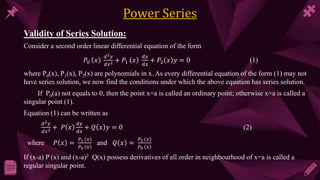
Validity of Series Solution:
Consider a second order linear differential equation of the form
𝑃0 𝑥
ⅆ2𝑦
ⅆ𝑥2 + 𝑃1 𝑥
ⅆ𝑦
ⅆ𝑥
+ 𝑃2 𝑥 𝑦 = 0 (1)
where P0(x), P1(x), P2(x) are polynomials in x. As every differential equation of the form (1) may not
have series solution, we now find the conditions under which the above equation has series solution.
If P0(a) not equals to 0, then the point x=a is called an ordinary point; otherwise x=a is called a
singular point (1).
Equation (1) can be written as
ⅆ2𝑦
ⅆ𝑥2 + 𝑃 𝑥
ⅆ𝑦
ⅆ𝑥
+ 𝑄 𝑥 𝑦 = 0 (2)
where 𝑃 𝑥 =
𝑃1 𝑥
𝑃0 𝑥
and 𝑄 𝑥 =
𝑃2 𝑥
𝑃0 𝑥
If (x-a) P (x) and (x-a)2 Q(x) possess derivatives of all order in neighbourhood of x=a is called a
regular singular point.
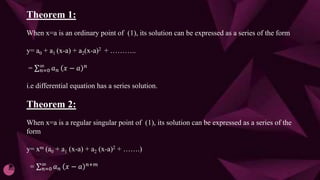
Theorem 1:
When x=a is an ordinary point of (1), its solution can be expressed as a series of the form
y= a0 + a1 (x-a) + a2(x-a)2 + ………..
= 𝑛=0
∞
𝑎𝑛 𝑥 − 𝑎 𝑛
i.e differential equation has a series solution.
Theorem 2:
When x=a is a regular singular point of (1), its solution can be expressed as a series of the
form
y= xm (a0 + a1 (x-a) + a2 (x-a)2 + …….)
= 𝑛=0
∞
𝑎𝑛 𝑥 − 𝑎 𝑛+𝑚
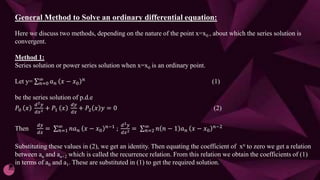
General Method to Solve an ordinary differential equation:
Here we discuss two methods, depending on the nature of the point x=x0 , about which the series solution is
convergent.
Method 1:
Series solution or power series solution when x=x0 is an ordinary point.
Let y= 𝑛=0
∞
𝑎𝑛 𝑥 − 𝑥0
𝑛
(1)
be the series solution of p.d.e
𝑃0 𝑥
ⅆ2𝑦
ⅆ𝑥2 + 𝑃1 𝑥
ⅆ𝑦
ⅆ𝑥
+ 𝑃2 𝑥 𝑦 = 0 (2)
Then
ⅆ𝑦
ⅆ𝑥
= 𝑛=1
∞
𝑛𝑎𝑛 𝑥 − 𝑥0
𝑛−1 ;
ⅆ2𝑦
ⅆ𝑥2 = 𝑛=2
∞
𝑛 𝑛 − 1 𝑎𝑛 𝑥 − 𝑥0
𝑛−2
Substituting these values in (2), we get an identity. Then equating the coefficient of xn to zero we get a relation
between an and an+2 which is called the recurrence relation. From this relation we obtain the coefficients of (1)
in terms of a0 and a1. These are substituted in (1) to get the required solution.
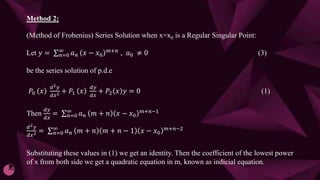
Method 2:
(Method of Frobenius) Series Solution when x=x0 is a Regular Singular Point:
Let 𝑦 = 𝑛=0
∞
𝑎𝑛 𝑥 − 𝑥0
𝑚+𝑛
, 𝑎0 ≠ 0 (3)
be the series solution of p.d.e
𝑃0 𝑥
ⅆ2𝑦
ⅆ𝑥2 + 𝑃1 𝑥
ⅆ𝑦
ⅆ𝑥
+ 𝑃2 𝑥 𝑦 = 0 (1)
Then
ⅆ𝑦
ⅆ𝑥
= 𝑛=0
∞
𝑎𝑛 𝑚 + 𝑛 𝑥 − 𝑥0
𝑚+𝑛−1
ⅆ2𝑦
ⅆ𝑥2 = 𝑛=0
∞
𝑎𝑛 𝑚 + 𝑛 𝑚 + 𝑛 − 1 𝑥 − 𝑥0
𝑚+𝑛−2
Substituting these values in (1) we get an identity. Then the coefficient of the lowest power
of x from both side we get a quadratic equation in m, known as indicial equation.
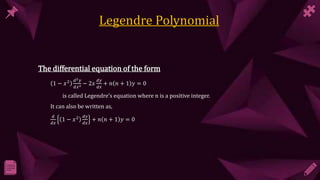
The differential equation of the form
1 − 𝑥2 ⅆ2𝑦
ⅆ𝑥2 − 2𝑥
ⅆ𝑦
ⅆ𝑥
+ 𝑛 𝑛 + 1 𝑦 = 0
is called Legendre’s equation where n is a positive integer.
It can also be written as,
ⅆ
ⅆ𝑥
1 − 𝑥2 ⅆ𝑦
ⅆ𝑥
+ 𝑛 𝑛 + 1 𝑦 = 0
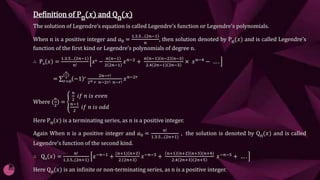
Definition of Pn(𝒙) and Qn(𝒙)
The solution of Legendre’s equation is called Legendre’s function or Legendre’s polynomials.
When n is a positive integer and 𝑎0 =
1.3.5… 2𝑛−1
𝑛
, then solution denoted by Pn(𝑥) and is called Legendre’s
function of the first kind or Legendre’s polynomials of degree n.
∴ Pn 𝑥 =
1.3.5… 2𝑛−1
𝑛!
𝑥𝑛 −
𝑛 𝑛−1
2 2𝑛−1
𝑥𝑛−2 +
𝑛 𝑛−1 𝑛−2 𝑛−3
2.4 2𝑛−1 2𝑛−3
× 𝑥𝑛−4 − … .
= 𝑟=0
(
𝑛
2
)
−1 𝑟 2𝑛−𝑟!
2𝑛 𝑟 𝑛−2𝑟! 𝑛−𝑟!
𝑥𝑛−2𝑟
Where (
𝑛
2
) =
𝑛
2
𝑖𝑓 𝑛 𝑖𝑠 𝑒𝑣𝑒𝑛
𝑛−1
2
𝑖𝑓 𝑛 𝑖𝑠 𝑜𝑑𝑑
Here Pn(𝑥) is a terminating series, as n is a positive integer.
Again When n is a positive integer and 𝑎0 =
𝑛!
1.3.5…(2𝑛+1)
, the solution is denoted by Qn(𝑥) and is called
Legendre’s function of the second kind.
∴ Qn 𝑥 =
𝑛!
1.3.5..(2𝑛+1)
𝑥−𝑛−1
+
(𝑛+1) 𝑛+2
2. 2𝑛+3
𝑥−𝑛−3
+
𝑛+1 𝑛+2 𝑛+3 (𝑛+4)
2.4 2𝑛+3 2𝑛+5
𝑥−𝑛−5
+ … .
Here Qn(𝑥) is an infinite or non-terminating series, as n is a positive integer.
Generating function for Legendre polynomials
Theorem. Pn(𝑥) is the coefficient of ℎ𝑛 in the expansion of (1-2𝑥h+ℎ2)
−
1
2 in ascending powers of h, where
𝑥 ≤ 1, |ℎ| < 1.
Proof. Since |𝑥|≤ 1, |ℎ| < 1, we have
(1-2𝑥h+ℎ2
)
−
1
2 = [1-h(2𝑥 − ℎ)] −
1
2
= 1+
1
2
ℎ 2𝑥 − ℎ +
1.3
2.4
ℎ2
2𝑥 − ℎ 2 +⋯ +
1.3… 2𝑛−3
2.4… 2𝑛−2
× ℎ𝑛−1
2𝑥 − ℎ 𝑛−1
+
1.3… 2𝑛−1
2.4…2𝑛
ℎ𝑛
2𝑥 − ℎ 𝑛
+ ⋯
Therefore coefficient of ℎ𝑛
=
1.3…(2𝑛−1)
2.4…2𝑛
(2𝑥)𝑛
+
1.3… 2𝑛−3
2.4… 2𝑛−2
𝑛 − 1𝐶1
−1 . (2𝑥)𝑛−2
+
1.3…(2𝑛−5)
2.4…(2𝑛−4)
𝑛 − 2𝐶2
(−1)2
. (2𝑥)𝑛−4
+ ⋯ … (1)
=
1.3…(2𝑛−1)
𝑛!
𝑥𝑛 −
2𝑛
2𝑛−1
𝑛 − 1 .
𝑥𝑛−2
22 +
2𝑛 2𝑛−1
2𝑛−1 2𝑛−3
×
𝑛−2 𝑛−3
2!
.
𝑥𝑛−4
24 − ⋯
=
1.3…(2𝑛−1)
𝑛!
𝑥𝑛 −
𝑛 𝑛−1
2 2𝑥−1
𝑥𝑛−2 +
𝑛 𝑛−1 𝑛−2 𝑛−3
2.4 2𝑛−1 2𝑛−2
𝑥𝑛−4 − ⋯
= Pn(𝑥)
Thus we can say that
𝑛=0
∝
ℎ𝑛Pn(𝑥) = (1−2𝑥h+ℎ2)
−
1
2
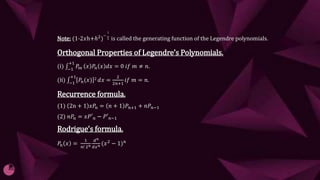
Note: (1-2𝑥h+ℎ2
)
−
1
2 is called the generating function of the Legendre polynomials.
Orthogonal Properties of Legendre’s Polynomials.
(𝔦) −1
+1
𝑃𝑚 𝑥 𝑃𝑛 𝑥 𝑑𝑥 = 0 𝑖𝑓 𝑚 ≠ 𝑛.
(𝔦𝔦) −1
+1
𝑃𝑛(𝑥) 2 𝑑𝑥 =
2
2𝑛+1
𝑖𝑓 𝑚 = 𝑛.
Recurrence formula.
(1) 2n + 1 𝑥𝑃𝑛 = 𝑛 + 1 𝑃𝑛+1 + 𝑛𝑃𝑛−1
(2) 𝑛𝑃𝑛 = 𝑥𝑃′𝑛 − 𝑃′𝑛−1
Rodrigue’s formula.
𝑃𝑛 𝑥 =
1
𝑛! 2𝑛
ⅆ𝑛
ⅆ𝑥𝑛 (𝑥2 − 1)𝑛
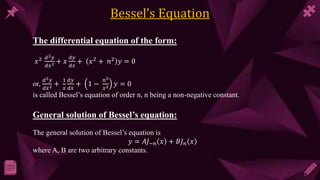
General solution of Bessel’s equation:
The general solution of Bessel’s equation is
𝑦 = 𝐴𝐽−𝑛 𝑥 + 𝐵𝐽𝑛 𝑥
where A, B are two arbitrary constants.
The differential equation of the form:
𝑥2 ⅆ2𝑦
ⅆ𝑥2 + 𝑥
ⅆ𝑦
ⅆ𝑥
+ 𝑥2 + 𝑛2 𝑦 = 0
or,
ⅆ2𝑦
ⅆ𝑥2 +
1
𝑥
ⅆ𝑦
ⅆ𝑥
+ 1 −
𝑛2
𝑥2 𝑦 = 0
is called Bessel’s equation of order n, n being a non-negative constant.
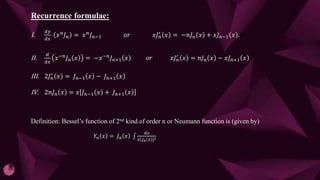
Recurrence formulae:
I.
ⅆ𝑦
ⅆ𝑥
𝑥𝑛𝐽𝑛 = 𝑥𝑛𝐽𝑛−1 𝑜𝑟 𝑥𝐽𝑛
′ 𝑥 = −𝑛𝐽𝑛 𝑥 + 𝑥𝐽𝑛−1 𝑥 .
II.
ⅆ
ⅆ𝑥
𝑥−𝑛
𝐽𝑛 𝑥 = −𝑥−𝑛
𝐽𝑛+1 𝑥 𝑜𝑟 𝑥𝐽𝑛
′
𝑥 = 𝑛𝐽𝑛 𝑥 − 𝑥𝐽𝑛+1 𝑥
III. 2𝐽𝑛
′ 𝑥 = 𝐽𝑛−1 𝑥 − 𝐽𝑛+1 𝑥
IV. 2𝑛𝐽𝑛 𝑥 = 𝑥 𝐽𝑛−1 𝑥 + 𝐽𝑛+1 𝑥
Definition: Bessel’s function of 2nd kind of order n or Neumann function is (given by)
𝑌𝑛 𝑥 = 𝐽𝑛 𝑥
ⅆ𝑥
𝑥 𝐽𝑛 𝑥 2
This project has been beneficial for us , as it enabled us to gain a lot of knowledge about the use of
Power Series , Legendre Polynomial and Bessel’s Equation as well as its applications. It also helped
us to develop a better coordination among us as we shared different perspectives and ideas
regarding the sub-topics and equations we organized in this project .
• https://en.wikipedia.org/wiki/Legendre_polynomials
• https://en.wikipedia.org/wiki/Bessel_function
• https://en.wikipedia.org/wiki/Power_series_solution_of_diff
erential_equations
• Engineering Mathematics II B – B.K.Pal & K.Das
Power Series - Legendre Polynomial - Bessel's Equation

Power Series - Legendre Polynomial - Bessel's Equation

  • 1.
  • 2.
     Abstract  Keywords Termology  Introduction  Power Series  Legendre Polynomial  Bessel’s Equation  Conclusion
  • 3.
    In this presentation, our aim is to solve an infinite convergent series using Power series, Legendre Polynomial and Bessel’s Equation. Throughout this presentation we will gather the basic knowledge about the topic . This presentation is a team work and every member is associated with this presentation has collected the data from various trusted sources.
  • 4.
     Power Series Legendre Polynomial  Bessel’s Equation
  • 5.
     Power SeriesSolution: The power series method is used to seek a power series solution to certain differential equations. In general, such a solution assumes a power series with unknown coefficients, then substitutes that solution into the differential equation to find a recurrence relation for the coefficients.  Legendre Polynomial: Legendre polynomials are a system of complete and orthogonal polynomials, with a vast number of mathematical properties, and numerous applications.  Bessel’s Equation: Bessel functions, first defined by the mathematician Daniel Bernoulli and then generalized by Friedrich Bessel, are canonical solutions y(x) of Bessel's differential equation for an arbitrary complex number α, the order of the Bessel function.
  • 6.
    Sometimes we facesome differential equations which cannot be solved by the ordinary methods. For such equations an infinite convergent series arranged in ascending power of independent variables satisfying the equation approximately. Those equations could be easier to solve if we use one the followings:  Power Series  Legendre Polynomial  Bessel’s Equation
  • 7.
    Validity of SeriesSolution: Consider a second order linear differential equation of the form 𝑃0 𝑥 ⅆ2𝑦 ⅆ𝑥2 + 𝑃1 𝑥 ⅆ𝑦 ⅆ𝑥 + 𝑃2 𝑥 𝑦 = 0 (1) where P0(x), P1(x), P2(x) are polynomials in x. As every differential equation of the form (1) may not have series solution, we now find the conditions under which the above equation has series solution. If P0(a) not equals to 0, then the point x=a is called an ordinary point; otherwise x=a is called a singular point (1). Equation (1) can be written as ⅆ2𝑦 ⅆ𝑥2 + 𝑃 𝑥 ⅆ𝑦 ⅆ𝑥 + 𝑄 𝑥 𝑦 = 0 (2) where 𝑃 𝑥 = 𝑃1 𝑥 𝑃0 𝑥 and 𝑄 𝑥 = 𝑃2 𝑥 𝑃0 𝑥 If (x-a) P (x) and (x-a)2 Q(x) possess derivatives of all order in neighbourhood of x=a is called a regular singular point.
  • 8.
    Theorem 1: When x=ais an ordinary point of (1), its solution can be expressed as a series of the form y= a0 + a1 (x-a) + a2(x-a)2 + ……….. = 𝑛=0 ∞ 𝑎𝑛 𝑥 − 𝑎 𝑛 i.e differential equation has a series solution. Theorem 2: When x=a is a regular singular point of (1), its solution can be expressed as a series of the form y= xm (a0 + a1 (x-a) + a2 (x-a)2 + …….) = 𝑛=0 ∞ 𝑎𝑛 𝑥 − 𝑎 𝑛+𝑚
  • 9.
    General Method toSolve an ordinary differential equation: Here we discuss two methods, depending on the nature of the point x=x0 , about which the series solution is convergent. Method 1: Series solution or power series solution when x=x0 is an ordinary point. Let y= 𝑛=0 ∞ 𝑎𝑛 𝑥 − 𝑥0 𝑛 (1) be the series solution of p.d.e 𝑃0 𝑥 ⅆ2𝑦 ⅆ𝑥2 + 𝑃1 𝑥 ⅆ𝑦 ⅆ𝑥 + 𝑃2 𝑥 𝑦 = 0 (2) Then ⅆ𝑦 ⅆ𝑥 = 𝑛=1 ∞ 𝑛𝑎𝑛 𝑥 − 𝑥0 𝑛−1 ; ⅆ2𝑦 ⅆ𝑥2 = 𝑛=2 ∞ 𝑛 𝑛 − 1 𝑎𝑛 𝑥 − 𝑥0 𝑛−2 Substituting these values in (2), we get an identity. Then equating the coefficient of xn to zero we get a relation between an and an+2 which is called the recurrence relation. From this relation we obtain the coefficients of (1) in terms of a0 and a1. These are substituted in (1) to get the required solution.
  • 10.
    Method 2: (Method ofFrobenius) Series Solution when x=x0 is a Regular Singular Point: Let 𝑦 = 𝑛=0 ∞ 𝑎𝑛 𝑥 − 𝑥0 𝑚+𝑛 , 𝑎0 ≠ 0 (3) be the series solution of p.d.e 𝑃0 𝑥 ⅆ2𝑦 ⅆ𝑥2 + 𝑃1 𝑥 ⅆ𝑦 ⅆ𝑥 + 𝑃2 𝑥 𝑦 = 0 (1) Then ⅆ𝑦 ⅆ𝑥 = 𝑛=0 ∞ 𝑎𝑛 𝑚 + 𝑛 𝑥 − 𝑥0 𝑚+𝑛−1 ⅆ2𝑦 ⅆ𝑥2 = 𝑛=0 ∞ 𝑎𝑛 𝑚 + 𝑛 𝑚 + 𝑛 − 1 𝑥 − 𝑥0 𝑚+𝑛−2 Substituting these values in (1) we get an identity. Then the coefficient of the lowest power of x from both side we get a quadratic equation in m, known as indicial equation.
  • 11.
    The differential equationof the form 1 − 𝑥2 ⅆ2𝑦 ⅆ𝑥2 − 2𝑥 ⅆ𝑦 ⅆ𝑥 + 𝑛 𝑛 + 1 𝑦 = 0 is called Legendre’s equation where n is a positive integer. It can also be written as, ⅆ ⅆ𝑥 1 − 𝑥2 ⅆ𝑦 ⅆ𝑥 + 𝑛 𝑛 + 1 𝑦 = 0
  • 12.
    Definition of Pn(𝒙)and Qn(𝒙) The solution of Legendre’s equation is called Legendre’s function or Legendre’s polynomials. When n is a positive integer and 𝑎0 = 1.3.5… 2𝑛−1 𝑛 , then solution denoted by Pn(𝑥) and is called Legendre’s function of the first kind or Legendre’s polynomials of degree n. ∴ Pn 𝑥 = 1.3.5… 2𝑛−1 𝑛! 𝑥𝑛 − 𝑛 𝑛−1 2 2𝑛−1 𝑥𝑛−2 + 𝑛 𝑛−1 𝑛−2 𝑛−3 2.4 2𝑛−1 2𝑛−3 × 𝑥𝑛−4 − … . = 𝑟=0 ( 𝑛 2 ) −1 𝑟 2𝑛−𝑟! 2𝑛 𝑟 𝑛−2𝑟! 𝑛−𝑟! 𝑥𝑛−2𝑟 Where ( 𝑛 2 ) = 𝑛 2 𝑖𝑓 𝑛 𝑖𝑠 𝑒𝑣𝑒𝑛 𝑛−1 2 𝑖𝑓 𝑛 𝑖𝑠 𝑜𝑑𝑑 Here Pn(𝑥) is a terminating series, as n is a positive integer. Again When n is a positive integer and 𝑎0 = 𝑛! 1.3.5…(2𝑛+1) , the solution is denoted by Qn(𝑥) and is called Legendre’s function of the second kind. ∴ Qn 𝑥 = 𝑛! 1.3.5..(2𝑛+1) 𝑥−𝑛−1 + (𝑛+1) 𝑛+2 2. 2𝑛+3 𝑥−𝑛−3 + 𝑛+1 𝑛+2 𝑛+3 (𝑛+4) 2.4 2𝑛+3 2𝑛+5 𝑥−𝑛−5 + … . Here Qn(𝑥) is an infinite or non-terminating series, as n is a positive integer.
  • 13.
    Generating function forLegendre polynomials Theorem. Pn(𝑥) is the coefficient of ℎ𝑛 in the expansion of (1-2𝑥h+ℎ2) − 1 2 in ascending powers of h, where 𝑥 ≤ 1, |ℎ| < 1. Proof. Since |𝑥|≤ 1, |ℎ| < 1, we have (1-2𝑥h+ℎ2 ) − 1 2 = [1-h(2𝑥 − ℎ)] − 1 2 = 1+ 1 2 ℎ 2𝑥 − ℎ + 1.3 2.4 ℎ2 2𝑥 − ℎ 2 +⋯ + 1.3… 2𝑛−3 2.4… 2𝑛−2 × ℎ𝑛−1 2𝑥 − ℎ 𝑛−1 + 1.3… 2𝑛−1 2.4…2𝑛 ℎ𝑛 2𝑥 − ℎ 𝑛 + ⋯ Therefore coefficient of ℎ𝑛 = 1.3…(2𝑛−1) 2.4…2𝑛 (2𝑥)𝑛 + 1.3… 2𝑛−3 2.4… 2𝑛−2 𝑛 − 1𝐶1 −1 . (2𝑥)𝑛−2 + 1.3…(2𝑛−5) 2.4…(2𝑛−4) 𝑛 − 2𝐶2 (−1)2 . (2𝑥)𝑛−4 + ⋯ … (1) = 1.3…(2𝑛−1) 𝑛! 𝑥𝑛 − 2𝑛 2𝑛−1 𝑛 − 1 . 𝑥𝑛−2 22 + 2𝑛 2𝑛−1 2𝑛−1 2𝑛−3 × 𝑛−2 𝑛−3 2! . 𝑥𝑛−4 24 − ⋯ = 1.3…(2𝑛−1) 𝑛! 𝑥𝑛 − 𝑛 𝑛−1 2 2𝑥−1 𝑥𝑛−2 + 𝑛 𝑛−1 𝑛−2 𝑛−3 2.4 2𝑛−1 2𝑛−2 𝑥𝑛−4 − ⋯ = Pn(𝑥) Thus we can say that 𝑛=0 ∝ ℎ𝑛Pn(𝑥) = (1−2𝑥h+ℎ2) − 1 2
  • 14.
    Note: (1-2𝑥h+ℎ2 ) − 1 2 iscalled the generating function of the Legendre polynomials. Orthogonal Properties of Legendre’s Polynomials. (𝔦) −1 +1 𝑃𝑚 𝑥 𝑃𝑛 𝑥 𝑑𝑥 = 0 𝑖𝑓 𝑚 ≠ 𝑛. (𝔦𝔦) −1 +1 𝑃𝑛(𝑥) 2 𝑑𝑥 = 2 2𝑛+1 𝑖𝑓 𝑚 = 𝑛. Recurrence formula. (1) 2n + 1 𝑥𝑃𝑛 = 𝑛 + 1 𝑃𝑛+1 + 𝑛𝑃𝑛−1 (2) 𝑛𝑃𝑛 = 𝑥𝑃′𝑛 − 𝑃′𝑛−1 Rodrigue’s formula. 𝑃𝑛 𝑥 = 1 𝑛! 2𝑛 ⅆ𝑛 ⅆ𝑥𝑛 (𝑥2 − 1)𝑛
  • 15.
    General solution ofBessel’s equation: The general solution of Bessel’s equation is 𝑦 = 𝐴𝐽−𝑛 𝑥 + 𝐵𝐽𝑛 𝑥 where A, B are two arbitrary constants. The differential equation of the form: 𝑥2 ⅆ2𝑦 ⅆ𝑥2 + 𝑥 ⅆ𝑦 ⅆ𝑥 + 𝑥2 + 𝑛2 𝑦 = 0 or, ⅆ2𝑦 ⅆ𝑥2 + 1 𝑥 ⅆ𝑦 ⅆ𝑥 + 1 − 𝑛2 𝑥2 𝑦 = 0 is called Bessel’s equation of order n, n being a non-negative constant.
  • 16.
    Recurrence formulae: I. ⅆ𝑦 ⅆ𝑥 𝑥𝑛𝐽𝑛 =𝑥𝑛𝐽𝑛−1 𝑜𝑟 𝑥𝐽𝑛 ′ 𝑥 = −𝑛𝐽𝑛 𝑥 + 𝑥𝐽𝑛−1 𝑥 . II. ⅆ ⅆ𝑥 𝑥−𝑛 𝐽𝑛 𝑥 = −𝑥−𝑛 𝐽𝑛+1 𝑥 𝑜𝑟 𝑥𝐽𝑛 ′ 𝑥 = 𝑛𝐽𝑛 𝑥 − 𝑥𝐽𝑛+1 𝑥 III. 2𝐽𝑛 ′ 𝑥 = 𝐽𝑛−1 𝑥 − 𝐽𝑛+1 𝑥 IV. 2𝑛𝐽𝑛 𝑥 = 𝑥 𝐽𝑛−1 𝑥 + 𝐽𝑛+1 𝑥 Definition: Bessel’s function of 2nd kind of order n or Neumann function is (given by) 𝑌𝑛 𝑥 = 𝐽𝑛 𝑥 ⅆ𝑥 𝑥 𝐽𝑛 𝑥 2
  • 17.
    This project hasbeen beneficial for us , as it enabled us to gain a lot of knowledge about the use of Power Series , Legendre Polynomial and Bessel’s Equation as well as its applications. It also helped us to develop a better coordination among us as we shared different perspectives and ideas regarding the sub-topics and equations we organized in this project .
  • 18.
    • https://en.wikipedia.org/wiki/Legendre_polynomials • https://en.wikipedia.org/wiki/Bessel_function •https://en.wikipedia.org/wiki/Power_series_solution_of_diff erential_equations • Engineering Mathematics II B – B.K.Pal & K.Das