BENIGN
PROSTATIC
ENLARGEMENT
Kanchan Kusatha
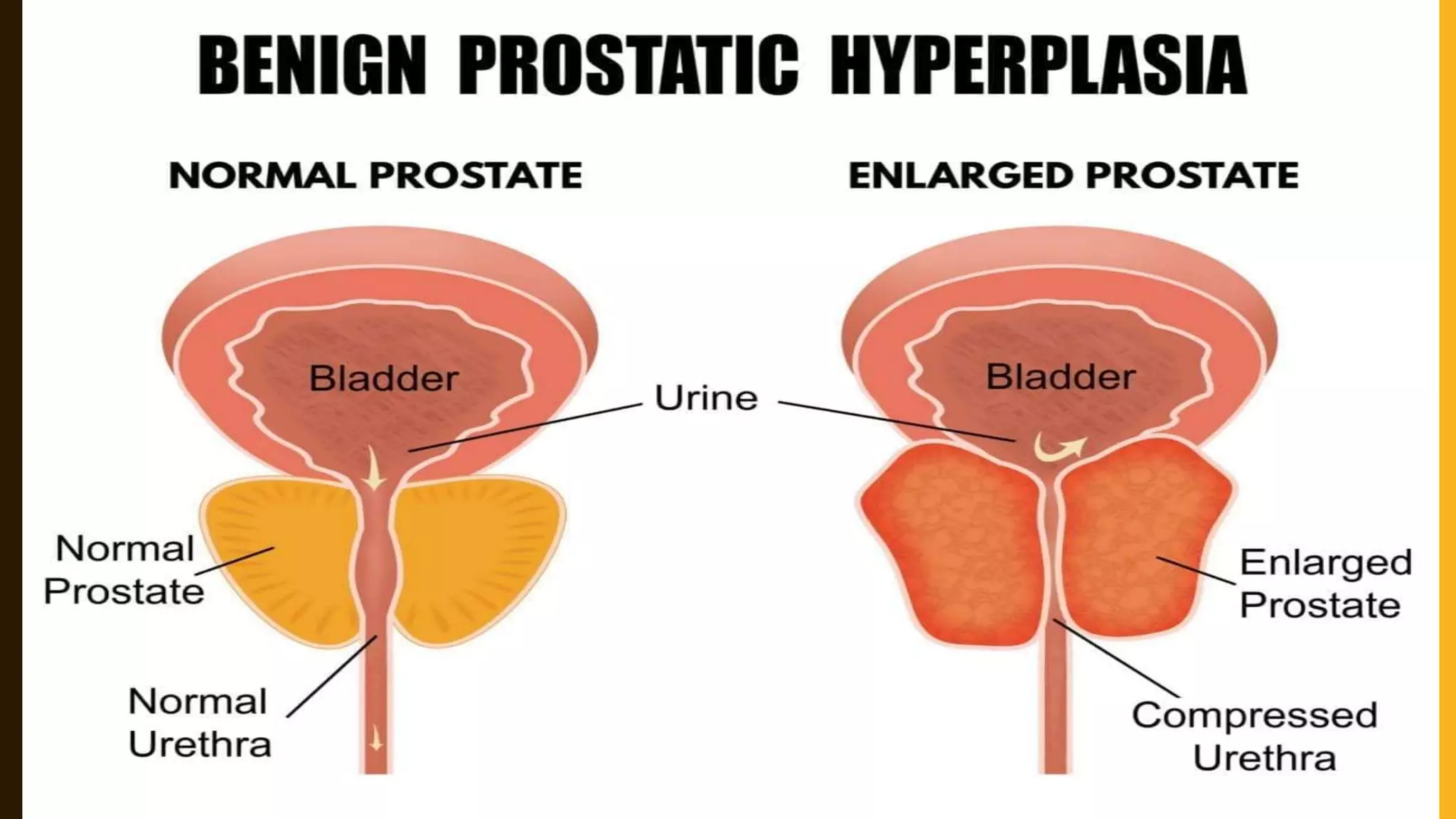
Benign Prostatic Enlargement is common disease in
aging men.
Is a non cancerous enlargement or hypertrophy of the
prostate gland.
When prostate enlarges, then it can squeeze down on
urethra and impede (slow) the flow of urine.
It is also known as benign prostatic hyperplasia and
abbreviated as BPH
Etiology
•Unknown (Idiopathic)
•Risk Factor
–Aging >40 YR
–Family history
–Ethnic background
Prostate enlargement is less common in Asian
men than in white and black men
CONT.….
–Diabetes, Heart Disease and Cirrhosis Of Liver
–Lifestyle:
oObesity increases the risk of BPH
oPhysical inactivity
oDietary factors
PATHOPHYSIOLOGY
Clinical Manifestation
Less Common Signs And Symptoms Include
• Blood in the urine
• Fatigue
• Anorexia
• Nausea and vomiting
• Pelvic discomfort
Diagnosis
• History taking; includes specific question about day
time voiding, frequency, nocturia, urgency.
Digital
Rectal
Examination
CONT.….
• Urine analysis and urine C/S
• Intravenous Pyelogram
• Prostate-Specific Antigen (PSA) test:
–PSA is a protein made only by the prostate gland. PSA
level above 4.0 ng/mL.
• Transrectal prostatic ultrasound
Medical Management
Medication classes for BPH management are alpha
adrenergic blockers and 5α-reductase inhibitors.
1. Alpha adrenergic blockers
–it is most common choice for initial therapy like
alfuzosin, doxazosin.
–Alpha blockers relax smooth muscle in the prostate
and the bladder neck, thus decreasing the blockage
of urine flow
CONT.….
2. 5α-Reductase inhibitors:
–Finasteride and Dutasteride are used for BPH.
–These medications inhibit the 5α-reductase enzyme,
which, in turn, inhibits production of DHT
{dihydrotestosterone or androstanol one}, a
hormone responsible for enlarging the prostate
Relieve Retention:
• Immediate catheterization
• Voiding position: sitting position
Lifestyle:
–Decreasing fluid intake before bedtime
–Avoid alcohol, smoking, consumption
Surgical Management
Transurethral resection of prostate (TURP)
Remove excessive growth of the prostate gland,
resulting from Benign Prostatic Hyperplasia (BPH)
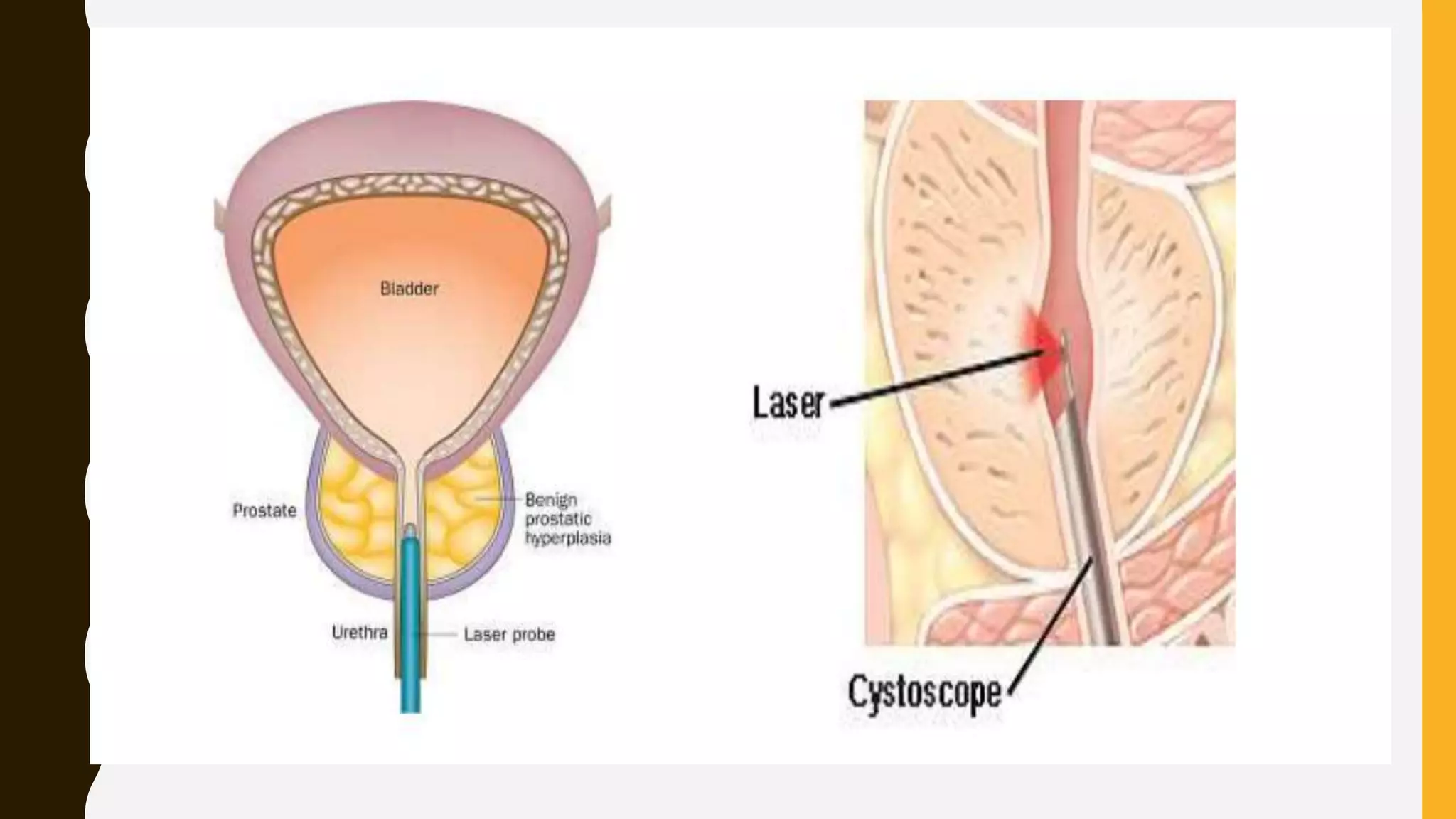
Laser PVP (Photo selective Vaporization of the
Prostate)
During laser PVP surgery, a tube with an imaging
system (cystoscope) is inserted into the penis. A
surgeon places a laser through the cystoscope to burn
away (vaporize) excess tissue that is blocking urine flow
through the prostate
Transurethral microwave therapy (TUMT)
It's generally used for men with small- to moderate-
sized prostates.
A small microwave antenna is inserted through tip of
the penis into the bladder (urethra).
The antenna emits a dose of microwave energy that
heats and destroys excess prostate tissue blocking
urine flow.
Transurethral needle ablation (TUNA)--
radiofrequency ablation
A combined visual and surgical
instrument(resectoscope) is inserted through the tip of
the penis.
Through which doctor guides a pair of tiny needles into
the prostate tissue that is pressing on the urethra.
Radio waves are then passed through the needles,
generating heat that creates scar tissue. Special shields
protect the urethra from the heat.
The scarring shrinks prostate tissue, allowing urine to
 Transurethral incision of the prostate (TUIP)
A combined visual and surgical instrument
(resectoscope) is inserted through the tip of the penis
into the tube that carries urine from the bladder
(urethra).
prostate that surrounds the urethra, cuts one or two
small grooves in the area where the prostate and the
bladder are connected (bladder neck) to open the
urinary channel and allow urine to pass through more
easily.
Nursing Management
Assessment
• Ask the patient to describe all urinary manifestation
• Assess the patient’s ability to empty his bladder
• After surgery assess vital signs and maintenance of
urinary drainage
• Assess the patient’s urine output
• Assess for the patency of urinary catheter
Nursing Diagnosis
• Impaired urinary elimination related to enlargement
of prostate as manifested by frequency, urgency.
• Acute pain related to surgery and bladder spasm.
• Risk for injury related to presence of urinary catheter,
hematuria, irrigation.
• Risk of deficient fluid volume related to renal
dysfunction.
Intervention
• Catheterize when the client has urinary difficulties
such as obstruction, urinary retention or diminished
renal function.
• Monitor urine output; it should be at least 0.5 ml/ kg/
hr.
• Maintain irrigation:
If obstruction is suspected, 60ml of irrigant can be
pushed manually and evacuate blood debris and
clot.
C O N T . …
• Monitor for bleeding:
Venous blood can be controlled by increasing the
pressure in the balloon.
If arterial bleeding is present then it need
immediate surgical intervention
• Prevent infection:
Keep the skin around the catheter site clean, dry and
protected.
C O N T. … . .
• Maintain a closed urinary drainage system until
manual irrigation is absolutely required.
• Perform voiding trial 1- 2 days before catheter
removal to prevent urinary retention.
• Antispasmodic drugs; oxybutynin should be given.
CONT.……
• Patient Teaching
Avoid prolong sitting as it increases intra-
abdominal pressure and precipitate bleeding.
Strenuous activities, prolong ride in automobiles is
contraindicated for 4-6 wks.
Avoid to strain during defecation for at least 6 wks.
C O N T. … .
Teach to tighten the pelvic muscle for 6-10 second
followed by rest period of equal duration. Begin with
5-10 exercise daily and gradually increase up to 25-30
daily.
Information and supportive care for the patient and
his partner for the uncommon complication of
prostectomy i.e. penile erectile dysfunction.
C O N T. …
• Follow up:
Ask the patient to report immediately for any
unusual bleeding, obstructed urine flow.
Provide teaching about date, time and place for
follow-up.
Complication
• Hydronephrosis
• Renal calculi
• Thickening diverticulation
• Impeded outflow of urine
• Acute or chronic renal failure

Benign prostatic enlargement

  • 1.
  • 3.
    Benign Prostatic Enlargementis common disease in aging men. Is a non cancerous enlargement or hypertrophy of the prostate gland. When prostate enlarges, then it can squeeze down on urethra and impede (slow) the flow of urine. It is also known as benign prostatic hyperplasia and abbreviated as BPH
  • 4.
    Etiology •Unknown (Idiopathic) •Risk Factor –Aging>40 YR –Family history –Ethnic background Prostate enlargement is less common in Asian men than in white and black men
  • 5.
    CONT.…. –Diabetes, Heart Diseaseand Cirrhosis Of Liver –Lifestyle: oObesity increases the risk of BPH oPhysical inactivity oDietary factors
  • 6.
  • 8.
  • 10.
    Less Common SignsAnd Symptoms Include • Blood in the urine • Fatigue • Anorexia • Nausea and vomiting • Pelvic discomfort
  • 11.
    Diagnosis • History taking;includes specific question about day time voiding, frequency, nocturia, urgency.
  • 12.
  • 13.
    CONT.…. • Urine analysisand urine C/S • Intravenous Pyelogram • Prostate-Specific Antigen (PSA) test: –PSA is a protein made only by the prostate gland. PSA level above 4.0 ng/mL. • Transrectal prostatic ultrasound
  • 14.
    Medical Management Medication classesfor BPH management are alpha adrenergic blockers and 5α-reductase inhibitors. 1. Alpha adrenergic blockers –it is most common choice for initial therapy like alfuzosin, doxazosin. –Alpha blockers relax smooth muscle in the prostate and the bladder neck, thus decreasing the blockage of urine flow
  • 15.
    CONT.…. 2. 5α-Reductase inhibitors: –Finasterideand Dutasteride are used for BPH. –These medications inhibit the 5α-reductase enzyme, which, in turn, inhibits production of DHT {dihydrotestosterone or androstanol one}, a hormone responsible for enlarging the prostate
  • 16.
    Relieve Retention: • Immediatecatheterization • Voiding position: sitting position Lifestyle: –Decreasing fluid intake before bedtime –Avoid alcohol, smoking, consumption
  • 17.
  • 18.
    Transurethral resection ofprostate (TURP) Remove excessive growth of the prostate gland, resulting from Benign Prostatic Hyperplasia (BPH)
  • 19.
    Laser PVP (Photoselective Vaporization of the Prostate) During laser PVP surgery, a tube with an imaging system (cystoscope) is inserted into the penis. A surgeon places a laser through the cystoscope to burn away (vaporize) excess tissue that is blocking urine flow through the prostate
  • 21.
    Transurethral microwave therapy(TUMT) It's generally used for men with small- to moderate- sized prostates. A small microwave antenna is inserted through tip of the penis into the bladder (urethra). The antenna emits a dose of microwave energy that heats and destroys excess prostate tissue blocking urine flow.
  • 23.
    Transurethral needle ablation(TUNA)-- radiofrequency ablation A combined visual and surgical instrument(resectoscope) is inserted through the tip of the penis. Through which doctor guides a pair of tiny needles into the prostate tissue that is pressing on the urethra. Radio waves are then passed through the needles, generating heat that creates scar tissue. Special shields protect the urethra from the heat. The scarring shrinks prostate tissue, allowing urine to
  • 25.
     Transurethral incisionof the prostate (TUIP) A combined visual and surgical instrument (resectoscope) is inserted through the tip of the penis into the tube that carries urine from the bladder (urethra). prostate that surrounds the urethra, cuts one or two small grooves in the area where the prostate and the bladder are connected (bladder neck) to open the urinary channel and allow urine to pass through more easily.
  • 26.
  • 27.
    Assessment • Ask thepatient to describe all urinary manifestation • Assess the patient’s ability to empty his bladder • After surgery assess vital signs and maintenance of urinary drainage • Assess the patient’s urine output • Assess for the patency of urinary catheter
  • 28.
    Nursing Diagnosis • Impairedurinary elimination related to enlargement of prostate as manifested by frequency, urgency. • Acute pain related to surgery and bladder spasm. • Risk for injury related to presence of urinary catheter, hematuria, irrigation. • Risk of deficient fluid volume related to renal dysfunction.
  • 29.
    Intervention • Catheterize whenthe client has urinary difficulties such as obstruction, urinary retention or diminished renal function. • Monitor urine output; it should be at least 0.5 ml/ kg/ hr. • Maintain irrigation: If obstruction is suspected, 60ml of irrigant can be pushed manually and evacuate blood debris and clot.
  • 30.
    C O NT . … • Monitor for bleeding: Venous blood can be controlled by increasing the pressure in the balloon. If arterial bleeding is present then it need immediate surgical intervention • Prevent infection: Keep the skin around the catheter site clean, dry and protected.
  • 31.
    C O NT. … . . • Maintain a closed urinary drainage system until manual irrigation is absolutely required. • Perform voiding trial 1- 2 days before catheter removal to prevent urinary retention. • Antispasmodic drugs; oxybutynin should be given.
  • 32.
    CONT.…… • Patient Teaching Avoidprolong sitting as it increases intra- abdominal pressure and precipitate bleeding. Strenuous activities, prolong ride in automobiles is contraindicated for 4-6 wks. Avoid to strain during defecation for at least 6 wks.
  • 33.
    C O NT. … . Teach to tighten the pelvic muscle for 6-10 second followed by rest period of equal duration. Begin with 5-10 exercise daily and gradually increase up to 25-30 daily. Information and supportive care for the patient and his partner for the uncommon complication of prostectomy i.e. penile erectile dysfunction.
  • 34.
    C O NT. … • Follow up: Ask the patient to report immediately for any unusual bleeding, obstructed urine flow. Provide teaching about date, time and place for follow-up.
  • 35.
    Complication • Hydronephrosis • Renalcalculi • Thickening diverticulation • Impeded outflow of urine • Acute or chronic renal failure