presented by:Dr.JYOTINDRA SINGH
RENAL STONE DISEASE -
AN UPDATE
"View a negative experience in your life
like you'd look at a photo negative. A
single negative can create an unlimited
number of positive prints."
Gerhard Gschwandtner
Founder of "Selling Power" magazine
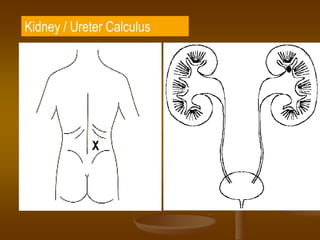
Kidney / Ureter Calculus
SEMINAR PLAN
 Introduction
Anatomy
Incidence
Aetilogy
Stages of stone formation
 Types of renal calculi
 clinical features
 investigations
 medical/surgical management
 Recent Advances/Take home message
References
 questions
Renal Calculi
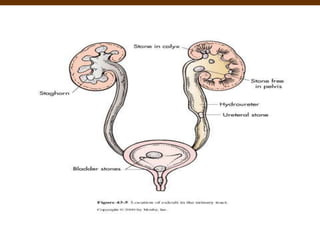
 Called nephrolithiasis or urolithiasis
 Most commonly develop in the renal pelvis
but can be anywhere in the urinary tract
 Vary in size –from very large to tiny
 Can be one stone or many stones
 May stay in kidney or travel into the
ureter
 Can damage the urinary tract
 May cause hydronephrosis
 More common in white males 30-50 years
of age
CHANGING MODALITIES
 WITH WESTERNIZATION, THE SITE OF STONE
FORMATION HAS MIGRATED FROM LOWER TO
UPPER URINARY TRACT
 DISEASE ONCE LIMITED TO MEN IS
INCREASINGLY GENDER BLIND,
 SURGICAL TREATMENT ALTHOUGH THEY
REMOVE THE OFFENDING STONE,DO LITTLE
TO ALTER THE COURSE OF THE DISEASE
 THOROUGH UNDERSTANDING OF
ETILOGY,EPIDEMIOLOGY AND PATHOGENESIS
OF URINARY TRACT STONE DISEASE IS
NECESSARY
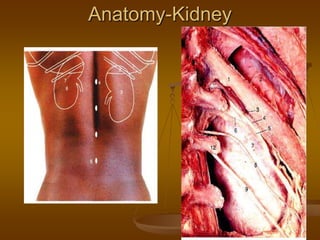
Anatomy-Kidney
Kidney anatomy
 Right kidney lower than left
 Retroperitoneal
 Reddish brown, bean shaped
 Hilum – medial surface; vessels, ureter; renal nerves
 Adrenal glands on superior poles of kidney
 Located on either side of vertebral column
 Renal fascia – connective tissue
 Adipose capsule – fat pad
 Hold kidney in place and protects kidney
 Renal capsule - fibrous sac that encloses
kidney
26-10
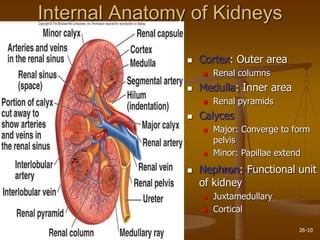
Internal Anatomy of Kidneys
 Cortex: Outer area
 Renal columns
 Medulla: Inner area
 Renal pyramids
 Calyces
 Major: Converge to form
pelvis
 Minor: Papillae extend
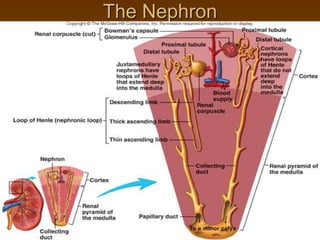
 Nephron: Functional unit
of kidney
 Juxtamedullary
 Cortical
26-11
The Nephron
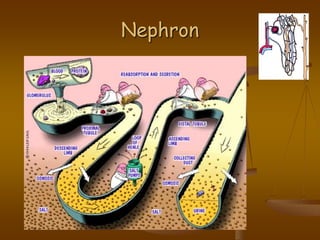
Nephron
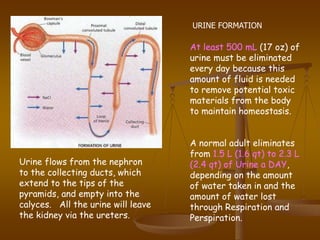
At least 500 mL (17 oz) of
urine must be eliminated
every day because this
amount of fluid is needed
to remove potential toxic
materials from the body
to maintain homeostasis.
A normal adult eliminates
from 1.5 L (1.6 qt) to 2.3 L
(2.4 qt) of Urine a DAY,
depending on the amount
of water taken in and the
amount of water lost
through Respiration and
Perspiration.
Urine flows from the nephron
to the collecting ducts, which
extend to the tips of the
pyramids, and empty into the
calyces. All the urine will leave
the kidney via the ureters.
URINE FORMATION
INCIDENCE
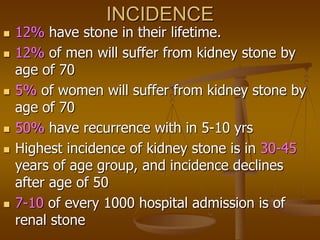
 12% have stone in their lifetime.
 12% of men will suffer from kidney stone by
age of 70
 5% of women will suffer from kidney stone by
age of 70
 50% have recurrence with in 5-10 yrs
 Highest incidence of kidney stone is in 30-45
years of age group, and incidence declines
after age of 50
 7-10 of every 1000 hospital admission is of
renal stone
COMPARATIVE INCIDENCES OF FORMS OF URINARY
LITHIASIS
Stone analysis in Percentage
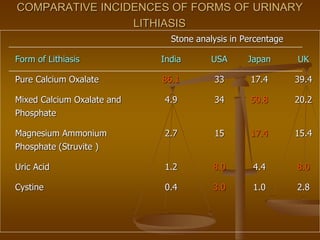
Form of Lithiasis India USA Japan UK
Pure Calcium Oxalate 86.1 33 17.4 39.4
Mixed Calcium Oxalate and 4.9 34 50.8 20.2
Phosphate
Magnesium Ammonium 2.7 15 17.4 15.4
Phosphate (Struvite )
Uric Acid 1.2 8.0 4.4 8.0
Cystine 0.4 3.0 1.0 2.8
In INDIA---STONE BELTS
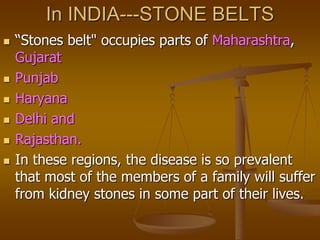
 “Stones belt" occupies parts of Maharashtra,
Gujarat
 Punjab
 Haryana
 Delhi and
 Rajasthan.
 In these regions, the disease is so prevalent
that most of the members of a family will suffer
from kidney stones in some part of their lives.
AETILOGY
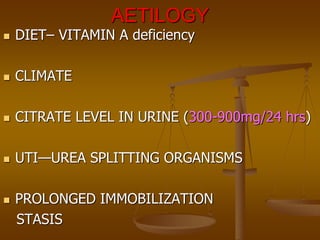
 DIET– VITAMIN A deficiency
 CLIMATE
 CITRATE LEVEL IN URINE (300-900mg/24 hrs)
 UTI—UREA SPLITTING ORGANISMS
 PROLONGED IMMOBILIZATION
STASIS
AETIOLOGY--METABOLIC
 HYPERPARATHYROIDISM
HYPEROXALURIA---Glycine metabolism
 CYSTINURIA
 HYPERURICOSURIA
 HYPOCITRATURIA
 HYPOMAGNESURIA
 RENAL TUBULAR ACIDOSIS
Stages of stone formation
 SUPERSATURATION
 NUCLEUS FORMATION
 CRYSTALLIZTION
 AGGREGATION
 MATRIX FORMATION
 In normal human urine—concentration of
calcium oxalate--- four times higher than its
solubility in water
 Precipitation occurs when supersaturation
exceeds the solubility by 7 to 11 times.
 Homogenous nucleation is the process by
which nuclei form in pure solution.
 Nuclei are the earliest structure that will not
dissolve.
 If enough nuclei form and grow ,aggregation of
crystals will form larger particles—that can
occlude tubular lumen.
 MATRIX– Renal calculi contain both crystalline
and non crystalline component . Non crystalline
component is termed Matrix.
Randalls plaque theory—
erosion and deposition of urinary
salts as Randalls plaque at the apex of renal
papillae.
Carrs postulate—
minute concretions are carried away by renal
lymphatics.If these lymphatics are blocked they
enlarge and act as nidus of stone formatin.
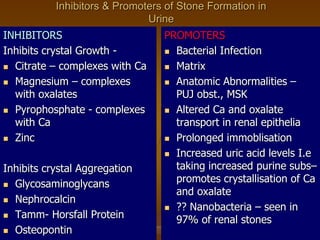
Inhibitors & Promoters of Stone Formation in
Urine
INHIBITORS
Inhibits crystal Growth -
 Citrate – complexes with Ca
 Magnesium – complexes
with oxalates
 Pyrophosphate - complexes
with Ca
 Zinc
Inhibits crystal Aggregation
 Glycosaminoglycans
 Nephrocalcin
 Tamm- Horsfall Protein
 Osteopontin
PROMOTERS
 Bacterial Infection
 Matrix
 Anatomic Abnormalities –
PUJ obst., MSK
 Altered Ca and oxalate
transport in renal epithelia
 Prolonged immoblisation
 Increased uric acid levels I.e
taking increased purine subs–
promotes crystallisation of Ca
and oxalate
 ?? Nanobacteria – seen in
97% of renal stones
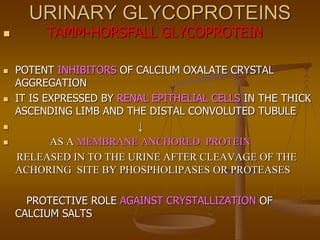
URINARY GLYCOPROTEINS
 TAMM-HORSFALL GLYCOPROTEIN
 POTENT INHIBITORS OF CALCIUM OXALATE CRYSTAL
AGGREGATION
 IT IS EXPRESSED BY RENAL EPITHELIAL CELLS IN THE THICK
ASCENDING LIMB AND THE DISTAL CONVOLUTED TUBULE
 ↓
 AS A MEMBRANE ANCHORED PROTEIN
RELEASED IN TO THE URINE AFTER CLEAVAGE OF THE
ACHORING SITE BY PHOSPHOLIPASES OR PROTEASES
PROTECTIVE ROLE AGAINST CRYSTALLIZATION OF
CALCIUM SALTS
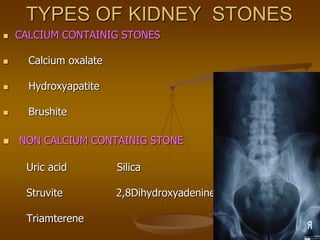
TYPES OF KIDNEY STONES
 CALCIUM CONTAINIG STONES
 Calcium oxalate
 Hydroxyapatite
 Brushite
 NON CALCIUM CONTAINIG STONE
Uric acid Silica
Struvite 2,8Dihydroxyadenine
Triamterene
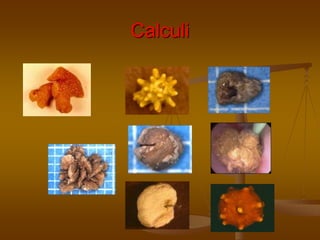
Calculi
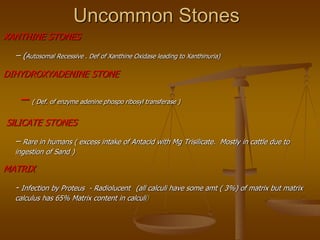
Uncommon Stones
XANTHINE STONES
– (Autosomal Recessive . Def of Xanthine Oxidase leading to Xanthinuria)
DIHYDROXYADENINE STONE
– ( Def. of enzyme adenine phospo ribosyl transferase )
SlLICATE STONES
– Rare in humans ( excess intake of Antacid with Mg Trisilicate. Mostly in cattle due to
ingestion of Sand )
MATRIX
- Infection by Proteus - Radiolucent (all calculi have some amt ( 3%) of matrix but matrix
calculus has 65% Matrix content in calculi)
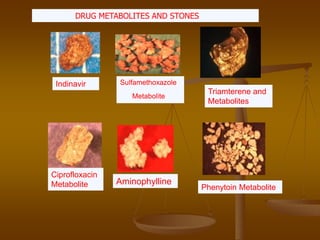
Indinavir Sulfamethoxazole
Metabolite
Triamterene and
Metabolites
Ciprofloxacin
Metabolite Aminophylline
Phenytoin Metabolite
DRUG METABOLITES AND STONES
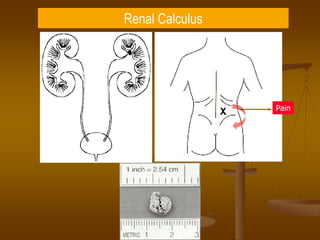
Renal Calculus
Pain
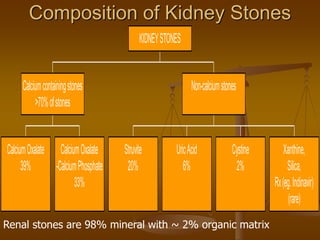
Composition of Kidney Stones
CalciumOxalate
39%
CalciumOxalate
-CalciumPhosphate
33%
Calciumcontainingstones
>70%ofstones
Struvite
20%
UricAcid
6%
Cystine
2%
Xanthine,
Silica,
Rx(eg.Indinavir)
(rare)
Non-calciumstones
KIDNEYSTONES
Renal stones are 98% mineral with ~ 2% organic matrix
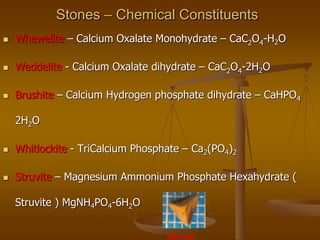
Stones – Chemical Constituents
 Whewelite – Calcium Oxalate Monohydrate – CaC2O4-H2O
 Weddelite - Calcium Oxalate dihydrate – CaC2O4-2H2O
 Brushite – Calcium Hydrogen phosphate dihydrate – CaHPO4
2H2O
 Whitlockite - TriCalcium Phosphate – Ca2(PO4)2
 Struvite – Magnesium Ammonium Phosphate Hexahydrate (
Struvite ) MgNH4PO4-6H2O
Struvite
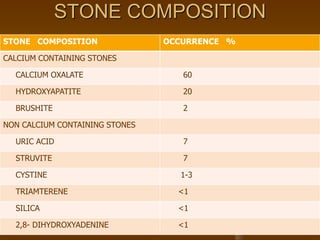
STONE COMPOSITION
STONE COMPOSITION OCCURRENCE %
CALCIUM CONTAINING STONES
CALCIUM OXALATE 60
HYDROXYAPATITE 20
BRUSHITE 2
NON CALCIUM CONTAINING STONES
URIC ACID 7
STRUVITE 7
CYSTINE 1-3
TRIAMTERENE <1
SILICA <1
2,8- DIHYDROXYADENINE <1
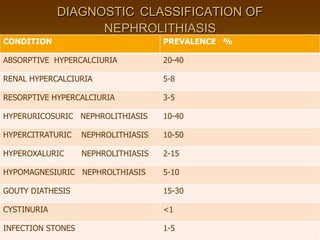
DIAGNOSTIC CLASSIFICATION OF
NEPHROLITHIASIS
CONDITION PREVALENCE %
ABSORPTIVE HYPERCALCIURIA 20-40
RENAL HYPERCALCIURIA 5-8
RESORPTIVE HYPERCALCIURIA 3-5
HYPERURICOSURIC NEPHROLITHIASIS 10-40
HYPERCITRATURIC NEPHROLITHIASIS 10-50
HYPEROXALURIC NEPHROLITHIASIS 2-15
HYPOMAGNESIURIC NEPHROLTHIASIS 5-10
GOUTY DIATHESIS 15-30
CYSTINURIA <1
INFECTION STONES 1-5
CALCIUM OXALATE
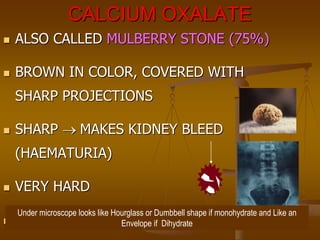
 ALSO CALLED MULBERRY STONE (75%)
 BROWN IN COLOR, COVERED WITH
SHARP PROJECTIONS
 SHARP MAKES KIDNEY BLEED
(HAEMATURIA)
 VERY HARD
 RADIO - OPAQUE
Under microscope looks like Hourglass or Dumbbell shape if monohydrate and Like an
Envelope if Dihydrate
Calcium Stones
 Hereditary Hypercalciuria condition
 Mean value of calcium in urine in excess of:
 300 mg/day (7.5 mmol/day) for males
 250 mg/day (6.25 mmol/day) for females
 4 mg/day (0.1 mmol/kg/day) for either in random urine
collections
 30-40% patients with calcium stones have
hypercalciuria
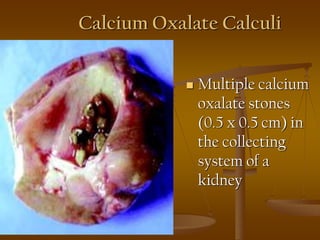
Calcium Oxalate Calculi
 Multiple calcium
oxalate stones
(0.5 x 0.5 cm) in
the collecting
system of a
kidney
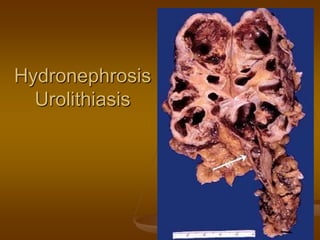
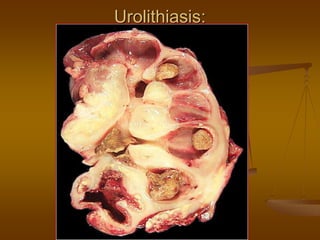
Urolithiasis:
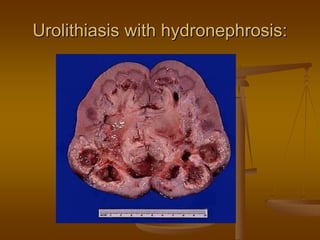
Urolithiasis with hydronephrosis:
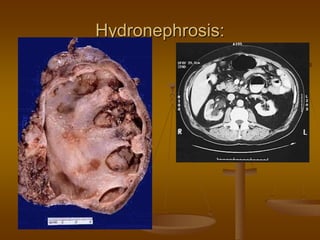
Hydronephrosis:
Hydronephrosis
Urolithiasis
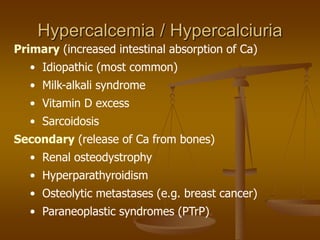
Primary (increased intestinal absorption of Ca)
• Idiopathic (most common)
• Milk-alkali syndrome
• Vitamin D excess
• Sarcoidosis
Secondary (release of Ca from bones)
• Renal osteodystrophy
• Hyperparathyroidism
• Osteolytic metastases (e.g. breast cancer)
• Paraneoplastic syndromes (PTrP)
Hypercalcemia / Hypercalciuria
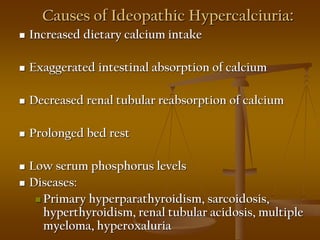
Causes of Ideopathic Hypercalciuria:
 Increased dietary calcium intake
 Exaggerated intestinal absorption of calcium
 Decreased renal tubular reabsorption of calcium
 Prolonged bed rest
 Low serum phosphorus levels
 Diseases:
 Primary hyperparathyroidism, sarcoidosis,
hyperthyroidism, renal tubular acidosis, multiple
myeloma, hyperoxaluria
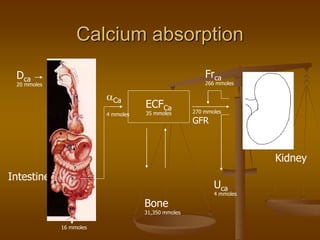
Calcium absorption
ECFCa
35 mmoles
Bone
31,350 mmoles
Uca
4 mmoles
Kidney
270 mmoles
GFR
Frca
266 mmoles
Intestine
Dca
20 mmoles
16 mmoles
Ca
4 mmoles
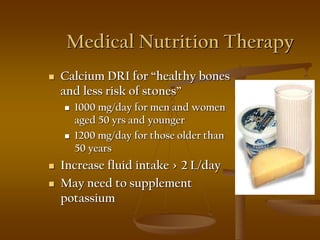
Medical Nutrition Therapy
 Calcium DRI for “healthy bones
and less risk of stones”
 1000 mg/day for men and women
aged 50 yrs and younger
 1200 mg/day for those older than
50 years
 Increase fluid intake > 2 L/day
 May need to supplement
potassium
Calcium Study Findings
 Low calcium diet
 23 of the 60 men had stone recurrences
 Oxalate excretion was increased
 Normal calcium, decreased sodium and
reduced animal protein diet
 12 of the 60 men had stone recurrences
 Oxalate excretion was decreased
 Contrary to previous therapy, calcium restriction
does not prevent prevent stone formation, but
may do the opposite.
Calcium Stones and Oxalate
 Hyperoxaluria
 Urinary excretion of oxalate in excess of 45 mg/day
 Results from endogenous synthesis and from
absorption of dietary oxalate
 Observed in 20% of recurrent calculi formers
 Normal diet contains oxalate range of 80-100
mg/day (absorption does not exceed 10-20%
amount in food consumed)
 Oxalate cannot be metabolized in body– renal route
is the only excretion method
 Normal healthy adult excretion is 15-40 mg/day
Calcium Stones and Oxalate
 Oxalate to calcium ratio 1:5
 Low calcium diets increase passive absorption of
free oxalate and enhance urinary oxalate excretion,
promoting the risk of calcium oxalate stones
 Disease states resulting in hyperoxaluria
 Inflammatory bowel disease, ileal disease, short
bowel syndrome, gastrointestinal decolonization of
Oxalobacterformigens
 Hyperoxaluria also due to:
 Autosomal recessive genetic defect of a hepatic
enzyme, resulting in 3 to 8 times normal level
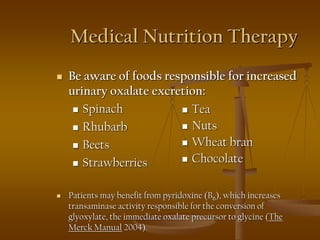
Medical Nutrition Therapy
 Be aware of foods responsible for increased
urinary oxalate excretion:
 Spinach
 Rhubarb
 Beets
 Strawberries
 Patients may benefit from pyridoxine (B6), which increases
transaminase activity responsible for the conversion of
glyoxylate, the immediate oxalate precursor to glycine (The
Merck Manual 2004).
 Tea
 Nuts
 Wheat bran
 Chocolate
Calcium Stones and Animal Protein
 Increased protein intake facilitates
nephrolithiasis risk by contributing to:
 Hypercalciuria
 Hyperuricosuria (urinary uric acid > 750 mg/day for
women or > 800 mg/day for men)
 Hyperoxaluria
 Low urine pH
 Hypocitraturia (urinary citrate < 350 mg/day)
 1/3 of calcium calculi formers are sensitive to meat
protein and so excrete oxalate
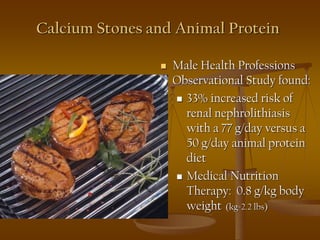
Calcium Stones and Animal Protein
 Male Health Professions
Observational Study found:
 33% increased risk of
renal nephrolithiasis
with a 77 g/day versus a
50 g/day animal protein
diet
 Medical Nutrition
Therapy: 0.8 g/kg body
weight (kg=2.2 lbs)
.
Calcium Stones and Citrate
 Citrate: Acts as a urinary stone inhibitor
 Prevents formation of calcium oxalate or calcium phosphate
stones
 Disease states that decrease citrate levels in body: distal
renal tubular acidosis, acidosis along with
hypokalemia, enteric hyperoxaluria and
malabsorption syndrome, as well as excessive meat
intake.
 Normal urinary citrate level > 640 mg/day
 Medical Nutrition Therapy: 4 oz. lemon juice diluted with 2 L
water
 Standard Medical Practice: oral alkali (K citrate)
Calcium Stones and Sodium
 Dietary and urinary sodium is directly linked with excretion of
calcium in the urine, so a reduction in sodium excretion will
produce a reduction in calcium excretion, resulting in reduced
risk of developing calculi.
 For every 60 mmol (1380mg) increase in urine sodium, the risk of
hypercalciuria rises 1.63 times
 Medical Nutrition Therapy: to prevent, keep sodium amounts to
< 100 mmol/day or 2300 mg
 With recurring calculi condition, restrict sodium intake
< 50 mmol/day
.
Calcium Stones and Potassium
 Potassium intake is inversely proportional to
nephrolithiasis risk.
 For every 104 mmol/day (4042 mg/day) vs. 74
mmol/day (2895 mg/day), there was a 50% decrease
in renal stone manifestation.
 Medical Nutrition Therapy: Advise patients to eat
variety of low oxalate fruits and vegetables
.
To Sum It All Up:
Dietary Influence for Calcium
Stone Formation Risk
 Increased Risk
 Oxalate
 Animal Protein
 Sodium
Decreased Risk
Calcium
Magnesium
Potassium
Fluid Intake
Fiber
Pyridoxine
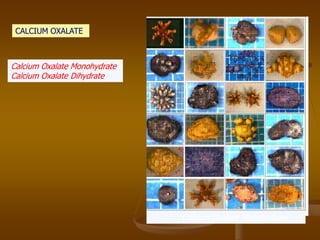
Calcium Oxalate Monohydrate
Calcium Oxalate Dihydrate
CALCIUM OXALATE
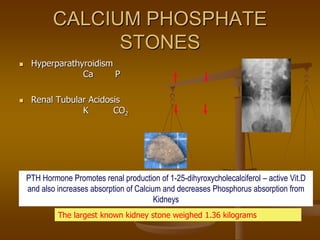
CALCIUM PHOSPHATE
STONES
 Hyperparathyroidism
Ca P
 Renal Tubular Acidosis
K CO2
PTH Hormone Promotes renal production of 1-25-dihyroxycholecalciferol – active Vit.D
and also increases absorption of Calcium and decreases Phosphorus absorption from
Kidneys
The largest known kidney stone weighed 1.36 kilograms.
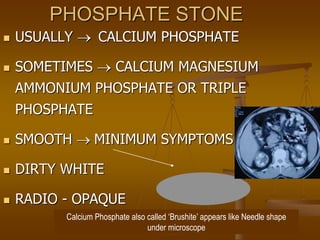
PHOSPHATE STONE
 USUALLY CALCIUM PHOSPHATE
 SOMETIMES  CALCIUM MAGNESIUM
AMMONIUM PHOSPHATE OR TRIPLE
PHOSPHATE
 SMOOTH MINIMUM SYMPTOMS
 DIRTY WHITE
 RADIO - OPAQUE
Calcium Phosphate also called ‘Brushite’ appears like Needle shape
under microscope
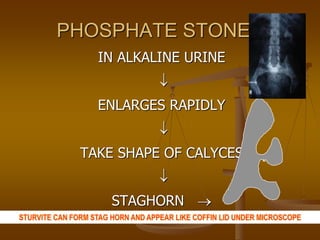
PHOSPHATE STONES
IN ALKALINE URINE

ENLARGES RAPIDLY

TAKE SHAPE OF CALYCES

STAGHORN 
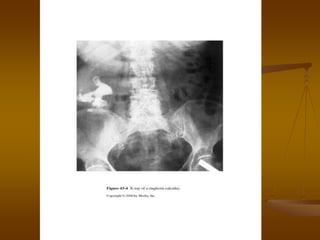
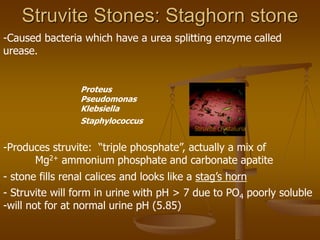
Struvite Stones: Staghorn stone
-Caused bacteria which have a urea splitting enzyme called
urease.
Proteus
Pseudomonas
Klebsiella
Staphylococcus
-Produces struvite: “triple phosphate”, actually a mix of
Mg2+ ammonium phosphate and carbonate apatite
- Struvite will form in urine with pH > 7 due to PO4 poorly soluble
-will not for at normal urine pH (5.85)
- stone fills renal calices and looks like a stag’s horn
Struvite crystaluria
Struvite Stones
 Under these conditions, struvite stones grow into large
staghorn stones in renal pelvis
 Medical Nutrition Therapy: Advise balanced meals
with variety of fruits and vegetables to maintain health,
help fight bacteria
 Standard Medical Treatment
 Surgical removal
 Extracorporeal shockwave lithotripsy
 Culture-specific antimicrobials with urease inhibitors
 Goal: Prevent and eliminate UTIs through regular screening
and monitoring of urine cultures
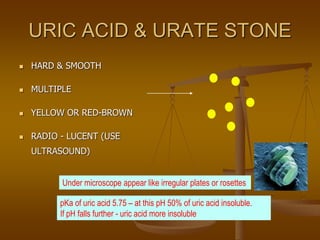
URIC ACID & URATE STONE
 HARD & SMOOTH
 MULTIPLE
 YELLOW OR RED-BROWN
 RADIO - LUCENT (USE
ULTRASOUND)
Under microscope appear like irregular plates or rosettes
pKa of uric acid 5.75 – at this pH 50% of uric acid insoluble.
If pH falls further - uric acid more insoluble
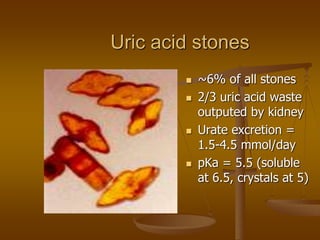
Uric acid stones
 ~6% of all stones
 2/3 uric acid waste
outputed by kidney
 Urate excretion =
1.5-4.5 mmol/day
 pKa = 5.5 (soluble
at 6.5, crystals at 5)
Uric Acid Stones
 Uric Acid: end product of purine metabolism
 Derived from exogenous sources
 Produced endogenously during cell turnover
 Contributing disease states to uric-acid stones:
 Inflammatory bowel disease,
 lymphoproliferative and myeloproliferative disorders
due to increased cellular breakdown which causes
purines to be released and so increases uric acid load
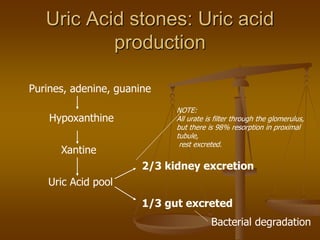
Uric Acid stones: Uric acid
production
Purines, adenine, guanine
Hypoxanthine
Xantine
Uric Acid pool
2/3 kidney excretion
1/3 gut excreted
Bacterial degradation
NOTE:
All urate is filter through the glomerulus,
but there is 98% resorption in proximal
tubule,
rest excreted.
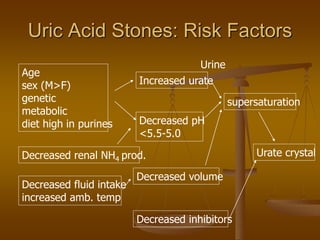
Uric Acid Stones: Risk Factors
Age
sex (M>F)
genetic
metabolic
diet high in purines
Decreased renal NH4 prod.
Decreased fluid intake
increased amb. temp
Increased urate
Decreased pH
<5.5-5.0
Decreased volume
Decreased inhibitors
supersaturation
Urate crystal
Urine
Uric Acid Stones
 Medical Nutrition Therapy: moderately use foods high
in purines such as:
 Organ meats
 Anchovies, herring
 Animal flesh proteins
 Fish, poultry
 Standard Medical Practice:
 Potassium citrate dissolution therapy
 Urine alkalinization (pH 6.0-6.5)
 Sodium bicarbonate therapy discouraged
 Increases monosodium urate along with calcium
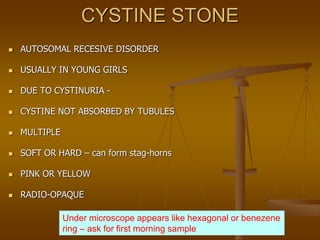
CYSTINE STONE
 AUTOSOMAL RECESIVE DISORDER
 USUALLY IN YOUNG GIRLS
 DUE TO CYSTINURIA -
 CYSTINE NOT ABSORBED BY TUBULES
 MULTIPLE
 SOFT OR HARD – can form stag-horns
 PINK OR YELLOW
 RADIO-OPAQUE
Under microscope appears like hexagonal or benezene
ring – ask for first morning sample
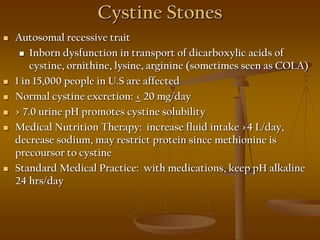
Cystine Stones
 Autosomal recessive trait
 Inborn dysfunction in transport of dicarboxylic acids of
cystine, ornithine, lysine, arginine (sometimes seen as COLA)
 1 in 15,000 people in U.S are affected
 Normal cystine excretion: < 20 mg/day
 > 7.0 urine pH promotes cystine solubility
 Medical Nutrition Therapy: increase fluid intake >4 L/day,
decrease sodium, may restrict protein since methionine is
precoursor to cystine
 Standard Medical Practice: with medications, keep pH alkaline
24 hrs/day
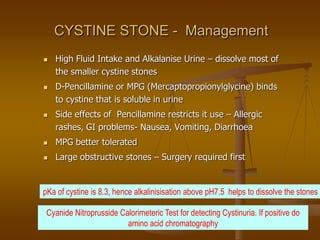
CYSTINE STONE - Management
 High Fluid Intake and Alkalanise Urine – dissolve most of
the smaller cystine stones
 D-Pencillamine or MPG (Mercaptopropionylglycine) binds
to cystine that is soluble in urine
 Side effects of Pencillamine restricts it use – Allergic
rashes, GI problems- Nausea, Vomiting, Diarrhoea
 MPG better tolerated
 Large obstructive stones – Surgery required first
Cyanide Nitroprusside Calorimeteric Test for detecting Cystinuria. If positive do
amino acid chromatography
pKa of cystine is 8.3, hence alkalinisisation above pH7.5 helps to dissolve the stones
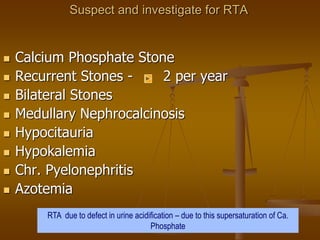
Suspect and investigate for RTA
 Calcium Phosphate Stone
 Recurrent Stones - 2 per year
 Bilateral Stones
 Medullary Nephrocalcinosis
 Hypocitauria
 Hypokalemia
 Chr. Pyelonephritis
 Azotemia
RTA due to defect in urine acidification – due to this supersaturation of Ca.
Phosphate
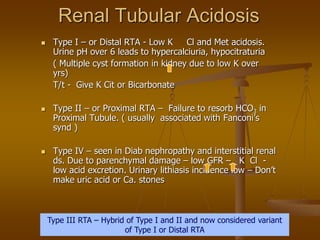
Renal Tubular Acidosis
 Type I – or Distal RTA - Low K Cl and Met acidosis.
Urine pH over 6 leads to hypercalciuria, hypocitraturia
( Multiple cyst formation in kidney due to low K over
yrs)
T/t - Give K Cit or Bicarbonate
 Type II – or Proximal RTA – Failure to resorb HCO3 in
Proximal Tubule. ( usually associated with Fanconi’s
synd )
 Type IV – seen in Diab nephropathy and interstitial renal
ds. Due to parenchymal damage – low GFR – K Cl -
low acid excretion. Urinary lithiasis incidence low – Don’t
make uric acid or Ca. stones
Type III RTA – Hybrid of Type I and II and now considered variant
of Type I or Distal RTA
Keep In Mind…
 Although a person may
have several risk factors
for the development of
nephrolithiasis,
prevention and
management through
Medical Nutrition
Therapy can deter renal
calculi formations.
Evidence-Based Medicine
 Become familiar with products that may
be popular, but are not necessarily
scientifically proven for the treatment of
kidney stones:
 Cranberry concentrate pills
 Wild yam
 Flaxseed
 Zinc
 Copper
 Vitamin A
 Evening primrose oil
 Goldenrod
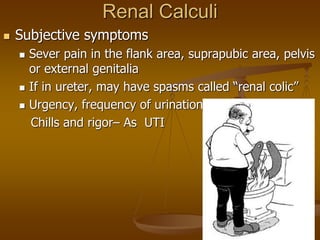
Renal Calculi
 Subjective symptoms
 Sever pain in the flank area, suprapubic area, pelvis
or external genitalia
 If in ureter, may have spasms called “renal colic”
 Urgency, frequency of urination
Chills and rigor– As UTI
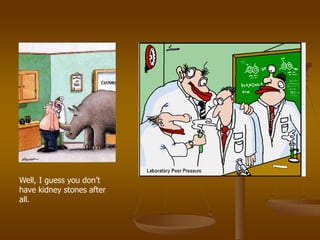
Well, I guess you don’t
have kidney stones after
all.
Renal Calculi
 Objective symptoms
 Increased temperature
 Pallor
 Hematuria
 Pyuria
 Anuria
Renal Calculi
 Assessment
 History and physical exam
 Location, severity, and nature of pain
 I/O
 Vital signs, looking for fever
 Palpation of flank area, and abdomen
Renal Calculi
 Nursing interventions
 Primary is to treat pain – usually with opioids
 Ambulate
 Force fluids, may have IV
 Watch for fluid overload
 Strain urine – send stone to lab if passed
 Accurate I/O
 Medicate
Investigations for Diagnosis
 Urinalysis
 urine pH, culture, 24-hr assessment
 Serum electrolytes
 calcium, phosphate, bicarbonate, uric acid
 Blood urea nitrogen
 to determine level of renal function
 Serum creatinine
 to determine level of renal function
 Parathyroid hormone
 if elevated serum calcium
 Stone analysis
 if possible
.
Stone Analysis - Methods
 Macroscopic &
Microscopic Examination
 X-ray Diffractometry
 Infrared
Spectrophotometry
 Chromatography
 Fluoresence
 Polarization Optical
Crystallography
 Chemical Microscopy
 Ultraviolet-visible
Spectroscopy
 Photomicroscopy
 MR Spectrometry
Investigations for Diagnosis
 Plain Abdominal Film/Kidney-Ureter-Bladder View
 Assessment of radio-opacity of stone
 Allows monitoring calculus progression
 Guides shockwave lithotripsy
Un-enhanced Helical Computed Tomography
 99% accurate
 Provides measurement of stone density
 Stones with density > 1000 Housnfield units respond less
well to lithotripsy
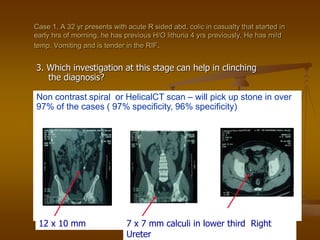
Case 1. A 32 yr presents with acute R sided abd. colic in casualty that started in
early hrs of morning, he has previous H/O lithuria 4 yrs previously. He has mild
temp. Vomiting and is tender in the RIF.
3. Which investigation at this stage can help in clinching
the diagnosis?
Non contrast spiral or HelicalCT scan – will pick up stone in over
97% of the cases ( 97% specificity, 96% specificity)
12 x 10 mm 7 x 7 mm calculi in lower third Right
Ureter
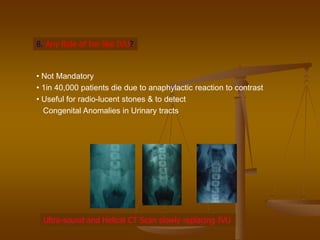
8. Any Role of Inv like IVU?
• Not Mandatory
• 1in 40,000 patients die due to anaphylactic reaction to contrast
• Useful for radio-lucent stones & to detect
Congenital Anomalies in Urinary tracts
Ultra-sound and Helical CT Scan slowly replacing IVU
DD of Radiolucent filling defect on IVU in Ureter or Kidney
Must Know
 Uric Acid Calculus
 Matrix Calculus
 Sloughed Papilla
 Blood Clots
 TCC
 Renal Cysts
 Vascular Lesions
Know For Brownie Points
 Xanthine Calculus
 Hydroxyadenine Calculus
 Ephederine Calculus
 Infection due to gas forming
Org.
 Fungal Ball
 Tuberculoma
 Malacoplakia
 Hypertrophied Papilla
 Renal pseudo-tumour
Stone Size and rate of passage
 Follw-up is 2 MONTHS
 Stone size0-4 mm 83%
 4-6 mm 60%
 greater 6mm 0%
Modern Management of Urolithiasis
 ESWL
 Uretero-renoscopy
 Percutaneous Nephrolithotomy
 Laparoscopic Approach to stones
Open Ureterolithotomy, Pyelolithotomy or Nephro-pyelolithotomy
is required in less than 1 to 2% of modern stone management
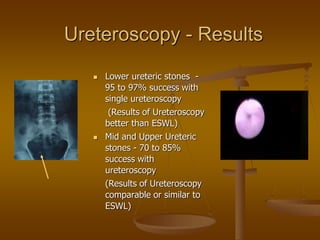
Ureteroscopy - Results
 Lower ureteric stones -
95 to 97% success with
single ureteroscopy
(Results of Ureteroscopy
better than ESWL)
 Mid and Upper Ureteric
stones - 70 to 85%
success with
ureteroscopy
(Results of Ureteroscopy
comparable or similar to
ESWL)
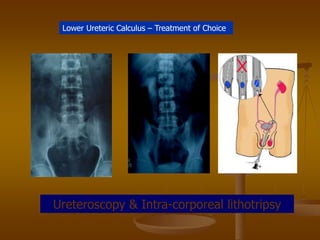
Lower Ureteric Calculus – Treatment of Choice
Ureteroscopy & Intra-corporeal lithotripsy
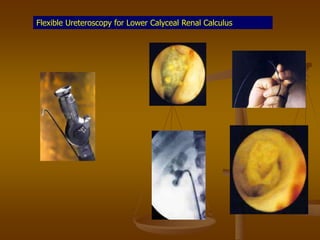
Flexible Ureteroscopy for Lower Calyceal Renal Calculus
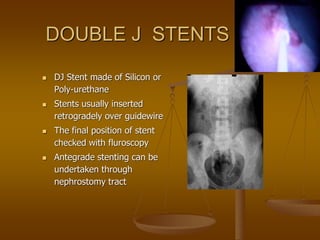
DOUBLE J STENTS
 DJ Stent made of Silicon or
Poly-urethane
 Stents usually inserted
retrogradely over guidewire
 The final position of stent
checked with fluroscopy
 Antegrade stenting can be
undertaken through
nephrostomy tract
DOUBLE J STENTS
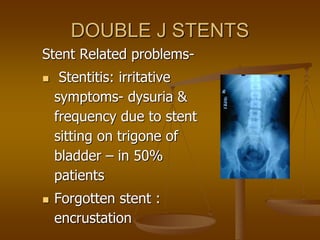
Stent Related problems-
 Stentitis: irritative
symptoms- dysuria &
frequency due to stent
sitting on trigone of
bladder – in 50%
patients
 Forgotten stent :
encrustation
TREATMENT (IDEALLY)
MAJORITY : 80 TO 85 % of all stones can be
treated by -
EXTRA - CORPOREAL SHOCK WAVE
LITHOTRIPSY (ESWL)
MINORITY : 15 TO 20 % SHOULD NEED
MINIMALLY INVASIVE SURGERY (PCNL /
URETEROSCOPY)
ESWL vs PCNL for renal stones
 < 10 mm, ESWL is usually the primary approach
 10 - 20 mm, ESWL is still the first-line treatment
 Unless factors of composition, location, or renal
anatomy shift the balance toward more invasive but
definitive treatment modalities (PCNL or RIRS)
 > 20 mm should primarily be treated by PCNL
 Unless specific indications for ureteroscopy are
present (e.g., bleeding diathesis, obesity)
EXTRA - CORPOREAL SHOCK WAVE LITHOTRIPSY
(ESWL)
SHOCK WAVES GENERATED UNDER WATER CAN
TRAVEL THROUGH BODY WITHOUT ANY
APPRECIABLE LOSS OF ENERGY. WHEN THEY
ENCOUNTER STONES THE CHANGES IN DENSITY
CAUSES ENERGY TO BE ABSORBED AND REFLECTED
BY THE STONE & THIS RESULTS IN FRAGMENTATION
OF THE STONES.
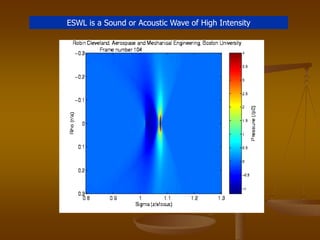
ESWL is a Sound or Acoustic Wave of High Intensity
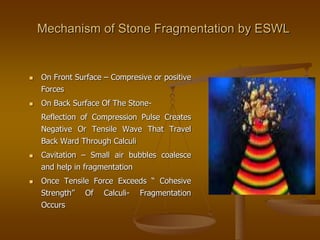
Mechanism of Stone Fragmentation by ESWL
 On Front Surface – Compresive or positive
Forces
 On Back Surface Of The Stone-
Reflection of Compression Pulse Creates
Negative Or Tensile Wave That Travel
Back Ward Through Calculi
 Cavitation – Small air bubbles coalesce
and help in fragmentation
 Once Tensile Force Exceeds “ Cohesive
Strength” Of Calculi- Fragmentation
Occurs
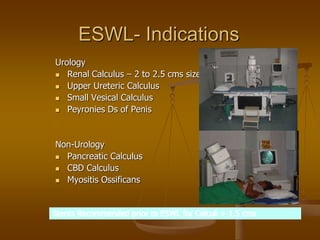
ESWL- Indications
Urology
 Renal Calculus – 2 to 2.5 cms size
 Upper Ureteric Calculus
 Small Vesical Calculus
 Peyronies Ds of Penis
Non-Urology
 Pancreatic Calculus
 CBD Calculus
 Myositis Ossificans
Stents Recommended prior to ESWL for Calculi > 1.5 cms
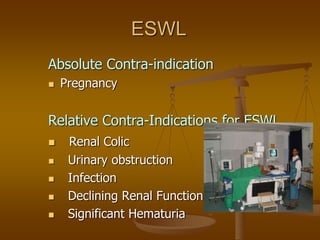
ESWL
Absolute Contra-indication
 Pregnancy
Relative Contra-Indications for ESWL
 Renal Colic
 Urinary obstruction
 Infection
 Declining Renal Function
 Significant Hematuria
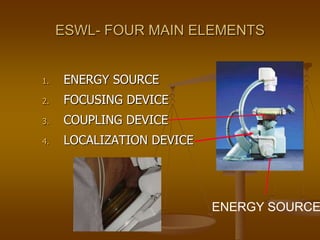
ESWL- FOUR MAIN ELEMENTS
1. ENERGY SOURCE
2. FOCUSING DEVICE
3. COUPLING DEVICE
4. LOCALIZATION DEVICE
ENERGY SOURCE
ESWL COMPLICATIONS
 Haematuria – is quite common ( short term
antibiotics Recommended )
 Incomplete stone Fragmentation &
Obstruction
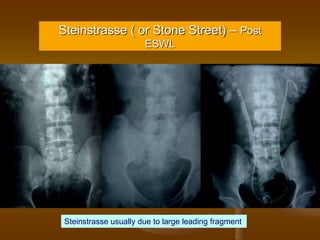
 “Stienstrasse” ( stone street ) usually due to
a large “ Leading fragment”
( Stents Recommended prior to ESWL for
Calculi > 1.5 cm )
Steinstrasse ( or Stone Street) – Post
ESWL
Steinstrasse usually due to large leading fragment
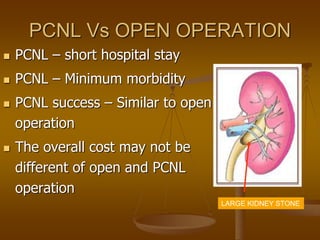
PCNL Vs OPEN OPERATION
 PCNL – short hospital stay
 PCNL – Minimum morbidity
 PCNL success – Similar to open
operation
 The overall cost may not be
different of open and PCNL
operation
LARGE KIDNEY STONE
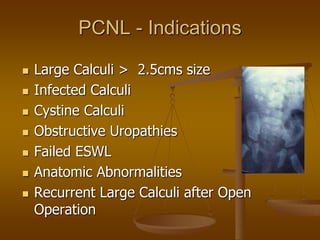
PCNL - Indications
 Large Calculi > 2.5cms size
 Infected Calculi
 Cystine Calculi
 Obstructive Uropathies
 Failed ESWL
 Anatomic Abnormalities
 Recurrent Large Calculi after Open
Operation
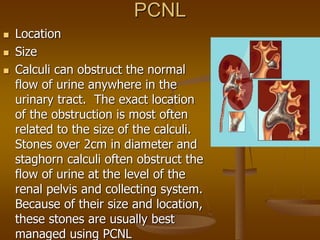
PCNL
 Location
 Size
 Calculi can obstruct the normal
flow of urine anywhere in the
urinary tract. The exact location
of the obstruction is most often
related to the size of the calculi.
Stones over 2cm in diameter and
staghorn calculi often obstruct the
flow of urine at the level of the
renal pelvis and collecting system.
Because of their size and location,
these stones are usually best
managed using PCNL
PCNL-TECHNIQUE
 Prone position
 Under x-ray or Ultra sound guidance
 Percutaneous access under taken
 Pencil Tipped (18g) needle used to puncture
lower calyx
Steps of the Procedure
 1. Opacify the Collecting System
 2. Establish Percutaneous Access
 3. Dilate the Nephrostomy Tract
 4. Break up/Remove Calculi
 5. Establish Nephrostomy Drainage
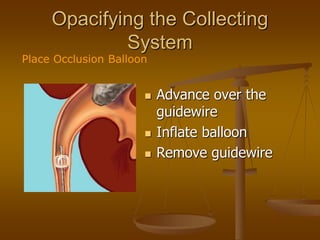
Opacifying the Collecting
System
 Advance over the
guidewire
 Inflate balloon
 Remove guidewire
Place Occlusion Balloon
Opacifying the Collecting
System
 Assess renal anatomy
 Assess stone location
 Identify best route for access
Retrograde Injection of Contrast
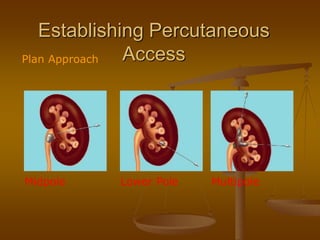
Establishing Percutaneous
AccessPlan Approach
Midpole Lower Pole Multipole
Urinary Tract Calculi
 Indications for endourologic, lithotripsy or
surgery
 Cystoscopy
 Cystolitholapaxy
 Cystoscopic lithotripsy
 Ultrasonic, laser or electrohydraulic
lithotripsy
 Percutaneous nephrolithotomy
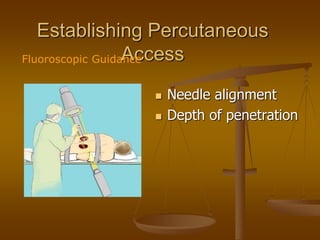
Establishing Percutaneous
Access
 Needle alignment
 Depth of penetration
Fluoroscopic Guidance
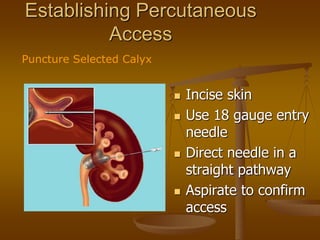
Establishing Percutaneous
Access
 Incise skin
 Use 18 gauge entry
needle
 Direct needle in a
straight pathway
 Aspirate to confirm
access
Puncture Selected Calyx
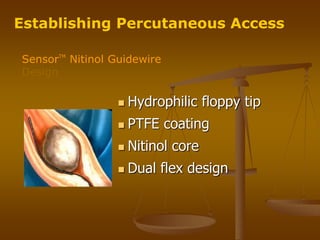
 Hydrophilic floppy tip
 PTFE coating
 Nitinol core
 Dual flex design
SensorTM
Nitinol Guidewire
Design
Establishing Percutaneous Access
Establishing Percutaneous
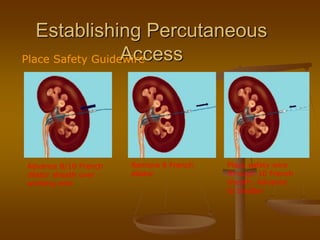
AccessPlace Safety Guidewire
Advance 8/10 French
dilator sheath over
working wire
Remove 8 French
dilator
Place safety wire
through 10 French
sheath; Advance
to bladder
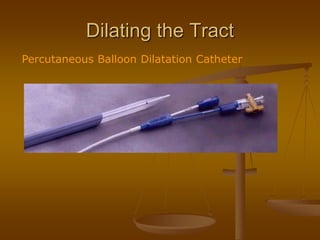
Dilating the Tract
Percutaneous Balloon Dilatation Catheter
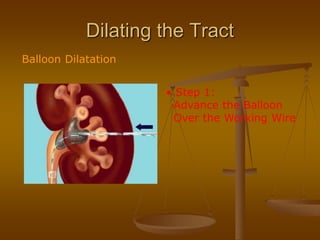
Dilating the Tract
Balloon Dilatation
• Step 1:
Advance the Balloon
Over the Working Wire
Dilating the Tract
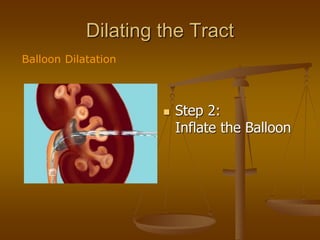
 Step 2:
Inflate the Balloon
Balloon Dilatation
Dilating the Tract
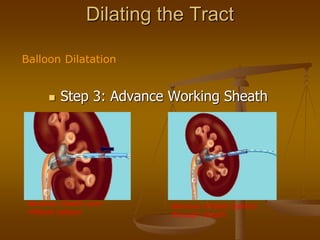
 Step 3: Advance Working Sheath
Advance sheath over
inflated balloon
Remove inflated balloon
through sheath
Balloon Dilatation
Dilating the Tract
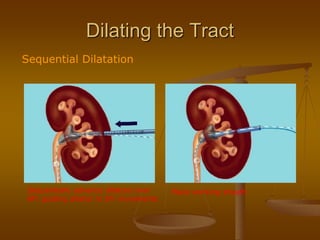
Sequential Dilatation
Sequentially advance dilators over
8Fr guiding dilator in 2Fr increments
Place working sheath
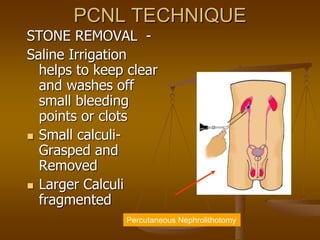
PCNL TECHNIQUE
STONE REMOVAL -
Saline Irrigation
helps to keep clear
and washes off
small bleeding
points or clots
 Small calculi-
Grasped and
Removed
 Larger Calculi
fragmented
Percutaneous Nephrolithotomy
Removing Calculi
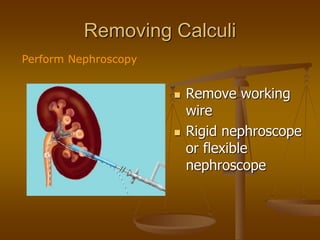
 Remove working
wire
 Rigid nephroscope
or flexible
nephroscope
Perform Nephroscopy
Removing Calculi
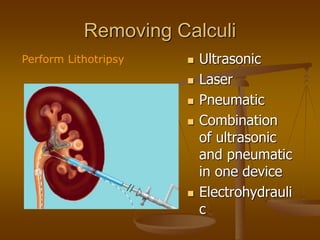
 Ultrasonic
 Laser
 Pneumatic
 Combination
of ultrasonic
and pneumatic
in one device
 Electrohydrauli
c
Perform Lithotripsy
Removing Calculi
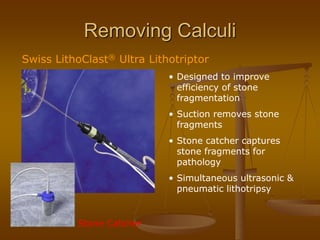
Swiss LithoClast® Ultra Lithotriptor
• Designed to improve
efficiency of stone
fragmentation
• Suction removes stone
fragments
• Stone catcher captures
stone fragments for
pathology
• Simultaneous ultrasonic &
pneumatic lithotripsy
Stone Catcher
Removing Calculi
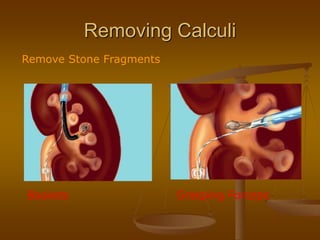
Remove Stone Fragments
Baskets Grasping Forceps
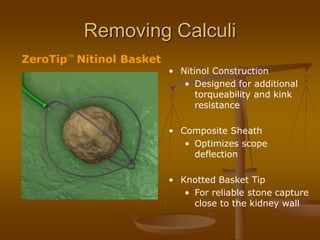
ZeroTipTM
Nitinol Basket
Removing Calculi
• Nitinol Construction
• Designed for additional
torqueability and kink
resistance
• Composite Sheath
• Optimizes scope
deflection
• Knotted Basket Tip
• For reliable stone capture
close to the kidney wall
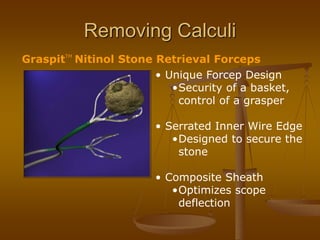
GraspitTM
Nitinol Stone Retrieval Forceps
Removing Calculi
• Unique Forcep Design
•Security of a basket,
control of a grasper
• Serrated Inner Wire Edge
•Designed to secure the
stone
• Composite Sheath
•Optimizes scope
deflection
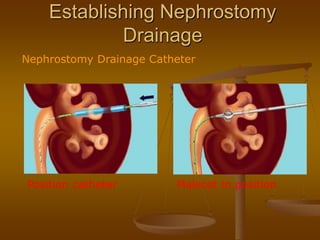
Establishing Nephrostomy
Drainage
Nephrostomy Drainage Catheter
Position catheter Malecot in position
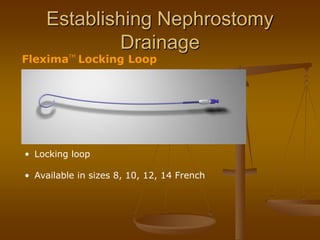
FleximaTM
Locking Loop
Establishing Nephrostomy
Drainage
• Locking loop
• Available in sizes 8, 10, 12, 14 French
PCNL- COMPLICATIONS
 Bleeding Blood Transfusion 3 to 10%
 Septicemia - More With Struvite
Calculus
 Perforation & Extravasation of Fluid
 Pleural Injury - Upper Calyceal
Puncture  Duodenal Injury / Colon Injury
 Liver & Spleen Injuries- Rare
 Injury to Vessels:Renal vein, Renal
Artery or IVC- Rare
OPEN SURGERIES
 Pyelolithotomy
 Extended Pyelolithotomy ::: Gil- Vernet
 Nephrolithotomy
 Nephropyelolithotomy- Staghorn calculus
 Partial Nephrectomy
 Bench Surgery
 Coagulum Pyelolithotomy
 Anatrophic Pyelolithotomy
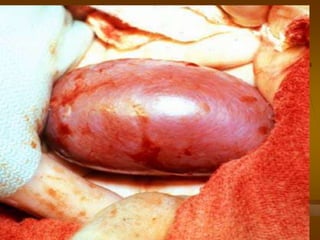
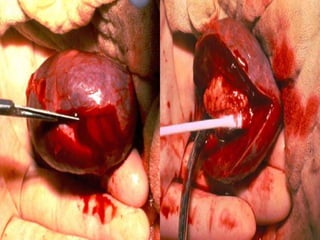
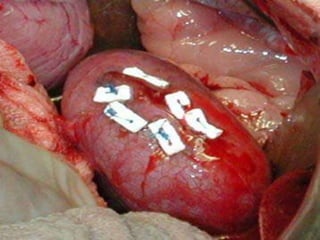
Nephroliths: Nephrotomy
 􀂄 Kidney reduced: 20 to 50%
 􀂄 Midline celiotomy
 􀂄 Occlusion of blood supply
 􀂄 Incision on convex surface
 􀂄 Flush ureter and renal pelvis
 􀂄 Reestablish blood flow
 􀂄 Suture renal capsule Vs no suture
Nephroliths: Pyelolithotomy
 􀂄 Dilation of renal pelvis
 􀂄 Less effect on renal function
 􀂄 Midline celiotomy
 􀂄 No occlusion of renal blood supply
 􀂄 Dissect peritoneal attachment and
 rotate medially
Nephroliths: Pyelolithotomy
 􀂄 Incision in renal pelvis and proximal
ureter
 􀂄 Extraction of urolith
 􀂄 Cystoscope 1.9 mm
 􀂄 Flush renal pelvis and ureter
 􀂄 Retrograde catheterization from
 bladder
 􀂄 Suture with simple continuous pattern
 􀂄 5-0 monofilament absorbable
 QuickTime
EXTENDED PYELOLITHOTOMY
 PLANE DEVELOPED BETWEEN INTRA RENAL
PELVIS AND OVERLYING PARENCHYMA,WHICH
IS THEN RETRACTED
 INCISION INTO THE PELVIS CAN THEN BE
EXTENDED INTO THE NECK OF CALYCES TO
REMOVE A STAGORN CALCULUS
 INCISION IS CLOSED WITH ABSORBABLE
SUTURES AND A URETERIC STENT LEFT insitu
NEPHROLITHOTOMY
 INCISION IS MADE DIRECTLY THROUGH
THE RENAL PARENCHYMA INTO A CALYX
 HAEMORRHAGE MAY BE BRISK
TOTAL OR PARTIAL
NEPHRECTOMY
 NON FUNCTIOINING KIDNEY WITH A
STAGHORN CALCULUS WHICH IS THE SEAT OF
A RECURRENT URINARY SEPSIS
TAKE HOME MESSAE
 􀂄 5mm stones are not likely to pass and
require surgical evaluation.
 􀂄 Non contrast helical CT remains the gold
standard for diagnosis.
 􀂄 Work-up after the 1st stone=different
approaches, be patient centered!
 􀂄 ESWL can tx 85% of kidney stones that
need surgical intervention and
ureterorenoscopy often treats the rest
(i.e the more distal stones
REFERENCES
 BAILEY & LOVE’S- SHORT PRACTISE OF
SURGERY
 SABISTON TEXTBOOK OF SURGERY
 MASTERY OF SURGERY by Fischer
 Urology CAMBELL
 Glenn- UROLOGIC SURGERIES
 UROLOGY CASE PRESENTATIONS
 RECENT ADVANCES- WOLTERS KLUWER
Questions?


Renal stone disease

  • 1.
    presented by:Dr.JYOTINDRA SINGH RENALSTONE DISEASE - AN UPDATE
  • 2.
    "View a negativeexperience in your life like you'd look at a photo negative. A single negative can create an unlimited number of positive prints." Gerhard Gschwandtner Founder of "Selling Power" magazine
  • 3.
  • 4.
    SEMINAR PLAN  Introduction Anatomy Incidence Aetilogy Stagesof stone formation  Types of renal calculi  clinical features  investigations  medical/surgical management  Recent Advances/Take home message References  questions
  • 5.
    Renal Calculi  Callednephrolithiasis or urolithiasis  Most commonly develop in the renal pelvis but can be anywhere in the urinary tract  Vary in size –from very large to tiny  Can be one stone or many stones  May stay in kidney or travel into the ureter  Can damage the urinary tract  May cause hydronephrosis  More common in white males 30-50 years of age
  • 7.
    CHANGING MODALITIES  WITHWESTERNIZATION, THE SITE OF STONE FORMATION HAS MIGRATED FROM LOWER TO UPPER URINARY TRACT  DISEASE ONCE LIMITED TO MEN IS INCREASINGLY GENDER BLIND,  SURGICAL TREATMENT ALTHOUGH THEY REMOVE THE OFFENDING STONE,DO LITTLE TO ALTER THE COURSE OF THE DISEASE  THOROUGH UNDERSTANDING OF ETILOGY,EPIDEMIOLOGY AND PATHOGENESIS OF URINARY TRACT STONE DISEASE IS NECESSARY
  • 8.
  • 9.
    Kidney anatomy  Rightkidney lower than left  Retroperitoneal  Reddish brown, bean shaped  Hilum – medial surface; vessels, ureter; renal nerves  Adrenal glands on superior poles of kidney  Located on either side of vertebral column  Renal fascia – connective tissue  Adipose capsule – fat pad  Hold kidney in place and protects kidney  Renal capsule - fibrous sac that encloses kidney
  • 10.
    26-10 Internal Anatomy ofKidneys  Cortex: Outer area  Renal columns  Medulla: Inner area  Renal pyramids  Calyces  Major: Converge to form pelvis  Minor: Papillae extend  Nephron: Functional unit of kidney  Juxtamedullary  Cortical
  • 11.
  • 12.
  • 13.
    At least 500mL (17 oz) of urine must be eliminated every day because this amount of fluid is needed to remove potential toxic materials from the body to maintain homeostasis. A normal adult eliminates from 1.5 L (1.6 qt) to 2.3 L (2.4 qt) of Urine a DAY, depending on the amount of water taken in and the amount of water lost through Respiration and Perspiration. Urine flows from the nephron to the collecting ducts, which extend to the tips of the pyramids, and empty into the calyces. All the urine will leave the kidney via the ureters. URINE FORMATION
  • 14.
    INCIDENCE  12% havestone in their lifetime.  12% of men will suffer from kidney stone by age of 70  5% of women will suffer from kidney stone by age of 70  50% have recurrence with in 5-10 yrs  Highest incidence of kidney stone is in 30-45 years of age group, and incidence declines after age of 50  7-10 of every 1000 hospital admission is of renal stone
  • 15.
    COMPARATIVE INCIDENCES OFFORMS OF URINARY LITHIASIS Stone analysis in Percentage Form of Lithiasis India USA Japan UK Pure Calcium Oxalate 86.1 33 17.4 39.4 Mixed Calcium Oxalate and 4.9 34 50.8 20.2 Phosphate Magnesium Ammonium 2.7 15 17.4 15.4 Phosphate (Struvite ) Uric Acid 1.2 8.0 4.4 8.0 Cystine 0.4 3.0 1.0 2.8
  • 16.
    In INDIA---STONE BELTS “Stones belt" occupies parts of Maharashtra, Gujarat  Punjab  Haryana  Delhi and  Rajasthan.  In these regions, the disease is so prevalent that most of the members of a family will suffer from kidney stones in some part of their lives.
  • 17.
    AETILOGY  DIET– VITAMINA deficiency  CLIMATE  CITRATE LEVEL IN URINE (300-900mg/24 hrs)  UTI—UREA SPLITTING ORGANISMS  PROLONGED IMMOBILIZATION STASIS
  • 18.
    AETIOLOGY--METABOLIC  HYPERPARATHYROIDISM HYPEROXALURIA---Glycine metabolism CYSTINURIA  HYPERURICOSURIA  HYPOCITRATURIA  HYPOMAGNESURIA  RENAL TUBULAR ACIDOSIS
  • 19.
    Stages of stoneformation  SUPERSATURATION  NUCLEUS FORMATION  CRYSTALLIZTION  AGGREGATION  MATRIX FORMATION
  • 20.
     In normalhuman urine—concentration of calcium oxalate--- four times higher than its solubility in water  Precipitation occurs when supersaturation exceeds the solubility by 7 to 11 times.  Homogenous nucleation is the process by which nuclei form in pure solution.  Nuclei are the earliest structure that will not dissolve.  If enough nuclei form and grow ,aggregation of crystals will form larger particles—that can occlude tubular lumen.
  • 21.
     MATRIX– Renalcalculi contain both crystalline and non crystalline component . Non crystalline component is termed Matrix. Randalls plaque theory— erosion and deposition of urinary salts as Randalls plaque at the apex of renal papillae. Carrs postulate— minute concretions are carried away by renal lymphatics.If these lymphatics are blocked they enlarge and act as nidus of stone formatin.
  • 22.
    Inhibitors & Promotersof Stone Formation in Urine INHIBITORS Inhibits crystal Growth -  Citrate – complexes with Ca  Magnesium – complexes with oxalates  Pyrophosphate - complexes with Ca  Zinc Inhibits crystal Aggregation  Glycosaminoglycans  Nephrocalcin  Tamm- Horsfall Protein  Osteopontin PROMOTERS  Bacterial Infection  Matrix  Anatomic Abnormalities – PUJ obst., MSK  Altered Ca and oxalate transport in renal epithelia  Prolonged immoblisation  Increased uric acid levels I.e taking increased purine subs– promotes crystallisation of Ca and oxalate  ?? Nanobacteria – seen in 97% of renal stones
  • 23.
    URINARY GLYCOPROTEINS  TAMM-HORSFALLGLYCOPROTEIN  POTENT INHIBITORS OF CALCIUM OXALATE CRYSTAL AGGREGATION  IT IS EXPRESSED BY RENAL EPITHELIAL CELLS IN THE THICK ASCENDING LIMB AND THE DISTAL CONVOLUTED TUBULE  ↓  AS A MEMBRANE ANCHORED PROTEIN RELEASED IN TO THE URINE AFTER CLEAVAGE OF THE ACHORING SITE BY PHOSPHOLIPASES OR PROTEASES PROTECTIVE ROLE AGAINST CRYSTALLIZATION OF CALCIUM SALTS
  • 24.
    TYPES OF KIDNEYSTONES  CALCIUM CONTAINIG STONES  Calcium oxalate  Hydroxyapatite  Brushite  NON CALCIUM CONTAINIG STONE Uric acid Silica Struvite 2,8Dihydroxyadenine Triamterene
  • 25.
  • 26.
    Uncommon Stones XANTHINE STONES –(Autosomal Recessive . Def of Xanthine Oxidase leading to Xanthinuria) DIHYDROXYADENINE STONE – ( Def. of enzyme adenine phospo ribosyl transferase ) SlLICATE STONES – Rare in humans ( excess intake of Antacid with Mg Trisilicate. Mostly in cattle due to ingestion of Sand ) MATRIX - Infection by Proteus - Radiolucent (all calculi have some amt ( 3%) of matrix but matrix calculus has 65% Matrix content in calculi)
  • 27.
    Indinavir Sulfamethoxazole Metabolite Triamterene and Metabolites Ciprofloxacin MetaboliteAminophylline Phenytoin Metabolite DRUG METABOLITES AND STONES
  • 28.
  • 29.
    Composition of KidneyStones CalciumOxalate 39% CalciumOxalate -CalciumPhosphate 33% Calciumcontainingstones >70%ofstones Struvite 20% UricAcid 6% Cystine 2% Xanthine, Silica, Rx(eg.Indinavir) (rare) Non-calciumstones KIDNEYSTONES Renal stones are 98% mineral with ~ 2% organic matrix
  • 30.
    Stones – ChemicalConstituents  Whewelite – Calcium Oxalate Monohydrate – CaC2O4-H2O  Weddelite - Calcium Oxalate dihydrate – CaC2O4-2H2O  Brushite – Calcium Hydrogen phosphate dihydrate – CaHPO4 2H2O  Whitlockite - TriCalcium Phosphate – Ca2(PO4)2  Struvite – Magnesium Ammonium Phosphate Hexahydrate ( Struvite ) MgNH4PO4-6H2O Struvite
  • 31.
    STONE COMPOSITION STONE COMPOSITIONOCCURRENCE % CALCIUM CONTAINING STONES CALCIUM OXALATE 60 HYDROXYAPATITE 20 BRUSHITE 2 NON CALCIUM CONTAINING STONES URIC ACID 7 STRUVITE 7 CYSTINE 1-3 TRIAMTERENE <1 SILICA <1 2,8- DIHYDROXYADENINE <1
  • 32.
    DIAGNOSTIC CLASSIFICATION OF NEPHROLITHIASIS CONDITIONPREVALENCE % ABSORPTIVE HYPERCALCIURIA 20-40 RENAL HYPERCALCIURIA 5-8 RESORPTIVE HYPERCALCIURIA 3-5 HYPERURICOSURIC NEPHROLITHIASIS 10-40 HYPERCITRATURIC NEPHROLITHIASIS 10-50 HYPEROXALURIC NEPHROLITHIASIS 2-15 HYPOMAGNESIURIC NEPHROLTHIASIS 5-10 GOUTY DIATHESIS 15-30 CYSTINURIA <1 INFECTION STONES 1-5
  • 34.
    CALCIUM OXALATE  ALSOCALLED MULBERRY STONE (75%)  BROWN IN COLOR, COVERED WITH SHARP PROJECTIONS  SHARP MAKES KIDNEY BLEED (HAEMATURIA)  VERY HARD  RADIO - OPAQUE Under microscope looks like Hourglass or Dumbbell shape if monohydrate and Like an Envelope if Dihydrate
  • 35.
    Calcium Stones  HereditaryHypercalciuria condition  Mean value of calcium in urine in excess of:  300 mg/day (7.5 mmol/day) for males  250 mg/day (6.25 mmol/day) for females  4 mg/day (0.1 mmol/kg/day) for either in random urine collections  30-40% patients with calcium stones have hypercalciuria
  • 36.
    Calcium Oxalate Calculi Multiple calcium oxalate stones (0.5 x 0.5 cm) in the collecting system of a kidney
  • 37.
  • 38.
  • 39.
  • 40.
  • 41.
    Primary (increased intestinalabsorption of Ca) • Idiopathic (most common) • Milk-alkali syndrome • Vitamin D excess • Sarcoidosis Secondary (release of Ca from bones) • Renal osteodystrophy • Hyperparathyroidism • Osteolytic metastases (e.g. breast cancer) • Paraneoplastic syndromes (PTrP) Hypercalcemia / Hypercalciuria
  • 42.
    Causes of IdeopathicHypercalciuria:  Increased dietary calcium intake  Exaggerated intestinal absorption of calcium  Decreased renal tubular reabsorption of calcium  Prolonged bed rest  Low serum phosphorus levels  Diseases:  Primary hyperparathyroidism, sarcoidosis, hyperthyroidism, renal tubular acidosis, multiple myeloma, hyperoxaluria
  • 43.
    Calcium absorption ECFCa 35 mmoles Bone 31,350mmoles Uca 4 mmoles Kidney 270 mmoles GFR Frca 266 mmoles Intestine Dca 20 mmoles 16 mmoles Ca 4 mmoles
  • 44.
    Medical Nutrition Therapy Calcium DRI for “healthy bones and less risk of stones”  1000 mg/day for men and women aged 50 yrs and younger  1200 mg/day for those older than 50 years  Increase fluid intake > 2 L/day  May need to supplement potassium
  • 45.
    Calcium Study Findings Low calcium diet  23 of the 60 men had stone recurrences  Oxalate excretion was increased  Normal calcium, decreased sodium and reduced animal protein diet  12 of the 60 men had stone recurrences  Oxalate excretion was decreased  Contrary to previous therapy, calcium restriction does not prevent prevent stone formation, but may do the opposite.
  • 46.
    Calcium Stones andOxalate  Hyperoxaluria  Urinary excretion of oxalate in excess of 45 mg/day  Results from endogenous synthesis and from absorption of dietary oxalate  Observed in 20% of recurrent calculi formers  Normal diet contains oxalate range of 80-100 mg/day (absorption does not exceed 10-20% amount in food consumed)  Oxalate cannot be metabolized in body– renal route is the only excretion method  Normal healthy adult excretion is 15-40 mg/day
  • 47.
    Calcium Stones andOxalate  Oxalate to calcium ratio 1:5  Low calcium diets increase passive absorption of free oxalate and enhance urinary oxalate excretion, promoting the risk of calcium oxalate stones  Disease states resulting in hyperoxaluria  Inflammatory bowel disease, ileal disease, short bowel syndrome, gastrointestinal decolonization of Oxalobacterformigens  Hyperoxaluria also due to:  Autosomal recessive genetic defect of a hepatic enzyme, resulting in 3 to 8 times normal level
  • 48.
    Medical Nutrition Therapy Be aware of foods responsible for increased urinary oxalate excretion:  Spinach  Rhubarb  Beets  Strawberries  Patients may benefit from pyridoxine (B6), which increases transaminase activity responsible for the conversion of glyoxylate, the immediate oxalate precursor to glycine (The Merck Manual 2004).  Tea  Nuts  Wheat bran  Chocolate
  • 49.
    Calcium Stones andAnimal Protein  Increased protein intake facilitates nephrolithiasis risk by contributing to:  Hypercalciuria  Hyperuricosuria (urinary uric acid > 750 mg/day for women or > 800 mg/day for men)  Hyperoxaluria  Low urine pH  Hypocitraturia (urinary citrate < 350 mg/day)  1/3 of calcium calculi formers are sensitive to meat protein and so excrete oxalate
  • 50.
    Calcium Stones andAnimal Protein  Male Health Professions Observational Study found:  33% increased risk of renal nephrolithiasis with a 77 g/day versus a 50 g/day animal protein diet  Medical Nutrition Therapy: 0.8 g/kg body weight (kg=2.2 lbs) .
  • 51.
    Calcium Stones andCitrate  Citrate: Acts as a urinary stone inhibitor  Prevents formation of calcium oxalate or calcium phosphate stones  Disease states that decrease citrate levels in body: distal renal tubular acidosis, acidosis along with hypokalemia, enteric hyperoxaluria and malabsorption syndrome, as well as excessive meat intake.  Normal urinary citrate level > 640 mg/day  Medical Nutrition Therapy: 4 oz. lemon juice diluted with 2 L water  Standard Medical Practice: oral alkali (K citrate)
  • 52.
    Calcium Stones andSodium  Dietary and urinary sodium is directly linked with excretion of calcium in the urine, so a reduction in sodium excretion will produce a reduction in calcium excretion, resulting in reduced risk of developing calculi.  For every 60 mmol (1380mg) increase in urine sodium, the risk of hypercalciuria rises 1.63 times  Medical Nutrition Therapy: to prevent, keep sodium amounts to < 100 mmol/day or 2300 mg  With recurring calculi condition, restrict sodium intake < 50 mmol/day .
  • 53.
    Calcium Stones andPotassium  Potassium intake is inversely proportional to nephrolithiasis risk.  For every 104 mmol/day (4042 mg/day) vs. 74 mmol/day (2895 mg/day), there was a 50% decrease in renal stone manifestation.  Medical Nutrition Therapy: Advise patients to eat variety of low oxalate fruits and vegetables .
  • 54.
    To Sum ItAll Up: Dietary Influence for Calcium Stone Formation Risk  Increased Risk  Oxalate  Animal Protein  Sodium Decreased Risk Calcium Magnesium Potassium Fluid Intake Fiber Pyridoxine
  • 55.
    Calcium Oxalate Monohydrate CalciumOxalate Monohydrate Calcium Oxalate Dihydrate CALCIUM OXALATE
  • 56.
    CALCIUM PHOSPHATE STONES  Hyperparathyroidism CaP  Renal Tubular Acidosis K CO2 PTH Hormone Promotes renal production of 1-25-dihyroxycholecalciferol – active Vit.D and also increases absorption of Calcium and decreases Phosphorus absorption from Kidneys The largest known kidney stone weighed 1.36 kilograms.
  • 57.
    PHOSPHATE STONE  USUALLYCALCIUM PHOSPHATE  SOMETIMES  CALCIUM MAGNESIUM AMMONIUM PHOSPHATE OR TRIPLE PHOSPHATE  SMOOTH MINIMUM SYMPTOMS  DIRTY WHITE  RADIO - OPAQUE Calcium Phosphate also called ‘Brushite’ appears like Needle shape under microscope
  • 58.
    PHOSPHATE STONES IN ALKALINEURINE  ENLARGES RAPIDLY  TAKE SHAPE OF CALYCES  STAGHORN 
  • 60.
    Struvite Stones: Staghornstone -Caused bacteria which have a urea splitting enzyme called urease. Proteus Pseudomonas Klebsiella Staphylococcus -Produces struvite: “triple phosphate”, actually a mix of Mg2+ ammonium phosphate and carbonate apatite - Struvite will form in urine with pH > 7 due to PO4 poorly soluble -will not for at normal urine pH (5.85) - stone fills renal calices and looks like a stag’s horn Struvite crystaluria
  • 61.
    Struvite Stones  Underthese conditions, struvite stones grow into large staghorn stones in renal pelvis  Medical Nutrition Therapy: Advise balanced meals with variety of fruits and vegetables to maintain health, help fight bacteria  Standard Medical Treatment  Surgical removal  Extracorporeal shockwave lithotripsy  Culture-specific antimicrobials with urease inhibitors  Goal: Prevent and eliminate UTIs through regular screening and monitoring of urine cultures
  • 62.
    URIC ACID &URATE STONE  HARD & SMOOTH  MULTIPLE  YELLOW OR RED-BROWN  RADIO - LUCENT (USE ULTRASOUND) Under microscope appear like irregular plates or rosettes pKa of uric acid 5.75 – at this pH 50% of uric acid insoluble. If pH falls further - uric acid more insoluble
  • 63.
    Uric acid stones ~6% of all stones  2/3 uric acid waste outputed by kidney  Urate excretion = 1.5-4.5 mmol/day  pKa = 5.5 (soluble at 6.5, crystals at 5)
  • 64.
    Uric Acid Stones Uric Acid: end product of purine metabolism  Derived from exogenous sources  Produced endogenously during cell turnover  Contributing disease states to uric-acid stones:  Inflammatory bowel disease,  lymphoproliferative and myeloproliferative disorders due to increased cellular breakdown which causes purines to be released and so increases uric acid load
  • 65.
    Uric Acid stones:Uric acid production Purines, adenine, guanine Hypoxanthine Xantine Uric Acid pool 2/3 kidney excretion 1/3 gut excreted Bacterial degradation NOTE: All urate is filter through the glomerulus, but there is 98% resorption in proximal tubule, rest excreted.
  • 66.
    Uric Acid Stones:Risk Factors Age sex (M>F) genetic metabolic diet high in purines Decreased renal NH4 prod. Decreased fluid intake increased amb. temp Increased urate Decreased pH <5.5-5.0 Decreased volume Decreased inhibitors supersaturation Urate crystal Urine
  • 67.
    Uric Acid Stones Medical Nutrition Therapy: moderately use foods high in purines such as:  Organ meats  Anchovies, herring  Animal flesh proteins  Fish, poultry  Standard Medical Practice:  Potassium citrate dissolution therapy  Urine alkalinization (pH 6.0-6.5)  Sodium bicarbonate therapy discouraged  Increases monosodium urate along with calcium
  • 68.
    CYSTINE STONE  AUTOSOMALRECESIVE DISORDER  USUALLY IN YOUNG GIRLS  DUE TO CYSTINURIA -  CYSTINE NOT ABSORBED BY TUBULES  MULTIPLE  SOFT OR HARD – can form stag-horns  PINK OR YELLOW  RADIO-OPAQUE Under microscope appears like hexagonal or benezene ring – ask for first morning sample
  • 69.
    Cystine Stones  Autosomalrecessive trait  Inborn dysfunction in transport of dicarboxylic acids of cystine, ornithine, lysine, arginine (sometimes seen as COLA)  1 in 15,000 people in U.S are affected  Normal cystine excretion: < 20 mg/day  > 7.0 urine pH promotes cystine solubility  Medical Nutrition Therapy: increase fluid intake >4 L/day, decrease sodium, may restrict protein since methionine is precoursor to cystine  Standard Medical Practice: with medications, keep pH alkaline 24 hrs/day
  • 70.
    CYSTINE STONE -Management  High Fluid Intake and Alkalanise Urine – dissolve most of the smaller cystine stones  D-Pencillamine or MPG (Mercaptopropionylglycine) binds to cystine that is soluble in urine  Side effects of Pencillamine restricts it use – Allergic rashes, GI problems- Nausea, Vomiting, Diarrhoea  MPG better tolerated  Large obstructive stones – Surgery required first Cyanide Nitroprusside Calorimeteric Test for detecting Cystinuria. If positive do amino acid chromatography pKa of cystine is 8.3, hence alkalinisisation above pH7.5 helps to dissolve the stones
  • 71.
    Suspect and investigatefor RTA  Calcium Phosphate Stone  Recurrent Stones - 2 per year  Bilateral Stones  Medullary Nephrocalcinosis  Hypocitauria  Hypokalemia  Chr. Pyelonephritis  Azotemia RTA due to defect in urine acidification – due to this supersaturation of Ca. Phosphate
  • 72.
    Renal Tubular Acidosis Type I – or Distal RTA - Low K Cl and Met acidosis. Urine pH over 6 leads to hypercalciuria, hypocitraturia ( Multiple cyst formation in kidney due to low K over yrs) T/t - Give K Cit or Bicarbonate  Type II – or Proximal RTA – Failure to resorb HCO3 in Proximal Tubule. ( usually associated with Fanconi’s synd )  Type IV – seen in Diab nephropathy and interstitial renal ds. Due to parenchymal damage – low GFR – K Cl - low acid excretion. Urinary lithiasis incidence low – Don’t make uric acid or Ca. stones Type III RTA – Hybrid of Type I and II and now considered variant of Type I or Distal RTA
  • 73.
    Keep In Mind… Although a person may have several risk factors for the development of nephrolithiasis, prevention and management through Medical Nutrition Therapy can deter renal calculi formations.
  • 74.
    Evidence-Based Medicine  Becomefamiliar with products that may be popular, but are not necessarily scientifically proven for the treatment of kidney stones:  Cranberry concentrate pills  Wild yam  Flaxseed  Zinc  Copper  Vitamin A  Evening primrose oil  Goldenrod
  • 75.
    Renal Calculi  Subjectivesymptoms  Sever pain in the flank area, suprapubic area, pelvis or external genitalia  If in ureter, may have spasms called “renal colic”  Urgency, frequency of urination Chills and rigor– As UTI
  • 76.
    Well, I guessyou don’t have kidney stones after all.
  • 77.
    Renal Calculi  Objectivesymptoms  Increased temperature  Pallor  Hematuria  Pyuria  Anuria
  • 78.
    Renal Calculi  Assessment History and physical exam  Location, severity, and nature of pain  I/O  Vital signs, looking for fever  Palpation of flank area, and abdomen
  • 79.
    Renal Calculi  Nursinginterventions  Primary is to treat pain – usually with opioids  Ambulate  Force fluids, may have IV  Watch for fluid overload  Strain urine – send stone to lab if passed  Accurate I/O  Medicate
  • 80.
    Investigations for Diagnosis Urinalysis  urine pH, culture, 24-hr assessment  Serum electrolytes  calcium, phosphate, bicarbonate, uric acid  Blood urea nitrogen  to determine level of renal function  Serum creatinine  to determine level of renal function  Parathyroid hormone  if elevated serum calcium  Stone analysis  if possible .
  • 81.
    Stone Analysis -Methods  Macroscopic & Microscopic Examination  X-ray Diffractometry  Infrared Spectrophotometry  Chromatography  Fluoresence  Polarization Optical Crystallography  Chemical Microscopy  Ultraviolet-visible Spectroscopy  Photomicroscopy  MR Spectrometry
  • 82.
    Investigations for Diagnosis Plain Abdominal Film/Kidney-Ureter-Bladder View  Assessment of radio-opacity of stone  Allows monitoring calculus progression  Guides shockwave lithotripsy Un-enhanced Helical Computed Tomography  99% accurate  Provides measurement of stone density  Stones with density > 1000 Housnfield units respond less well to lithotripsy
  • 83.
    Case 1. A32 yr presents with acute R sided abd. colic in casualty that started in early hrs of morning, he has previous H/O lithuria 4 yrs previously. He has mild temp. Vomiting and is tender in the RIF. 3. Which investigation at this stage can help in clinching the diagnosis? Non contrast spiral or HelicalCT scan – will pick up stone in over 97% of the cases ( 97% specificity, 96% specificity) 12 x 10 mm 7 x 7 mm calculi in lower third Right Ureter
  • 84.
    8. Any Roleof Inv like IVU? • Not Mandatory • 1in 40,000 patients die due to anaphylactic reaction to contrast • Useful for radio-lucent stones & to detect Congenital Anomalies in Urinary tracts Ultra-sound and Helical CT Scan slowly replacing IVU
  • 85.
    DD of Radiolucentfilling defect on IVU in Ureter or Kidney Must Know  Uric Acid Calculus  Matrix Calculus  Sloughed Papilla  Blood Clots  TCC  Renal Cysts  Vascular Lesions Know For Brownie Points  Xanthine Calculus  Hydroxyadenine Calculus  Ephederine Calculus  Infection due to gas forming Org.  Fungal Ball  Tuberculoma  Malacoplakia  Hypertrophied Papilla  Renal pseudo-tumour
  • 86.
    Stone Size andrate of passage  Follw-up is 2 MONTHS  Stone size0-4 mm 83%  4-6 mm 60%  greater 6mm 0%
  • 87.
    Modern Management ofUrolithiasis  ESWL  Uretero-renoscopy  Percutaneous Nephrolithotomy  Laparoscopic Approach to stones Open Ureterolithotomy, Pyelolithotomy or Nephro-pyelolithotomy is required in less than 1 to 2% of modern stone management
  • 88.
    Ureteroscopy - Results Lower ureteric stones - 95 to 97% success with single ureteroscopy (Results of Ureteroscopy better than ESWL)  Mid and Upper Ureteric stones - 70 to 85% success with ureteroscopy (Results of Ureteroscopy comparable or similar to ESWL)
  • 89.
    Lower Ureteric Calculus– Treatment of Choice Ureteroscopy & Intra-corporeal lithotripsy
  • 90.
    Flexible Ureteroscopy forLower Calyceal Renal Calculus
  • 91.
    DOUBLE J STENTS DJ Stent made of Silicon or Poly-urethane  Stents usually inserted retrogradely over guidewire  The final position of stent checked with fluroscopy  Antegrade stenting can be undertaken through nephrostomy tract
  • 92.
    DOUBLE J STENTS StentRelated problems-  Stentitis: irritative symptoms- dysuria & frequency due to stent sitting on trigone of bladder – in 50% patients  Forgotten stent : encrustation
  • 93.
    TREATMENT (IDEALLY) MAJORITY :80 TO 85 % of all stones can be treated by - EXTRA - CORPOREAL SHOCK WAVE LITHOTRIPSY (ESWL) MINORITY : 15 TO 20 % SHOULD NEED MINIMALLY INVASIVE SURGERY (PCNL / URETEROSCOPY)
  • 94.
    ESWL vs PCNLfor renal stones  < 10 mm, ESWL is usually the primary approach  10 - 20 mm, ESWL is still the first-line treatment  Unless factors of composition, location, or renal anatomy shift the balance toward more invasive but definitive treatment modalities (PCNL or RIRS)  > 20 mm should primarily be treated by PCNL  Unless specific indications for ureteroscopy are present (e.g., bleeding diathesis, obesity)
  • 95.
    EXTRA - CORPOREALSHOCK WAVE LITHOTRIPSY (ESWL) SHOCK WAVES GENERATED UNDER WATER CAN TRAVEL THROUGH BODY WITHOUT ANY APPRECIABLE LOSS OF ENERGY. WHEN THEY ENCOUNTER STONES THE CHANGES IN DENSITY CAUSES ENERGY TO BE ABSORBED AND REFLECTED BY THE STONE & THIS RESULTS IN FRAGMENTATION OF THE STONES.
  • 96.
    ESWL is aSound or Acoustic Wave of High Intensity
  • 97.
    Mechanism of StoneFragmentation by ESWL  On Front Surface – Compresive or positive Forces  On Back Surface Of The Stone- Reflection of Compression Pulse Creates Negative Or Tensile Wave That Travel Back Ward Through Calculi  Cavitation – Small air bubbles coalesce and help in fragmentation  Once Tensile Force Exceeds “ Cohesive Strength” Of Calculi- Fragmentation Occurs
  • 98.
    ESWL- Indications Urology  RenalCalculus – 2 to 2.5 cms size  Upper Ureteric Calculus  Small Vesical Calculus  Peyronies Ds of Penis Non-Urology  Pancreatic Calculus  CBD Calculus  Myositis Ossificans Stents Recommended prior to ESWL for Calculi > 1.5 cms
  • 99.
    ESWL Absolute Contra-indication  Pregnancy RelativeContra-Indications for ESWL  Renal Colic  Urinary obstruction  Infection  Declining Renal Function  Significant Hematuria
  • 100.
    ESWL- FOUR MAINELEMENTS 1. ENERGY SOURCE 2. FOCUSING DEVICE 3. COUPLING DEVICE 4. LOCALIZATION DEVICE ENERGY SOURCE
  • 101.
    ESWL COMPLICATIONS  Haematuria– is quite common ( short term antibiotics Recommended )  Incomplete stone Fragmentation & Obstruction  “Stienstrasse” ( stone street ) usually due to a large “ Leading fragment” ( Stents Recommended prior to ESWL for Calculi > 1.5 cm )
  • 102.
    Steinstrasse ( orStone Street) – Post ESWL Steinstrasse usually due to large leading fragment
  • 103.
    PCNL Vs OPENOPERATION  PCNL – short hospital stay  PCNL – Minimum morbidity  PCNL success – Similar to open operation  The overall cost may not be different of open and PCNL operation LARGE KIDNEY STONE
  • 104.
    PCNL - Indications Large Calculi > 2.5cms size  Infected Calculi  Cystine Calculi  Obstructive Uropathies  Failed ESWL  Anatomic Abnormalities  Recurrent Large Calculi after Open Operation
  • 105.
    PCNL  Location  Size Calculi can obstruct the normal flow of urine anywhere in the urinary tract. The exact location of the obstruction is most often related to the size of the calculi. Stones over 2cm in diameter and staghorn calculi often obstruct the flow of urine at the level of the renal pelvis and collecting system. Because of their size and location, these stones are usually best managed using PCNL
  • 106.
    PCNL-TECHNIQUE  Prone position Under x-ray or Ultra sound guidance  Percutaneous access under taken  Pencil Tipped (18g) needle used to puncture lower calyx
  • 107.
    Steps of theProcedure  1. Opacify the Collecting System  2. Establish Percutaneous Access  3. Dilate the Nephrostomy Tract  4. Break up/Remove Calculi  5. Establish Nephrostomy Drainage
  • 109.
    Opacifying the Collecting System Advance over the guidewire  Inflate balloon  Remove guidewire Place Occlusion Balloon
  • 110.
    Opacifying the Collecting System Assess renal anatomy  Assess stone location  Identify best route for access Retrograde Injection of Contrast
  • 111.
  • 112.
    Urinary Tract Calculi Indications for endourologic, lithotripsy or surgery  Cystoscopy  Cystolitholapaxy  Cystoscopic lithotripsy  Ultrasonic, laser or electrohydraulic lithotripsy  Percutaneous nephrolithotomy
  • 113.
    Establishing Percutaneous Access  Needlealignment  Depth of penetration Fluoroscopic Guidance
  • 114.
    Establishing Percutaneous Access  Inciseskin  Use 18 gauge entry needle  Direct needle in a straight pathway  Aspirate to confirm access Puncture Selected Calyx
  • 115.
     Hydrophilic floppytip  PTFE coating  Nitinol core  Dual flex design SensorTM Nitinol Guidewire Design Establishing Percutaneous Access
  • 116.
    Establishing Percutaneous AccessPlace SafetyGuidewire Advance 8/10 French dilator sheath over working wire Remove 8 French dilator Place safety wire through 10 French sheath; Advance to bladder
  • 117.
    Dilating the Tract PercutaneousBalloon Dilatation Catheter
  • 118.
    Dilating the Tract BalloonDilatation • Step 1: Advance the Balloon Over the Working Wire
  • 119.
    Dilating the Tract Step 2: Inflate the Balloon Balloon Dilatation
  • 120.
    Dilating the Tract Step 3: Advance Working Sheath Advance sheath over inflated balloon Remove inflated balloon through sheath Balloon Dilatation
  • 121.
    Dilating the Tract SequentialDilatation Sequentially advance dilators over 8Fr guiding dilator in 2Fr increments Place working sheath
  • 122.
    PCNL TECHNIQUE STONE REMOVAL- Saline Irrigation helps to keep clear and washes off small bleeding points or clots  Small calculi- Grasped and Removed  Larger Calculi fragmented Percutaneous Nephrolithotomy
  • 123.
    Removing Calculi  Removeworking wire  Rigid nephroscope or flexible nephroscope Perform Nephroscopy
  • 124.
    Removing Calculi  Ultrasonic Laser  Pneumatic  Combination of ultrasonic and pneumatic in one device  Electrohydrauli c Perform Lithotripsy
  • 125.
    Removing Calculi Swiss LithoClast®Ultra Lithotriptor • Designed to improve efficiency of stone fragmentation • Suction removes stone fragments • Stone catcher captures stone fragments for pathology • Simultaneous ultrasonic & pneumatic lithotripsy Stone Catcher
  • 126.
    Removing Calculi Remove StoneFragments Baskets Grasping Forceps
  • 127.
    ZeroTipTM Nitinol Basket Removing Calculi •Nitinol Construction • Designed for additional torqueability and kink resistance • Composite Sheath • Optimizes scope deflection • Knotted Basket Tip • For reliable stone capture close to the kidney wall
  • 128.
    GraspitTM Nitinol Stone RetrievalForceps Removing Calculi • Unique Forcep Design •Security of a basket, control of a grasper • Serrated Inner Wire Edge •Designed to secure the stone • Composite Sheath •Optimizes scope deflection
  • 129.
    Establishing Nephrostomy Drainage Nephrostomy DrainageCatheter Position catheter Malecot in position
  • 130.
    FleximaTM Locking Loop Establishing Nephrostomy Drainage •Locking loop • Available in sizes 8, 10, 12, 14 French
  • 131.
    PCNL- COMPLICATIONS  BleedingBlood Transfusion 3 to 10%  Septicemia - More With Struvite Calculus  Perforation & Extravasation of Fluid  Pleural Injury - Upper Calyceal Puncture  Duodenal Injury / Colon Injury  Liver & Spleen Injuries- Rare  Injury to Vessels:Renal vein, Renal Artery or IVC- Rare
  • 132.
    OPEN SURGERIES  Pyelolithotomy Extended Pyelolithotomy ::: Gil- Vernet  Nephrolithotomy  Nephropyelolithotomy- Staghorn calculus  Partial Nephrectomy  Bench Surgery  Coagulum Pyelolithotomy  Anatrophic Pyelolithotomy
  • 133.
    Nephroliths: Nephrotomy  􀂄Kidney reduced: 20 to 50%  􀂄 Midline celiotomy  􀂄 Occlusion of blood supply  􀂄 Incision on convex surface  􀂄 Flush ureter and renal pelvis  􀂄 Reestablish blood flow  􀂄 Suture renal capsule Vs no suture
  • 137.
    Nephroliths: Pyelolithotomy  􀂄Dilation of renal pelvis  􀂄 Less effect on renal function  􀂄 Midline celiotomy  􀂄 No occlusion of renal blood supply  􀂄 Dissect peritoneal attachment and  rotate medially
  • 138.
    Nephroliths: Pyelolithotomy  􀂄Incision in renal pelvis and proximal ureter  􀂄 Extraction of urolith  􀂄 Cystoscope 1.9 mm  􀂄 Flush renal pelvis and ureter  􀂄 Retrograde catheterization from  bladder  􀂄 Suture with simple continuous pattern  􀂄 5-0 monofilament absorbable  QuickTime
  • 139.
    EXTENDED PYELOLITHOTOMY  PLANEDEVELOPED BETWEEN INTRA RENAL PELVIS AND OVERLYING PARENCHYMA,WHICH IS THEN RETRACTED  INCISION INTO THE PELVIS CAN THEN BE EXTENDED INTO THE NECK OF CALYCES TO REMOVE A STAGORN CALCULUS  INCISION IS CLOSED WITH ABSORBABLE SUTURES AND A URETERIC STENT LEFT insitu
  • 140.
    NEPHROLITHOTOMY  INCISION ISMADE DIRECTLY THROUGH THE RENAL PARENCHYMA INTO A CALYX  HAEMORRHAGE MAY BE BRISK
  • 141.
    TOTAL OR PARTIAL NEPHRECTOMY NON FUNCTIOINING KIDNEY WITH A STAGHORN CALCULUS WHICH IS THE SEAT OF A RECURRENT URINARY SEPSIS
  • 142.
    TAKE HOME MESSAE 􀂄 5mm stones are not likely to pass and require surgical evaluation.  􀂄 Non contrast helical CT remains the gold standard for diagnosis.  􀂄 Work-up after the 1st stone=different approaches, be patient centered!  􀂄 ESWL can tx 85% of kidney stones that need surgical intervention and ureterorenoscopy often treats the rest (i.e the more distal stones
  • 143.
    REFERENCES  BAILEY &LOVE’S- SHORT PRACTISE OF SURGERY  SABISTON TEXTBOOK OF SURGERY  MASTERY OF SURGERY by Fischer  Urology CAMBELL  Glenn- UROLOGIC SURGERIES  UROLOGY CASE PRESENTATIONS  RECENT ADVANCES- WOLTERS KLUWER
  • 144.