ACID BASE
IMBALANCE
Kanchan kusatha
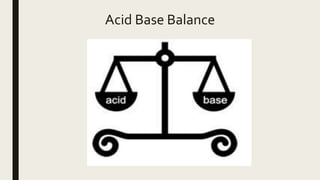
Acid Base Balance
Acid: is any proton donor (a molecule that releases a
proton H+ in water).
e.g. hydrochloric acid(HCL), carbonic acid, lactic acid
Base: is a proton acceptor (a substance accept H+
often with the release of hydroxyl (OH-) ions).
e.g. Hydroxyl ion (OH-), Bicarbonate (HCO3)
Acid-base balance is very important for the
homeostasis of the body and almost all the
physiological activities depend upon the acid base
status of the body.
• Acids are constantly produced in the body.
• However, the acid production is balanced by the
production of bases so that the acid-base status of
the body is maintained
Hydrogen ion (H+) contains only a single proton
(positively charged particle).
• It is the smallest ionic particle, it is highly
reactive.
• The pH is another term for H+ concentration
that is generally used nowadays instead of
‘hydrogen ion concentration’
Power Of Hydrogen
pH is the negative logarithm of hydrogen ion
concentration in solution.
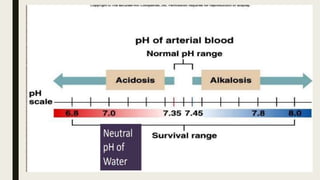
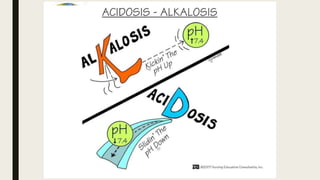
An increase in H+ ion concentration decreases the pH
(acidosis) and a reduction in H+ concentration increases
the pH (alkalosis).
• In a healthy person, pH value:
Arterial blood: 7.41
Venous blood: 7.35
pH of arterial blood gas is 7.35 - 7.45
Effects of changes in pH scale
■ Changes in excitability of nerve and muscle cells
■ Influences enzymes activity
■ Influences k+ level
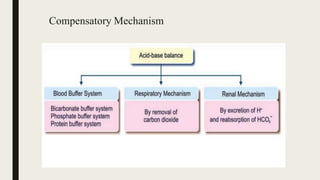
Compensatory Mechanism
Disturbance of acid base status
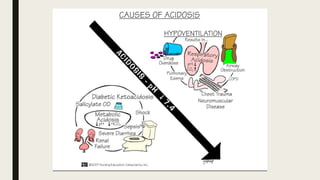
Acidosis
It refers to any pathological condition that causes a
relative excess of acid in the body
Acidosis is the reduction in pH (increase in H+
concentration) below normal range.
• Acidosis is produced by:
1. Increase in partial pressure of CO2 in the body fluids
particularly in arterial blood
2. Decrease in HCO3– concentration.
Types:
■ Respiratory acidosis
■ Metabolic acidosis
Respiratory acidosis
■ It is a state of relative excess of acid in the body fluid
resulting from retention or excessive production of
carbon dioxide.
■ It is an acid-base imbalance characterized by
increased partial pressure of carbon dioxide and
decreased blood ph.
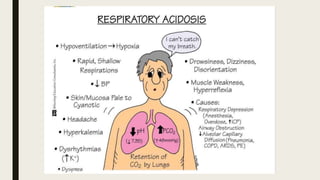
Causes:
Hypoventilation (decreased ventilation) is the primary
cause for excess CO2 in the body
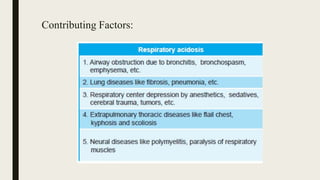
Contributing Factors:
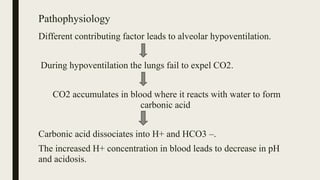
Pathophysiology
Different contributing factor leads to alveolar hypoventilation.
During hypoventilation the lungs fail to expel CO2.
CO2 accumulates in blood where it reacts with water to form
carbonic acid
Carbonic acid dissociates into H+ and HCO3 –.
The increased H+ concentration in blood leads to decrease in pH
and acidosis.
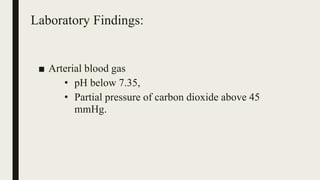
Laboratory Findings:
■ Arterial blood gas
• pH below 7.35,
• Partial pressure of carbon dioxide above 45
mmHg.
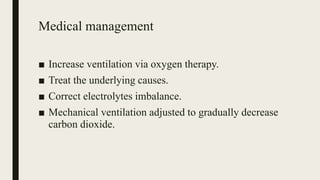
Medical management
■ Increase ventilation via oxygen therapy.
■ Treat the underlying causes.
■ Correct electrolytes imbalance.
■ Mechanical ventilation adjusted to gradually decrease
carbon dioxide.
Nursing management
1. Assessment
■ Assess patients vitals signs especially respiratory
pattern, oxygen saturation.
■ Assess for the patient general condition, altered mental
status.
■ Assess for extremities for color, temperature, moisture.
■ Assess for laboratory findings.
■ Monitor intake and output.
2. Nursing diagnosis
 Impaired gas exchange related to different contributing
factors.
 Ineffective breathing pattern related to different
contributing factors.
 Ineffective tissue perfusion related to hypoventilation.
 Acute confusion related to hypoxemia
 Risk for injury related to dizziness, drowsiness
3. Nursing intervention
■ Administer oxygen therapy, low flow rate in COPD
patient
■ Assist with positioning.
■ Maintain hydration (IV/PO) and provide
humidification.
■ Provide appropriate chest physiotherapy, including
postural drainage and breathing exercises.
Cont.…
■ Restrict use of hypnotic sedatives or tranquilizers
■ Administer Naloxone hydrochloride (Narcan), to over
counter effect of sedatives or opioids.
■ Monitor and graph serial ABGs, pulse oximetry
readings; Hb, serum electrolyte levels.
■ Sodium bicarbonate (NaHCO3) to correct acidosis
■ Administer IV solutions such as lactated Ringer’s
solution
Cont.…
■ Assist ventilation with mechanical ventilation if
necessary
■ Institute safety measures.
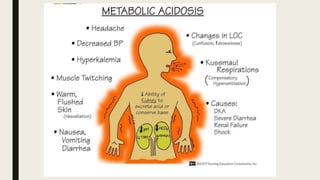
Metabolic Acidosis
It is an acid base imbalance resulting from excessive
absorption or retention of acid or excessive excretion of
bicarbonate.
Metabolic acidosis is the acid-base imbalance characterized
by excess accumulation of organic acids in the body, which is
caused by abnormal metabolic processes.
Organic acids such as lactic acid, ketoacids and uric acid are
formed by normal metabolism.
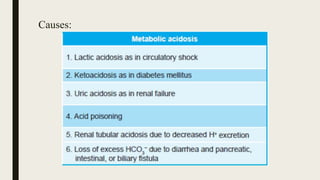
Causes:
Other causes:
■ Strenuous exercise
■ Prolong fasting
■ Ileostomy tube drainage
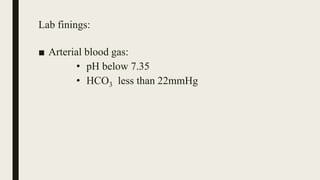
Lab finings:
■ Arterial blood gas:
• pH below 7.35
• HCO3 less than 22mmHg
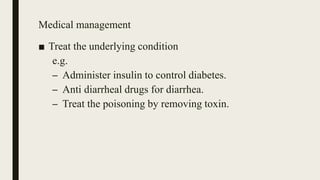
Medical management
■ Treat the underlying condition
e.g.
– Administer insulin to control diabetes.
– Anti diarrheal drugs for diarrhea.
– Treat the poisoning by removing toxin.
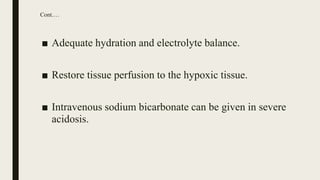
Cont.…
■ Adequate hydration and electrolyte balance.
■ Restore tissue perfusion to the hypoxic tissue.
■ Intravenous sodium bicarbonate can be given in severe
acidosis.
Cont.…
■ Strict intake and output charting.
■ Frequent ABG analysis.
■ In case of not responding, dialysis is alternative
Nursing management
A. Assessment
• Monitor vitals signs, heart rate and rhythm
• Observe for altered respiratory excursion, rate, and
depth.
• Assess skin temperature, color, capillary refill.
• Monitor I&O closely and weigh daily.
Cont.…
• Assess Loss of consciousness and note progressive
changes in neuromuscular status. Note
neuromuscular strength, tone, movement.
• Monitor and graph serial ABGs.
• Monitor serum electrolytes, especially potassium.
B. Nursing diagnosis
■ Decreased cardiac output related to the acidosis
■ Risk for excess fluid volume related to correction
therapy
■ Risk for injury related to disease condition
C. Implementation
■ Replace fluids, as indicated depending on underlying
etiology:
D5W or saline solutions.
■ Intravenous Sodium bicarbonate infusion for severe
acidosis
■ Intravenous calcium phosphate 10% infusion slowly
over 10 mins to correct hyperkalemia
■ Dextrose insulin also can be given to correct lactic
acidosis and hyperkalemia.
Cont.…
■ Modify diet as indicated: low-protein, high-
carbohydrate diet in presence of renal failure or
Diabetes diet for the person with diabetes.
■ Maintain urine output, provide diuretic or assist with
dialysis as indicated
■ Provide seizure or coma precautions and bed in low
position, use of side rails, frequent observation.
■ Provide oral hygiene with chlorhexidine mouth wash,
lemon, glycerin swabs.
Acidosis

Acidosis

  • 1.
  • 2.
  • 3.
    Acid: is anyproton donor (a molecule that releases a proton H+ in water). e.g. hydrochloric acid(HCL), carbonic acid, lactic acid Base: is a proton acceptor (a substance accept H+ often with the release of hydroxyl (OH-) ions). e.g. Hydroxyl ion (OH-), Bicarbonate (HCO3)
  • 4.
    Acid-base balance isvery important for the homeostasis of the body and almost all the physiological activities depend upon the acid base status of the body. • Acids are constantly produced in the body. • However, the acid production is balanced by the production of bases so that the acid-base status of the body is maintained
  • 5.
    Hydrogen ion (H+)contains only a single proton (positively charged particle). • It is the smallest ionic particle, it is highly reactive. • The pH is another term for H+ concentration that is generally used nowadays instead of ‘hydrogen ion concentration’
  • 6.
    Power Of Hydrogen pHis the negative logarithm of hydrogen ion concentration in solution. An increase in H+ ion concentration decreases the pH (acidosis) and a reduction in H+ concentration increases the pH (alkalosis). • In a healthy person, pH value: Arterial blood: 7.41 Venous blood: 7.35 pH of arterial blood gas is 7.35 - 7.45
  • 8.
    Effects of changesin pH scale ■ Changes in excitability of nerve and muscle cells ■ Influences enzymes activity ■ Influences k+ level
  • 9.
  • 10.
  • 12.
    Acidosis It refers toany pathological condition that causes a relative excess of acid in the body Acidosis is the reduction in pH (increase in H+ concentration) below normal range. • Acidosis is produced by: 1. Increase in partial pressure of CO2 in the body fluids particularly in arterial blood 2. Decrease in HCO3– concentration.
  • 13.
  • 15.
    Respiratory acidosis ■ Itis a state of relative excess of acid in the body fluid resulting from retention or excessive production of carbon dioxide. ■ It is an acid-base imbalance characterized by increased partial pressure of carbon dioxide and decreased blood ph.
  • 16.
    Causes: Hypoventilation (decreased ventilation)is the primary cause for excess CO2 in the body
  • 17.
  • 18.
    Pathophysiology Different contributing factorleads to alveolar hypoventilation. During hypoventilation the lungs fail to expel CO2. CO2 accumulates in blood where it reacts with water to form carbonic acid Carbonic acid dissociates into H+ and HCO3 –. The increased H+ concentration in blood leads to decrease in pH and acidosis.
  • 20.
    Laboratory Findings: ■ Arterialblood gas • pH below 7.35, • Partial pressure of carbon dioxide above 45 mmHg.
  • 21.
    Medical management ■ Increaseventilation via oxygen therapy. ■ Treat the underlying causes. ■ Correct electrolytes imbalance. ■ Mechanical ventilation adjusted to gradually decrease carbon dioxide.
  • 22.
    Nursing management 1. Assessment ■Assess patients vitals signs especially respiratory pattern, oxygen saturation. ■ Assess for the patient general condition, altered mental status. ■ Assess for extremities for color, temperature, moisture. ■ Assess for laboratory findings. ■ Monitor intake and output.
  • 23.
    2. Nursing diagnosis Impaired gas exchange related to different contributing factors.  Ineffective breathing pattern related to different contributing factors.  Ineffective tissue perfusion related to hypoventilation.  Acute confusion related to hypoxemia  Risk for injury related to dizziness, drowsiness
  • 24.
    3. Nursing intervention ■Administer oxygen therapy, low flow rate in COPD patient ■ Assist with positioning. ■ Maintain hydration (IV/PO) and provide humidification. ■ Provide appropriate chest physiotherapy, including postural drainage and breathing exercises.
  • 25.
    Cont.… ■ Restrict useof hypnotic sedatives or tranquilizers ■ Administer Naloxone hydrochloride (Narcan), to over counter effect of sedatives or opioids. ■ Monitor and graph serial ABGs, pulse oximetry readings; Hb, serum electrolyte levels. ■ Sodium bicarbonate (NaHCO3) to correct acidosis ■ Administer IV solutions such as lactated Ringer’s solution
  • 26.
    Cont.… ■ Assist ventilationwith mechanical ventilation if necessary ■ Institute safety measures.
  • 27.
    Metabolic Acidosis It isan acid base imbalance resulting from excessive absorption or retention of acid or excessive excretion of bicarbonate. Metabolic acidosis is the acid-base imbalance characterized by excess accumulation of organic acids in the body, which is caused by abnormal metabolic processes. Organic acids such as lactic acid, ketoacids and uric acid are formed by normal metabolism.
  • 28.
  • 29.
    Other causes: ■ Strenuousexercise ■ Prolong fasting ■ Ileostomy tube drainage
  • 31.
    Lab finings: ■ Arterialblood gas: • pH below 7.35 • HCO3 less than 22mmHg
  • 32.
    Medical management ■ Treatthe underlying condition e.g. – Administer insulin to control diabetes. – Anti diarrheal drugs for diarrhea. – Treat the poisoning by removing toxin.
  • 33.
    Cont.… ■ Adequate hydrationand electrolyte balance. ■ Restore tissue perfusion to the hypoxic tissue. ■ Intravenous sodium bicarbonate can be given in severe acidosis.
  • 34.
    Cont.… ■ Strict intakeand output charting. ■ Frequent ABG analysis. ■ In case of not responding, dialysis is alternative
  • 35.
    Nursing management A. Assessment •Monitor vitals signs, heart rate and rhythm • Observe for altered respiratory excursion, rate, and depth. • Assess skin temperature, color, capillary refill. • Monitor I&O closely and weigh daily.
  • 36.
    Cont.… • Assess Lossof consciousness and note progressive changes in neuromuscular status. Note neuromuscular strength, tone, movement. • Monitor and graph serial ABGs. • Monitor serum electrolytes, especially potassium.
  • 37.
    B. Nursing diagnosis ■Decreased cardiac output related to the acidosis ■ Risk for excess fluid volume related to correction therapy ■ Risk for injury related to disease condition
  • 38.
    C. Implementation ■ Replacefluids, as indicated depending on underlying etiology: D5W or saline solutions. ■ Intravenous Sodium bicarbonate infusion for severe acidosis ■ Intravenous calcium phosphate 10% infusion slowly over 10 mins to correct hyperkalemia ■ Dextrose insulin also can be given to correct lactic acidosis and hyperkalemia.
  • 39.
    Cont.… ■ Modify dietas indicated: low-protein, high- carbohydrate diet in presence of renal failure or Diabetes diet for the person with diabetes. ■ Maintain urine output, provide diuretic or assist with dialysis as indicated ■ Provide seizure or coma precautions and bed in low position, use of side rails, frequent observation. ■ Provide oral hygiene with chlorhexidine mouth wash, lemon, glycerin swabs.