DR NILESH KATE
MBBS,MD
ASSOCIATE PROF
ESIC MEDICAL COLLEGE, GULBARGA.
DEPT. OF PHYSIOLOGY
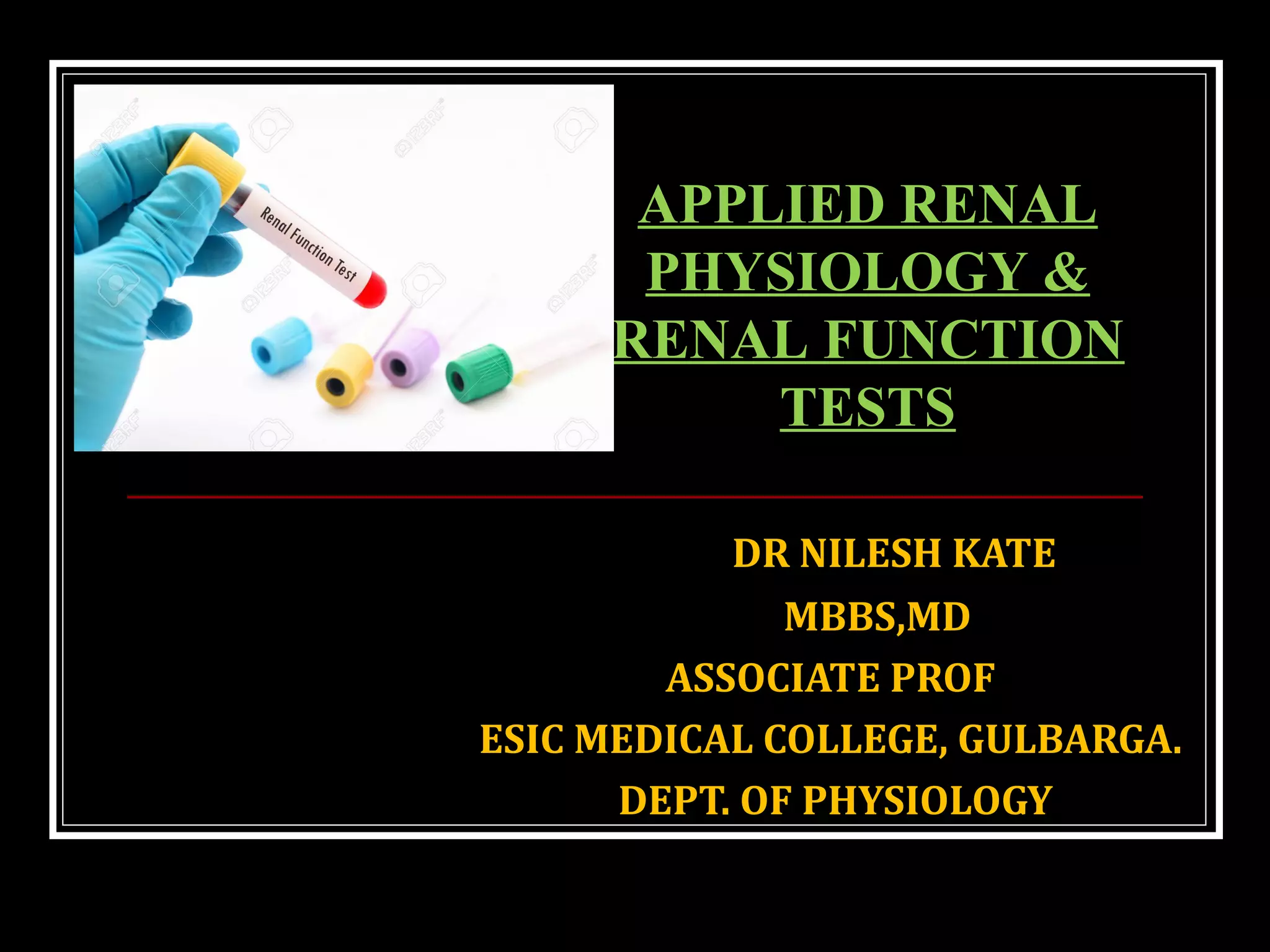
APPLIED RENAL
PHYSIOLOGY &
RENAL FUNCTION
TESTS
OBJECTIVES.
 Pathophysiology of common renal disorders
 Diuretics
 Renal function tests
 Dialysis and renal Transplantataion.
PATHOPHYSIOLOGY OF
COMMON RENAL DISORDERS
 Common urinary symptoms
 Renal failure
 Nephrotic syndrome
Thursday, April 26, 2018
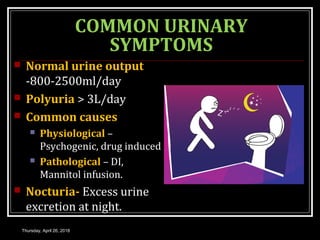
COMMON URINARY
SYMPTOMS
 Normal urine output
-800-2500ml/day
 Polyuria > 3L/day
 Common causes
 Physiological –
Psychogenic, drug induced
 Pathological – DI,
Mannitol infusion.
 Nocturia- Excess urine
excretion at night.
Thursday, April 26, 2018
COMMON URINARY
SYMPTOMS
 Dysuria -pain or burning during micturition.
 Urgency of Micturirtion - Exagerrated sense or
urge to micturate
 Enuresis – Involuntary passage of urine at night.
 Oliguria- urine output< 500 ml/day.
Thursday, April 26, 2018
INCONTINENCE
 Inability to retain
urine in bladder.
 Causes
 Neurogenic
 Stress
 Mechanical
 Overflow
 Psychogenic
 Functional
Thursday, April 26, 2018
RENAL FAILURE
 Deterioration of Renal function resulting in
decline in Glomerular filtration rate & rise in
urea & Non-nitrogenous substances in blood.
 2 types
 Acute
 chronic
Thursday, April 26, 2018
RENAL FAILURE
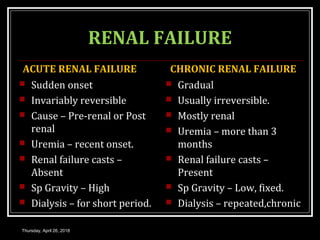
ACUTE RENAL FAILURE
 Sudden onset
 Invariably reversible
 Cause – Pre-renal or Post
renal
 Uremia – recent onset.
 Renal failure casts –
Absent
 Sp Gravity – High
 Dialysis – for short period.
CHRONIC RENAL FAILURE
 Gradual
 Usually irreversible.
 Mostly renal
 Uremia – more than 3
months
 Renal failure casts –
Present
 Sp Gravity – Low, fixed.
 Dialysis – repeated,chronic
Thursday, April 26, 2018
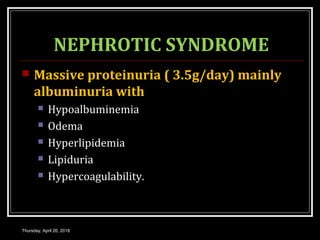
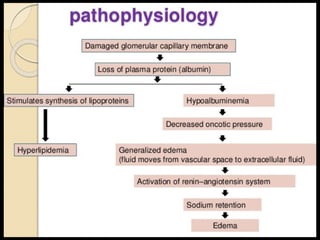
NEPHROTIC SYNDROME
 Massive proteinuria ( 3.5g/day) mainly
albuminuria with
 Hypoalbuminemia
 Odema
 Hyperlipidemia
 Lipiduria
 Hypercoagulability.
Thursday, April 26, 2018
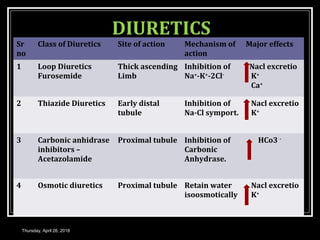
DIURETICS
Sr
no
Class of Diuretics Site of action Mechanism of
action
Major effects
1 Loop Diuretics
Furosemide
Thick ascending
Limb
Inhibition of
Na+
-K+
-2Cl-
Nacl excretio
K+
Ca+
2 Thiazide Diuretics Early distal
tubule
Inhibition of
Na-Cl symport.
Nacl excretio
K+
3 Carbonic anhidrase
inhibitors –
Acetazolamide
Proximal tubule Inhibition of
Carbonic
Anhydrase.
HCo3 -
4 Osmotic diuretics Proximal tubule Retain water
isoosmotically
Nacl excretio
K+
Thursday, April 26, 2018
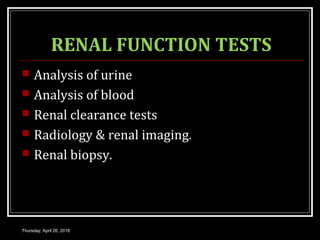
RENAL FUNCTION TESTS
 Analysis of urine
 Analysis of blood
 Renal clearance tests
 Radiology & renal imaging.
 Renal biopsy.
Thursday, April 26, 2018
ANALYSIS OF URINE
 Volume – normal 500-2500
ml/day
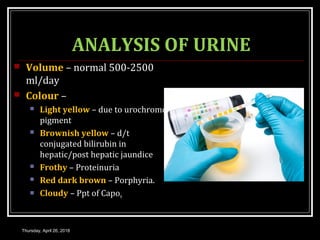
 Colour –
 Light yellow – due to urochrome
pigment
 Brownish yellow – d/t
conjugated bilirubin in
hepatic/post hepatic jaundice
 Frothy – Proteinuria
 Red dark brown – Porphyria.
 Cloudy – Ppt of Capo4
Thursday, April 26, 2018
ANALYSIS OF URINE
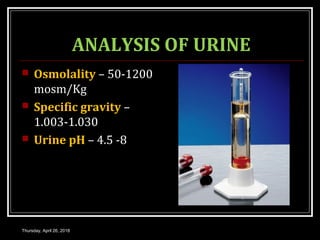
 Osmolality – 50-1200
mosm/Kg
 Specific gravity –
1.003-1.030
 Urine pH – 4.5 -8
Thursday, April 26, 2018
ANALYSIS OF URINE
 Chemical analysis for abnormal urinary
constituents
 Proteinuria
 Glycosuria
 Ketonuria
 Bilirubinuria
 Haemoglobinuria
 Haematuria.
Thursday, April 26, 2018
ANALYSIS OF URINE
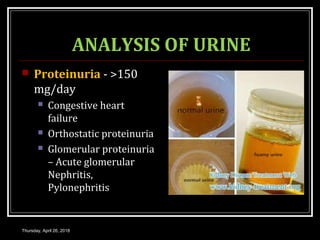
 Proteinuria - >150
mg/day
 Congestive heart
failure
 Orthostatic proteinuria
 Glomerular proteinuria
– Acute glomerular
Nephritis,
Pylonephritis
Thursday, April 26, 2018
ANALYSIS OF URINE
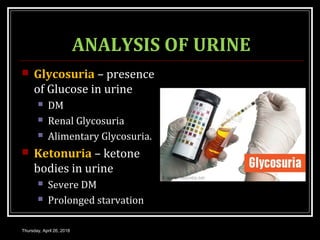
 Glycosuria – presence
of Glucose in urine
 DM
 Renal Glycosuria
 Alimentary Glycosuria.
 Ketonuria – ketone
bodies in urine
 Severe DM
 Prolonged starvation
Thursday, April 26, 2018
ANALYSIS OF URINE
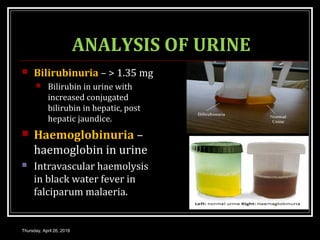
 Bilirubinuria – > 1.35 mg
 Bilirubin in urine with
increased conjugated
bilirubin in hepatic, post
hepatic jaundice.
 Haemoglobinuria –
haemoglobin in urine
 Intravascular haemolysis
in black water fever in
falciparum malaeria.
Thursday, April 26, 2018
ANALYSIS OF URINE
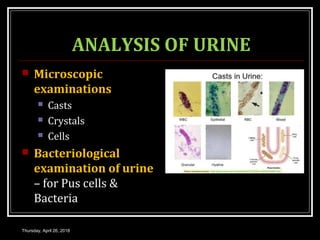
 Microscopic
examinations
 Casts
 Crystals
 Cells
 Bacteriological
examination of urine
– for Pus cells &
Bacteria
Thursday, April 26, 2018
MICROSCOPIC EXAMINATIONS
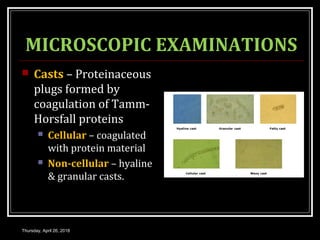
 Casts – Proteinaceous
plugs formed by
coagulation of Tamm-
Horsfall proteins
 Cellular – coagulated
with protein material
 Non-cellular – hyaline
& granular casts.
Thursday, April 26, 2018
MICROSCOPIC EXAMINATIONS
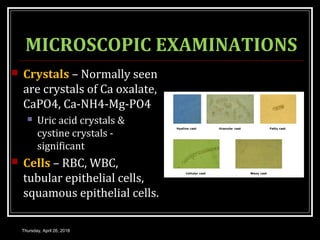
 Crystals – Normally seen
are crystals of Ca oxalate,
CaPO4, Ca-NH4-Mg-PO4
 Uric acid crystals &
cystine crystals -
significant
 Cells – RBC, WBC,
tubular epithelial cells,
squamous epithelial cells.
Thursday, April 26, 2018
ANALYSIS OF BLOOD
 Blood urea level – normal 20-40mg/dl
 50% glomerular damage.
 Plasma creatinine concentration.(0.6-1.5
mg/dl)
Thursday, April 26, 2018
ANALYSIS OF BLOOD
 Serum protein levels
 6.7-8 gm/dl
 Albumin – 3-5 gm/dl
 Globulin – 2-3 gm/dl
 Serum cholesterol levels – 150-200 mg/dl.
 Nephrotic syndrome
 Serum electrolyte levels
 Na – 152 mEq/L, K - 5 mEq/L, Ca 9-11 mg/dl.
Thursday, April 26, 2018
MEASUREMENT OF GFR
 If a substance (W) is neither reabsorbed nor secreted
by tubule:
 The amount excreted in urine/min. will be equal
to the amount filtered out of the glomeruli /min.
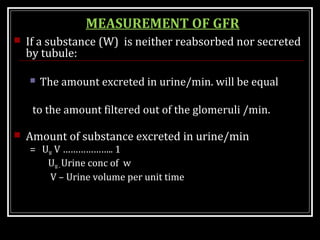
 Amount of substance excreted in urine/min
= UW V ……………….. 1
UW–Urine conc of w
V – Urine volume per unit time
MEASUREMENT OF GFR
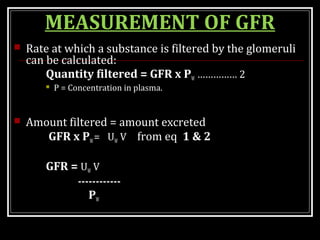
 Rate at which a substance is filtered by the glomeruli
can be calculated:
Quantity filtered = GFR x PW …………… 2
 P = Concentration in plasma.
 Amount filtered = amount excreted
GFR x PW= UW V from eq 1 & 2
GFR = UW V
------------
PW
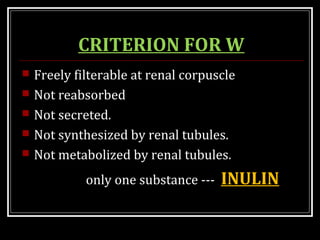
CRITERION FOR W
 Freely filterable at renal corpuscle
 Not reabsorbed
 Not secreted.
 Not synthesized by renal tubules.
 Not metabolized by renal tubules.
only one substance --- INULIN
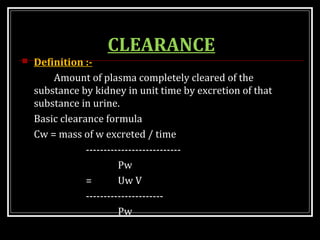
CLEARANCE
 Definition :-
Amount of plasma completely cleared of the
substance by kidney in unit time by excretion of that
substance in urine.
Basic clearance formula
Cw = mass of w excreted / time
---------------------------
Pw
= Uw V
----------------------
Pw
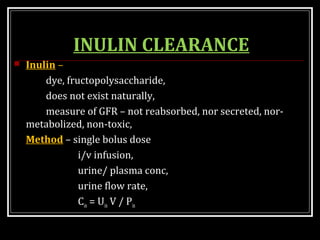
INULIN CLEARANCE
 Inulin –
dye, fructopolysaccharide,
does not exist naturally,
measure of GFR – not reabsorbed, nor secreted, nor-
metabolized, non-toxic,
Method – single bolus dose
i/v infusion,
urine/ plasma conc,
urine flow rate,
Cin = Uin V / Pin
CLINICAL APPLICATION
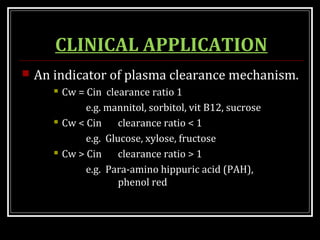
 An indicator of plasma clearance mechanism.
 Cw = Cin clearance ratio 1
e.g. mannitol, sorbitol, vit B12, sucrose
 Cw < Cin clearance ratio < 1
e.g. Glucose, xylose, fructose
 Cw > Cin clearance ratio > 1
e.g. Para-amino hippuric acid (PAH),
phenol red
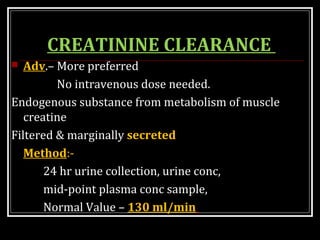
CREATININE CLEARANCE
 Adv.– More preferred
No intravenous dose needed.
Endogenous substance from metabolism of muscle
creatine
Filtered & marginally secreted
Method:-
24 hr urine collection, urine conc,
mid-point plasma conc sample,
Normal Value – 130 ml/min
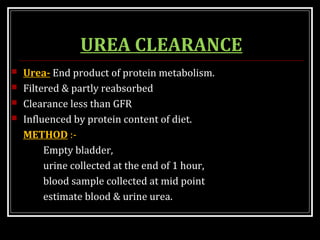
UREA CLEARANCE
 Urea- End product of protein metabolism.
 Filtered & partly reabsorbed
 Clearance less than GFR
 Influenced by protein content of diet.
METHOD :-
Empty bladder,
urine collected at the end of 1 hour,
blood sample collected at mid point
estimate blood & urine urea.
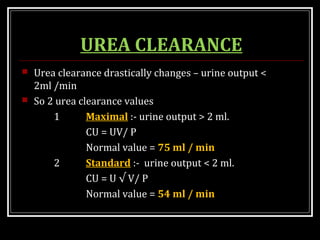
UREA CLEARANCE
 Urea clearance drastically changes – urine output <
2ml /min
 So 2 urea clearance values
1 Maximal :- urine output > 2 ml.
CU = UV/ P
Normal value = 75 ml / min
2 Standard :- urine output < 2 ml.
CU = U √ V/ P
Normal value = 54 ml / min
MEASUREENT OF RENAL PLASMA
FLOW
 FICK’S Principle to kidney
“ Amount of substance excreted by
the kidney per unit time (UV) is equal
to the product of renal plasma flow
(RPF) and arteriovenous difference in
its plasma concentration.”
UV = RPF (Pa- Pv)
RPF = UV / (Pa-Pv)……………(1)
PAH CLEARANCE – TO
MEASURE RPF
 PAH clearance is used to measure
RPF
b’coz–
1 Completely extracted.
2 Neither metabolized nor
reabsorbed.
3 Does not affect RBF.
4 Actively secreted.
5 Conc. easily measured.
METHOD
 RPF = UV/ (Pa – Pv)
 All PAH excreted in urine nothing returned
so Pv is 0
RPF = UV / Pa
 Also PAH not excreted by any other organ so plasma PAH
conc can be used.
RPF = UV / P PAH
 BUT UV / P PAH= PAH Clearance
So RPF = PAH Clearance.
ERPF = PAH Clearance.
TRUE ERPF = CPAH / 0.9
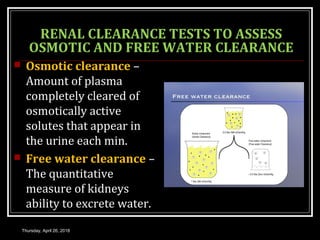
RENAL CLEARANCE TESTS TO ASSESS
OSMOTIC AND FREE WATER CLEARANCE
 Osmotic clearance –
Amount of plasma
completely cleared of
osmotically active
solutes that appear in
the urine each min.
 Free water clearance –
The quantitative
measure of kidneys
ability to excrete water.
Thursday, April 26, 2018
TESTS FOR TUBULAR
FUNCTIONS
 Urine concentration tests
 Urine dilution tests
 Urine acidification tests
 Other methods of study of tubular functions.
Thursday, April 26, 2018
URINE CONCENTRATION
TESTS
 Measuring specific gravity of urine after 12 hrs of
water deprivation or after giving vasopressin
 If above 1.020 normal
Thursday, April 26, 2018
URINE DILUTION TESTS
 Pt asked to drink 1 l of water & measure urine
sample for 4 hours, - 750 ml should be collected &
one sample osmolality should be less than
100msom/Kg of water.
Thursday, April 26, 2018
URINE ACIDIFICATION TESTS
 Pt given NH4Cl (0.1 gm/kg) & urine sample
collected after 6 hrs
 Urine pH should be below 5.3
Thursday, April 26, 2018
OTHER METHODS OF STUDY
OF TUBULAR FUNCTIONS.
 Micro Puncture technique
 Micro Cryoscopic studies
 Micro Electrode studies.
Thursday, April 26, 2018
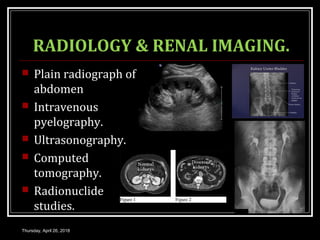
RADIOLOGY & RENAL IMAGING.
 Plain radiograph of
abdomen
 Intravenous
pyelography.
 Ultrasonography.
 Computed
tomography.
 Radionuclide
studies.
Thursday, April 26, 2018
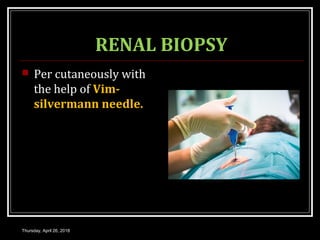
RENAL BIOPSY
 Per cutaneously with
the help of Vim-
silvermann needle.
Thursday, April 26, 2018
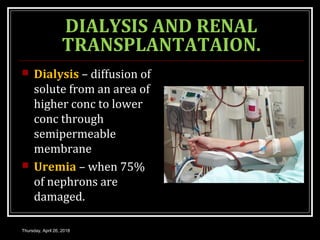
DIALYSIS AND RENAL
TRANSPLANTATAION.
 Dialysis – diffusion of
solute from an area of
higher conc to lower
conc through
semipermeable
membrane
 Uremia – when 75%
of nephrons are
damaged.
Thursday, April 26, 2018
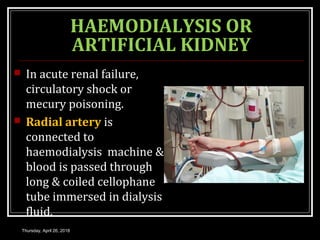
HAEMODIALYSIS OR
ARTIFICIAL KIDNEY
 In acute renal failure,
circulatory shock or
mecury poisoning.
 Radial artery is
connected to
haemodialysis machine &
blood is passed through
long & coiled cellophane
tube immersed in dialysis
fluid.
Thursday, April 26, 2018
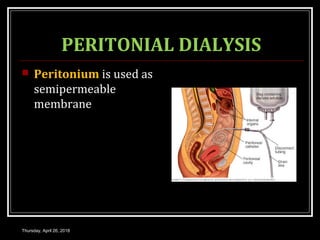
PERITONIAL DIALYSIS
 Peritonium is used as
semipermeable
membrane
Thursday, April 26, 2018
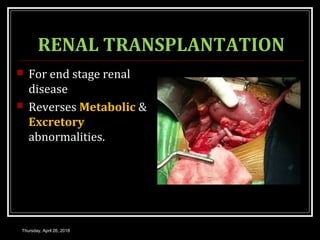
RENAL TRANSPLANTATION
 For end stage renal
disease
 Reverses Metabolic &
Excretory
abnormalities.
Thursday, April 26, 2018
THANK YOU

RENAL FUNCTION TESTS

  • 1.
    DR NILESH KATE MBBS,MD ASSOCIATEPROF ESIC MEDICAL COLLEGE, GULBARGA. DEPT. OF PHYSIOLOGY APPLIED RENAL PHYSIOLOGY & RENAL FUNCTION TESTS
  • 2.
    OBJECTIVES.  Pathophysiology ofcommon renal disorders  Diuretics  Renal function tests  Dialysis and renal Transplantataion.
  • 3.
    PATHOPHYSIOLOGY OF COMMON RENALDISORDERS  Common urinary symptoms  Renal failure  Nephrotic syndrome Thursday, April 26, 2018
  • 4.
    COMMON URINARY SYMPTOMS  Normalurine output -800-2500ml/day  Polyuria > 3L/day  Common causes  Physiological – Psychogenic, drug induced  Pathological – DI, Mannitol infusion.  Nocturia- Excess urine excretion at night. Thursday, April 26, 2018
  • 5.
    COMMON URINARY SYMPTOMS  Dysuria-pain or burning during micturition.  Urgency of Micturirtion - Exagerrated sense or urge to micturate  Enuresis – Involuntary passage of urine at night.  Oliguria- urine output< 500 ml/day. Thursday, April 26, 2018
  • 6.
    INCONTINENCE  Inability toretain urine in bladder.  Causes  Neurogenic  Stress  Mechanical  Overflow  Psychogenic  Functional Thursday, April 26, 2018
  • 7.
    RENAL FAILURE  Deteriorationof Renal function resulting in decline in Glomerular filtration rate & rise in urea & Non-nitrogenous substances in blood.  2 types  Acute  chronic Thursday, April 26, 2018
  • 8.
    RENAL FAILURE ACUTE RENALFAILURE  Sudden onset  Invariably reversible  Cause – Pre-renal or Post renal  Uremia – recent onset.  Renal failure casts – Absent  Sp Gravity – High  Dialysis – for short period. CHRONIC RENAL FAILURE  Gradual  Usually irreversible.  Mostly renal  Uremia – more than 3 months  Renal failure casts – Present  Sp Gravity – Low, fixed.  Dialysis – repeated,chronic Thursday, April 26, 2018
  • 9.
    NEPHROTIC SYNDROME  Massiveproteinuria ( 3.5g/day) mainly albuminuria with  Hypoalbuminemia  Odema  Hyperlipidemia  Lipiduria  Hypercoagulability. Thursday, April 26, 2018
  • 10.
  • 11.
    DIURETICS Sr no Class of DiureticsSite of action Mechanism of action Major effects 1 Loop Diuretics Furosemide Thick ascending Limb Inhibition of Na+ -K+ -2Cl- Nacl excretio K+ Ca+ 2 Thiazide Diuretics Early distal tubule Inhibition of Na-Cl symport. Nacl excretio K+ 3 Carbonic anhidrase inhibitors – Acetazolamide Proximal tubule Inhibition of Carbonic Anhydrase. HCo3 - 4 Osmotic diuretics Proximal tubule Retain water isoosmotically Nacl excretio K+ Thursday, April 26, 2018
  • 12.
    RENAL FUNCTION TESTS Analysis of urine  Analysis of blood  Renal clearance tests  Radiology & renal imaging.  Renal biopsy. Thursday, April 26, 2018
  • 13.
    ANALYSIS OF URINE Volume – normal 500-2500 ml/day  Colour –  Light yellow – due to urochrome pigment  Brownish yellow – d/t conjugated bilirubin in hepatic/post hepatic jaundice  Frothy – Proteinuria  Red dark brown – Porphyria.  Cloudy – Ppt of Capo4 Thursday, April 26, 2018
  • 14.
    ANALYSIS OF URINE Osmolality – 50-1200 mosm/Kg  Specific gravity – 1.003-1.030  Urine pH – 4.5 -8 Thursday, April 26, 2018
  • 15.
    ANALYSIS OF URINE Chemical analysis for abnormal urinary constituents  Proteinuria  Glycosuria  Ketonuria  Bilirubinuria  Haemoglobinuria  Haematuria. Thursday, April 26, 2018
  • 16.
    ANALYSIS OF URINE Proteinuria - >150 mg/day  Congestive heart failure  Orthostatic proteinuria  Glomerular proteinuria – Acute glomerular Nephritis, Pylonephritis Thursday, April 26, 2018
  • 17.
    ANALYSIS OF URINE Glycosuria – presence of Glucose in urine  DM  Renal Glycosuria  Alimentary Glycosuria.  Ketonuria – ketone bodies in urine  Severe DM  Prolonged starvation Thursday, April 26, 2018
  • 18.
    ANALYSIS OF URINE Bilirubinuria – > 1.35 mg  Bilirubin in urine with increased conjugated bilirubin in hepatic, post hepatic jaundice.  Haemoglobinuria – haemoglobin in urine  Intravascular haemolysis in black water fever in falciparum malaeria. Thursday, April 26, 2018
  • 19.
    ANALYSIS OF URINE Microscopic examinations  Casts  Crystals  Cells  Bacteriological examination of urine – for Pus cells & Bacteria Thursday, April 26, 2018
  • 20.
    MICROSCOPIC EXAMINATIONS  Casts– Proteinaceous plugs formed by coagulation of Tamm- Horsfall proteins  Cellular – coagulated with protein material  Non-cellular – hyaline & granular casts. Thursday, April 26, 2018
  • 21.
    MICROSCOPIC EXAMINATIONS  Crystals– Normally seen are crystals of Ca oxalate, CaPO4, Ca-NH4-Mg-PO4  Uric acid crystals & cystine crystals - significant  Cells – RBC, WBC, tubular epithelial cells, squamous epithelial cells. Thursday, April 26, 2018
  • 22.
    ANALYSIS OF BLOOD Blood urea level – normal 20-40mg/dl  50% glomerular damage.  Plasma creatinine concentration.(0.6-1.5 mg/dl) Thursday, April 26, 2018
  • 23.
    ANALYSIS OF BLOOD Serum protein levels  6.7-8 gm/dl  Albumin – 3-5 gm/dl  Globulin – 2-3 gm/dl  Serum cholesterol levels – 150-200 mg/dl.  Nephrotic syndrome  Serum electrolyte levels  Na – 152 mEq/L, K - 5 mEq/L, Ca 9-11 mg/dl. Thursday, April 26, 2018
  • 24.
    MEASUREMENT OF GFR If a substance (W) is neither reabsorbed nor secreted by tubule:  The amount excreted in urine/min. will be equal to the amount filtered out of the glomeruli /min.  Amount of substance excreted in urine/min = UW V ……………….. 1 UW–Urine conc of w V – Urine volume per unit time
  • 25.
    MEASUREMENT OF GFR Rate at which a substance is filtered by the glomeruli can be calculated: Quantity filtered = GFR x PW …………… 2  P = Concentration in plasma.  Amount filtered = amount excreted GFR x PW= UW V from eq 1 & 2 GFR = UW V ------------ PW
  • 26.
    CRITERION FOR W Freely filterable at renal corpuscle  Not reabsorbed  Not secreted.  Not synthesized by renal tubules.  Not metabolized by renal tubules. only one substance --- INULIN
  • 27.
    CLEARANCE  Definition :- Amountof plasma completely cleared of the substance by kidney in unit time by excretion of that substance in urine. Basic clearance formula Cw = mass of w excreted / time --------------------------- Pw = Uw V ---------------------- Pw
  • 28.
    INULIN CLEARANCE  Inulin– dye, fructopolysaccharide, does not exist naturally, measure of GFR – not reabsorbed, nor secreted, nor- metabolized, non-toxic, Method – single bolus dose i/v infusion, urine/ plasma conc, urine flow rate, Cin = Uin V / Pin
  • 29.
    CLINICAL APPLICATION  Anindicator of plasma clearance mechanism.  Cw = Cin clearance ratio 1 e.g. mannitol, sorbitol, vit B12, sucrose  Cw < Cin clearance ratio < 1 e.g. Glucose, xylose, fructose  Cw > Cin clearance ratio > 1 e.g. Para-amino hippuric acid (PAH), phenol red
  • 30.
    CREATININE CLEARANCE  Adv.–More preferred No intravenous dose needed. Endogenous substance from metabolism of muscle creatine Filtered & marginally secreted Method:- 24 hr urine collection, urine conc, mid-point plasma conc sample, Normal Value – 130 ml/min
  • 31.
    UREA CLEARANCE  Urea-End product of protein metabolism.  Filtered & partly reabsorbed  Clearance less than GFR  Influenced by protein content of diet. METHOD :- Empty bladder, urine collected at the end of 1 hour, blood sample collected at mid point estimate blood & urine urea.
  • 32.
    UREA CLEARANCE  Ureaclearance drastically changes – urine output < 2ml /min  So 2 urea clearance values 1 Maximal :- urine output > 2 ml. CU = UV/ P Normal value = 75 ml / min 2 Standard :- urine output < 2 ml. CU = U √ V/ P Normal value = 54 ml / min
  • 33.
    MEASUREENT OF RENALPLASMA FLOW  FICK’S Principle to kidney “ Amount of substance excreted by the kidney per unit time (UV) is equal to the product of renal plasma flow (RPF) and arteriovenous difference in its plasma concentration.” UV = RPF (Pa- Pv) RPF = UV / (Pa-Pv)……………(1)
  • 34.
    PAH CLEARANCE –TO MEASURE RPF  PAH clearance is used to measure RPF b’coz– 1 Completely extracted. 2 Neither metabolized nor reabsorbed. 3 Does not affect RBF. 4 Actively secreted. 5 Conc. easily measured.
  • 35.
    METHOD  RPF =UV/ (Pa – Pv)  All PAH excreted in urine nothing returned so Pv is 0 RPF = UV / Pa  Also PAH not excreted by any other organ so plasma PAH conc can be used. RPF = UV / P PAH  BUT UV / P PAH= PAH Clearance So RPF = PAH Clearance. ERPF = PAH Clearance. TRUE ERPF = CPAH / 0.9
  • 36.
    RENAL CLEARANCE TESTSTO ASSESS OSMOTIC AND FREE WATER CLEARANCE  Osmotic clearance – Amount of plasma completely cleared of osmotically active solutes that appear in the urine each min.  Free water clearance – The quantitative measure of kidneys ability to excrete water. Thursday, April 26, 2018
  • 37.
    TESTS FOR TUBULAR FUNCTIONS Urine concentration tests  Urine dilution tests  Urine acidification tests  Other methods of study of tubular functions. Thursday, April 26, 2018
  • 38.
    URINE CONCENTRATION TESTS  Measuringspecific gravity of urine after 12 hrs of water deprivation or after giving vasopressin  If above 1.020 normal Thursday, April 26, 2018
  • 39.
    URINE DILUTION TESTS Pt asked to drink 1 l of water & measure urine sample for 4 hours, - 750 ml should be collected & one sample osmolality should be less than 100msom/Kg of water. Thursday, April 26, 2018
  • 40.
    URINE ACIDIFICATION TESTS Pt given NH4Cl (0.1 gm/kg) & urine sample collected after 6 hrs  Urine pH should be below 5.3 Thursday, April 26, 2018
  • 41.
    OTHER METHODS OFSTUDY OF TUBULAR FUNCTIONS.  Micro Puncture technique  Micro Cryoscopic studies  Micro Electrode studies. Thursday, April 26, 2018
  • 42.
    RADIOLOGY & RENALIMAGING.  Plain radiograph of abdomen  Intravenous pyelography.  Ultrasonography.  Computed tomography.  Radionuclide studies. Thursday, April 26, 2018
  • 43.
    RENAL BIOPSY  Percutaneously with the help of Vim- silvermann needle. Thursday, April 26, 2018
  • 44.
    DIALYSIS AND RENAL TRANSPLANTATAION. Dialysis – diffusion of solute from an area of higher conc to lower conc through semipermeable membrane  Uremia – when 75% of nephrons are damaged. Thursday, April 26, 2018
  • 45.
    HAEMODIALYSIS OR ARTIFICIAL KIDNEY In acute renal failure, circulatory shock or mecury poisoning.  Radial artery is connected to haemodialysis machine & blood is passed through long & coiled cellophane tube immersed in dialysis fluid. Thursday, April 26, 2018
  • 46.
    PERITONIAL DIALYSIS  Peritoniumis used as semipermeable membrane Thursday, April 26, 2018
  • 47.
    RENAL TRANSPLANTATION  Forend stage renal disease  Reverses Metabolic & Excretory abnormalities. Thursday, April 26, 2018
  • 48.