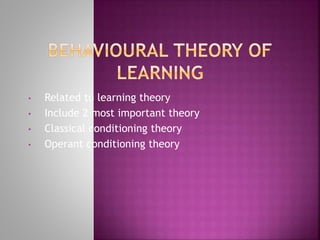
• Related to learning theory
• Include 2 most important theory
• Classical conditioning theory
• Operant conditioning theory
• Behaviourism is also known as “behavioural
psychology”
• Behavioural psychology is a theory of learning
• This theory of learning based on the idea that all
behaviours are acquired through condition.
• We can learning through various condition.
• Any action that is a behaviour is called behaviour.
• Behaviour can be studied in a systematic and
observational manner regardless of internal
mental stress.
• Observable manner should be considered –
cognitions, emotions and moods are far too
subjective.
• Different scientist give different theories about
behaviours.
• But I can focused on 2 major types of behavioural
theory.
1. Classical conditioning theory
2. Operant conditioning theory
• This theory was given by “IVAN PAVLOR”
• “Pavlor” experiment on Dog
• Observer are hidden
• Food given through automatic devices.
• Salivary glands were operated and connected with
the tubes to collect the saliva test and measure.
• Site of food is work to (as a natural) stimulus & we
take natural response
NS (Natural stimulus) NR (Natural response)
Food (Salivation)
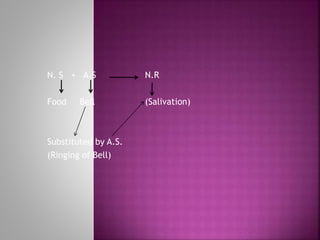
N. S + A.S N.R
Food Bell (Salivation)
Substituted by A.S.
(Ringing of Bell)
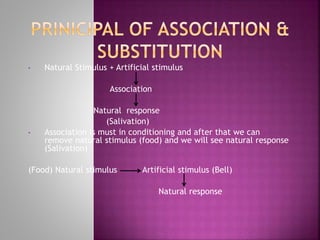
• Natural Stimulus + Artificial stimulus
Association
Natural response
(Salivation)
• Association is must in conditioning and after that we can
remove natural stimulus (food) and we will see natural response
(Salivation)
(Food) Natural stimulus Artificial stimulus (Bell)
Natural response
• Is also known as S type conditioning (stimulus
type conditioning)
• Because firstly we can give stimulus and after that
we get natural response study.
• Associate with natural stimulus + Artificial
stimulus & after that remove artificial stimulus we
get natural response.
• This theory was given by B.F. skinner.
• Theory of B.F. skinner is based upon the idea that learning is
a function of change in our behaviour.
• The distinctive characteristics of operant conditioning
relative to previous forms of behaviorism.
• The theory also covers negative reinforcement any stimulus
that result in the increases frequency of a response when it
is with drawn (different from adversive stimuli – punishment
– which result in reduced responses)
• A great deal of attention was given to schedules of
reinforcement.
e.g :
• Internal rersus ratio and their effects on
establishing and maintaining behaviour.
“CONCLUSION OF OPERANT CONDITIONING”
• Appropriate behaviour is achieved by building a
chain of response. Things or step by other called
shaping of behaviour.
• Shaping of behaviour through reinforcement.
• R-type of conditioning.

Behavioural theory of learning

  • 3.
    • Related tolearning theory • Include 2 most important theory • Classical conditioning theory • Operant conditioning theory
  • 4.
    • Behaviourism isalso known as “behavioural psychology” • Behavioural psychology is a theory of learning • This theory of learning based on the idea that all behaviours are acquired through condition. • We can learning through various condition.
  • 5.
    • Any actionthat is a behaviour is called behaviour. • Behaviour can be studied in a systematic and observational manner regardless of internal mental stress. • Observable manner should be considered – cognitions, emotions and moods are far too subjective.
  • 6.
    • Different scientistgive different theories about behaviours. • But I can focused on 2 major types of behavioural theory. 1. Classical conditioning theory 2. Operant conditioning theory
  • 7.
    • This theorywas given by “IVAN PAVLOR” • “Pavlor” experiment on Dog • Observer are hidden • Food given through automatic devices. • Salivary glands were operated and connected with the tubes to collect the saliva test and measure. • Site of food is work to (as a natural) stimulus & we take natural response NS (Natural stimulus) NR (Natural response) Food (Salivation)
  • 8.
    N. S +A.S N.R Food Bell (Salivation) Substituted by A.S. (Ringing of Bell)
  • 9.
    • Natural Stimulus+ Artificial stimulus Association Natural response (Salivation) • Association is must in conditioning and after that we can remove natural stimulus (food) and we will see natural response (Salivation) (Food) Natural stimulus Artificial stimulus (Bell) Natural response
  • 10.
    • Is alsoknown as S type conditioning (stimulus type conditioning) • Because firstly we can give stimulus and after that we get natural response study. • Associate with natural stimulus + Artificial stimulus & after that remove artificial stimulus we get natural response.
  • 11.
    • This theorywas given by B.F. skinner. • Theory of B.F. skinner is based upon the idea that learning is a function of change in our behaviour. • The distinctive characteristics of operant conditioning relative to previous forms of behaviorism. • The theory also covers negative reinforcement any stimulus that result in the increases frequency of a response when it is with drawn (different from adversive stimuli – punishment – which result in reduced responses) • A great deal of attention was given to schedules of reinforcement.
  • 12.
    e.g : • Internalrersus ratio and their effects on establishing and maintaining behaviour. “CONCLUSION OF OPERANT CONDITIONING” • Appropriate behaviour is achieved by building a chain of response. Things or step by other called shaping of behaviour. • Shaping of behaviour through reinforcement. • R-type of conditioning.