1. The document discusses different learning theories including classical conditioning, operant conditioning, and social learning theory.
2. Classical conditioning involves pairing a neutral stimulus with an unconditioned stimulus to elicit a conditioned response, while operant conditioning uses reinforcement and punishment to modify behavior.
3. Social learning theory, proposed by Bandura, suggests that people can learn through observation of others via modeling behaviors.
NAVODAYA DENTAL COLLEGE
DEPARTMENTOF PEDODONTICS
STAFF NAME – Dr VINOD KUMAR
Professor and Head of department
TOPIC NAME –Behaviour learning theories
2.
A. Classical conditioning:
Russian physiologist and scientist Ivan P. Pavlov developed
the conditioning technique known as ‘Pavlovian’
conditioning’.
He conducted much of his research on dogs, and example
of classical conditioning can be found in many human
behaviors.
1. Behavioral perspective
3.
Classical conditioningis a type of learning in which a
neutral stimulus comes to bring about a response after it is
paired with a stimulus that naturally brings about that
response.
4.
BASIC ELEMENTS OFCLASSICAL
CONDITIONING
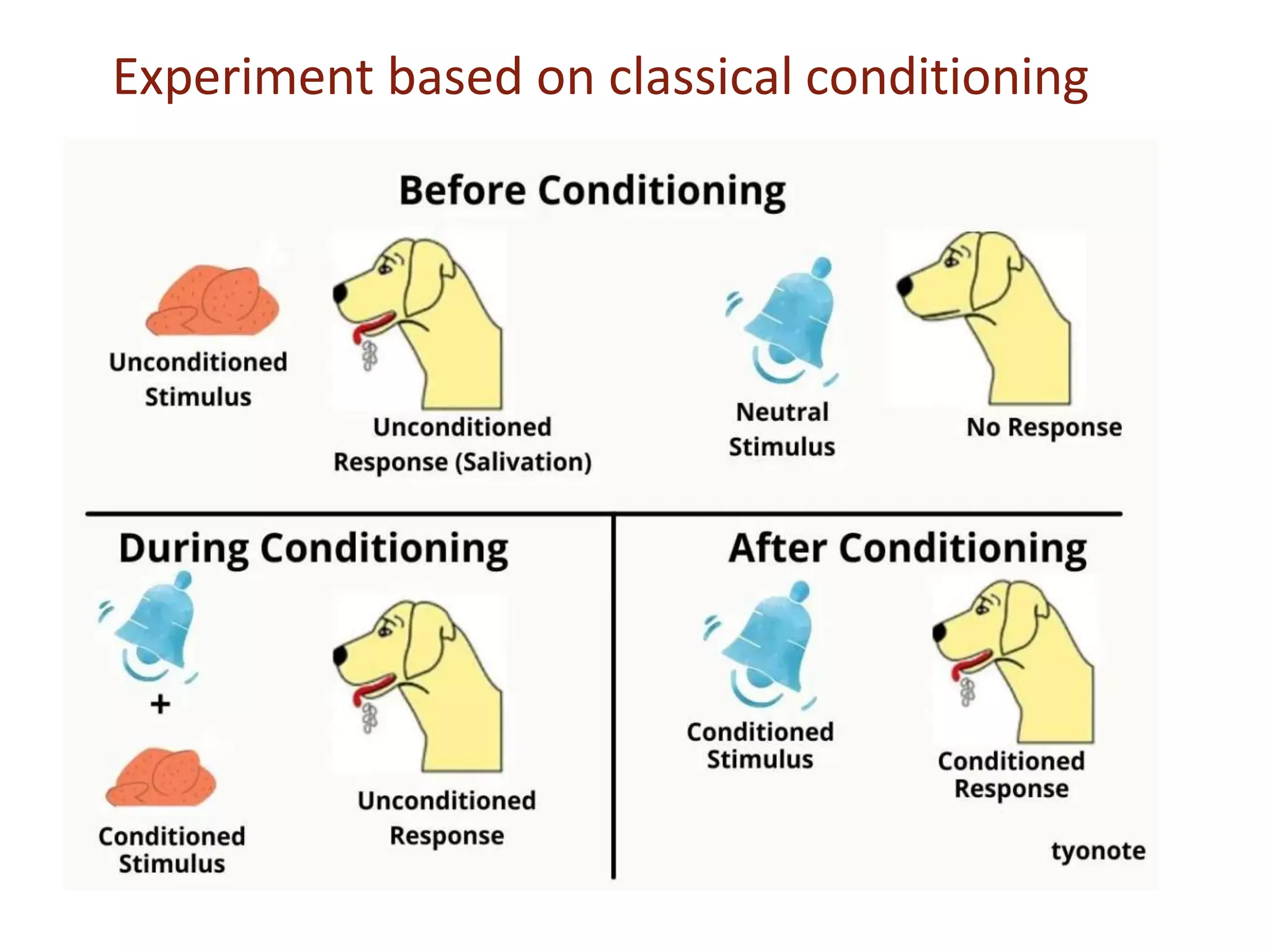
1. Neutral stimulus:Astimulus that before conditioning, does
not naturally bring about the response of interest.
2. Unconditioned stimulus:Astimulus that naturally brings
about a particular response without having been learned.
3. Unconditioned response:Aresponse that is natural and needs
no training.
5.
BASIC ELEMENTS OFCLASSICAL
CONDITIONING
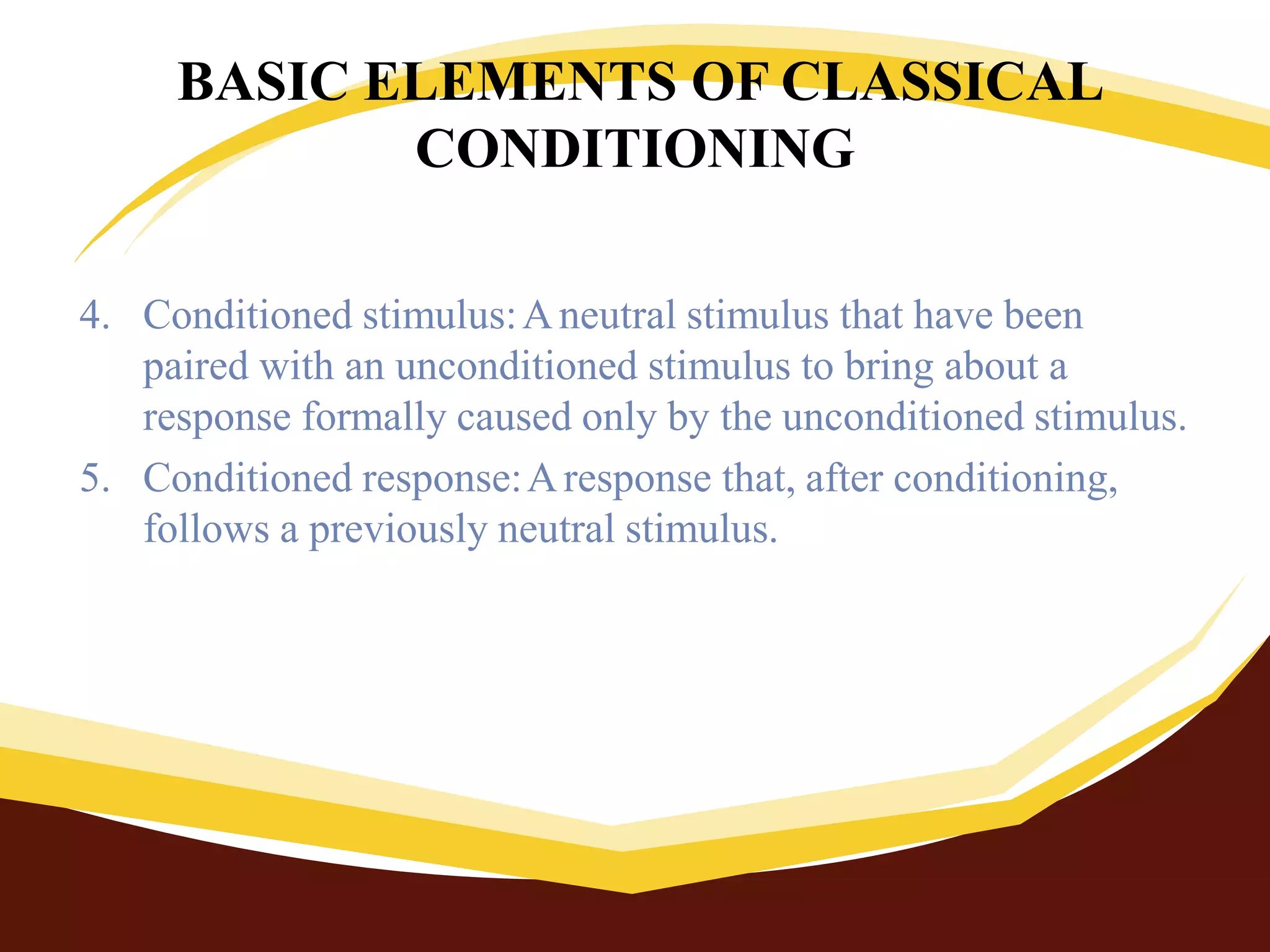
4. Conditioned stimulus:Aneutral stimulus that have been
paired with an unconditioned stimulus to bring about a
response formally caused only by the unconditioned stimulus.
5. Conditioned response:Aresponse that, after conditioning,
follows a previously neutral stimulus.
BASIC PRINCIPLES OFCLASSICAL
CONDITIONING
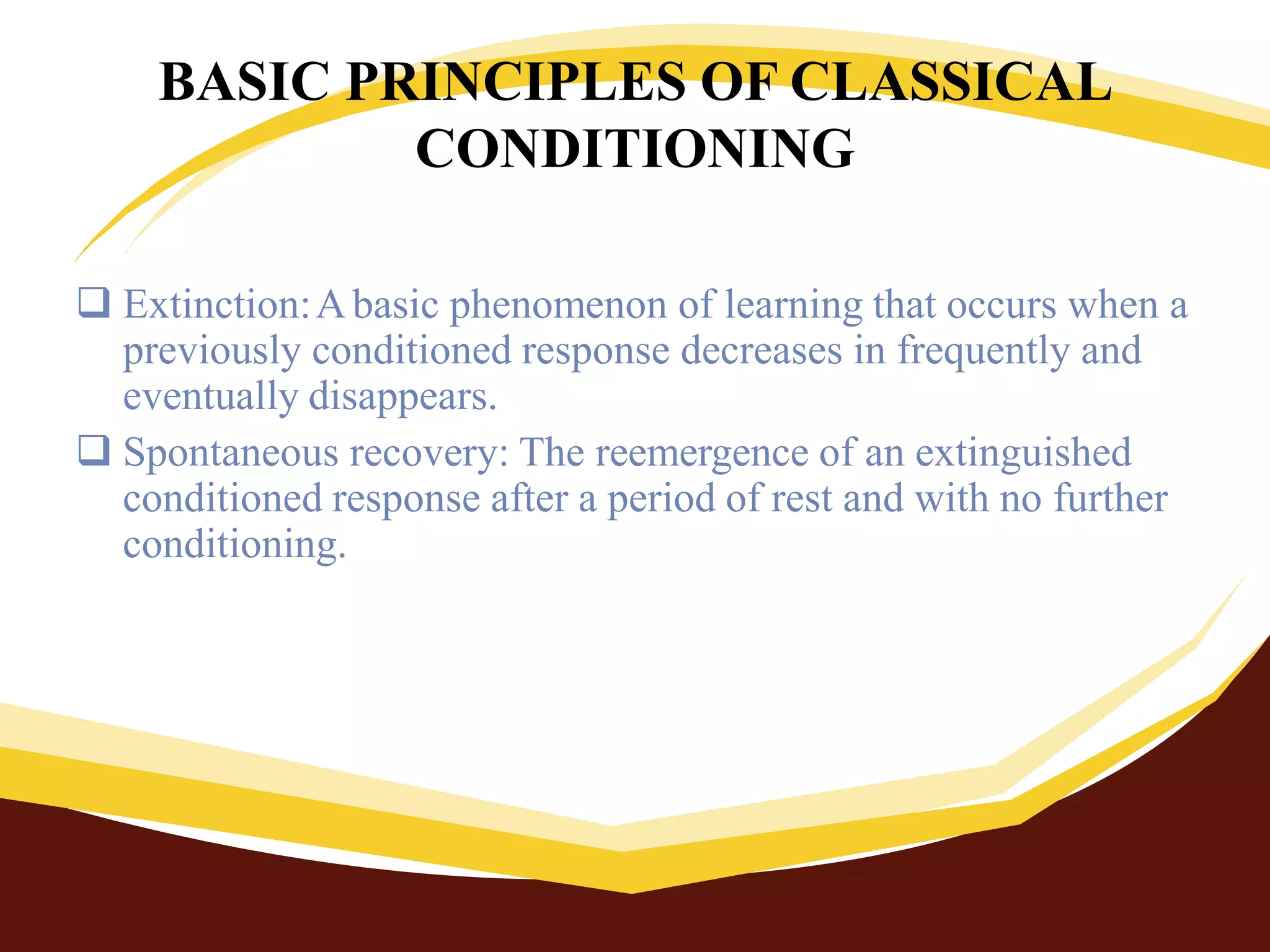
Extinction:Abasic phenomenon of learning that occurs when a
previously conditioned response decreases in frequently and
eventually disappears.
Spontaneous recovery: The reemergence of an extinguished
conditioned response after a period of rest and with no further
conditioning.
9.
stimulus generalization
the tendencyto respond to the stimulus that is
similar to the original conditioned stimulus with
conditioned response
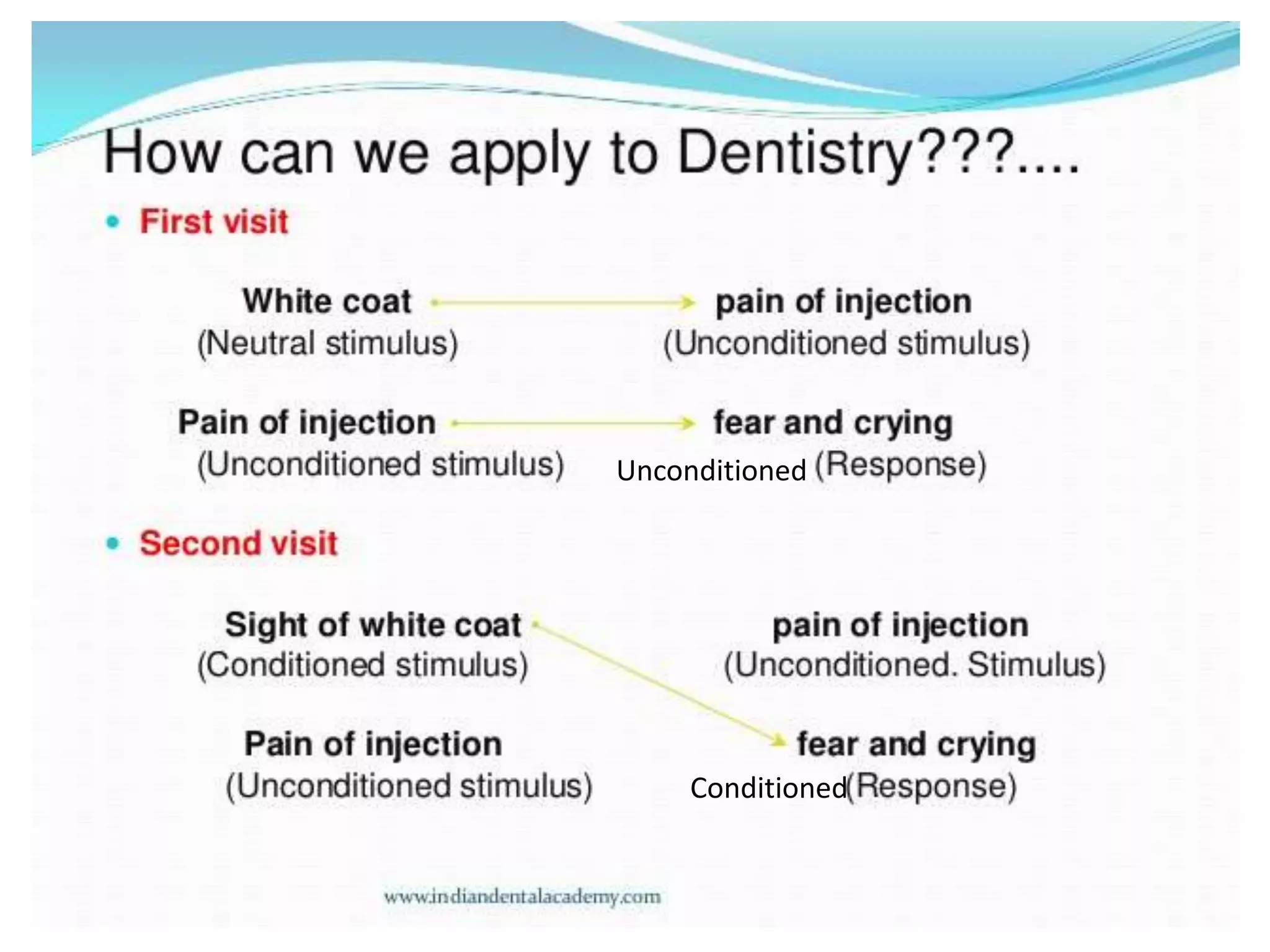
EXAMPLE : A child who had a painful experience with
a doctor in a white coat always associates any doctor
in white coat with pain
10.
stimulus discrimination
EXAMPLE :if a child is exposed to
clinical settings which are different to
those associated with the painful
experiences, the child learns to
discriminate between the two clinics
The tendency to stop making a generalised response
to a stimulus
11.
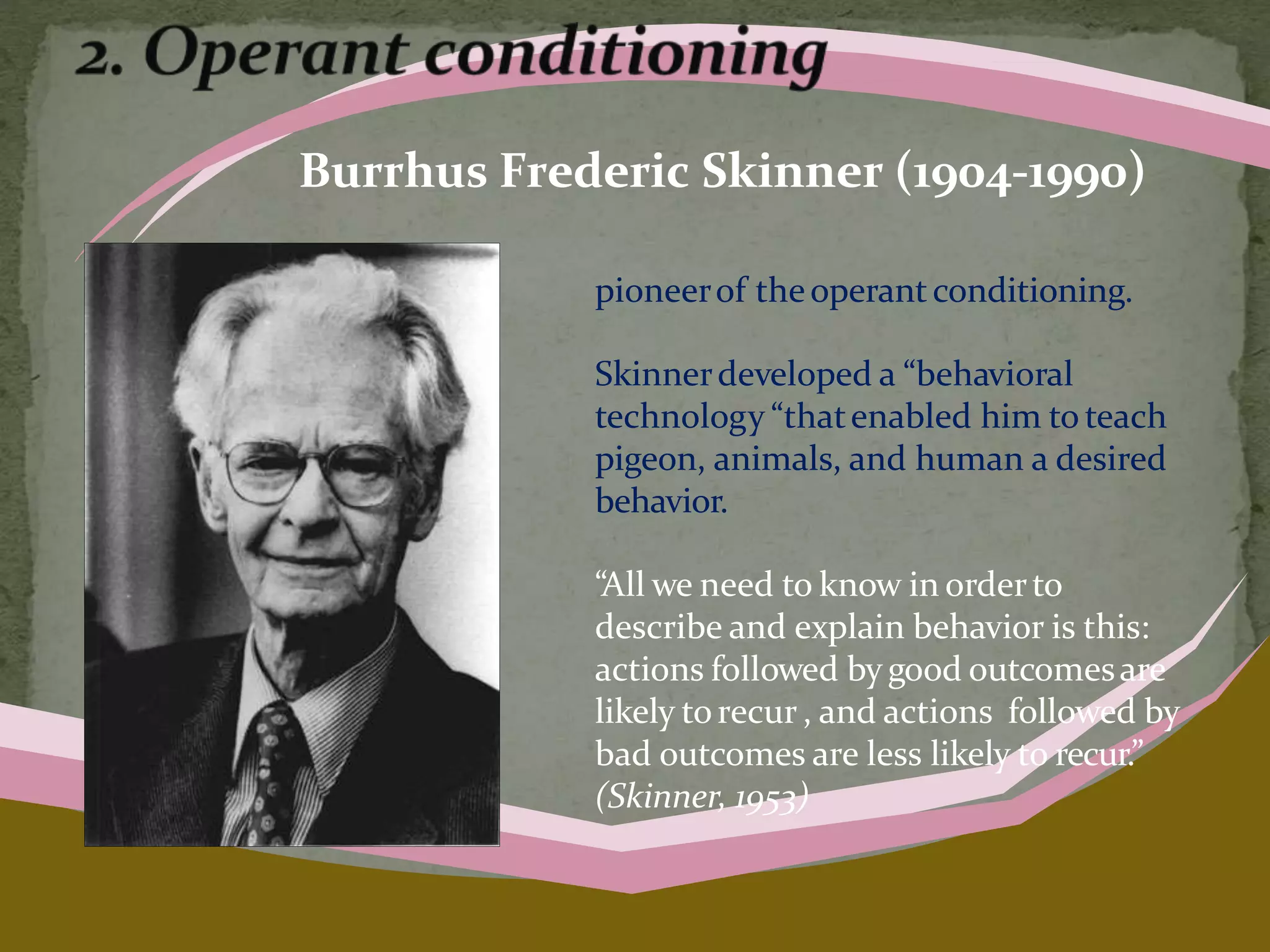
Burrhus Frederic Skinner(1904-1990)
pioneerof theoperantconditioning.
Skinnerdeveloped a “behavioral
technology “thatenabled him to teach
pigeon, animals, and human a desired
behavior.
“All we need to know in orderto
describe and explain behavior is this:
actions followed by good outcomesare
likely torecur , and actions followed by
bad outcomes are less likely to recur.”
(Skinner, 1953)
12.
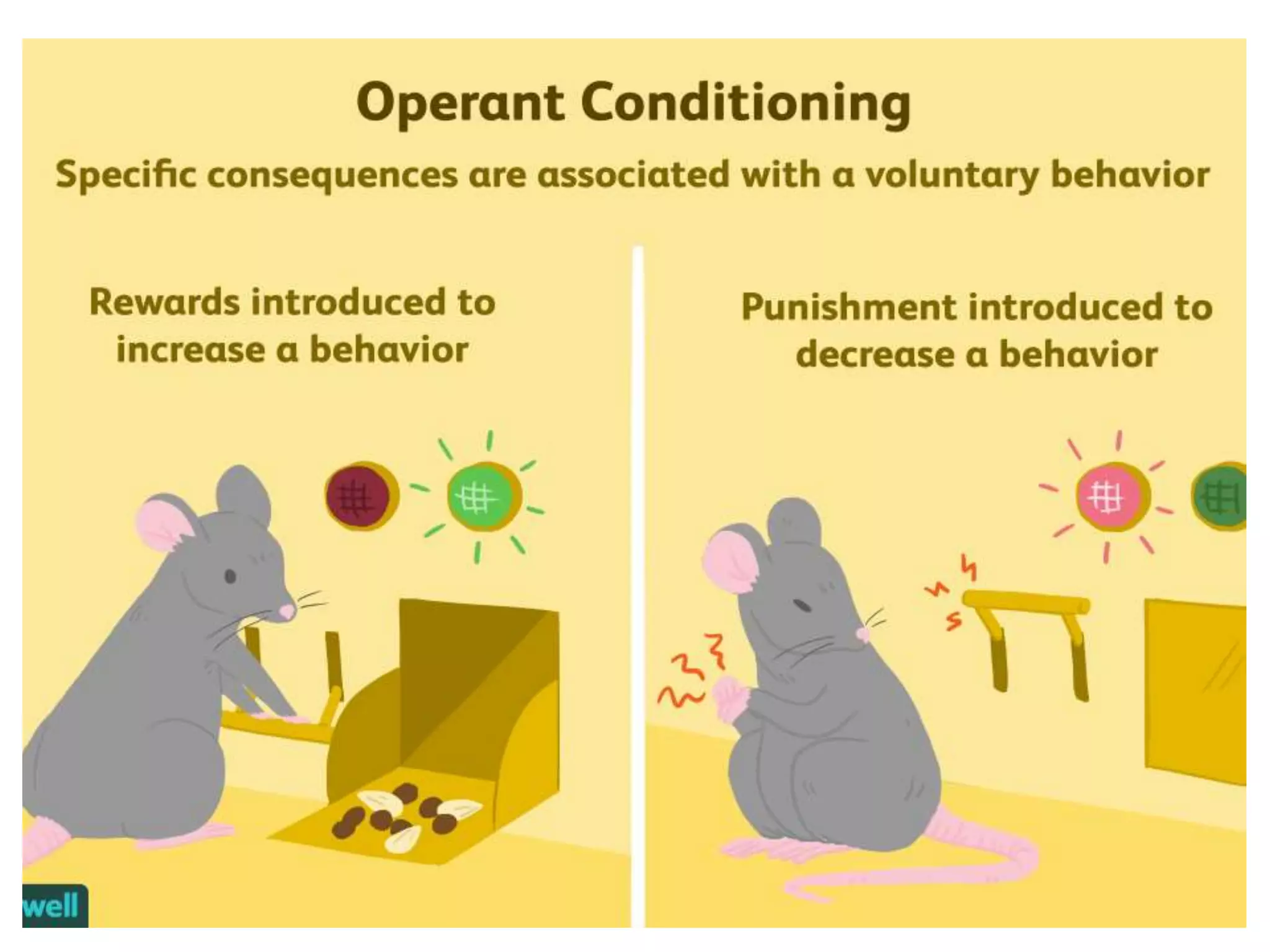
B. Operant conditioning:
It is derived from the word ‘operate’.
Skinner used the term operant to refer to any "active behavior
that operates upon the environment to generate
consequences" (1953).
Operant conditioning is a method of learning that occurs through
rewards and punishments for behavior through operant
conditioning, an association is made between a behavior and
a consequence for that behavior.
14.
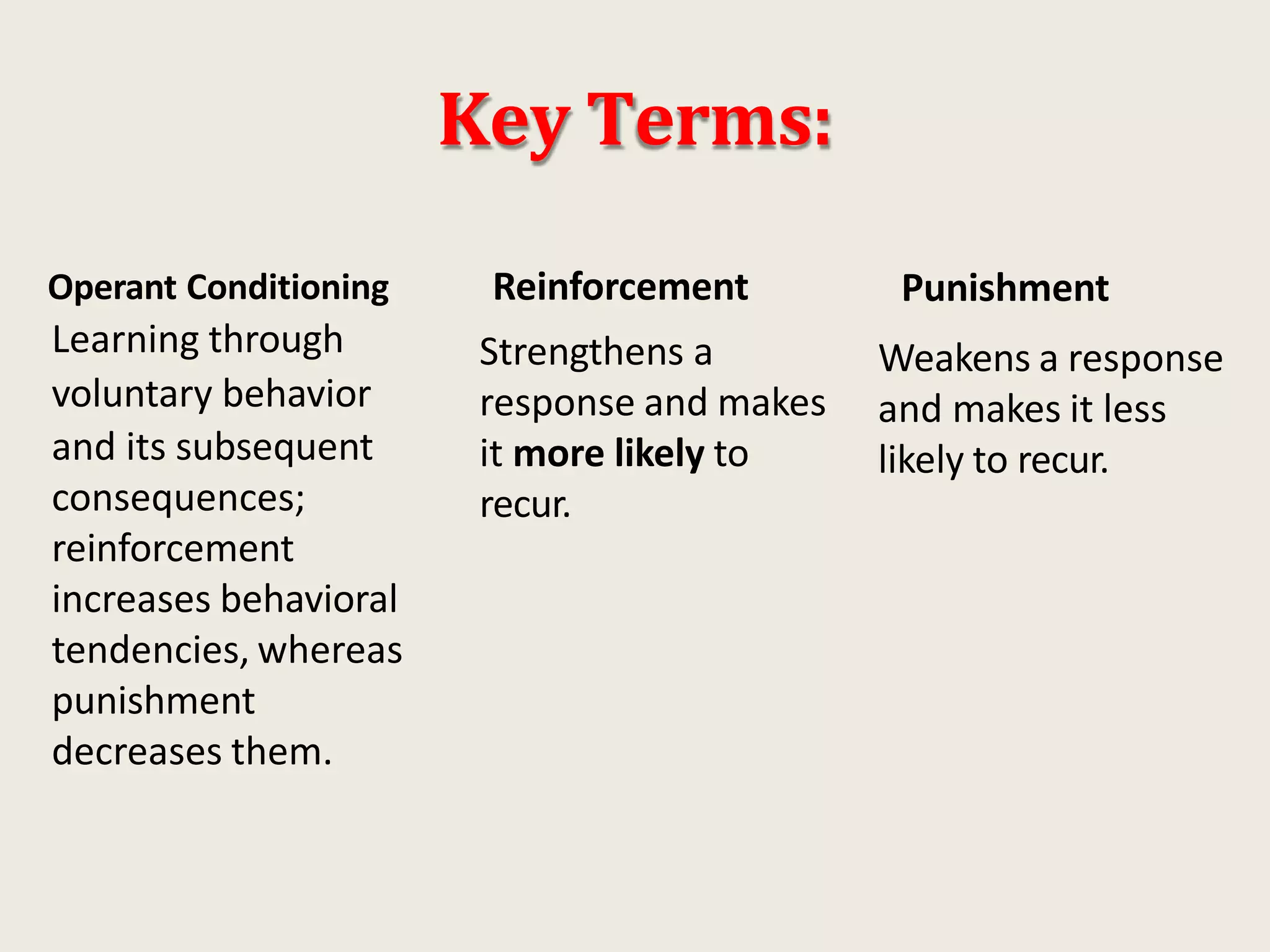
Key Terms:
Operant Conditioning
Learningthrough
voluntary behavior
and its subsequent
consequences;
reinforcement
increases behavioral
tendencies, whereas
punishment
decreases them.
Reinforcement
Strengthens a
response and makes
it more likely to
recur.
Punishment
Weakens a response
and makes it less
likely to recur.
Reinforcement
Procedure that:
increasesthe likelihood that the response will occur &
strengthen behavior
It is the application or removal of a stimulus to increase the
strength of a specific behavior.
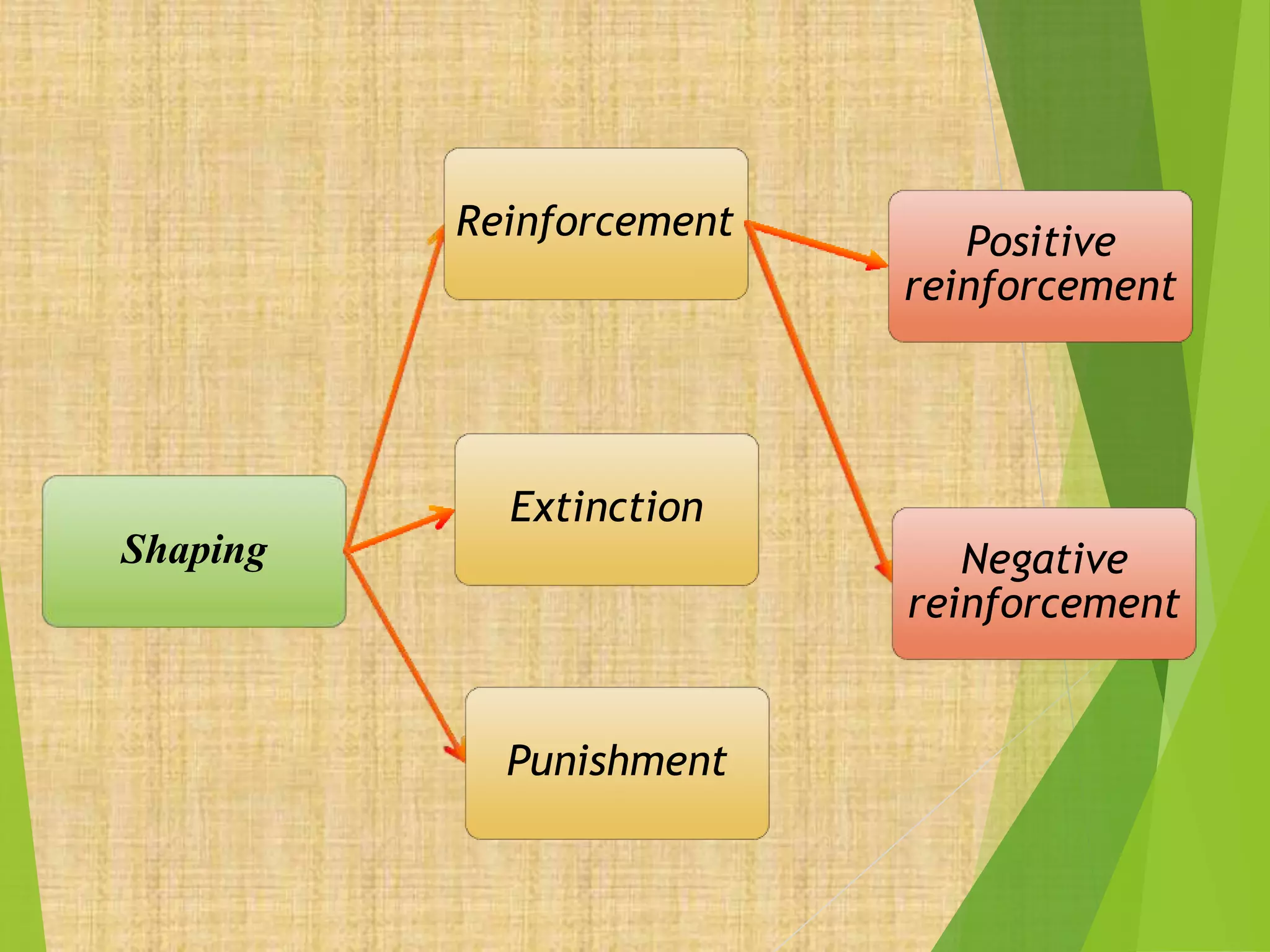
There are two types of reinforcement:
Positive reinforcement
Negative reinforcement
17.
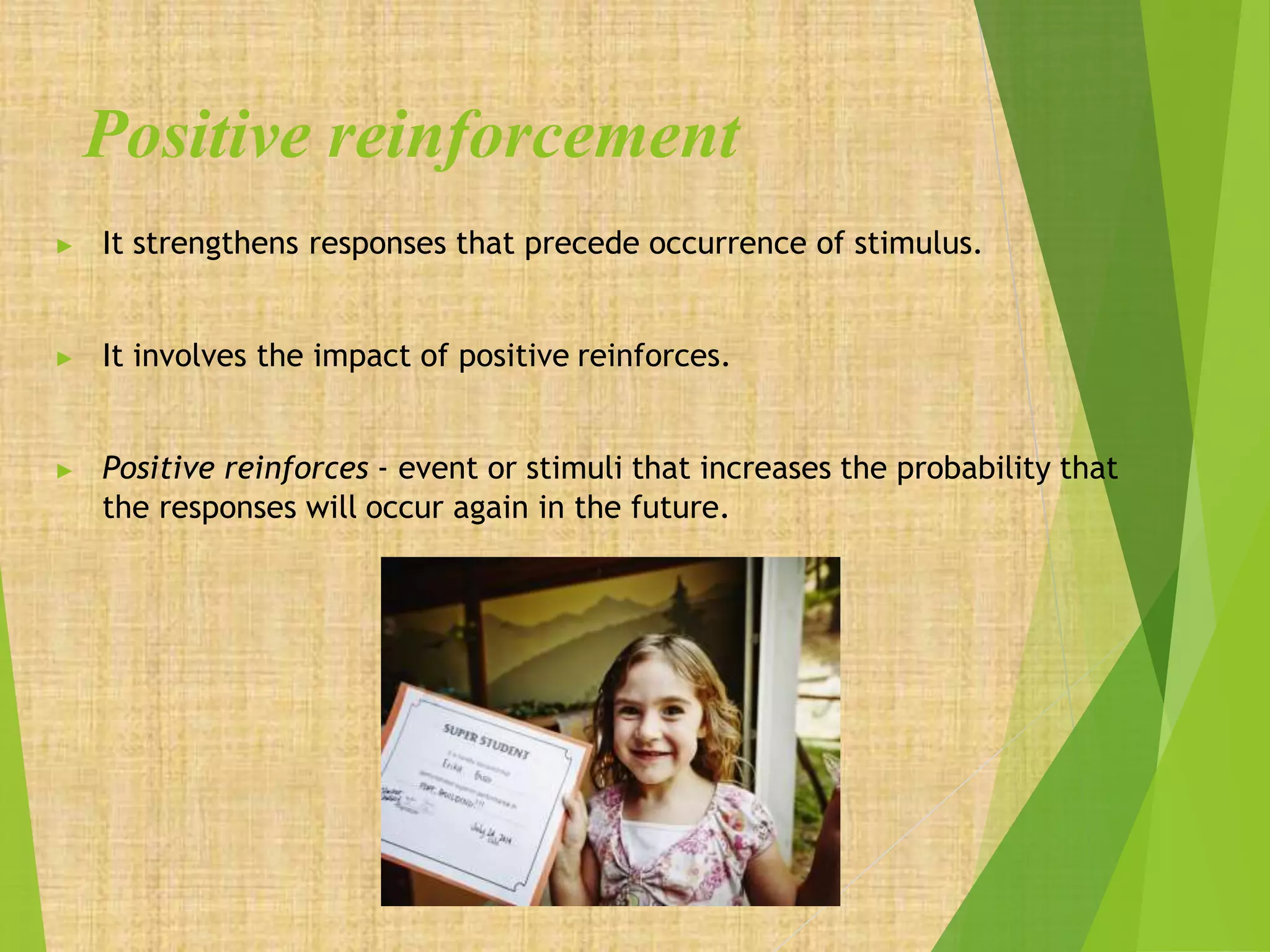
Positive reinforcement
▶ Itstrengthens responses that precede occurrence of stimulus.
▶ It involves the impact of positive reinforces.
▶ Positive reinforces - event or stimuli that increases the probability that
the responses will occur again in the future.
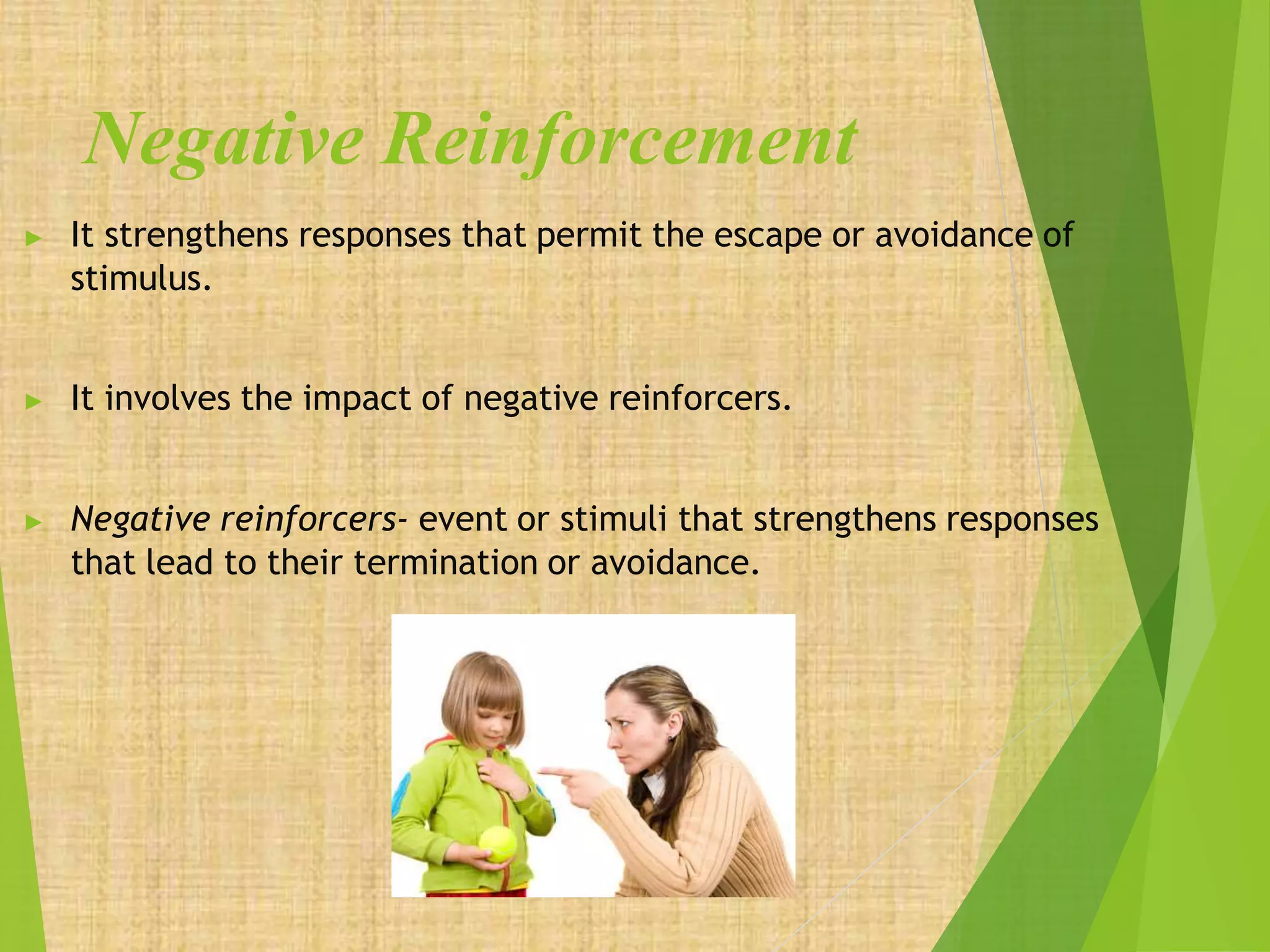
Negative Reinforcement
▶ Itstrengthens responses that permit the escape or avoidance of
stimulus.
▶ It involves the impact of negative reinforcers.
▶ Negative reinforcers- event or stimuli that strengthens responses
that lead to their termination or avoidance.
Punishment
▶ A punishmenthas the opposite affect, decreasing the
likelihood, or rate of responding to a target response.
▶ Punishment, when appropriately used, can be a valuable
tool for discouraging inappropriate behavior.
▶ Punishment is also positive and negative.
22.
Extinction
Extinction refersto the systematic withholding of the
reinforcers which had previously maintained a behavior.
Ignoring a behavior is an example of extinction if that
behavior has been maintained by the attention of the
person doing the ignoring.
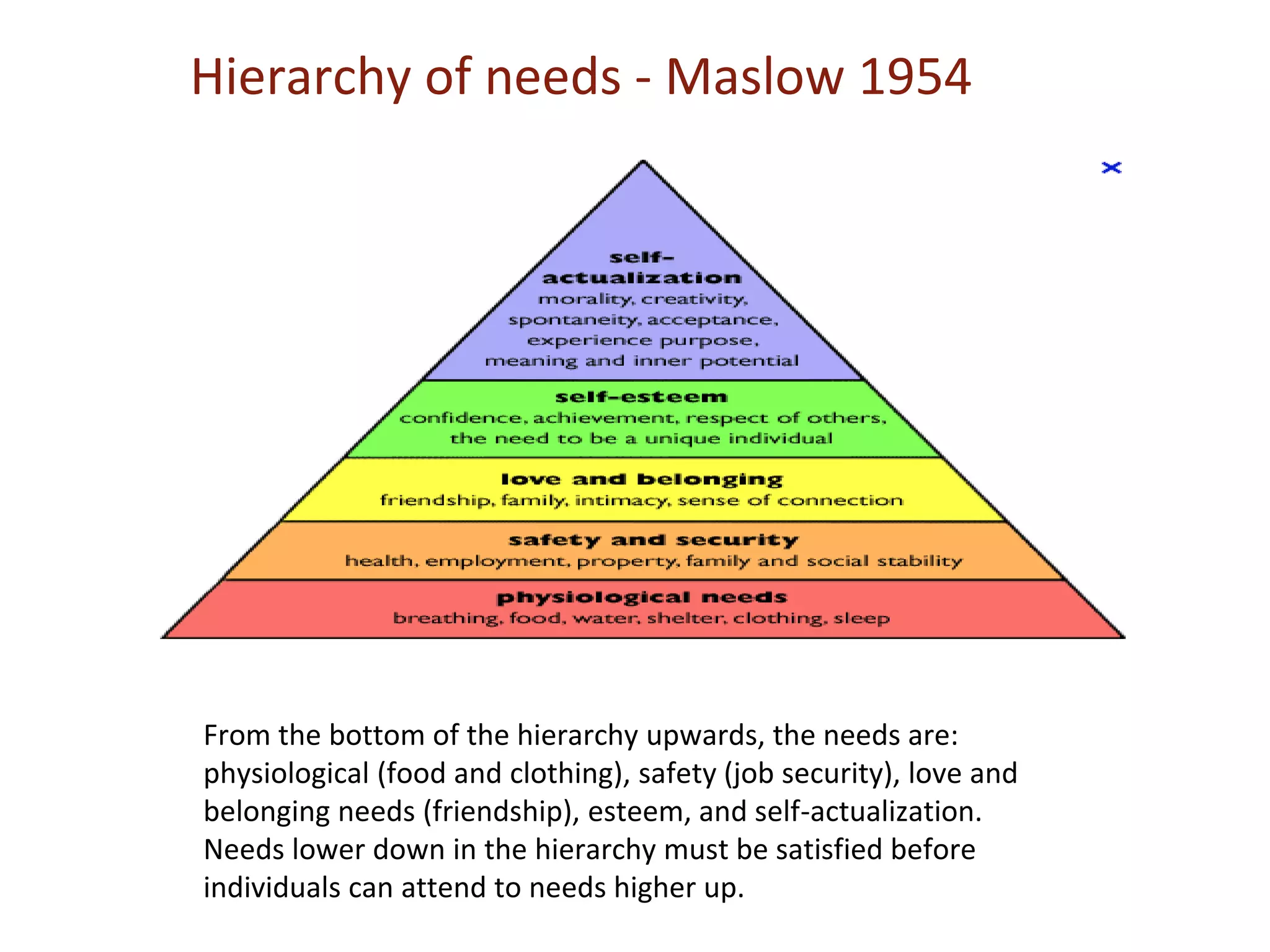
23.
Hierarchy of needs- Maslow 1954
From the bottom of the hierarchy upwards, the needs are:
physiological (food and clothing), safety (job security), love and
belonging needs (friendship), esteem, and self-actualization.
Needs lower down in the hierarchy must be satisfied before
individuals can attend to needs higher up.
24.
SOCIAL LEARNING THEORY-BANDURA 1963
Social learning theory is thoyght to be the most
complete, clinically useful and theoretically a
sophisticated form of behaviour therapy
25.
modeling
learning through observationeliminates trial
and error search.
1. live models - siblings,
parents of child
2. filmed models
3.posters
4. audiovisual aids
modeling can be done by
26.
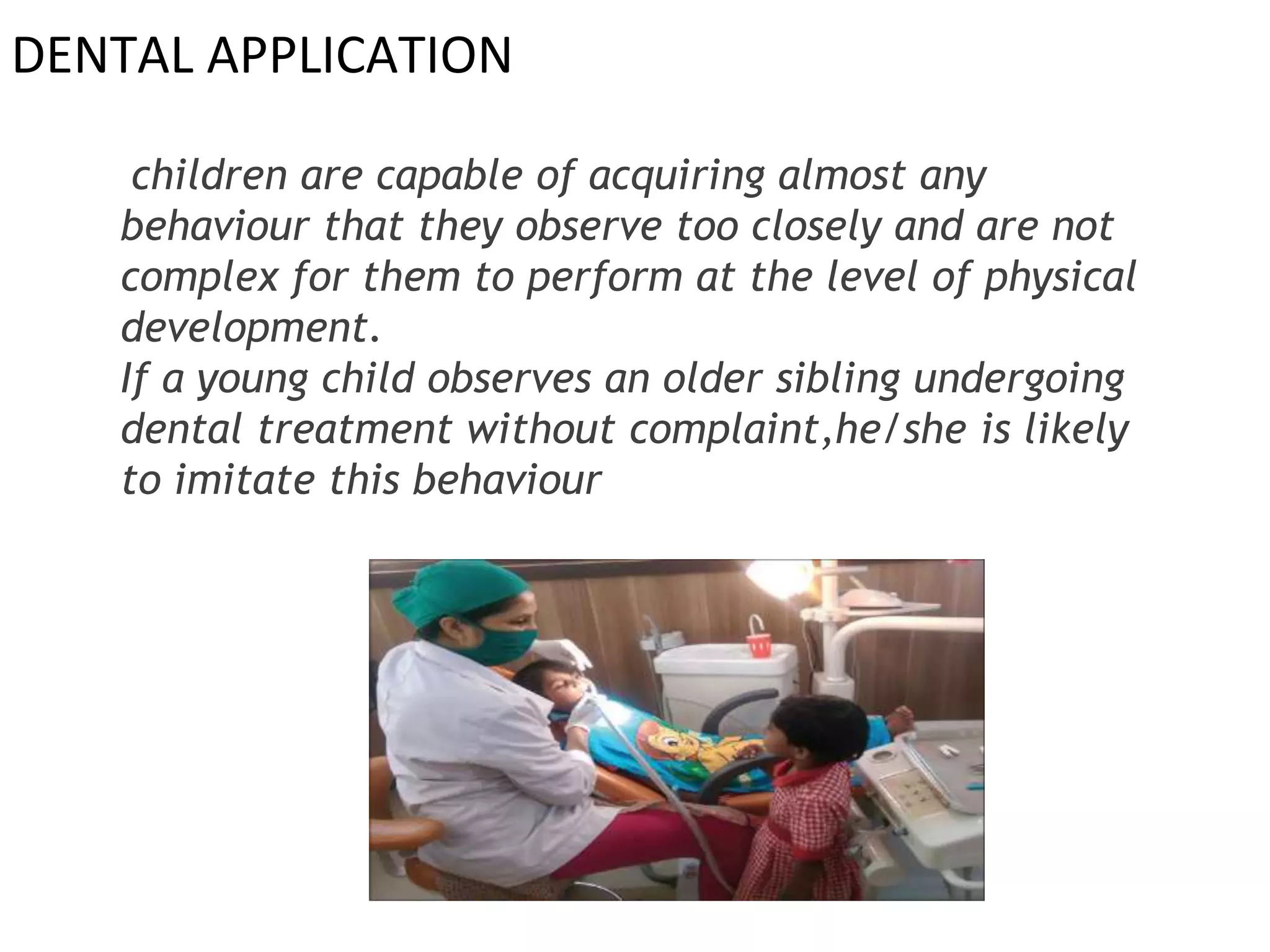
DENTAL APPLICATION
children arecapable of acquiring almost any
behaviour that they observe too closely and are not
complex for them to perform at the level of physical
development.
If a young child observes an older sibling undergoing
dental treatment without complaint,he/she is likely
to imitate this behaviour