Reinforces & Punishment
    Vital Concepts in Operant Conditioning
     Vital Concepts in Operant Conditioning
Operant Conditioning
Can be defined as a way of learning in which a voluntary response becomes more
    likely to occur again or less likely, depending on its favorable to unfavorable
 consequences. This type of conditioning applies to voluntary responses, which is
produced so that a potential favorable outcome will occur. This was termed by B. F.
 Skinner in 1937, and thereafter, inspired many future studies and revalations. The
  Skinner Box was his most common invention, which is based on the process he
                                 called 'reinforcement.'


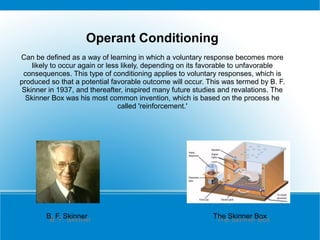
        B. F. Skinner
         B. F. Skinner                                      The Skinner Box
                                                             The Skinner Box
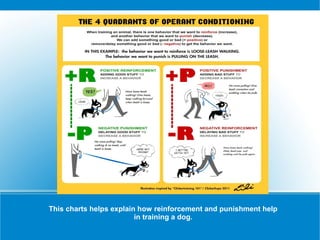
This charts helps explain how reinforcement and punishment help
                         in training a dog.
Reinforcement is the process in which a
   stimulus increases the probability that a
    preceding behavior will occur again. A
reinforcer can be defined as the stimulus that
       increases during reinforcement.

    Reinforcers can be either negative or
                 postitive.
POSITIVE REINFORCER

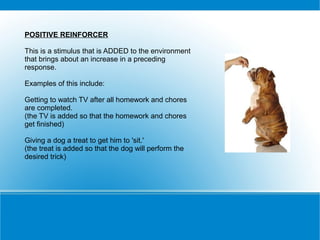
This is a stimulus that is ADDED to the environment
that brings about an increase in a preceding
response.

Examples of this include:

Getting to watch TV after all homework and chores
are completed.
(the TV is added so that the homework and chores
get finished)

Giving a dog a treat to get him to 'sit.'
(the treat is added so that the dog will perform the
desired trick)
NEGATIVE REINFORCER

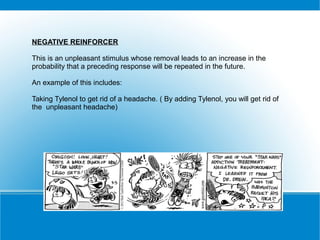
This is an unpleasant stimulus whose removal leads to an increase in the
probability that a preceding response will be repeated in the future.

An example of this includes:

Taking Tylenol to get rid of a headache. ( By adding Tylenol, you will get rid of
the unpleasant headache)
POSTIVE PUNISHMENT

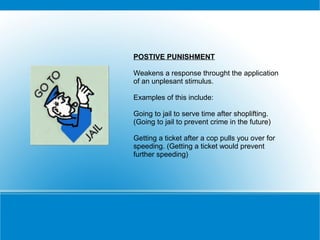
Weakens a response throught the application
of an unplesant stimulus.

Examples of this include:

Going to jail to serve time after shoplifting.
(Going to jail to prevent crime in the future)

Getting a ticket after a cop pulls you over for
speeding. (Getting a ticket would prevent
further speeding)
NEGATIVE PUNISHMENT

The removal of something pleasant.

Examples of this include:

Taking away a child's TV program because he
did not do his chores. (TV taken to prevent
further disobedience)

Taking a child's fun time from him to write
sentences of the board for disrupting class.
(Fun time taken aways to prevent further
disruption)
Punishment has several disadvantages, including:
                       It's frequently ineffective
    It can convey the idea that physical aggression is permissable
                             and/or desirable
 It also does not present an option to act through a different, more
                          appropriate behavior.

B.F. Skinner advocated against using punishment. Reinforcement is
 a much better psychological tool, and simpler to utilize. When you
 weigh the side effects which are possible with punishment, versus
the possible success of reinforcement, the choice is clear. In certain
    cases, punishment is necessary, but only after reinforcement
       oriented behavior modification has repetitively failed.


   Reinforcement VS Punishment
SOURCES


Information
Psychsmart text by McGraw-Hill
Essortment (website)

Pictures
Google Search (Operant learning)

Reinforcement & Punishment

  • 1.
    Reinforces & Punishment Vital Concepts in Operant Conditioning Vital Concepts in Operant Conditioning
  • 2.
    Operant Conditioning Can bedefined as a way of learning in which a voluntary response becomes more likely to occur again or less likely, depending on its favorable to unfavorable consequences. This type of conditioning applies to voluntary responses, which is produced so that a potential favorable outcome will occur. This was termed by B. F. Skinner in 1937, and thereafter, inspired many future studies and revalations. The Skinner Box was his most common invention, which is based on the process he called 'reinforcement.' B. F. Skinner B. F. Skinner The Skinner Box The Skinner Box
  • 3.
    This charts helpsexplain how reinforcement and punishment help in training a dog.
  • 4.
    Reinforcement is theprocess in which a stimulus increases the probability that a preceding behavior will occur again. A reinforcer can be defined as the stimulus that increases during reinforcement. Reinforcers can be either negative or postitive.
  • 5.
    POSITIVE REINFORCER This isa stimulus that is ADDED to the environment that brings about an increase in a preceding response. Examples of this include: Getting to watch TV after all homework and chores are completed. (the TV is added so that the homework and chores get finished) Giving a dog a treat to get him to 'sit.' (the treat is added so that the dog will perform the desired trick)
  • 6.
    NEGATIVE REINFORCER This isan unpleasant stimulus whose removal leads to an increase in the probability that a preceding response will be repeated in the future. An example of this includes: Taking Tylenol to get rid of a headache. ( By adding Tylenol, you will get rid of the unpleasant headache)
  • 7.
    POSTIVE PUNISHMENT Weakens aresponse throught the application of an unplesant stimulus. Examples of this include: Going to jail to serve time after shoplifting. (Going to jail to prevent crime in the future) Getting a ticket after a cop pulls you over for speeding. (Getting a ticket would prevent further speeding)
  • 8.
    NEGATIVE PUNISHMENT The removalof something pleasant. Examples of this include: Taking away a child's TV program because he did not do his chores. (TV taken to prevent further disobedience) Taking a child's fun time from him to write sentences of the board for disrupting class. (Fun time taken aways to prevent further disruption)
  • 9.
    Punishment has severaldisadvantages, including: It's frequently ineffective It can convey the idea that physical aggression is permissable and/or desirable It also does not present an option to act through a different, more appropriate behavior. B.F. Skinner advocated against using punishment. Reinforcement is a much better psychological tool, and simpler to utilize. When you weigh the side effects which are possible with punishment, versus the possible success of reinforcement, the choice is clear. In certain cases, punishment is necessary, but only after reinforcement oriented behavior modification has repetitively failed. Reinforcement VS Punishment
  • 10.
    SOURCES Information Psychsmart text byMcGraw-Hill Essortment (website) Pictures Google Search (Operant learning)