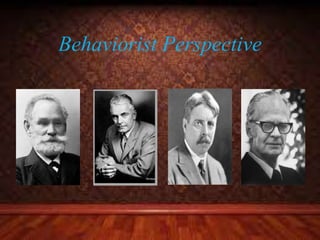
Behaviorist Perspective
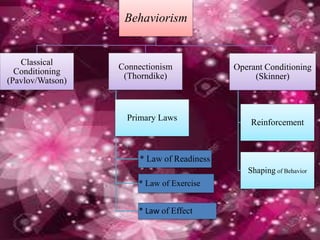
Behaviorism
Classical
Conditioning
(Pavlov/Watson)
Connectionism
(Thorndike)
Primary Laws
* Law of Readiness
* Law of Exercise
* Law of Effect
Operant Conditioning
(Skinner)
Reinforcement
Shaping of Behavior
Behaviorism
= Focuses on the study of observable and measurable
behavior
= Emphasizes that behavior is mostly learned through
conditioning and reinforcement ( rewards &
punishments)
= Does not give much attention to the mind and the
possibility of thought processes occurring in the mind
Classical Conditioning
* A learning process by which a subject
comes to respond in a specific way to a previously
neutral stimulus after the subject repeatedly
encounters the neutral stimulus together with
another stimulus that already elicits the response.
* A learning process that occurs when two
stimuli are repeatedly paired.
Pavlov’s Experiment
1. Stimulus Generalization = refers to the
process by which the conditioned response
transfers to other stimuli that are similar to
the original conditioned stimulus.
2. Extinction = the process by which
conditioned responses are lost.
3. Spontaneous Recovery = extinguished
responses can be “ recovered “ after an
elapsed time
Pavlov’s Findings
4. Discrimination = a process by which we learn
not to respond to similar stimuli in an identical
manner. We respond differently to stimuli
because of our previous experiences in which
certain of our responses were successful in the
presence of certain stimuli.
5. Higher-Order Conditioning = refers to a
situation in which a stimulus that was previously
neutral is paired with a conditioned stimulus.
Connectionism
the theory that all mental
processes can be described as the
operation of inherited or acquired
bonds between stimulus and response.
Operant
Conditioning
= type of learning in which the strength of
a behavior is modified by the behavior’s
consequences, such as reward or punishment.
= a process that attempts to modify
behavior through the use of positive (+) and
negative (-) reinforcement.
Components
Reinforcement
= a kind of stimulus that aims to increase
the strength in behavior due to its consequence
= responses from the environment that
increase the probability of a behavior being
repeated
Negative Reinforcement
= a response or behavior is strengthened by
stopping, removing or avoiding a negative
outcome or aversive stimulus.
= different from punishment, because
punishment as a consequence intended to result
in reduced responses.
2 Learnings of Negative Reinforcement
1. Escape
remove noxious stimuli following correct
behavior
2. Active Avoidance
behavior avoids noxious stimulus
Shaping of Behavior
= a gradual, behavior modification technique in
which successive approximations to the desired behavior
is rewarded.
= teaching a new behavior through successive
approximations. Basically, you start with a very low
criteria and gradually increase your criteria until you
reach your target behavior
= by breaking the behavior down into small steps,
you can create a new behavior w/out difficulties.
Behaviorism

Behaviorism

  • 1.
  • 2.
    Behaviorism Classical Conditioning (Pavlov/Watson) Connectionism (Thorndike) Primary Laws * Lawof Readiness * Law of Exercise * Law of Effect Operant Conditioning (Skinner) Reinforcement Shaping of Behavior
  • 3.
    Behaviorism = Focuses onthe study of observable and measurable behavior = Emphasizes that behavior is mostly learned through conditioning and reinforcement ( rewards & punishments) = Does not give much attention to the mind and the possibility of thought processes occurring in the mind
  • 4.
    Classical Conditioning * Alearning process by which a subject comes to respond in a specific way to a previously neutral stimulus after the subject repeatedly encounters the neutral stimulus together with another stimulus that already elicits the response. * A learning process that occurs when two stimuli are repeatedly paired.
  • 6.
  • 7.
    1. Stimulus Generalization= refers to the process by which the conditioned response transfers to other stimuli that are similar to the original conditioned stimulus. 2. Extinction = the process by which conditioned responses are lost. 3. Spontaneous Recovery = extinguished responses can be “ recovered “ after an elapsed time Pavlov’s Findings
  • 8.
    4. Discrimination =a process by which we learn not to respond to similar stimuli in an identical manner. We respond differently to stimuli because of our previous experiences in which certain of our responses were successful in the presence of certain stimuli. 5. Higher-Order Conditioning = refers to a situation in which a stimulus that was previously neutral is paired with a conditioned stimulus.
  • 11.
    Connectionism the theory thatall mental processes can be described as the operation of inherited or acquired bonds between stimulus and response.
  • 14.
    Operant Conditioning = type oflearning in which the strength of a behavior is modified by the behavior’s consequences, such as reward or punishment. = a process that attempts to modify behavior through the use of positive (+) and negative (-) reinforcement.
  • 18.
  • 19.
    Reinforcement = a kindof stimulus that aims to increase the strength in behavior due to its consequence = responses from the environment that increase the probability of a behavior being repeated
  • 25.
    Negative Reinforcement = aresponse or behavior is strengthened by stopping, removing or avoiding a negative outcome or aversive stimulus. = different from punishment, because punishment as a consequence intended to result in reduced responses.
  • 26.
    2 Learnings ofNegative Reinforcement 1. Escape remove noxious stimuli following correct behavior 2. Active Avoidance behavior avoids noxious stimulus
  • 35.
    Shaping of Behavior =a gradual, behavior modification technique in which successive approximations to the desired behavior is rewarded. = teaching a new behavior through successive approximations. Basically, you start with a very low criteria and gradually increase your criteria until you reach your target behavior = by breaking the behavior down into small steps, you can create a new behavior w/out difficulties.