B.F. Skinner
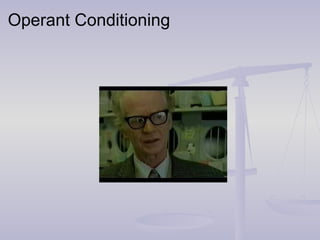
Operant Conditioning
By
Jenifer Flores
Patricia Guardado
Vicky
Introduction
• Skinner’s Theory is based on the idea that
learning is a function of change in overt
Behavior
• Skinner’s Theory is known as Operant
Conditioning
o Operant Conditioning is distinct in that the
organism can emit responses, instead of
eliciting a response due to an external
stimulus.
Terminology
• Organism in this presentation will refer to
animals in experiments and students and
children.
• External Stimulus: A signal that originates
from outside and organism (students,
animals)
• Stimulus Response: Anything that
strengthens a desired response, is
reinforcement, such as verbal prais.
Terminology Cont’d
• Negative Reinforcement: Any stimulus
that promotes increased frequency of a
response. It is not punishment.
Distinctive Aspect of Skinner’s
Theory
• Skinner’s Theory attempted to provide
Behavioral explanations for a range of
cognitive phenomena, such as drive
(motivation), in terms of deprivation.
Operant Conditioning
• http://www.simplypsychology.pwp.blueyonder.co.
uk/operant-conditioning.html
• Skinner believed that we do have such a thing
as a mind, but that it is simply more productive to
study observable behaviour rather than internal
mental events.
• Skinner believed that the best way to understand
behavior is to look at the acuse of an action and
its consequences. (operant conditioning)
Operant Conditioning Continued
• Based on the work of Edward Thorndike.
o Studied learning in animals (cats) by using a puzzle
box to propose the theory ‘Law of Effect’
o Law of Effect stated that nay behavior that is followed
by pleasant consequences is likely to be repeated,
and nay behavior followed by unpleasant
consequences is likely to be stopped.
o Law of Effect lead to the development of operant
conditioning, within behaviorism.
Operant Conditioning
• http://www.simplypsychology.pwp.blueyonder.co.
uk/edward-thorndike.html
• Skinner is regarded as the father of Operant
Conditioning, but his work was based on
Thorndike’s law of effect.
• Skinner introduced a new term into the Law of
Effect - Reinforcement. Behaviour which is
reinforced tends to be repeated (i.e.
strengthened); behaviour which is not reinforced
tends to die out-or be extinguished (i.e.
weakened).
Skinner’s Three Type of Responses That
Can Follow Behavior
• Neutral Operants
o Neither increase nor decrease the probability of a
beharior being repeated.
• Reinforcers:
o Responses from the environment that increase the
probability of a behavior being repeateed
• Punishers
o Response fron the environment that decrease the
likelihood of a behavior being repeated. Punishment
weakens behavior.
Negative Reinforcement
• The removal of an unpleasant reinforcer
can also strengthen behaviour. This is
known as Negative Reinforcement
because it is the removal of an adverse
stimulus which is ‘rewarding’ to the
animal. Negative reinforcement
strengthens behaviour because it stops or
removes an unpleasant experience.
Summary of Skinner’s Operant
Conditioning
• Behaviorism is primarily concerned with
observable behavior, as opposed to
internal events like thinking and emotion.
• The major influence on human behavior is
learning from our environment.
o Ex: In Skinner’s study, because food follwoed
a particular behavior the rats learned to repeat
that behavior.
LINKS FOR OPERANT
CONDITIONING
• http://www.simplypsychology.pwp.blue
yonder.co.uk/Operant
%20Conditioning.pdf
• http://www.youtube.com/watch?
v=I_ctJqjlrHA&feature=player_embedd
ed
http://www.youtube.com/watch?v=I_ctJqjlrHA&feature=player_embedded
Skinner’s Theory Implications for
Instructional Technology
• Article: Direct Instruction Revisited: A Key Model
for Instructional Technology, by Susan G.
Magliaro, Barbara B. Lockee & John K. Burton
• Rooted in behavioral theory, particularly the
radical or selectivist behaviorism of B.F.
Skinner (1953, 1954, 1966, 1968, 1974), the
direct instruction (DI) approach to teaching is
now well into its third decade of influencing
curriculum, instruction, and research.
• I will insert the implications of Skinner’s
theory in Direct Instruction today and for
Instructional Technology, from my article
Operant Conditioning

Group illuminate project-1

  • 1.
    B.F. Skinner Operant Conditioning By JeniferFlores Patricia Guardado Vicky
  • 2.
    Introduction • Skinner’s Theoryis based on the idea that learning is a function of change in overt Behavior • Skinner’s Theory is known as Operant Conditioning o Operant Conditioning is distinct in that the organism can emit responses, instead of eliciting a response due to an external stimulus.
  • 3.
    Terminology • Organism inthis presentation will refer to animals in experiments and students and children. • External Stimulus: A signal that originates from outside and organism (students, animals) • Stimulus Response: Anything that strengthens a desired response, is reinforcement, such as verbal prais.
  • 4.
    Terminology Cont’d • NegativeReinforcement: Any stimulus that promotes increased frequency of a response. It is not punishment.
  • 5.
    Distinctive Aspect ofSkinner’s Theory • Skinner’s Theory attempted to provide Behavioral explanations for a range of cognitive phenomena, such as drive (motivation), in terms of deprivation.
  • 6.
    Operant Conditioning • http://www.simplypsychology.pwp.blueyonder.co. uk/operant-conditioning.html •Skinner believed that we do have such a thing as a mind, but that it is simply more productive to study observable behaviour rather than internal mental events. • Skinner believed that the best way to understand behavior is to look at the acuse of an action and its consequences. (operant conditioning)
  • 7.
    Operant Conditioning Continued •Based on the work of Edward Thorndike. o Studied learning in animals (cats) by using a puzzle box to propose the theory ‘Law of Effect’ o Law of Effect stated that nay behavior that is followed by pleasant consequences is likely to be repeated, and nay behavior followed by unpleasant consequences is likely to be stopped. o Law of Effect lead to the development of operant conditioning, within behaviorism.
  • 8.
    Operant Conditioning • http://www.simplypsychology.pwp.blueyonder.co. uk/edward-thorndike.html •Skinner is regarded as the father of Operant Conditioning, but his work was based on Thorndike’s law of effect. • Skinner introduced a new term into the Law of Effect - Reinforcement. Behaviour which is reinforced tends to be repeated (i.e. strengthened); behaviour which is not reinforced tends to die out-or be extinguished (i.e. weakened).
  • 9.
    Skinner’s Three Typeof Responses That Can Follow Behavior • Neutral Operants o Neither increase nor decrease the probability of a beharior being repeated. • Reinforcers: o Responses from the environment that increase the probability of a behavior being repeateed • Punishers o Response fron the environment that decrease the likelihood of a behavior being repeated. Punishment weakens behavior.
  • 10.
    Negative Reinforcement • Theremoval of an unpleasant reinforcer can also strengthen behaviour. This is known as Negative Reinforcement because it is the removal of an adverse stimulus which is ‘rewarding’ to the animal. Negative reinforcement strengthens behaviour because it stops or removes an unpleasant experience.
  • 11.
    Summary of Skinner’sOperant Conditioning • Behaviorism is primarily concerned with observable behavior, as opposed to internal events like thinking and emotion. • The major influence on human behavior is learning from our environment. o Ex: In Skinner’s study, because food follwoed a particular behavior the rats learned to repeat that behavior.
  • 12.
    LINKS FOR OPERANT CONDITIONING •http://www.simplypsychology.pwp.blue yonder.co.uk/Operant %20Conditioning.pdf • http://www.youtube.com/watch? v=I_ctJqjlrHA&feature=player_embedd ed http://www.youtube.com/watch?v=I_ctJqjlrHA&feature=player_embedded
  • 13.
    Skinner’s Theory Implicationsfor Instructional Technology • Article: Direct Instruction Revisited: A Key Model for Instructional Technology, by Susan G. Magliaro, Barbara B. Lockee & John K. Burton • Rooted in behavioral theory, particularly the radical or selectivist behaviorism of B.F. Skinner (1953, 1954, 1966, 1968, 1974), the direct instruction (DI) approach to teaching is now well into its third decade of influencing curriculum, instruction, and research.
  • 14.
    • I willinsert the implications of Skinner’s theory in Direct Instruction today and for Instructional Technology, from my article
  • 15.