What is Learning?
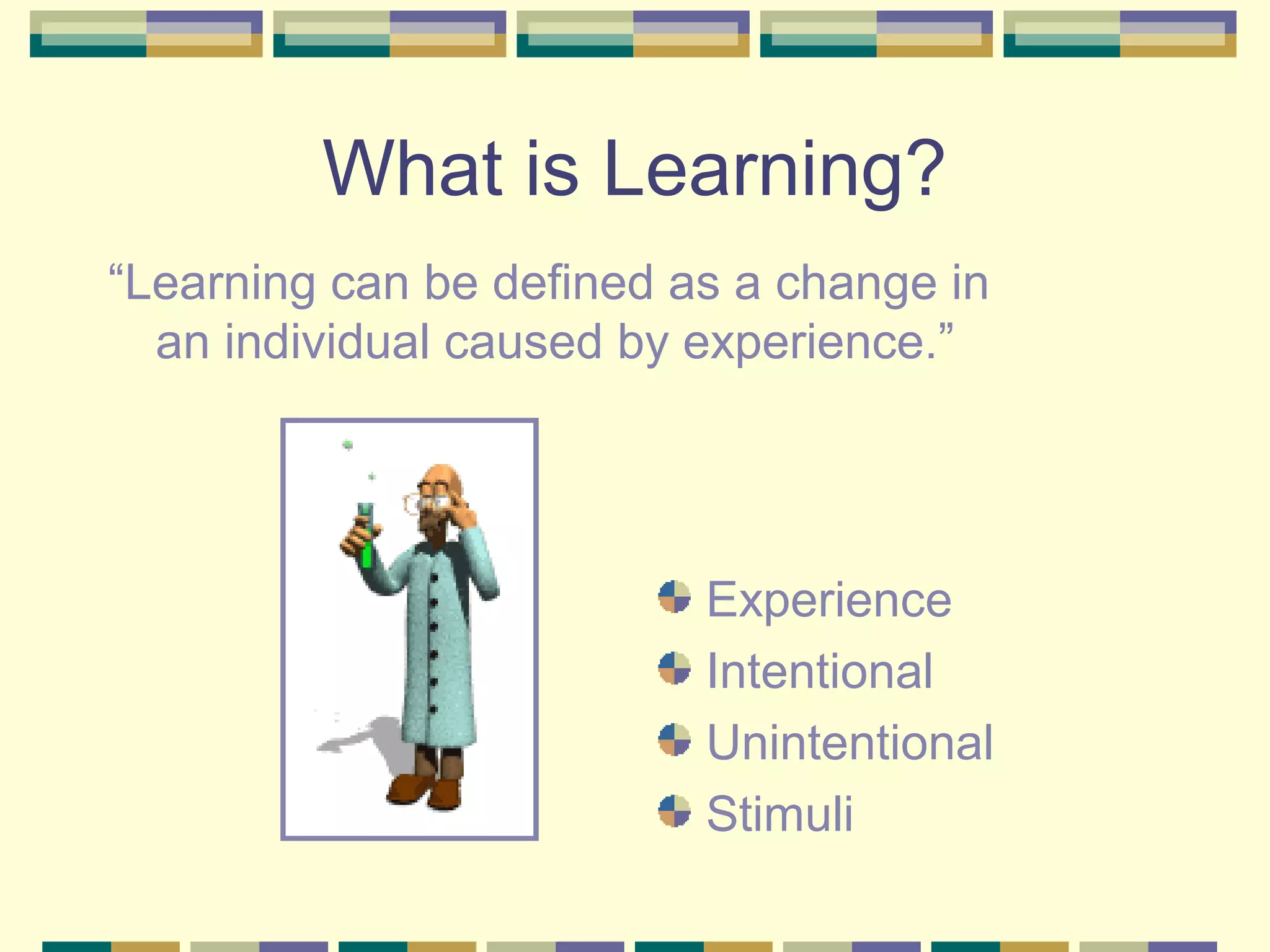
“Learning can be defined as a change in
an individual caused by experience.”
Experience
Intentional
Unintentional
Stimuli
Behaviorism
Definition
Behaviorism is a theory of animal and
human learning that only focuses on
objectively observable behaviors and
discounts mental activities.
Behavior theorists define learning as
nothing more than the acquisition of new
behavior.
Behaviorism
Conditioning
Experiments by behaviorists identify
conditioning as a universal learning
process. There are two different types of
conditioning, each yielding a different
behavioral pattern:
Behaviorism
Classical Conditioning
occurs when a natural reflex responds to a
stimulus. The most popular example is
Pavlov's observation that dogs salivate
when they eat or even see food.
Essentially, animals and people are
biologically "wired" so that a certain
stimulus will produce a specific response.
Pavlov & Classical
Conditioning
Pavlov: Classical Conditioning
Unconditioned
Stimulus
Unconditioned
Response
Neutral Stimulus
Conditioned
Response
Pavlov: Classical Conditioning
Unconditioned
stimulus =
unconditioned
response
Unconditioned
stimulus +
Neutral stimulus =
unconditioned
response
Neutral stimulus =
No response
Conditioned
stimulus=
Conditioned
response
Thorndike: The Law of Effect
If an act is followed by a satisfying
change in the environment, the
likelihood that the act will be
repeated in similar situations
increases.
However, if the behavior is followed
by an unsatisfying change, the
chances of a repeat of behavior
decreases.
Thorndike: The Law of Effect
While Pavlov was concentrating on the
physiological responses of dogs in
harnesses, Thorndike (1911) was
studying the behavioural responses of
cats in puzzle boxes. Instead of
delivering food independently of
behaviour whenever a signal had been
presented, Thorndike delivered it once
his animals had responded.
He called this learning
“Trial and Error”
2nd Type of Behaviorism
Operant Conditioning
occurs when a response to a stimulus is
reinforced.
Basically, operant conditioning is a simple
feedback system: If a reward or reinforcement
follows the response to a stimulus, then the
response becomes more probable in the
future.
For example, leading behaviorist B.F. Skinner
used reinforcement techniques to teach
pigeons to dance and bowl a ball in a mini-
alley.
Skinner: Operant Conditioning
They “operate” on the environment
without unconditioned stimuli (i.e. food)
Consequences Behavior
Skinner: Operant Conditioning
The “Air Crib”
Question
Can you think of unintentional operant
conditioning which you have
experienced or observed.
Remember that operant conditioning
results from linking a behavior to its
consequences.
Principles of Operant
Conditioning:
Role of Consequences
Reinforcers (a consequence that strengthens a
behavior)
Punishers (a consequence that weakens a
behavior)
Principles of Operant
Conditioning:
Reinforcers
Primary (satisfy basic human needs)
 Food,water,security,warmth,sex)
Secondary(acquire value based upon
association)
 Money, for example
Positive and Negative (escape an unpleasant
consequence)
Premack Principle (eat your veggies)
Intrinsic and Extrinsic (external rewards)
Principles of Operant
Conditioning:
Punishers
A punisher weakens behavior
Presentation
The use of unpleasant consequences
(aversive stimuli)
Removal
Time Out
Effects
Based upon immediacy of consequences
Principles of Operant
Conditioning:
Immediacy of Consequences
Immediate versus Delayed
Consequences
Connection between Behavior and
Consequence
Informational Value of Feedback
Principles of Operant
Conditioning:
Shaping
Reinforcing Approaching Final Behavior
Breaking Task into Parts
Uses in the Classroom
Principles of Operant
Conditioning:
Extinction
Extinction Burst
Consequences for Classroom
Management
Principles of Operant
Conditioning:
Schedules of Reinforcement
Fixed Ratio
Variable Ratio
Fixed Interval
Variable Interval
Principles of Operant
Conditioning:
Maintenance
Natural Reinforcers
Intrinsic Reinforcers
Resistance to Extinction
Principles of Operant
Conditioning:
Role of Antecedents
Cueing
Discrimination
Generalization
Techniques for Increasing
Generalization
Social Learning Theory:
Bandura
Modeling
Phases of Observational Learning
Vicarious Learning
Self-Regulated Learning
Strengths and Limitations of
Behavioral Learning Theories
Firmly Established Basic Principles
Limited Scope
Social Learning Theory as Bridge
between Behavioral and Cognitive
Theories
Behaviorism
There have been many criticisms of
behaviorism, including the following:
 Behaviorism does not account for all kinds of learning, since
it disregards the activities of the mind.
 Behaviorism does not explain some learning--such as the
recognition of new language patterns by young children--for
which there is no reinforcement mechanism.
 Research has shown that animals adapt their reinforced
patterns to new information. For instance, a rat can shift its
behavior to respond to changes in the layout of a maze it
had previously mastered through reinforcements.
Behaviorism
How Behaviorism Impacts Learning
 This theory is relatively simple to understand because it relies only
on observable behavior and describes several universal laws of
behavior.
 Its positive and negative reinforcement techniques can be very
effective--both in animals, and in treatments for human disorders
such as autism and antisocial behavior.
 Behaviorism often is used by teachers, who reward or punish
student behaviors.

Behavior

  • 1.
    What is Learning? “Learningcan be defined as a change in an individual caused by experience.” Experience Intentional Unintentional Stimuli
  • 2.
    Behaviorism Definition Behaviorism is atheory of animal and human learning that only focuses on objectively observable behaviors and discounts mental activities. Behavior theorists define learning as nothing more than the acquisition of new behavior.
  • 3.
    Behaviorism Conditioning Experiments by behavioristsidentify conditioning as a universal learning process. There are two different types of conditioning, each yielding a different behavioral pattern:
  • 4.
    Behaviorism Classical Conditioning occurs whena natural reflex responds to a stimulus. The most popular example is Pavlov's observation that dogs salivate when they eat or even see food. Essentially, animals and people are biologically "wired" so that a certain stimulus will produce a specific response.
  • 5.
  • 6.
  • 7.
    Pavlov: Classical Conditioning Unconditioned stimulus= unconditioned response Unconditioned stimulus + Neutral stimulus = unconditioned response Neutral stimulus = No response Conditioned stimulus= Conditioned response
  • 8.
    Thorndike: The Lawof Effect If an act is followed by a satisfying change in the environment, the likelihood that the act will be repeated in similar situations increases. However, if the behavior is followed by an unsatisfying change, the chances of a repeat of behavior decreases.
  • 9.
    Thorndike: The Lawof Effect While Pavlov was concentrating on the physiological responses of dogs in harnesses, Thorndike (1911) was studying the behavioural responses of cats in puzzle boxes. Instead of delivering food independently of behaviour whenever a signal had been presented, Thorndike delivered it once his animals had responded. He called this learning “Trial and Error”
  • 10.
    2nd Type ofBehaviorism Operant Conditioning occurs when a response to a stimulus is reinforced. Basically, operant conditioning is a simple feedback system: If a reward or reinforcement follows the response to a stimulus, then the response becomes more probable in the future. For example, leading behaviorist B.F. Skinner used reinforcement techniques to teach pigeons to dance and bowl a ball in a mini- alley.
  • 11.
    Skinner: Operant Conditioning They“operate” on the environment without unconditioned stimuli (i.e. food) Consequences Behavior
  • 12.
  • 13.
    Question Can you thinkof unintentional operant conditioning which you have experienced or observed. Remember that operant conditioning results from linking a behavior to its consequences.
  • 14.
    Principles of Operant Conditioning: Roleof Consequences Reinforcers (a consequence that strengthens a behavior) Punishers (a consequence that weakens a behavior)
  • 15.
    Principles of Operant Conditioning: Reinforcers Primary(satisfy basic human needs)  Food,water,security,warmth,sex) Secondary(acquire value based upon association)  Money, for example Positive and Negative (escape an unpleasant consequence) Premack Principle (eat your veggies) Intrinsic and Extrinsic (external rewards)
  • 16.
    Principles of Operant Conditioning: Punishers Apunisher weakens behavior Presentation The use of unpleasant consequences (aversive stimuli) Removal Time Out Effects Based upon immediacy of consequences
  • 17.
    Principles of Operant Conditioning: Immediacyof Consequences Immediate versus Delayed Consequences Connection between Behavior and Consequence Informational Value of Feedback
  • 18.
    Principles of Operant Conditioning: Shaping ReinforcingApproaching Final Behavior Breaking Task into Parts Uses in the Classroom
  • 19.
    Principles of Operant Conditioning: Extinction ExtinctionBurst Consequences for Classroom Management
  • 20.
    Principles of Operant Conditioning: Schedulesof Reinforcement Fixed Ratio Variable Ratio Fixed Interval Variable Interval
  • 21.
    Principles of Operant Conditioning: Maintenance NaturalReinforcers Intrinsic Reinforcers Resistance to Extinction
  • 22.
    Principles of Operant Conditioning: Roleof Antecedents Cueing Discrimination Generalization Techniques for Increasing Generalization
  • 23.
    Social Learning Theory: Bandura Modeling Phasesof Observational Learning Vicarious Learning Self-Regulated Learning
  • 24.
    Strengths and Limitationsof Behavioral Learning Theories Firmly Established Basic Principles Limited Scope Social Learning Theory as Bridge between Behavioral and Cognitive Theories
  • 25.
    Behaviorism There have beenmany criticisms of behaviorism, including the following:  Behaviorism does not account for all kinds of learning, since it disregards the activities of the mind.  Behaviorism does not explain some learning--such as the recognition of new language patterns by young children--for which there is no reinforcement mechanism.  Research has shown that animals adapt their reinforced patterns to new information. For instance, a rat can shift its behavior to respond to changes in the layout of a maze it had previously mastered through reinforcements.
  • 26.
    Behaviorism How Behaviorism ImpactsLearning  This theory is relatively simple to understand because it relies only on observable behavior and describes several universal laws of behavior.  Its positive and negative reinforcement techniques can be very effective--both in animals, and in treatments for human disorders such as autism and antisocial behavior.  Behaviorism often is used by teachers, who reward or punish student behaviors.