Downloaded 131 times



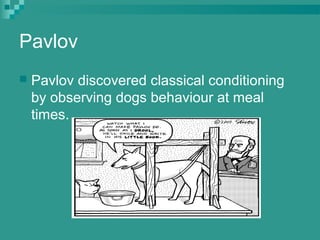
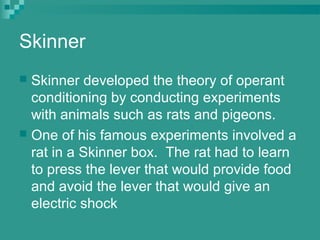





The behaviorist approach assumes that all human behavior is learned through conditioning experiences with the environment. Classical conditioning involves learning through associations, like Pavlov's dogs learning to associate food with a bell. Operant conditioning involves learning through consequences of actions, where behaviors are reinforced through reward or punishment. Behaviorists like Watson, Pavlov, and Skinner conducted experiments demonstrating how conditioning shapes behavior, influencing fields like education and phobia treatment. Their focus on observable and measurable behavior helped establish psychology as a science.


![MEDICAL_BEHAVIORAL_SCIENCE[1] [Autosaved].pptx](https://cdn.slidesharecdn.com/ss_thumbnails/medicalbehavioralscience1autosaved-241126100112-21c18b33-thumbnail.jpg?width=640&height=640&fit=bounds)


