Behavior modificationis the systematic application of the
principles of operant conditioning, such as:
Positive reinforcement
Negative reinforcement
Punishment
Extinction
For the purpose of strengthening or weakening behavior.
3.
Classical Conditioning
Alsocalled Pavlov’s respondent conditioning, Controlled by
the autonomic nervous system and involuntary muscles.
Examples of respondent behaviors are
Eyeblink reflex
The knee-jerk reflex
Heartbeat
The salivation response and many other physiological and / or
somatic responses of the body which characterize emotional
states such as anger, anxiety and the like
4.
Respondent behaviorsare elicited in response to the presentation
of a stimulus, that is respondent behaviors occur only after a
stimulus appears.
5.
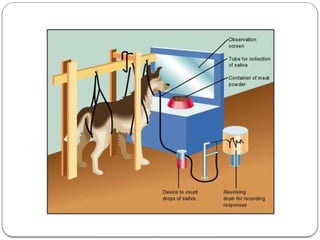
While researchingthe digestive function of dogs, he noted his
subjects would salivate before the delivery of food. In a series
of well-known experiments, he presented a variety of stimuli
before the presentation of food, eventually finding that, after
repeated association, a dog would salivate to the presence of a
stimulus other than food. He termed this response a conditional
reflex.
6.
Pavlov (1902)started from the idea that there are some things
that a dog does not need to learn. For example, dogs don’t learn
to salivate whenever they see food.This reflex is‘hard wired’
into the dog. In behaviorist terms, it is an unconditioned
response (i.e. a stimulus-response connection that required no
learning). In behaviorist terms, we write:
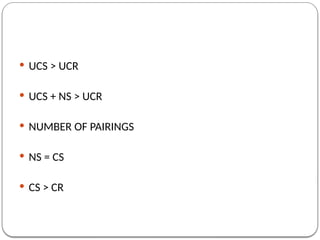
Unconditioned Stimulus (Food) > Unconditioned Response (Salivate)
7.
Pavlov showedthe existence of the unconditioned response by
presenting a dog with a bowl of food and the measuring its
salivary secretions.
However, when Pavlov discovered that any object or event which
the dogs learnt to associate with food (such as the lab assistant)
would trigger the same response, he realized that he had made an
important scientific discovery, and he devoted the rest of his
career to studying this type of learning.
8.
Pavlov knewthat somehow, the dogs in his lab had learned to
associate food with his lab assistant.This must have been learned,
because at one point the dogs did not do it, and there came a
point where they started, so their behavior had changed. A
change in behavior of this type must be the result of learning.
In behaviorist terms, the lab assistant was originally a neutral
stimulus. It is called neutral because it produces no response.
What had happened was that the neutral stimulus (the lab
assistant) had become associated with an unconditioned stimulus
(food).
9.
In hisexperiment, Pavlov used a bell as his neutral stimulus.
Whenever he gave food to his dogs, he also rang a bell.After a
number of repeats of this procedure, he tried the bell on its own.
As you might expect, the bell on its own now caused an increase
in salivation.
So the dog had learned an association between the bell and the
food and a new behavior had been learnt. Because this response
was learned (or conditioned), it is called a conditioned response.
The neutral stimulus has become a conditioned stimulus
10.
Pavlov found thatfor associations to be made, the two stimuli had
to be presented close together in time. He called this the law of
temporal contiguity. If the time between the conditioned
stimulus (bell) and unconditioned stimulus (food) is too great,
then learning will not occur.
Operant Conditioning
Operantbehaviors are controlled by the central nervous
system and the voluntary muscles.
Operants usually occur first and are later modified (i.e.,
changed) or maintained (i.e., kept the same) by the
presentation of a stimulus.
14.
The termoperant means to operate, and operate means to
produce an effect.
Operant behavior is a behavior that produces an effect on the
environment.
Operants can also be influenced by environmental events that
precede them (something in the environment can stimulate and
elicit an operant called antecedent stimulus event-ASE)
15.
Skinner’s Theory
“Allwe need to know in order to describe and explain
behavior is this: actions followed by good outcomes
are likely to recur , and actions followed by bad
outcomes are less likely to recur.” (Skinner, 1953)
16.
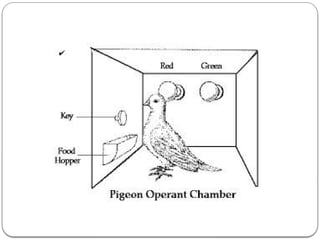
Skinner Box
Subjectsegregated from all irrelevant environmental
influences
Only stimuli were controlled by experimenter
Reinforcement rates & schedule were measured
Positive-food, negative-electric shock
18.
Operant Conditioning
Operantconditioning (sometimes referred to
as instrumental conditioning) is a method of learning
that occurs through rewards and punishments for behavior.
Through operant conditioning, an association is made
between a behavior and a consequence for that behavior.
19.
Operant Conditioning Techniques
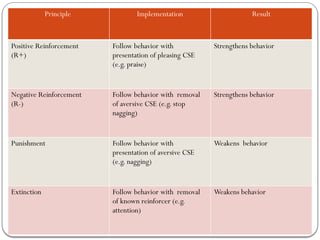
POSITIVE REINFORCEMENT (R+) = the strengthening of an
operant by immediately following it with a designated reward
or the presentation of something a person likes.
NEGATIVE REINFORCEMENT (R-) = is the strengthening
of an operant by immediately following it with the removal
or avoidance of something the person doesn’t like.
20.
EXTINCTION =Since reinforcers are CSEs that strengthen
operants, it becomes possible to weaken an operant by
withholding a known positive reinforcer.
PUNISHMENT = decreasing a behavior by administering
an aversive stimulus following a behavior OR by removing
a positive stimulus. It is the weakening of an operant by
following it with an aversive CSE.
21.
Reciprocal Relationships
The behavioristversion of reciprocal determinism is limited to
behaviors and environments.
When you attempt to condition another person’s behavior
through R+, R-, punishment, or extinction, the result of that
attempt may serve to condition your behavior as well.
22.
Positive Reinforcement
(R+)
Follow behaviorwith
presentation of pleasing CSE
(e.g. praise)
Strengthens behavior
Negative Reinforcement
(R-)
Follow behavior with removal
of aversive CSE (e.g. stop
nagging)
Strengthens behavior
Punishment Follow behavior with
presentation of aversive CSE
(e.g. nagging)
Weakens behavior
Extinction Follow behavior with removal
of known reinforcer (e.g.
attention)
Weakens behavior
Principle Implementation Result





![learning_theories_(skinner_operant_conditioning)[1].ppt](https://cdn.slidesharecdn.com/ss_thumbnails/learningtheoriesskinneroperantconditioning1-240115075324-0569245b-thumbnail.jpg?width=640&height=640&fit=bounds)


