Observational Learning Theory
By
Khemraj Subedi
Associate Professor
Far Western University
Observational Learning
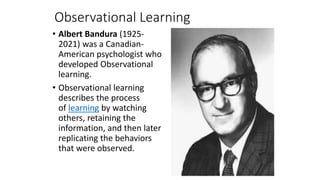
• Albert Bandura (1925-
2021) was a Canadian-
American psychologist who
developed Observational
learning.
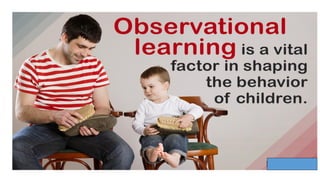
• Observational learning
describes the process
of learning by watching
others, retaining the
information, and then later
replicating the behaviors
that were observed.
Introduction to Observational Learning
• Observational learning theory, also known as social learning theory or
modeling, is a psychological theory developed by Albert Bandura that
explains how people learn new behaviors by observing others. His
work was published in 1977 book titled Social Learning Theory.
According to this theory, learning can occur through direct experience
or through the observation of others' actions, behaviors, and the
consequences they experience.
• Observational learning theory has been influential in understanding
various aspects of human behavior, from the development of social
skills to the acquisition of complex behaviors. It has applications in
education, therapy, and the study of aggression, pro-social behavior,
and media influence.
Key concepts of observational learning theory include:
1.Imitation: Observational learning involves the process of imitating or
copying the actions of a model. People learn by observing and replicating the
behaviors they see in others. The observed model can be a real person, a
fictional character, or even symbolic representations such as media figures or
role models.
2.Modeling: Modeling refers to the demonstration of a behavior by a model.
Models can be individuals who are similar or influential to the observer, and
they provide examples for learning. Observers pay attention to the model's
behavior and the consequences of that behavior.
3. Vicarious Reinforcement: In observational learning, reinforcement plays a
significant role. Observers are more likely to imitate a behavior if they see
the model being rewarded or reinforced for that behavior. Similarly, they are
less likely to imitate a behavior if they see the model being punished. This
process is called vicarious reinforcement, as the observer learns from the
consequences experienced by the model.
Key concepts of observational learning cont …
4. Attention: Attention is a critical component of observational
learning. For learning to occur, observers must pay attention to the
model's behavior and the relevant features of the situation. Factors
that influence attention include the characteristics of the model (e.g.,
attractiveness, expertise), the salience of the behavior, and the
observer's level of motivation.
5. Retention: Observational learning involves storing information about
the observed behavior in memory. The observer must retain the
information to reproduce the behavior later. This retention can be
enhanced through rehearsal and practice.
Key concepts of observational learning cont …
• Motor Reproduction: After attention and retention, the observer
must be capable of reproducing the behavior. This requires the
physical and cognitive ability to imitate the observed actions. The
observer may start with simpler actions and gradually develop
proficiency through practice.
• Motivation: Motivation plays a crucial role in observational learning.
Individuals are more likely to engage in imitative behavior if they are
motivated to do so. Motivation can stem from various factors,
including the expectation of rewards or positive outcomes associated
with the behavior, identification with the model, or the desire to fulfill
certain needs.
• According to Albert Bandura, learning cannot simply be based merely
on associations or reinforcements which he has mentioned in his
writings in his book Social Learning Theory which was published in
1977. Instead, his focus was on learning based on observation, which
he has proven through his well known Bobo Doll experiment. He
reckoned that children keenly observe their surroundings and the
behaviour of people around them particularly their caregivers,
teachers and siblings and try to imitate those behaviours in their day
to day life. He also tried proving through his experiment that children
can easily imitate the negative behaviours or actions.
• Another important principle of Bandura’s Social Learning Theory was
that learning something by way of observation, need not necessarily
mean that it would lead to a change in the behaviour. This
behavioural change is entirely influenced by the felt need or
motivation of a person to endorse and adopt a behavioural change.
Application of Observational Learning in business
management
• Leadership Development:
• Training and Skill Development:
• Conflict Resolution:
• Customer Service Training:
• Change Management:
• Decision-Making:
• Innovation and Creativity:
• Ethical Behavior:
• Management teams can benefit from observational learning by
observing successful team dynamics.
• Sales and Marketing Techniques:
References
• Bandura, A., Grusec, J. E., & Menlove, F. L. (1966). Observational learning as
a function of symbolization and incentive set. Child development, 499-506.
• Deguchi, H. (1984). Observational learning from a radical-behavioristic
viewpoint. The Behavior Analyst, 7, 83-95.
• Greer, R. D., Dudek-Singer, J., & Gautreaux, G. (2020). Observational learning.
In Behavior Analysis Around the World (pp. 486-499). Psychology Press.
• Fryling, M. J., Johnston, C., & Hayes, L. J. (2011). Understanding
observational learning: An interbehavioral approach. The Analysis of verbal
behavior, 27, 191-203.
• Horn, R. R., & Williams, A. M. (2004). Observational learning. Skills
acquisition in sport: Research, theory, and practice, 175-203.
• Hodges, N. J., Williams, A. M., Hayes, S. J., & Breslin, G. (2007). What is
modelled during observational learning?. Journal of sports sciences, 25(5),
531-545.

Observational Learning Theory and Its Application.pdf

  • 1.
    Observational Learning Theory By KhemrajSubedi Associate Professor Far Western University
  • 2.
    Observational Learning • AlbertBandura (1925- 2021) was a Canadian- American psychologist who developed Observational learning. • Observational learning describes the process of learning by watching others, retaining the information, and then later replicating the behaviors that were observed.
  • 3.
    Introduction to ObservationalLearning • Observational learning theory, also known as social learning theory or modeling, is a psychological theory developed by Albert Bandura that explains how people learn new behaviors by observing others. His work was published in 1977 book titled Social Learning Theory. According to this theory, learning can occur through direct experience or through the observation of others' actions, behaviors, and the consequences they experience. • Observational learning theory has been influential in understanding various aspects of human behavior, from the development of social skills to the acquisition of complex behaviors. It has applications in education, therapy, and the study of aggression, pro-social behavior, and media influence.
  • 5.
    Key concepts ofobservational learning theory include: 1.Imitation: Observational learning involves the process of imitating or copying the actions of a model. People learn by observing and replicating the behaviors they see in others. The observed model can be a real person, a fictional character, or even symbolic representations such as media figures or role models. 2.Modeling: Modeling refers to the demonstration of a behavior by a model. Models can be individuals who are similar or influential to the observer, and they provide examples for learning. Observers pay attention to the model's behavior and the consequences of that behavior. 3. Vicarious Reinforcement: In observational learning, reinforcement plays a significant role. Observers are more likely to imitate a behavior if they see the model being rewarded or reinforced for that behavior. Similarly, they are less likely to imitate a behavior if they see the model being punished. This process is called vicarious reinforcement, as the observer learns from the consequences experienced by the model.
  • 6.
    Key concepts ofobservational learning cont … 4. Attention: Attention is a critical component of observational learning. For learning to occur, observers must pay attention to the model's behavior and the relevant features of the situation. Factors that influence attention include the characteristics of the model (e.g., attractiveness, expertise), the salience of the behavior, and the observer's level of motivation. 5. Retention: Observational learning involves storing information about the observed behavior in memory. The observer must retain the information to reproduce the behavior later. This retention can be enhanced through rehearsal and practice.
  • 7.
    Key concepts ofobservational learning cont … • Motor Reproduction: After attention and retention, the observer must be capable of reproducing the behavior. This requires the physical and cognitive ability to imitate the observed actions. The observer may start with simpler actions and gradually develop proficiency through practice. • Motivation: Motivation plays a crucial role in observational learning. Individuals are more likely to engage in imitative behavior if they are motivated to do so. Motivation can stem from various factors, including the expectation of rewards or positive outcomes associated with the behavior, identification with the model, or the desire to fulfill certain needs.
  • 8.
    • According toAlbert Bandura, learning cannot simply be based merely on associations or reinforcements which he has mentioned in his writings in his book Social Learning Theory which was published in 1977. Instead, his focus was on learning based on observation, which he has proven through his well known Bobo Doll experiment. He reckoned that children keenly observe their surroundings and the behaviour of people around them particularly their caregivers, teachers and siblings and try to imitate those behaviours in their day to day life. He also tried proving through his experiment that children can easily imitate the negative behaviours or actions. • Another important principle of Bandura’s Social Learning Theory was that learning something by way of observation, need not necessarily mean that it would lead to a change in the behaviour. This behavioural change is entirely influenced by the felt need or motivation of a person to endorse and adopt a behavioural change.
  • 9.
    Application of ObservationalLearning in business management • Leadership Development: • Training and Skill Development: • Conflict Resolution: • Customer Service Training: • Change Management: • Decision-Making: • Innovation and Creativity: • Ethical Behavior: • Management teams can benefit from observational learning by observing successful team dynamics. • Sales and Marketing Techniques:
  • 10.
    References • Bandura, A.,Grusec, J. E., & Menlove, F. L. (1966). Observational learning as a function of symbolization and incentive set. Child development, 499-506. • Deguchi, H. (1984). Observational learning from a radical-behavioristic viewpoint. The Behavior Analyst, 7, 83-95. • Greer, R. D., Dudek-Singer, J., & Gautreaux, G. (2020). Observational learning. In Behavior Analysis Around the World (pp. 486-499). Psychology Press. • Fryling, M. J., Johnston, C., & Hayes, L. J. (2011). Understanding observational learning: An interbehavioral approach. The Analysis of verbal behavior, 27, 191-203. • Horn, R. R., & Williams, A. M. (2004). Observational learning. Skills acquisition in sport: Research, theory, and practice, 175-203. • Hodges, N. J., Williams, A. M., Hayes, S. J., & Breslin, G. (2007). What is modelled during observational learning?. Journal of sports sciences, 25(5), 531-545.