MATRIX ALGEBRAMATRIX ALGEBRA
Vector Calculus & linear AlgebraVector Calculus & linear Algebra
Presented by : Prasenjit RathodPresented by : Prasenjit Rathod
MECHANICAL - CMECHANICAL - C
• Prasenjit Rathod {130810119133}Prasenjit Rathod {130810119133}
• Pavan Patel {130810119117}Pavan Patel {130810119117}
• Nirmal Patel {130810119114}Nirmal Patel {130810119114}
INTRODUCTIONINTRODUCTION
 A matrix is a rectangular table of elements which may be numbers
or any abstract quantities that can be added and multiplied.
 Matrices are used to describe linear equations, keep track of the
coefficients of linear transformation and to record data that depend
on multiple parameters.
 There are many applications of matrices in mathematics viz., graph
theory, probability theory, statics, computer graphics, geometrical
optics, etc.
MATRIXMATRIX
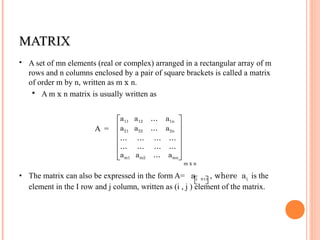
 A set of mn elements (real or complex) arranged in a rectangular array of m
rows and n columns enclosed by a pair of square brackets is called a matrix
of order m by n, written as m x n.
 A m x n matrix is usually written as
A =
 The matrix can also be expressed in the form A= aij mx n , where aij is the
element in the I row and j column, written as (i , j ) element of the matrix.
a11 a12 … a1n
a21 a22 … a2n
… … … …
… … … …
am1 am2 … amn
m x n
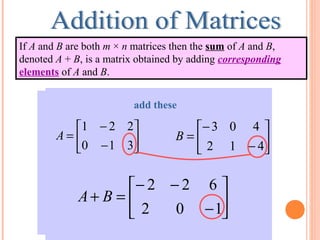
If A and B are both m × n matrices then the sum of A and B,
denoted A + B, is a matrix obtained by adding corresponding
elements of A and B.






−
−
=
310
221
A 





−
−
=
412
403
B





−
=+
2
BA
If A and B are both m × n matrices then the sum of A and B,
denoted A + B, is a matrix obtained by adding corresponding
elements of A and B.
add these






−
−
=
310
221
A 





−
−
=
412
403
B





 −−
=+
22
BA
add these






−
−
=
310
221
A 





−
−
=
412
403
B





 −−
=+
622
BA
add these






−
−
=
310
221
A 





−
−
=
412
403
B





 −−
=+
2
622
BA
add these






−
−
=
310
221
A 





−
−
=
412
403
B





 −−
=+
02
622
BA
add these






−
−
=
310
221
A 





−
−
=
412
403
B






−
−−
=+
102
622
BA
add these
ABBA +=+
CBACBA ++=++ )()(
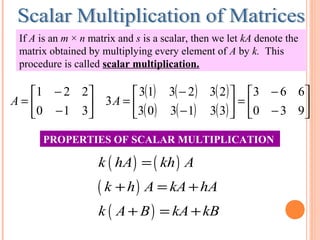
If A is an m × n matrix and s is a scalar, then we let kA denote the
matrix obtained by multiplying every element of A by k. This
procedure is called scalar multiplication.
( ) ( )
( )
( )
k hA kh A
k h A kA hA
k A B kA kB
=
+ = +
+ = +






−
−
=
310
221
A
( ) ( ) ( )
( ) ( ) ( ) 





−
−
=





−
−
=
930
663
331303
232313
3A
PROPERTIES OF SCALAR MULTIPLICATION
The m × n zero matrix, denoted 0, is the m × n
matrix whose elements are all zeros.
( ) 00
0)(
0
=
=−+
=+
A
AA
AA






00
00
[ ]000
2 × 2
1 × 3
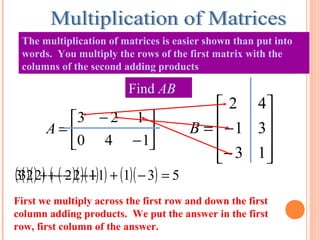
The multiplication of matrices is easier shown than put into
words. You multiply the rows of the first matrix with the
columns of the second adding products






−
−
=
140
123
A










−
−=
13
31
42
B
Find AB
First we multiply across the first row and down the first
column adding products. We put the answer in the first
row, first column of the answer.
( )23( ) ( )( )1223 −−+( )( ) ( )( ) ( )( ) 5311223 =−+−−+






−
−
=
140
123
A










−
−=
13
31
42
B
Find AB
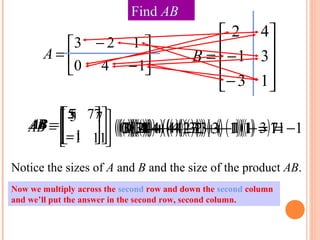
We multiplied across first row and down first column so we put
the answer in the first row, first column.






=
5
AB
Now we multiply across the first row and down the second column
and we’ll put the answer in the first row, second column.
( )( )43( )( ) ( )( )3243 −+( )( ) ( )( ) ( )( ) 7113243 =+−+





=
75
AB
Now we multiply across the second row and down the first column
and we’ll put the answer in the second row, first column.
( )( )20( )( ) ( )( )1420 −+( )( ) ( )( ) ( )( ) 1311420 −=−−+−+





−
=
1
75
AB
Now we multiply across the second row and down the second column
and we’ll put the answer in the second row, second column.
( )( )40( )( ) ( )( )3440 +( )( ) ( )( ) ( )( ) 11113440 =−++





−
=
111
75
AB
Notice the sizes of A and B and the size of the product AB.
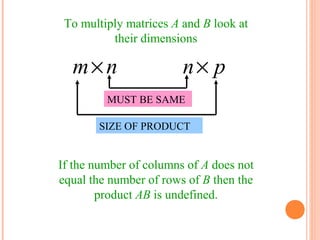
To multiply matrices A and B look at
their dimensions
pnnm ××
MUST BE SAME
SIZE OF PRODUCT
If the number of columns of A does not
equal the number of rows of B then the
product AB is undefined.










=
6
BA










=
126
BA









 −
=
2126
BA










−
−
= 3
2126
BA










−
−
= 143
2126
BA










−−
−
= 4143
2126
BA










−
−−
−
=
9
4143
2126
BA










−
−−
−
=
109
4143
2126
BA










−−
−−
−
=
4109
4143
2126
BA
Now let’s look at the product BA.










−
−=
13
31
42
B 





−
−
=
140
123
A
BAAB ≠
2×33×2
can multiply
size of answer
across first row as
we go down first
column:
( )( ) ( )( ) 60432 =+
across first row as
we go down
second column:
( )( ) ( )( ) 124422 =+−
across first row as
we go down third
column:
( )( ) ( )( ) 21412 −=−+
across second row
as we go down
first column:
( )( ) ( )( ) 30331 −=+−
across second row
as we go down
second column:
( )( ) ( )( ) 144321 =+−−
across second row
as we go down
third column:
( )( ) ( )( ) 41311 −=−+−
across third row
as we go down
first column:
( )( ) ( )( ) 90133 −=+−
across third row
as we go down
second column:
( )( ) ( )( ) 104123 =+−−
across third row
as we go down
third column:
( )( ) ( )( ) 41113 −=−+−
Completely different than AB!
Commuter's Beware!
( ) ( )
( )
( ) BCACCBA
ACABCBA
CABBCA
+=+
+=+
=
PROPERTIES OF MATRIX
MULTIPLICATION
BAAB ≠
Is it possible for AB = BA ?,yes it is possible.
an n × n matrix with ones on the main diagonal and zeros
elsewhere










=
100
010
001
3I
What is AI?
What is IA?










−
−
=
322
510
212
A










=
100
010
001
3I
A=










−
−
322
510
212
A=










−
−
322
510
212
Multiplying a
matrix by the
identity gives the
matrix back again.






=















 −−
10
01
24
13
?
Let A be an n× n matrix. If there exists a matrix B
such that AB = BA = I then we call this matrix the
inverse of A and denote it A-1
.










−−
2
3
2
2
1
1






=




 −−










−−
10
01
24
13
2
3
2
2
1
1
Can we find a matrix to multiply the first matrix by to get
the identity?
If A has an inverse we say that A is nonsingular. If A-1
does not exist we say A is singular.
To find the inverse of a matrix we put the matrix A, a line and
then the identity matrix. We then perform row operations on
matrix A to turn it into the identity. We carry the row
operations across and the right hand side will turn into the
inverse.
To find the inverse of a matrix we put the matrix A, a line and
then the identity matrix. We then perform row operations on
matrix A to turn it into the identity. We carry the row
operations across and the right hand side will turn into the
inverse.






−−
=
72
31
A






− 1210
0131
2r1+r2






−− 1072
0131






−− 1210
0131
−r2






−− 1210
3701r1 − r2






−−
=
72
31
A 





−−
=−
12
371
A
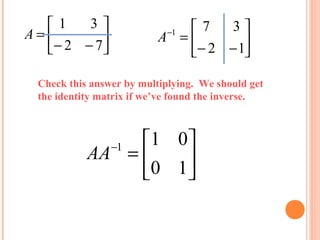
Check this answer by multiplying. We should get
the identity matrix if we’ve found the inverse.






=−
10
011
AA
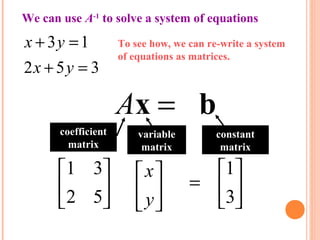
We can use A-1
to solve a system of equations
352
13
=+
=+
yx
yx
bx =A
To see how, we can re-write a system
of equations as matrices.
coefficient
matrix
variable
matrix
constant
matrix






52
31






y
x






=
3
1
bx 1−
= A
bx 11 −−
= AAA
bx =A left multiply both sides by
the inverse of A
This is just the identity
bx 1−
= AI
but the identity times a
matrix just gives us back
the matrix so we have:
This then gives us a formula for
finding the variable matrix:
Multiply A inverse by the
constants.
352
13
=+
=+
yx
yx






=
52
31
A find the inverse






1052
0131






−− 1210
0131
-2r1+r2






−1210
0131
-r2






−
−
1210
3501r1-3r2






−
=











−
−
=−
1
4
3
1
12
351
bA
This is the
answer to the
system
x
y

Matrix algebra

  • 2.
    MATRIX ALGEBRAMATRIX ALGEBRA VectorCalculus & linear AlgebraVector Calculus & linear Algebra Presented by : Prasenjit RathodPresented by : Prasenjit Rathod
  • 3.
    MECHANICAL - CMECHANICAL- C • Prasenjit Rathod {130810119133}Prasenjit Rathod {130810119133} • Pavan Patel {130810119117}Pavan Patel {130810119117} • Nirmal Patel {130810119114}Nirmal Patel {130810119114}
  • 4.
    INTRODUCTIONINTRODUCTION  A matrixis a rectangular table of elements which may be numbers or any abstract quantities that can be added and multiplied.  Matrices are used to describe linear equations, keep track of the coefficients of linear transformation and to record data that depend on multiple parameters.  There are many applications of matrices in mathematics viz., graph theory, probability theory, statics, computer graphics, geometrical optics, etc.
  • 5.
    MATRIXMATRIX  A setof mn elements (real or complex) arranged in a rectangular array of m rows and n columns enclosed by a pair of square brackets is called a matrix of order m by n, written as m x n.  A m x n matrix is usually written as A =  The matrix can also be expressed in the form A= aij mx n , where aij is the element in the I row and j column, written as (i , j ) element of the matrix. a11 a12 … a1n a21 a22 … a2n … … … … … … … … am1 am2 … amn m x n
  • 6.
    If A andB are both m × n matrices then the sum of A and B, denoted A + B, is a matrix obtained by adding corresponding elements of A and B.       − − = 310 221 A       − − = 412 403 B      − =+ 2 BA If A and B are both m × n matrices then the sum of A and B, denoted A + B, is a matrix obtained by adding corresponding elements of A and B. add these       − − = 310 221 A       − − = 412 403 B       −− =+ 22 BA add these       − − = 310 221 A       − − = 412 403 B       −− =+ 622 BA add these       − − = 310 221 A       − − = 412 403 B       −− =+ 2 622 BA add these       − − = 310 221 A       − − = 412 403 B       −− =+ 02 622 BA add these       − − = 310 221 A       − − = 412 403 B       − −− =+ 102 622 BA add these
  • 7.
  • 8.
    If A isan m × n matrix and s is a scalar, then we let kA denote the matrix obtained by multiplying every element of A by k. This procedure is called scalar multiplication. ( ) ( ) ( ) ( ) k hA kh A k h A kA hA k A B kA kB = + = + + = +       − − = 310 221 A ( ) ( ) ( ) ( ) ( ) ( )       − − =      − − = 930 663 331303 232313 3A PROPERTIES OF SCALAR MULTIPLICATION
  • 9.
    The m ×n zero matrix, denoted 0, is the m × n matrix whose elements are all zeros. ( ) 00 0)( 0 = =−+ =+ A AA AA       00 00 [ ]000 2 × 2 1 × 3
  • 10.
    The multiplication ofmatrices is easier shown than put into words. You multiply the rows of the first matrix with the columns of the second adding products       − − = 140 123 A           − −= 13 31 42 B Find AB First we multiply across the first row and down the first column adding products. We put the answer in the first row, first column of the answer. ( )23( ) ( )( )1223 −−+( )( ) ( )( ) ( )( ) 5311223 =−+−−+
  • 11.
          − − = 140 123 A           − −= 13 31 42 B Find AB We multipliedacross first row and down first column so we put the answer in the first row, first column.       = 5 AB Now we multiply across the first row and down the second column and we’ll put the answer in the first row, second column. ( )( )43( )( ) ( )( )3243 −+( )( ) ( )( ) ( )( ) 7113243 =+−+      = 75 AB Now we multiply across the second row and down the first column and we’ll put the answer in the second row, first column. ( )( )20( )( ) ( )( )1420 −+( )( ) ( )( ) ( )( ) 1311420 −=−−+−+      − = 1 75 AB Now we multiply across the second row and down the second column and we’ll put the answer in the second row, second column. ( )( )40( )( ) ( )( )3440 +( )( ) ( )( ) ( )( ) 11113440 =−++      − = 111 75 AB Notice the sizes of A and B and the size of the product AB.
  • 12.
    To multiply matricesA and B look at their dimensions pnnm ×× MUST BE SAME SIZE OF PRODUCT If the number of columns of A does not equal the number of rows of B then the product AB is undefined.
  • 13.
              = 6 BA           = 126 BA           − = 2126 BA           − − = 3 2126 BA           − − =143 2126 BA           −− − = 4143 2126 BA           − −− − = 9 4143 2126 BA           − −− − = 109 4143 2126 BA           −− −− − = 4109 4143 2126 BA Now let’s look at the product BA.           − −= 13 31 42 B       − − = 140 123 A BAAB ≠ 2×33×2 can multiply size of answer across first row as we go down first column: ( )( ) ( )( ) 60432 =+ across first row as we go down second column: ( )( ) ( )( ) 124422 =+− across first row as we go down third column: ( )( ) ( )( ) 21412 −=−+ across second row as we go down first column: ( )( ) ( )( ) 30331 −=+− across second row as we go down second column: ( )( ) ( )( ) 144321 =+−− across second row as we go down third column: ( )( ) ( )( ) 41311 −=−+− across third row as we go down first column: ( )( ) ( )( ) 90133 −=+− across third row as we go down second column: ( )( ) ( )( ) 104123 =+−− across third row as we go down third column: ( )( ) ( )( ) 41113 −=−+− Completely different than AB! Commuter's Beware!
  • 14.
    ( ) () ( ) ( ) BCACCBA ACABCBA CABBCA +=+ +=+ = PROPERTIES OF MATRIX MULTIPLICATION BAAB ≠ Is it possible for AB = BA ?,yes it is possible.
  • 15.
    an n ×n matrix with ones on the main diagonal and zeros elsewhere           = 100 010 001 3I What is AI? What is IA?           − − = 322 510 212 A           = 100 010 001 3I A=           − − 322 510 212 A=           − − 322 510 212 Multiplying a matrix by the identity gives the matrix back again.
  • 16.
          =                 −− 10 01 24 13 ? Let Abe an n× n matrix. If there exists a matrix B such that AB = BA = I then we call this matrix the inverse of A and denote it A-1 .           −− 2 3 2 2 1 1       =      −−           −− 10 01 24 13 2 3 2 2 1 1 Can we find a matrix to multiply the first matrix by to get the identity?
  • 17.
    If A hasan inverse we say that A is nonsingular. If A-1 does not exist we say A is singular. To find the inverse of a matrix we put the matrix A, a line and then the identity matrix. We then perform row operations on matrix A to turn it into the identity. We carry the row operations across and the right hand side will turn into the inverse. To find the inverse of a matrix we put the matrix A, a line and then the identity matrix. We then perform row operations on matrix A to turn it into the identity. We carry the row operations across and the right hand side will turn into the inverse.       −− = 72 31 A       − 1210 0131 2r1+r2       −− 1072 0131       −− 1210 0131 −r2       −− 1210 3701r1 − r2
  • 18.
          −− = 72 31 A       −− =− 12 371 A Check thisanswer by multiplying. We should get the identity matrix if we’ve found the inverse.       =− 10 011 AA
  • 19.
    We can useA-1 to solve a system of equations 352 13 =+ =+ yx yx bx =A To see how, we can re-write a system of equations as matrices. coefficient matrix variable matrix constant matrix       52 31       y x       = 3 1
  • 20.
    bx 1− = A bx11 −− = AAA bx =A left multiply both sides by the inverse of A This is just the identity bx 1− = AI but the identity times a matrix just gives us back the matrix so we have: This then gives us a formula for finding the variable matrix: Multiply A inverse by the constants.
  • 21.
    352 13 =+ =+ yx yx       = 52 31 A find theinverse       1052 0131       −− 1210 0131 -2r1+r2       −1210 0131 -r2       − − 1210 3501r1-3r2       − =            − − =− 1 4 3 1 12 351 bA This is the answer to the system x y