Learning Intention and Success
Criteria
 Learning Intention: Students will understand the
meaning of a variety of terms relating to matrices
 Success Criteria: You can use accurate mathematical
terminology to describe matrices and correctly
identify characteristics of a variety of matrices.
What is a Matrix?
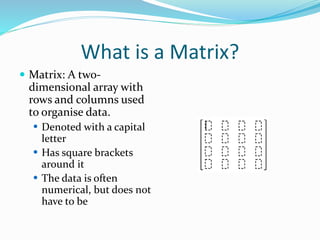
 Matrix: A two-
dimensional array with
rows and columns used
to organise data.
 Denoted with a capital
letter
 Has square brackets
around it
 The data is often
numerical, but does not
have to be
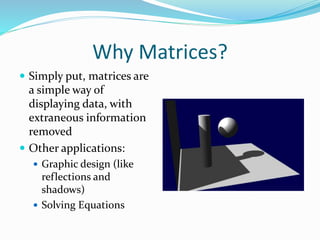
Why Matrices?
 Simply put, matrices are
a simple way of
displaying data, with
extraneous information
removed
 Other applications:
 Graphic design (like
reflections and
shadows)
 Solving Equations
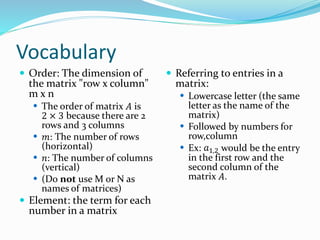
Vocabulary
 Order: The dimension of
the matrix "row x column"
m x n
 The order of matrix 𝐴 is
2 × 3 because there are 2
rows and 3 columns
 𝑚: The number of rows
(horizontal)
 𝑛: The number of columns
(vertical)
 (Do not use M or N as
names of matrices)
 Element: the term for each
number in a matrix
 Referring to entries in a
matrix:
 Lowercase letter (the same
letter as the name of the
matrix)
 Followed by numbers for
row,column
 Ex: 𝑎1,2 would be the entry
in the first row and the
second column of the
matrix 𝐴.
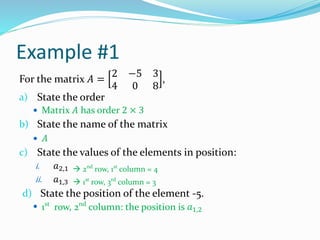
Example #1
For the matrix 𝐴 =
2 −5 3
4 0 8
,
a) State the order
 Matrix 𝐴 has order 2 × 3
b) State the name of the matrix
 𝐴
c) State the values of the elements in position:
i. 𝑎2,1
ii. 𝑎1,3
d) State the position of the element -5.
 1st
row, 2nd
column: the position is 𝑎1,2
 2nd
row, 1st
column = 4
 1st
row, 3rd
column = 3
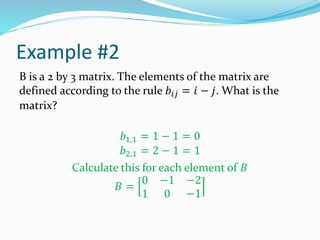
Example #2
B is a 2 by 3 matrix. The elements of the matrix are
defined according to the rule 𝑏𝑖𝑗 = 𝑖 − 𝑗. What is the
matrix?
𝑏1,1 = 1 − 1 = 0
𝑏2,1 = 2 − 1 = 1
Calculate this for each element of 𝐵
𝐵 =
0 −1 −2
1 0 −1
Special Types of Matrices
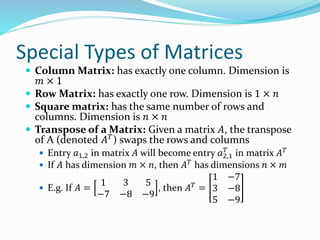
 Column Matrix: has exactly one column. Dimension is
𝑚 × 1
 Row Matrix: has exactly one row. Dimension is 1 × 𝑛
 Square matrix: has the same number of rows and
columns. Dimension is 𝑛 × 𝑛
 Transpose of a Matrix: Given a matrix 𝐴, the transpose
of A (denoted 𝐴 𝑇) swaps the rows and columns
 Entry 𝑎1,2 in matrix 𝐴 will become entry 𝑎2,1
𝑇
in matrix 𝐴 𝑇
 If 𝐴 has dimension 𝑚 × 𝑛, then 𝐴 𝑇
has dimensions 𝑛 × 𝑚
 E.g. If 𝐴 =
1 3 5
−7 −8 −9
, then 𝐴 𝑇
=
1 −7
3 −8
5 −9
Square Matrices Sub-categories
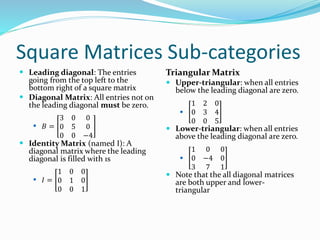
 Leading diagonal: The entries
going from the top left to the
bottom right of a square matrix
 Diagonal Matrix: All entries not on
the leading diagonal must be zero.
 𝐵 =
3 0 0
0 5 0
0 0 −4
 Identity Matrix (named I): A
diagonal matrix where the leading
diagonal is filled with 1s
 𝐼 =
1 0 0
0 1 0
0 0 1
Triangular Matrix
 Upper-triangular: when all entries
below the leading diagonal are zero.

1 2 0
0 3 4
0 0 5
 Lower-triangular: when all entries
above the leading diagonal are zero.

1 0 0
0 −4 0
3 7 1
 Note that the all diagonal matrices
are both upper and lower-
triangular

Lesson 1 - Introduction to Matrices

  • 2.
    Learning Intention andSuccess Criteria  Learning Intention: Students will understand the meaning of a variety of terms relating to matrices  Success Criteria: You can use accurate mathematical terminology to describe matrices and correctly identify characteristics of a variety of matrices.
  • 3.
    What is aMatrix?  Matrix: A two- dimensional array with rows and columns used to organise data.  Denoted with a capital letter  Has square brackets around it  The data is often numerical, but does not have to be
  • 4.
    Why Matrices?  Simplyput, matrices are a simple way of displaying data, with extraneous information removed  Other applications:  Graphic design (like reflections and shadows)  Solving Equations
  • 5.
    Vocabulary  Order: Thedimension of the matrix "row x column" m x n  The order of matrix 𝐴 is 2 × 3 because there are 2 rows and 3 columns  𝑚: The number of rows (horizontal)  𝑛: The number of columns (vertical)  (Do not use M or N as names of matrices)  Element: the term for each number in a matrix  Referring to entries in a matrix:  Lowercase letter (the same letter as the name of the matrix)  Followed by numbers for row,column  Ex: 𝑎1,2 would be the entry in the first row and the second column of the matrix 𝐴.
  • 6.
    Example #1 For thematrix 𝐴 = 2 −5 3 4 0 8 , a) State the order  Matrix 𝐴 has order 2 × 3 b) State the name of the matrix  𝐴 c) State the values of the elements in position: i. 𝑎2,1 ii. 𝑎1,3 d) State the position of the element -5.  1st row, 2nd column: the position is 𝑎1,2  2nd row, 1st column = 4  1st row, 3rd column = 3
  • 7.
    Example #2 B isa 2 by 3 matrix. The elements of the matrix are defined according to the rule 𝑏𝑖𝑗 = 𝑖 − 𝑗. What is the matrix? 𝑏1,1 = 1 − 1 = 0 𝑏2,1 = 2 − 1 = 1 Calculate this for each element of 𝐵 𝐵 = 0 −1 −2 1 0 −1
  • 8.
    Special Types ofMatrices  Column Matrix: has exactly one column. Dimension is 𝑚 × 1  Row Matrix: has exactly one row. Dimension is 1 × 𝑛  Square matrix: has the same number of rows and columns. Dimension is 𝑛 × 𝑛  Transpose of a Matrix: Given a matrix 𝐴, the transpose of A (denoted 𝐴 𝑇) swaps the rows and columns  Entry 𝑎1,2 in matrix 𝐴 will become entry 𝑎2,1 𝑇 in matrix 𝐴 𝑇  If 𝐴 has dimension 𝑚 × 𝑛, then 𝐴 𝑇 has dimensions 𝑛 × 𝑚  E.g. If 𝐴 = 1 3 5 −7 −8 −9 , then 𝐴 𝑇 = 1 −7 3 −8 5 −9
  • 9.
    Square Matrices Sub-categories Leading diagonal: The entries going from the top left to the bottom right of a square matrix  Diagonal Matrix: All entries not on the leading diagonal must be zero.  𝐵 = 3 0 0 0 5 0 0 0 −4  Identity Matrix (named I): A diagonal matrix where the leading diagonal is filled with 1s  𝐼 = 1 0 0 0 1 0 0 0 1 Triangular Matrix  Upper-triangular: when all entries below the leading diagonal are zero.  1 2 0 0 3 4 0 0 5  Lower-triangular: when all entries above the leading diagonal are zero.  1 0 0 0 −4 0 3 7 1  Note that the all diagonal matrices are both upper and lower- triangular