MATHS  MATHS  
PRESENTATIONPRESENTATION
GROUP MEMBERS : DRISHTI (1838)
VANDANA (1831)
DIMPY(1833)
 Operations with Matrices
 Properties of Matrix Operations
 The Inverse of a Matrix
MATRICES
 Matrix:
A=[ aij ]=
[
a11 a12 a13 ⋯ a1n
a21 a22 a23 ⋯ a2n
a31 a32 a33 ⋯ a3n
⋮ ⋮ ⋮ ⋮
am1 am2 am3 ⋯ amn
]m×n
∈ M m×n
(i, j)-th entry: aij
row: m
column: n
size: m×n
 i-th row vector
ri=[ai1 ai2 ⋯ ain ]
 j-th column vector
c j=
[
c1j
c2j
⋮
cmj
]
row matrix
column matrix
 Square matrix: m = n
 Diagonal matrix:
A=diag (d1 ,d2 ,⋯ ,dn) =
[
d1 0 … 0
0 d2 ⋯ 0
⋮ ⋮ ⋱ ⋮
0 0 ⋯ dn
]∈M n×n
 Trace:
If A=[aij ]n×n
Then Tr ( A )=a11 +a22 +⋯+ann
Ex:
A=[1 2 3
4 5 6 ] =
[r1
r2
]
=[c1 c2 c3 ]
r1=[1 2 3 ], r2=[4 5 6 ]
c1=[1
4], c2=[2
5], c3=[3
6]
A=[1 2 3
4 5 6 ]
⇒
⇒
If A=[aij ]m×n , B=[bij ]m×n
 Equal matrix:
Then A=B if and only if aij =bij ∀ 1≤i≤m, 1≤ j≤n
 Ex 1: (Equal matrix)
A=[1 2
3 4 ] B=[a b
c d ]
If A=B
Then a=1, b=2, c=3, d=4
 Matrix addition:
If A=[aij ]m×n , B=[bij ]m×n
Then A+B=[ aij ]m×n +[ bij ]m×n=[ aij +bij ]m×n
 Ex 2: (Matrix addition)
[−1 2
0 1 ]+[ 1 3
−1 2 ]=[−1+1 2+3
0−1 1+2 ]=[0 5
−1 3 ]
[1
−3
−2]+
[−1
3
2 ]=
[1−1
−3+3
−2+2] =
[0
0
0]
 Matrix subtraction:
A−B=A+(−1)B
 Scalar multiplication:
If A=[aij ]m×n , c: scalar
 Ex 3: (Scalar multiplication and matrix subtraction)
A=
[1 2 4
−3 0 −1
2 1 2 ] B=
[2 0 0
1 −4 3
−1 3 2 ]
Find (a) 3A, (b) –B, (c) 3A – B
Then cA=[caij ]m×n
(a)
3A=3
[1 2 4
−3 0 −1
2 1 2 ]
(b)
−B=(−1)
[2 0 0
1 −4 3
−1 3 2 ]
(c)
3A−B=
[3 6 12
−9 0 −3
6 3 6 ]−
[2 0 0
1 −4 3
−1 3 2 ]
Sol:
=
[3 6 12
−9 0 −3
6 3 6 ]=
[
3(1) 3(2) 3(4)
3(−3) 3(0) 3(−1)
3(2) 3(1) 3(2) ]
=
[−2 0 0
−1 4 −3
1 −3 −2 ]
=
[ 1 6 12
−10 4 −6
7 0 4 ]
 Matrix multiplication:
If A=[aij ]m×n , B=[bij ]n× p
Then AB=[ aij ]m×n [bij ]n× p=[cij ]m×p
cij=∑
k=1
n
aik bkj =ai1 b1j +ai2 b2j+⋯+ain bnj
where
 Notes: (1) A+B = B+A, (2)AB≠BA
Size of AB
[
a11 a12 ⋯ a1n
⋮ ⋮ ⋮
ai1 ai2 ⋯ ain
⋮
an1
⋮
an2
⋯
⋮
ann
][
b11 ⋯ b1j ⋯ b1n
b21 ⋮ b2j ⋯ b2n
⋮ ⋮ ⋮ ⋮
bn1 ⋯ bnj ⋯ bnn
]=
[ci1 ci2 ⋯ cij ⋯ cin
]
A=
[−1 3
4 −2
5 0 ] B=[−3 2
−4 1 ]
 Ex 4: (Find AB)
Sol:
AB=
[
(−1)(−3)+(3)(−4) (−1)(2)+(3)(1)
(4)(−3)+(−2)(−4) (4)(2)+(−2)(1)
(5)(−3)+(0)(−4) (5)(2)+(0)(1) ]
=
[−9 1
−4 6
−15 10 ]
 Matrix form of a system of linear
equations:
{
a11 x1 +a12 x2+⋯+a1n xn =b1
a21 x1 +a22 x2+⋯+a2n xn =b2
⋮
am1 x1 +am2 x2+⋯+amn xn =bm
}=
=
=
A x b
m linear equations
Single matrix equation
Ax =b
m×nn×1 m×1[
a11 a12 ⋯ a1n
a21 a22 ⋯ a2n
⋮ ⋮ ⋮ ⋮
am1 am2 ⋯ amn
][
x1
x2
⋮
xn
]=
[
b1
b2
⋮
bm
]
⇓
 Partitioned matrices:
A=
[
a11 a12 a13 a14
a21 a22 a23 a24
a31 a32 a33 a34
]=
[A11 A12
A21 A22
]
submatrix
A=
[
a11 a12 a13 a14
a21 a22 a23 a24
a31 a32 a33 a34
]=
[
r1
r2
r3
]
A=
[
a11 a12 a13 a14
a21 a22 a23 a24
a31 a32 a33 a34
]=[c1 c2 c3 c4 ]
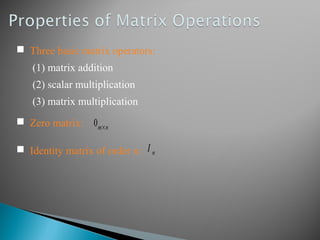
 Three basic matrix operators:
(1) matrix addition
(2) scalar multiplication
(3) matrix multiplication
 Zero matrix: 0m×n
 Identity matrix of order n: I n
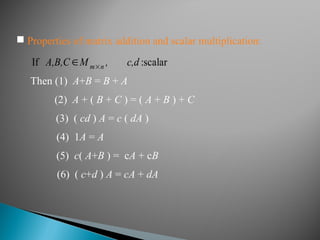
Then (1) A+B = B + A
(2) A + ( B + C ) = ( A + B ) + C
(3) ( cd ) A = c ( dA )
(4) 1A = A
(5) c( A+B ) = cA + cB
(6) ( c+d ) A = cA + dA
If A,B,C ∈M m×n , c,d :scalar
 Properties of matrix addition and scalar multiplication:
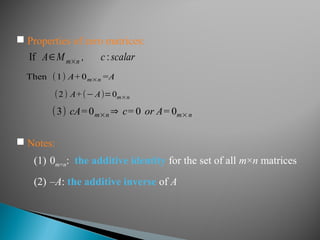
If A∈Mm×n , c :scalar
Then (1) A+0m×n =A
(2) A+(− A)=0m×n
(3) cA=0m×n ⇒ c= 0 or A= 0m× n
 Notes:
(1) 0m×n: the additive identity for the set of all m×n matrices
(2) –A: the additive inverse of A
 Properties of zero matrices:
If A=
[
a11 a12 ⋯ a1n
a21 a22 ⋯ a2n
⋮ ⋮ ⋮ ⋮
am1 am2 ⋯ amn
]∈M m×n
Then AT
=
[
a11 a21 ⋯ am1
a12 a22 ⋯ am2
⋮ ⋮ ⋮ ⋮
a1n a2n ⋯ amn
]∈ M n×m
 Transpose of a matrix :
Transpose is the interchange of rows and columns of a
given matrix.
A=[2
8] (b) A=
[1 2 3
4 5 6
7 8 9 ] (c
)
A=
[0 1
2 4
1 −1]
Sol: (a)
A=[2
8] ⇒ A
T
=[2 8 ]
(b)
A=
[1 2 3
4 5 6
7 8 9 ] ⇒ AT
=
[1 4 7
2 5 8
3 6 9 ](c
)
A=
[0 1
2 4
1 −1] ⇒ AT
=[0 2 1
1 4 −1]
(a)
 Ex 8: (Find the transpose of the following matrix)
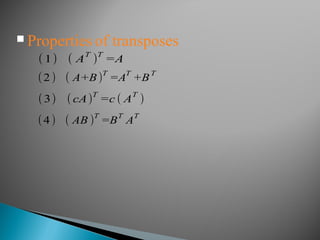
(1) ( A
T
)
T
=A
(2 ) ( A+B)
T
=A
T
+B
T
(3) (cA)T
=c ( AT
)
(4 ) ( AB )
T
=B
T
A
T
 Properties of transposes
A square matrix A is symmetric if A = AT
 Ex:
If A=
[1 2 3
a 4 5
b c 6 ] is symmetric, find a, b, c?
A square matrix A is skew-symmetric if AT
= –A
 Skew-symmetric matrix:
Sol:
A=
[1 2 3
a 4 5
b c 6 ] AT
=
[1 a b
2 4 c
3 5 6 ] a= 2,b= 3,c= 5
A=A
T
⇒
 Symmetric matrix:
If A=
[0 1 2
a 0 3
b c 0 ] is a skew-symmetric, find a, b, c?

Note:
AAT
is symmetric
Pf: (AAT
)T
=( AT
)T
AT
=AAT
AA∴
T
is symmetric
Sol:
A=
[0 1 2
a 0 3
b c 0 ] −AT
=
[0 −a −b
−1 0 −c
−2 −3 0 ]
A=−A
T
a=−1,b=−2,c=−3⇒
 Ex:
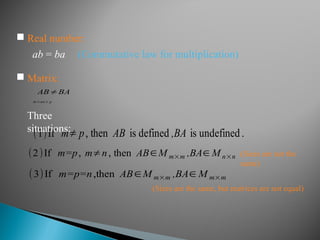
ab = ba (Commutative law for multiplication)
(1)If m≠ p, then AB is defined ,BA is undefined .
(3)If m=p=n,then AB∈M m×m ,BA∈ M m×m
(2)If m=p, m≠n, then AB∈M m×m ,BA∈ M n×n (Sizes are not the
same)
(Sizes are the same, but matrices are not equal)
 Real number:
 Matrix:
AB≠BA
m×nn× p
Three
situations:
A=[1 3
2 −1] B=[2 −1
0 2 ]
Sol:
AB=[1 3
2 −1 ][2 −1
0 2 ]=[2 5
4 −4 ]
 Note: AB≠BA
BA=[2 −1
0 2 ][1 3
2 −1]=[0 7
4 −2 ]
 Ex 4:
Sow that AB and BA are not equal for the matrices.
and
(Cancellation is not
valid)
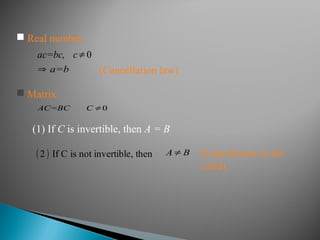
ac=bc, c≠0
⇒ a=b (Cancellation law)
 Matrix:
AC=BC C ≠0
(1) If C is invertible, then A = B
 Real number:
A≠B(2) If C is not invertible, then
26
/61
A=[1 3
0 1 ], B=[2 4
2 3 ], C=[ 1 −2
−1 2 ]
Sol:
AC=[1 3
0 1 ][ 1 −2
−1 2 ]=[−2 4
−1 2 ]
So AC=BC
But A≠B
BC=[2 4
2 3 ][ 1 −2
−1 2 ]=[−2 4
−1 2 ]
 Ex 5: (An example in which cancellation is not valid)
Show that AC=BC
Elementary Linear Algebra: Section 2.2, p.65
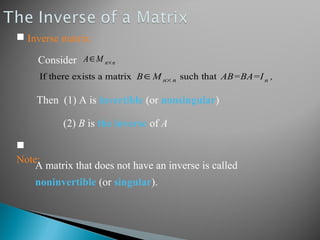
A∈M n×n
If there exists a matrix B∈ M n× n such that AB=BA=In ,

Note:
A matrix that does not have an inverse is called
noninvertible (or singular).
Consider
Then (1) A is invertible (or nonsingular)
(2) B is the inverse of A
 Inverse matrix:
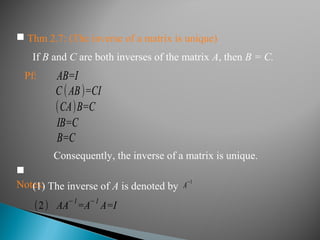
If B and C are both inverses of the matrix A, then B = C.
Pf: AB=I
C (AB)=CI
(CA)B=C
IB=C
B=C
Consequently, the inverse of a matrix is unique.

Notes:(1) The inverse of A is denoted by A
−1
(2) AA
−1
=A
−1
A=I
 Thm 2.7: (The inverse of a matrix is unique)
[A ∣ I ]⃗Gauss-Jordan Elimination [I ∣ A−1
]
 Ex 2: (Find the inverse of the matrix)
A=[ 1 4
−1 −3 ]
Sol:
AX=I
[ 1 4
−1 −3 ][x11 x12
x21 x22
]=[1 0
0 1 ]
[ x11+4x21 x12+4x22
−x11−3x21 −x12−3x22
]=[1 0
0 1 ]
 Find the inverse of a matrix by Gauss-Jordan
Elimination:
(1)⇒[ 1 4 ⋮ 1
−1 −3 ⋮ 0 ]⃗
r12
(1)
, r21
(−4)
[1 0 ⋮ −3
0 1 ⋮ 1 ]
(2)⇒[1 4 ⋮ 0
−1 −3 ⋮ 1 ]⃗
r12
(1)
, r21
(−4)
[1 0 ⋮ −4
0 1 ⋮ 1 ]
⇒ x11=−3, x21=1
⇒ x12=−4, x22=1
X=A−1
=
[x11 x12
x21 x22
]=[−3 −4
1 1 ] ( AX=I=AA-1
)
Thus
⇒
x11 + 4x21 1
−x11 − 3x21 0
(1)
x12 + 4x22 0
−x12 − 3x22 1
(2)
⃗r12
(1)
,r
21
(−4)
[1 0 ⋮ −3 −4
0 1 ⋮ 1 1 ]¿ A I I A−1
¿¿¿
If A can’t be row reduced to I, then A is singular.
 Note:
A=
[1 −1 0
1 0 −1
−6 2 3 ]
⃗R2−R1
[1 −1 0 ⋮ 1 0 0
0 1 −1 ⋮ −1 1 0
−6 2 3 ⋮ 0 0 1]
Sol:
[A ⋮ I ] =
[1 −1 0
1 0 −1
−6 2 3
⋮
⋮
⋮
1 0 0
0 1 0
0 0 1 ]
⃗R3+6R1
[1 −1 0
0 1 −1
0 −4 3
⋮
⋮
⋮
1 0 0
−1 1 0
6 0 1 ]
⃗−R3
[1 −1 0 ⋮ 1 0 0
0 1 −1 ⋮ −1 1 0
0 0 1 ⋮ −2 −4 −1 ]⃗R3+4R2
[1 −1 0 ⋮ 1 0 0
0 1 −1 ⋮ −1 1 0
0 0 −1 ⋮ 2 4 1 ]
 Ex 3: (Find the inverse of the following matrix)
⃗R2+R3
[1 −1 0 ⋮ 1 0 0
0 1 0 ⋮ −3 −3 −1
0 0 1 ⋮ −2 −4 −1 ] ⃗R1+R2
[1 0 0 ⋮ −2 −3 −1
0 1 0 ⋮ −3 −3 −1
0 0 1 ⋮ −1 −4 −1 ]
So the matrix A is invertible, and its inverse is
A−1
=
[−2 −3 −1
−3 −3 −1
−2 −4 −1 ]
= [I ⋮ A−1
]
 Check:
AA−1
=A−1
A=I
(1) A
0
=I
(2) A
k
=AA⋯A⏟
k factors
(k> 0)
(3) Ar
⋅As
=Ar+s
r,s:integers
( A
r
)
s
=A
rs
(4) D=
[
d1 0 ⋯ 0
0 d2 ⋯ 0
⋮ ⋮ ⋱ ⋮
0 0 ⋯ dn
]⇒ Dk
=
[
d1
k
0 ⋯ 0
0 d2
k
⋯ 0
⋮ ⋮ ⋮
0 0 ⋯ dn
k ]
 Power of a square matrix:
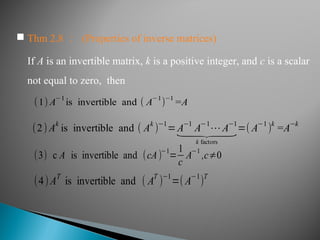
If A is an invertible matrix, k is a positive integer, and c is a scalar
not equal to zero, then
(1) A
−1
is invertible and ( A
−1
)
−1
=A
(2) Ak
is invertible and ( Ak
)−1
=A−1
A−1
⋯A−1
⏟
k factors
=( A−1
)k
=A−k
(3) c A is invertible and (cA)−1
=
1
c
A−1
,c≠0
(4)A
T
is invertible and ( A
T
)
−1
=(A
−1
)
T
 Thm 2.8 : (Properties of inverse matrices)
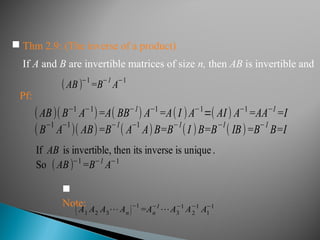
 Thm 2.9: (The inverse of a product)
If A and B are invertible matrices of size n, then AB is invertible and
(AB)
−1
=B
−1
A
−1
If AB is invertible, then its inverse is unique.
So (AB)−1
=B−1
A−1
Pf:
(AB)(B−1
A−1
)=A( BB−1
) A−1
=A(I )A−1
=( AI) A−1
=AA−1
=I
(B
−1
A
−1
)( AB)=B
−1
( A
−1
A)B=B
−1
(I )B=B
−1
( IB)=B
−1
B=I

Note:
(A1 A2 A3⋯An )
−1
=An
−1
⋯A3
−1
A2
−1
A1
−1
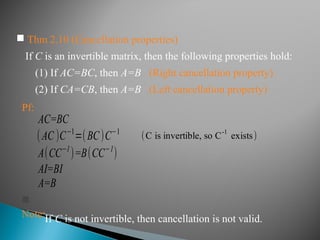
 Thm 2.10 (Cancellation properties)
If C is an invertible matrix, then the following properties hold:
(1) If AC=BC, then A=B (Right cancellation property)
(2) If CA=CB, then A=B (Left cancellation property)
Pf:
AC=BC
(AC )C−1
=(BC)C−1
A(CC−1
)=B(CC−1
)
AI=BI
A=B
(C is invertible, so C
-1
exists)

Note:If C is not invertible, then cancellation is not valid.
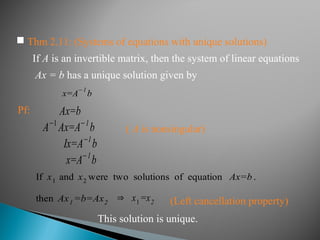
 Thm 2.11: (Systems of equations with unique solutions)
If A is an invertible matrix, then the system of linear equations
Ax = b has a unique solution given by
x=A
−1
b
Pf:
( A is nonsingular)
Ax=b
A−1
Ax=A−1
b
Ix=A−1
b
x=A−1
b
This solution is unique.
If x1 and x2 were two solutions of equation Ax=b .
then Ax1 =b=Ax2
⇒ x1=x2 (Left cancellation property)

Matrices - Mathematics

  • 1.
    MATHS  MATHS   PRESENTATIONPRESENTATION GROUP MEMBERS :DRISHTI (1838) VANDANA (1831) DIMPY(1833)
  • 2.
     Operations withMatrices  Properties of Matrix Operations  The Inverse of a Matrix MATRICES
  • 3.
     Matrix: A=[ aij]= [ a11 a12 a13 ⋯ a1n a21 a22 a23 ⋯ a2n a31 a32 a33 ⋯ a3n ⋮ ⋮ ⋮ ⋮ am1 am2 am3 ⋯ amn ]m×n ∈ M m×n (i, j)-th entry: aij row: m column: n size: m×n
  • 4.
     i-th rowvector ri=[ai1 ai2 ⋯ ain ]  j-th column vector c j= [ c1j c2j ⋮ cmj ] row matrix column matrix  Square matrix: m = n
  • 5.
     Diagonal matrix: A=diag(d1 ,d2 ,⋯ ,dn) = [ d1 0 … 0 0 d2 ⋯ 0 ⋮ ⋮ ⋱ ⋮ 0 0 ⋯ dn ]∈M n×n  Trace: If A=[aij ]n×n Then Tr ( A )=a11 +a22 +⋯+ann
  • 6.
    Ex: A=[1 2 3 45 6 ] = [r1 r2 ] =[c1 c2 c3 ] r1=[1 2 3 ], r2=[4 5 6 ] c1=[1 4], c2=[2 5], c3=[3 6] A=[1 2 3 4 5 6 ] ⇒ ⇒
  • 7.
    If A=[aij ]m×n, B=[bij ]m×n  Equal matrix: Then A=B if and only if aij =bij ∀ 1≤i≤m, 1≤ j≤n  Ex 1: (Equal matrix) A=[1 2 3 4 ] B=[a b c d ] If A=B Then a=1, b=2, c=3, d=4
  • 8.
     Matrix addition: IfA=[aij ]m×n , B=[bij ]m×n Then A+B=[ aij ]m×n +[ bij ]m×n=[ aij +bij ]m×n  Ex 2: (Matrix addition) [−1 2 0 1 ]+[ 1 3 −1 2 ]=[−1+1 2+3 0−1 1+2 ]=[0 5 −1 3 ] [1 −3 −2]+ [−1 3 2 ]= [1−1 −3+3 −2+2] = [0 0 0]
  • 9.
     Matrix subtraction: A−B=A+(−1)B Scalar multiplication: If A=[aij ]m×n , c: scalar  Ex 3: (Scalar multiplication and matrix subtraction) A= [1 2 4 −3 0 −1 2 1 2 ] B= [2 0 0 1 −4 3 −1 3 2 ] Find (a) 3A, (b) –B, (c) 3A – B Then cA=[caij ]m×n
  • 10.
    (a) 3A=3 [1 2 4 −30 −1 2 1 2 ] (b) −B=(−1) [2 0 0 1 −4 3 −1 3 2 ] (c) 3A−B= [3 6 12 −9 0 −3 6 3 6 ]− [2 0 0 1 −4 3 −1 3 2 ] Sol: = [3 6 12 −9 0 −3 6 3 6 ]= [ 3(1) 3(2) 3(4) 3(−3) 3(0) 3(−1) 3(2) 3(1) 3(2) ] = [−2 0 0 −1 4 −3 1 −3 −2 ] = [ 1 6 12 −10 4 −6 7 0 4 ]
  • 11.
     Matrix multiplication: IfA=[aij ]m×n , B=[bij ]n× p Then AB=[ aij ]m×n [bij ]n× p=[cij ]m×p cij=∑ k=1 n aik bkj =ai1 b1j +ai2 b2j+⋯+ain bnj where  Notes: (1) A+B = B+A, (2)AB≠BA Size of AB [ a11 a12 ⋯ a1n ⋮ ⋮ ⋮ ai1 ai2 ⋯ ain ⋮ an1 ⋮ an2 ⋯ ⋮ ann ][ b11 ⋯ b1j ⋯ b1n b21 ⋮ b2j ⋯ b2n ⋮ ⋮ ⋮ ⋮ bn1 ⋯ bnj ⋯ bnn ]= [ci1 ci2 ⋯ cij ⋯ cin ]
  • 12.
    A= [−1 3 4 −2 50 ] B=[−3 2 −4 1 ]  Ex 4: (Find AB) Sol: AB= [ (−1)(−3)+(3)(−4) (−1)(2)+(3)(1) (4)(−3)+(−2)(−4) (4)(2)+(−2)(1) (5)(−3)+(0)(−4) (5)(2)+(0)(1) ] = [−9 1 −4 6 −15 10 ]
  • 13.
     Matrix formof a system of linear equations: { a11 x1 +a12 x2+⋯+a1n xn =b1 a21 x1 +a22 x2+⋯+a2n xn =b2 ⋮ am1 x1 +am2 x2+⋯+amn xn =bm }= = = A x b m linear equations Single matrix equation Ax =b m×nn×1 m×1[ a11 a12 ⋯ a1n a21 a22 ⋯ a2n ⋮ ⋮ ⋮ ⋮ am1 am2 ⋯ amn ][ x1 x2 ⋮ xn ]= [ b1 b2 ⋮ bm ] ⇓
  • 14.
     Partitioned matrices: A= [ a11a12 a13 a14 a21 a22 a23 a24 a31 a32 a33 a34 ]= [A11 A12 A21 A22 ] submatrix A= [ a11 a12 a13 a14 a21 a22 a23 a24 a31 a32 a33 a34 ]= [ r1 r2 r3 ] A= [ a11 a12 a13 a14 a21 a22 a23 a24 a31 a32 a33 a34 ]=[c1 c2 c3 c4 ]
  • 15.
     Three basicmatrix operators: (1) matrix addition (2) scalar multiplication (3) matrix multiplication  Zero matrix: 0m×n  Identity matrix of order n: I n
  • 16.
    Then (1) A+B= B + A (2) A + ( B + C ) = ( A + B ) + C (3) ( cd ) A = c ( dA ) (4) 1A = A (5) c( A+B ) = cA + cB (6) ( c+d ) A = cA + dA If A,B,C ∈M m×n , c,d :scalar  Properties of matrix addition and scalar multiplication:
  • 17.
    If A∈Mm×n ,c :scalar Then (1) A+0m×n =A (2) A+(− A)=0m×n (3) cA=0m×n ⇒ c= 0 or A= 0m× n  Notes: (1) 0m×n: the additive identity for the set of all m×n matrices (2) –A: the additive inverse of A  Properties of zero matrices:
  • 18.
    If A= [ a11 a12⋯ a1n a21 a22 ⋯ a2n ⋮ ⋮ ⋮ ⋮ am1 am2 ⋯ amn ]∈M m×n Then AT = [ a11 a21 ⋯ am1 a12 a22 ⋯ am2 ⋮ ⋮ ⋮ ⋮ a1n a2n ⋯ amn ]∈ M n×m  Transpose of a matrix : Transpose is the interchange of rows and columns of a given matrix.
  • 19.
    A=[2 8] (b) A= [12 3 4 5 6 7 8 9 ] (c ) A= [0 1 2 4 1 −1] Sol: (a) A=[2 8] ⇒ A T =[2 8 ] (b) A= [1 2 3 4 5 6 7 8 9 ] ⇒ AT = [1 4 7 2 5 8 3 6 9 ](c ) A= [0 1 2 4 1 −1] ⇒ AT =[0 2 1 1 4 −1] (a)  Ex 8: (Find the transpose of the following matrix)
  • 20.
    (1) ( A T ) T =A (2) ( A+B) T =A T +B T (3) (cA)T =c ( AT ) (4 ) ( AB ) T =B T A T  Properties of transposes
  • 21.
    A square matrixA is symmetric if A = AT  Ex: If A= [1 2 3 a 4 5 b c 6 ] is symmetric, find a, b, c? A square matrix A is skew-symmetric if AT = –A  Skew-symmetric matrix: Sol: A= [1 2 3 a 4 5 b c 6 ] AT = [1 a b 2 4 c 3 5 6 ] a= 2,b= 3,c= 5 A=A T ⇒  Symmetric matrix:
  • 22.
    If A= [0 12 a 0 3 b c 0 ] is a skew-symmetric, find a, b, c?  Note: AAT is symmetric Pf: (AAT )T =( AT )T AT =AAT AA∴ T is symmetric Sol: A= [0 1 2 a 0 3 b c 0 ] −AT = [0 −a −b −1 0 −c −2 −3 0 ] A=−A T a=−1,b=−2,c=−3⇒  Ex:
  • 23.
    ab = ba(Commutative law for multiplication) (1)If m≠ p, then AB is defined ,BA is undefined . (3)If m=p=n,then AB∈M m×m ,BA∈ M m×m (2)If m=p, m≠n, then AB∈M m×m ,BA∈ M n×n (Sizes are not the same) (Sizes are the same, but matrices are not equal)  Real number:  Matrix: AB≠BA m×nn× p Three situations:
  • 24.
    A=[1 3 2 −1]B=[2 −1 0 2 ] Sol: AB=[1 3 2 −1 ][2 −1 0 2 ]=[2 5 4 −4 ]  Note: AB≠BA BA=[2 −1 0 2 ][1 3 2 −1]=[0 7 4 −2 ]  Ex 4: Sow that AB and BA are not equal for the matrices. and
  • 25.
    (Cancellation is not valid) ac=bc,c≠0 ⇒ a=b (Cancellation law)  Matrix: AC=BC C ≠0 (1) If C is invertible, then A = B  Real number: A≠B(2) If C is not invertible, then
  • 26.
    26 /61 A=[1 3 0 1], B=[2 4 2 3 ], C=[ 1 −2 −1 2 ] Sol: AC=[1 3 0 1 ][ 1 −2 −1 2 ]=[−2 4 −1 2 ] So AC=BC But A≠B BC=[2 4 2 3 ][ 1 −2 −1 2 ]=[−2 4 −1 2 ]  Ex 5: (An example in which cancellation is not valid) Show that AC=BC Elementary Linear Algebra: Section 2.2, p.65
  • 27.
    A∈M n×n If thereexists a matrix B∈ M n× n such that AB=BA=In ,  Note: A matrix that does not have an inverse is called noninvertible (or singular). Consider Then (1) A is invertible (or nonsingular) (2) B is the inverse of A  Inverse matrix:
  • 28.
    If B andC are both inverses of the matrix A, then B = C. Pf: AB=I C (AB)=CI (CA)B=C IB=C B=C Consequently, the inverse of a matrix is unique.  Notes:(1) The inverse of A is denoted by A −1 (2) AA −1 =A −1 A=I  Thm 2.7: (The inverse of a matrix is unique)
  • 29.
    [A ∣ I]⃗Gauss-Jordan Elimination [I ∣ A−1 ]  Ex 2: (Find the inverse of the matrix) A=[ 1 4 −1 −3 ] Sol: AX=I [ 1 4 −1 −3 ][x11 x12 x21 x22 ]=[1 0 0 1 ] [ x11+4x21 x12+4x22 −x11−3x21 −x12−3x22 ]=[1 0 0 1 ]  Find the inverse of a matrix by Gauss-Jordan Elimination:
  • 30.
    (1)⇒[ 1 4⋮ 1 −1 −3 ⋮ 0 ]⃗ r12 (1) , r21 (−4) [1 0 ⋮ −3 0 1 ⋮ 1 ] (2)⇒[1 4 ⋮ 0 −1 −3 ⋮ 1 ]⃗ r12 (1) , r21 (−4) [1 0 ⋮ −4 0 1 ⋮ 1 ] ⇒ x11=−3, x21=1 ⇒ x12=−4, x22=1 X=A−1 = [x11 x12 x21 x22 ]=[−3 −4 1 1 ] ( AX=I=AA-1 ) Thus ⇒ x11 + 4x21 1 −x11 − 3x21 0 (1) x12 + 4x22 0 −x12 − 3x22 1 (2)
  • 31.
    ⃗r12 (1) ,r 21 (−4) [1 0 ⋮−3 −4 0 1 ⋮ 1 1 ]¿ A I I A−1 ¿¿¿ If A can’t be row reduced to I, then A is singular.  Note:
  • 32.
    A= [1 −1 0 10 −1 −6 2 3 ] ⃗R2−R1 [1 −1 0 ⋮ 1 0 0 0 1 −1 ⋮ −1 1 0 −6 2 3 ⋮ 0 0 1] Sol: [A ⋮ I ] = [1 −1 0 1 0 −1 −6 2 3 ⋮ ⋮ ⋮ 1 0 0 0 1 0 0 0 1 ] ⃗R3+6R1 [1 −1 0 0 1 −1 0 −4 3 ⋮ ⋮ ⋮ 1 0 0 −1 1 0 6 0 1 ] ⃗−R3 [1 −1 0 ⋮ 1 0 0 0 1 −1 ⋮ −1 1 0 0 0 1 ⋮ −2 −4 −1 ]⃗R3+4R2 [1 −1 0 ⋮ 1 0 0 0 1 −1 ⋮ −1 1 0 0 0 −1 ⋮ 2 4 1 ]  Ex 3: (Find the inverse of the following matrix)
  • 33.
    ⃗R2+R3 [1 −1 0⋮ 1 0 0 0 1 0 ⋮ −3 −3 −1 0 0 1 ⋮ −2 −4 −1 ] ⃗R1+R2 [1 0 0 ⋮ −2 −3 −1 0 1 0 ⋮ −3 −3 −1 0 0 1 ⋮ −1 −4 −1 ] So the matrix A is invertible, and its inverse is A−1 = [−2 −3 −1 −3 −3 −1 −2 −4 −1 ] = [I ⋮ A−1 ]  Check: AA−1 =A−1 A=I
  • 34.
    (1) A 0 =I (2) A k =AA⋯A⏟ kfactors (k> 0) (3) Ar ⋅As =Ar+s r,s:integers ( A r ) s =A rs (4) D= [ d1 0 ⋯ 0 0 d2 ⋯ 0 ⋮ ⋮ ⋱ ⋮ 0 0 ⋯ dn ]⇒ Dk = [ d1 k 0 ⋯ 0 0 d2 k ⋯ 0 ⋮ ⋮ ⋮ 0 0 ⋯ dn k ]  Power of a square matrix:
  • 35.
    If A isan invertible matrix, k is a positive integer, and c is a scalar not equal to zero, then (1) A −1 is invertible and ( A −1 ) −1 =A (2) Ak is invertible and ( Ak )−1 =A−1 A−1 ⋯A−1 ⏟ k factors =( A−1 )k =A−k (3) c A is invertible and (cA)−1 = 1 c A−1 ,c≠0 (4)A T is invertible and ( A T ) −1 =(A −1 ) T  Thm 2.8 : (Properties of inverse matrices)
  • 36.
     Thm 2.9:(The inverse of a product) If A and B are invertible matrices of size n, then AB is invertible and (AB) −1 =B −1 A −1 If AB is invertible, then its inverse is unique. So (AB)−1 =B−1 A−1 Pf: (AB)(B−1 A−1 )=A( BB−1 ) A−1 =A(I )A−1 =( AI) A−1 =AA−1 =I (B −1 A −1 )( AB)=B −1 ( A −1 A)B=B −1 (I )B=B −1 ( IB)=B −1 B=I  Note: (A1 A2 A3⋯An ) −1 =An −1 ⋯A3 −1 A2 −1 A1 −1
  • 37.
     Thm 2.10(Cancellation properties) If C is an invertible matrix, then the following properties hold: (1) If AC=BC, then A=B (Right cancellation property) (2) If CA=CB, then A=B (Left cancellation property) Pf: AC=BC (AC )C−1 =(BC)C−1 A(CC−1 )=B(CC−1 ) AI=BI A=B (C is invertible, so C -1 exists)  Note:If C is not invertible, then cancellation is not valid.
  • 38.
     Thm 2.11:(Systems of equations with unique solutions) If A is an invertible matrix, then the system of linear equations Ax = b has a unique solution given by x=A −1 b Pf: ( A is nonsingular) Ax=b A−1 Ax=A−1 b Ix=A−1 b x=A−1 b This solution is unique. If x1 and x2 were two solutions of equation Ax=b . then Ax1 =b=Ax2 ⇒ x1=x2 (Left cancellation property)