NON INVASIVE
VENTILATION (
NIV)
Mohammad Rezaei, MD
Pediatric Pulmonologist
VENTILATORY SUPPORT
Invasive
Non Invasive
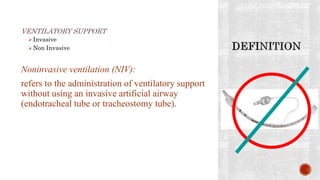
Noninvasive ventilation (NIV):
refers to the administration of ventilatory support
without using an invasive artificial airway
(endotracheal tube or tracheostomy tube).
 An unknown philosopher stated “The lungs
are the center of the universe and the seat of
the soul”.
 The earliest reference for attempts to restore
breathing was about 3150 BC when
Egyptian physicians tried to save drowned
victims by placing a reed in the throat and
blowing into the lungs . The Chinese in 2000
BC described lien ch’i, as a transfer of
inspired air into the “soul” (life): mouth
positive pressure.
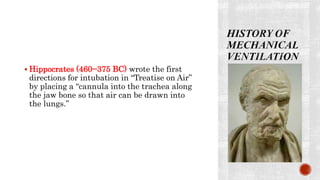
 Hippocrates (460−375 BC) wrote the first
directions for intubation in “Treatise on Air”
by placing a “cannula into the trachea along
the jaw bone so that air can be drawn into
the lungs.”
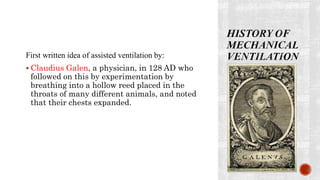
First written idea of assisted ventilation by:
 Claudius Galen, a physician, in 128 AD who
followed on this by experimentation by
breathing into a hollow reed placed in the
throats of many different animals, and noted
that their chests expanded.
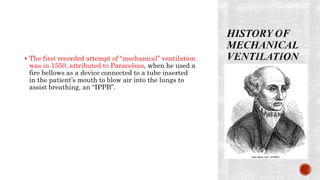
 The first recorded attempt of “mechanical” ventilation
was in 1550, attributed to Paracelsus, when he used a
fire bellows as a device connected to a tube inserted
in the patient’s mouth to blow air into the lungs to
assist breathing, an “IPPB”.
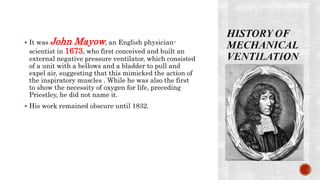
 It was John Mayow, an English physician-
scientist in 1673, who first conceived and built an
external negative pressure ventilator, which consisted
of a unit with a bellows and a bladder to pull and
expel air, suggesting that this mimicked the action of
the inspiratory muscles . While he was also the first
to show the necessity of oxygen for life, preceding
Priestley, he did not name it.
 His work remained obscure until 1832.
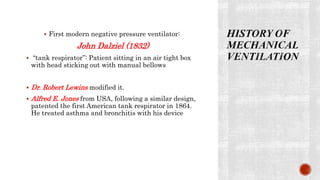
 First modern negative pressure ventilator:
John Dalziel (1832)
 “tank respirator”: Patient sitting in an air tight box
with head sticking out with manual bellows
 Dr. Robert Lewins modified it.
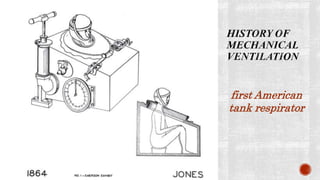
 Alfred E. Jones from USA, following a similar design,
patented the first American tank respirator in 1864.
He treated asthma and bronchitis with his device
first American
tank respirator
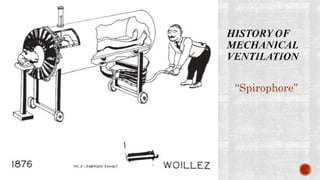
“Spirophore”
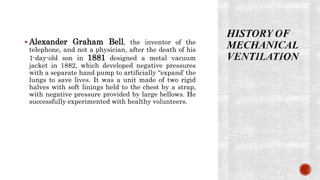
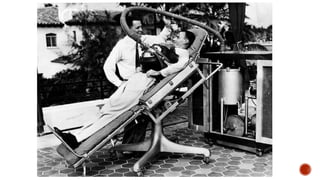
 Alexander Graham Bell, the inventor of the
telephone, and not a physician, after the death of his
1-day-old son in 1881 designed a metal vacuum
jacket in 1882, which developed negative pressures
with a separate hand pump to artificially “expand’ the
lungs to save lives. It was a unit made of two rigid
halves with soft linings held to the chest by a strap,
with negative pressure provided by large bellows. He
successfully experimented with healthy volunteers.
The first widely used negative pressure ventilator:
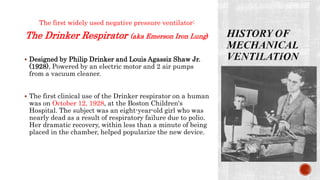
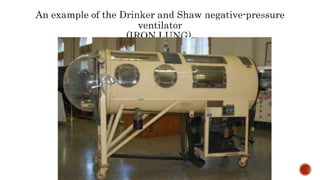
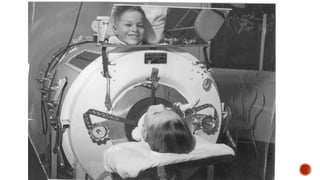
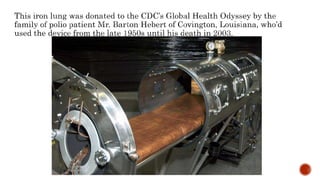
The Drinker Respirator (aka Emerson Iron Lung)
 Designed by Philip Drinker and Louis Agassiz Shaw Jr.
(1928), Powered by an electric motor and 2 air pumps
from a vacuum cleaner.
 The first clinical use of the Drinker respirator on a human
was on October 12, 1928, at the Boston Children's
Hospital. The subject was an eight-year-old girl who was
nearly dead as a result of respiratory failure due to polio.
Her dramatic recovery, within less than a minute of being
placed in the chamber, helped popularize the new device.
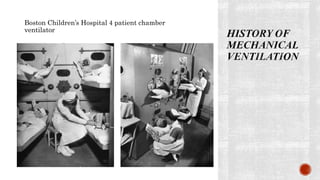
Boston Children’s Hospital 4 patient chamber
ventilator
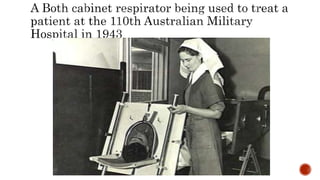
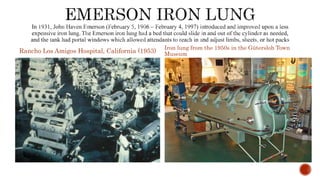
Rancho Los Amigos Hospital, California (1953)
Iron lung from the 1950s in the Gütersloh Town
Museum
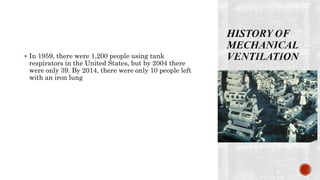
 In 1959, there were 1,200 people using tank
respirators in the United States, but by 2004 there
were only 39. By 2014, there were only 10 people left
with an iron lung
Movement away from negative pressure devices (1960s)
 Large, taking up much space, difficult to access patient
 No PEEP
 Significant leakage leading to patient cooling
 “Tank shock” – blood pooling in abdomen and lower
extremities
 they were used for the first time in Blegdams
Hospital, Copenhagen, Denmark, during a polio
outbreak in 1952.[It proved a success and soon
superseded the iron lung throughout Europe.
 are now more common than negative pressure
systems.
Positive
pressure
ventilation
 In 1980sit was recognized that delivery of
continuous positive airway pressure by close fitting
nasal masks for treatment of obstructive sleep apnea
could also be used to deliver an intermittent positive
pressure
NIPPV
 Decreased incidence of nosocomial infections
 Improves patient comfort
 Minimal sedation requirement
 Less painful
 Accelerates weaning
 decreased ICU length of stay, mortality
 Decreased costs
Potential
Benefits
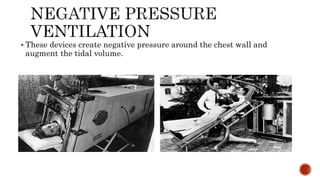
 Negative pressure (NNPV):
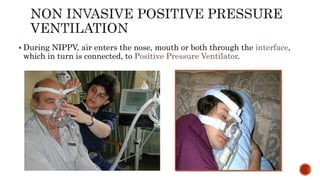
 Positive pressure (NIPPV): TECHNIQUES
OF
APPLICATION
 These devices create negative pressure around the chest wall and
augment the tidal volume.
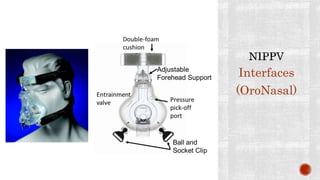
 During NIPPV, air enters the nose, mouth or both through the interface,
which in turn is connected, to Positive Pressure Ventilator.
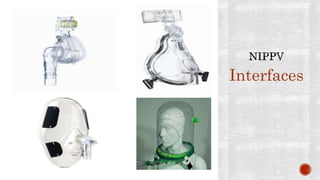
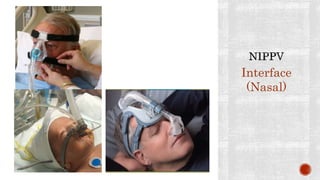
Interfaces
Interface
(Nasal)
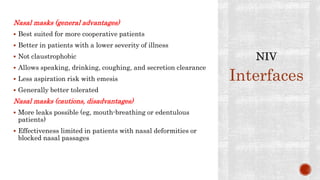
Nasal masks (general advantages)
 Best suited for more cooperative patients
 Better in patients with a lower severity of illness
 Not claustrophobic
 Allows speaking, drinking, coughing, and secretion clearance
 Less aspiration risk with emesis
 Generally better tolerated
Nasal masks (cautions, disadvantages)
 More leaks possible (eg, mouth-breathing or edentulous
patients)
 Effectiveness limited in patients with nasal deformities or
blocked nasal passages
Interfaces
Interfaces
(OroNasal)
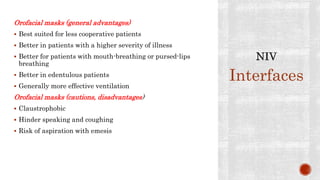
Orofacial masks (general advantages)
 Best suited for less cooperative patients
 Better in patients with a higher severity of illness
 Better for patients with mouth-breathing or pursed-lips
breathing
 Better in edentulous patients
 Generally more effective ventilation
Orofacial masks (cautions, disadvantages)
 Claustrophobic
 Hinder speaking and coughing
 Risk of aspiration with emesis
Interfaces
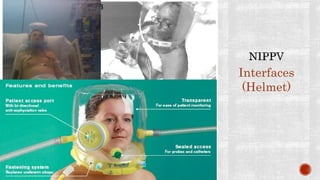
Interfaces
(Helmet)
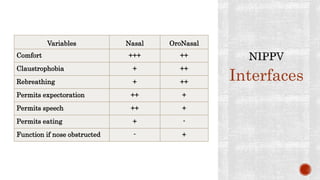
Interfaces
Variables Nasal OroNasal
Comfort +++ ++
Claustrophobia + ++
Rebreathing + ++
Permits expectoration ++ +
Permits speech ++ +
Permits eating + -
Function if nose obstructed - +
INTERFACE
S
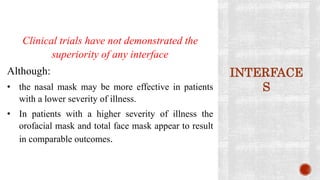
Clinical trials have not demonstrated the
superiority of any interface
Although:
• the nasal mask may be more effective in patients
with a lower severity of illness.
• In patients with a higher severity of illness the
orofacial mask and total face mask appear to result
in comparable outcomes.
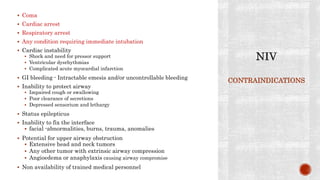
 Coma
 Cardiac arrest
 Respiratory arrest
 Any condition requiring immediate intubation
 Cardiac instability
 Shock and need for pressor support
 Ventricular dysrhythmias
 Complicated acute myocardial infarction
 GI bleeding - Intractable emesis and/or uncontrollable bleeding
 Inability to protect airway
 Impaired cough or swallowing
 Poor clearance of secretions
 Depressed sensorium and lethargy
 Status epilepticus
 Inability to fix the interface
 facial -abnormalities, burns, trauma, anomalies
 Potential for upper airway obstruction
 Extensive head and neck tumors
 Any other tumor with extrinsic airway compression
 Angioedema or anaphylaxis causing airway compromise
 Non availability of trained medical personnel
CONTRAINDICATIONS
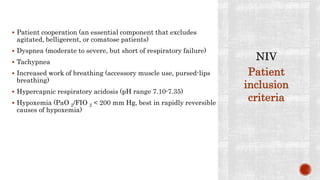
 Patient cooperation (an essential component that excludes
agitated, belligerent, or comatose patients)
 Dyspnea (moderate to severe, but short of respiratory failure)
 Tachypnea
 Increased work of breathing (accessory muscle use, pursed-lips
breathing)
 Hypercapnic respiratory acidosis (pH range 7.10-7.35)
 Hypoxemia (PaO 2/FIO 2 < 200 mm Hg, best in rapidly reversible
causes of hypoxemia)
Patient
inclusion
criteria
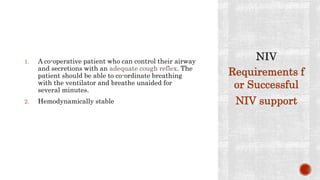
1. A co-operative patient who can control their airway
and secretions with an adequate cough reflex. The
patient should be able to co-ordinate breathing
with the ventilator and breathe unaided for
several minutes.
2. Hemodynamically stable
Requirements f
or Successful
NIV support
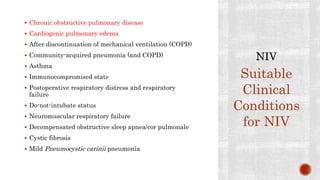
 Chronic obstructive pulmonary disease
 Cardiogenic pulmonary edema
 After discontinuation of mechanical ventilation (COPD)
 Community-acquired pneumonia (and COPD)
 Asthma
 Immunocompromised state
 Postoperative respiratory distress and respiratory
failure
 Do-not-intubate status
 Neuromuscular respiratory failure
 Decompensated obstructive sleep apnea/cor pulmonale
 Cystic fibrosis
 Mild Pneumocystic carinii pneumonia
Suitable
Clinical
Conditions
for NIV
Volume ventilator
Pressure-controlled
Choosing the initial mode of ventilation is based on:
past experience
capability of ventilators available
condition being treated
Modes of
ventilation
 Controlled mechanical ventilation:
 No patient effort
 Referred as Timed (T) mode
 Similar to PCV
 Assist mode:
 Ventilatory support to patients effort. No backup
 Referred to spont. (S) mode
 Similar to PSV
 Assist control ventilation:
 Ventilatory support in response to pt. effort and backup safety
rate if pt. does not trigger
 Referred as spontaneous/timed (S/T) mode
 Similar to PS with apnea backup with PC breaths
Modes of
ventilation
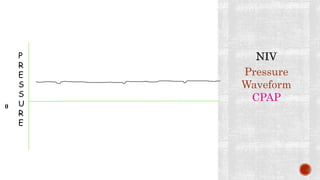
 CPAP:
 A constant pressure is applied to airway throughout the cycle
 Used primarily to correct hypoxemia
 Not a ventilatory mode
 Main indication- cardiogenic pulmonary edema, OSA, …
Modes of
ventilation
 Proportional Assist Ventilation (PAV)
 By instantaneously tracking patient inspiratory flow
and its integral (volume) using an in-line
pneumotochograph, this mode has the capability of
responding rapidly to the patient’s ventilatory effort.
 By adjusting the gain on the flow and volume signals,
one can select the proportion of breathing work that is
to be assisted.
Modes of
ventilation
Other Modes of Noninvasive Ventilatory
Assistance
Modes of
ventilation
Most patients who are provided noninvasive
ventilation are provided support with pressure
ventilation, with continuous positive airway
pressure (CPAP), which is the most basic level of
support.
CPAP may be especially useful in patients with
congestive heart failure or obstructive sleep apnea
Modes of
ventilation
Pressure
Waveform
CPAP
0
P
R
E
S
S
U
R
E
Bilevel positive airway pressure (BiPAP) is
probably the most common mode noninvasive
positive pressure ventilation and requires
provisions for inspiratory positive airway pressure
(IPAP) and expiratory positive airway pressure
(EPAP).
The difference between IPAP and EPAP is a
reflection of the amount of pressure support
ventilation provided to the patient, and EPAP is
synonymous with positive end-expiratory pressure
(PEEP).
Modes of
ventilation
Bi-PAP and
Changes in
EPAP Pressure
5 cm
Delta P 10 cm
10 cm
15 cm
Delta pressure 5
cm
EPAP increased to 10 cm
IPAP increased to 20 cm
Delta P returned to 10 cm
P
R
E
S
S
U
R
E
Decreasing delta pressure will usually result in lower Vt
recognize that certain parameters may predict successful
noninvasive ventilation or failure of noninvasive ventilation.
 reflection of the patient's ability to cooperate with noninvasive
ventilation,
 patient-ventilatory synchrony,
 noninvasive ventilation effectiveness
Trials of noninvasive ventilation are usually 1-2
hours in length and are useful to determine if a
patient can be treated with noninvasive ventilation.
Extended trials without significant improvement are not
recommended because this only delays intubation and mechanical
ventilation
Predictors of
successful
noninvasive
ventilation
Predictors of success - Response to trial of NIV (1-2 h)
 Decrease in PaCO2 greater than 8 mm Hg
 Improvement in pH greater than 0.06
 Correction of respiratory acidosis
Predictors of
successful
noninvasive
ventilation
failure to NIV
 No improvement in gas exchange or dyspnea
progressively increases
 Deterioration or no change in the mental condition of
the hypercapnic patients
 Need for airway protection
 Hemodynamic instability
 Fresh MI or arrhythmias
 Patient unable to tolerate the mask
When to
intubate
during
NIV???
 Facial and nasal pressure injury and sores
 Result of tight mask seals used to attain adequate inspiratory volumes
 Minimize pressure by intermittent application of noninvasive ventilation
 Schedule breaks (30-90 min) to minimize effects of mask pressure
 Balance strap tension to minimize mask leaks without excessive mask
pressures
 Cover vulnerable areas (erythematous points of contact) with protective
dressings
 Gastric distension
 Rarely a problem
 Avoid by limiting peak inspiratory pressures to less than 25 cm water
 Nasogastric tubes can be placed but can worsen leaks from the mask
 Nasogastric tube also bypasses the lower esophageal sphincter and permits
reflux
 Dry mucous membranes and thick secretions
 Seen in patients with extended use of noninvasive ventilation
 Provide humidification for noninvasive ventilation devices
 Provide daily oral care
 Aspiration of gastric contents
 Especially if emesis during noninvasive ventilation
 Avoid noninvasive ventilation in patient with ongoing emesis or hematemesis
Complications
of Noninvasive
Ventilation
Complications of both noninvasive and invasive ventilation
 Barotrauma (significantly less risk with noninvasive
ventilation)
 Hypotension related to positive intrathoracic pressure
(support with fluids)
Complications
of Noninvasive
Ventilation
Complications Avoided by Noninvasive Ventilation
 Ventilator-associated pneumonia
 Sinusitis
 Reduction in need for sedative agents - Sedatives used in less
than 15% of noninvasive ventilation patients in one survey
Complications
Avoided by
Noninvasive
Ventilation
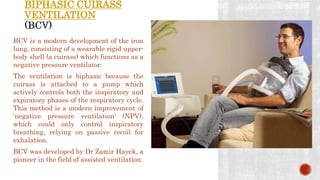
BIPHASIC CUIRASS
VENTILATION
BCV is a modern development of the iron
lung, consisting of a wearable rigid upper-
body shell (a cuirass) which functions as a
negative pressure ventilator.
The ventilation is biphasic because the
cuirass is attached to a pump which
actively controls both the inspiratory and
expiratory phases of the respiratory cycle.
This method is a modern improvement of
'negative pressure ventilation' (NPV),
which could only control inspiratory
breathing, relying on passive recoil for
exhalation.
BCV was developed by Dr Zamir Hayek, a
pioneer in the field of assisted ventilation.
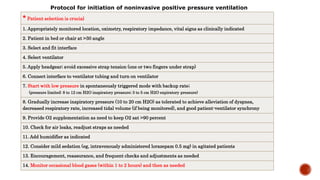
* Patient selection is crucial
1. Appropriately monitored location, oximetry, respiratory impedance, vital signs as clinically indicated
2. Patient in bed or chair at >30 angle
3. Select and fit interface
4. Select ventilator
5. Apply headgear; avoid excessive strap tension (one or two fingers under strap)
6. Connect interface to ventilator tubing and turn on ventilator
7. Start with low pressure in spontaneously triggered mode with backup rate;
(pressure limited: 8 to 12 cm H2O inspiratory pressure; 3 to 5 cm H2O expiratory pressure)
8. Gradually increase inspiratory pressure (10 to 20 cm H2O) as tolerated to achieve alleviation of dyspnea,
decreased respiratory rate, increased tidal volume (if being monitored), and good patient-ventilator synchrony
9. Provide O2 supplementation as need to keep O2 sat >90 percent
10. Check for air leaks, readjust straps as needed
11. Add humidifier as indicated
12. Consider mild sedation (eg, intravenously administered lorazepam 0.5 mg) in agitated patients
13. Encouragement, reassurance, and frequent checks and adjustments as needed
14. Monitor occasional blood gases (within 1 to 2 hours) and then as needed
Protocol for initiation of noninvasive positive pressure ventilation
THANK YOU FOR YOUR ATTENTION

NIV (Non Invasive Mechanical Ventilation)

  • 1.
    NON INVASIVE VENTILATION ( NIV) MohammadRezaei, MD Pediatric Pulmonologist
  • 2.
    VENTILATORY SUPPORT Invasive Non Invasive Noninvasiveventilation (NIV): refers to the administration of ventilatory support without using an invasive artificial airway (endotracheal tube or tracheostomy tube).
  • 4.
     An unknownphilosopher stated “The lungs are the center of the universe and the seat of the soul”.  The earliest reference for attempts to restore breathing was about 3150 BC when Egyptian physicians tried to save drowned victims by placing a reed in the throat and blowing into the lungs . The Chinese in 2000 BC described lien ch’i, as a transfer of inspired air into the “soul” (life): mouth positive pressure.
  • 5.
     Hippocrates (460−375BC) wrote the first directions for intubation in “Treatise on Air” by placing a “cannula into the trachea along the jaw bone so that air can be drawn into the lungs.”
  • 6.
    First written ideaof assisted ventilation by:  Claudius Galen, a physician, in 128 AD who followed on this by experimentation by breathing into a hollow reed placed in the throats of many different animals, and noted that their chests expanded.
  • 7.
     The firstrecorded attempt of “mechanical” ventilation was in 1550, attributed to Paracelsus, when he used a fire bellows as a device connected to a tube inserted in the patient’s mouth to blow air into the lungs to assist breathing, an “IPPB”.
  • 8.
     It wasJohn Mayow, an English physician- scientist in 1673, who first conceived and built an external negative pressure ventilator, which consisted of a unit with a bellows and a bladder to pull and expel air, suggesting that this mimicked the action of the inspiratory muscles . While he was also the first to show the necessity of oxygen for life, preceding Priestley, he did not name it.  His work remained obscure until 1832.
  • 9.
     First modernnegative pressure ventilator: John Dalziel (1832)  “tank respirator”: Patient sitting in an air tight box with head sticking out with manual bellows  Dr. Robert Lewins modified it.  Alfred E. Jones from USA, following a similar design, patented the first American tank respirator in 1864. He treated asthma and bronchitis with his device
  • 10.
  • 11.
  • 12.
     Alexander GrahamBell, the inventor of the telephone, and not a physician, after the death of his 1-day-old son in 1881 designed a metal vacuum jacket in 1882, which developed negative pressures with a separate hand pump to artificially “expand’ the lungs to save lives. It was a unit made of two rigid halves with soft linings held to the chest by a strap, with negative pressure provided by large bellows. He successfully experimented with healthy volunteers.
  • 13.
    The first widelyused negative pressure ventilator: The Drinker Respirator (aka Emerson Iron Lung)  Designed by Philip Drinker and Louis Agassiz Shaw Jr. (1928), Powered by an electric motor and 2 air pumps from a vacuum cleaner.  The first clinical use of the Drinker respirator on a human was on October 12, 1928, at the Boston Children's Hospital. The subject was an eight-year-old girl who was nearly dead as a result of respiratory failure due to polio. Her dramatic recovery, within less than a minute of being placed in the chamber, helped popularize the new device.
  • 15.
    Boston Children’s Hospital4 patient chamber ventilator
  • 17.
    Rancho Los AmigosHospital, California (1953) Iron lung from the 1950s in the Gütersloh Town Museum
  • 21.
     In 1959,there were 1,200 people using tank respirators in the United States, but by 2004 there were only 39. By 2014, there were only 10 people left with an iron lung
  • 22.
    Movement away fromnegative pressure devices (1960s)  Large, taking up much space, difficult to access patient  No PEEP  Significant leakage leading to patient cooling  “Tank shock” – blood pooling in abdomen and lower extremities
  • 23.
     they wereused for the first time in Blegdams Hospital, Copenhagen, Denmark, during a polio outbreak in 1952.[It proved a success and soon superseded the iron lung throughout Europe.  are now more common than negative pressure systems. Positive pressure ventilation
  • 24.
     In 1980sitwas recognized that delivery of continuous positive airway pressure by close fitting nasal masks for treatment of obstructive sleep apnea could also be used to deliver an intermittent positive pressure NIPPV
  • 26.
     Decreased incidenceof nosocomial infections  Improves patient comfort  Minimal sedation requirement  Less painful  Accelerates weaning  decreased ICU length of stay, mortality  Decreased costs Potential Benefits
  • 27.
     Negative pressure(NNPV):  Positive pressure (NIPPV): TECHNIQUES OF APPLICATION
  • 28.
     These devicescreate negative pressure around the chest wall and augment the tidal volume.
  • 29.
     During NIPPV,air enters the nose, mouth or both through the interface, which in turn is connected, to Positive Pressure Ventilator.
  • 30.
  • 31.
  • 32.
    Nasal masks (generaladvantages)  Best suited for more cooperative patients  Better in patients with a lower severity of illness  Not claustrophobic  Allows speaking, drinking, coughing, and secretion clearance  Less aspiration risk with emesis  Generally better tolerated Nasal masks (cautions, disadvantages)  More leaks possible (eg, mouth-breathing or edentulous patients)  Effectiveness limited in patients with nasal deformities or blocked nasal passages Interfaces
  • 33.
  • 34.
    Orofacial masks (generaladvantages)  Best suited for less cooperative patients  Better in patients with a higher severity of illness  Better for patients with mouth-breathing or pursed-lips breathing  Better in edentulous patients  Generally more effective ventilation Orofacial masks (cautions, disadvantages)  Claustrophobic  Hinder speaking and coughing  Risk of aspiration with emesis Interfaces
  • 35.
  • 36.
    Interfaces Variables Nasal OroNasal Comfort+++ ++ Claustrophobia + ++ Rebreathing + ++ Permits expectoration ++ + Permits speech ++ + Permits eating + - Function if nose obstructed - +
  • 37.
    INTERFACE S Clinical trials havenot demonstrated the superiority of any interface Although: • the nasal mask may be more effective in patients with a lower severity of illness. • In patients with a higher severity of illness the orofacial mask and total face mask appear to result in comparable outcomes.
  • 38.
     Coma  Cardiacarrest  Respiratory arrest  Any condition requiring immediate intubation  Cardiac instability  Shock and need for pressor support  Ventricular dysrhythmias  Complicated acute myocardial infarction  GI bleeding - Intractable emesis and/or uncontrollable bleeding  Inability to protect airway  Impaired cough or swallowing  Poor clearance of secretions  Depressed sensorium and lethargy  Status epilepticus  Inability to fix the interface  facial -abnormalities, burns, trauma, anomalies  Potential for upper airway obstruction  Extensive head and neck tumors  Any other tumor with extrinsic airway compression  Angioedema or anaphylaxis causing airway compromise  Non availability of trained medical personnel CONTRAINDICATIONS
  • 39.
     Patient cooperation(an essential component that excludes agitated, belligerent, or comatose patients)  Dyspnea (moderate to severe, but short of respiratory failure)  Tachypnea  Increased work of breathing (accessory muscle use, pursed-lips breathing)  Hypercapnic respiratory acidosis (pH range 7.10-7.35)  Hypoxemia (PaO 2/FIO 2 < 200 mm Hg, best in rapidly reversible causes of hypoxemia) Patient inclusion criteria
  • 40.
    1. A co-operativepatient who can control their airway and secretions with an adequate cough reflex. The patient should be able to co-ordinate breathing with the ventilator and breathe unaided for several minutes. 2. Hemodynamically stable Requirements f or Successful NIV support
  • 41.
     Chronic obstructivepulmonary disease  Cardiogenic pulmonary edema  After discontinuation of mechanical ventilation (COPD)  Community-acquired pneumonia (and COPD)  Asthma  Immunocompromised state  Postoperative respiratory distress and respiratory failure  Do-not-intubate status  Neuromuscular respiratory failure  Decompensated obstructive sleep apnea/cor pulmonale  Cystic fibrosis  Mild Pneumocystic carinii pneumonia Suitable Clinical Conditions for NIV
  • 42.
    Volume ventilator Pressure-controlled Choosing theinitial mode of ventilation is based on: past experience capability of ventilators available condition being treated Modes of ventilation
  • 43.
     Controlled mechanicalventilation:  No patient effort  Referred as Timed (T) mode  Similar to PCV  Assist mode:  Ventilatory support to patients effort. No backup  Referred to spont. (S) mode  Similar to PSV  Assist control ventilation:  Ventilatory support in response to pt. effort and backup safety rate if pt. does not trigger  Referred as spontaneous/timed (S/T) mode  Similar to PS with apnea backup with PC breaths Modes of ventilation
  • 44.
     CPAP:  Aconstant pressure is applied to airway throughout the cycle  Used primarily to correct hypoxemia  Not a ventilatory mode  Main indication- cardiogenic pulmonary edema, OSA, … Modes of ventilation
  • 45.
     Proportional AssistVentilation (PAV)  By instantaneously tracking patient inspiratory flow and its integral (volume) using an in-line pneumotochograph, this mode has the capability of responding rapidly to the patient’s ventilatory effort.  By adjusting the gain on the flow and volume signals, one can select the proportion of breathing work that is to be assisted. Modes of ventilation
  • 46.
    Other Modes ofNoninvasive Ventilatory Assistance Modes of ventilation
  • 47.
    Most patients whoare provided noninvasive ventilation are provided support with pressure ventilation, with continuous positive airway pressure (CPAP), which is the most basic level of support. CPAP may be especially useful in patients with congestive heart failure or obstructive sleep apnea Modes of ventilation
  • 48.
  • 49.
    Bilevel positive airwaypressure (BiPAP) is probably the most common mode noninvasive positive pressure ventilation and requires provisions for inspiratory positive airway pressure (IPAP) and expiratory positive airway pressure (EPAP). The difference between IPAP and EPAP is a reflection of the amount of pressure support ventilation provided to the patient, and EPAP is synonymous with positive end-expiratory pressure (PEEP). Modes of ventilation
  • 50.
    Bi-PAP and Changes in EPAPPressure 5 cm Delta P 10 cm 10 cm 15 cm Delta pressure 5 cm EPAP increased to 10 cm IPAP increased to 20 cm Delta P returned to 10 cm P R E S S U R E Decreasing delta pressure will usually result in lower Vt
  • 51.
    recognize that certainparameters may predict successful noninvasive ventilation or failure of noninvasive ventilation.  reflection of the patient's ability to cooperate with noninvasive ventilation,  patient-ventilatory synchrony,  noninvasive ventilation effectiveness Trials of noninvasive ventilation are usually 1-2 hours in length and are useful to determine if a patient can be treated with noninvasive ventilation. Extended trials without significant improvement are not recommended because this only delays intubation and mechanical ventilation Predictors of successful noninvasive ventilation
  • 52.
    Predictors of success- Response to trial of NIV (1-2 h)  Decrease in PaCO2 greater than 8 mm Hg  Improvement in pH greater than 0.06  Correction of respiratory acidosis Predictors of successful noninvasive ventilation
  • 53.
    failure to NIV No improvement in gas exchange or dyspnea progressively increases  Deterioration or no change in the mental condition of the hypercapnic patients  Need for airway protection  Hemodynamic instability  Fresh MI or arrhythmias  Patient unable to tolerate the mask When to intubate during NIV???
  • 54.
     Facial andnasal pressure injury and sores  Result of tight mask seals used to attain adequate inspiratory volumes  Minimize pressure by intermittent application of noninvasive ventilation  Schedule breaks (30-90 min) to minimize effects of mask pressure  Balance strap tension to minimize mask leaks without excessive mask pressures  Cover vulnerable areas (erythematous points of contact) with protective dressings  Gastric distension  Rarely a problem  Avoid by limiting peak inspiratory pressures to less than 25 cm water  Nasogastric tubes can be placed but can worsen leaks from the mask  Nasogastric tube also bypasses the lower esophageal sphincter and permits reflux  Dry mucous membranes and thick secretions  Seen in patients with extended use of noninvasive ventilation  Provide humidification for noninvasive ventilation devices  Provide daily oral care  Aspiration of gastric contents  Especially if emesis during noninvasive ventilation  Avoid noninvasive ventilation in patient with ongoing emesis or hematemesis Complications of Noninvasive Ventilation
  • 55.
    Complications of bothnoninvasive and invasive ventilation  Barotrauma (significantly less risk with noninvasive ventilation)  Hypotension related to positive intrathoracic pressure (support with fluids) Complications of Noninvasive Ventilation
  • 56.
    Complications Avoided byNoninvasive Ventilation  Ventilator-associated pneumonia  Sinusitis  Reduction in need for sedative agents - Sedatives used in less than 15% of noninvasive ventilation patients in one survey Complications Avoided by Noninvasive Ventilation
  • 58.
    BIPHASIC CUIRASS VENTILATION BCV isa modern development of the iron lung, consisting of a wearable rigid upper- body shell (a cuirass) which functions as a negative pressure ventilator. The ventilation is biphasic because the cuirass is attached to a pump which actively controls both the inspiratory and expiratory phases of the respiratory cycle. This method is a modern improvement of 'negative pressure ventilation' (NPV), which could only control inspiratory breathing, relying on passive recoil for exhalation. BCV was developed by Dr Zamir Hayek, a pioneer in the field of assisted ventilation.
  • 60.
    * Patient selectionis crucial 1. Appropriately monitored location, oximetry, respiratory impedance, vital signs as clinically indicated 2. Patient in bed or chair at >30 angle 3. Select and fit interface 4. Select ventilator 5. Apply headgear; avoid excessive strap tension (one or two fingers under strap) 6. Connect interface to ventilator tubing and turn on ventilator 7. Start with low pressure in spontaneously triggered mode with backup rate; (pressure limited: 8 to 12 cm H2O inspiratory pressure; 3 to 5 cm H2O expiratory pressure) 8. Gradually increase inspiratory pressure (10 to 20 cm H2O) as tolerated to achieve alleviation of dyspnea, decreased respiratory rate, increased tidal volume (if being monitored), and good patient-ventilator synchrony 9. Provide O2 supplementation as need to keep O2 sat >90 percent 10. Check for air leaks, readjust straps as needed 11. Add humidifier as indicated 12. Consider mild sedation (eg, intravenously administered lorazepam 0.5 mg) in agitated patients 13. Encouragement, reassurance, and frequent checks and adjustments as needed 14. Monitor occasional blood gases (within 1 to 2 hours) and then as needed Protocol for initiation of noninvasive positive pressure ventilation
  • 61.
    THANK YOU FORYOUR ATTENTION