MODES OF MECHANICAL
VENTILLATION
Dr. JAKEER HUSSAIN
MD,DNB, IDCCM
Basic Ventilator Parameters
FiO2
Fractional concentration of inspired oxygen delivered expressed as
a % (21-100)
Breath Rate (f)
The number of times over a one minute period inspiration is
initiated (bpm)
Tidal volume (VT)
The amount of gas that is delivered during inspiration expressed
in mls or Liters Inspired or exhaled.
Flow
The velocity of gas flow or volume of gas per minute
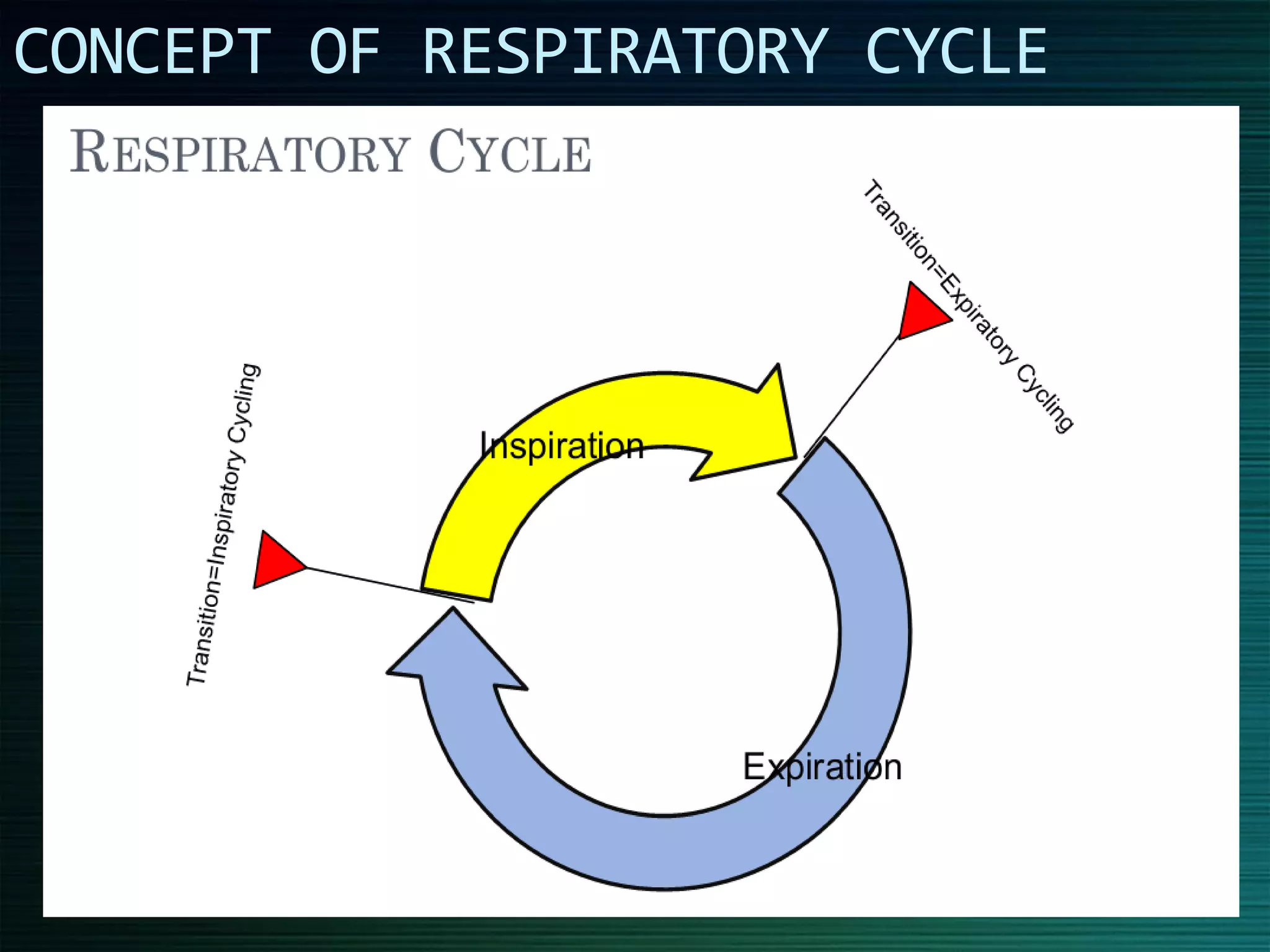
CONCEPT OF RESPIRATORY CYCLE
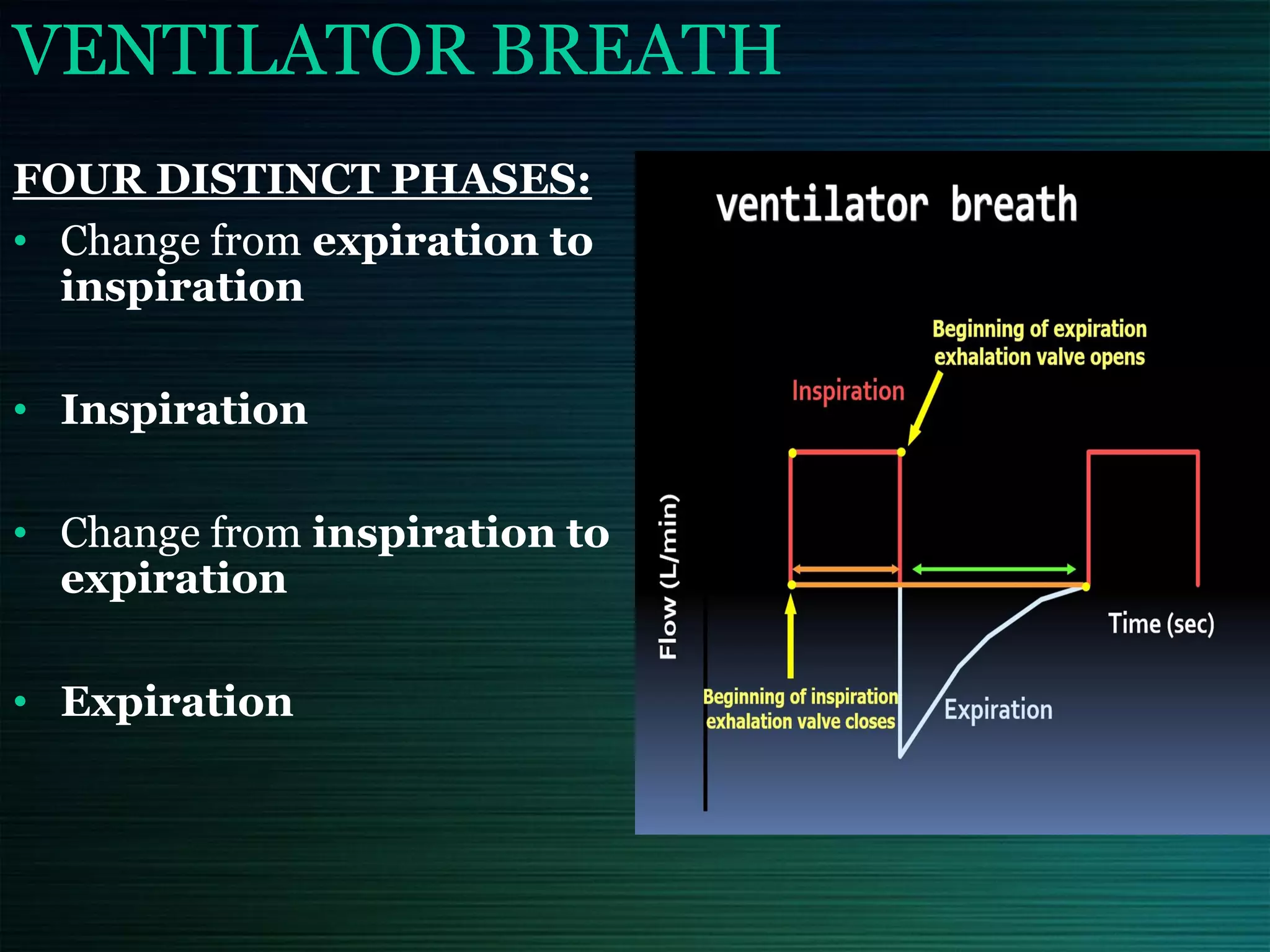
VENTILATOR BREATH
FOUR DISTINCT PHASES:
• Change from expiration to
inspiration
• Inspiration
• Change from inspiration to
expiration
• Expiration
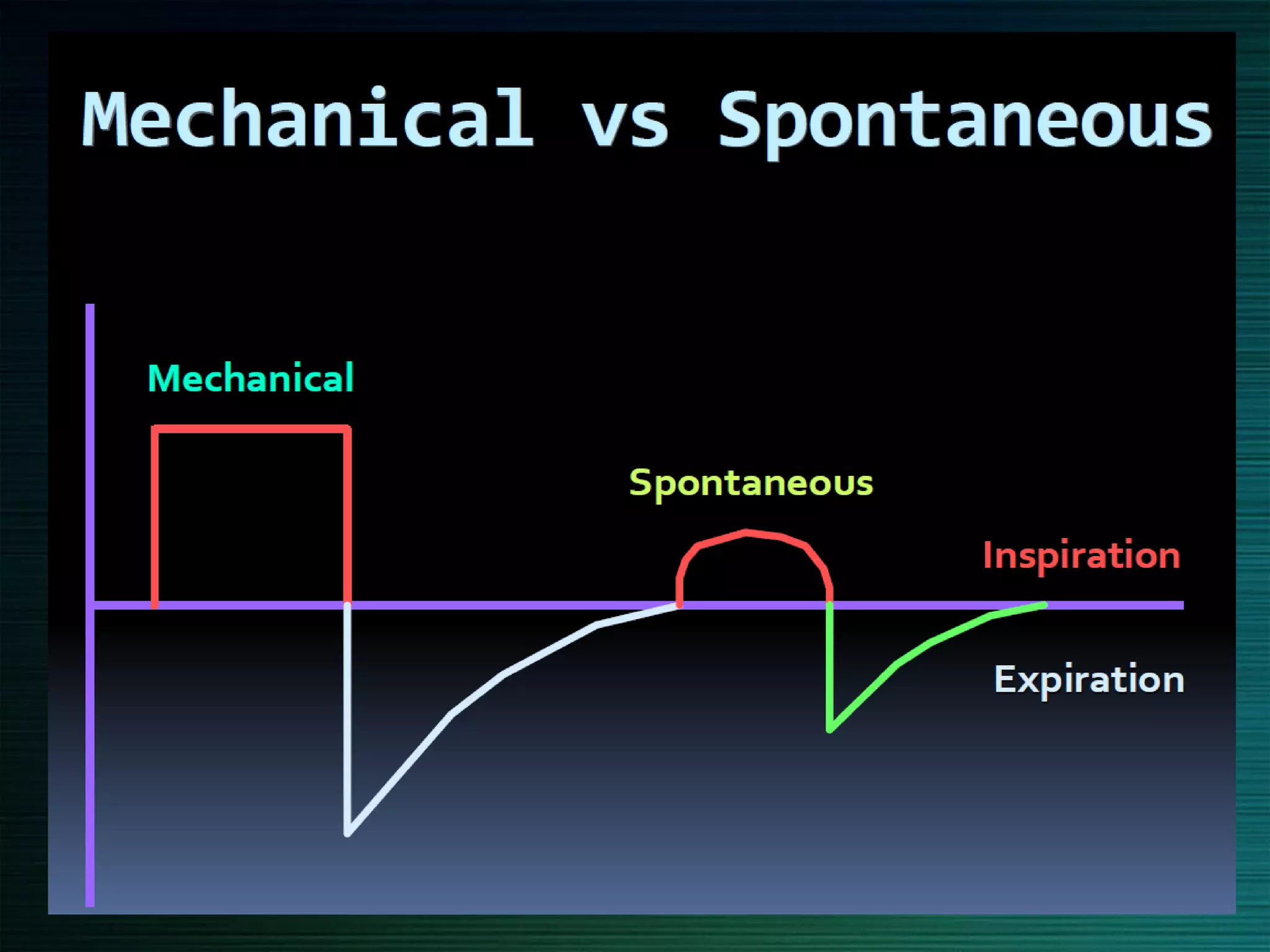
MANDATORY/ MECHANICAL BREATH
• The machine controls the timing of inspiration.(i.e) machine
can trigger, or control the breath or both.
SPONTANEOUS BREATH
• The patient controls the timing of inspiration. (i.e) the patient
triggers and cycles the breath.
• Spontaneous breath can be assisted where a part of work is
done by the ventilator, or unassisted where ventilator does not
contribute to work of breathing.
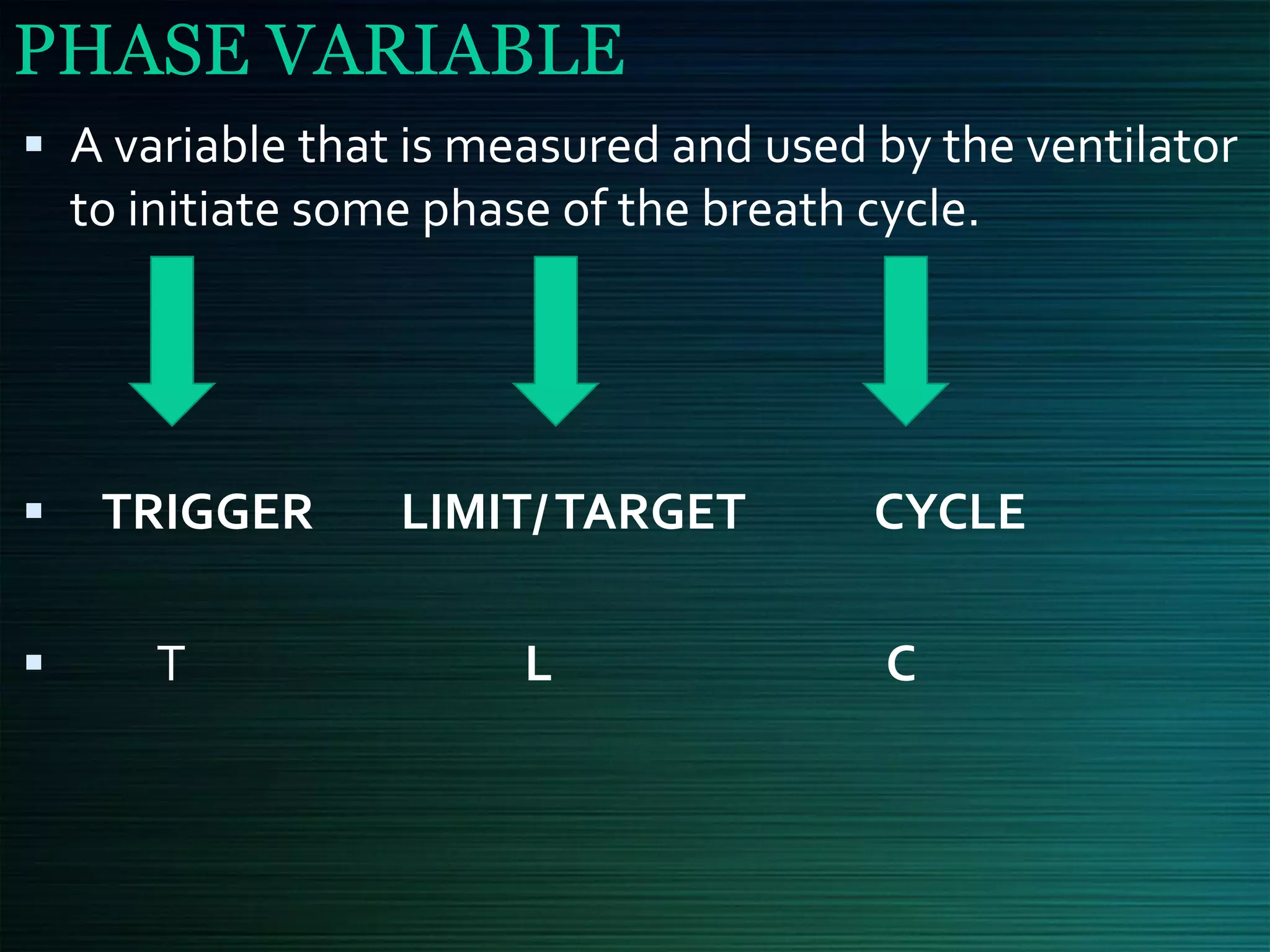
PHASE VARIABLE
▪ A variable that is measured and used by the ventilator
to initiate some phase of the breath cycle.
▪ TRIGGER LIMIT/TARGET CYCLE
▪ T L C
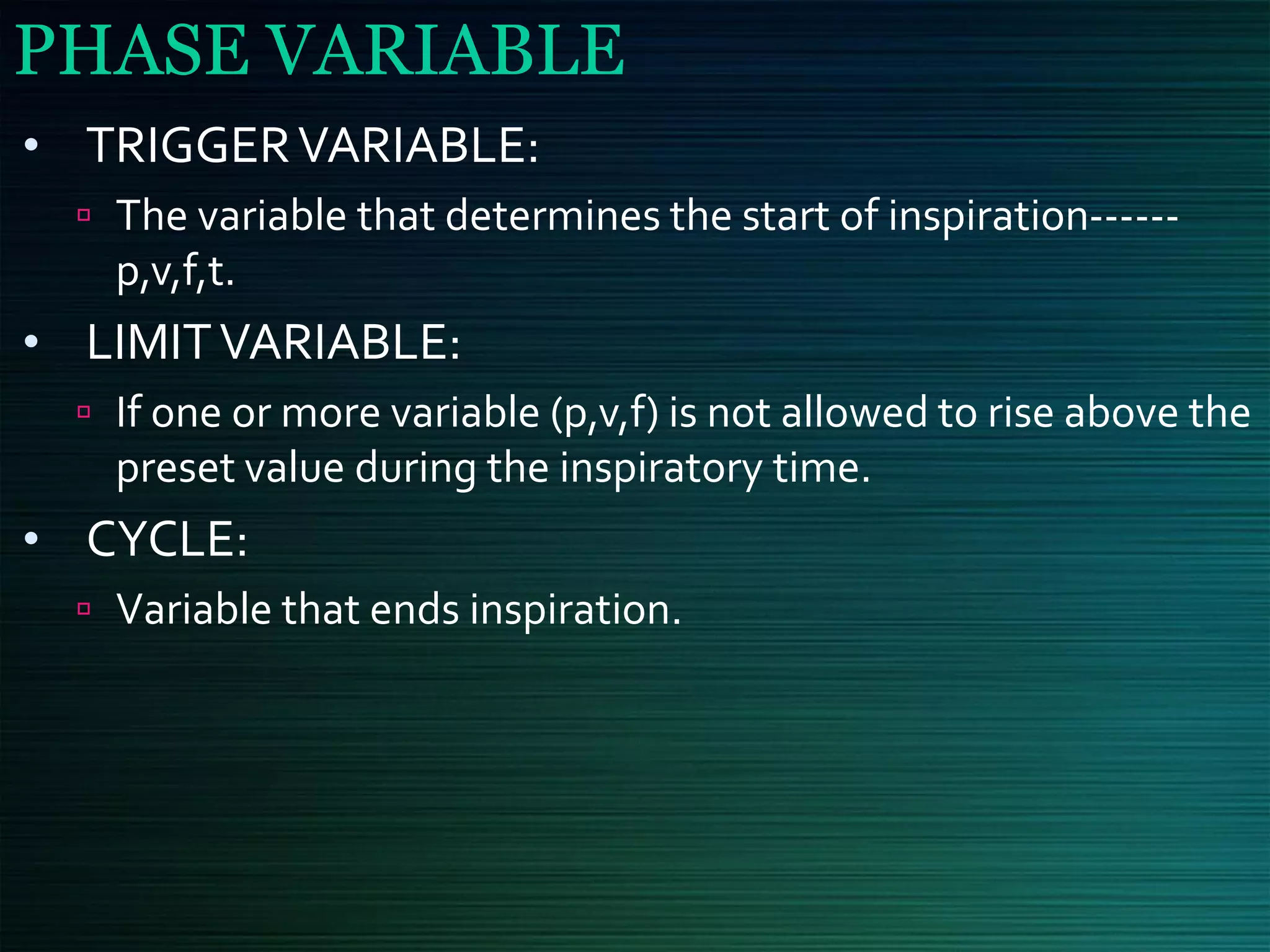
PHASE VARIABLE
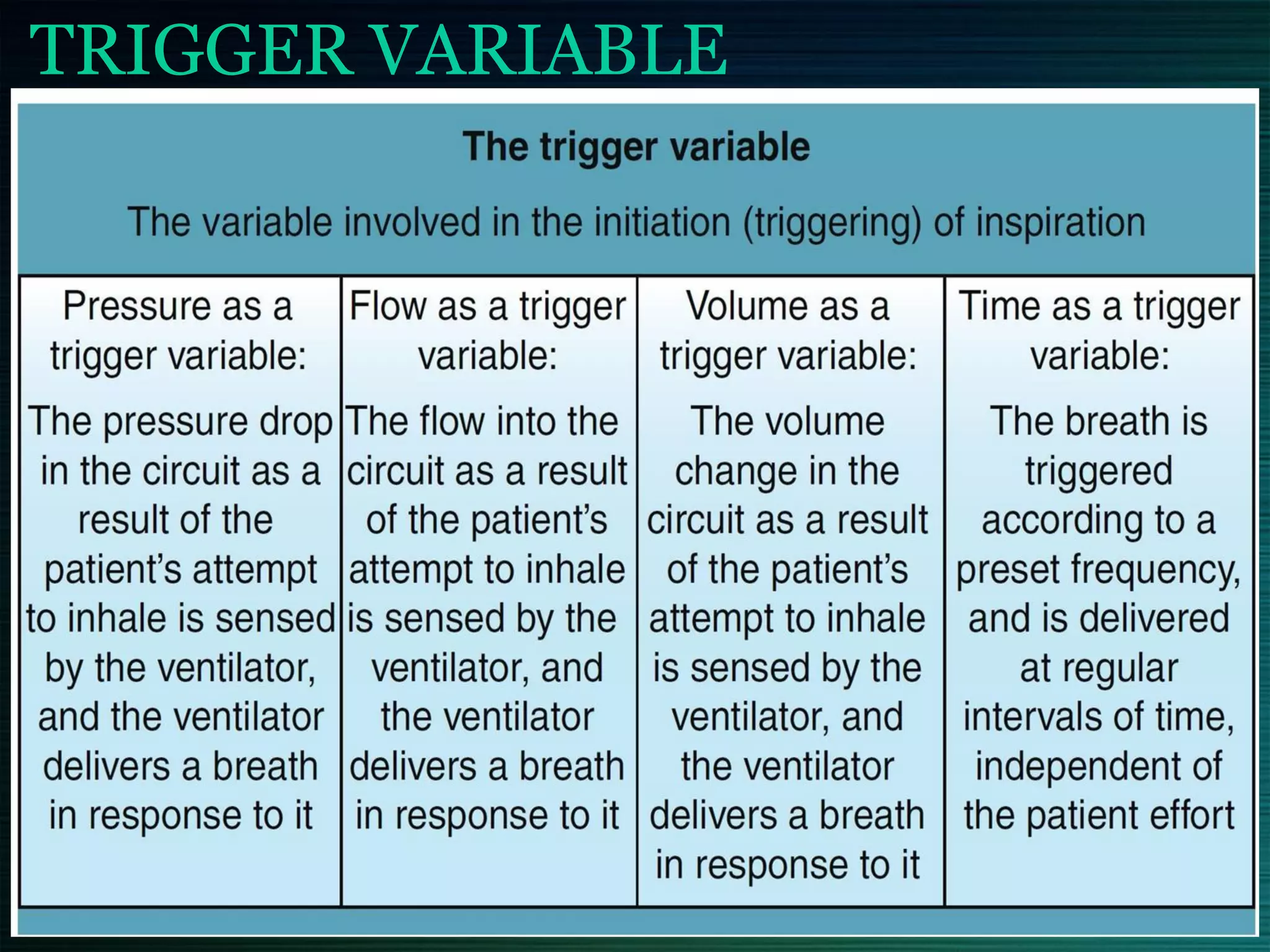
• TRIGGERVARIABLE:
 The variable that determines the start of inspiration------
p,v,f,t.
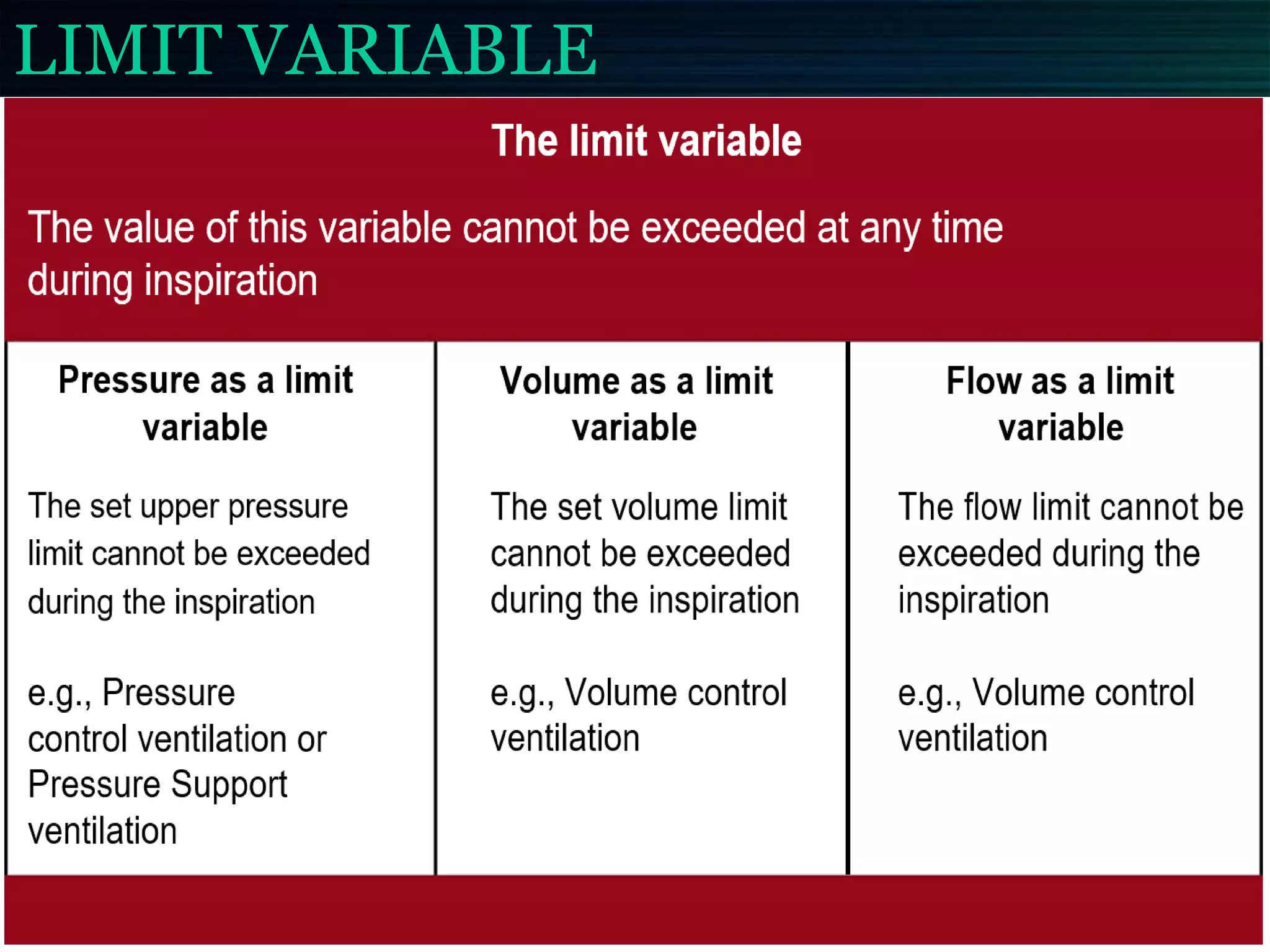
• LIMITVARIABLE:
 If one or more variable (p,v,f) is not allowed to rise above the
preset value during the inspiratory time.
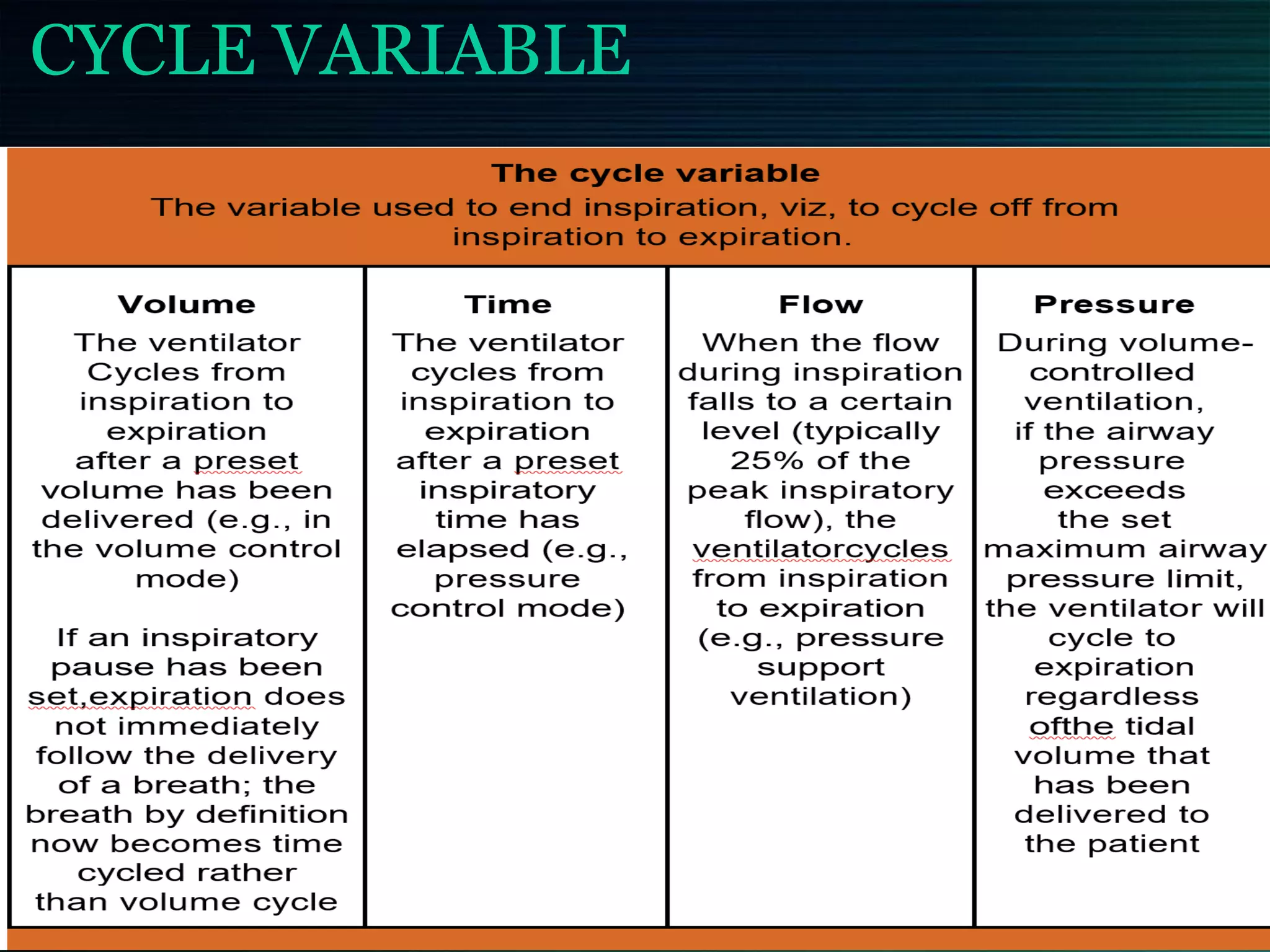
• CYCLE:
 Variable that ends inspiration.
TRIGGER
• What causes the breath to begin (signal to open the
inspiratory valve)
• Machine (controlled): the ventilator will trigger regular
breaths at a frequency which will depend on the set
respiratory rate, ie, they will be ventilator time triggered.
• Patient (assisted): If the patient does make an effort to
breathe and the ventilator can sense it (by either sensing
a negative inspiratory pressure or an inspiratory flow)
and deliver a breath, it will be called a patient triggered
breath.
TRIGGER VARIABLE
LIMIT VARIABLE
CYCLE VARIABLE
WHAT IS MODE
• Mode is a specification of how the ventilator
controls pressure, volume, and flow within a
breath, along with a description of how the
breaths are sequenced.
• The way the machine ventilates the patient
• How much the patient will participate in his
own ventilatory pattern.
• Each mode is different in determining how
much work of breathing the patient has to do.
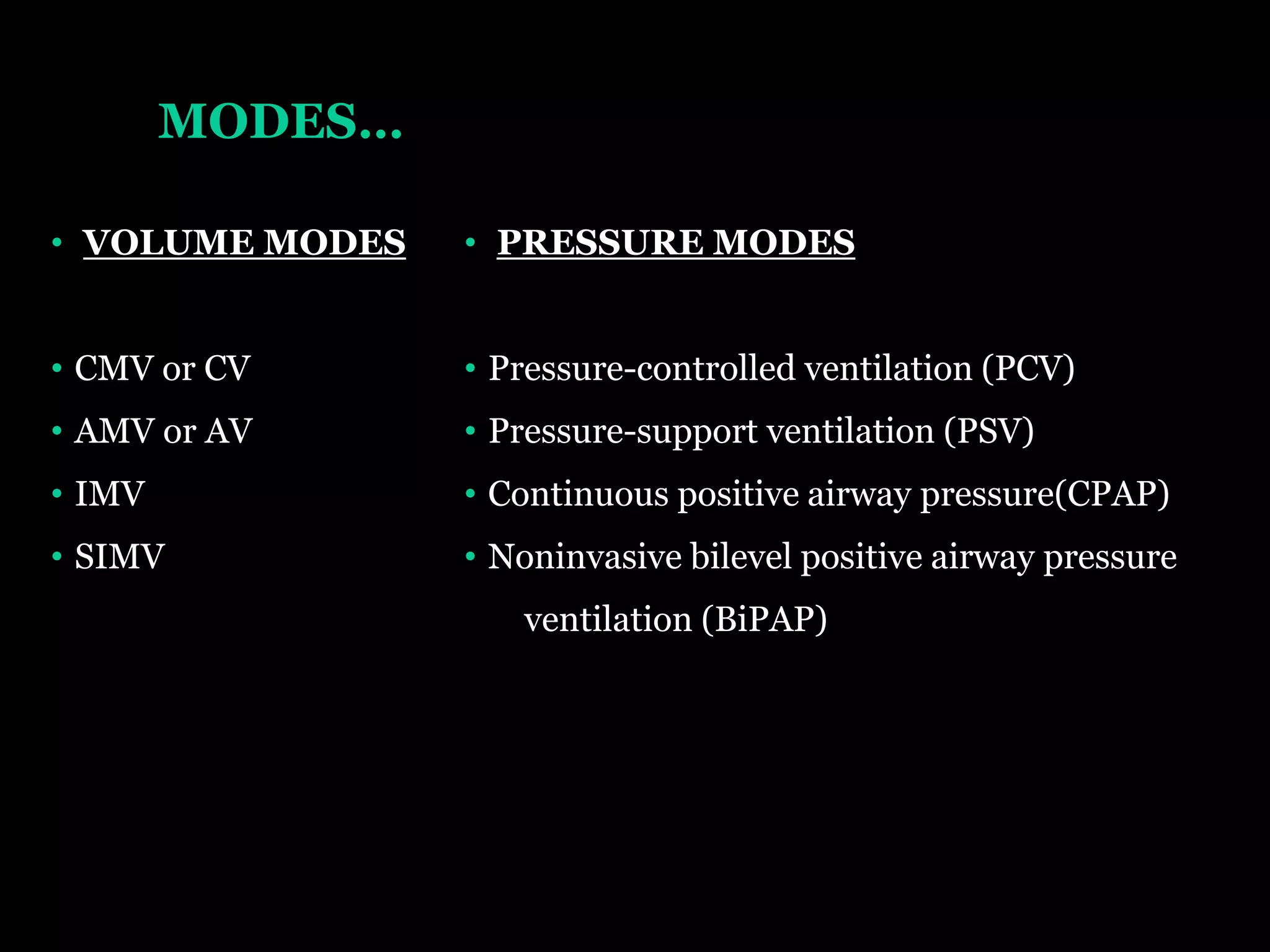
MODES…
• VOLUME MODES
• CMV or CV
• AMV or AV
• IMV
• SIMV
• PRESSURE MODES
• Pressure-controlled ventilation (PCV)
• Pressure-support ventilation (PSV)
• Continuous positive airway pressure(CPAP)
• Noninvasive bilevel positive airway pressure
ventilation (BiPAP)
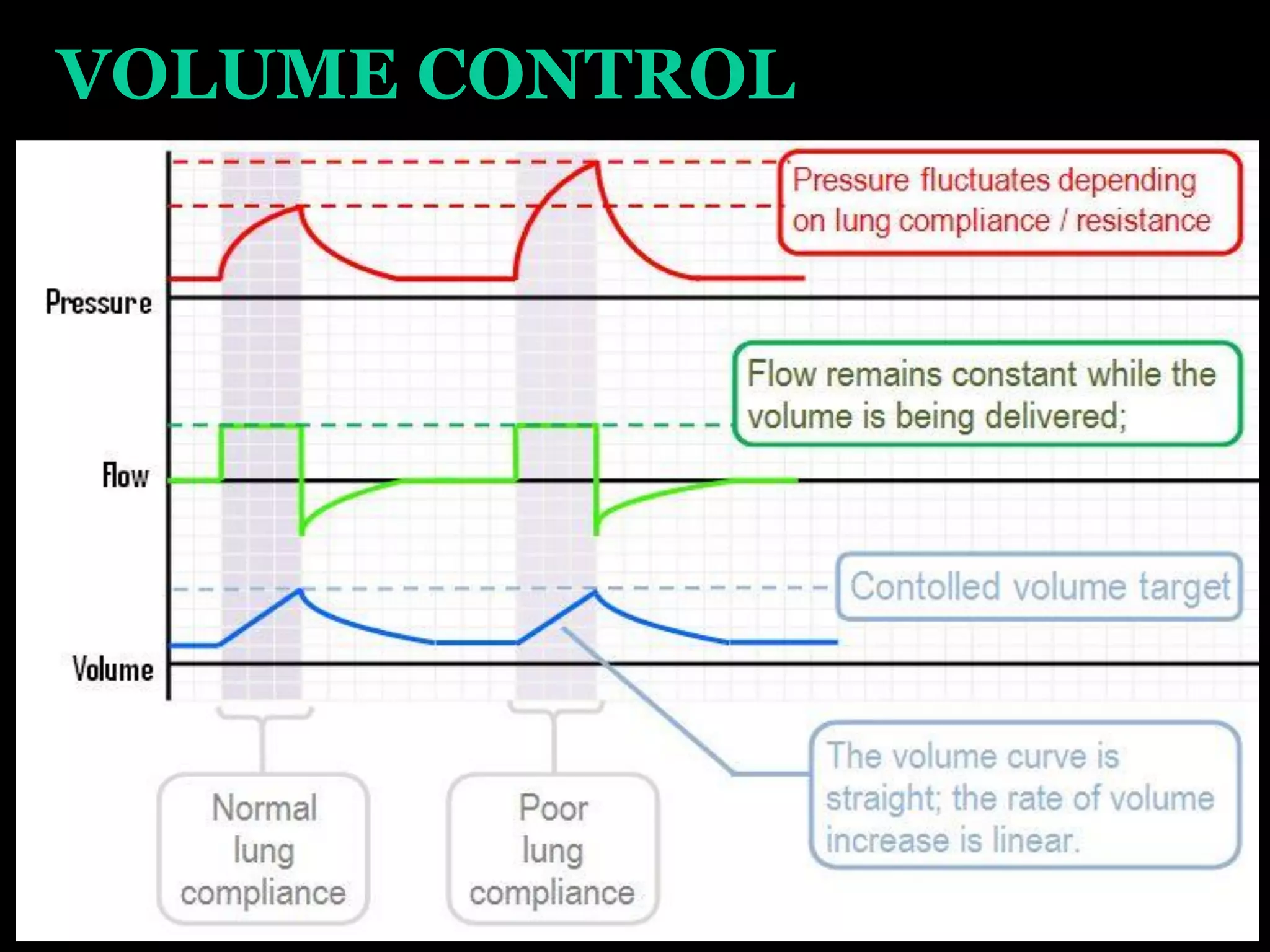
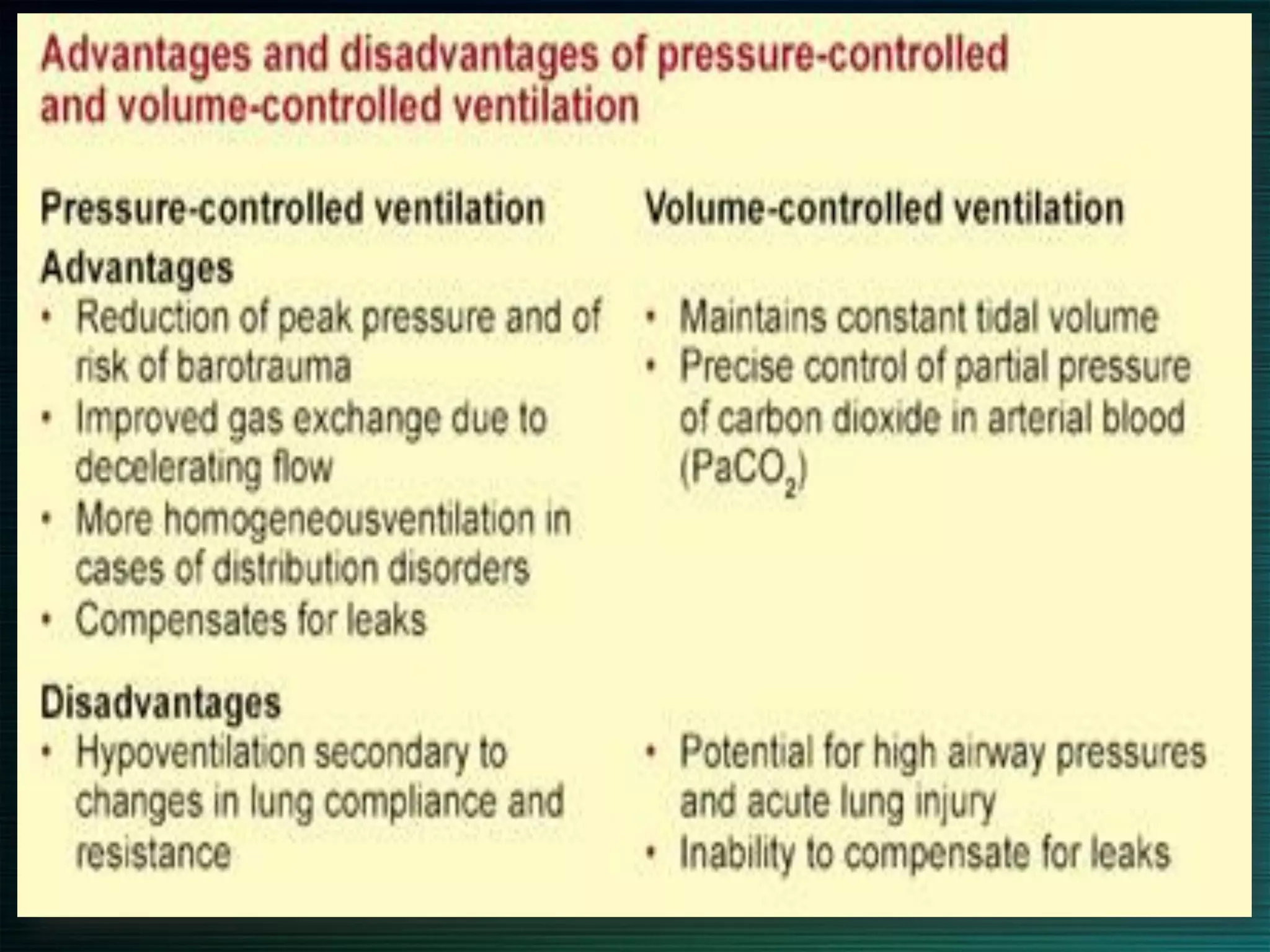
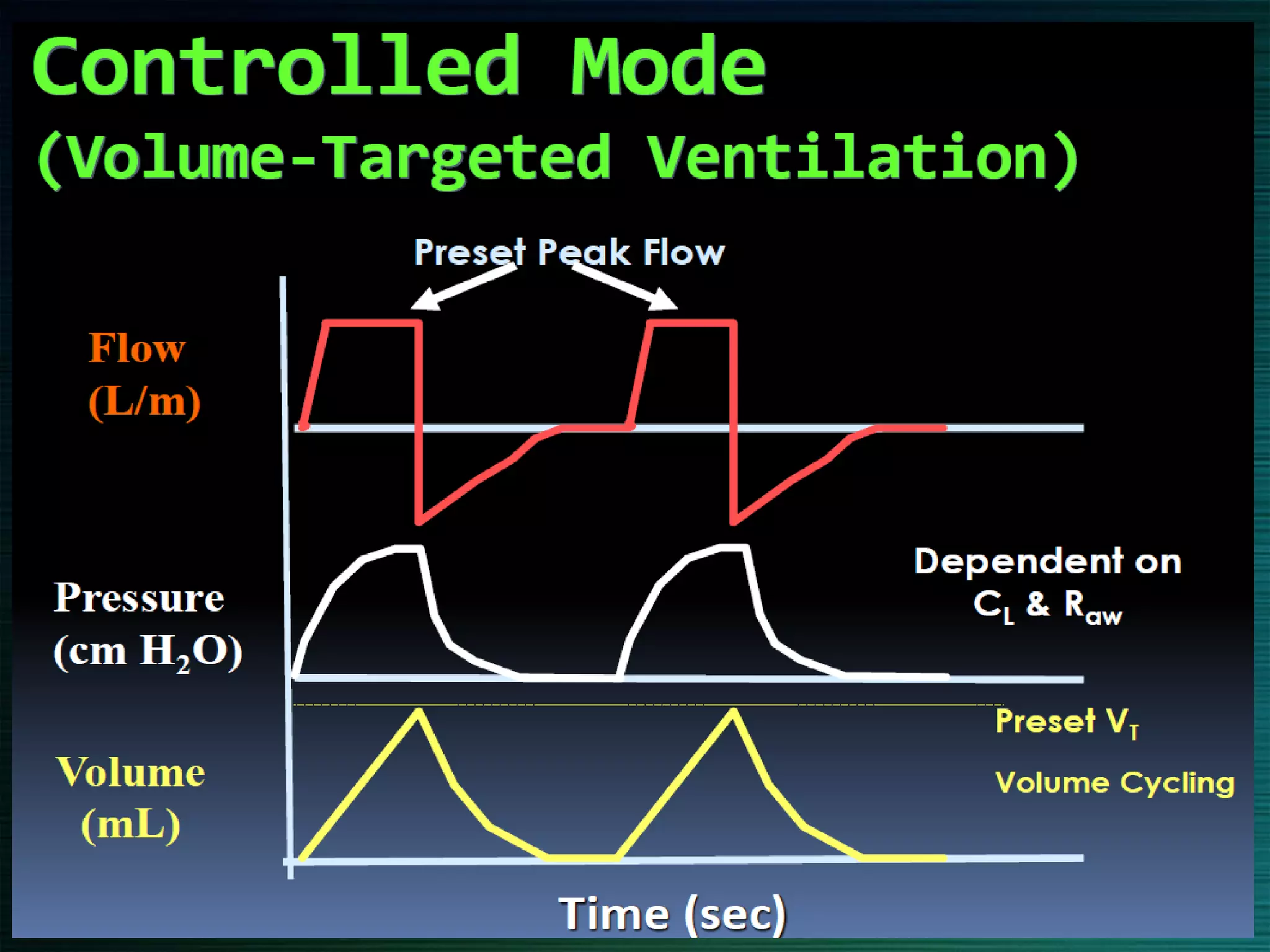
VOLUME CONTROL
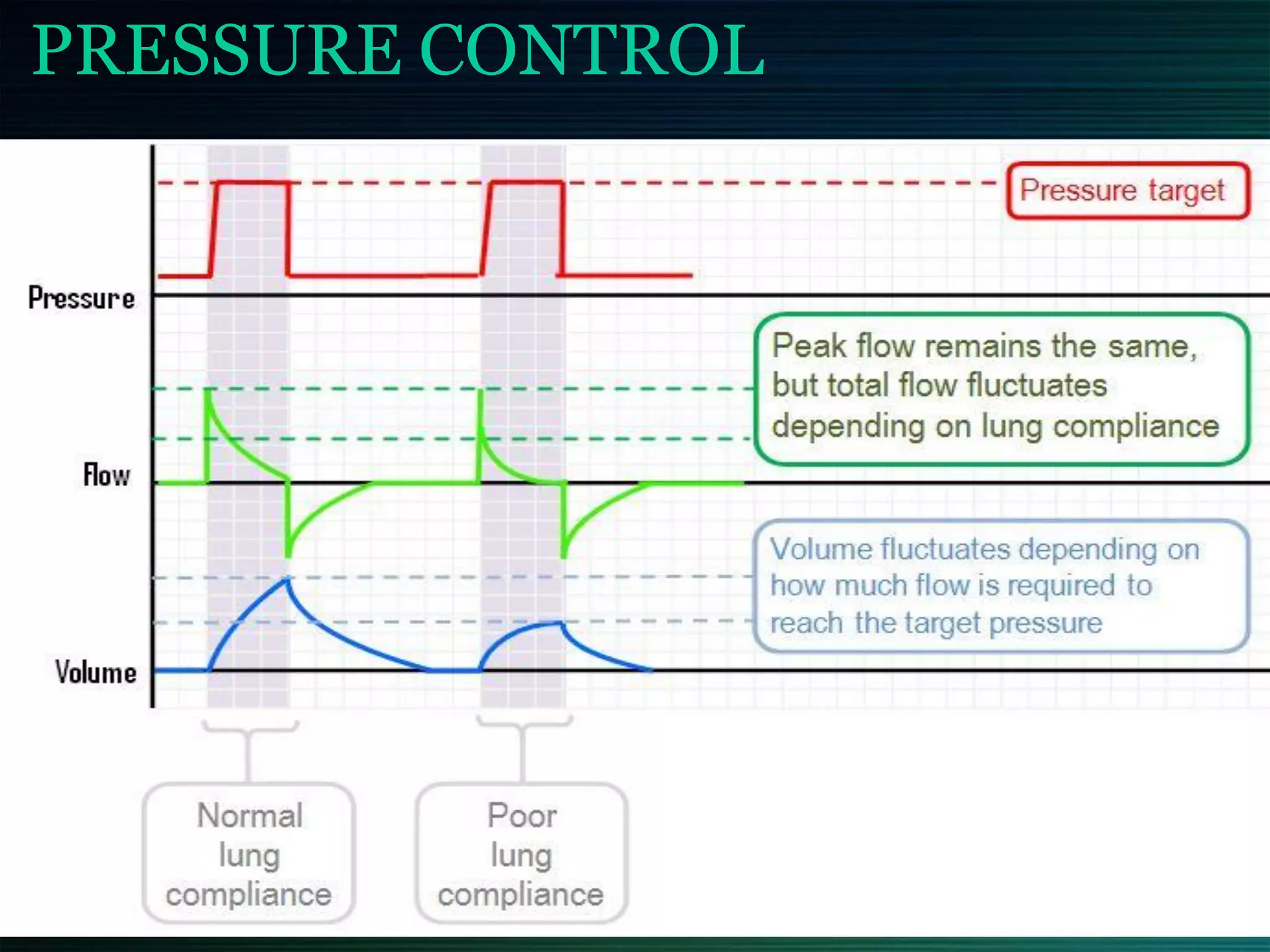
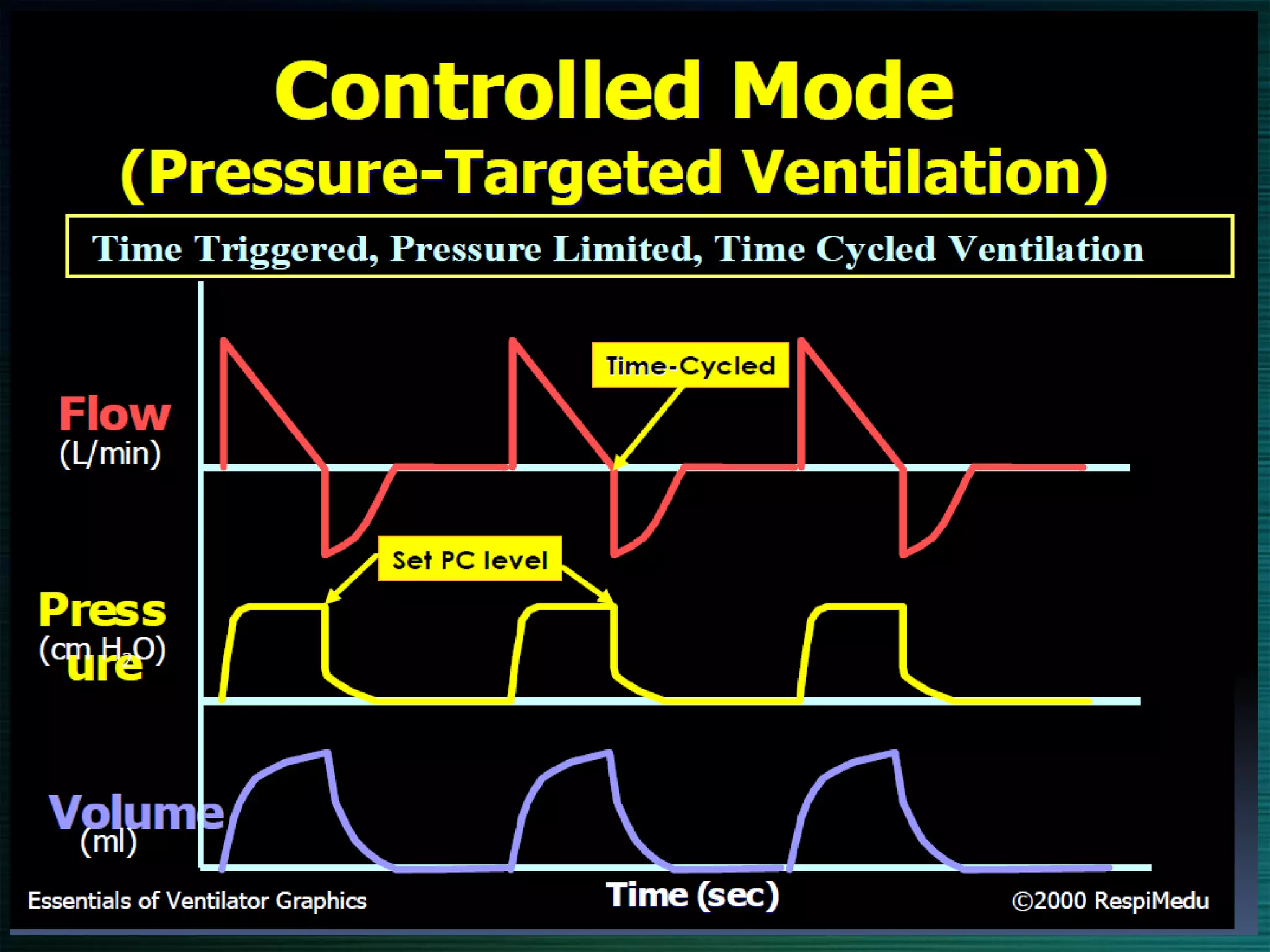
PRESSURE CONTROL
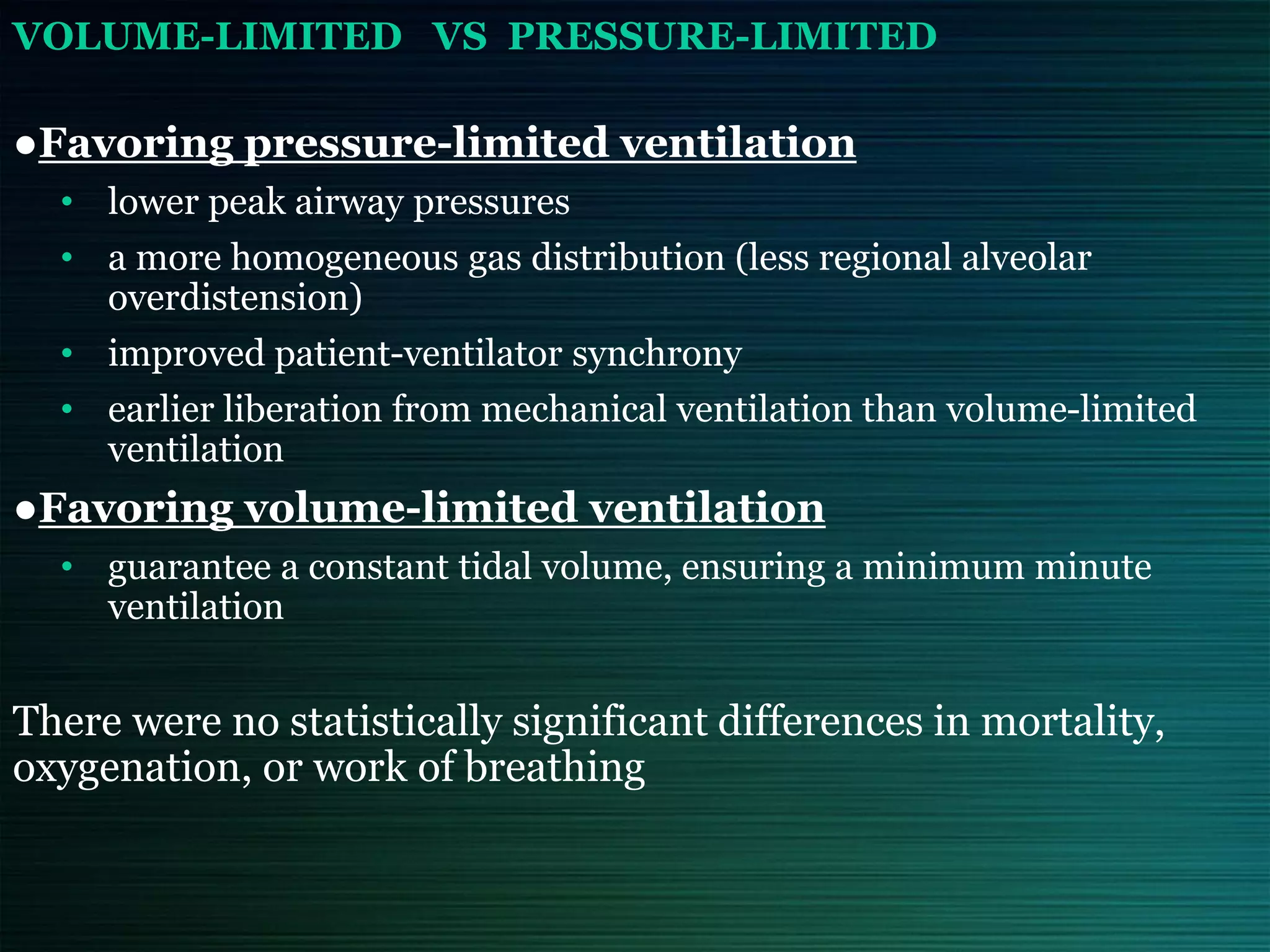
VOLUME-LIMITED VS PRESSURE-LIMITED
●Favoring pressure-limited ventilation
• lower peak airway pressures
• a more homogeneous gas distribution (less regional alveolar
overdistension)
• improved patient-ventilator synchrony
• earlier liberation from mechanical ventilation than volume-limited
ventilation
●Favoring volume-limited ventilation
• guarantee a constant tidal volume, ensuring a minimum minute
ventilation
There were no statistically significant differences in mortality,
oxygenation, or work of breathing
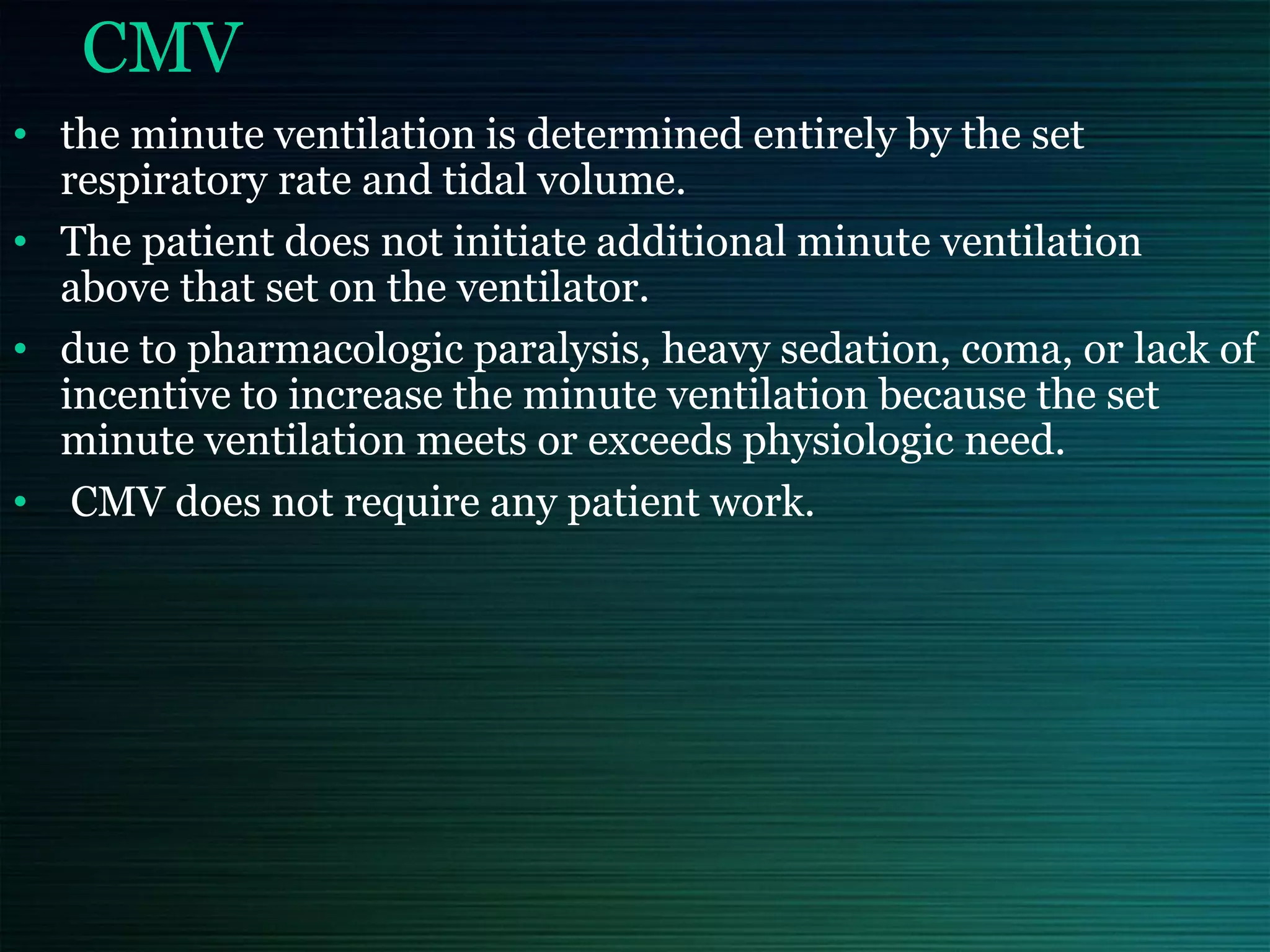
CMV
• the minute ventilation is determined entirely by the set
respiratory rate and tidal volume.
• The patient does not initiate additional minute ventilation
above that set on the ventilator.
• due to pharmacologic paralysis, heavy sedation, coma, or lack of
incentive to increase the minute ventilation because the set
minute ventilation meets or exceeds physiologic need.
• CMV does not require any patient work.
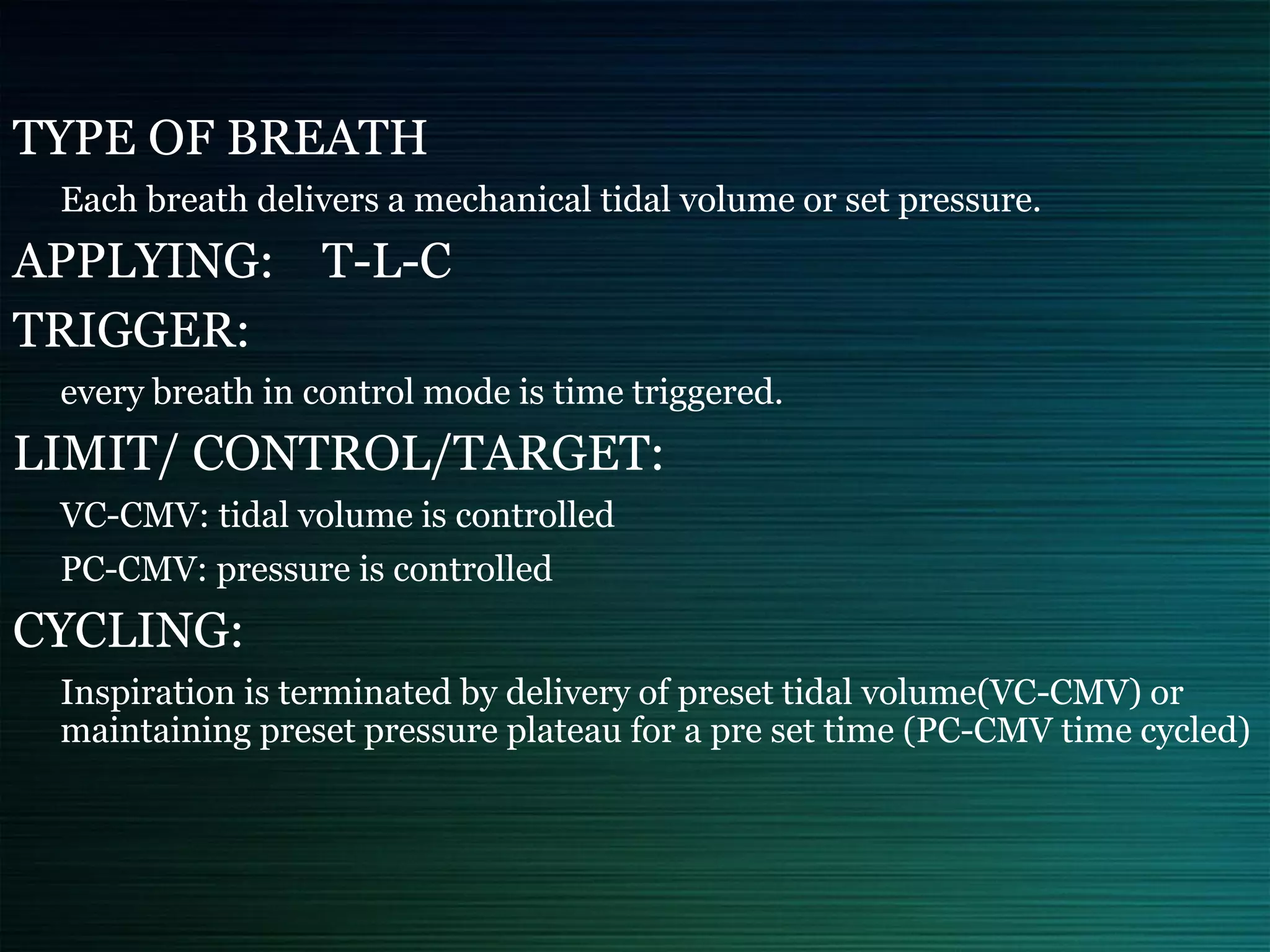
TYPE OF BREATH
Each breath delivers a mechanical tidal volume or set pressure.
APPLYING: T-L-C
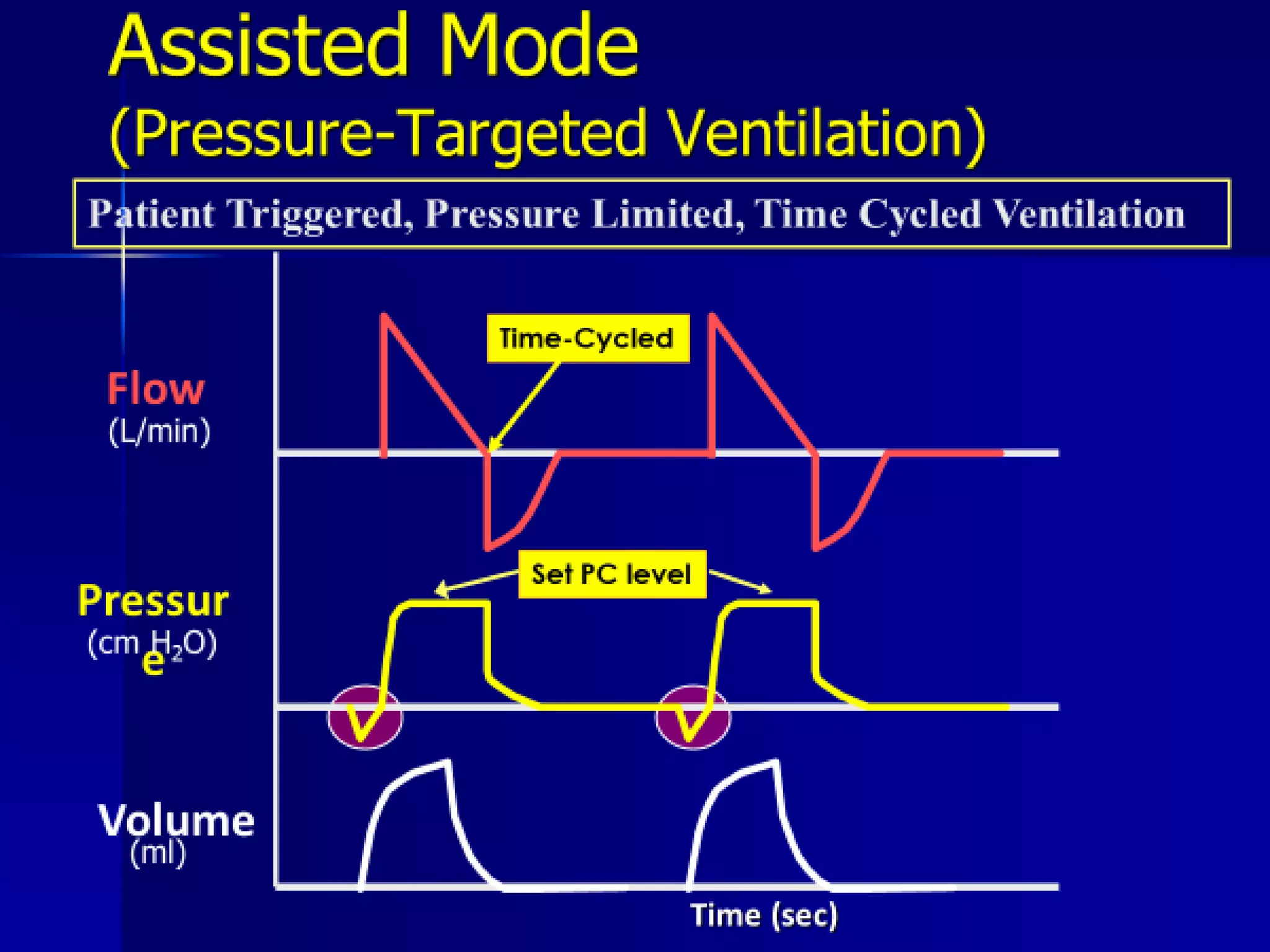
TRIGGER:
every breath in control mode is time triggered.
LIMIT/ CONTROL/TARGET:
VC-CMV: tidal volume is controlled
PC-CMV: pressure is controlled
CYCLING:
Inspiration is terminated by delivery of preset tidal volume(VC-CMV) or
maintaining preset pressure plateau for a pre set time (PC-CMV time cycled)
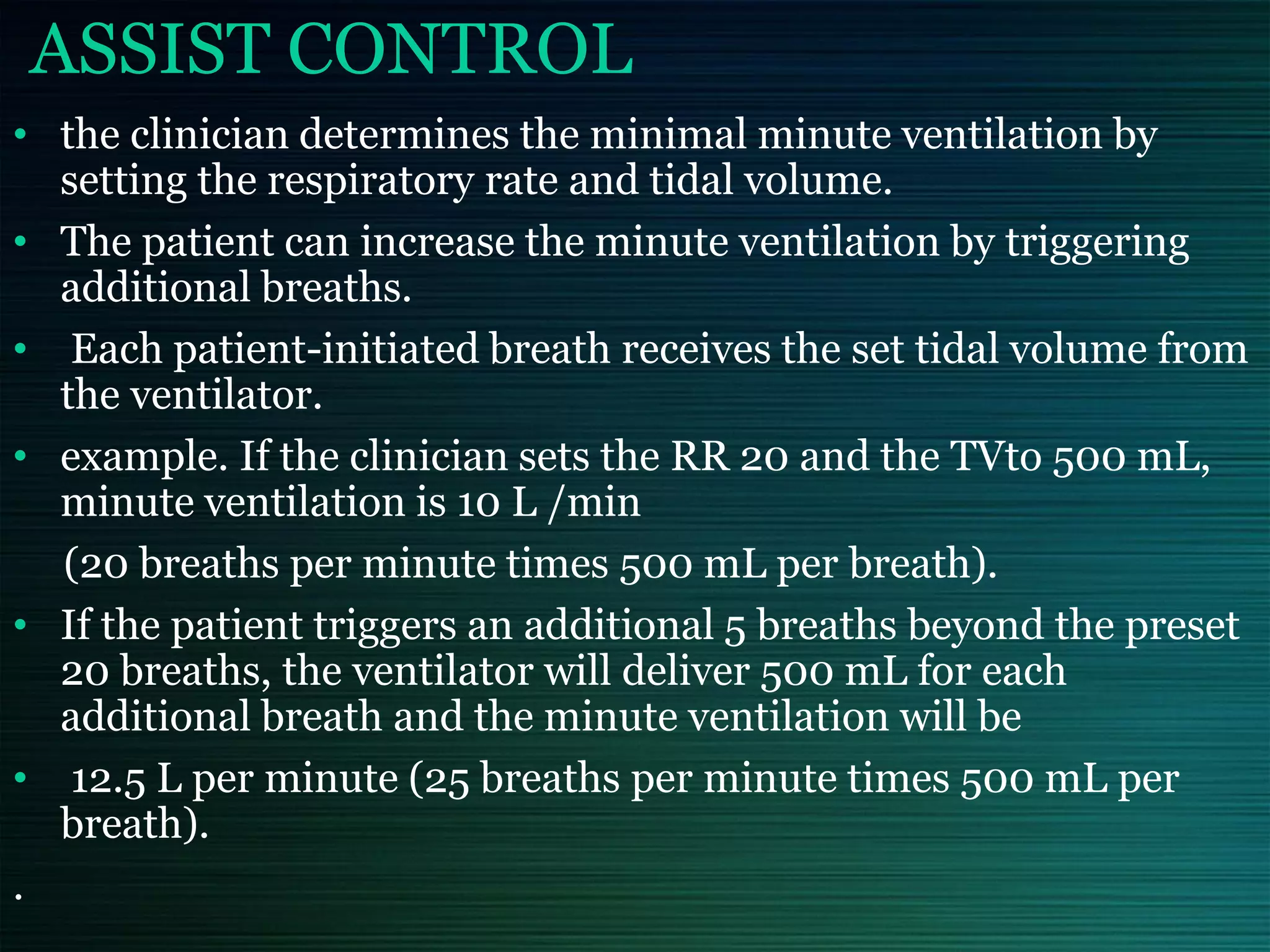
ASSIST CONTROL
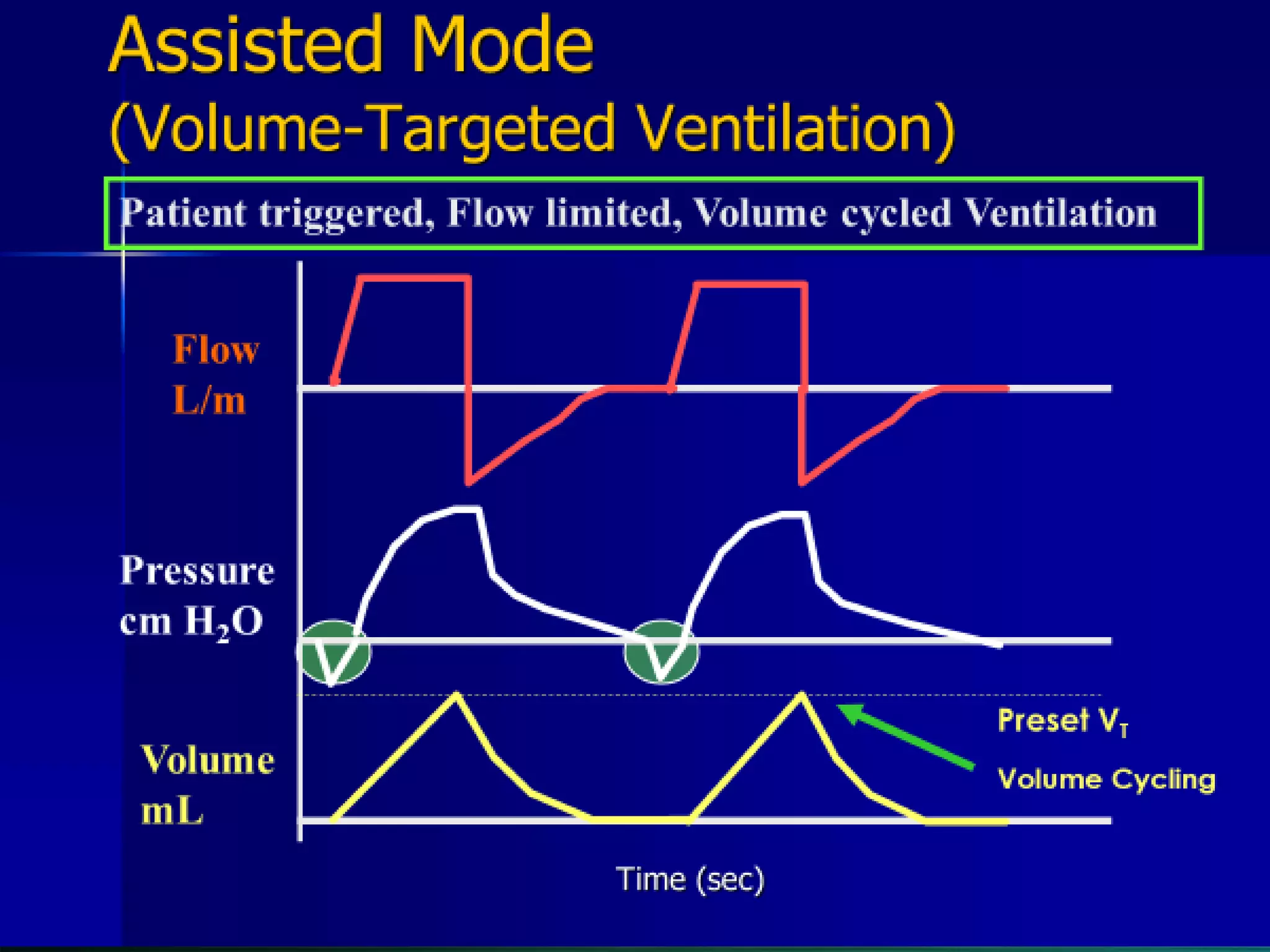
• the clinician determines the minimal minute ventilation by
setting the respiratory rate and tidal volume.
• The patient can increase the minute ventilation by triggering
additional breaths.
• Each patient-initiated breath receives the set tidal volume from
the ventilator.
• example. If the clinician sets the RR 20 and the TVto 500 mL,
minute ventilation is 10 L /min
(20 breaths per minute times 500 mL per breath).
• If the patient triggers an additional 5 breaths beyond the preset
20 breaths, the ventilator will deliver 500 mL for each
additional breath and the minute ventilation will be
• 12.5 L per minute (25 breaths per minute times 500 mL per
breath).
.
ASSIST CONTROL
▪ Patient can increase the ventilator breath rate in
addition to the preset mechanical respiratory rate.
▪ Each control breath provides the preset tidal volume.
▪ Each assist breath also delivers preset ventilator
delivered tidal volume.
ASSIST CONTROL
▪ TYPE OF BREATH:
▪ Each breath assist or control delivers a preset mechanical
tidal volume
▪ APPLYING: T-L-C
▪ Trigger: may be patient triggered (assist) or time
triggered.
▪ Limit/control/target: tidal volume/ set pressure.
▪ Cycling: inspiration is terminated by delivery of preset
tidal volume or high pressure limit.
IMV
• IMV is similar to AC in two ways:
• the clinician determines the minimal minute ventilation (by
setting the RR & TV) and the patient is able to increase the
minute ventilation.
• IMV differs from AC in the way that the minute ventilation is
increased. Specifically, patients increase MV by spontaneous
breathing, rather than patient-initiated ventilator breaths.
• example. If the clinician sets the RR to 10 , TV to 500 mL per
breath, the lowest possible minute ventilation is 5 L per minute
(10 breaths per minute times 500 mL per breath).
• If the patient initiates an additional 5 breaths beyond the preset
10 breaths, the TV for each additional breath will be whatever
size the patient is able to generate and the minute ventilation
will be some amount greater than 5 L per minute.
• The precise minute ventilation depends on the size of the tidal
volume for each spontaneous breath.
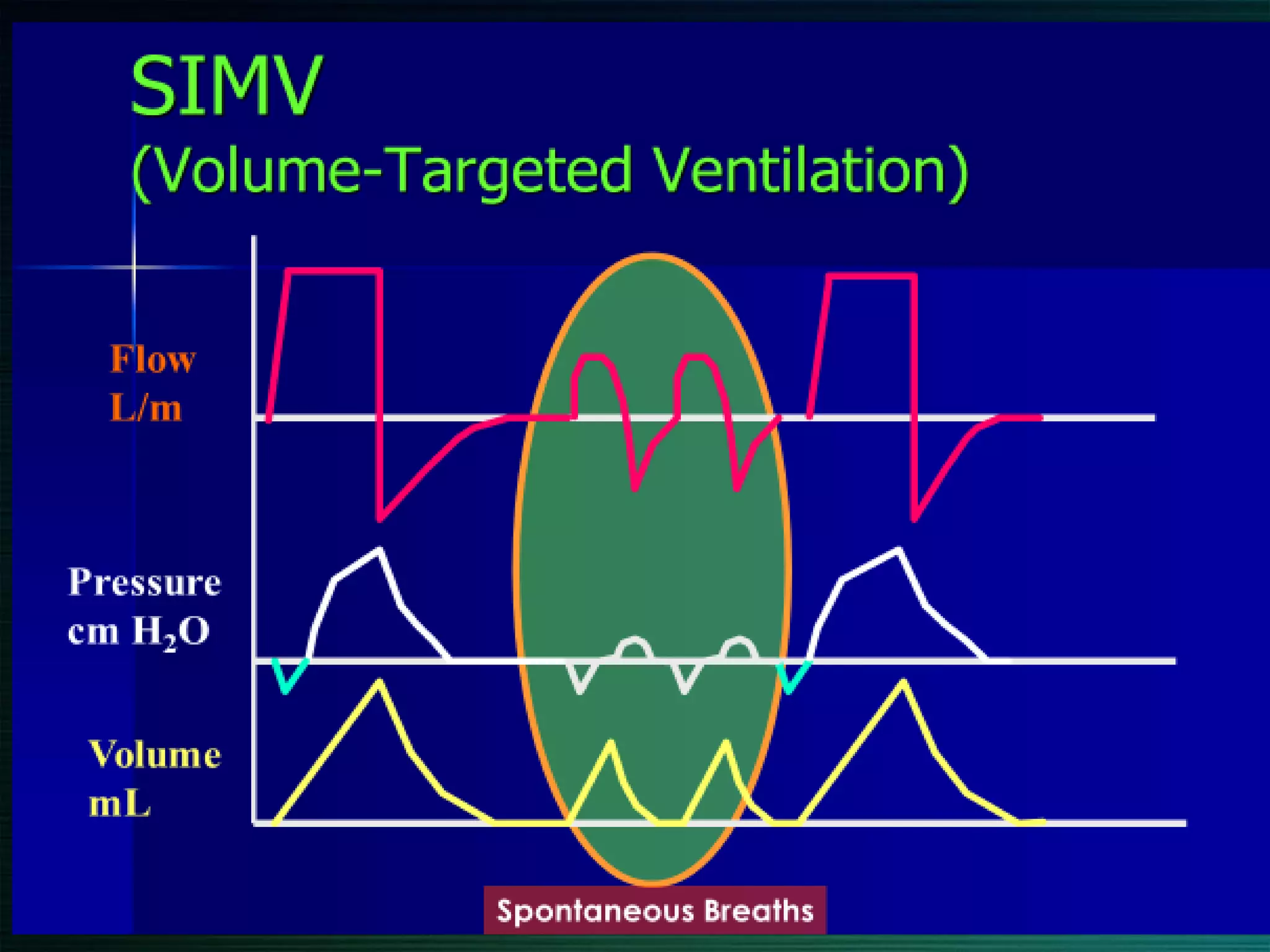
SYNCHRONISED INTERMITTENT
MANDATORY VENTILATION (SIMV)
▪ The ventilator delivers controlled or mandatory breath
to the patient at or near the time of spontaneous
breath.
▪ The mandatory breaths are synchronised with
spontaneous breath s as to avoid breath stacking.
▪ SIMV permits the patient to breath to any tidal
volume between the mandatory breath.
SIMV
• SIMV is a variation of IMV, in which the ventilator breaths are
synchronized with patient inspiratory effort
• SIMV (or IMV) can be used to titrate the level of ventilatory
support over a wide range
• This is an advantage unique to these modes. Ventilatory
support can range from full support (set respiratory rate is high
enough that the patient does not overbreathe) to no ventilatory
support (set respiratory rate is zero).
The level of support may need to be modified if hemodynamic
consequences of positive pressure ventilation develop. In one
study, cardiac output, mean blood pressure, pulmonary capillary
wedge pressure, and oxygen consumption were all better when the
level of support provided by SIMV was less than 50 percent
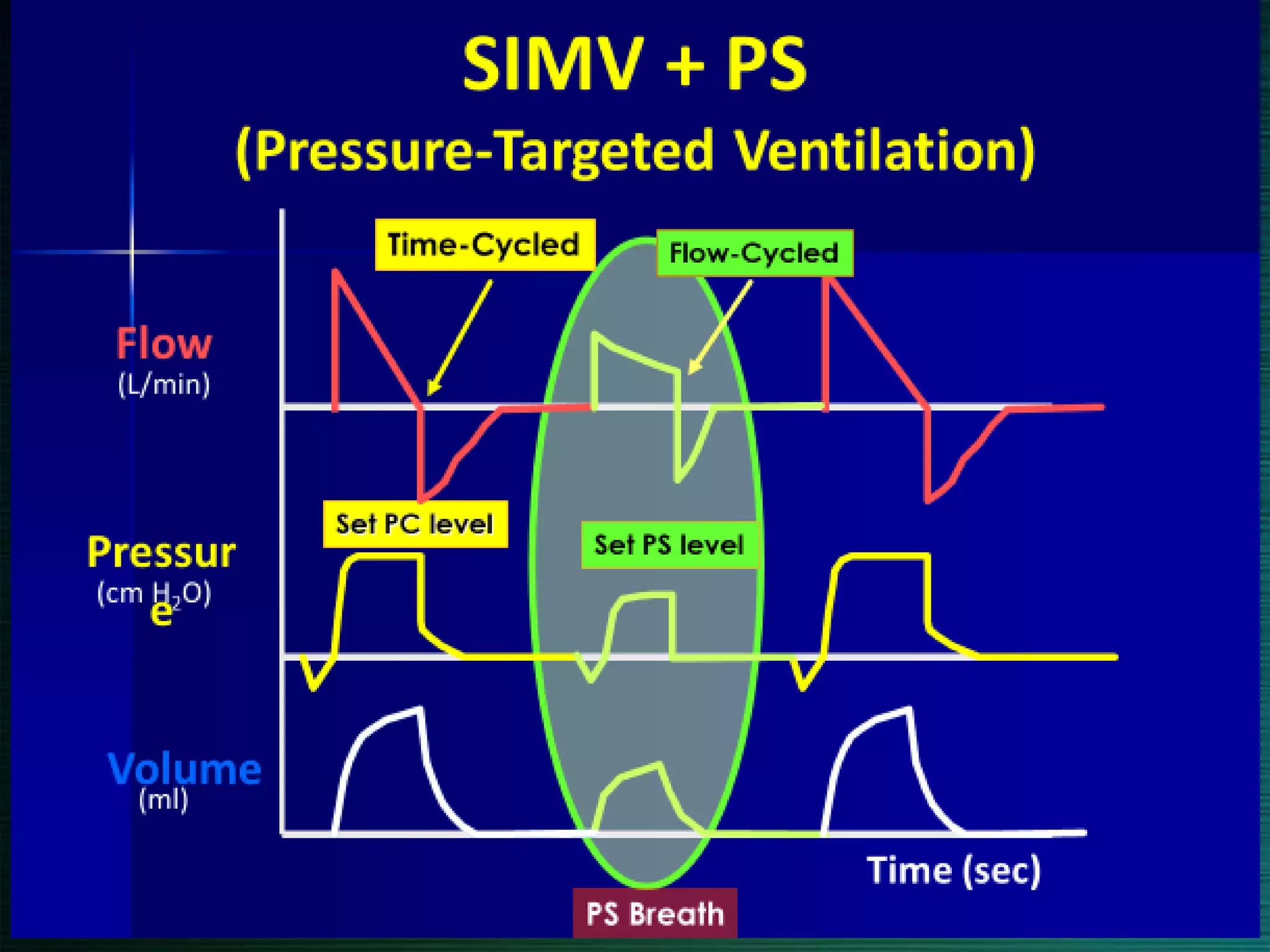
PRESSURE SUPPORT VENTILATION-PSV
▪ Used to lower the work of spontaneous breathing.
▪ Augments patients spontaneous tidal volume.
▪ Pressure supported breaths are spontaneous:
 Are patient triggered.
 Vt varies with patients inspiratory flow demand and lasts
the inspiration time.
 Max airway pressure cannot exceed the preset pressure
support level.
 Not active during mandatory breaths.
PRESSURE SUPPORT VENTILATION-PSV
▪ INDICATIONS:
 Used along with SIMV to facilitate weaning. (Olden days)
 ReducesWOB.
▪ CAUTION:
 When using as standalone mode close monitoring for signs
of fatigue is required as every breath is patient triggered.
CHARACTERISTICS OF PSV
▪ TYPE OF BREATH: SPONTANEOUS
▪ APPLYING: T-L-C
▪ Trigger: patient triggered.
▪ Limit/control/target: preset pressure level
▪ Cycling: flow cycled.
CONTINUOUS POSITIVE AIRWAY PRESSURE
(CPAP)
▪ CPAP is the positive pressure applied to the airway of
a patient who is breathing spontaneously.
▪ Patients must have adequate lung function to sustain
eucapnic ventilation.
▪ Can given via a face mask, nasal mask or endotracheal
tube.
Modes of  MECHANICAL VENTILLATION

Modes of MECHANICAL VENTILLATION

  • 1.
    MODES OF MECHANICAL VENTILLATION Dr.JAKEER HUSSAIN MD,DNB, IDCCM
  • 2.
    Basic Ventilator Parameters FiO2 Fractionalconcentration of inspired oxygen delivered expressed as a % (21-100) Breath Rate (f) The number of times over a one minute period inspiration is initiated (bpm) Tidal volume (VT) The amount of gas that is delivered during inspiration expressed in mls or Liters Inspired or exhaled. Flow The velocity of gas flow or volume of gas per minute
  • 3.
  • 4.
    VENTILATOR BREATH FOUR DISTINCTPHASES: • Change from expiration to inspiration • Inspiration • Change from inspiration to expiration • Expiration
  • 5.
    MANDATORY/ MECHANICAL BREATH •The machine controls the timing of inspiration.(i.e) machine can trigger, or control the breath or both. SPONTANEOUS BREATH • The patient controls the timing of inspiration. (i.e) the patient triggers and cycles the breath. • Spontaneous breath can be assisted where a part of work is done by the ventilator, or unassisted where ventilator does not contribute to work of breathing.
  • 7.
    PHASE VARIABLE ▪ Avariable that is measured and used by the ventilator to initiate some phase of the breath cycle. ▪ TRIGGER LIMIT/TARGET CYCLE ▪ T L C
  • 8.
    PHASE VARIABLE • TRIGGERVARIABLE: The variable that determines the start of inspiration------ p,v,f,t. • LIMITVARIABLE:  If one or more variable (p,v,f) is not allowed to rise above the preset value during the inspiratory time. • CYCLE:  Variable that ends inspiration.
  • 9.
    TRIGGER • What causesthe breath to begin (signal to open the inspiratory valve) • Machine (controlled): the ventilator will trigger regular breaths at a frequency which will depend on the set respiratory rate, ie, they will be ventilator time triggered. • Patient (assisted): If the patient does make an effort to breathe and the ventilator can sense it (by either sensing a negative inspiratory pressure or an inspiratory flow) and deliver a breath, it will be called a patient triggered breath.
  • 10.
  • 11.
  • 12.
  • 13.
    WHAT IS MODE •Mode is a specification of how the ventilator controls pressure, volume, and flow within a breath, along with a description of how the breaths are sequenced. • The way the machine ventilates the patient • How much the patient will participate in his own ventilatory pattern. • Each mode is different in determining how much work of breathing the patient has to do.
  • 14.
    MODES… • VOLUME MODES •CMV or CV • AMV or AV • IMV • SIMV • PRESSURE MODES • Pressure-controlled ventilation (PCV) • Pressure-support ventilation (PSV) • Continuous positive airway pressure(CPAP) • Noninvasive bilevel positive airway pressure ventilation (BiPAP)
  • 15.
  • 16.
  • 17.
    VOLUME-LIMITED VS PRESSURE-LIMITED ●Favoringpressure-limited ventilation • lower peak airway pressures • a more homogeneous gas distribution (less regional alveolar overdistension) • improved patient-ventilator synchrony • earlier liberation from mechanical ventilation than volume-limited ventilation ●Favoring volume-limited ventilation • guarantee a constant tidal volume, ensuring a minimum minute ventilation There were no statistically significant differences in mortality, oxygenation, or work of breathing
  • 19.
    CMV • the minuteventilation is determined entirely by the set respiratory rate and tidal volume. • The patient does not initiate additional minute ventilation above that set on the ventilator. • due to pharmacologic paralysis, heavy sedation, coma, or lack of incentive to increase the minute ventilation because the set minute ventilation meets or exceeds physiologic need. • CMV does not require any patient work.
  • 20.
    TYPE OF BREATH Eachbreath delivers a mechanical tidal volume or set pressure. APPLYING: T-L-C TRIGGER: every breath in control mode is time triggered. LIMIT/ CONTROL/TARGET: VC-CMV: tidal volume is controlled PC-CMV: pressure is controlled CYCLING: Inspiration is terminated by delivery of preset tidal volume(VC-CMV) or maintaining preset pressure plateau for a pre set time (PC-CMV time cycled)
  • 23.
    ASSIST CONTROL • theclinician determines the minimal minute ventilation by setting the respiratory rate and tidal volume. • The patient can increase the minute ventilation by triggering additional breaths. • Each patient-initiated breath receives the set tidal volume from the ventilator. • example. If the clinician sets the RR 20 and the TVto 500 mL, minute ventilation is 10 L /min (20 breaths per minute times 500 mL per breath). • If the patient triggers an additional 5 breaths beyond the preset 20 breaths, the ventilator will deliver 500 mL for each additional breath and the minute ventilation will be • 12.5 L per minute (25 breaths per minute times 500 mL per breath). .
  • 24.
    ASSIST CONTROL ▪ Patientcan increase the ventilator breath rate in addition to the preset mechanical respiratory rate. ▪ Each control breath provides the preset tidal volume. ▪ Each assist breath also delivers preset ventilator delivered tidal volume.
  • 25.
    ASSIST CONTROL ▪ TYPEOF BREATH: ▪ Each breath assist or control delivers a preset mechanical tidal volume ▪ APPLYING: T-L-C ▪ Trigger: may be patient triggered (assist) or time triggered. ▪ Limit/control/target: tidal volume/ set pressure. ▪ Cycling: inspiration is terminated by delivery of preset tidal volume or high pressure limit.
  • 28.
    IMV • IMV issimilar to AC in two ways: • the clinician determines the minimal minute ventilation (by setting the RR & TV) and the patient is able to increase the minute ventilation. • IMV differs from AC in the way that the minute ventilation is increased. Specifically, patients increase MV by spontaneous breathing, rather than patient-initiated ventilator breaths. • example. If the clinician sets the RR to 10 , TV to 500 mL per breath, the lowest possible minute ventilation is 5 L per minute (10 breaths per minute times 500 mL per breath). • If the patient initiates an additional 5 breaths beyond the preset 10 breaths, the TV for each additional breath will be whatever size the patient is able to generate and the minute ventilation will be some amount greater than 5 L per minute. • The precise minute ventilation depends on the size of the tidal volume for each spontaneous breath.
  • 30.
    SYNCHRONISED INTERMITTENT MANDATORY VENTILATION(SIMV) ▪ The ventilator delivers controlled or mandatory breath to the patient at or near the time of spontaneous breath. ▪ The mandatory breaths are synchronised with spontaneous breath s as to avoid breath stacking. ▪ SIMV permits the patient to breath to any tidal volume between the mandatory breath.
  • 34.
    SIMV • SIMV isa variation of IMV, in which the ventilator breaths are synchronized with patient inspiratory effort • SIMV (or IMV) can be used to titrate the level of ventilatory support over a wide range • This is an advantage unique to these modes. Ventilatory support can range from full support (set respiratory rate is high enough that the patient does not overbreathe) to no ventilatory support (set respiratory rate is zero). The level of support may need to be modified if hemodynamic consequences of positive pressure ventilation develop. In one study, cardiac output, mean blood pressure, pulmonary capillary wedge pressure, and oxygen consumption were all better when the level of support provided by SIMV was less than 50 percent
  • 35.
    PRESSURE SUPPORT VENTILATION-PSV ▪Used to lower the work of spontaneous breathing. ▪ Augments patients spontaneous tidal volume. ▪ Pressure supported breaths are spontaneous:  Are patient triggered.  Vt varies with patients inspiratory flow demand and lasts the inspiration time.  Max airway pressure cannot exceed the preset pressure support level.  Not active during mandatory breaths.
  • 36.
    PRESSURE SUPPORT VENTILATION-PSV ▪INDICATIONS:  Used along with SIMV to facilitate weaning. (Olden days)  ReducesWOB. ▪ CAUTION:  When using as standalone mode close monitoring for signs of fatigue is required as every breath is patient triggered.
  • 37.
    CHARACTERISTICS OF PSV ▪TYPE OF BREATH: SPONTANEOUS ▪ APPLYING: T-L-C ▪ Trigger: patient triggered. ▪ Limit/control/target: preset pressure level ▪ Cycling: flow cycled.
  • 38.
    CONTINUOUS POSITIVE AIRWAYPRESSURE (CPAP) ▪ CPAP is the positive pressure applied to the airway of a patient who is breathing spontaneously. ▪ Patients must have adequate lung function to sustain eucapnic ventilation. ▪ Can given via a face mask, nasal mask or endotracheal tube.