Dr Bikal Lamichhane, IM
Resident,NAMS
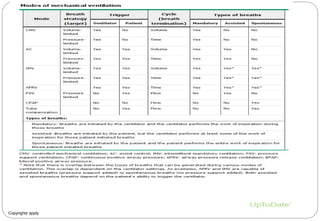
Different modes of ventilation
Introduction
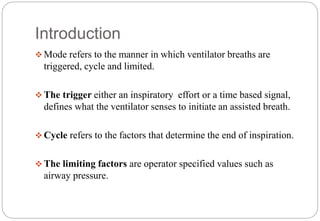
 Mode refers to the manner in which ventilator breaths are
triggered, cycle and limited.
 The trigger either an inspiratory effort or a time based signal,
defines what the ventilator senses to initiate an assisted breath.
 Cycle refers to the factors that determine the end of inspiration.
 The limiting factors are operator specified values such as
airway pressure.
Mechanical Ventilation
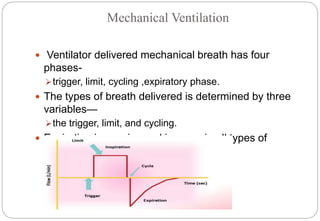
 Ventilator delivered mechanical breath has four
phases-
trigger, limit, cycling ,expiratory phase.
 The types of breath delivered is determined by three
variables—
the trigger, limit, and cycling.
 Expiration is passive and is same in all types of
breaths.
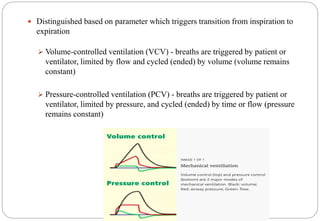
 Distinguished based on parameter which triggers transition from inspiration to
expiration
 Volume-controlled ventilation (VCV) - breaths are triggered by patient or
ventilator, limited by flow and cycled (ended) by volume (volume remains
constant)
 Pressure-controlled ventilation (PCV) - breaths are triggered by patient or
ventilator, limited by pressure, and cycled (ended) by time or flow (pressure
remains constant)
Copyrights apply
Volume limited ventilation
 Volume-limited ventilation (also called volume-controlled or
volume-cycled ventilation)
requires the clinician to set the peak flow rate, flow pattern, tidal
volume, respiratory rate, positive end-expiratory pressure (applied
PEEP, also known as extrinsic PEEP), and fraction of inspired oxygen
(FiO2).
Inspiration ends once the inspiratory time set has elapsed.
 The inspiratory time and inspiratory to expiratory (I:E) ratio are
determined by the peak inspiratory flow rate.
 Increasing the peak inspiratory flow rate will decrease inspiratory
time, increase expiratory time, and decrease the I:E ratio.
Contd…
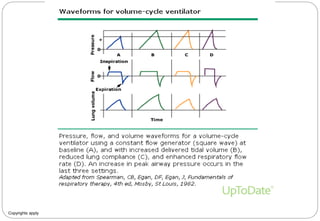
 Airway pressures (peak, plateau, and mean) depend on both the
ventilator settings and patient-related variables (eg, compliance,
airway resistance).
 High airway pressures may be a consequence of large tidal
volumes, a high peak flow, poor compliance (eg, acute
respiratory distress syndrome, minimal sedation), or increased
airway resistance
Copyrights apply
Different volume controlled modes
 Controlled mechanical ventilation (CMV)
 Assist control (AC)
 Intermittent mandatory ventilation (IMV)
 Synchronized intermittent mandatory ventilation (SIMV)
CONTROLLED MECHANICAL
VENTILATION(CMV)
 The minute ventilation is determined entirely by the set
respiratory rate and tidal volume.
 The patient does not initiate additional minute ventilation above
that set on the ventilator.
 This may be due to pharmacologic paralysis, heavy sedation,
coma, or lack of incentive to increase the minute ventilation
because the set minute ventilation meets or exceeds physiologic
need.
 CMV does not require any patient work.
Assist control(AC)
 During AC, the clinician determines the minimal minute
ventilation by setting the respiratory rate and tidal volume.
 The patient can increase the minute ventilation by triggering
additional breaths.
 Each patient-initiated breath receives the set tidal volume from
the ventilator.
Intermittent mandatory ventilation (IMV)
 IMV is similar to AC in two ways: the clinician determines the
minimal minute ventilation (by setting the respiratory rate and
tidal volume) and the patient is able to increase the minute
ventilation.
 However, IMV differs from AC in the way that the minute
ventilation is increased.
 Specifically, patients increase the minute ventilation by
spontaneous breathing, rather than patient-initiated ventilator
breaths.
Synchronized intermittent mandatory ventilation
(SIMV)
 SIMV is a variation of IMV, in which the ventilator breaths are
synchronized with patient inspiratory effort .
 SIMV (or IMV) can be used to titrate the level of ventilatory
support over a wide range . This is an advantage unique to these
modes.
 Ventilatory support can range from full support (set respiratory
rate is high enough that the patient does not overbreathe) to no
ventilatory support (set respiratory rate is zero).
PRESSURE CONTROL
VENTILATION
 Pressure-limited ventilation (also called pressure-cycled ventilation) requires the
clinician to set the inspiratory pressure level, inspiratory to expiratory (I:E) ratio,
respiratory rate, positive end-expiratory pressure (applied PEEP), and fraction of
inspired oxygen (FiO2).
 Inspiration ends after delivery of the set inspiratory pressure.
 The tidal volume is variable during pressure-limited ventilation.
 It is related to inspiratory pressure level, compliance, airway resistance, and
tubing resistance.
 Specifically, tidal volumes will be larger when the set inspiratory pressure level is
high or there is good compliance, little airway resistance, or little resistance from
the ventilator tubing.
CONTD…
 During pressure-limited controlled mechanical ventilation (CMV; also called pressure
control ventilation), the minute ventilation is determined entirely by the set respiratory rate
and inspiratory pressure level.
 The patient does not initiate additional minute ventilation above that set on the ventilator.
 During pressure-limited assist control (AC), the set respiratory rate and inspiratory pressure
level determine the minimum minute ventilation.
 The patient is able to increase the minute ventilation by triggering additional ventilator-
assisted, pressure-limited breaths.
 During pressure-limited intermittent mandatory ventilation (IMV) or synchronized
intermittent mandatory ventilation (SIMV), the set respiratory rate and inspiratory pressure
level determine the minimum minute ventilation.
 The patient is able to increase the minute ventilation by initiating spontaneous breaths.
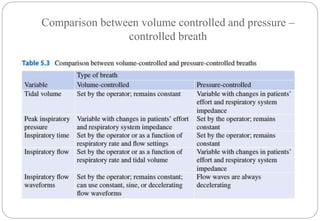
Comparison between volume controlled and pressure –
controlled breath
Volume control Vs pressure control
There were no statistically significant differences in mortality,
oxygenation, or work of breathing.
Pressure-limited ventilation, is associated with lower peak
airway pressures, a more homogeneous gas distribution (less
regional alveolar overdistension), improved patient-ventilator
synchrony, and earlier liberation from mechanical ventilation
than volume-limited ventilation.
Volume-limited ventilation can guarantee a constant tidal
volume, ensuring a minimum minute ventilation.
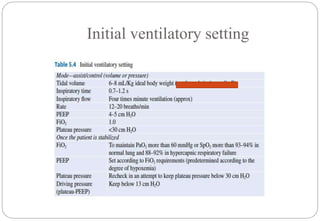
Initial ventilatory setting
Pressure support ventilation
 Pressure support ventilation (PSV) is a flow-limited mode of ventilation that
delivers inspiratory pressure until the inspiratory flow decreases to a
predetermined percentage of its peak value. This is usually 25 percent .
 For PSV, the clinician sets the pressure support level (inspiratory pressure
level), applied PEEP, and FiO2.
 The patient must trigger each breath because there is no set respiratory rate.
 The tidal volume, respiratory rate, and minute ventilation are dependent on
multiple factors, including the ventilator settings and patient-related variables
(eg, compliance, sedation). In general, a high pressure support level results in
large tidal volumes and a low respiratory rate.
Contd…
 Particularly well suited for weaning from mechanical ventilation
because it tends to be a comfortable mode, giving the patient
greater control over the inspiratory flow rate and respiratory rate.
 PSV is frequently combined with synchronized intermittent
mandatory ventilation (SIMV).
 The ventilator delivers the set respiratory rate using SIMV, but
patient-initiated breaths beyond the set respiratory rate are
delivered using PSV.
CONTINUOUS POSITIVE AIRWAY
PRESSURE
Continuous positive airway pressure (CPAP) refers to the
delivery of a continuous level of positive airway pressure.
 It is functionally similar to PEEP. The ventilator does not
cycle during CPAP, no additional pressure above the level
of CPAP is provided, and patients must initiate all breaths.
CPAP is most commonly used in the management of sleep
related breathing disorders, cardiogenic pulmonary edema,
and obesity hypoventilation syndrome
Other modes of ventilation
 Adaptive support ventilation (ASV) is a ventilatory mode in
which respiratory mechanics dictate adjustments to the
respiratory rate and inspiratory pressure that are necessary to
achieve a desired minute ventilation:-
o Patients who are unable to trigger the ventilator are given
pressure-control breaths.
o Patients who are able to trigger the ventilator are given pressure
support for the triggered breaths, supplemented with pressure-
control breaths as needed to achieve the desired respiratory rate.
 Neurally adjusted ventilatory assist ventilation (NAVA) is an
investigational ventilatory mode in which the electrical discharge
from the diaphragm (ie, diaphragmatic excitation; EAdi) is used to
trigger a mechanical breath .
o When a deflection in the EAdi signal greater than the set threshold
(typically 0.5 microvolts) is detected by a catheter embedded in a
gastric tube, a mechanical breath is delivered.
o The degree of assist varies with the amplitude of the detected
EAdi and an assist level set by the clinician such that there is breath-
to-breath variation in the tidal volume.
 Inverse ratio ventilation (IRV) is not a mode of mechanical
ventilation, but rather a strategy employed during volume-
limited or pressure-limited mechanical ventilation.
 The inspiratory time exceeds the expiratory time during IRV (the
inspiratory to expiratory [I:E] ratio is inversed), increasing the
mean airway pressure and potentially improving oxygenation.
 A trial of IRV may be warranted when a patient is severely
hypoxemic despite optimal positive end-expiratory pressure
(PEEP) and fraction of inspired oxygen (FiO2).
Thank you

Different modes of ventilation dr bikal

  • 1.
    Dr Bikal Lamichhane,IM Resident,NAMS Different modes of ventilation
  • 2.
    Introduction  Mode refersto the manner in which ventilator breaths are triggered, cycle and limited.  The trigger either an inspiratory effort or a time based signal, defines what the ventilator senses to initiate an assisted breath.  Cycle refers to the factors that determine the end of inspiration.  The limiting factors are operator specified values such as airway pressure.
  • 3.
    Mechanical Ventilation  Ventilatordelivered mechanical breath has four phases- trigger, limit, cycling ,expiratory phase.  The types of breath delivered is determined by three variables— the trigger, limit, and cycling.  Expiration is passive and is same in all types of breaths.
  • 4.
     Distinguished basedon parameter which triggers transition from inspiration to expiration  Volume-controlled ventilation (VCV) - breaths are triggered by patient or ventilator, limited by flow and cycled (ended) by volume (volume remains constant)  Pressure-controlled ventilation (PCV) - breaths are triggered by patient or ventilator, limited by pressure, and cycled (ended) by time or flow (pressure remains constant)
  • 5.
  • 6.
    Volume limited ventilation Volume-limited ventilation (also called volume-controlled or volume-cycled ventilation) requires the clinician to set the peak flow rate, flow pattern, tidal volume, respiratory rate, positive end-expiratory pressure (applied PEEP, also known as extrinsic PEEP), and fraction of inspired oxygen (FiO2). Inspiration ends once the inspiratory time set has elapsed.  The inspiratory time and inspiratory to expiratory (I:E) ratio are determined by the peak inspiratory flow rate.  Increasing the peak inspiratory flow rate will decrease inspiratory time, increase expiratory time, and decrease the I:E ratio.
  • 7.
    Contd…  Airway pressures(peak, plateau, and mean) depend on both the ventilator settings and patient-related variables (eg, compliance, airway resistance).  High airway pressures may be a consequence of large tidal volumes, a high peak flow, poor compliance (eg, acute respiratory distress syndrome, minimal sedation), or increased airway resistance
  • 8.
  • 9.
    Different volume controlledmodes  Controlled mechanical ventilation (CMV)  Assist control (AC)  Intermittent mandatory ventilation (IMV)  Synchronized intermittent mandatory ventilation (SIMV)
  • 10.
    CONTROLLED MECHANICAL VENTILATION(CMV)  Theminute ventilation is determined entirely by the set respiratory rate and tidal volume.  The patient does not initiate additional minute ventilation above that set on the ventilator.  This may be due to pharmacologic paralysis, heavy sedation, coma, or lack of incentive to increase the minute ventilation because the set minute ventilation meets or exceeds physiologic need.  CMV does not require any patient work.
  • 11.
    Assist control(AC)  DuringAC, the clinician determines the minimal minute ventilation by setting the respiratory rate and tidal volume.  The patient can increase the minute ventilation by triggering additional breaths.  Each patient-initiated breath receives the set tidal volume from the ventilator.
  • 12.
    Intermittent mandatory ventilation(IMV)  IMV is similar to AC in two ways: the clinician determines the minimal minute ventilation (by setting the respiratory rate and tidal volume) and the patient is able to increase the minute ventilation.  However, IMV differs from AC in the way that the minute ventilation is increased.  Specifically, patients increase the minute ventilation by spontaneous breathing, rather than patient-initiated ventilator breaths.
  • 13.
    Synchronized intermittent mandatoryventilation (SIMV)  SIMV is a variation of IMV, in which the ventilator breaths are synchronized with patient inspiratory effort .  SIMV (or IMV) can be used to titrate the level of ventilatory support over a wide range . This is an advantage unique to these modes.  Ventilatory support can range from full support (set respiratory rate is high enough that the patient does not overbreathe) to no ventilatory support (set respiratory rate is zero).
  • 14.
    PRESSURE CONTROL VENTILATION  Pressure-limitedventilation (also called pressure-cycled ventilation) requires the clinician to set the inspiratory pressure level, inspiratory to expiratory (I:E) ratio, respiratory rate, positive end-expiratory pressure (applied PEEP), and fraction of inspired oxygen (FiO2).  Inspiration ends after delivery of the set inspiratory pressure.  The tidal volume is variable during pressure-limited ventilation.  It is related to inspiratory pressure level, compliance, airway resistance, and tubing resistance.  Specifically, tidal volumes will be larger when the set inspiratory pressure level is high or there is good compliance, little airway resistance, or little resistance from the ventilator tubing.
  • 15.
    CONTD…  During pressure-limitedcontrolled mechanical ventilation (CMV; also called pressure control ventilation), the minute ventilation is determined entirely by the set respiratory rate and inspiratory pressure level.  The patient does not initiate additional minute ventilation above that set on the ventilator.  During pressure-limited assist control (AC), the set respiratory rate and inspiratory pressure level determine the minimum minute ventilation.  The patient is able to increase the minute ventilation by triggering additional ventilator- assisted, pressure-limited breaths.  During pressure-limited intermittent mandatory ventilation (IMV) or synchronized intermittent mandatory ventilation (SIMV), the set respiratory rate and inspiratory pressure level determine the minimum minute ventilation.  The patient is able to increase the minute ventilation by initiating spontaneous breaths.
  • 16.
    Comparison between volumecontrolled and pressure – controlled breath
  • 17.
    Volume control Vspressure control There were no statistically significant differences in mortality, oxygenation, or work of breathing. Pressure-limited ventilation, is associated with lower peak airway pressures, a more homogeneous gas distribution (less regional alveolar overdistension), improved patient-ventilator synchrony, and earlier liberation from mechanical ventilation than volume-limited ventilation. Volume-limited ventilation can guarantee a constant tidal volume, ensuring a minimum minute ventilation.
  • 18.
  • 19.
    Pressure support ventilation Pressure support ventilation (PSV) is a flow-limited mode of ventilation that delivers inspiratory pressure until the inspiratory flow decreases to a predetermined percentage of its peak value. This is usually 25 percent .  For PSV, the clinician sets the pressure support level (inspiratory pressure level), applied PEEP, and FiO2.  The patient must trigger each breath because there is no set respiratory rate.  The tidal volume, respiratory rate, and minute ventilation are dependent on multiple factors, including the ventilator settings and patient-related variables (eg, compliance, sedation). In general, a high pressure support level results in large tidal volumes and a low respiratory rate.
  • 20.
    Contd…  Particularly wellsuited for weaning from mechanical ventilation because it tends to be a comfortable mode, giving the patient greater control over the inspiratory flow rate and respiratory rate.  PSV is frequently combined with synchronized intermittent mandatory ventilation (SIMV).  The ventilator delivers the set respiratory rate using SIMV, but patient-initiated breaths beyond the set respiratory rate are delivered using PSV.
  • 21.
    CONTINUOUS POSITIVE AIRWAY PRESSURE Continuouspositive airway pressure (CPAP) refers to the delivery of a continuous level of positive airway pressure.  It is functionally similar to PEEP. The ventilator does not cycle during CPAP, no additional pressure above the level of CPAP is provided, and patients must initiate all breaths. CPAP is most commonly used in the management of sleep related breathing disorders, cardiogenic pulmonary edema, and obesity hypoventilation syndrome
  • 22.
    Other modes ofventilation  Adaptive support ventilation (ASV) is a ventilatory mode in which respiratory mechanics dictate adjustments to the respiratory rate and inspiratory pressure that are necessary to achieve a desired minute ventilation:- o Patients who are unable to trigger the ventilator are given pressure-control breaths. o Patients who are able to trigger the ventilator are given pressure support for the triggered breaths, supplemented with pressure- control breaths as needed to achieve the desired respiratory rate.
  • 23.
     Neurally adjustedventilatory assist ventilation (NAVA) is an investigational ventilatory mode in which the electrical discharge from the diaphragm (ie, diaphragmatic excitation; EAdi) is used to trigger a mechanical breath . o When a deflection in the EAdi signal greater than the set threshold (typically 0.5 microvolts) is detected by a catheter embedded in a gastric tube, a mechanical breath is delivered. o The degree of assist varies with the amplitude of the detected EAdi and an assist level set by the clinician such that there is breath- to-breath variation in the tidal volume.
  • 24.
     Inverse ratioventilation (IRV) is not a mode of mechanical ventilation, but rather a strategy employed during volume- limited or pressure-limited mechanical ventilation.  The inspiratory time exceeds the expiratory time during IRV (the inspiratory to expiratory [I:E] ratio is inversed), increasing the mean airway pressure and potentially improving oxygenation.  A trial of IRV may be warranted when a patient is severely hypoxemic despite optimal positive end-expiratory pressure (PEEP) and fraction of inspired oxygen (FiO2).
  • 25.