Chemical Equations and Reactions CHAPTER 8
What is a chemical equation?
List  and  describe  some indications of an occurrence of a chemical reaction.
List  and  describe  some indications of an occurrence of a chemical reaction.  Evolution of energy as heat and light Production of a gas Formation of a precipitate Color change
List  and  describe  some characteristics of chemical equations.
List  and  describe  some characteristics of chemical equations.  The equation must represent known facts The equation must contain the correct formulas for the reactants and products The law of conservation of mass must be satisfied
What does the arrow,   , signify?
How do you read the equation with an arrow?
How do you balance a chemical equation?
What does it mean when a chemical reaction is reversible? Give an example.
Symbols and Explanations  (s) (aq) (l) (g)
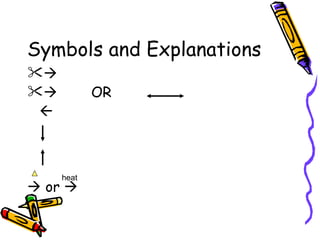
Symbols and Explanations    OR     or   heat
Reaction in a Bag Lab Overview 2 reactants CaCl 2 (calcium chloride) NaHCO 3   (sodium bicarbonate) Exothermic reactions gives off heat  (feels hot)  Endothermic reaction takes in heat  (feels cool)
Reaction in a Bag Lab Overview CaCl 2 (calcium chloride) NaHCO 3   (sodium bicarbonate) AKA baking soda Universal indicator and vinegar
Reaction in a Bag Lab Overview Describe some indications that a chemical reaction occurred.
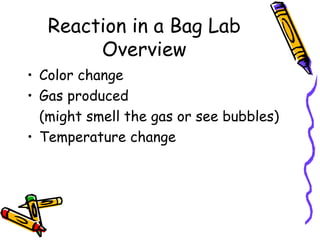
Reaction in a Bag Lab Overview Color change  Gas produced  (might smell the gas or see bubbles) Temperature  change
Elements that Normally Exist as Diatomic Molecules Hydrogen Nitrogen Oxygen Fluorine Chlorine Bromine Iodine
Which element exists as a liquid? Which element exists as a solid at room temperature?
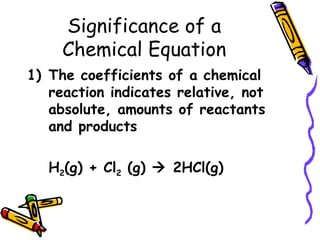
Significance of a Chemical Equation The coefficients of a chemical reaction indicates relative, not absolute, amounts of reactants and products H 2 (g) + Cl 2  (g)    2HCl(g)
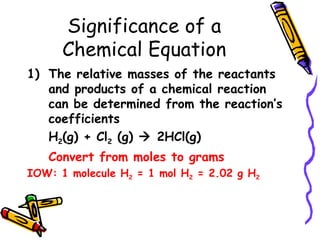
Significance of a Chemical Equation The relative masses of the reactants and products of a chemical reaction can be determined from the reaction’s coefficients H 2 (g) + Cl 2  (g)    2HCl(g) Convert from moles to grams IOW: 1 molecule H 2  = 1 mol H 2  = 2.02 g H 2
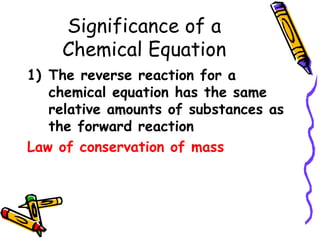
Significance of a Chemical Equation The reverse reaction for a chemical equation has the same relative amounts of substances as the forward reaction Law of conservation of mass
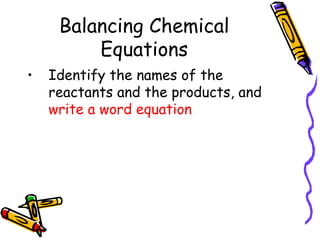
Balancing Chemical Equations Identify the names of the reactants and the products, and  write a word equation
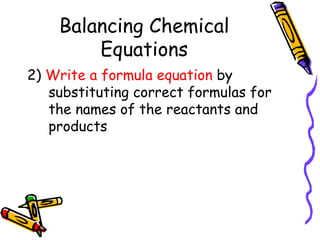
Balancing Chemical Equations 2)  Write a formula equation  by substituting correct formulas for the names of the reactants and products
Balancing Chemical Equations 3)  Balance the formula equation  according to the law of conservation of mass using coefficients
Balancing Chemical Equations 4)  CHECK!  Count atoms to be sure that the equation is balanced.
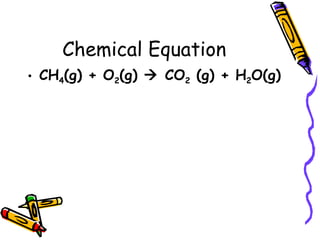
Chemical Equation CH 4 (g) + O 2 (g)    CO 2  (g) + H 2 O(g)
Try this… Write the word and balanced chemical equations for the following: Hydrogen peroxide in an aqueous solution decomposes to produce oxygen and water
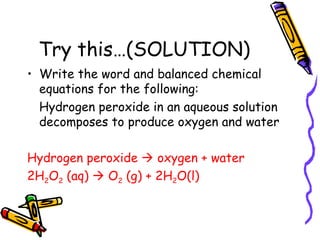
Try this…(SOLUTION) Write the word and balanced chemical equations for the following: Hydrogen peroxide in an aqueous solution decomposes to produce oxygen and water Hydrogen peroxide    oxygen + water 2H 2 O 2  (aq)    O 2  (g) + 2H 2 O(l)
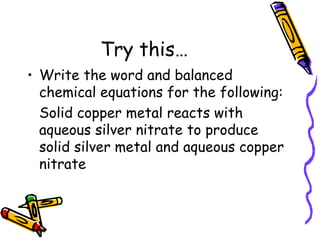
Try this… Write the word and balanced chemical equations for the following: Solid copper metal reacts with aqueous silver nitrate to produce solid silver metal and aqueous copper nitrate
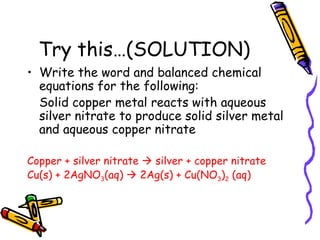
Try this…(SOLUTION) Write the word and balanced chemical equations for the following: Solid copper metal reacts with aqueous silver nitrate to produce solid silver metal and aqueous copper nitrate Copper + silver nitrate    silver + copper nitrate Cu(s) + 2AgNO 3 (aq)    2Ag(s) + Cu(NO 3 ) 2  (aq)
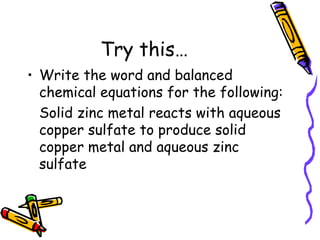
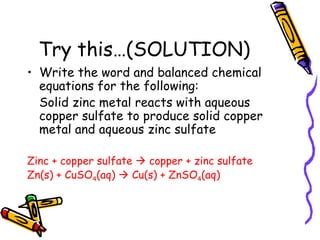
Try this… Write the word and balanced chemical equations for the following: Solid zinc metal reacts with aqueous copper sulfate to produce solid copper metal and aqueous zinc sulfate
Try this…(SOLUTION) Write the word and balanced chemical equations for the following: Solid zinc metal reacts with aqueous copper sulfate to produce solid copper metal and aqueous zinc sulfate Zinc + copper sulfate    copper + zinc sulfate Zn(s) + CuSO 4 (aq)    Cu(s) + ZnSO 4 (aq)
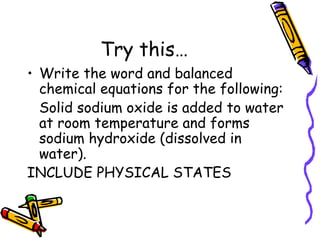
Try this… Write the word and balanced chemical equations for the following: Solid sodium oxide is added to water at room temperature and forms sodium hydroxide (dissolved in water).  INCLUDE PHYSICAL STATES
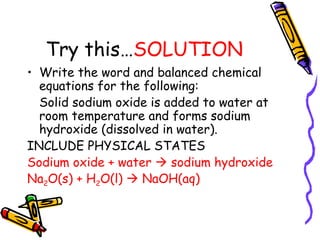
Try this… SOLUTION Write the word and balanced chemical equations for the following: Solid sodium oxide is added to water at room temperature and forms sodium hydroxide (dissolved in water).  INCLUDE PHYSICAL STATES Sodium oxide + water    sodium hydroxide Na 2 O(s) + H 2 O(l)    NaOH(aq)
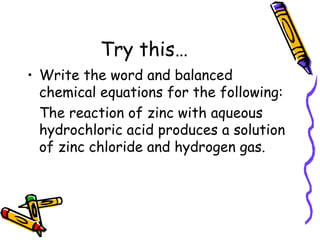
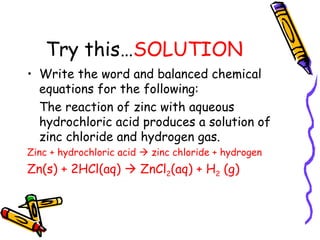
Try this… Write the word and balanced chemical equations for the following: The reaction of zinc with aqueous hydrochloric acid produces a solution of zinc chloride and hydrogen gas.
Try this… SOLUTION Write the word and balanced chemical equations for the following: The reaction of zinc with aqueous hydrochloric acid produces a solution of zinc chloride and hydrogen gas.  Zinc + hydrochloric acid    zinc chloride + hydrogen Zn(s) + 2HCl(aq)    ZnCl 2 (aq) + H 2  (g)
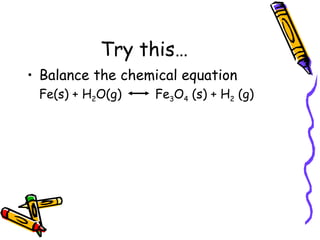
Try this… Balance the chemical equation Fe(s) + H 2 O(g) Fe 3 O 4  (s) + H 2  (g)
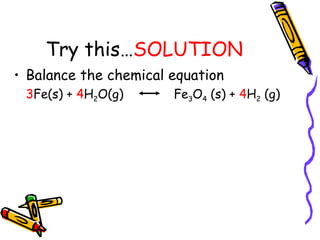
Try this… SOLUTION Balance the chemical equation 3 Fe(s) +  4 H 2 O(g) Fe 3 O 4  (s) +  4 H 2  (g)
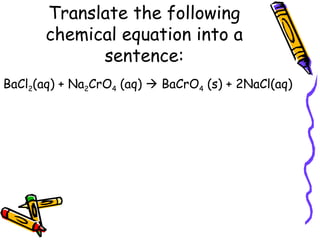
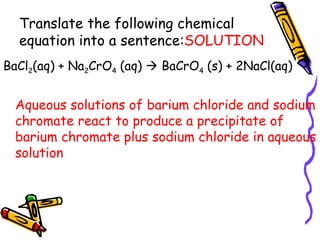
Translate the following chemical equation into a sentence: BaCl 2 (aq) + Na 2 CrO 4  (aq)    BaCrO 4  (s) + 2NaCl(aq)
Translate the following chemical  equation into a sentence: SOLUTION BaCl 2 (aq) + Na 2 CrO 4  (aq)    BaCrO 4  (s) + 2NaCl(aq) Aqueous solutions of barium chloride and sodium chromate react to produce a precipitate of barium chromate plus sodium chloride in aqueous solution
Section 2: Types of Chemical Reactions Synthesis Decomposition Single-displacement Double-displacement Combustion
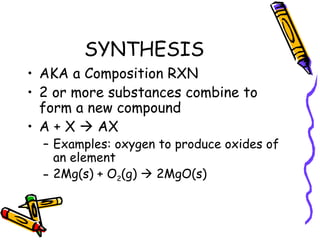
SYNTHESIS AKA a Composition RXN 2 or more substances combine to form a new compound A + X    AX Examples: oxygen to produce oxides of an element 2Mg(s) + O 2 (g)    2MgO(s)
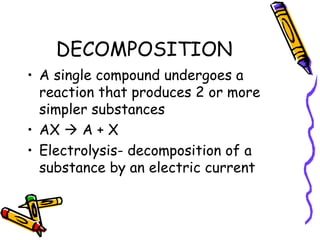
DECOMPOSITION A single compound undergoes a reaction that produces 2 or more simpler substances AX    A + X Electrolysis- decomposition of a substance by an electric current
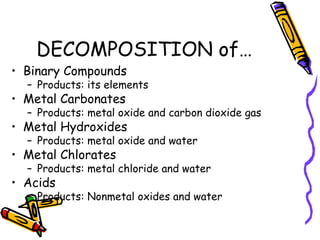
DECOMPOSITION of… Binary Compounds Products: its elements Metal Carbonates Products: metal oxide and carbon dioxide gas Metal Hydroxides Products: metal oxide and water Metal Chlorates Products: metal chloride and water Acids Products: Nonmetal oxides and water
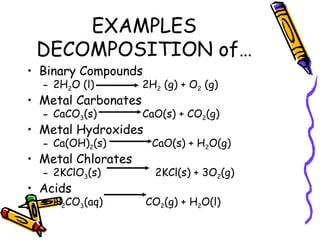
EXAMPLES DECOMPOSITION of… Binary Compounds 2H 2 O (l)    2H 2  (g) + O 2  (g) Metal Carbonates CaCO 3 (s)    CaO(s) + CO 2 (g) Metal Hydroxides Ca(OH) 2 (s)    CaO(s) + H 2 O(g) Metal Chlorates 2KClO 3 (s) 2KCl(s) + 3O 2 (g) Acids H 2 CO 3 (aq)   CO 2 (g) + H 2 O(l)
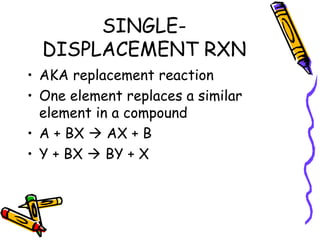
SINGLE-DISPLACEMENT RXN AKA replacement reaction One element replaces a similar element in a compound A + BX    AX + B Y + BX    BY + X
SINGLE-DISPLACEMENT RXN Use your textbook (page 281) and give the products of each type of single displacement reaction and an example.  The structure should be similar to how I did decomposition rxns
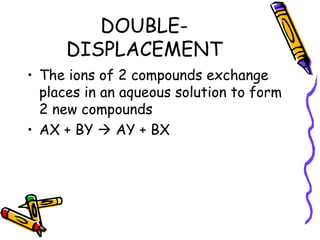
DOUBLE-DISPLACEMENT The ions of 2 compounds exchange places in an aqueous solution to form 2 new compounds AX + BY    AY + BX
DOUBLE-DISPLACEMENT Use your textbook (page 282-282) and give the products of each type of double-displacement reaction and an example.  The structure should be similar to how I did decomposition rxns (and how you did single-displacement rxns)
COMBUSTION  A substance combines with  oxygen , releasing a large amount of energy in the form of light and heat 2H 2 (g) + O 2  (g)    2H 2 O(g)
Section 3: ACTIVITY SERIES OF THE ELEMENTS Activity: ability for an element to react Activity Series: a list of elements organized according to the ease with which the elements undergo certain chemical reactions
ACTIVITY SERIES Help you predict whether or not a given reaction will occur and what the products will be
Think back for a minute… From previous knowledge, which groups can you expect to be the most and least reactive? I expect everyone to know the answer!
Activity Series Metals: greater activity    greater loss of electrons (form positive ions) Nonmetals: greater activity    greater ease of gain of electrons (form negative ions)
Activity Series The order is determined by single-displacement reactions The most-active element is at the top of the series and can replace any element below through a single-displacement reaction
Activity Series Metals: greater activity    greater loss of electrons (form positive ions) Nonmetals: greater activity    greater ease of gain of electrons (form negative ions)
Activity Series Based on experimentation Information is used as a general guide for predicting reaction outcomes
Activity Series Draw table 3 (page 286) in your notes
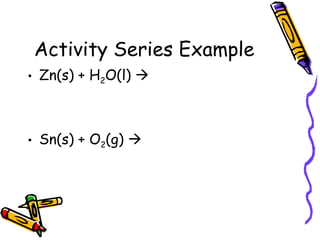
Activity Series Example Zn(s) + H 2 O(l)   Sn(s) + O 2 (g)  
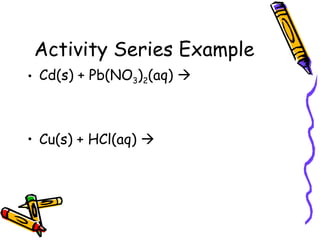
Activity Series Example Cd(s) + Pb(NO 3 ) 2 (aq)   Cu(s) + HCl(aq)  

Ch. 8 Chemical Equations And Reactions

  • 1.
    Chemical Equations andReactions CHAPTER 8
  • 2.
    What is achemical equation?
  • 3.
    List and describe some indications of an occurrence of a chemical reaction.
  • 4.
    List and describe some indications of an occurrence of a chemical reaction. Evolution of energy as heat and light Production of a gas Formation of a precipitate Color change
  • 5.
    List and describe some characteristics of chemical equations.
  • 6.
    List and describe some characteristics of chemical equations. The equation must represent known facts The equation must contain the correct formulas for the reactants and products The law of conservation of mass must be satisfied
  • 7.
    What does thearrow,  , signify?
  • 8.
    How do youread the equation with an arrow?
  • 9.
    How do youbalance a chemical equation?
  • 10.
    What does itmean when a chemical reaction is reversible? Give an example.
  • 11.
    Symbols and Explanations (s) (aq) (l) (g)
  • 12.
    Symbols and Explanations   OR   or  heat
  • 13.
    Reaction in aBag Lab Overview 2 reactants CaCl 2 (calcium chloride) NaHCO 3 (sodium bicarbonate) Exothermic reactions gives off heat (feels hot) Endothermic reaction takes in heat (feels cool)
  • 14.
    Reaction in aBag Lab Overview CaCl 2 (calcium chloride) NaHCO 3 (sodium bicarbonate) AKA baking soda Universal indicator and vinegar
  • 15.
    Reaction in aBag Lab Overview Describe some indications that a chemical reaction occurred.
  • 16.
    Reaction in aBag Lab Overview Color change Gas produced (might smell the gas or see bubbles) Temperature change
  • 17.
    Elements that NormallyExist as Diatomic Molecules Hydrogen Nitrogen Oxygen Fluorine Chlorine Bromine Iodine
  • 18.
    Which element existsas a liquid? Which element exists as a solid at room temperature?
  • 19.
    Significance of aChemical Equation The coefficients of a chemical reaction indicates relative, not absolute, amounts of reactants and products H 2 (g) + Cl 2 (g)  2HCl(g)
  • 20.
    Significance of aChemical Equation The relative masses of the reactants and products of a chemical reaction can be determined from the reaction’s coefficients H 2 (g) + Cl 2 (g)  2HCl(g) Convert from moles to grams IOW: 1 molecule H 2 = 1 mol H 2 = 2.02 g H 2
  • 21.
    Significance of aChemical Equation The reverse reaction for a chemical equation has the same relative amounts of substances as the forward reaction Law of conservation of mass
  • 22.
    Balancing Chemical EquationsIdentify the names of the reactants and the products, and write a word equation
  • 23.
    Balancing Chemical Equations2) Write a formula equation by substituting correct formulas for the names of the reactants and products
  • 24.
    Balancing Chemical Equations3) Balance the formula equation according to the law of conservation of mass using coefficients
  • 25.
    Balancing Chemical Equations4) CHECK! Count atoms to be sure that the equation is balanced.
  • 26.
    Chemical Equation CH4 (g) + O 2 (g)  CO 2 (g) + H 2 O(g)
  • 27.
    Try this… Writethe word and balanced chemical equations for the following: Hydrogen peroxide in an aqueous solution decomposes to produce oxygen and water
  • 28.
    Try this…(SOLUTION) Writethe word and balanced chemical equations for the following: Hydrogen peroxide in an aqueous solution decomposes to produce oxygen and water Hydrogen peroxide  oxygen + water 2H 2 O 2 (aq)  O 2 (g) + 2H 2 O(l)
  • 29.
    Try this… Writethe word and balanced chemical equations for the following: Solid copper metal reacts with aqueous silver nitrate to produce solid silver metal and aqueous copper nitrate
  • 30.
    Try this…(SOLUTION) Writethe word and balanced chemical equations for the following: Solid copper metal reacts with aqueous silver nitrate to produce solid silver metal and aqueous copper nitrate Copper + silver nitrate  silver + copper nitrate Cu(s) + 2AgNO 3 (aq)  2Ag(s) + Cu(NO 3 ) 2 (aq)
  • 31.
    Try this… Writethe word and balanced chemical equations for the following: Solid zinc metal reacts with aqueous copper sulfate to produce solid copper metal and aqueous zinc sulfate
  • 32.
    Try this…(SOLUTION) Writethe word and balanced chemical equations for the following: Solid zinc metal reacts with aqueous copper sulfate to produce solid copper metal and aqueous zinc sulfate Zinc + copper sulfate  copper + zinc sulfate Zn(s) + CuSO 4 (aq)  Cu(s) + ZnSO 4 (aq)
  • 33.
    Try this… Writethe word and balanced chemical equations for the following: Solid sodium oxide is added to water at room temperature and forms sodium hydroxide (dissolved in water). INCLUDE PHYSICAL STATES
  • 34.
    Try this… SOLUTIONWrite the word and balanced chemical equations for the following: Solid sodium oxide is added to water at room temperature and forms sodium hydroxide (dissolved in water). INCLUDE PHYSICAL STATES Sodium oxide + water  sodium hydroxide Na 2 O(s) + H 2 O(l)  NaOH(aq)
  • 35.
    Try this… Writethe word and balanced chemical equations for the following: The reaction of zinc with aqueous hydrochloric acid produces a solution of zinc chloride and hydrogen gas.
  • 36.
    Try this… SOLUTIONWrite the word and balanced chemical equations for the following: The reaction of zinc with aqueous hydrochloric acid produces a solution of zinc chloride and hydrogen gas. Zinc + hydrochloric acid  zinc chloride + hydrogen Zn(s) + 2HCl(aq)  ZnCl 2 (aq) + H 2 (g)
  • 37.
    Try this… Balancethe chemical equation Fe(s) + H 2 O(g) Fe 3 O 4 (s) + H 2 (g)
  • 38.
    Try this… SOLUTIONBalance the chemical equation 3 Fe(s) + 4 H 2 O(g) Fe 3 O 4 (s) + 4 H 2 (g)
  • 39.
    Translate the followingchemical equation into a sentence: BaCl 2 (aq) + Na 2 CrO 4 (aq)  BaCrO 4 (s) + 2NaCl(aq)
  • 40.
    Translate the followingchemical equation into a sentence: SOLUTION BaCl 2 (aq) + Na 2 CrO 4 (aq)  BaCrO 4 (s) + 2NaCl(aq) Aqueous solutions of barium chloride and sodium chromate react to produce a precipitate of barium chromate plus sodium chloride in aqueous solution
  • 41.
    Section 2: Typesof Chemical Reactions Synthesis Decomposition Single-displacement Double-displacement Combustion
  • 42.
    SYNTHESIS AKA aComposition RXN 2 or more substances combine to form a new compound A + X  AX Examples: oxygen to produce oxides of an element 2Mg(s) + O 2 (g)  2MgO(s)
  • 43.
    DECOMPOSITION A singlecompound undergoes a reaction that produces 2 or more simpler substances AX  A + X Electrolysis- decomposition of a substance by an electric current
  • 44.
    DECOMPOSITION of… BinaryCompounds Products: its elements Metal Carbonates Products: metal oxide and carbon dioxide gas Metal Hydroxides Products: metal oxide and water Metal Chlorates Products: metal chloride and water Acids Products: Nonmetal oxides and water
  • 45.
    EXAMPLES DECOMPOSITION of…Binary Compounds 2H 2 O (l) 2H 2 (g) + O 2 (g) Metal Carbonates CaCO 3 (s) CaO(s) + CO 2 (g) Metal Hydroxides Ca(OH) 2 (s) CaO(s) + H 2 O(g) Metal Chlorates 2KClO 3 (s) 2KCl(s) + 3O 2 (g) Acids H 2 CO 3 (aq) CO 2 (g) + H 2 O(l)
  • 46.
    SINGLE-DISPLACEMENT RXN AKAreplacement reaction One element replaces a similar element in a compound A + BX  AX + B Y + BX  BY + X
  • 47.
    SINGLE-DISPLACEMENT RXN Useyour textbook (page 281) and give the products of each type of single displacement reaction and an example. The structure should be similar to how I did decomposition rxns
  • 48.
    DOUBLE-DISPLACEMENT The ionsof 2 compounds exchange places in an aqueous solution to form 2 new compounds AX + BY  AY + BX
  • 49.
    DOUBLE-DISPLACEMENT Use yourtextbook (page 282-282) and give the products of each type of double-displacement reaction and an example. The structure should be similar to how I did decomposition rxns (and how you did single-displacement rxns)
  • 50.
    COMBUSTION Asubstance combines with oxygen , releasing a large amount of energy in the form of light and heat 2H 2 (g) + O 2 (g)  2H 2 O(g)
  • 51.
    Section 3: ACTIVITYSERIES OF THE ELEMENTS Activity: ability for an element to react Activity Series: a list of elements organized according to the ease with which the elements undergo certain chemical reactions
  • 52.
    ACTIVITY SERIES Helpyou predict whether or not a given reaction will occur and what the products will be
  • 53.
    Think back fora minute… From previous knowledge, which groups can you expect to be the most and least reactive? I expect everyone to know the answer!
  • 54.
    Activity Series Metals:greater activity  greater loss of electrons (form positive ions) Nonmetals: greater activity  greater ease of gain of electrons (form negative ions)
  • 55.
    Activity Series Theorder is determined by single-displacement reactions The most-active element is at the top of the series and can replace any element below through a single-displacement reaction
  • 56.
    Activity Series Metals:greater activity  greater loss of electrons (form positive ions) Nonmetals: greater activity  greater ease of gain of electrons (form negative ions)
  • 57.
    Activity Series Basedon experimentation Information is used as a general guide for predicting reaction outcomes
  • 58.
    Activity Series Drawtable 3 (page 286) in your notes
  • 59.
    Activity Series ExampleZn(s) + H 2 O(l)  Sn(s) + O 2 (g) 
  • 60.
    Activity Series ExampleCd(s) + Pb(NO 3 ) 2 (aq)  Cu(s) + HCl(aq) 