This Photo by Unknown Author is licensed under CC BY-NC This Photo by Unknown Author is licensed under CC BY-NC
For entire 1st Grading Period
Content Standard:
The learners demonstrate understanding of the relationship
among the locations of volcanoes, earthquake epicenters,
and mountain ranges
Performance Standard:
1. Demonstrate ways to ensure disaster preparedness
during earthquakes, tsunamis, and volcanic eruptions
2. Suggest ways by which he/she can contribute to
government efforts in reducing damage due to
earthquakes, tsunamis, and volcanic eruptions
Objectives:
•Discuss what is Plate Tectonic Theory.
•Explain how tectonic plates moves.
•Enumerate the different tectonic
plates and how they named it.
Elicit:
•Please open your menti.com
•Then answer the question
“Describe earth’s lithosphere in
one word”
Engage •Picture Gallery
Game
Engage
This Photo by Unknown Author is licensed under CC BY-SA
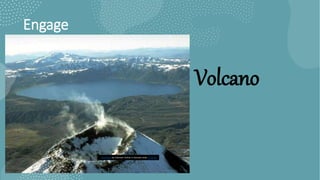
Volcano
Engage
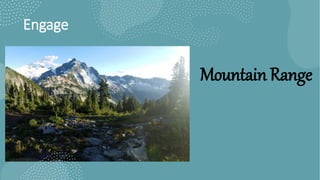
Mountain Range
Engage
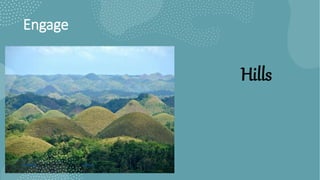
Hills
This Photo by Unknown Author is licensed under CC BY-SA
Engage
Plains
This Photo by Unknown Author is licensed under CC BY-NC-ND
Engage
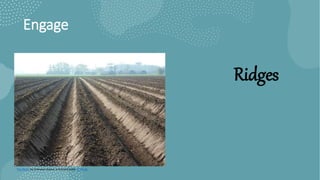
Ridges
This Photo by Unknown Author is licensed under CC BY-SA
•Choose 1
landform and
explain how it
forms.
EXPLAIN
Explain
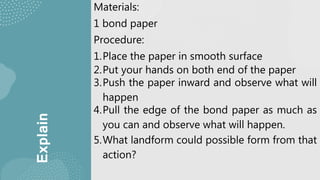
Materials:
1 bond paper
Procedure:
1.Place the paper in smooth surface
2.Put your hands on both end of the paper
3.Push the paper inward and observe what will
happen
4.Pull the edge of the bond paper as much as
you can and observe what will happen.
5.What landform could possible form from that
action?
Explain
Guide Questions:
1.What happen as you push the paper
inward?
2.Why does it happen?
3.What landform could possible form
from that action?
4.What happen as you pull the paper
outward?
5.Why does it happen?
6.What landform could possible form
from that action?
Explain:
Discuss the guide questions
Plate
Tectonic
Theory
• Theory that Earth's
outer shell is divided
into several plates
that glide over the
mantle, the rocky
inner layer above the
core.
Plate
Tectonic
Theory
•Developed from the
1950s through the
1970s, plate tectonics is
the modern version of
continental drift, a
theory first proposed by
scientist Alfred Wegener
in 1912.
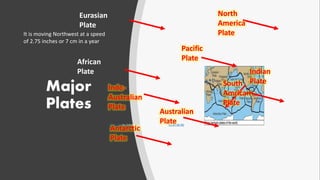
Major
Plates
This Photo by Unknown Author is licensed under CC BY-SA-NC
Eurasian
Plate
African
Plate Indian
Plate
South
Amrican
Plate
Australian
Plate
Antarctic
Plate
Pacific
Plate
North
America
Plate
Indo-
Australian
Plate
It is moving Northwest at a speed
of 2.75 inches or 7 cm in a year
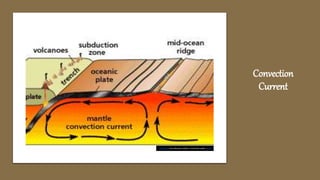
Plate Tectonics
•The driving force
of plate tectonic
is the Convection
Current.
Convection
Current
This Photo by Unknown Author is licensed under CC BY
ELABORATE:
Using the jamboard.
Answer this question:
What are the things or phenomenon that is
related to Plate Tectonic Theory?
1. What is plate tectonic
theory?
ELABORATE:
2. Explain how plate
moves?
3. What are the different
tectonic plates and how
they named it?
Evaluatio
n • Please proceed to your google classroom to
answer your short quiz
Extend
Check your assignment in
google classroom
•1. Define volcanoes
•2. Named some active
volcanoes in the Philippines
and their locations.
•3. Where do we usually find
an active volcano?
Lesson 1 in science 10

Lesson 1 in science 10

  • 2.
    This Photo byUnknown Author is licensed under CC BY-NC This Photo by Unknown Author is licensed under CC BY-NC For entire 1st Grading Period Content Standard: The learners demonstrate understanding of the relationship among the locations of volcanoes, earthquake epicenters, and mountain ranges Performance Standard: 1. Demonstrate ways to ensure disaster preparedness during earthquakes, tsunamis, and volcanic eruptions 2. Suggest ways by which he/she can contribute to government efforts in reducing damage due to earthquakes, tsunamis, and volcanic eruptions
  • 3.
    Objectives: •Discuss what isPlate Tectonic Theory. •Explain how tectonic plates moves. •Enumerate the different tectonic plates and how they named it.
  • 4.
    Elicit: •Please open yourmenti.com •Then answer the question “Describe earth’s lithosphere in one word”
  • 5.
  • 6.
    Engage This Photo byUnknown Author is licensed under CC BY-SA Volcano
  • 7.
  • 8.
    Engage Hills This Photo byUnknown Author is licensed under CC BY-SA
  • 9.
    Engage Plains This Photo byUnknown Author is licensed under CC BY-NC-ND
  • 10.
    Engage Ridges This Photo byUnknown Author is licensed under CC BY-SA
  • 11.
  • 12.
  • 13.
    Explain Materials: 1 bond paper Procedure: 1.Placethe paper in smooth surface 2.Put your hands on both end of the paper 3.Push the paper inward and observe what will happen 4.Pull the edge of the bond paper as much as you can and observe what will happen. 5.What landform could possible form from that action?
  • 14.
    Explain Guide Questions: 1.What happenas you push the paper inward? 2.Why does it happen? 3.What landform could possible form from that action? 4.What happen as you pull the paper outward? 5.Why does it happen? 6.What landform could possible form from that action?
  • 15.
  • 16.
    Plate Tectonic Theory • Theory thatEarth's outer shell is divided into several plates that glide over the mantle, the rocky inner layer above the core.
  • 17.
    Plate Tectonic Theory •Developed from the 1950sthrough the 1970s, plate tectonics is the modern version of continental drift, a theory first proposed by scientist Alfred Wegener in 1912.
  • 18.
    Major Plates This Photo byUnknown Author is licensed under CC BY-SA-NC Eurasian Plate African Plate Indian Plate South Amrican Plate Australian Plate Antarctic Plate Pacific Plate North America Plate Indo- Australian Plate It is moving Northwest at a speed of 2.75 inches or 7 cm in a year
  • 19.
    Plate Tectonics •The drivingforce of plate tectonic is the Convection Current.
  • 20.
    Convection Current This Photo byUnknown Author is licensed under CC BY This Photo by Unknown Author is licensed under CC BY
  • 21.
    ELABORATE: Using the jamboard. Answerthis question: What are the things or phenomenon that is related to Plate Tectonic Theory?
  • 22.
    1. What isplate tectonic theory? ELABORATE: 2. Explain how plate moves? 3. What are the different tectonic plates and how they named it?
  • 23.
    Evaluatio n • Pleaseproceed to your google classroom to answer your short quiz
  • 24.
    Extend Check your assignmentin google classroom •1. Define volcanoes •2. Named some active volcanoes in the Philippines and their locations. •3. Where do we usually find an active volcano?