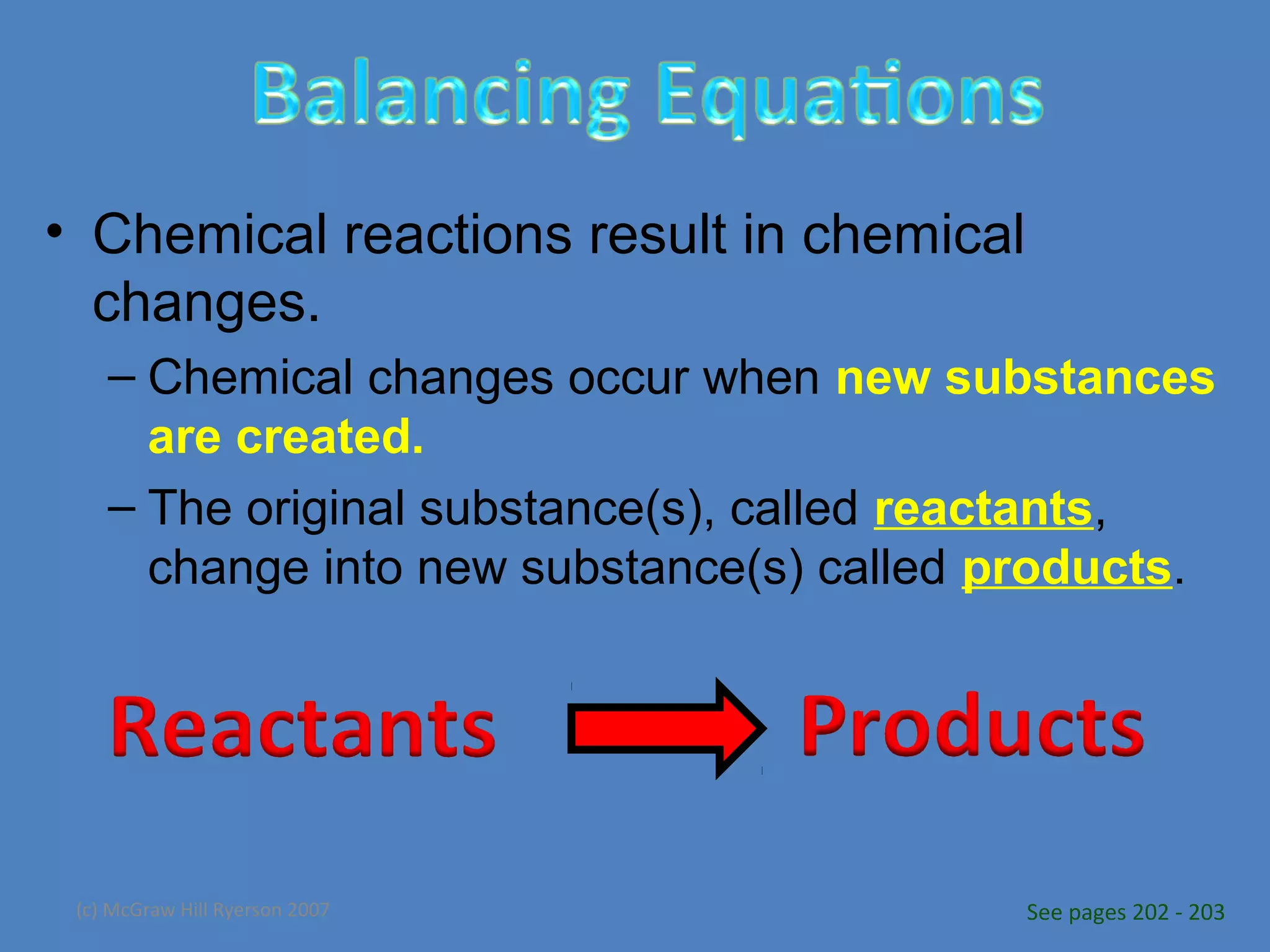
• Chemical reactions result in chemical
changes.
– Chemical changes occur when new substances
are created.
– The original substance(s), called reactants,
change into new substance(s) called products.

(c) McGraw Hill Ryerson 2007

See pages 202 - 203
(c) McGraw Hill Ryerson 2007

See pages 202 - 203
• Chemical reactions can be written in different
ways.
– A word equation:
• Nitrogen monoxide + oxygen → nitrogen dioxide

– A symbolic equation:
• 2NO(g) + O2(g) → 2NO2(g)
COEFFICIENTS

STATE OF MATTER
- Letters indicate the state of
each compound.
(aq) = aqueous/dissolved in
water

- Indicates how many of each
molecule there is.

(s) = solid

-Ie: there are 2 molecules of NO.

(g) = gas

(c) McGraw Hill Ryerson 2007

( ) = liquid
• When a chemical reaction occurs, new compounds are
created, BUT…
– No new matter is created or destroyed; atoms are
destroyed
just rearranged as the atoms change partners to form
new compounds.
– If there are 3 atoms of oxygen in the reactants, there
MUST be 3 atoms of oxygen in the products.
– Number of each atom in reactants = number of each
atom in products.
• The law of conservation of mass:
– Mass of reactants = mass of products
If you could collect and measure all of the exhaust from
this car, you would find that mass of reactants (gas + O2) =
mass of products (exhaust).
(c) McGraw Hill Ryerson 2007
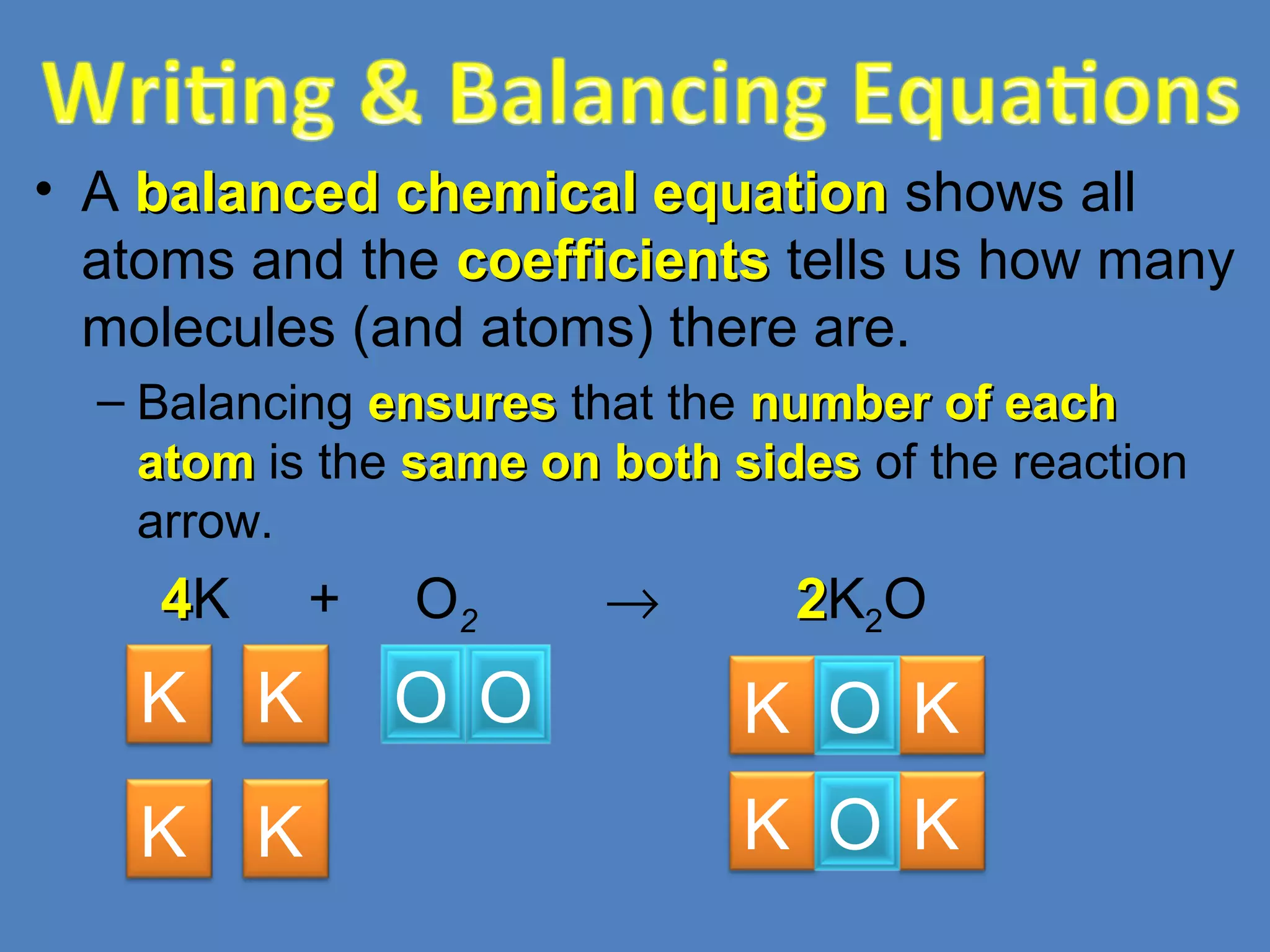
• A balanced chemical equation shows all
atoms and the coefficients tells us how many
molecules (and atoms) there are.
– Balancing ensures that the number of each
atom is the same on both sides of the reaction
arrow.

4K

K K
K K

+

O2

O O

→

2K2O

K O K
K O K
Skeleton equation:
The same number
of atoms must be on
each side.

Balanced equation:

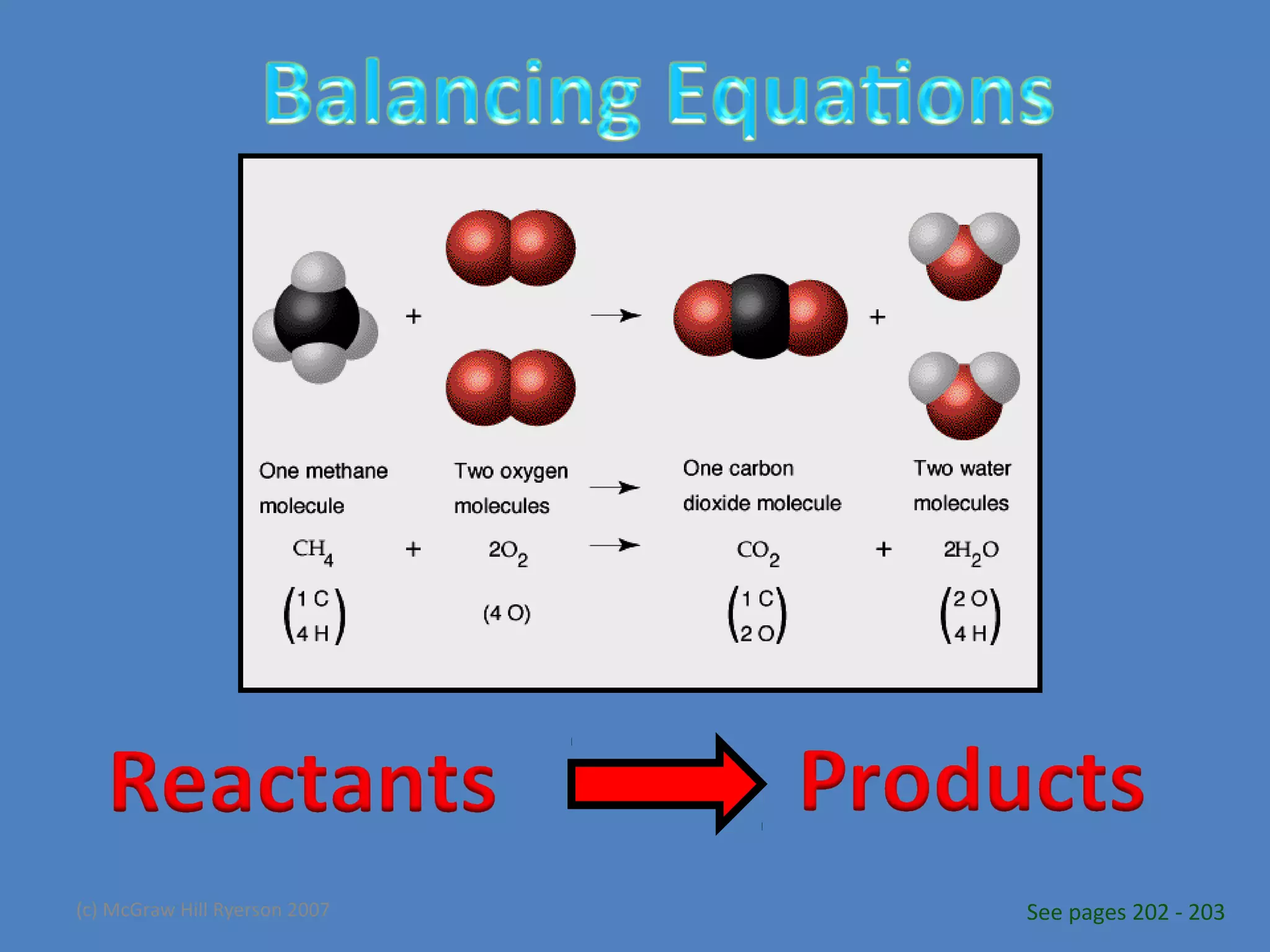
CH4 + O2 → H2O + CO2
Carbon = 1
Hydrogen = 4
Oxygen = 2

Carbon = 1
Hydrogen = 2
Oxygen = 3

CH4 + 2O2 → 2H2O + CO2
Carbon = 1
Hydrogen = 4
Oxygen = 4

(c) McGraw Hill Ryerson 2007

Carbon = 1
Hydrogen = 4
Oxygen = 4

See Page 207
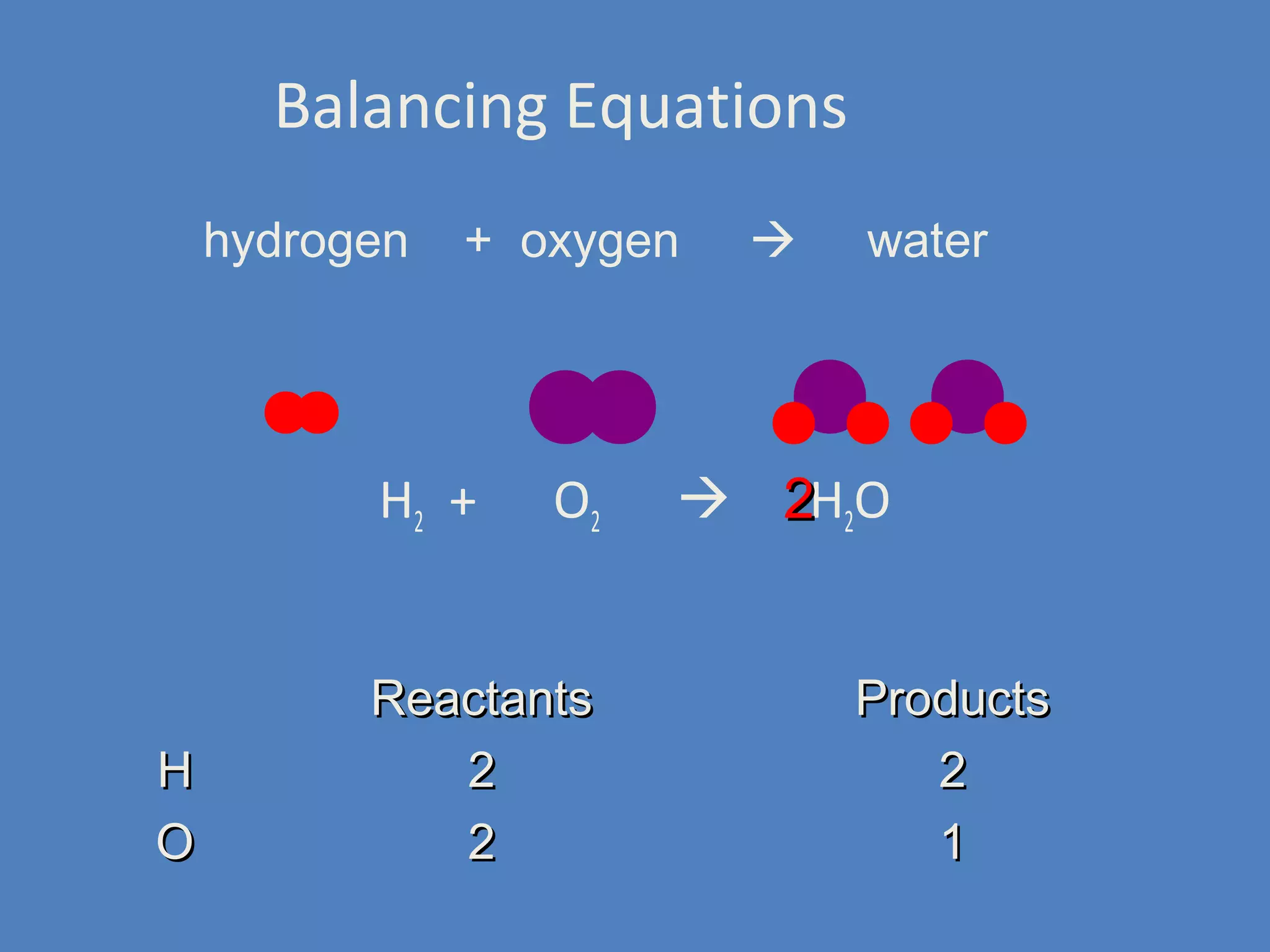
Balancing Equations
hydrogen

+ oxygen

H2 +

H
O

O2





water

H2O

Reactants
2

Products
2

2

1
Balancing Equations
+ oxygen



hydrogen peroxide

X

hydrogen

H2 +

O2



H2O2

YOU CANNOT CHANGE THE SUBSCRIPTS
H
O

Reactants
2
2

Products
2
2
Balancing Equations
hydrogen

+ oxygen

H2 +

H
O

O2

Reactants
2
2



water

 2H2O
Products
2
1
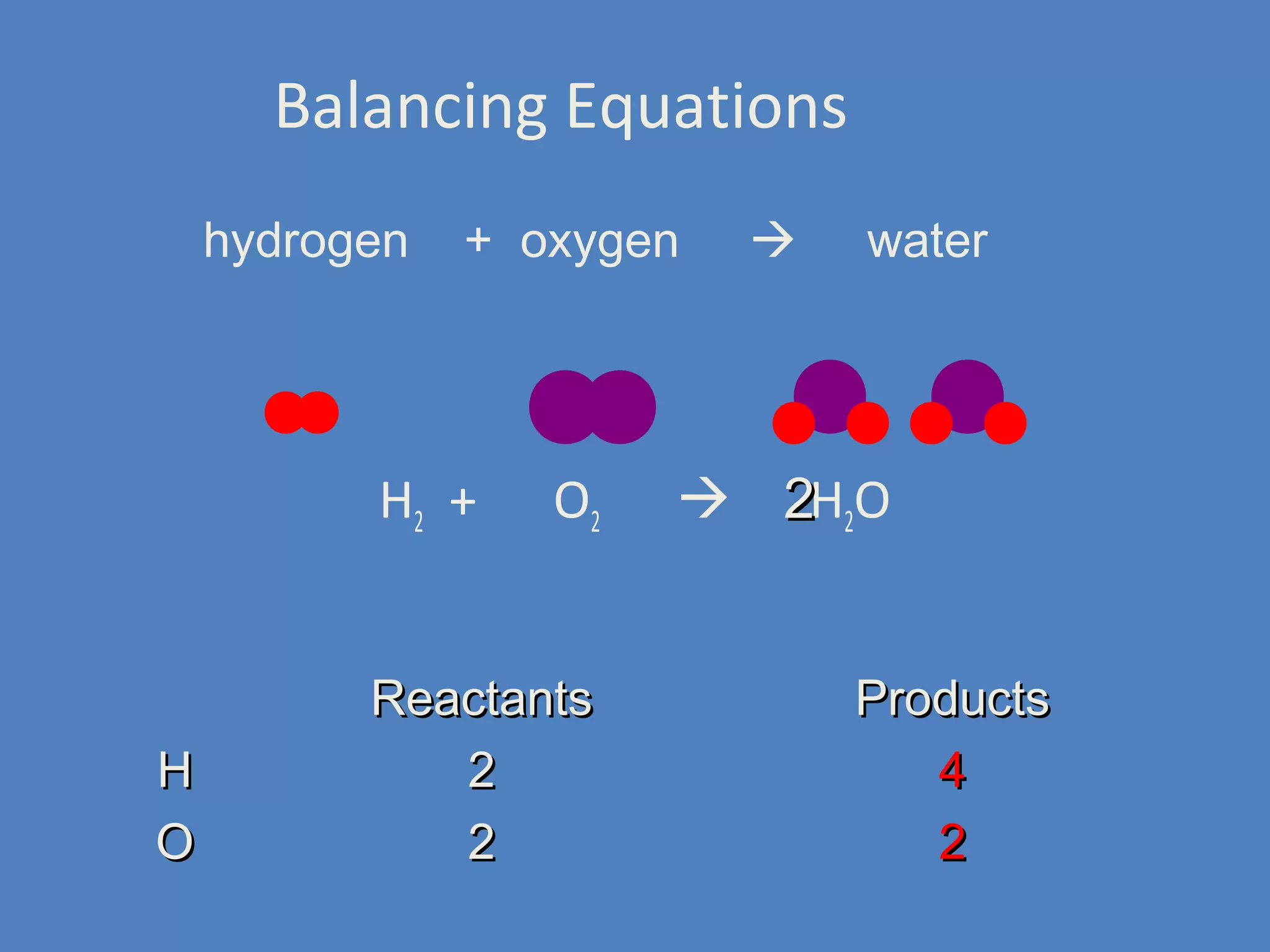
Balancing Equations
hydrogen

+ oxygen

H2 +

H
O

O2

Reactants
2
2



water

 2H2O
Products
4
2
Balancing Equations
hydrogen

+ oxygen

2 H(g) +
2

H
O

O2

Reactants
4
2

(g)



water

 2H2O

(l)

Products
4
2
http://www.authorstream.com/Presentation/kellymdeters-86103-section-2-7-balancin
• Balance the following:
– ____Fe + ____Br2 → _____FeBr3

Sn(NO2)4 +

C2H6 +

K3PO4 →

O2 →

KNO2 +

CO2 +

H2O

Sn3 (PO4)4
____Ba + ____H2O

____CO2 + ____H2O

→

→

____Ba(OH)2 + ____H2

____H2CO3

____Fe2O3 + ____C

→

____Fe + ____CO

____Fe + ____H2O

→

____H2 + ____Fe2O3

Balancing equations

  • 1.
    • Chemical reactionsresult in chemical changes. – Chemical changes occur when new substances are created. – The original substance(s), called reactants, change into new substance(s) called products. (c) McGraw Hill Ryerson 2007 See pages 202 - 203
  • 2.
    (c) McGraw HillRyerson 2007 See pages 202 - 203
  • 3.
    • Chemical reactionscan be written in different ways. – A word equation: • Nitrogen monoxide + oxygen → nitrogen dioxide – A symbolic equation: • 2NO(g) + O2(g) → 2NO2(g) COEFFICIENTS STATE OF MATTER - Letters indicate the state of each compound. (aq) = aqueous/dissolved in water - Indicates how many of each molecule there is. (s) = solid -Ie: there are 2 molecules of NO. (g) = gas (c) McGraw Hill Ryerson 2007 ( ) = liquid
  • 4.
    • When achemical reaction occurs, new compounds are created, BUT… – No new matter is created or destroyed; atoms are destroyed just rearranged as the atoms change partners to form new compounds. – If there are 3 atoms of oxygen in the reactants, there MUST be 3 atoms of oxygen in the products. – Number of each atom in reactants = number of each atom in products. • The law of conservation of mass: – Mass of reactants = mass of products If you could collect and measure all of the exhaust from this car, you would find that mass of reactants (gas + O2) = mass of products (exhaust). (c) McGraw Hill Ryerson 2007
  • 5.
    • A balancedchemical equation shows all atoms and the coefficients tells us how many molecules (and atoms) there are. – Balancing ensures that the number of each atom is the same on both sides of the reaction arrow. 4K K K K K + O2 O O → 2K2O K O K K O K
  • 6.
    Skeleton equation: The samenumber of atoms must be on each side. Balanced equation: CH4 + O2 → H2O + CO2 Carbon = 1 Hydrogen = 4 Oxygen = 2 Carbon = 1 Hydrogen = 2 Oxygen = 3 CH4 + 2O2 → 2H2O + CO2 Carbon = 1 Hydrogen = 4 Oxygen = 4 (c) McGraw Hill Ryerson 2007 Carbon = 1 Hydrogen = 4 Oxygen = 4 See Page 207
  • 7.
    Balancing Equations hydrogen + oxygen H2+ H O O2   water H2O Reactants 2 Products 2 2 1
  • 8.
    Balancing Equations + oxygen  hydrogenperoxide X hydrogen H2 + O2  H2O2 YOU CANNOT CHANGE THE SUBSCRIPTS H O Reactants 2 2 Products 2 2
  • 9.
    Balancing Equations hydrogen + oxygen H2+ H O O2 Reactants 2 2  water  2H2O Products 2 1
  • 10.
    Balancing Equations hydrogen + oxygen H2+ H O O2 Reactants 2 2  water  2H2O Products 4 2
  • 11.
    Balancing Equations hydrogen + oxygen 2H(g) + 2 H O O2 Reactants 4 2 (g)  water  2H2O (l) Products 4 2
  • 12.
  • 13.
    • Balance thefollowing: – ____Fe + ____Br2 → _____FeBr3 Sn(NO2)4 + C2H6 + K3PO4 → O2 → KNO2 + CO2 + H2O Sn3 (PO4)4
  • 14.
    ____Ba + ____H2O ____CO2+ ____H2O → → ____Ba(OH)2 + ____H2 ____H2CO3 ____Fe2O3 + ____C → ____Fe + ____CO ____Fe + ____H2O → ____H2 + ____Fe2O3

Editor's Notes