Sergimage
TTyyppeess ooff 
ddaattaa 
Sergimage
Sergimage 
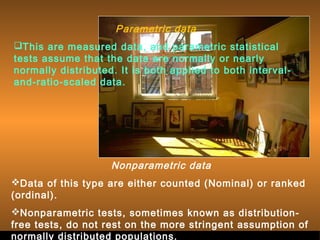
Parametric data 
This are measured data, and parametric statistical 
tests assume that the data are normally or nearly 
normally distributed. It is both applied to both interval-and- 
ratio-scaled data. 
Nonparametric data 
Data of this type are either counted (Nominal) or ranked 
(ordinal). 
Nonparametric tests, sometimes known as distribution-free 
tests, do not rest on the more stringent assumption of 
normally distributed populations. .
Sergimage 
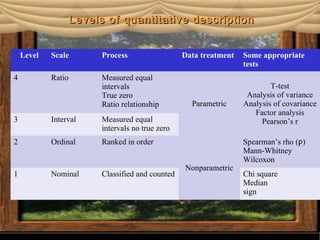
Levels of quantitative ddeessccrriippttiioonn 
Level Scale Process Data treatment Some appropriate 
tests 
4 Ratio Measured equal 
intervals 
True zero 
Ratio relationship Parametric 
T-test 
Analysis of variance 
Analysis of covariance 
Factor analysis 
3 Interval Measured equal Pearson’s r 
intervals no true zero 
2 Ordinal Ranked in order 
Nonparametric 
Spearman’s rho (ƿ) 
Mann-Whitney 
Wilcoxon 
1 Nominal Classified and counted Chi square 
Median 
sign
DDeessccrriippttiivvee 
Sergimage 
aanndd 
iinnffeerreennttiiaall 
aannaallyyssiiss
Descriptive Analysis 
Limits generalization to the 
particular group of individuals 
observed. 
No conclusions are 
extended beyond this group, 
and any similarity to those 
outside the group cannot be 
assumed. 
The data describe one 
group and that group only. 
Sergimage 
.
Sergimage 
Example of descriptive analysis 
Descriptive research 
 Deals with the relationships between variables, the 
testing of hypothesis, and the development of 
generalizations, principles, or theories that have 
universal validity. 
 They involve hypothesis formulation and testing 
 They use logical methods of inductive-deductive 
reasoning to arrive at generalization. 
 They often employ methods or randomization so that 
error may be estimated when population 
characteristics are inferred from observations of 
samples. 
 The variables and procedures are described as 
accurately and completely as possible so that the 
study can be replicated by other researcher.s.
Sergimage 
Inferential analysis 
Always involves the process of sampling and the 
selection of a small group assumed to be related to the 
population from which it is drawn. 
The small group is known as the sample , and the large 
group is the population. 
Drawing conclusions about populations based on 
observations of samples is the purpose of inferential 
analysis. .
Statistic: 
Is a measure based on observations of the 
characteristics of a sample/ 
A statistic computed from a sample may be 
used to estimate a parameter, the 
corresponding value in the population from 
which the sample is selected. 
Statistics are usually represented by 
letters of our Roman alphabet such as X, S 
and r. 
Parameters are usually represented by 
letters of the Greek such as μ, ƿ, σ 
Sergimage 
.
Statistic: 
Is a measure based on observations of the 
characteristics of a sample/ 
A statistic computed from a sample may be 
used to estimate a parameter, the 
corresponding value in the population from 
which the sample is selected. 
Statistics are usually represented by 
letters of our Roman alphabet such as X, S 
and r. 
Parameters are usually represented by 
letters of the Greek such as μ, ƿ, σ 
Sergimage 
.

Research

  • 1.
  • 2.
  • 3.
    Sergimage Parametric data This are measured data, and parametric statistical tests assume that the data are normally or nearly normally distributed. It is both applied to both interval-and- ratio-scaled data. Nonparametric data Data of this type are either counted (Nominal) or ranked (ordinal). Nonparametric tests, sometimes known as distribution-free tests, do not rest on the more stringent assumption of normally distributed populations. .
  • 4.
    Sergimage Levels ofquantitative ddeessccrriippttiioonn Level Scale Process Data treatment Some appropriate tests 4 Ratio Measured equal intervals True zero Ratio relationship Parametric T-test Analysis of variance Analysis of covariance Factor analysis 3 Interval Measured equal Pearson’s r intervals no true zero 2 Ordinal Ranked in order Nonparametric Spearman’s rho (ƿ) Mann-Whitney Wilcoxon 1 Nominal Classified and counted Chi square Median sign
  • 5.
    DDeessccrriippttiivvee Sergimage aanndd iinnffeerreennttiiaall aannaallyyssiiss
  • 6.
    Descriptive Analysis Limitsgeneralization to the particular group of individuals observed. No conclusions are extended beyond this group, and any similarity to those outside the group cannot be assumed. The data describe one group and that group only. Sergimage .
  • 7.
    Sergimage Example ofdescriptive analysis Descriptive research  Deals with the relationships between variables, the testing of hypothesis, and the development of generalizations, principles, or theories that have universal validity.  They involve hypothesis formulation and testing  They use logical methods of inductive-deductive reasoning to arrive at generalization.  They often employ methods or randomization so that error may be estimated when population characteristics are inferred from observations of samples.  The variables and procedures are described as accurately and completely as possible so that the study can be replicated by other researcher.s.
  • 8.
    Sergimage Inferential analysis Always involves the process of sampling and the selection of a small group assumed to be related to the population from which it is drawn. The small group is known as the sample , and the large group is the population. Drawing conclusions about populations based on observations of samples is the purpose of inferential analysis. .
  • 9.
    Statistic: Is ameasure based on observations of the characteristics of a sample/ A statistic computed from a sample may be used to estimate a parameter, the corresponding value in the population from which the sample is selected. Statistics are usually represented by letters of our Roman alphabet such as X, S and r. Parameters are usually represented by letters of the Greek such as μ, ƿ, σ Sergimage .
  • 10.
    Statistic: Is ameasure based on observations of the characteristics of a sample/ A statistic computed from a sample may be used to estimate a parameter, the corresponding value in the population from which the sample is selected. Statistics are usually represented by letters of our Roman alphabet such as X, S and r. Parameters are usually represented by letters of the Greek such as μ, ƿ, σ Sergimage .