Chemical
Changes/Reaction
Changes Occurring in Food Processing
Objectives
• Content Standard
• Explain the different process that occurs in food processing.
• Performance Standard
• Choose one way of preserving foods and explain the changes
that occurs during the preservation, storage and utilization
• Learning Competencies
• Discuss the changes occurring during food processing, storage
and utilization
Unpacked Learning Competencies
•Explain chemical changes
•Discuss the different type of chemical
reaction
•Identify which among these chemical
reaction is common in food processing.
Elicit
•3 volunteers to discussed
what they have learned
from the previous lesson
This Photo by
Unknown Author is
licensed under CC
BY-SA-NC
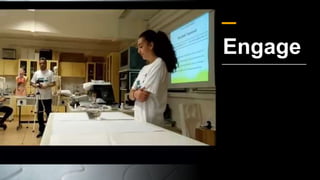
Engage
Explore
•What can you infer in the video that you
have just watched?
•Could this chemical reaction will also be
found in food processing? Explain your
answer.
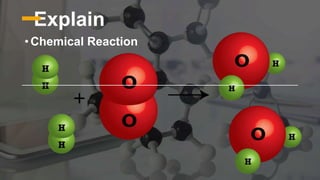
Explain
• Chemical Reaction
• A process in which one or more substances, the
reactants, are converted to one or more different
substances, the products.
• Substances are either chemical elements or
compounds.
• A chemical reaction rearranges the constituent
atoms of the reactants to create different
substances as products.
Explain
• Chemical Reaction
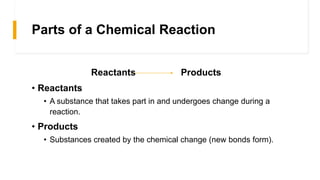
Parts of a Chemical Reaction
Reactants Products
• Reactants
• A substance that takes part in and undergoes change during a
reaction.
• Products
• Substances created by the chemical change (new bonds form).
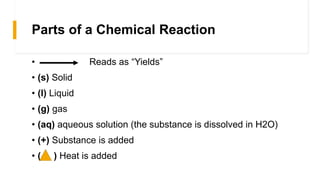
Parts of a Chemical Reaction
• Reads as “Yields”
• (s) Solid
• (l) Liquid
• (g) gas
• (aq) aqueous solution (the substance is dissolved in H2O)
• (+) Substance is added
• ( ) Heat is added
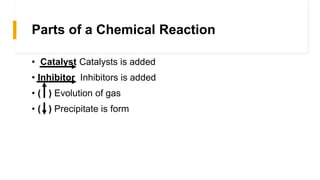
Parts of a Chemical Reaction
• Catalyst Catalysts is added
• Inhibitor Inhibitors is added
• ( ) Evolution of gas
• ( ) Precipitate is form
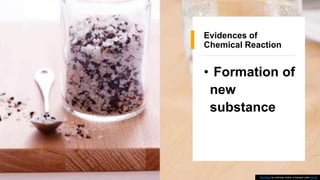
Evidences of
Chemical Reaction
• Formation of
new
substance
This Photo by Unknown Author is licensed under CC BY
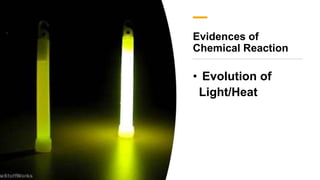
Evidences of
Chemical Reaction
• Evolution of
Light/Heat
Evidences of
Chemical Reaction
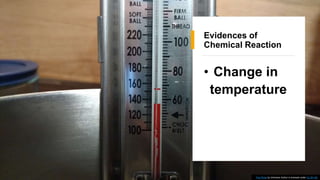
• Change in
temperature
This Photo by Unknown Author is licensed under CC BY-SA
Evidences of
Chemical Reaction
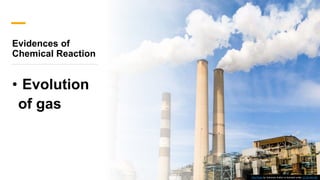
• Evolution
of gas
This Photo by Unknown Author is licensed under CC BY-NC-ND
Evidences of
Chemical Reaction
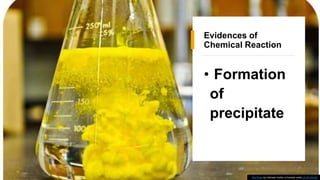
• Formation
of
precipitate
This Photo by Unknown Author is licensed under CC BY-SA-NC
Evidences of
Chemical Reaction
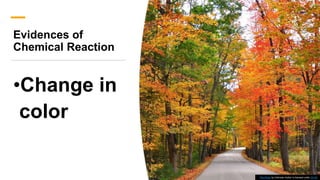
•Change in
color
This Photo by Unknown Author is licensed under CC BY
Elaborate
This Photo by Unknown Author is licensed under CC BY-SA-NC
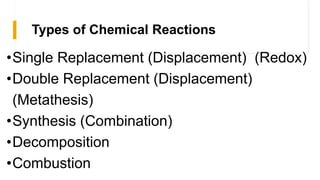
Types of Chemical Reactions
•Single Replacement (Displacement) (Redox)
•Double Replacement (Displacement)
(Metathesis)
•Synthesis (Combination)
•Decomposition
•Combustion
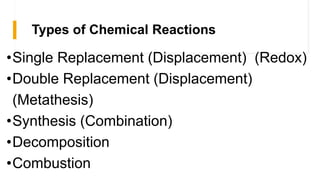
Types of Chemical Reactions
•Single Replacement (Displacement) (Redox)
•Double Replacement (Displacement)
(Metathesis)
•Synthesis (Combination)
•Decomposition
•Combustion

Chemical changes

  • 1.
  • 2.
    Objectives • Content Standard •Explain the different process that occurs in food processing. • Performance Standard • Choose one way of preserving foods and explain the changes that occurs during the preservation, storage and utilization • Learning Competencies • Discuss the changes occurring during food processing, storage and utilization
  • 3.
    Unpacked Learning Competencies •Explainchemical changes •Discuss the different type of chemical reaction •Identify which among these chemical reaction is common in food processing.
  • 4.
    Elicit •3 volunteers todiscussed what they have learned from the previous lesson This Photo by Unknown Author is licensed under CC BY-SA-NC
  • 5.
  • 6.
    Explore •What can youinfer in the video that you have just watched? •Could this chemical reaction will also be found in food processing? Explain your answer.
  • 7.
    Explain • Chemical Reaction •A process in which one or more substances, the reactants, are converted to one or more different substances, the products. • Substances are either chemical elements or compounds. • A chemical reaction rearranges the constituent atoms of the reactants to create different substances as products.
  • 8.
  • 9.
    Parts of aChemical Reaction Reactants Products • Reactants • A substance that takes part in and undergoes change during a reaction. • Products • Substances created by the chemical change (new bonds form).
  • 10.
    Parts of aChemical Reaction • Reads as “Yields” • (s) Solid • (l) Liquid • (g) gas • (aq) aqueous solution (the substance is dissolved in H2O) • (+) Substance is added • ( ) Heat is added
  • 11.
    Parts of aChemical Reaction • Catalyst Catalysts is added • Inhibitor Inhibitors is added • ( ) Evolution of gas • ( ) Precipitate is form
  • 12.
    Evidences of Chemical Reaction •Formation of new substance This Photo by Unknown Author is licensed under CC BY
  • 13.
    Evidences of Chemical Reaction •Evolution of Light/Heat
  • 14.
    Evidences of Chemical Reaction •Change in temperature This Photo by Unknown Author is licensed under CC BY-SA
  • 15.
    Evidences of Chemical Reaction •Evolution of gas This Photo by Unknown Author is licensed under CC BY-NC-ND
  • 16.
    Evidences of Chemical Reaction •Formation of precipitate This Photo by Unknown Author is licensed under CC BY-SA-NC
  • 17.
    Evidences of Chemical Reaction •Changein color This Photo by Unknown Author is licensed under CC BY
  • 18.
    Elaborate This Photo byUnknown Author is licensed under CC BY-SA-NC
  • 19.
    Types of ChemicalReactions •Single Replacement (Displacement) (Redox) •Double Replacement (Displacement) (Metathesis) •Synthesis (Combination) •Decomposition •Combustion
  • 20.
    Types of ChemicalReactions •Single Replacement (Displacement) (Redox) •Double Replacement (Displacement) (Metathesis) •Synthesis (Combination) •Decomposition •Combustion