CHEMICAL
REACTIONS
Week 5
OBJECTIVES:
• Apply the principles of conservation of mass to chemical reactions.
• Specifically:
• Explain chemical reactions
• Identify and describe the types of chemical reactions
• Balance the chemical equations
• A chemical reaction refers to a process in which atoms of the same different elements
rearrange themselves to form a new substance.
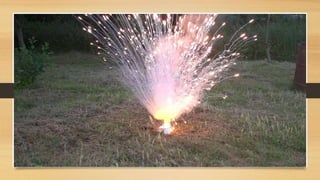
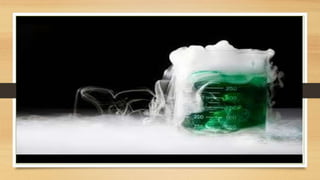
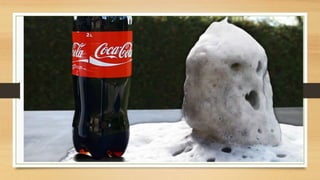
• There are several indicators that a chemical reaction has taken place such as: gas bubbles
appear; formation of precipitate; color change; temperature change; production of
light; volume change and change in smell or taste.
• Chemical reactions can be represented by chemical equations. The equation distinguishes
between the reactants, which are the starting materials and the products which are resulting
substance/s.
• It shows the symbols or formulas of the reactants and products, the phases (gas, solid,
liquid) of these substances, and the ratio of the substances as they react. Example: Zn
+ S → ZnS (Zinc + Sulfur → Zinc Sulfide)
• In this example, the reacting substances (reactants) are shown on the left of the arrow or the
Zn + S and the resulting substances from the reaction are written on the other side of the
arrow or the ZnS.
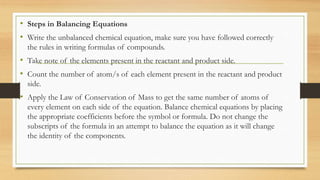
• Steps in Balancing Equations
• Write the unbalanced chemical equation, make sure you have followed correctly
the rules in writing formulas of compounds.
• Take note of the elements present in the reactant and product side.
• Count the number of atom/s of each element present in the reactant and product
side.
• Apply the Law of Conservation of Mass to get the same number of atoms of
every element on each side of the equation. Balance chemical equations by placing
the appropriate coefficients before the symbol or formula. Do not change the
subscripts of the formula in an attempt to balance the equation as it will change
the identity of the components.
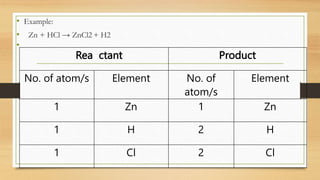
• Example:
• Zn + HCl → ZnCl2 + H2
•
Rea ctant Product
No. of atom/s Element No. of
atom/s
Element
1 Zn 1 Zn
1 H 2 H
1 Cl 2 Cl
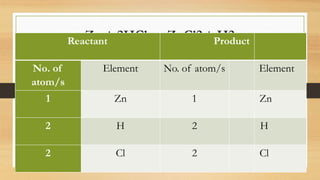
Zn + 2HCl → ZnCl2 + H2
Reactant Product
No. of
atom/s
Element No. of atom/s Element
1 Zn 1 Zn
2 H 2 H
2 Cl 2 Cl
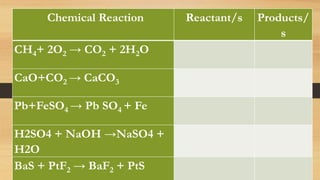
Chemical Reaction Reactant/s Products/
s
CH4+ 2O2 → CO2 + 2H2O
CaO+CO2 → CaCO3
Pb+FeSO4 → Pb SO4 + Fe
H2SO4 + NaOH →NaSO4 +
H2O
BaS + PtF2 → BaF2 + PtS
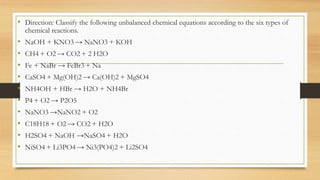
• Direction: Classify the following unbalanced chemical equations according to the six types of
chemical reactions.
• NaOH + KNO3 → NaNO3 + KOH
• CH4 + O2 → CO2 + 2 H2O
• Fe + NaBr → FeBr3 + Na
• CaSO4 + Mg(OH)2 → Ca(OH)2 + MgSO4
• NH4OH + HBr → H2O + NH4Br
• P4 + O2 → P2O5
• NaNO3 →NaNO2 + O2
• C18H18 + O2 → CO2 + H2O
• H2SO4 + NaOH →NaSO4 + H2O
• NiSO4 + Li3PO4 → Ni3(PO4)2 + Li2SO4
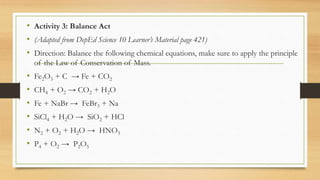
• Activity 3: Balance Act
• (Adapted from DepEd Science 10 Learner’s Material page 421)
• Direction: Balance the following chemical equations, make sure to apply the principle
of the Law of Conservation of Mass.
• Fe2O3 + C → Fe + CO2
• CH4 + O2 → CO2 + H2O
• Fe + NaBr → FeBr3 + Na
• SiCl4 + H2O → SiO2 + HCl
• N2 + O2 + H2O → HNO3
• P4 + O2 → P2O5

CHEMICAL-REACTIONS (2).pptx

  • 1.
  • 6.
    OBJECTIVES: • Apply theprinciples of conservation of mass to chemical reactions. • Specifically: • Explain chemical reactions • Identify and describe the types of chemical reactions • Balance the chemical equations
  • 7.
    • A chemicalreaction refers to a process in which atoms of the same different elements rearrange themselves to form a new substance. • There are several indicators that a chemical reaction has taken place such as: gas bubbles appear; formation of precipitate; color change; temperature change; production of light; volume change and change in smell or taste. • Chemical reactions can be represented by chemical equations. The equation distinguishes between the reactants, which are the starting materials and the products which are resulting substance/s. • It shows the symbols or formulas of the reactants and products, the phases (gas, solid, liquid) of these substances, and the ratio of the substances as they react. Example: Zn + S → ZnS (Zinc + Sulfur → Zinc Sulfide) • In this example, the reacting substances (reactants) are shown on the left of the arrow or the Zn + S and the resulting substances from the reaction are written on the other side of the arrow or the ZnS.
  • 9.
    • Steps inBalancing Equations • Write the unbalanced chemical equation, make sure you have followed correctly the rules in writing formulas of compounds. • Take note of the elements present in the reactant and product side. • Count the number of atom/s of each element present in the reactant and product side. • Apply the Law of Conservation of Mass to get the same number of atoms of every element on each side of the equation. Balance chemical equations by placing the appropriate coefficients before the symbol or formula. Do not change the subscripts of the formula in an attempt to balance the equation as it will change the identity of the components.
  • 10.
    • Example: • Zn+ HCl → ZnCl2 + H2 • Rea ctant Product No. of atom/s Element No. of atom/s Element 1 Zn 1 Zn 1 H 2 H 1 Cl 2 Cl
  • 11.
    Zn + 2HCl→ ZnCl2 + H2 Reactant Product No. of atom/s Element No. of atom/s Element 1 Zn 1 Zn 2 H 2 H 2 Cl 2 Cl
  • 12.
    Chemical Reaction Reactant/sProducts/ s CH4+ 2O2 → CO2 + 2H2O CaO+CO2 → CaCO3 Pb+FeSO4 → Pb SO4 + Fe H2SO4 + NaOH →NaSO4 + H2O BaS + PtF2 → BaF2 + PtS
  • 13.
    • Direction: Classifythe following unbalanced chemical equations according to the six types of chemical reactions. • NaOH + KNO3 → NaNO3 + KOH • CH4 + O2 → CO2 + 2 H2O • Fe + NaBr → FeBr3 + Na • CaSO4 + Mg(OH)2 → Ca(OH)2 + MgSO4 • NH4OH + HBr → H2O + NH4Br • P4 + O2 → P2O5 • NaNO3 →NaNO2 + O2 • C18H18 + O2 → CO2 + H2O • H2SO4 + NaOH →NaSO4 + H2O • NiSO4 + Li3PO4 → Ni3(PO4)2 + Li2SO4
  • 14.
    • Activity 3:Balance Act • (Adapted from DepEd Science 10 Learner’s Material page 421) • Direction: Balance the following chemical equations, make sure to apply the principle of the Law of Conservation of Mass. • Fe2O3 + C → Fe + CO2 • CH4 + O2 → CO2 + H2O • Fe + NaBr → FeBr3 + Na • SiCl4 + H2O → SiO2 + HCl • N2 + O2 + H2O → HNO3 • P4 + O2 → P2O5