Bakteri dan Archaea
Dosen Pengampu :
1. Prof. Dr. Ir. Wignyanto, MS
2. Dr.Ir. Nur Hidayat, MP
3. Irnia Nurika, STP, MP, PhD.
4. Nimas Mayang Sabrina, STP, MSc, PhD
5. Suprayogi, STP, MP, PhD
6. Vitta R. Permatasari, STP, MP
7. Tutut Arinda, Ssi, MSi
8
Agroindustrial Technology, Brawijaya University - 2020
Overview of Bacteria
• Bacteria are single celled microbes.
• The cell structure is simpler than that of other
organisms as there is no nucleus or membrane
bound organelles.
• Instead their control centre containing the
genetic information is contained in a single loop
of DNA.
Overview of Bacteria
• Some bacteria have an extra circle of genetic
material called a plasmid.
• The plasmid often contains genes that give the
bacterium some advantage over other bacteria.
• For example it may contain a gene that makes
the bacterium resistant to a certain antibiotic.
Bacteria
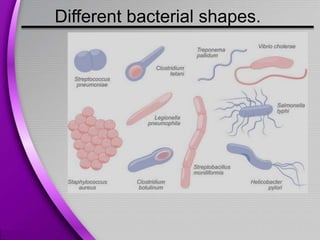
• Bacteria are classified into five groups
according to their basic shapes:
– spherical (cocci),
– rod (bacilli),
– spiral (spirilla),
– comma (vibrios) or
– corkscrew (spirochaetes).
They can exist as single cells, in pairs, chains or
clusters.
Different bacterial shapes.
Overview of Bacteria
• Bacteria are found in every habitat on Earth: soil, rock,
oceans and even arctic snow. Some live in or on other
organisms including plants and animals including
humans.
• There are approximately 10 times as many bacterial
cells as human cells in the human body. A lot of these
bacterial cells are found lining the digestive system.
• Some bacteria live in the soil or on dead plant matter
where they play an important role in the cycling of
nutrients.
• Some types cause food spoilage and crop damage but
others are incredibly useful in the production of
fermented foods such as yoghurt and soy sauce.
• Relatively few bacteria are parasites or pathogens that
cause disease in animals and plants.
How do bacteria reproduce?
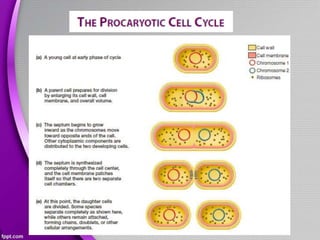
• Bacteria reproduce by binary fission.
• In this process the bacterium, which is a single cell,
divides into two identical daughter cells.
• Binary fission begins when the DNA of the bacterium
divides into two (replicates).
• The bacterial cell then elongates and splits into two
daughter cells each with identical DNA to the parent cell.
Each daughter cell is a clone of the parent cell.
How do bacteria reproduce?
• When conditions are favourable such as the right
temperature and nutrients are available, some bacteria
like Escherichia coli can divide every 20 minutes.
• This means that in just seven hours one bacterium can
generate 2,097,152 bacteria. After one more hour the
number of bacteria will have risen to a colossal
16,777,216.
• That’s why we can quickly become ill when pathogenic
microbes invade our bodies.
Survival mechanism
• Some bacteria can form endospores.
• These are dormant structures, which are extremely
resistant to hostile physical and chemical conditions
such as heat, UV radiation and disinfectants.
• This makes destroying them very difficult. Many
endospore-producing bacteria are nasty pathogens, for
example Bacillus anthracis, the cause of anthrax.
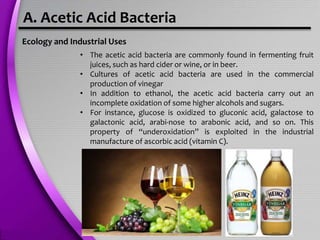
A. Acetic Acid Bacteria
Ecology and Industrial Uses
• The acetic acid bacteria are commonly found in fermenting fruit
juices, such as hard cider or wine, or in beer.
• Cultures of acetic acid bacteria are used in the commercial
production of vinegar
• In addition to ethanol, the acetic acid bacteria carry out an
incomplete oxidation of some higher alcohols and sugars.
• For instance, glucose is oxidized to gluconic acid, galactose to
galactonic acid, arabi-nose to arabonic acid, and so on. This
property of “underoxidation” is exploited in the industrial
manufacture of ascorbic acid (vitamin C).
Aerobic and Facultatively
Aerobic Chemoorganotrophic
Proteobacteria
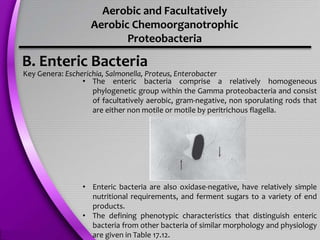
B. Enteric Bacteria
Key Genera: Escherichia, Salmonella, Proteus, Enterobacter
• The enteric bacteria comprise a relatively homogeneous
phylogenetic group within the Gamma proteobacteria and consist
of facultatively aerobic, gram-negative, non sporulating rods that
are either non motile or motile by peritrichous flagella.
• Enteric bacteria are also oxidase-negative, have relatively simple
nutritional requirements, and ferment sugars to a variety of end
products.
• The defining phenotypic characteristics that distinguish enteric
bacteria from other bacteria of similar morphology and physiology
are given in Table 17.12.
Archaea
• Archaea can be spherical, rod, spiral, lobed, rectangular
or irregular in shape.
• An unusual flat, square-shaped species that lives in salty
pools has also been discovered.
• Some exist as single cells, others form filaments or
clusters.
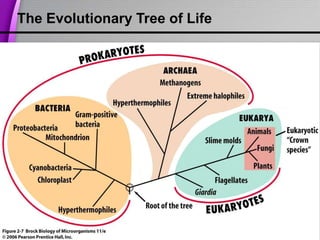
• Archaea are a group of micro-organisms that are similar
to, but evolutionarily distinct from bacteria.
The Evolutionary Tree of Life
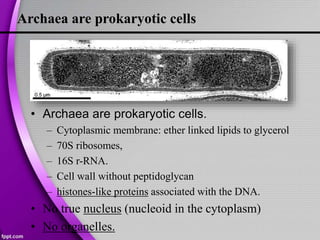
Archaea are prokaryotic cells
• Archaea are prokaryotic cells.
– Cytoplasmic membrane: ether linked lipids to glycerol
– 70S ribosomes,
– 16S r-RNA.
– Cell wall without peptidoglycan
– histones-like proteins associated with the DNA.
• No true nucleus (nucleoid in the cytoplasm)
• No organelles.
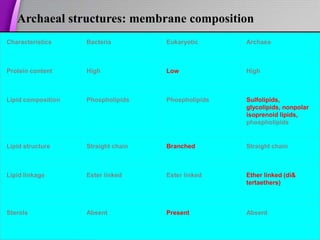
Archaeal structures: membrane composition
Characteristics Bacteria Eukaryotic Archaea
Protein content High Low High
Lipid composition Phospholipids Phospholipids Sulfolipids,
glycolipids, nonpolar
isoprenoid lipids,
phospholipids
Lipid structure Straight chain Branched Straight chain
Lipid linkage Ester linked Ester linked Ether linked (di&
tertaethers)
Sterols Absent Present Absent
Archaea (Microbiology Today - Aug 2017)
THANK YOU

09 bakteri dan archae (2).pptx

  • 1.
    Bakteri dan Archaea DosenPengampu : 1. Prof. Dr. Ir. Wignyanto, MS 2. Dr.Ir. Nur Hidayat, MP 3. Irnia Nurika, STP, MP, PhD. 4. Nimas Mayang Sabrina, STP, MSc, PhD 5. Suprayogi, STP, MP, PhD 6. Vitta R. Permatasari, STP, MP 7. Tutut Arinda, Ssi, MSi 8 Agroindustrial Technology, Brawijaya University - 2020
  • 2.
    Overview of Bacteria •Bacteria are single celled microbes. • The cell structure is simpler than that of other organisms as there is no nucleus or membrane bound organelles. • Instead their control centre containing the genetic information is contained in a single loop of DNA.
  • 3.
    Overview of Bacteria •Some bacteria have an extra circle of genetic material called a plasmid. • The plasmid often contains genes that give the bacterium some advantage over other bacteria. • For example it may contain a gene that makes the bacterium resistant to a certain antibiotic.
  • 4.
    Bacteria • Bacteria areclassified into five groups according to their basic shapes: – spherical (cocci), – rod (bacilli), – spiral (spirilla), – comma (vibrios) or – corkscrew (spirochaetes). They can exist as single cells, in pairs, chains or clusters.
  • 5.
  • 6.
    Overview of Bacteria •Bacteria are found in every habitat on Earth: soil, rock, oceans and even arctic snow. Some live in or on other organisms including plants and animals including humans. • There are approximately 10 times as many bacterial cells as human cells in the human body. A lot of these bacterial cells are found lining the digestive system. • Some bacteria live in the soil or on dead plant matter where they play an important role in the cycling of nutrients. • Some types cause food spoilage and crop damage but others are incredibly useful in the production of fermented foods such as yoghurt and soy sauce. • Relatively few bacteria are parasites or pathogens that cause disease in animals and plants.
  • 7.
    How do bacteriareproduce? • Bacteria reproduce by binary fission. • In this process the bacterium, which is a single cell, divides into two identical daughter cells. • Binary fission begins when the DNA of the bacterium divides into two (replicates). • The bacterial cell then elongates and splits into two daughter cells each with identical DNA to the parent cell. Each daughter cell is a clone of the parent cell.
  • 9.
    How do bacteriareproduce? • When conditions are favourable such as the right temperature and nutrients are available, some bacteria like Escherichia coli can divide every 20 minutes. • This means that in just seven hours one bacterium can generate 2,097,152 bacteria. After one more hour the number of bacteria will have risen to a colossal 16,777,216. • That’s why we can quickly become ill when pathogenic microbes invade our bodies.
  • 11.
    Survival mechanism • Somebacteria can form endospores. • These are dormant structures, which are extremely resistant to hostile physical and chemical conditions such as heat, UV radiation and disinfectants. • This makes destroying them very difficult. Many endospore-producing bacteria are nasty pathogens, for example Bacillus anthracis, the cause of anthrax.
  • 13.
    A. Acetic AcidBacteria Ecology and Industrial Uses • The acetic acid bacteria are commonly found in fermenting fruit juices, such as hard cider or wine, or in beer. • Cultures of acetic acid bacteria are used in the commercial production of vinegar • In addition to ethanol, the acetic acid bacteria carry out an incomplete oxidation of some higher alcohols and sugars. • For instance, glucose is oxidized to gluconic acid, galactose to galactonic acid, arabi-nose to arabonic acid, and so on. This property of “underoxidation” is exploited in the industrial manufacture of ascorbic acid (vitamin C).
  • 14.
    Aerobic and Facultatively AerobicChemoorganotrophic Proteobacteria B. Enteric Bacteria Key Genera: Escherichia, Salmonella, Proteus, Enterobacter • The enteric bacteria comprise a relatively homogeneous phylogenetic group within the Gamma proteobacteria and consist of facultatively aerobic, gram-negative, non sporulating rods that are either non motile or motile by peritrichous flagella. • Enteric bacteria are also oxidase-negative, have relatively simple nutritional requirements, and ferment sugars to a variety of end products. • The defining phenotypic characteristics that distinguish enteric bacteria from other bacteria of similar morphology and physiology are given in Table 17.12.
  • 15.
    Archaea • Archaea canbe spherical, rod, spiral, lobed, rectangular or irregular in shape. • An unusual flat, square-shaped species that lives in salty pools has also been discovered. • Some exist as single cells, others form filaments or clusters. • Archaea are a group of micro-organisms that are similar to, but evolutionarily distinct from bacteria.
  • 16.
  • 17.
    Archaea are prokaryoticcells • Archaea are prokaryotic cells. – Cytoplasmic membrane: ether linked lipids to glycerol – 70S ribosomes, – 16S r-RNA. – Cell wall without peptidoglycan – histones-like proteins associated with the DNA. • No true nucleus (nucleoid in the cytoplasm) • No organelles.
  • 18.
    Archaeal structures: membranecomposition Characteristics Bacteria Eukaryotic Archaea Protein content High Low High Lipid composition Phospholipids Phospholipids Sulfolipids, glycolipids, nonpolar isoprenoid lipids, phospholipids Lipid structure Straight chain Branched Straight chain Lipid linkage Ester linked Ester linked Ether linked (di& tertaethers) Sterols Absent Present Absent
  • 19.
  • 20.