B.Ed Course 2010-11 Anjana Jha Roll No- 20 Microorganisms ( Bacteria) Std –VIII
 
Table Of Content Sr. No Topic 1. Introduction to Micro-organism 2. Kingdom Monera 3. Structures of Bacterial Cell 4. Photosynthesis of Bacteria 5. Harmful & Helpful Bacteria 6. Evaluation
Micro-organisms Too small to be seen with the naked eyes Aggregations or colonies can be seen without the aid of a microscope Are found almost anywhere Are more abundant than any other life form They are forms on which all others depend.
THE KINGDOM OF MICROORGANISMS
Kingdom Monera  (Bacteria are prokaryotes) Pro -before Karyon – nucleus The simplest forms of life are prokaryotes. Earth’s first cells were prokaryotes .
Lots of Them ! Prokaryotes are Earth’s most abundant life forms. They can survive in many environments. They can get energy from many different sources.
Prokaryote Review Mostly single-celled No nucleus or organelles Circular chromosomes Cell walls Reproduce mostly asexually Anaerobic or aerobic Heterotrophic or autotrophic
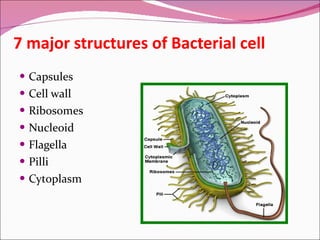
7 major structures of Bacterial cell Capsules Cell wall  Ribosomes Nucleoid Flagella Pilli Cytoplasm
Structure of Bacteria Two part to bacteria structure: Arrangement  Shape
Arrangement Paired: Diplo Grape like structures: Staphylo Chains: Srepto
Shapes Rod: Bacillus  Spheres: coccus Spirals: spirillum
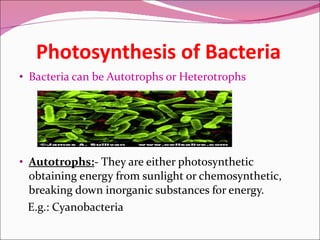
Photosynthesis of Bacteria Bacteria can be Autotrophs or Heterotrophs Autotrophs: - They are either photosynthetic obtaining energy from sunlight or chemosynthetic, breaking down inorganic substances for energy. E.g.: Cyanobacteria
Photosynthesis of Bacteria Cont… Heterotrophs : - They derive energy from breaking down complex organic compounds in the environment. This includes saprobes, bacteria that feed on decaying material and organic wastage as those that live on parasites, absorbing nutrients from living organisms.
Harmful Bacteria   Some bacteria cause diseases  Animals can pass diseases to humans  Communicable Disease: Disease passed from one organism to another This can happen in several ways:   Air Touching clothing, food, silverware, or toothbrush Drinking water that contains bacteria
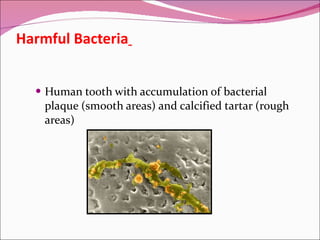
  Harmful Bacteria   Human tooth with accumulation of bacterial plaque (smooth areas) and calcified tartar (rough areas)
Helpful Bacteria Decomposers help recycle nutrients into the soil for other organisms to grow Bacteria grow in the stomach of a cow to break down grass and hay  Most are used to make antibiotics Some bacteria help make insulin Used to make industrial chemicals Some bacteria live on the roots of other plants, converting nitrogen into a usable form.
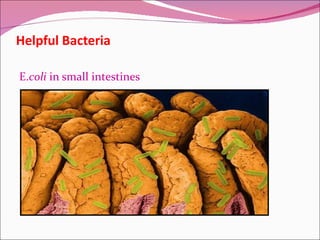
Helpful Bacteria E. coli  in small intestines
Helpful Bacteria Used to treat sewage            Organic waste is consumed by the bacteria, used as nutrients by the bacteria, and is no longer present to produce odors, sludge, pollution, or unsightly mess .  foods like yogurt, cottage & Swiss cheese, sour cream, buttermilk are made from bacteria that grows in milk
Questions Which Kingdom does bacteria belong to? What is the scientific name of grapes like structure found in Bacteria? Name any one examples of Autotrophs and Heterotroph Bacteria?  What are the two ways in which bacteria reproduce? Are E.Coli bacteria helpful or harmful Bacteria? What are the three ways to control Bacteria?
Which Kingdom does Bacteria belong to? Kingdom Protista  Kingdom Monera  Kingdom Plantae  Kingdom Animalia
What is the scientific name of grapes like structure found in Bacteria? Diplococcus Streptococcus Stephylococcus Tetracoccus
Where are E.Coli found? Brain Lung Small Intestines Large Intestines
Answers Monera Kingdom Staphylococcus Autotrophs- Cyanobacteria Heterotrophs-  Saprobes Binary fission and Asexual reproduction Helpful bacteria Canning, Pasteurization, Dehyration
 

Science (Bacteria)

  • 1.
    B.Ed Course 2010-11Anjana Jha Roll No- 20 Microorganisms ( Bacteria) Std –VIII
  • 2.
  • 3.
    Table Of ContentSr. No Topic 1. Introduction to Micro-organism 2. Kingdom Monera 3. Structures of Bacterial Cell 4. Photosynthesis of Bacteria 5. Harmful & Helpful Bacteria 6. Evaluation
  • 4.
    Micro-organisms Too smallto be seen with the naked eyes Aggregations or colonies can be seen without the aid of a microscope Are found almost anywhere Are more abundant than any other life form They are forms on which all others depend.
  • 5.
    THE KINGDOM OFMICROORGANISMS
  • 6.
    Kingdom Monera (Bacteria are prokaryotes) Pro -before Karyon – nucleus The simplest forms of life are prokaryotes. Earth’s first cells were prokaryotes .
  • 7.
    Lots of Them! Prokaryotes are Earth’s most abundant life forms. They can survive in many environments. They can get energy from many different sources.
  • 8.
    Prokaryote Review Mostlysingle-celled No nucleus or organelles Circular chromosomes Cell walls Reproduce mostly asexually Anaerobic or aerobic Heterotrophic or autotrophic
  • 9.
    7 major structuresof Bacterial cell Capsules Cell wall Ribosomes Nucleoid Flagella Pilli Cytoplasm
  • 10.
    Structure of BacteriaTwo part to bacteria structure: Arrangement Shape
  • 11.
    Arrangement Paired: DiploGrape like structures: Staphylo Chains: Srepto
  • 12.
    Shapes Rod: Bacillus Spheres: coccus Spirals: spirillum
  • 13.
    Photosynthesis of BacteriaBacteria can be Autotrophs or Heterotrophs Autotrophs: - They are either photosynthetic obtaining energy from sunlight or chemosynthetic, breaking down inorganic substances for energy. E.g.: Cyanobacteria
  • 14.
    Photosynthesis of BacteriaCont… Heterotrophs : - They derive energy from breaking down complex organic compounds in the environment. This includes saprobes, bacteria that feed on decaying material and organic wastage as those that live on parasites, absorbing nutrients from living organisms.
  • 15.
    Harmful Bacteria Some bacteria cause diseases Animals can pass diseases to humans Communicable Disease: Disease passed from one organism to another This can happen in several ways: Air Touching clothing, food, silverware, or toothbrush Drinking water that contains bacteria
  • 16.
    HarmfulBacteria Human tooth with accumulation of bacterial plaque (smooth areas) and calcified tartar (rough areas)
  • 17.
    Helpful Bacteria Decomposershelp recycle nutrients into the soil for other organisms to grow Bacteria grow in the stomach of a cow to break down grass and hay Most are used to make antibiotics Some bacteria help make insulin Used to make industrial chemicals Some bacteria live on the roots of other plants, converting nitrogen into a usable form.
  • 18.
    Helpful Bacteria E.coli in small intestines
  • 19.
    Helpful Bacteria Usedto treat sewage            Organic waste is consumed by the bacteria, used as nutrients by the bacteria, and is no longer present to produce odors, sludge, pollution, or unsightly mess . foods like yogurt, cottage & Swiss cheese, sour cream, buttermilk are made from bacteria that grows in milk
  • 20.
    Questions Which Kingdomdoes bacteria belong to? What is the scientific name of grapes like structure found in Bacteria? Name any one examples of Autotrophs and Heterotroph Bacteria? What are the two ways in which bacteria reproduce? Are E.Coli bacteria helpful or harmful Bacteria? What are the three ways to control Bacteria?
  • 21.
    Which Kingdom doesBacteria belong to? Kingdom Protista Kingdom Monera Kingdom Plantae Kingdom Animalia
  • 22.
    What is thescientific name of grapes like structure found in Bacteria? Diplococcus Streptococcus Stephylococcus Tetracoccus
  • 23.
    Where are E.Colifound? Brain Lung Small Intestines Large Intestines
  • 24.
    Answers Monera KingdomStaphylococcus Autotrophs- Cyanobacteria Heterotrophs- Saprobes Binary fission and Asexual reproduction Helpful bacteria Canning, Pasteurization, Dehyration
  • 25.