Kingdom Eubacteria (True Bacteria)
Bacteria are located everywhere – air, water,
land, and living organisms including people.
General Characteristics:
1. All are unicellular (one-celled structural level)
2. All are prokaryotic - cells that lack nucleus
(no nuclear envelope) (PRO = NO nucleus)
3. All have cell walls – NO cellulose in cell walls
4. Can live in both aerobic (with O2) and
anaerobic (without O2) environments
Ex: Streptococcus Ex: Lactobacillus Ex: Spirillium
•Motility - movement
•Swarming occurs with some
bacteria
•Arrangement basis for classification
•Monotrichous; 1 flagella
•Lophotrichous; tuft at one end
•Amphitrichous; both ends
•Peritrichous; all around bacteria
Flagella
Pili
•Short protein appendages
smaller than flagella
•Adhere bacteria to surfaces
•F-pilus; used in conjugation
Exchange
ofgenetic
information
Cell Membrane
•Bilayer Phospholipid
•Water can penetrate
•Flexible
•Not strong, ruptures easily
Capsule or Slime Layer
•Glycocalyx - Polysaccharide on
external surface
•Adhere bacteria to surface
•Prevents Phagocytosis
Cytoplasm
•80% Water {20% Salts-
Proteins)
•DNA is circular, Haploid
•Plasmids; extra circular DNA
•No organelles (Mitochondria,
Golgi, etc.)
Endospores
•Resistant structure
(Heat, irradiation, cold)
•Takes time and energy to make
spores
•Location important in classification
(Central, Subterminal, Terminal)
Causes Disease by:
1. Destroying cells of infected organisms
by breaking the cells down for food.
D. Importance:
1. Beneficial
a. breakdown dead matter to
recycle nutrients into
ecosystem - decomposers
b. dairy industry - bacteria in
yogurt, sour cream and cheese
c. Oil spills - bacteria can digest small oil
spills
d. Genetic
engineering—
Recombinant/synthetic
DNA (Ex: Insulin)
e. symbiotic relationship - E. coli and our
intestines-both organisms benefit
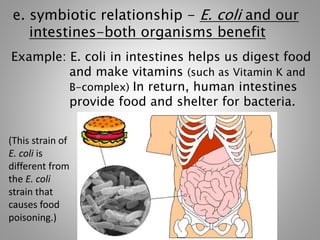
Example: E. coli in intestines helps us digest food
and make vitamins (such as Vitamin K and
B-complex) In return, human intestines
provide food and shelter for bacteria.
(This strain of
E. coli is
different from
the E. coli
strain that
causes food
poisoning.)
Harmful :
a. human diseases –
strep throat, tuberculosis,
tooth decay and bad
breath, anthrax, plague,
tetanus, food poisoning
Tetanus
Strep Throat
Anthrax
b. food spoilage and poisoning – caused by
Salmonella and Staphylococcus
c. Treated with antibiotics – Some bacteria are able
to survive in presence of antibiotics that kill
other bacteria – antibiotic resistant bacteria
Note: This is why doctors tell you to take the entire
amount of medicine given even if you start to feel better
because if not, bacteria will have the chance to evolve and
become antibiotic resistant.
G+ve
•Thicker cell wall
•Teichoic Acids
1.Glycerol, Phosphates, & Ribitol
2.Attachment for Phages
G-ve
Endotoxin – LPS
Gram+ve and Gram -ve
(1.Lipid A
2. Polysaccharide)
THANK YOU

Bacteria

  • 2.
    Kingdom Eubacteria (TrueBacteria) Bacteria are located everywhere – air, water, land, and living organisms including people. General Characteristics: 1. All are unicellular (one-celled structural level) 2. All are prokaryotic - cells that lack nucleus (no nuclear envelope) (PRO = NO nucleus) 3. All have cell walls – NO cellulose in cell walls 4. Can live in both aerobic (with O2) and anaerobic (without O2) environments
  • 3.
    Ex: Streptococcus Ex:Lactobacillus Ex: Spirillium
  • 5.
    •Motility - movement •Swarmingoccurs with some bacteria •Arrangement basis for classification •Monotrichous; 1 flagella •Lophotrichous; tuft at one end •Amphitrichous; both ends •Peritrichous; all around bacteria Flagella
  • 7.
    Pili •Short protein appendages smallerthan flagella •Adhere bacteria to surfaces •F-pilus; used in conjugation Exchange ofgenetic information
  • 8.
    Cell Membrane •Bilayer Phospholipid •Watercan penetrate •Flexible •Not strong, ruptures easily
  • 9.
    Capsule or SlimeLayer •Glycocalyx - Polysaccharide on external surface •Adhere bacteria to surface •Prevents Phagocytosis
  • 10.
    Cytoplasm •80% Water {20%Salts- Proteins) •DNA is circular, Haploid •Plasmids; extra circular DNA •No organelles (Mitochondria, Golgi, etc.)
  • 11.
    Endospores •Resistant structure (Heat, irradiation,cold) •Takes time and energy to make spores •Location important in classification (Central, Subterminal, Terminal)
  • 12.
    Causes Disease by: 1.Destroying cells of infected organisms by breaking the cells down for food.
  • 14.
    D. Importance: 1. Beneficial a.breakdown dead matter to recycle nutrients into ecosystem - decomposers
  • 15.
    b. dairy industry- bacteria in yogurt, sour cream and cheese c. Oil spills - bacteria can digest small oil spills
  • 16.
  • 17.
    e. symbiotic relationship- E. coli and our intestines-both organisms benefit Example: E. coli in intestines helps us digest food and make vitamins (such as Vitamin K and B-complex) In return, human intestines provide food and shelter for bacteria. (This strain of E. coli is different from the E. coli strain that causes food poisoning.)
  • 18.
    Harmful : a. humandiseases – strep throat, tuberculosis, tooth decay and bad breath, anthrax, plague, tetanus, food poisoning Tetanus Strep Throat Anthrax
  • 19.
    b. food spoilageand poisoning – caused by Salmonella and Staphylococcus c. Treated with antibiotics – Some bacteria are able to survive in presence of antibiotics that kill other bacteria – antibiotic resistant bacteria Note: This is why doctors tell you to take the entire amount of medicine given even if you start to feel better because if not, bacteria will have the chance to evolve and become antibiotic resistant.
  • 20.
    G+ve •Thicker cell wall •TeichoicAcids 1.Glycerol, Phosphates, & Ribitol 2.Attachment for Phages G-ve Endotoxin – LPS Gram+ve and Gram -ve (1.Lipid A 2. Polysaccharide)
  • 21.