BACTERIA
B.Sc
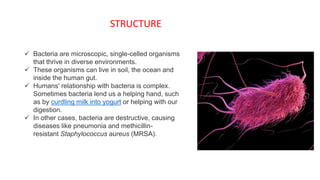
 Bacteria are microscopic, single-celled organisms
that thrive in diverse environments.
 These organisms can live in soil, the ocean and
inside the human gut.
 Humans' relationship with bacteria is complex.
Sometimes bacteria lend us a helping hand, such
as by curdling milk into yogurt or helping with our
digestion.
 In other cases, bacteria are destructive, causing
diseases like pneumonia and methicillin-
resistant Staphylococcus aureus (MRSA).
STRUCTURE
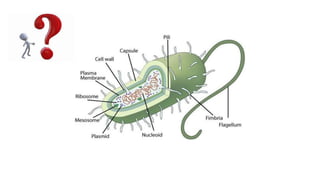
Bacteria Characteristics
 Bacteria are single-celled organisms.
 They lack organelles such as chloroplasts and mitochondria, and they do not
have the true nucleus found in eukaryotic cells.
 Instead, their DNA, a double strand that is continuous and circular, is located
in a nucleoid.
 The nucleoid is an irregularly shaped region that does not have a nuclear
membrane.
 Bacteria also have a cell membrane and a cell wall that is often made
of peptidoglycan.
 Together, the cell membrane and cell wall are referred to as the cell envelope.
Many bacteria need a cell wall in order to survive.
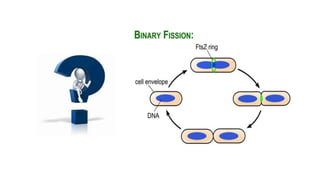
Reproduction occurs through binary fission, which is the
splitting of a bacterial cell after it reaches a certain size.
Bacteria reproduce asexually, so the two daughter cells that
result from binary fission have the same DNA as the parent
cell.
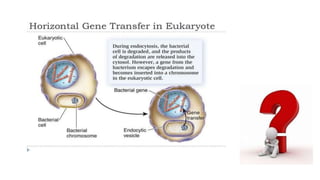
 However, some bacteria can also exchange genetic material
among one another in a process known as
horizontal gene transfer.
This method involves two already existing bacteria; it is not
a form of transmission from parent to child.
Bacteria Shapes
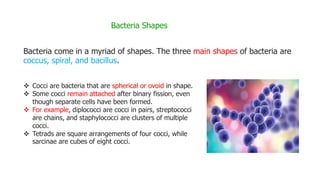
Bacteria come in a myriad of shapes. The three main shapes of bacteria are
coccus, spiral, and bacillus.
 Cocci are bacteria that are spherical or ovoid in shape.
 Some cocci remain attached after binary fission, even
though separate cells have been formed.
 For example, diplococci are cocci in pairs, streptococci
are chains, and staphylococci are clusters of multiple
cocci.
 Tetrads are square arrangements of four cocci, while
sarcinae are cubes of eight cocci.
Spiral bacteria are, as the
name suggests, spiral-shaped.
Spirillums are thick, tough
spirals.
Spirochetes are spirals that are
thin and flexible.
Vibrios are comma-shaped rods
with a small twist.
Bacilli are rod-shaped bacteria.
Like cocci, bacilli can be solitary
or arranged together.
Diplobacilli are two bacilli
arranged next to each other, and
streptobacilli are chains of bacilli.
Bacteria can also be other shapes such as
 filamentous (long and thin),
 square,
 star-shaped, and
 stalked.
 This diagram depicts the numerous shapes of bacteria.
Types of Bacteria
Many bacteria can be classified into one of two types:
o gram-positive, which show the stain and appear violet in
color under a microscope, and
o gram-negative, which only show the counterstain, and
appear red.
Related Biology Terms
•Prokaryote – An organism that has a simple prokaryotic cell;
bacteria and archaea are prokaryotes.
•Binary fission – The method by which bacteria reproduce
asexually through dividing.
•Probiotic – A bacterium that helps maintain a healthy digestive
tract when consumed.
•Horizontal gene transfer – Gene transfer between two
organisms that are not parent and offspring.
ECONOMIC IMPORTANCE OF
BACTERIA
 Economic importance of any organism refers to the advantages and
disadvantages of that organism to nature, the humans and the
environment.
 Bacteria, a prokaryote and microscopic organism, have the following
economic importance:
Beneficial effects of Bacteria:
Bacteria play important roles in different fields such as agriculture,
industry etc. Some of them are mentioned below:
A) Role in agriculture
 Preparation of Ensilage: Ensilage is preserved cattle fodder prepared
by packing fresh chopped fodder sprinkled with molasses. Fermentation
activity of bacteria produces lactic acid that acts as preservative in
ensilage.
 Production of fuel: Bacteria, while converting animal dung and other
organic wastes to manure, help in production of fuel that is a must in
gobar gas plant.
B) Role in Industry
 Dairy Industry: Bacteria such as Streptococcus lactis convert milk sugar lactose
into lactic acid that coagulates casein (milk protein).
Then, milk is converted into curd, yoghurt, cheese etc needed for the industry.
 Fibre Retting: The action of some bacteria like Clostridium,
 Pseudomonas etc. help in fibre retting i.e. separation of stem and leaf fibre of
plants from other softer tissue.
 Curing: The leaves of tea and tobacco, beans of coffee and coca are cured off
their bitterness with the help of action of certain bacteria such as Bacillus
megatherium.
 Production of Antibiotics: Number of anti bacterial and anti
fungal antibiotics such as Hamycin, Polymyxin, Trichomycin etc
are obtained from mycelia bacteria (like Streptomyces). Similarly,
Bacillus is used for production of antibiotics such as Bacitracin,
Gramicidin etc
 Production of Vitamins: Different kinds of vitamins are
produced from bacteria like Riboflavin from Clostridium
butylicum, Vitamin B12 from Bacillus megatherium and Vitamin K
and B-complex from Escherichia coli.
Harmful effects of Bacteria:
Though bacteria plays important role in agriculture,
industries and natural sanitation etc, it has the following
harmful effects:
a) Food Spoiling: Saprophytic bacteria always not only
help in decomposition of dead matters, but they also cause
the rotting of vegetables, fruits, meat, bread etc.
b) Food Poisoning: Bacteria like Staphylococcus
aureus cause food poisoning and cause people diarrhea
and vomiting.
c) Damaging of domestic articles: Spirochete
cytophaga deteriorates cotton, leather and wooden
articles.
d) Denitrification: Bacteria such
as Thiobacillus and Microbacillusconvert nitrate of the soil to the
gaseous nitrogen. This hampers plants very much.
e) Desulphurication: Bacteria such as Desulfovibrio convert
soil sulphates into hydrogen sulphide.
f) Cause of Diseases: It is known that over 90% of human
diseases and over 10% of plant diseases are caused by
bacteria.
1. How do bacteria reproduce?
A. Sexual reproduction
B. Horizontal gene transfer
C. Binary fission
D. Mitosis
Quiz
2. Which is not one of the three main shapes
of bacteria?
A. Coccus
B. Bacillus
C. Spiral
D. Star
{Star-shaped bacteria, such as those in the genus Stella}
3. When did bacteria first begin to exist on
Earth?
A. 4 billion years ago
B. 2 billion years ago
C. 1.6 billion years ago
D. 1 billion years ago
BACTERIA/EUBACTERIA  (Microbiology)

BACTERIA/EUBACTERIA (Microbiology)

  • 1.
  • 2.
     Bacteria aremicroscopic, single-celled organisms that thrive in diverse environments.  These organisms can live in soil, the ocean and inside the human gut.  Humans' relationship with bacteria is complex. Sometimes bacteria lend us a helping hand, such as by curdling milk into yogurt or helping with our digestion.  In other cases, bacteria are destructive, causing diseases like pneumonia and methicillin- resistant Staphylococcus aureus (MRSA). STRUCTURE
  • 3.
    Bacteria Characteristics  Bacteriaare single-celled organisms.  They lack organelles such as chloroplasts and mitochondria, and they do not have the true nucleus found in eukaryotic cells.  Instead, their DNA, a double strand that is continuous and circular, is located in a nucleoid.  The nucleoid is an irregularly shaped region that does not have a nuclear membrane.  Bacteria also have a cell membrane and a cell wall that is often made of peptidoglycan.  Together, the cell membrane and cell wall are referred to as the cell envelope. Many bacteria need a cell wall in order to survive.
  • 5.
    Reproduction occurs throughbinary fission, which is the splitting of a bacterial cell after it reaches a certain size. Bacteria reproduce asexually, so the two daughter cells that result from binary fission have the same DNA as the parent cell.  However, some bacteria can also exchange genetic material among one another in a process known as horizontal gene transfer. This method involves two already existing bacteria; it is not a form of transmission from parent to child.
  • 8.
    Bacteria Shapes Bacteria comein a myriad of shapes. The three main shapes of bacteria are coccus, spiral, and bacillus.  Cocci are bacteria that are spherical or ovoid in shape.  Some cocci remain attached after binary fission, even though separate cells have been formed.  For example, diplococci are cocci in pairs, streptococci are chains, and staphylococci are clusters of multiple cocci.  Tetrads are square arrangements of four cocci, while sarcinae are cubes of eight cocci.
  • 9.
    Spiral bacteria are,as the name suggests, spiral-shaped. Spirillums are thick, tough spirals. Spirochetes are spirals that are thin and flexible. Vibrios are comma-shaped rods with a small twist. Bacilli are rod-shaped bacteria. Like cocci, bacilli can be solitary or arranged together. Diplobacilli are two bacilli arranged next to each other, and streptobacilli are chains of bacilli.
  • 10.
    Bacteria can alsobe other shapes such as  filamentous (long and thin),  square,  star-shaped, and  stalked.  This diagram depicts the numerous shapes of bacteria.
  • 11.
    Types of Bacteria Manybacteria can be classified into one of two types: o gram-positive, which show the stain and appear violet in color under a microscope, and o gram-negative, which only show the counterstain, and appear red.
  • 14.
    Related Biology Terms •Prokaryote– An organism that has a simple prokaryotic cell; bacteria and archaea are prokaryotes. •Binary fission – The method by which bacteria reproduce asexually through dividing. •Probiotic – A bacterium that helps maintain a healthy digestive tract when consumed. •Horizontal gene transfer – Gene transfer between two organisms that are not parent and offspring.
  • 15.
    ECONOMIC IMPORTANCE OF BACTERIA Economic importance of any organism refers to the advantages and disadvantages of that organism to nature, the humans and the environment.  Bacteria, a prokaryote and microscopic organism, have the following economic importance:
  • 16.
    Beneficial effects ofBacteria: Bacteria play important roles in different fields such as agriculture, industry etc. Some of them are mentioned below: A) Role in agriculture  Preparation of Ensilage: Ensilage is preserved cattle fodder prepared by packing fresh chopped fodder sprinkled with molasses. Fermentation activity of bacteria produces lactic acid that acts as preservative in ensilage.  Production of fuel: Bacteria, while converting animal dung and other organic wastes to manure, help in production of fuel that is a must in gobar gas plant.
  • 17.
    B) Role inIndustry  Dairy Industry: Bacteria such as Streptococcus lactis convert milk sugar lactose into lactic acid that coagulates casein (milk protein). Then, milk is converted into curd, yoghurt, cheese etc needed for the industry.  Fibre Retting: The action of some bacteria like Clostridium,  Pseudomonas etc. help in fibre retting i.e. separation of stem and leaf fibre of plants from other softer tissue.  Curing: The leaves of tea and tobacco, beans of coffee and coca are cured off their bitterness with the help of action of certain bacteria such as Bacillus megatherium.
  • 19.
     Production ofAntibiotics: Number of anti bacterial and anti fungal antibiotics such as Hamycin, Polymyxin, Trichomycin etc are obtained from mycelia bacteria (like Streptomyces). Similarly, Bacillus is used for production of antibiotics such as Bacitracin, Gramicidin etc  Production of Vitamins: Different kinds of vitamins are produced from bacteria like Riboflavin from Clostridium butylicum, Vitamin B12 from Bacillus megatherium and Vitamin K and B-complex from Escherichia coli.
  • 20.
    Harmful effects ofBacteria: Though bacteria plays important role in agriculture, industries and natural sanitation etc, it has the following harmful effects: a) Food Spoiling: Saprophytic bacteria always not only help in decomposition of dead matters, but they also cause the rotting of vegetables, fruits, meat, bread etc. b) Food Poisoning: Bacteria like Staphylococcus aureus cause food poisoning and cause people diarrhea and vomiting. c) Damaging of domestic articles: Spirochete cytophaga deteriorates cotton, leather and wooden articles.
  • 21.
    d) Denitrification: Bacteriasuch as Thiobacillus and Microbacillusconvert nitrate of the soil to the gaseous nitrogen. This hampers plants very much. e) Desulphurication: Bacteria such as Desulfovibrio convert soil sulphates into hydrogen sulphide. f) Cause of Diseases: It is known that over 90% of human diseases and over 10% of plant diseases are caused by bacteria.
  • 22.
    1. How dobacteria reproduce? A. Sexual reproduction B. Horizontal gene transfer C. Binary fission D. Mitosis Quiz 2. Which is not one of the three main shapes of bacteria? A. Coccus B. Bacillus C. Spiral D. Star {Star-shaped bacteria, such as those in the genus Stella}
  • 23.
    3. When didbacteria first begin to exist on Earth? A. 4 billion years ago B. 2 billion years ago C. 1.6 billion years ago D. 1 billion years ago