ELECTRONIC PAPERBy Avinash Arun
contentsPast and the future…What is e-paper?Desirable features of E-paper and it’s advantage over LCD displayComparison of displaysVarious E-paper technology and companies designing frontplane and backplane of e-paper1) Electrophoretictechnology2) Cholesteric Liquid Crystal Display Technology3) Electrowetting Technology4) Electrochromic Technology5) Interferometric Modulator Technology6) Photonic crystal technology7) REED(Reverse Emulsion electrophoretic Display) TechnologyWhat urged researchers to design E-paper?Required future developmentsCurrent state of researchapplications
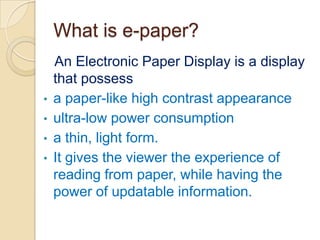
What is e-paper?An Electronic Paper Display is a display that possess a paper-like high contrast appearance
ultra-low power consumption
a thin, light form.
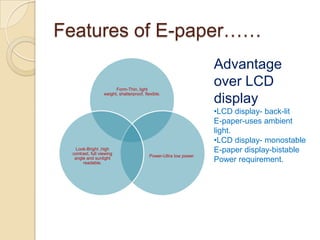
It gives the viewer the experience of reading from paper, while having the power of updatable information. Features of E-paper……Advantage over LCD displayLCD display- back-litE-paper-uses ambient light.LCD display- monostableE-paper display-bistablePower requirement.
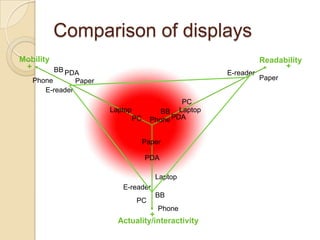
Comparison of displaysMobilityReadability++BBE-readerPDAPaperPhonePaperE-readerPCLaptopLaptopBBPDAPCPhonePaperPDALaptopE-readerBBPCPhone+Actuality/interactivity
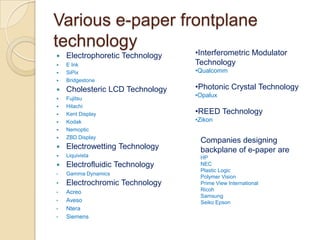
Various e-paper frontplane technologyInterferometric Modulator Technology
Qualcomm
Photonic Crystal Technology
Opalux
REED Technology
ZikonElectrophoretic TechnologyE InkSiPixBridgestoneCholesteric LCD TechnologyFujitsuHitachiKent DisplayKodakNemopticZBD DisplayElectrowetting TechnologyLiquivistaElectrofluidic TechnologyGamma Dynamics
Electrochromic Technology
Acreo
Aveso

Avinash

  • 1.
  • 2.
    contentsPast and thefuture…What is e-paper?Desirable features of E-paper and it’s advantage over LCD displayComparison of displaysVarious E-paper technology and companies designing frontplane and backplane of e-paper1) Electrophoretictechnology2) Cholesteric Liquid Crystal Display Technology3) Electrowetting Technology4) Electrochromic Technology5) Interferometric Modulator Technology6) Photonic crystal technology7) REED(Reverse Emulsion electrophoretic Display) TechnologyWhat urged researchers to design E-paper?Required future developmentsCurrent state of researchapplications
  • 4.
    What is e-paper?AnElectronic Paper Display is a display that possess a paper-like high contrast appearance
  • 5.
  • 6.
  • 7.
    It gives theviewer the experience of reading from paper, while having the power of updatable information. Features of E-paper……Advantage over LCD displayLCD display- back-litE-paper-uses ambient light.LCD display- monostableE-paper display-bistablePower requirement.
  • 8.
  • 9.
    Various e-paper frontplanetechnologyInterferometric Modulator Technology
  • 10.
  • 11.
  • 12.
  • 13.
  • 14.
    ZikonElectrophoretic TechnologyE InkSiPixBridgestoneCholestericLCD TechnologyFujitsuHitachiKent DisplayKodakNemopticZBD DisplayElectrowetting TechnologyLiquivistaElectrofluidic TechnologyGamma Dynamics
  • 15.
  • 16.
  • 17.
  • 18.
  • 19.
    SiemensCompanies designing backplaneof e-paper areHPNECPlastic LogicPolymer VisionPrime View InternationalRicohSamsungSeiko Epson
  • 20.
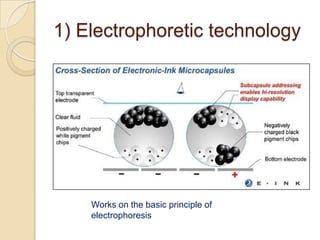
    1) Electrophoretic technologyWorkson the basic principle of electrophoresis
  • 21.
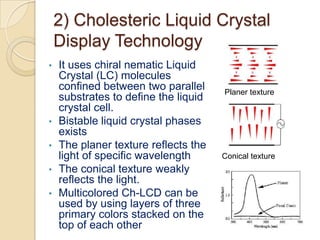
    2) Cholesteric LiquidCrystal Display TechnologyIt uses chiralnematic Liquid Crystal (LC) molecules confined between two parallel substrates to define the liquid crystal cell.
  • 22.
  • 23.
    The planer texturereflects the light of specific wavelength
  • 24.
    The conical textureweakly reflects the light.
  • 25.
    Multicolored Ch-LCD canbe used by using layers of three primary colors stacked on the top of each otherPlaner textureConical texture
  • 26.
    3) Electrowetting TechnologyWithno voltage applied, the (colored) oil forms a flat film between the water and a hydrophobic (water-repellent), insulating coating of an electrode, resulting in a colored pixel. Applying voltage between the electrode and the water causes the interfacial tension to change, which causes the water to move the oil aside. The result is a partly transparent pixel; if a reflective white surface is used under the switchable element, a white pixel results.
  • 27.
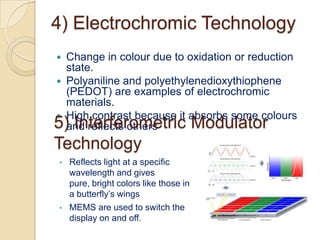
    4)Electrochromic TechnologyChange incolour due to oxidation or reduction state.Polyaniline and polyethylenedioxythiophene (PEDOT) are examples of electrochromic materials.High contrast because it absorbs some colours and reflects others5) Interferometric Modulator TechnologyReflects light at a specific wavelength and gives pure, bright colors like those in a butterfly’s wings
  • 28.
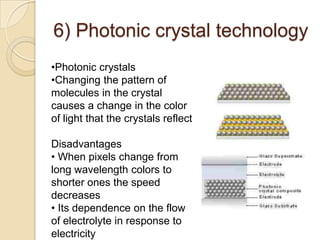
    MEMS are usedto switch the display on and off.6) Photonic crystal technologyPhotonic crystals
  • 29.
    Changing the patternof molecules in the crystal causes a change in the color of light that the crystals reflectDisadvantages When pixels change from long wavelength colors to shorter ones the speed decreases
  • 30.
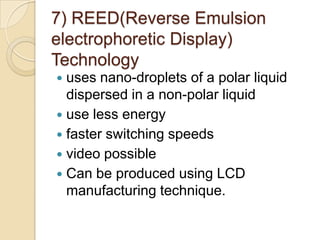
    Its dependenceon the flow of electrolyte in response to electricity7) REED(Reverse Emulsion electrophoretic Display) Technologyuses nano-droplets of a polar liquid dispersed in a non-polar liquiduse less energyfaster switching speedsvideo possibleCan be produced using LCD manufacturing technique.
  • 31.
    What urged researchersto design E-paper?Lack of a useable e-readerMost reading devices use LCDs, which use backlightsHigh power, hence low battery lifeFatigue due to screen flickerMost reading devices are small. Difficult to readCan not maintain original content layoutIf not, they are heavy.Laptop, computers
  • 32.
    Required future developmentsFullcolor implementationImplementation of video on it.Flexibility of the e-paper such that it can be rolled or foldedDevelop it in the such that it will reflect infra red rays and the documents can be read by using night vision camera only. So that it can be used by military. For security purpose. LCD has a backplane lightning which consumes much power.So , in case of low power state the same LCD screen can be made to work as a E-paper with no back light on.Current state of research
  • 33.
    applicationsEducation: digital schoolbooksWristwatchesNewspapersCellphones-Motorola's low-cost mobile phone, the Motorola F3, also uses an alphanumeric black/white electrophoretic display.
  • 34.
    The commercial goodswith full color display are expected to be in market within a decade.Thank you